Diseases of sclera
anatomy
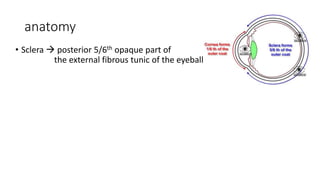
• Sclera  posterior 5/6th opaque part of
the external fibrous tunic of the eyeball.
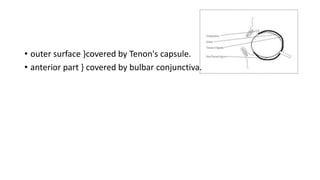
• outer surface }covered by Tenon's capsule.
• anterior part } covered by bulbar conjunctiva.
Its inner surface lies in contact with choroid
with a
potential suprachoroidal space in between
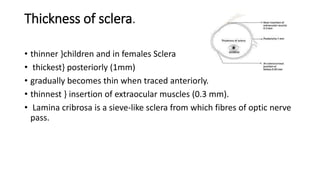
Thickness of sclera.
• thinner }children and in females Sclera
• thickest} posteriorly (1mm)
• gradually becomes thin when traced anteriorly.
• thinnest } insertion of extraocular muscles (0.3 mm).
• Lamina cribrosa is a sieve-like sclera from which fibres of optic nerve
pass.
Apertures of sclera
• Anterior
• Anterior ciliary vessels
• Middle
• four vortex veins (vena verticosae)
• Posterior
• Optic nerve
• Long & short ciliary nerves
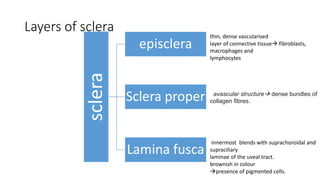
Layers of sclera
sclera
episclera
Sclera proper
Lamina fusca
thin, dense vascularised
layer of connective tissue fibroblasts,
macrophages and
lymphocytes
avascular structure dense bundles of
collagen fibres.
innermost blends with suprachoroidal and
supraciliary
laminae of the uveal tract.
brownish in colour
presence of pigmented cells.
Inflammations of sclera
• Episcleritis (superficial)
• Scleritis(deep)
episcleritis
• benign recurrent inflammation of the episclera,
• involving the overlying Tenon's capsule
• but not the underlying sclera.
etiology
• Unknown
• Associated with gout/psoriasis/rosacea
• Hypersensitivity reaction to endogenous tubercular or streptococcal
toxins.
incidence
• M>f
• Young adults
pathology
• localised lymphocytic infiltration of episcleral tissue
•  oedema and congestion of overlying Tenon's capsule and
conjunctiva.
symptoms
• by redness,
• mild ocular discomfort described as gritty, burning or
• foreign body sensation
signs
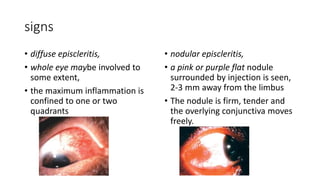
• diffuse episcleritis,
• whole eye maybe involved to
some extent,
• the maximum inflammation is
confined to one or two
quadrants
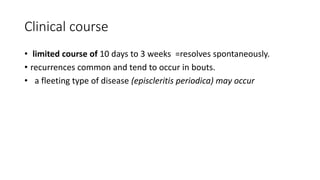
• nodular episcleritis,
• a pink or purple flat nodule
surrounded by injection is seen,
2-3 mm away from the limbus
• The nodule is firm, tender and
the overlying conjunctiva moves
freely.
Clinical course
• limited course of 10 days to 3 weeks =resolves spontaneously.
• recurrences common and tend to occur in bouts.
• a fleeting type of disease (episcleritis periodica) may occur
DD
• Inflammed pinguecula
• Scleritis
• Fb reaction on bulbar conjunctiva
treatment
• 1.Topical corticosteroid eyedrops 2-3 hourly,
• 2. Cold compresses applied to the closed lids
• 3. Systemic non-steroidal anti-inflammatory drugs
• flurbiprofen (300 mg OD),
• indomethacin (25 mg three times a day), or
• oxyphenbutazone
scleritis
scleritis
• c/c inflmn of sclera proper
• F>m
• Elderly
etiology
• Autoimmune collagen disorders RA(common),Wegener's
granulomatosis,PAN, SLE and ankylosing spondylitis.
• Metabolic disorders gout & thyrotoxicosis
• Infections herpes zoster ophthalmicus, c/c staphylococcal and
streptococcal infection
• Granulomatous diseases tb,syphilis, sarcoidosis, leprosy
• Miscellaneous conditions irradiation, chemical burns, Vogt-Koyanagi-
Harada syndrome, Behcet's disease and rosacea
• Surgically induced scleritis ocular surgery. within 6 month postoperatively.
• Idiopathic
pathology
• infiltration by PMNL , lymphocytes, plasma cells and macrophages
• Fibrinoid necrosis, destruction of collagen
•
• granuloma surrounded by multinucleated epitheloid giant cells
classification
• I. Anterior scleritis (98%)
• 1. Non-necrotizing scleritis (85%)
• (a) Diffuse
• (b) Nodular
• 2. Necrotizing scleritis (13%)
• (a) with inflammation
• (b) without inflammation (scleromalacia perforans)
• II. Posterior scleritis (2%)
Symptoms
• moderate to severe pain
• deep and boring in character and often
• wakes the patient early in the morning .
• radiates to the jaw and temple.
• localised or diffuse redness
• mild to severe photophobia
• lacrimation.
Signs
• 1. Non-necrotizing anterior diffuse scleritis.
• commonest,
• widespread inflammation involving a quadrant or more of the
anterior sclera.
• The area is raised and salmon pink to purple in colour
• Non-necrotizing anterior nodular scleritis.
• one or two hard, purplish elevated scleral nodules,
• usually situated near the limbus
• the nodules are arranged in a ring around the limbus (annular
scleritis).
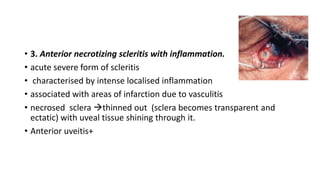
• 3. Anterior necrotizing scleritis with inflammation.
• acute severe form of scleritis
• characterised by intense localised inflammation
• associated with areas of infarction due to vasculitis
• necrosed sclera thinned out (sclera becomes transparent and
ectatic) with uveal tissue shining through it.
• Anterior uveitis+
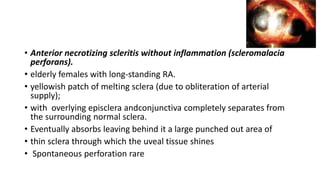
• Anterior necrotizing scleritis without inflammation (scleromalacia
perforans).
• elderly females with long-standing RA.
• yellowish patch of melting sclera (due to obliteration of arterial
supply);
• with overlying episclera andconjunctiva completely separates from
the surrounding normal sclera.
• Eventually absorbs leaving behind it a large punched out area of
• thin sclera through which the uveal tissue shines
• Spontaneous perforation rare
• posterior scleritis.
• the sclera behind the equator.
• frequently misdiagnosed.
• associated inflammation of adjacent structures,
• exudative retinal detachment,
• macular oedema,
• proptosis and
• limitation of ocular movements.
complications
• 2’ glaucoma (due to uveitis…)
• Complicated cataract
• sclerosing keratitis,
• keratolysis
investigations
• 1. TLC, DLC and ESR
• 2. Serum levels of complement (C3), immune complexes, rheumatoid
factor, antinuclear antibodies and L.E cells for an immunological
survey.
• 3. FTA - ABS, VDRL for syphilis.
• 4. Serum uric acid for gout.
• 5. Urine analysis.
• 6. Mantoux test.
• 7. X-rays of chest, paranasal sinuses, sacroiliac joint and orbit to rule
out foreign body especially in patients with nodular scleritis.
Treatment
• (A) Non-necrotising scleritis
• Topical steroid eyedrops and
• systemic indomethacin 100 mg daily for a day and then 75 mg daily until
inflammation resolves.
• (B) Necrotising scleritis.
• Topical steroids & heavy doses of oral steroids tapered slowly.
• In non-responsive cases, immuno-suppressive agents like methotrexate or
cyclophos-phamide
• Subconjunctival steroids are contraindicated because they may lead to scleral
thinning and perforation
Blue sclera
Blue sclera
• asymptomatic condition
• marked, generalised blue discolouration of sclera due to thinning.
osteogenesis imperfecta.
Marfan's syndrome,
Ehlers-Danlos syndrome,
pseudoxanthoma elasticum,
 buphthalmos,
High myopia and
 healed scleritis.
staphylomas
staphylomas
• localised bulging of weak and thin outer tunic of the eyeball (cornea
or sclera),
• lined by uveal tissue which shines through the thinned out fibrous
coat.
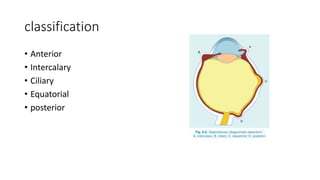
classification
• Anterior
• Intercalary
• Ciliary
• Equatorial
• posterior
Anterior staphyloma
• Ass. With ectasia of cornea & iris
• Due to perforating corneal ulcer & injury
Intercalary staphyloma
healing of a perforating injury or a peripheral corneal ulcer
to ectasia of weak scar tissue formed at the limbus
localised bulge in limbal area lined by root of iris
• marked corneal astigmatism Defective vision
• 2’angle closure glaucomaprogression of swelling
• Treatment
• localised staphylectomy under heavy doses of oral steroids.
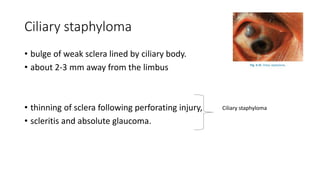
Ciliary staphyloma
• bulge of weak sclera lined by ciliary body.
• about 2-3 mm away from the limbus
• thinning of sclera following perforating injury,
• scleritis and absolute glaucoma.
Ciliary staphyloma
Equatorial staphyloma
• bulge of sclera lined by the choroid in the equatorial region
• at the regions of sclera which are perforated by vortex veins.
• causes= scleritis and degeneration of sclera in pathological myopia
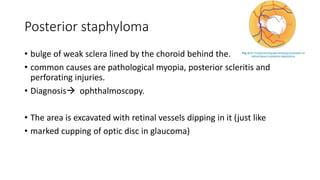
Posterior staphyloma
• bulge of weak sclera lined by the choroid behind the.
• common causes are pathological myopia, posterior scleritis and
perforating injuries.
• Diagnosis ophthalmoscopy.
• The area is excavated with retinal vessels dipping in it (just like
• marked cupping of optic disc in glaucoma)

Diseases of sclera

  • 1.
  • 2.
    anatomy • Sclera posterior 5/6th opaque part of the external fibrous tunic of the eyeball.
  • 3.
    • outer surface}covered by Tenon's capsule. • anterior part } covered by bulbar conjunctiva.
  • 4.
    Its inner surfacelies in contact with choroid with a potential suprachoroidal space in between
  • 6.
    Thickness of sclera. •thinner }children and in females Sclera • thickest} posteriorly (1mm) • gradually becomes thin when traced anteriorly. • thinnest } insertion of extraocular muscles (0.3 mm). • Lamina cribrosa is a sieve-like sclera from which fibres of optic nerve pass.
  • 7.
    Apertures of sclera •Anterior • Anterior ciliary vessels • Middle • four vortex veins (vena verticosae) • Posterior • Optic nerve • Long & short ciliary nerves
  • 8.
    Layers of sclera sclera episclera Scleraproper Lamina fusca thin, dense vascularised layer of connective tissue fibroblasts, macrophages and lymphocytes avascular structure dense bundles of collagen fibres. innermost blends with suprachoroidal and supraciliary laminae of the uveal tract. brownish in colour presence of pigmented cells.
  • 9.
    Inflammations of sclera •Episcleritis (superficial) • Scleritis(deep)
  • 10.
    episcleritis • benign recurrentinflammation of the episclera, • involving the overlying Tenon's capsule • but not the underlying sclera.
  • 11.
    etiology • Unknown • Associatedwith gout/psoriasis/rosacea • Hypersensitivity reaction to endogenous tubercular or streptococcal toxins.
  • 12.
  • 13.
    pathology • localised lymphocyticinfiltration of episcleral tissue •  oedema and congestion of overlying Tenon's capsule and conjunctiva.
  • 14.
    symptoms • by redness, •mild ocular discomfort described as gritty, burning or • foreign body sensation
  • 15.
    signs • diffuse episcleritis, •whole eye maybe involved to some extent, • the maximum inflammation is confined to one or two quadrants • nodular episcleritis, • a pink or purple flat nodule surrounded by injection is seen, 2-3 mm away from the limbus • The nodule is firm, tender and the overlying conjunctiva moves freely.
  • 16.
    Clinical course • limitedcourse of 10 days to 3 weeks =resolves spontaneously. • recurrences common and tend to occur in bouts. • a fleeting type of disease (episcleritis periodica) may occur
  • 17.
    DD • Inflammed pinguecula •Scleritis • Fb reaction on bulbar conjunctiva
  • 18.
    treatment • 1.Topical corticosteroideyedrops 2-3 hourly, • 2. Cold compresses applied to the closed lids • 3. Systemic non-steroidal anti-inflammatory drugs • flurbiprofen (300 mg OD), • indomethacin (25 mg three times a day), or • oxyphenbutazone
  • 19.
  • 20.
    scleritis • c/c inflmnof sclera proper • F>m • Elderly
  • 21.
    etiology • Autoimmune collagendisorders RA(common),Wegener's granulomatosis,PAN, SLE and ankylosing spondylitis. • Metabolic disorders gout & thyrotoxicosis • Infections herpes zoster ophthalmicus, c/c staphylococcal and streptococcal infection • Granulomatous diseases tb,syphilis, sarcoidosis, leprosy • Miscellaneous conditions irradiation, chemical burns, Vogt-Koyanagi- Harada syndrome, Behcet's disease and rosacea • Surgically induced scleritis ocular surgery. within 6 month postoperatively. • Idiopathic
  • 22.
    pathology • infiltration byPMNL , lymphocytes, plasma cells and macrophages • Fibrinoid necrosis, destruction of collagen • • granuloma surrounded by multinucleated epitheloid giant cells
  • 23.
    classification • I. Anteriorscleritis (98%) • 1. Non-necrotizing scleritis (85%) • (a) Diffuse • (b) Nodular • 2. Necrotizing scleritis (13%) • (a) with inflammation • (b) without inflammation (scleromalacia perforans) • II. Posterior scleritis (2%)
  • 24.
    Symptoms • moderate tosevere pain • deep and boring in character and often • wakes the patient early in the morning . • radiates to the jaw and temple. • localised or diffuse redness • mild to severe photophobia • lacrimation.
  • 25.
    Signs • 1. Non-necrotizinganterior diffuse scleritis. • commonest, • widespread inflammation involving a quadrant or more of the anterior sclera. • The area is raised and salmon pink to purple in colour
  • 26.
    • Non-necrotizing anteriornodular scleritis. • one or two hard, purplish elevated scleral nodules, • usually situated near the limbus • the nodules are arranged in a ring around the limbus (annular scleritis).
  • 27.
    • 3. Anteriornecrotizing scleritis with inflammation. • acute severe form of scleritis • characterised by intense localised inflammation • associated with areas of infarction due to vasculitis • necrosed sclera thinned out (sclera becomes transparent and ectatic) with uveal tissue shining through it. • Anterior uveitis+
  • 28.
    • Anterior necrotizingscleritis without inflammation (scleromalacia perforans). • elderly females with long-standing RA. • yellowish patch of melting sclera (due to obliteration of arterial supply); • with overlying episclera andconjunctiva completely separates from the surrounding normal sclera. • Eventually absorbs leaving behind it a large punched out area of • thin sclera through which the uveal tissue shines • Spontaneous perforation rare
  • 29.
    • posterior scleritis. •the sclera behind the equator. • frequently misdiagnosed. • associated inflammation of adjacent structures, • exudative retinal detachment, • macular oedema, • proptosis and • limitation of ocular movements.
  • 30.
    complications • 2’ glaucoma(due to uveitis…) • Complicated cataract • sclerosing keratitis, • keratolysis
  • 31.
    investigations • 1. TLC,DLC and ESR • 2. Serum levels of complement (C3), immune complexes, rheumatoid factor, antinuclear antibodies and L.E cells for an immunological survey. • 3. FTA - ABS, VDRL for syphilis. • 4. Serum uric acid for gout. • 5. Urine analysis. • 6. Mantoux test. • 7. X-rays of chest, paranasal sinuses, sacroiliac joint and orbit to rule out foreign body especially in patients with nodular scleritis.
  • 32.
    Treatment • (A) Non-necrotisingscleritis • Topical steroid eyedrops and • systemic indomethacin 100 mg daily for a day and then 75 mg daily until inflammation resolves. • (B) Necrotising scleritis. • Topical steroids & heavy doses of oral steroids tapered slowly. • In non-responsive cases, immuno-suppressive agents like methotrexate or cyclophos-phamide • Subconjunctival steroids are contraindicated because they may lead to scleral thinning and perforation
  • 33.
  • 34.
    Blue sclera • asymptomaticcondition • marked, generalised blue discolouration of sclera due to thinning. osteogenesis imperfecta. Marfan's syndrome, Ehlers-Danlos syndrome, pseudoxanthoma elasticum,  buphthalmos, High myopia and  healed scleritis.
  • 35.
  • 36.
    staphylomas • localised bulgingof weak and thin outer tunic of the eyeball (cornea or sclera), • lined by uveal tissue which shines through the thinned out fibrous coat.
  • 37.
    classification • Anterior • Intercalary •Ciliary • Equatorial • posterior
  • 38.
    Anterior staphyloma • Ass.With ectasia of cornea & iris • Due to perforating corneal ulcer & injury
  • 39.
    Intercalary staphyloma healing ofa perforating injury or a peripheral corneal ulcer to ectasia of weak scar tissue formed at the limbus localised bulge in limbal area lined by root of iris
  • 40.
    • marked cornealastigmatism Defective vision • 2’angle closure glaucomaprogression of swelling • Treatment • localised staphylectomy under heavy doses of oral steroids.
  • 41.
    Ciliary staphyloma • bulgeof weak sclera lined by ciliary body. • about 2-3 mm away from the limbus • thinning of sclera following perforating injury, • scleritis and absolute glaucoma. Ciliary staphyloma
  • 42.
    Equatorial staphyloma • bulgeof sclera lined by the choroid in the equatorial region • at the regions of sclera which are perforated by vortex veins. • causes= scleritis and degeneration of sclera in pathological myopia
  • 43.
    Posterior staphyloma • bulgeof weak sclera lined by the choroid behind the. • common causes are pathological myopia, posterior scleritis and perforating injuries. • Diagnosis ophthalmoscopy. • The area is excavated with retinal vessels dipping in it (just like • marked cupping of optic disc in glaucoma)