Optometryand
orthoptics
Maryam Fida (o-1827)
[CONTACT LENS SOLTIONS]
Contact lens solutions
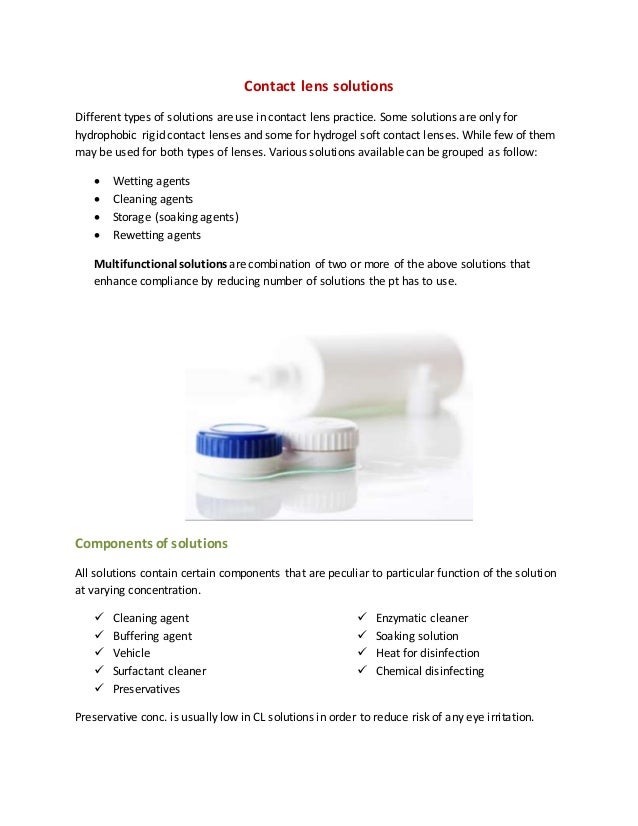
Different types of solutions are use in contact lens practice. Some solutions are only for
hydrophobic rigid contact lenses and some for hydrogel soft contact lenses. While few of them
may be used for both types of lenses. Various solutions available can be grouped as follow:
 Wetting agents
 Cleaning agents
 Storage (soaking agents)
 Rewetting agents
Multifunctionalsolutions are combination of two or more of the above solutions that
enhance compliance by reducing number of solutions the pt has to use.
Components of solutions
All solutions contain certain components that are peculiar to particular function of the solution
at varying concentration.
 Cleaning agent
 Buffering agent
 Vehicle
 Surfactant cleaner
 Enzymatic cleaner
 Soaking solution
 Heat for disinfection
 Chemical disinfecting
 Preservatives
Preservative conc. is usually low in CL solutions in order to reduce risk of any eye irritation.
Range of preservatives includes:
 Benzalkonium chloride
 Chlorobutanol
 Thiomesal
 Chlorhexidine
 Ethylene diamine tetra-acetic acid
(EDTA)
 Sorbic acid
 Potassium sorbate
1. Wetting solution
An agent that coats the contact lens with a film intends to minimize the friction of CL against
pelpebral conjunctiva and cornea. It act as
 buffer
 Cushioning agent
It disintegrates to be replaced by lacrimal fluid. It must meet standards as regard to sterility,
isotonicity, nonirritabilty and stability.
Should be buffered at pH of tears.
Essential characteristicsof a Wetting agent
1. Wet thoroughly and spread over an entire surface of lens, rendering it hydrophilic.
2. Should form a film sufficiently tenacious so that it’ll not be washed away during the
wearing period by tears.
3. Nonirritating and nonsensitizing
4. No residue existence (pure)
5. Cleaner, antiseptic and self-preserving
6. Viscous
7. Lubricant and preserving agent
8. Allow lens sticking on fingertip during insertion and sallow no oil of finger to get on lens
9. Not interfere with wetting by lacrimal fluid.
Wetting agents
 Polyvinyl alcohol
 Polysorbate 80
 Polyethylene oxide
 Cellulose-like derivatives (e;g methylcellulose)
 PVP
2. Cleaning solutions
Such solutions have 2 functions:
 Detergent which remove lacrimal film, mucus deposit
 Bactericidal agent.
Two types of cleaners are used in present days.
I. The surfactant cleaner II. Enzyme cleaner
I. Surfactant cleaners
 Most cleaners are nonionic surfactants, function as surface active cleaner.
 Preserved with thiomersal, potassium sorbate or sorbic acid.
 Tube polymeric beads act as abrasive on lens surface for removing surface
debris.
 Lens protein and debris on lens surface removal/debulking should be forcibly
recommended for all types of lenses on daily basis.
 Also for weekly cleaning, with special cleaning container which has ‘’washing
machine’’ type of action on CL-shaking off stubborn deposits are available.
 Cleaning agents emulsify lipids, solubilize debris and remove accumulated
contaminants most favorably in an alkaline environment (more pH than7.4).
 Household cleaners should not be used like laundry detergents, dishwashing
compounds, skin cleaners and hair shampoos because of their harsh action
on lens surface or potential for damage to cornea.
II. Enzymatic cleaners
 Cleaning of bound protein s and lipids from lens surface of soft and gas
permeable CL has solved a lot of problems of red eye and GPC.
 Tablets ‘’papain’’ as enzyme cleaners used.
 Lipase enzyme incorporation also proved as useful cleaner.
3. Soaking Solutions
 It posses bactericidal properties
 It serves as an antiseptic storage medium.
 Maintains the lenses in a hydrated state.
4. Rewetting agents
Rewetting agents/artificial tears used to rewet corneal surface of eye or lens device when it
is on the cornea.
Characteristics of rewetting agents:
 Feelings of lens awareness
 Blurring of vision
 Peripheral horizontal 3-9 o’clock staining (due to tear filmdisability to distribute
over lens surface).
 May contain viscous agent like polyvinyl alcohol or methylcellulose.
Commonly used agents in various CL solutions
o Benzalokonium chloride
o Chlorobutanol
o Thiomersal (0.04%)
o Chlorhexidine
o Hydrogen peroxide & povidone-iodine systems
o EDTA
o Polyvinyl alcohol

contact lens solution

  • 1.
  • 2.
    Contact lens solutions Differenttypes of solutions are use in contact lens practice. Some solutions are only for hydrophobic rigid contact lenses and some for hydrogel soft contact lenses. While few of them may be used for both types of lenses. Various solutions available can be grouped as follow:  Wetting agents  Cleaning agents  Storage (soaking agents)  Rewetting agents Multifunctionalsolutions are combination of two or more of the above solutions that enhance compliance by reducing number of solutions the pt has to use. Components of solutions All solutions contain certain components that are peculiar to particular function of the solution at varying concentration.  Cleaning agent  Buffering agent  Vehicle  Surfactant cleaner  Enzymatic cleaner  Soaking solution  Heat for disinfection  Chemical disinfecting  Preservatives Preservative conc. is usually low in CL solutions in order to reduce risk of any eye irritation.
  • 3.
    Range of preservativesincludes:  Benzalkonium chloride  Chlorobutanol  Thiomesal  Chlorhexidine  Ethylene diamine tetra-acetic acid (EDTA)  Sorbic acid  Potassium sorbate 1. Wetting solution An agent that coats the contact lens with a film intends to minimize the friction of CL against pelpebral conjunctiva and cornea. It act as  buffer  Cushioning agent It disintegrates to be replaced by lacrimal fluid. It must meet standards as regard to sterility, isotonicity, nonirritabilty and stability. Should be buffered at pH of tears. Essential characteristicsof a Wetting agent 1. Wet thoroughly and spread over an entire surface of lens, rendering it hydrophilic. 2. Should form a film sufficiently tenacious so that it’ll not be washed away during the wearing period by tears. 3. Nonirritating and nonsensitizing 4. No residue existence (pure) 5. Cleaner, antiseptic and self-preserving 6. Viscous 7. Lubricant and preserving agent 8. Allow lens sticking on fingertip during insertion and sallow no oil of finger to get on lens 9. Not interfere with wetting by lacrimal fluid. Wetting agents
  • 4.
     Polyvinyl alcohol Polysorbate 80  Polyethylene oxide  Cellulose-like derivatives (e;g methylcellulose)  PVP 2. Cleaning solutions Such solutions have 2 functions:  Detergent which remove lacrimal film, mucus deposit  Bactericidal agent. Two types of cleaners are used in present days. I. The surfactant cleaner II. Enzyme cleaner I. Surfactant cleaners  Most cleaners are nonionic surfactants, function as surface active cleaner.  Preserved with thiomersal, potassium sorbate or sorbic acid.  Tube polymeric beads act as abrasive on lens surface for removing surface debris.  Lens protein and debris on lens surface removal/debulking should be forcibly recommended for all types of lenses on daily basis.  Also for weekly cleaning, with special cleaning container which has ‘’washing machine’’ type of action on CL-shaking off stubborn deposits are available.  Cleaning agents emulsify lipids, solubilize debris and remove accumulated contaminants most favorably in an alkaline environment (more pH than7.4).  Household cleaners should not be used like laundry detergents, dishwashing compounds, skin cleaners and hair shampoos because of their harsh action on lens surface or potential for damage to cornea. II. Enzymatic cleaners  Cleaning of bound protein s and lipids from lens surface of soft and gas permeable CL has solved a lot of problems of red eye and GPC.  Tablets ‘’papain’’ as enzyme cleaners used.  Lipase enzyme incorporation also proved as useful cleaner.
  • 5.
    3. Soaking Solutions It posses bactericidal properties  It serves as an antiseptic storage medium.  Maintains the lenses in a hydrated state. 4. Rewetting agents Rewetting agents/artificial tears used to rewet corneal surface of eye or lens device when it is on the cornea. Characteristics of rewetting agents:  Feelings of lens awareness  Blurring of vision  Peripheral horizontal 3-9 o’clock staining (due to tear filmdisability to distribute over lens surface).  May contain viscous agent like polyvinyl alcohol or methylcellulose. Commonly used agents in various CL solutions o Benzalokonium chloride o Chlorobutanol o Thiomersal (0.04%) o Chlorhexidine o Hydrogen peroxide & povidone-iodine systems o EDTA o Polyvinyl alcohol