DISEASES OFSCLERA
Dr. Nikhil
Gotmare
Anatomy
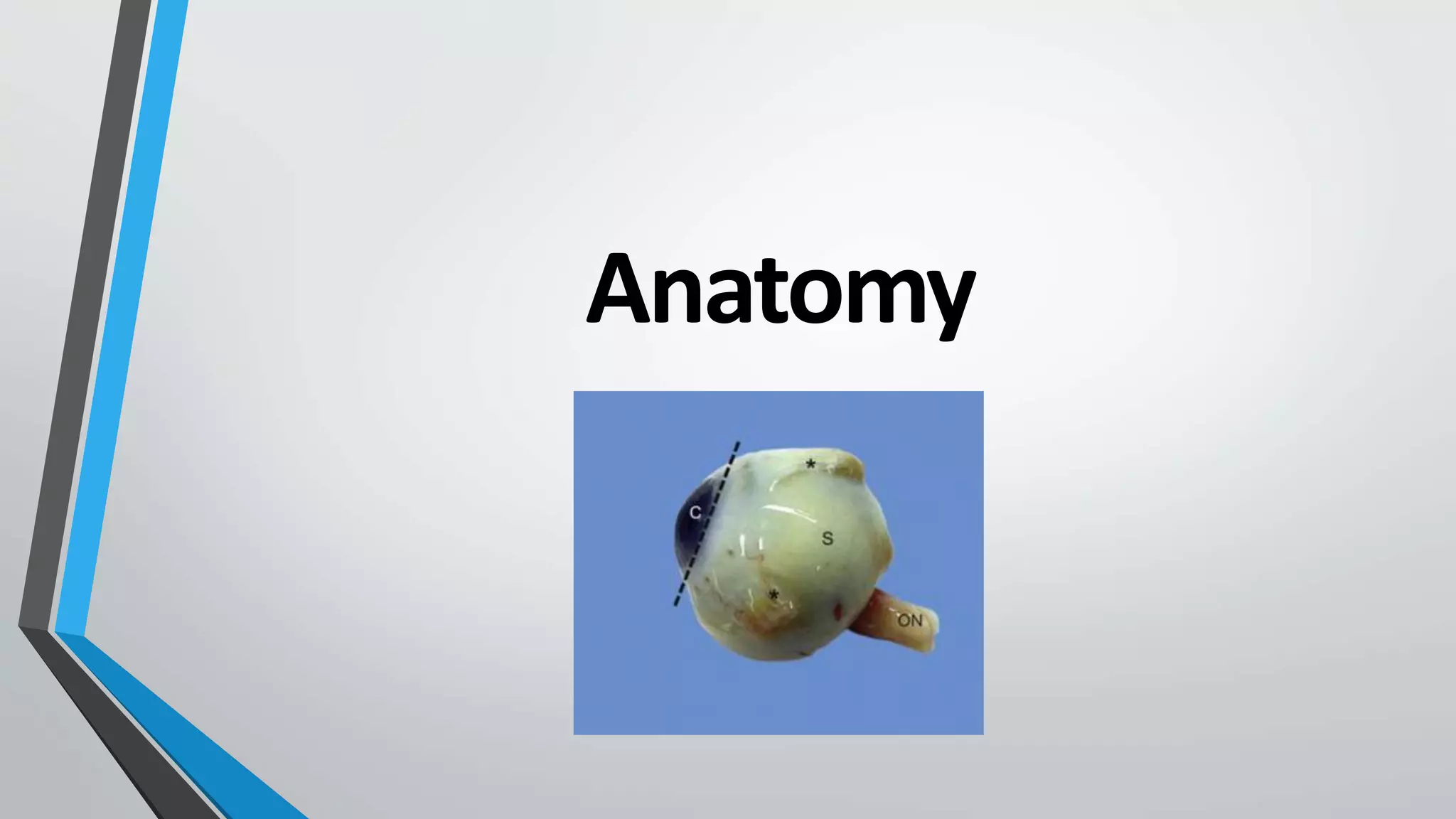
Anatomyofsclera
It forms the posterior opaque 5/6th part of
the external fibrous coat of the eyeball
Eye has three
coats:
Outer – Fibrous
Middle – Vascular
Inner - Nervous
• Outer surface - covered by Tenon's
capsule
• Anterior part - covered by bulbar
conjunctiva
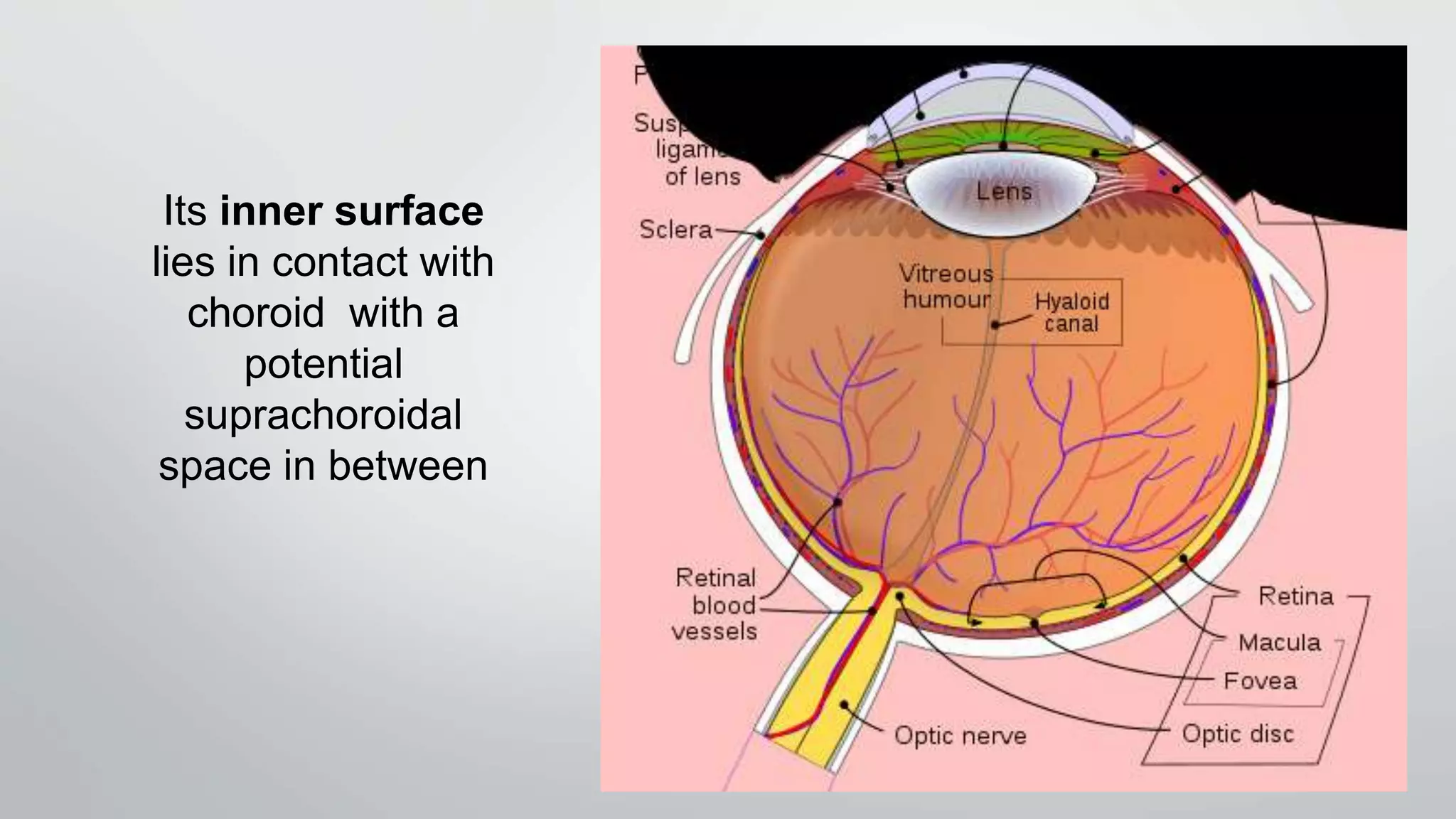
Its inner surface
lies in contact with
choroid with a
potential
suprachoroidal
space in between
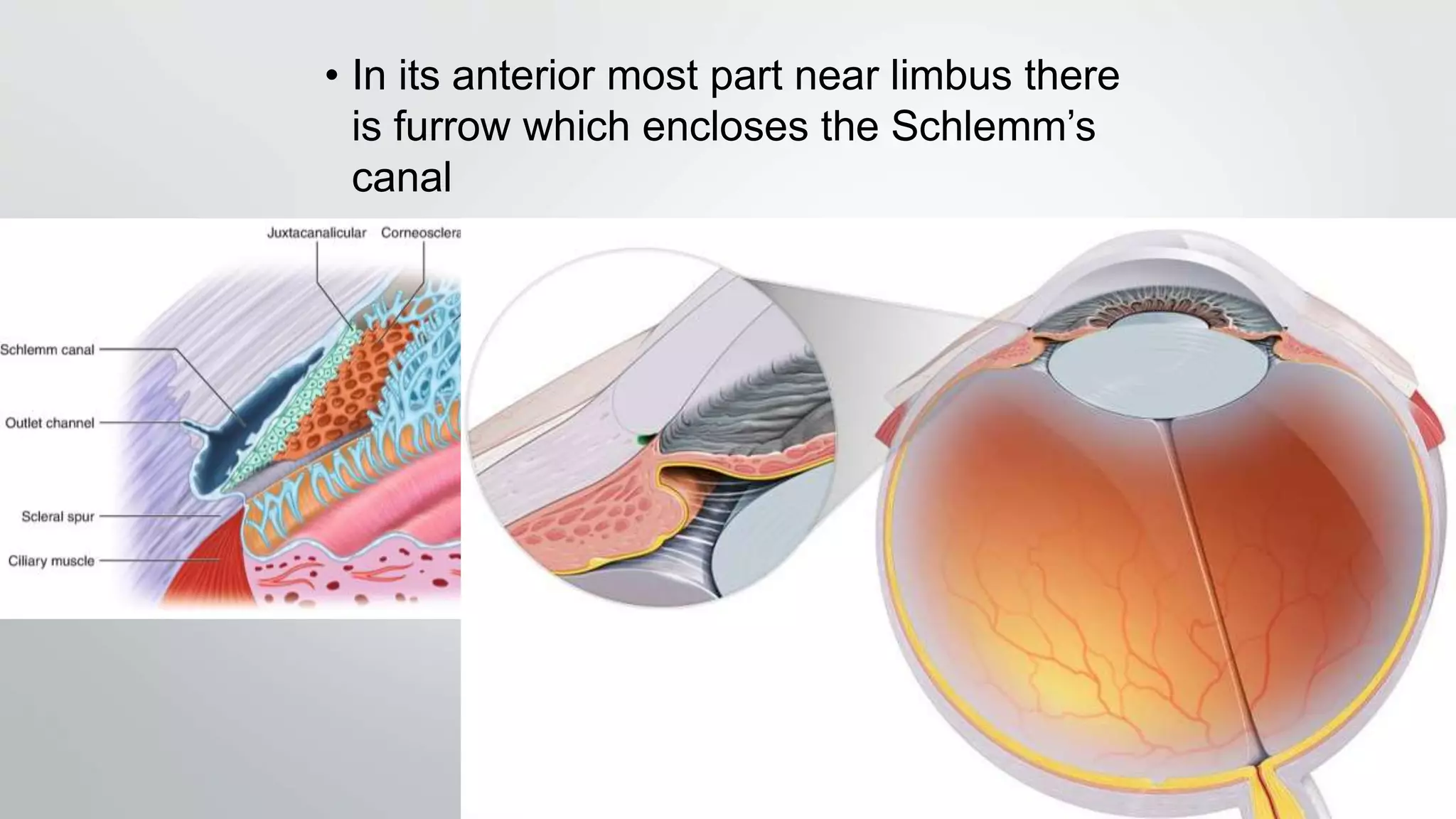
• In its anterior most part near limbus there
is furrow which encloses the Schlemm’s
canal
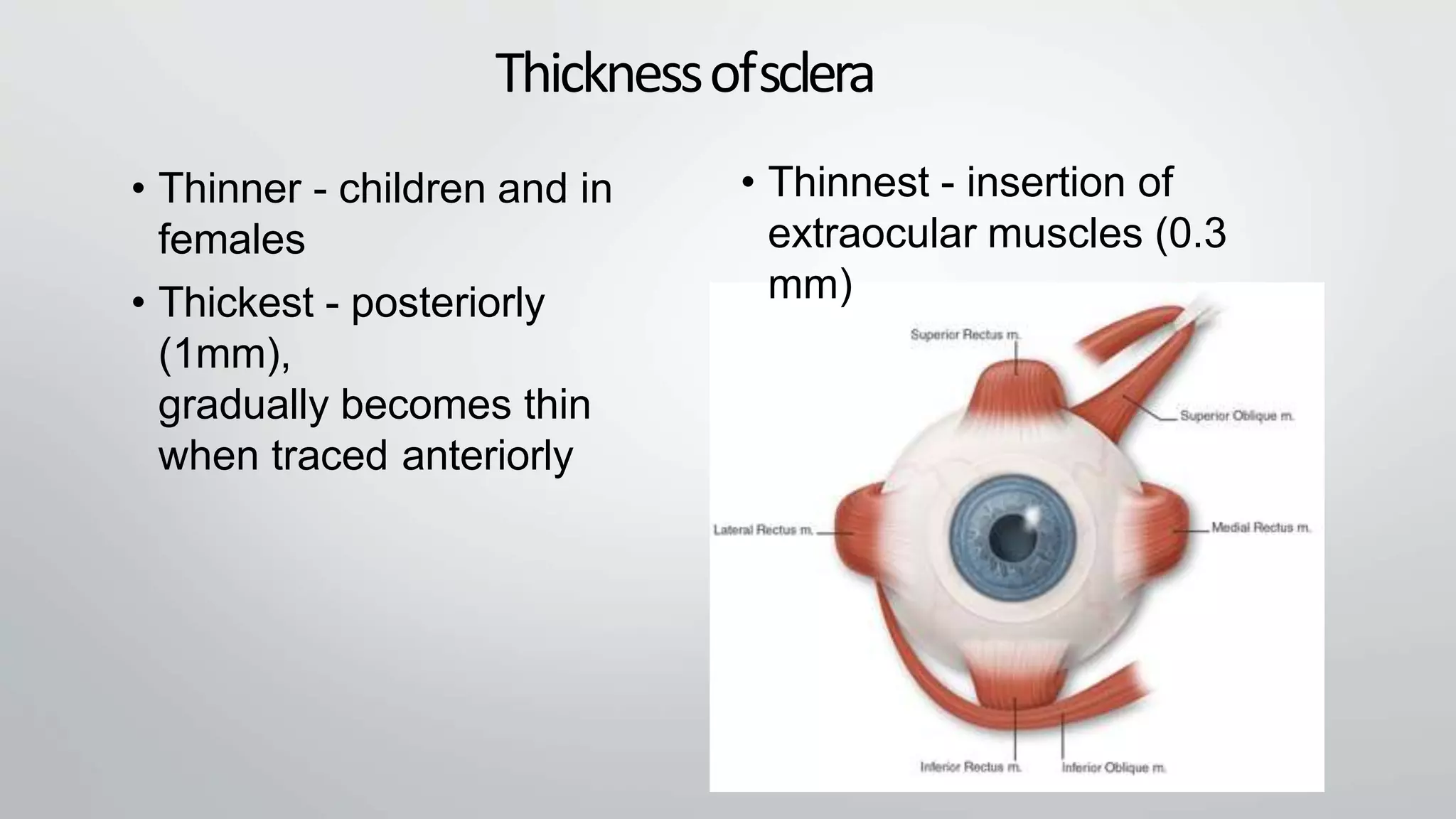
Thicknessofsclera
• Thinner - children and in
females
• Thickest - posteriorly
(1mm),
gradually becomes thin
when traced anteriorly
• Thinnest - insertion of
extraocular muscles (0.3
mm)
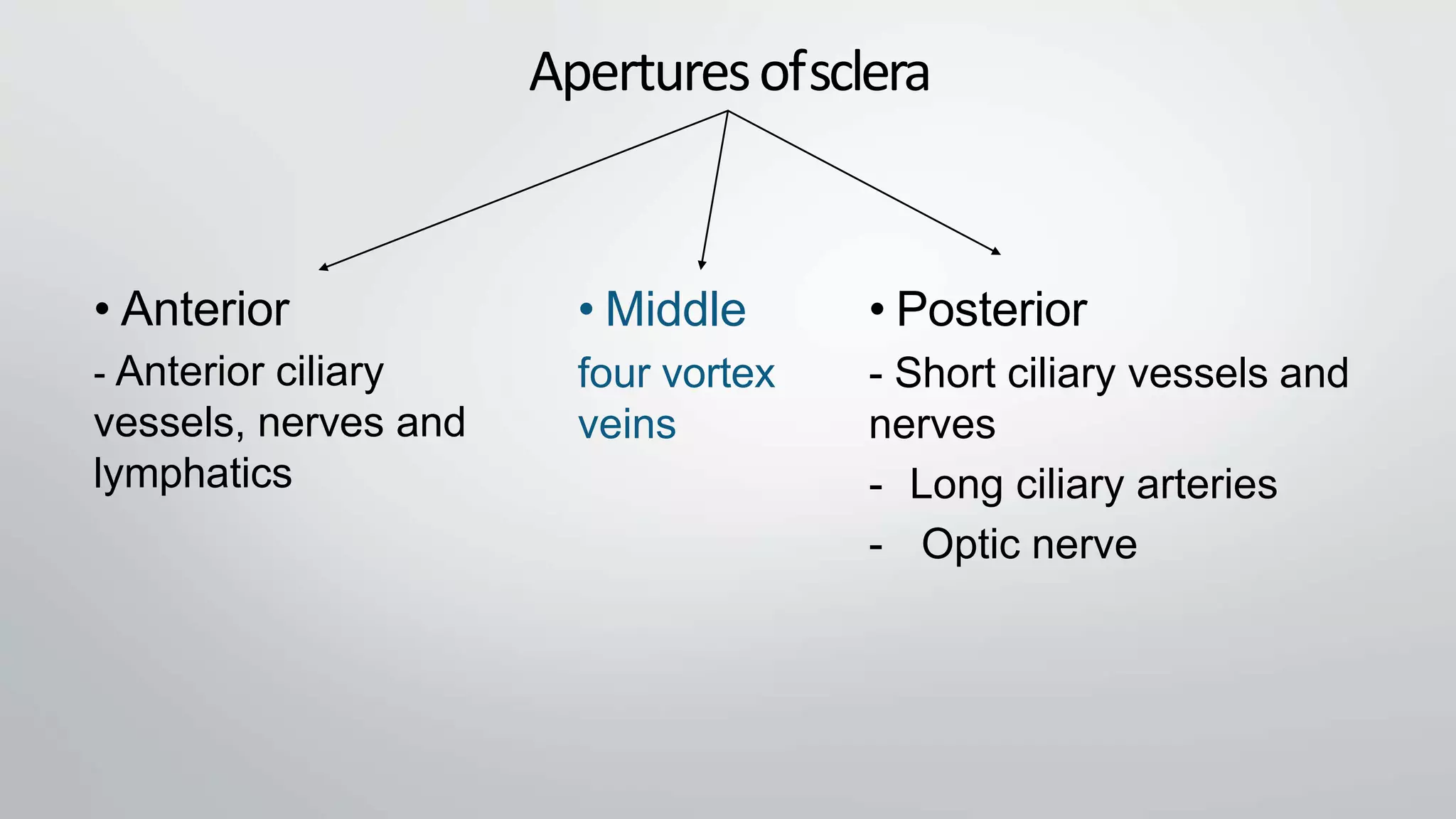
Aperturesofsclera
• Anterior
- Anterior ciliary
vessels, nerves and
lymphatics
• Middle
four vortex
veins
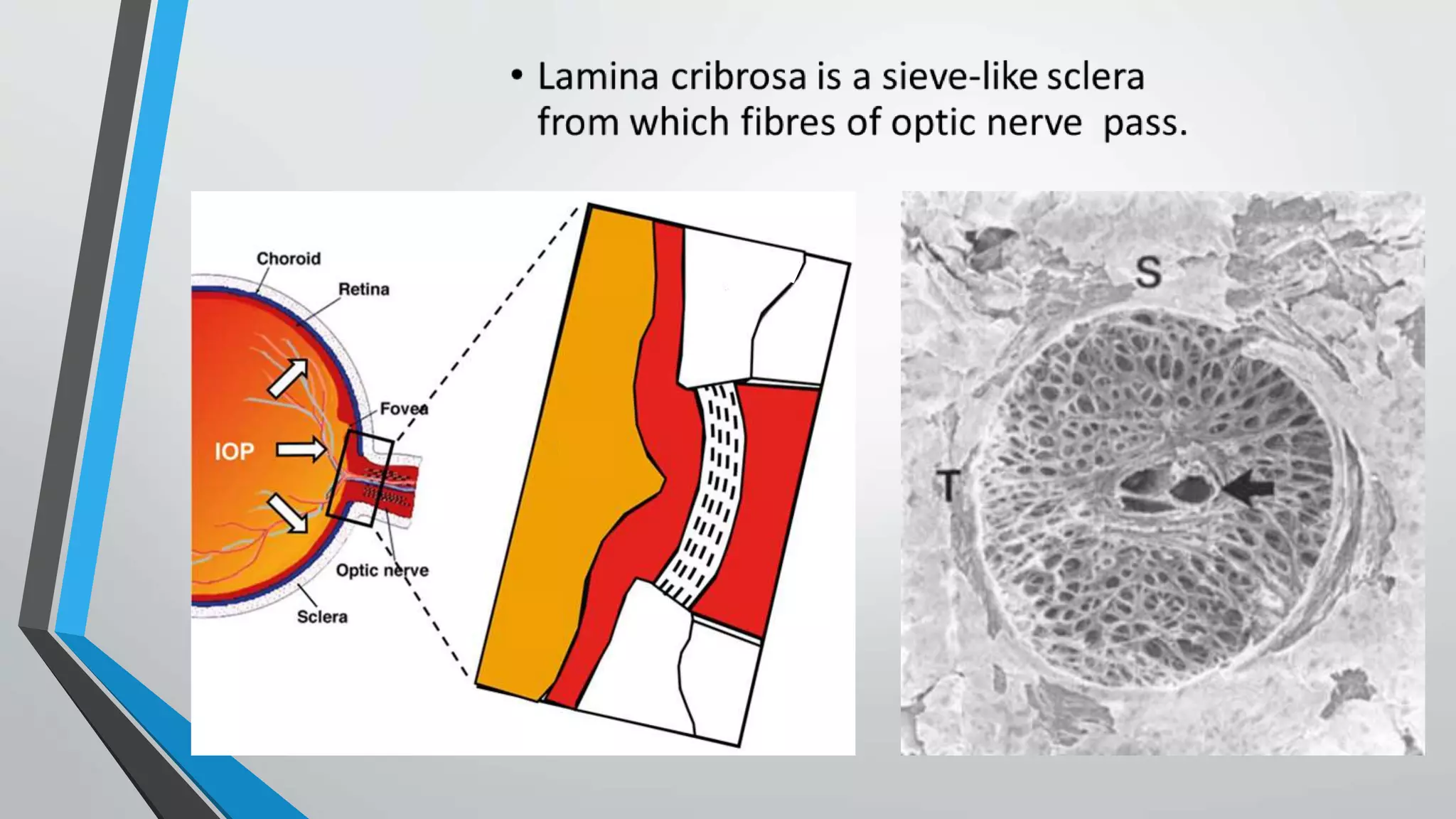
• Posterior
- Short ciliary vessels and
nerves
- Long ciliary arteries
- Optic nerve
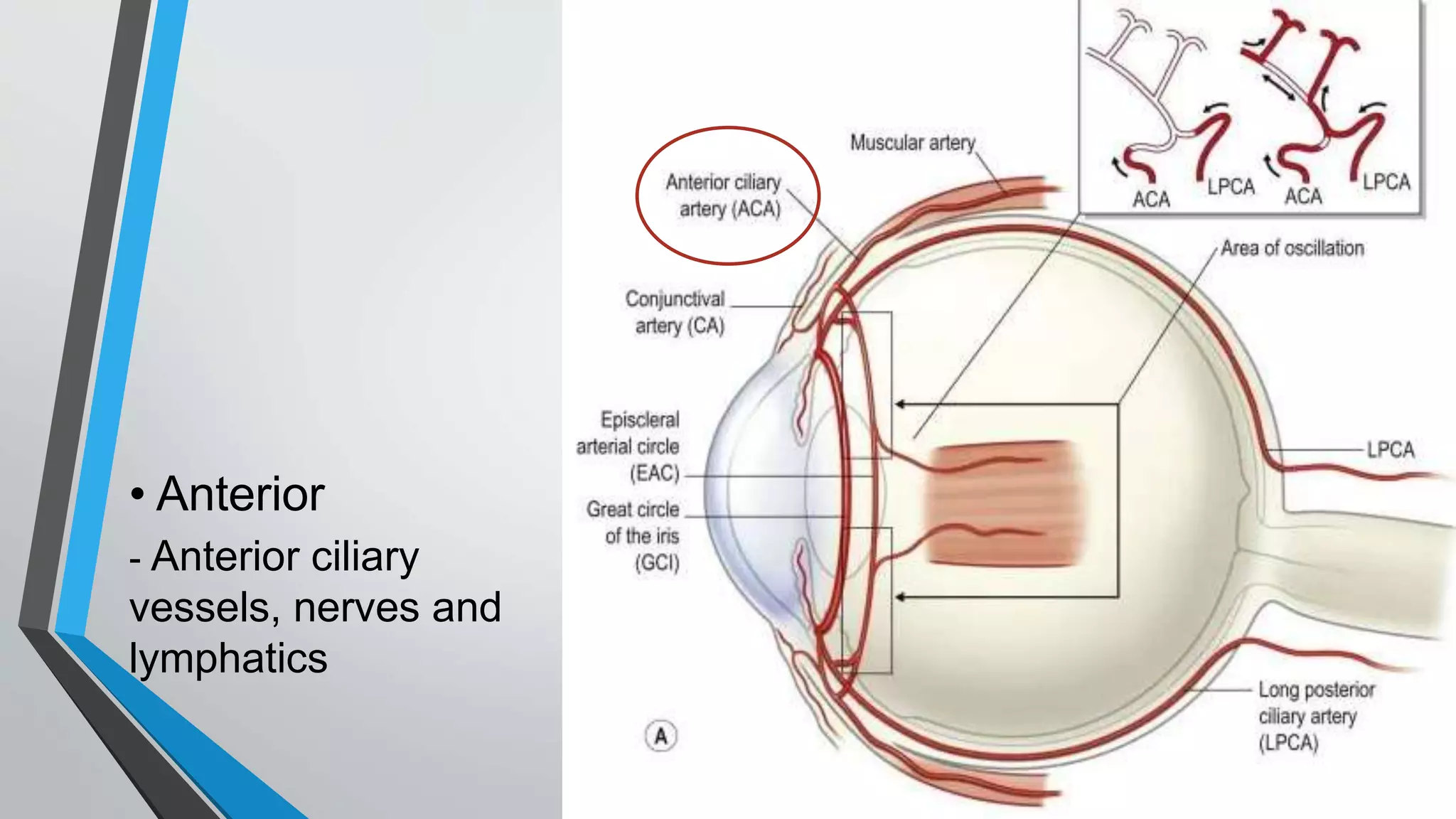
• Anterior
- Anterior ciliary
vessels, nerves and
lymphatics
• Middle
four vortex
veins
• Posterior
- Short ciliary vessels and
nerves
- Long ciliary arteries
- Optic nerve
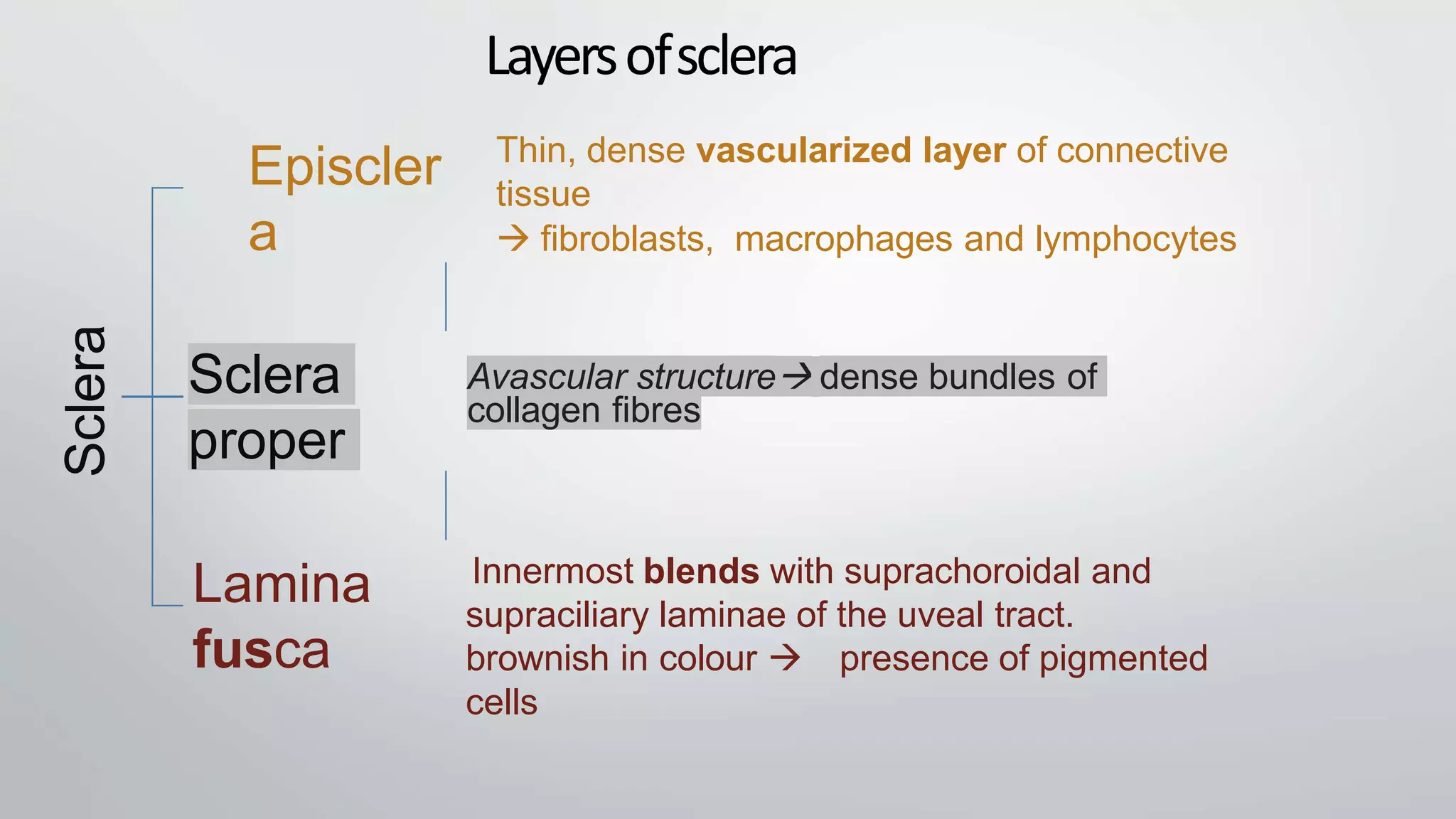
Layersofsclera
Sclera
Episcler
a
Sclera
proper
Lamina
fusca
Thin, dense vascularized layer of connective
tissue
 fibroblasts, macrophages and lymphocytes
Avascular structure dense bundles of
collagen fibres
Innermost blends with suprachoroidal and
supraciliary laminae of the uveal tract.
brownish in colour  presence of pigmented
cells
Staphylomas
• Localised bulging of weak and thin
outer tunic of the eyeball (cornea or
sclera)
• Lined by uveal tissue which shines
through the thinned out fibrous coat.
{‘Staphylo-’
bunch of grapes}
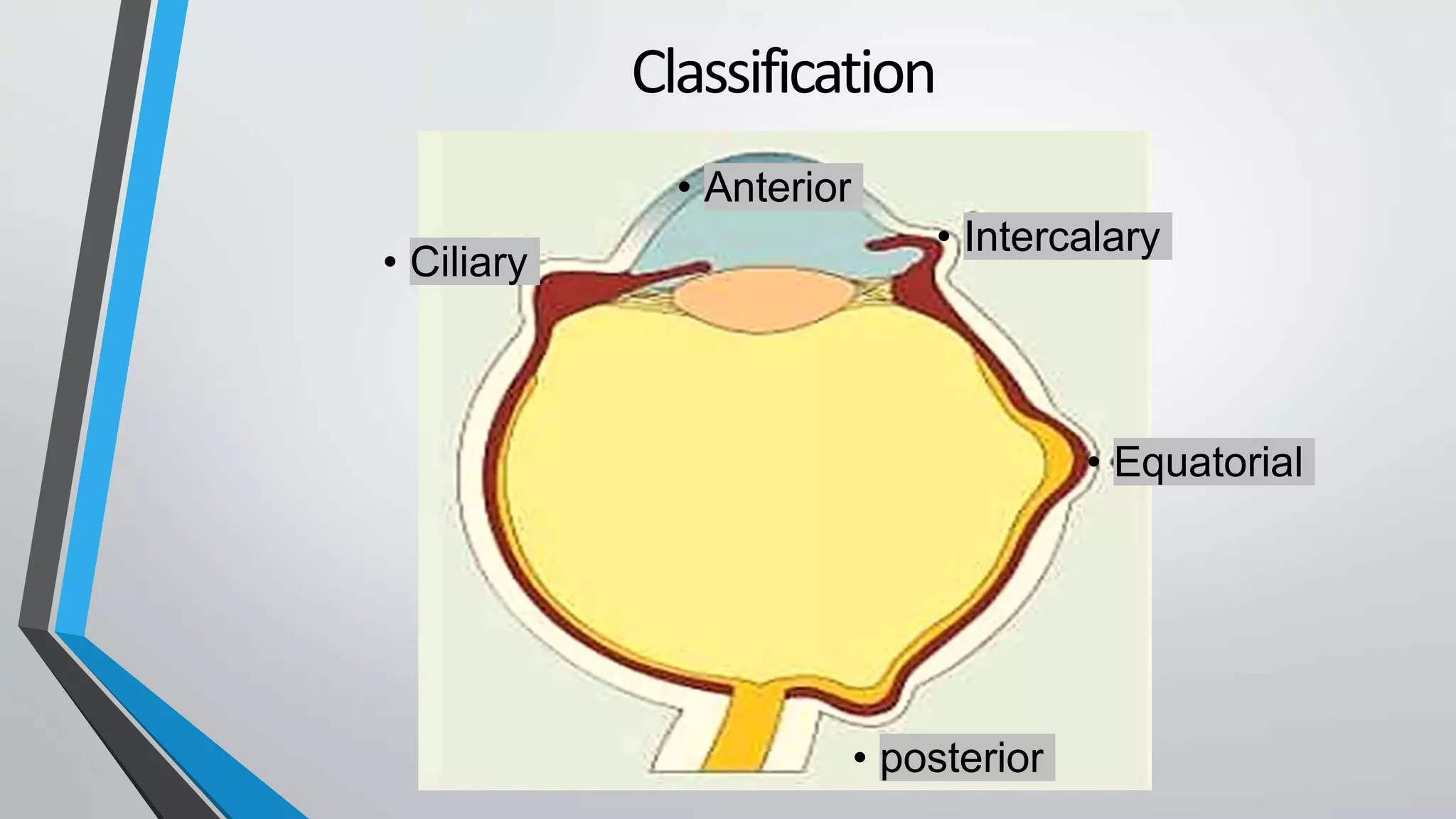
Classification
• posterior
• Anterior
• Intercalary
• Ciliary
• Equatorial
Anteriorstaphyloma
• Ass. With ectasia of cornea & iris
• Due to perforating corneal ulcer &
injury
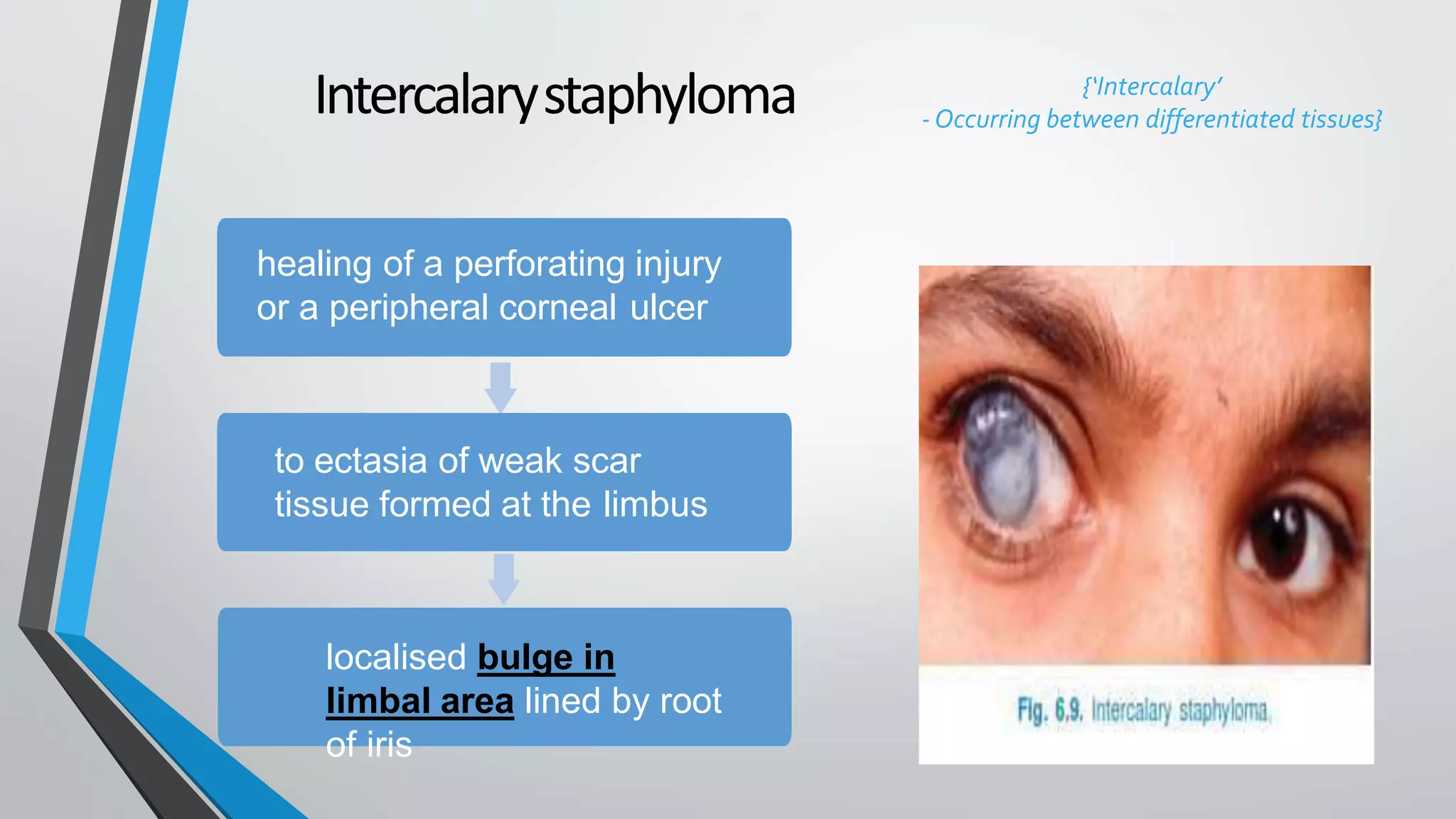
Intercalarystaphyloma
healing of a perforating injury
or a peripheral corneal ulcer
to ectasia of weak scar
tissue formed at the limbus
localised bulge in
limbal area lined by root
of iris
{‘Intercalary’
- Occurring between differentiated tissues}
Ciliarystaphyloma
• Bulge of weak sclera lined by ciliary
body
• About 2-3 mm away from the limbus
• Thinning of sclera following perforating
injury, scleritis and absolute glaucoma
Equatorialstaphyloma
• Bulge of sclera lined by the choroid
in the equatorial region at the
regions of sclera which are
perforated by vortex veins.
• Causes - Scleritis and
degeneration of sclera in
pathological myopia
{‘Equator
- 14mm behind limbus}
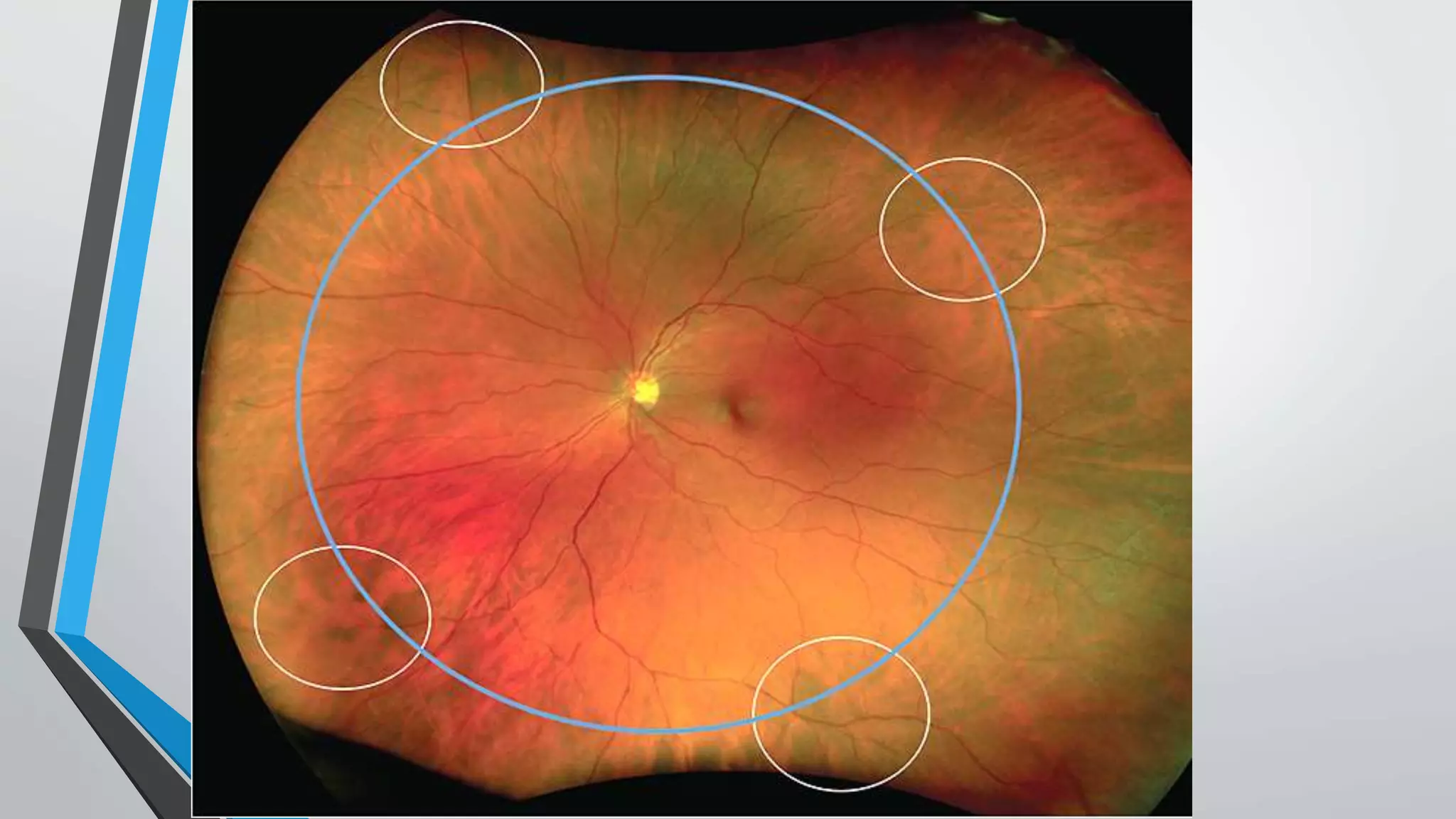
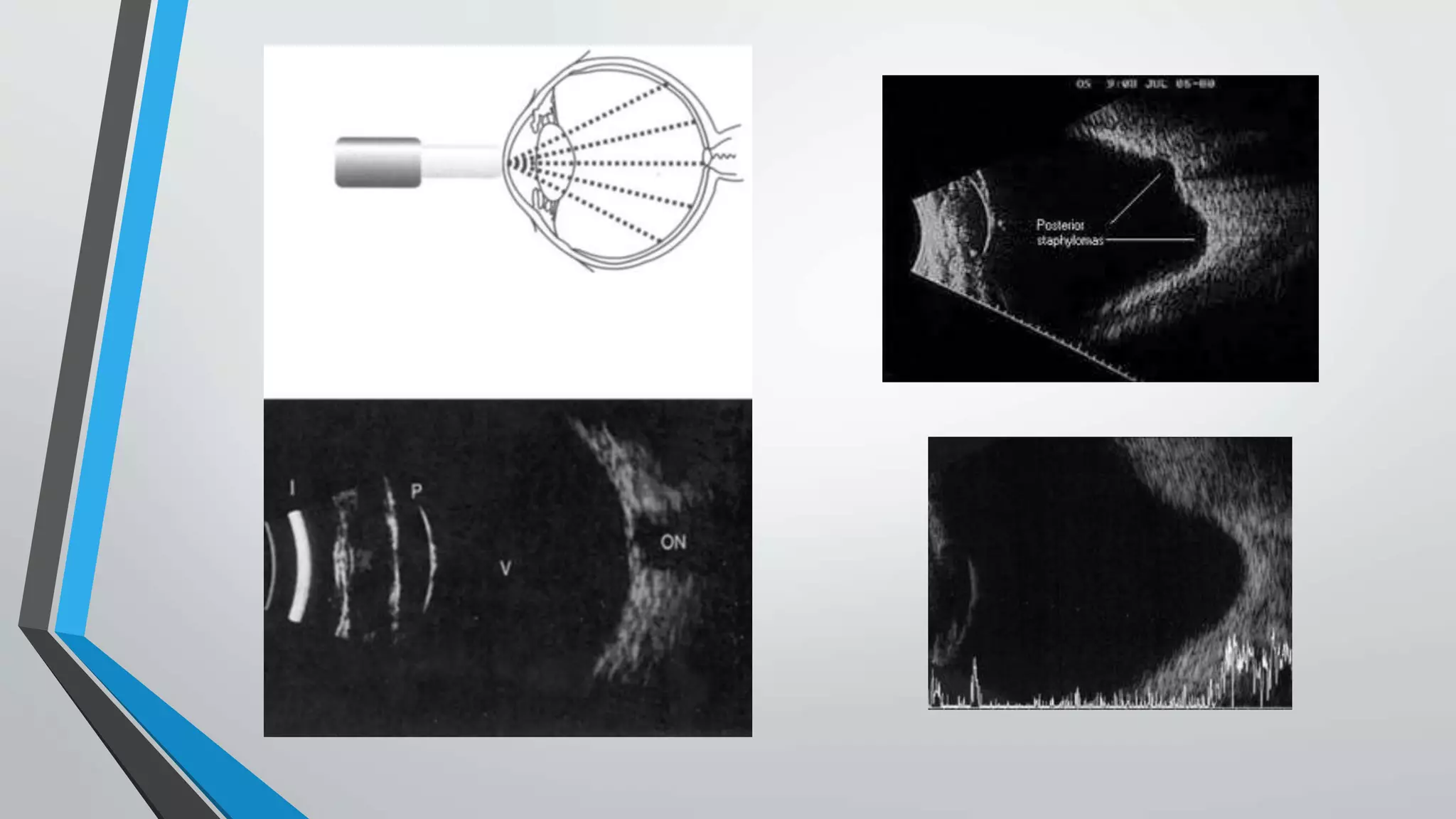
Posteriorstaphyloma
• Bulge of weak sclera lined by the choroid behind the
equator
• Common causes are pathological myopia, posterior
scleritis and perforating injuries.
Diagnosis Ophthalmoscopy
• The area is excavated with retinal vessels dipping
in it
Pathological
myopia
Bluesclera
Marked, generalised blue discolouration of sclera due to
thinning
CausesofBluesclera
• Mnemonic- { H O P E S are too big }
 H - High myopia, Hurlers and Healed scleritis
 O - Osteogenesis imperfecta
- Oculodermal melanosis
 P - Pseudoxanthoma elasticum
 E - Ehlers-Danlos syndrome
 S – Scleritis, Staphyloma, Scleromalacia
perforans
 Are - Marfan's syndrome
 Too – Turner’s
Inflammations of sclera
•Episcleritis (superficial)
•Scleritis (deep)
Anterior scleritis (98%) Posterior scleritis
(2%)
Necrotizing
scleritis with
inflammation
Non-necrotizing
scleritis (85%)
(a) Diffuse
(b) Nodular
Inflammationsofsclera
EPISCLERITIS
(SUPERFICIAL)
SCLERITIS
(DEEP)
• Simple episcleritis
• Nodular episcleritis Immune
mediated
Infectiou
s
Necrotizing scleritis
without inflammation
(Scleromalacia
perforans)
Episcleritis
• Benign, recurrent inflammation of the
episclera, involving the overlying Tenon's
capsule but not the underlying sclera
• Common
• Usually idiopathic
• Females > males
• Middle age
EPISCLERITIS
• Simple episcleritis
• Nodular episcleritis
SCLERITIS
o Immune mediated
• Anterior
- Non-
necrotising
- Necrotising
with
inflammation
- Necrotising
without
inflammation
(scleromalacia
perforans)
• Posterior
o Infectious
Simple episcleritis
• Accounts for 75% of cases
• Tendency to recur (60%)
• Features often peak within 24 hours, gradually fading over the next
few days
EPISCLERITIS
• Simple episcleritis
• Nodular episcleritis
SCLERITIS
o Immune mediated
• Anterior
- Non-
necrotising
- Necrotising
with
inflammation
- Necrotising
without
inflammation
(scleromalacia
perforans)
• Posterior
o Infectious
EPISCLERITIS
• Simple episcleritis
• Nodular episcleritis
SCLERITIS
o Immune mediated
• Anterior
- Non-
necrotising
- Necrotising
with
inflammation
- Necrotising
without
inflammation
(scleromalacia
perforans)
• Posterior
o Infectious
Nodular episcleritis
• Less acute onset and a more prolonged course
• Red eye typically first noted on waking, over next 2-3
days area of redness enlarges and becomes more
uncomfortable
• Tender red vascular nodule (Interpalpebral area)
• Underlying flat anterior scleral surface
deep beam is
not displaced
above the
scleral
surface
EPISCLERITIS
• Simple episcleritis
• Nodular episcleritis
SCLERITIS
o Immune mediated
• Anterior
- Non-
necrotising
- Necrotising
with
inflammation
- Necrotising
without
inflammation
(scleromalacia
perforans)
• Posterior
o Infectious
Treatment
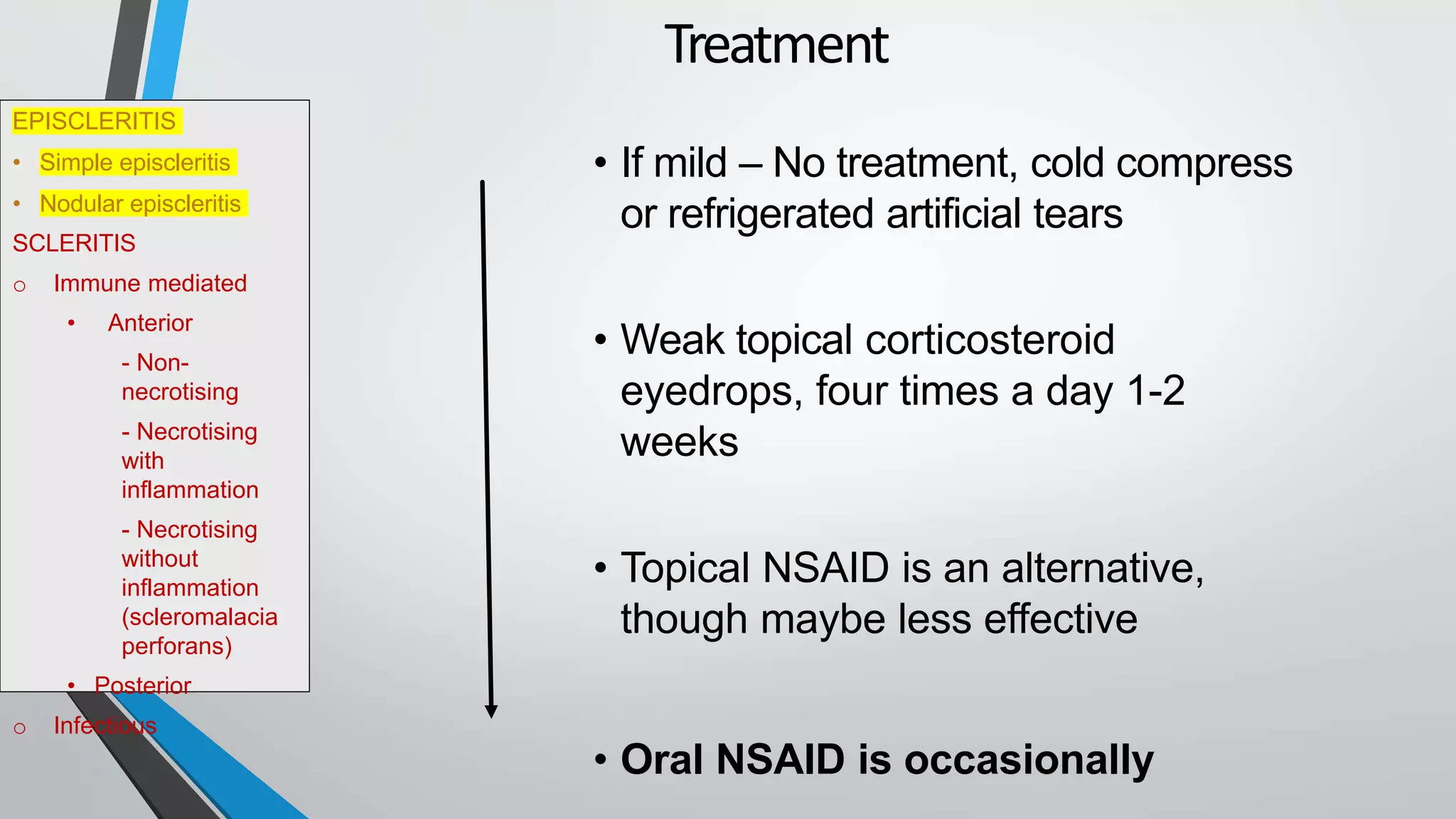
• If mild – No treatment, cold compress
or refrigerated artificial tears
• Weak topical corticosteroid
eyedrops, four times a day 1-2
weeks
• Topical NSAID is an alternative,
though maybe less effective
• Oral NSAID is occasionally
EPISCLERITIS
• Simple episcleritis
• Nodular episcleritis
SCLERITIS
o Immune mediated
• Anterior
- Non-
necrotising
- Necrotising
with
inflammation
- Necrotising
without
inflammation
(scleromalacia
perforans)
• Posterior
o Infectious
SCLERITI
S
• Oedema and cellular infiltration of the entire
thickness of sclera
EPISCLERITIS
• Simple episcleritis
• Nodular episcleritis
SCLERITIS
o Immune mediated
• Anterior
- Non-
necrotising
- Necrotising
with
inflammation
- Necrotising
without
inflammation
(scleromalacia
perforans)
• Posterior
o Infectious
Immune mediated
scleritis
• Most common type
• Much less common than episcleritis
• Spectrum – from trivial and self limiting disease to
a necrotizing process that can involve adjacent
tissue and threaten vision
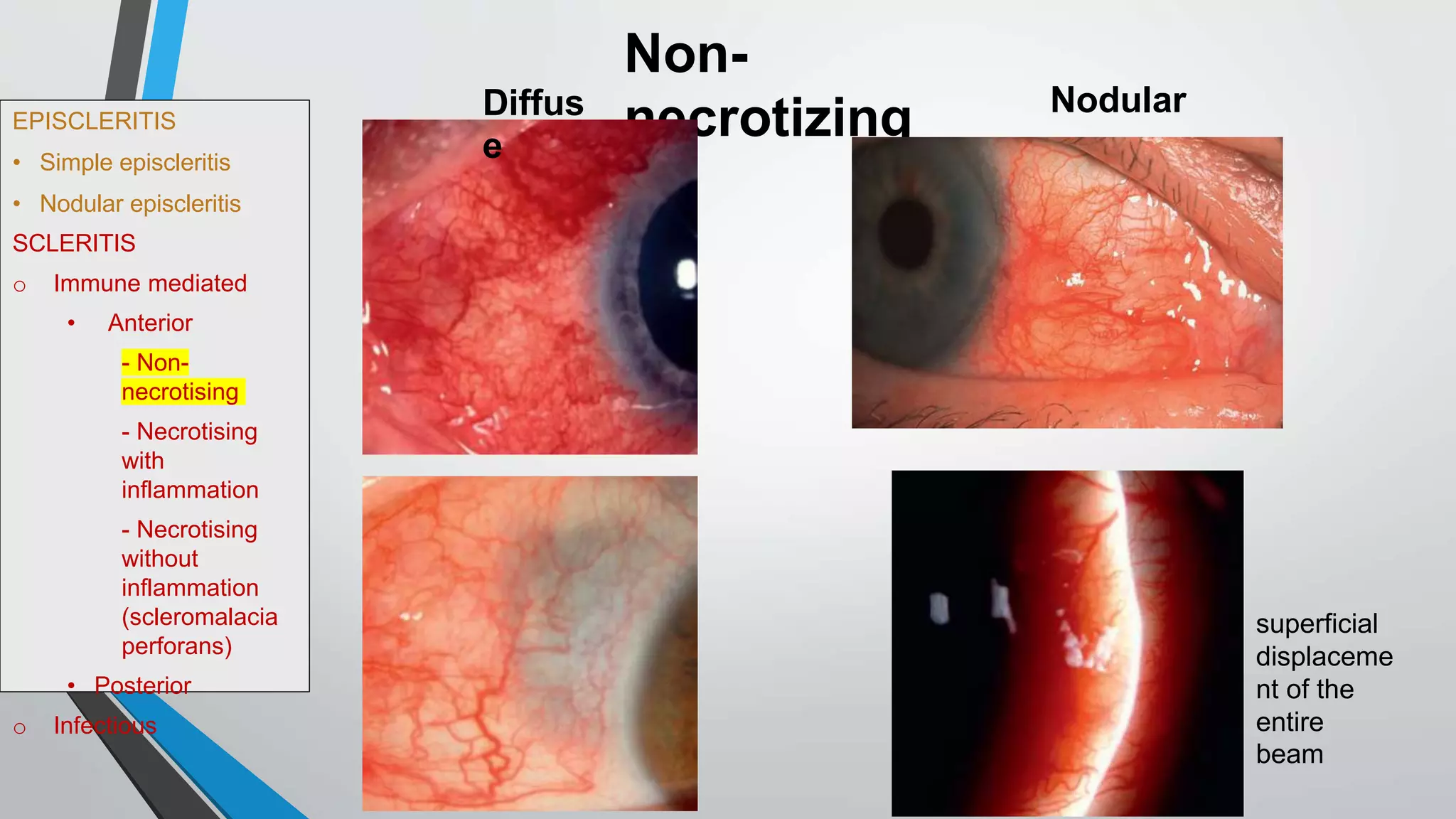
Non-
necrotizing
Diffus
e
Nodular
superficial
displaceme
nt of the
entire
beam
EPISCLERITIS
• Simple episcleritis
• Nodular episcleritis
SCLERITIS
o Immune mediated
• Anterior
- Non-
necrotising
- Necrotising
with
inflammation
- Necrotising
without
inflammation
(scleromalacia
perforans)
• Posterior
o Infectious
Non-
necrotizing
EPISCLERITIS
• Simple episcleritis
• Nodular episcleritis
SCLERITIS
o Immune mediated
• Anterior
- Non-
necrotising
- Necrotising
with
inflammation
- Necrotising
without
inflammation
(scleromalacia
perforans)
• Posterior
o Infectious
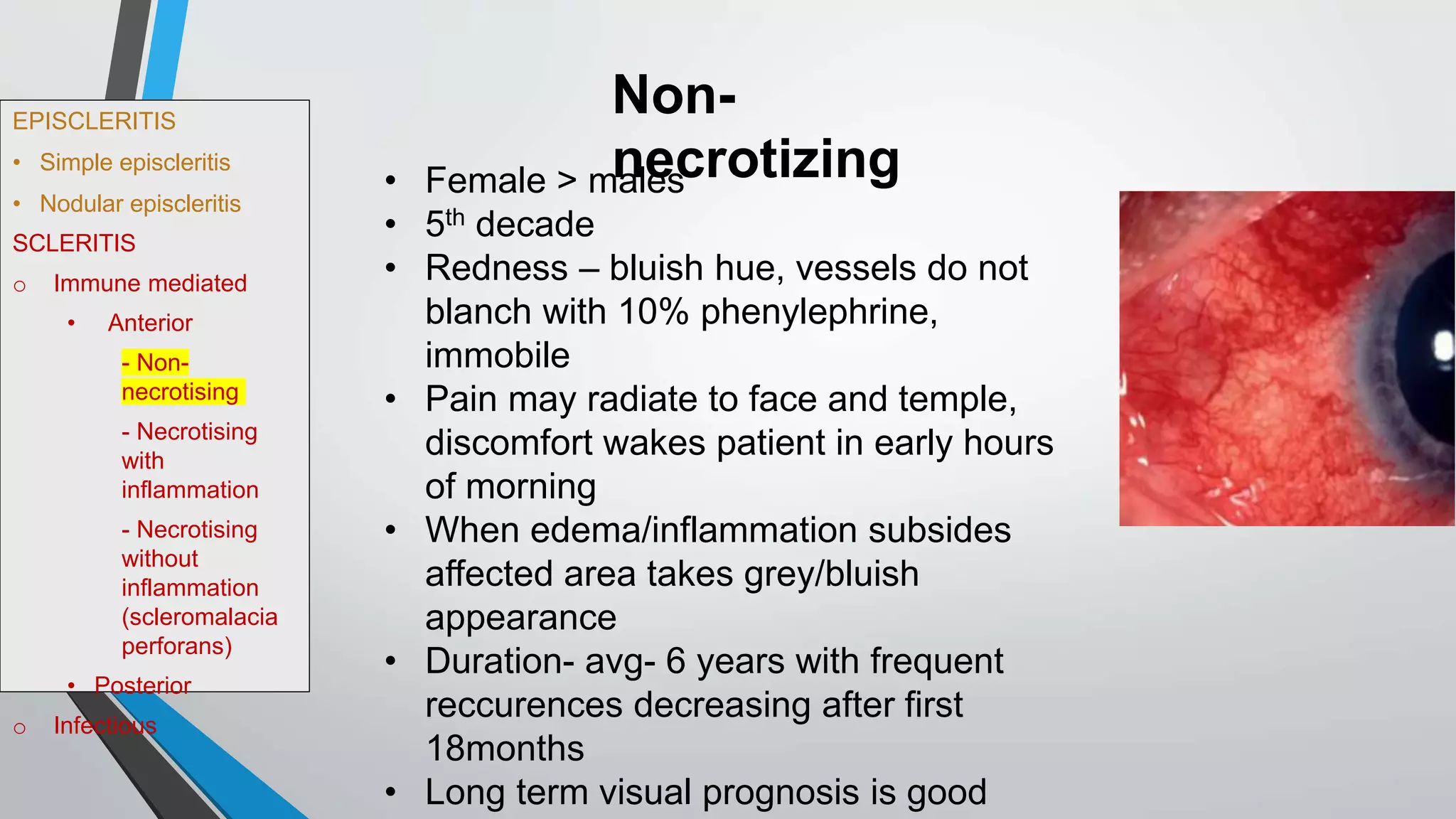
• Female > males
• 5th decade
• Redness – bluish hue, vessels do not
blanch with 10% phenylephrine,
immobile
• Pain may radiate to face and temple,
discomfort wakes patient in early hours
of morning
• When edema/inflammation subsides
affected area takes grey/bluish
appearance
• Duration- avg- 6 years with frequent
reccurences decreasing after first
18months
• Long term visual prognosis is good
Necrotizing scleritis
EPISCLERITIS
• Simple episcleritis
• Nodular episcleritis
SCLERITIS
o Immune mediated
• Anterior
- Non-
necrotising
- Necrotising
with
inflammation
- Necrotising
without
inflammation
(scleromalacia
perforans)
• Posterior
o Infectious
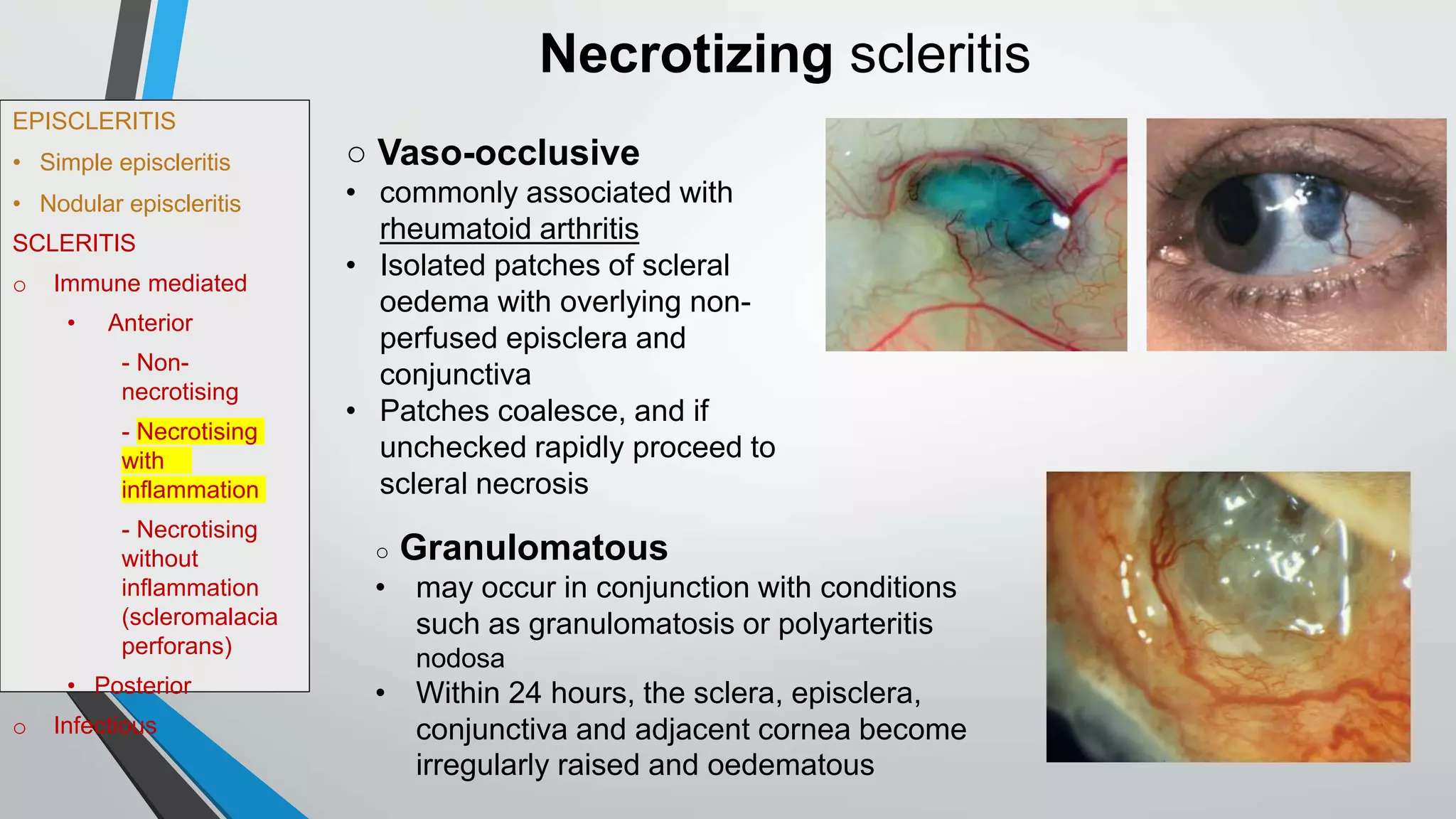
○ Vaso-occlusive
• commonly associated with
rheumatoid arthritis
• Isolated patches of scleral
oedema with overlying non-
perfused episclera and
conjunctiva
• Patches coalesce, and if
unchecked rapidly proceed to
scleral necrosis
○ Granulomatous
• may occur in conjunction with conditions
such as granulomatosis or polyarteritis
nodosa
• Within 24 hours, the sclera, episclera,
conjunctiva and adjacent cornea become
irregularly raised and oedematous
○ Surgically induced scleritis
• typically starts within 3 weeks of a procedure- strabismus
repair, trabeculectomy and scleral buckling, and excision
of pterygium with adjunctive mitomycin C.
• The necrotizing process starts at the site of surgery and
extends outwards, but tends to remain localized to one
sector.
EPISCLERITIS
• Simple episcleritis
• Nodular episcleritis
SCLERITIS
o Immune mediated
• Anterior
- Non-
necrotising
- Necrotising
with
inflammation
- Necrotising
without
inflammation
(scleromalacia
perforans)
• Posterior
o Infectious
EPISCLERITIS
• Simple episcleritis
• Nodular episcleritis
SCLERITIS
o Immune mediated
• Anterior
- Non-
necrotising
- Necrotising
with
inflammation
- Necrotising
without
inflammation
(scleromalacia
perforans)
• Posterior
o Infectious
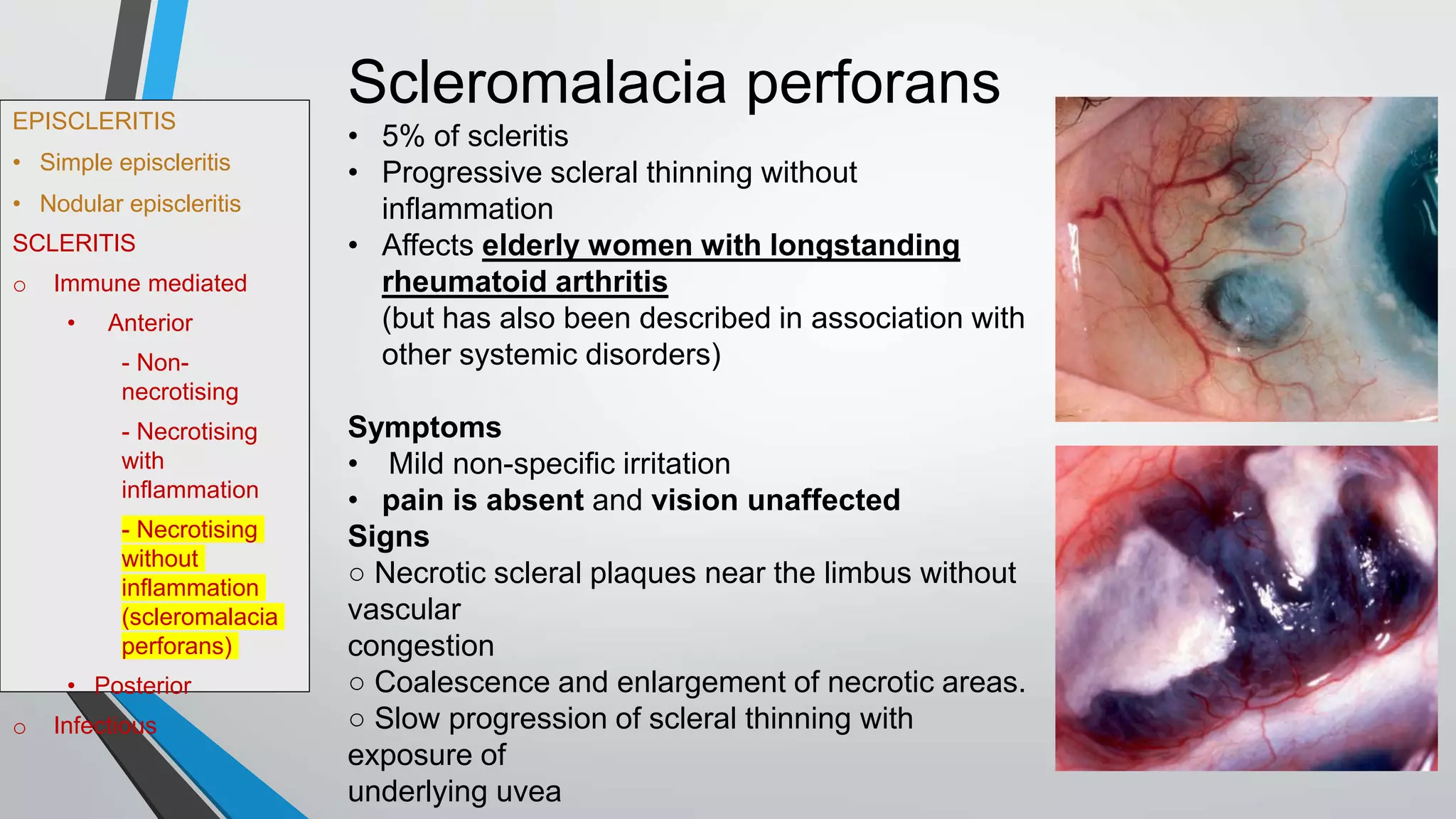
Scleromalacia perforans
• 5% of scleritis
• Progressive scleral thinning without
inflammation
• Affects elderly women with longstanding
rheumatoid arthritis
(but has also been described in association with
other systemic disorders)
Symptoms
• Mild non-specific irritation
• pain is absent and vision unaffected
Signs
○ Necrotic scleral plaques near the limbus without
vascular
congestion
○ Coalescence and enlargement of necrotic areas.
○ Slow progression of scleral thinning with
exposure of
underlying uvea
Posterior scleritis
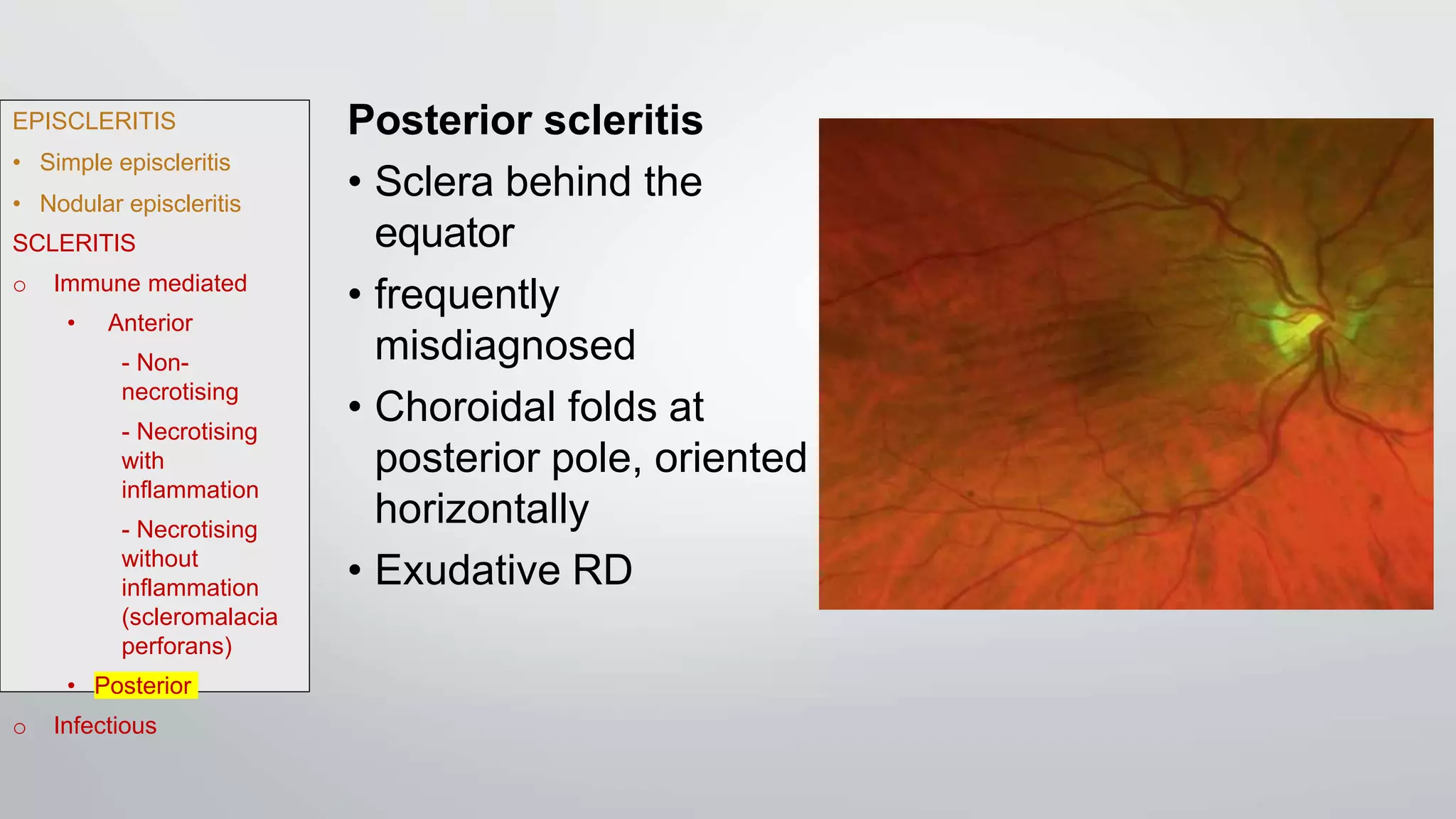
• Sclera behind the
equator
• frequently
misdiagnosed
• Choroidal folds at
posterior pole, oriented
horizontally
• Exudative RD
EPISCLERITIS
• Simple episcleritis
• Nodular episcleritis
SCLERITIS
o Immune mediated
• Anterior
- Non-
necrotising
- Necrotising
with
inflammation
- Necrotising
without
inflammation
(scleromalacia
perforans)
• Posterior
o Infectious
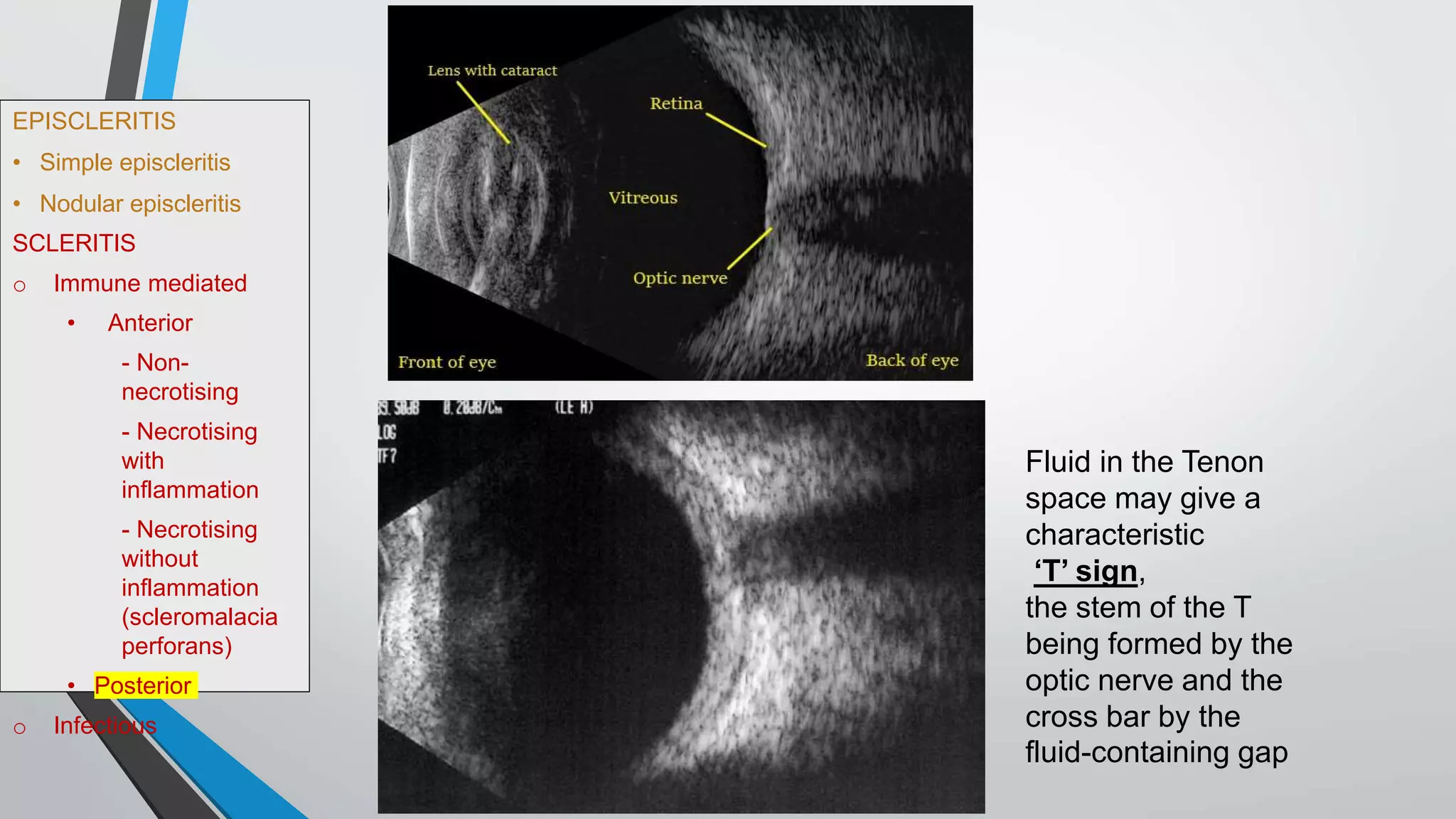
Fluid in the Tenon
space may give a
characteristic
‘T’ sign,
the stem of the T
being formed by the
optic nerve and the
cross bar by the
fluid-containing gap
EPISCLERITIS
• Simple episcleritis
• Nodular episcleritis
SCLERITIS
o Immune mediated
• Anterior
- Non-
necrotising
- Necrotising
with
inflammation
- Necrotising
without
inflammation
(scleromalacia
perforans)
• Posterior
o Infectious
EPISCLERITIS
• Simple episcleritis
• Nodular episcleritis
SCLERITIS
o Immune mediated
• Anterior
- Non-
necrotising
- Necrotising
with
inflammation
- Necrotising
without
inflammation
(scleromalacia
perforans)
• Posterior
o Infectious
Investigations
• Laboratory: ESR, CRP, ANA, C-ANCA, P-ANCA, CCP,
syphilis serology, Lyme serology, hepatitis B surface
antigen and antiphospholipidantibodies.
• Investigation for tuberculosis, sarcoidosis or ankylosing
spondylitis
• Radiological imaging: Chest, sinus, joint and other
imaging
may be indicated in the investigation of a range of
conditions such as tuberculosis, sarcoidosis, Churg–Strauss
syndrome, Wegener granulomatosis, ankylosing spondylitis
and other condition
EPISCLERITIS
• Simple episcleritis
• Nodular episcleritis
SCLERITIS
o Immune mediated
• Anterior
- Non-
necrotising
- Necrotising
with
inflammation
- Necrotising
without
inflammation
(scleromalacia
perforans)
• Posterior
o Infectious
• Topical steroids - do not affect the natural history of the scleral
inflammation, but may relieve symptoms and oedema in non-necrotizing
disease
• Systemic NSAIDs should be used alone only in non-necrotizing disease
• Periocular steroid injections may be used in non-necrotizing disease
but their effects are usually transient; [contraindicated in necrotizing
scleritis]
• Systemic steroids (e.g. prednisolone is 1–1.5 mg/kg/day) are used
when NSAIDs are inappropriate or inadequate (necrotizing disease).
Intravenous methylprednisolone may be used for emergent cases.
• Immunosuppressives and/or biological blockers - if control is
incomplete with steroids alone, as a steroid-sparing measure
cyclophosphamide, azathioprine, methotrexate, ciclosporin, tacrolimus and
others;
Treatment of immune-mediated scleritis
EPISCLERITIS
• Simple episcleritis
• Nodular episcleritis
SCLERITIS
o Immune mediated
• Anterior
- Non-
necrotising
- Necrotising
with
inflammation
- Necrotising
without
inflammation
(scleromalacia
perforans)
• Posterior
o Infectious
• Rare
• But may present diagnostic difficulty as the initial clinical features are similar
to those of immune-mediated disease
Causes
• Herpes zoster is the most common infective cause.
• Tuberculous scleritis is rare and difficult to diagnose.
• Leprosy.
• Syphilis.
• Lyme disease.
• Other causes include fungi (Fig. 8.14D), Pseudomonasaeruginosa and Nocardia.
Treatment
• Once the infective agent has been identified, specific antimicrobial therapy
initiated
• Topical and systemic steroids may also be used to reduce the inflammatory
reaction
• If appropriate, surgical debridement - to debulk a focus of infection and
facilitates the penetration of antibiotics
Infectious
scleritis
Thank you

Diseases of sclera

  • 1.
  • 2.
  • 3.
    Anatomyofsclera It forms theposterior opaque 5/6th part of the external fibrous coat of the eyeball Eye has three coats: Outer – Fibrous Middle – Vascular Inner - Nervous
  • 4.
    • Outer surface- covered by Tenon's capsule • Anterior part - covered by bulbar conjunctiva
  • 5.
    Its inner surface liesin contact with choroid with a potential suprachoroidal space in between
  • 6.
    • In itsanterior most part near limbus there is furrow which encloses the Schlemm’s canal
  • 7.
    Thicknessofsclera • Thinner -children and in females • Thickest - posteriorly (1mm), gradually becomes thin when traced anteriorly • Thinnest - insertion of extraocular muscles (0.3 mm)
  • 8.
    Aperturesofsclera • Anterior - Anteriorciliary vessels, nerves and lymphatics • Middle four vortex veins • Posterior - Short ciliary vessels and nerves - Long ciliary arteries - Optic nerve
  • 9.
    • Anterior - Anteriorciliary vessels, nerves and lymphatics
  • 10.
    • Middle four vortex veins •Posterior - Short ciliary vessels and nerves - Long ciliary arteries - Optic nerve
  • 12.
    Layersofsclera Sclera Episcler a Sclera proper Lamina fusca Thin, dense vascularizedlayer of connective tissue  fibroblasts, macrophages and lymphocytes Avascular structure dense bundles of collagen fibres Innermost blends with suprachoroidal and supraciliary laminae of the uveal tract. brownish in colour  presence of pigmented cells
  • 14.
    Staphylomas • Localised bulgingof weak and thin outer tunic of the eyeball (cornea or sclera) • Lined by uveal tissue which shines through the thinned out fibrous coat. {‘Staphylo-’ bunch of grapes}
  • 15.
    Classification • posterior • Anterior •Intercalary • Ciliary • Equatorial
  • 16.
    Anteriorstaphyloma • Ass. Withectasia of cornea & iris • Due to perforating corneal ulcer & injury
  • 17.
    Intercalarystaphyloma healing of aperforating injury or a peripheral corneal ulcer to ectasia of weak scar tissue formed at the limbus localised bulge in limbal area lined by root of iris {‘Intercalary’ - Occurring between differentiated tissues}
  • 18.
    Ciliarystaphyloma • Bulge ofweak sclera lined by ciliary body • About 2-3 mm away from the limbus • Thinning of sclera following perforating injury, scleritis and absolute glaucoma
  • 19.
    Equatorialstaphyloma • Bulge ofsclera lined by the choroid in the equatorial region at the regions of sclera which are perforated by vortex veins. • Causes - Scleritis and degeneration of sclera in pathological myopia {‘Equator - 14mm behind limbus}
  • 21.
    Posteriorstaphyloma • Bulge ofweak sclera lined by the choroid behind the equator • Common causes are pathological myopia, posterior scleritis and perforating injuries.
  • 22.
    Diagnosis Ophthalmoscopy • Thearea is excavated with retinal vessels dipping in it
  • 24.
  • 25.
    Bluesclera Marked, generalised bluediscolouration of sclera due to thinning
  • 26.
    CausesofBluesclera • Mnemonic- {H O P E S are too big }  H - High myopia, Hurlers and Healed scleritis  O - Osteogenesis imperfecta - Oculodermal melanosis  P - Pseudoxanthoma elasticum  E - Ehlers-Danlos syndrome  S – Scleritis, Staphyloma, Scleromalacia perforans  Are - Marfan's syndrome  Too – Turner’s
  • 27.
    Inflammations of sclera •Episcleritis(superficial) •Scleritis (deep)
  • 28.
    Anterior scleritis (98%)Posterior scleritis (2%) Necrotizing scleritis with inflammation Non-necrotizing scleritis (85%) (a) Diffuse (b) Nodular Inflammationsofsclera EPISCLERITIS (SUPERFICIAL) SCLERITIS (DEEP) • Simple episcleritis • Nodular episcleritis Immune mediated Infectiou s Necrotizing scleritis without inflammation (Scleromalacia perforans)
  • 29.
    Episcleritis • Benign, recurrentinflammation of the episclera, involving the overlying Tenon's capsule but not the underlying sclera • Common • Usually idiopathic • Females > males • Middle age EPISCLERITIS • Simple episcleritis • Nodular episcleritis SCLERITIS o Immune mediated • Anterior - Non- necrotising - Necrotising with inflammation - Necrotising without inflammation (scleromalacia perforans) • Posterior o Infectious
  • 30.
    Simple episcleritis • Accountsfor 75% of cases • Tendency to recur (60%) • Features often peak within 24 hours, gradually fading over the next few days EPISCLERITIS • Simple episcleritis • Nodular episcleritis SCLERITIS o Immune mediated • Anterior - Non- necrotising - Necrotising with inflammation - Necrotising without inflammation (scleromalacia perforans) • Posterior o Infectious
  • 31.
    EPISCLERITIS • Simple episcleritis •Nodular episcleritis SCLERITIS o Immune mediated • Anterior - Non- necrotising - Necrotising with inflammation - Necrotising without inflammation (scleromalacia perforans) • Posterior o Infectious Nodular episcleritis • Less acute onset and a more prolonged course • Red eye typically first noted on waking, over next 2-3 days area of redness enlarges and becomes more uncomfortable • Tender red vascular nodule (Interpalpebral area) • Underlying flat anterior scleral surface deep beam is not displaced above the scleral surface
  • 32.
    EPISCLERITIS • Simple episcleritis •Nodular episcleritis SCLERITIS o Immune mediated • Anterior - Non- necrotising - Necrotising with inflammation - Necrotising without inflammation (scleromalacia perforans) • Posterior o Infectious Treatment • If mild – No treatment, cold compress or refrigerated artificial tears • Weak topical corticosteroid eyedrops, four times a day 1-2 weeks • Topical NSAID is an alternative, though maybe less effective • Oral NSAID is occasionally
  • 33.
    EPISCLERITIS • Simple episcleritis •Nodular episcleritis SCLERITIS o Immune mediated • Anterior - Non- necrotising - Necrotising with inflammation - Necrotising without inflammation (scleromalacia perforans) • Posterior o Infectious SCLERITI S • Oedema and cellular infiltration of the entire thickness of sclera
  • 34.
    EPISCLERITIS • Simple episcleritis •Nodular episcleritis SCLERITIS o Immune mediated • Anterior - Non- necrotising - Necrotising with inflammation - Necrotising without inflammation (scleromalacia perforans) • Posterior o Infectious Immune mediated scleritis • Most common type • Much less common than episcleritis • Spectrum – from trivial and self limiting disease to a necrotizing process that can involve adjacent tissue and threaten vision
  • 35.
    Non- necrotizing Diffus e Nodular superficial displaceme nt of the entire beam EPISCLERITIS •Simple episcleritis • Nodular episcleritis SCLERITIS o Immune mediated • Anterior - Non- necrotising - Necrotising with inflammation - Necrotising without inflammation (scleromalacia perforans) • Posterior o Infectious
  • 36.
    Non- necrotizing EPISCLERITIS • Simple episcleritis •Nodular episcleritis SCLERITIS o Immune mediated • Anterior - Non- necrotising - Necrotising with inflammation - Necrotising without inflammation (scleromalacia perforans) • Posterior o Infectious • Female > males • 5th decade • Redness – bluish hue, vessels do not blanch with 10% phenylephrine, immobile • Pain may radiate to face and temple, discomfort wakes patient in early hours of morning • When edema/inflammation subsides affected area takes grey/bluish appearance • Duration- avg- 6 years with frequent reccurences decreasing after first 18months • Long term visual prognosis is good
  • 37.
    Necrotizing scleritis EPISCLERITIS • Simpleepiscleritis • Nodular episcleritis SCLERITIS o Immune mediated • Anterior - Non- necrotising - Necrotising with inflammation - Necrotising without inflammation (scleromalacia perforans) • Posterior o Infectious ○ Vaso-occlusive • commonly associated with rheumatoid arthritis • Isolated patches of scleral oedema with overlying non- perfused episclera and conjunctiva • Patches coalesce, and if unchecked rapidly proceed to scleral necrosis ○ Granulomatous • may occur in conjunction with conditions such as granulomatosis or polyarteritis nodosa • Within 24 hours, the sclera, episclera, conjunctiva and adjacent cornea become irregularly raised and oedematous
  • 38.
    ○ Surgically inducedscleritis • typically starts within 3 weeks of a procedure- strabismus repair, trabeculectomy and scleral buckling, and excision of pterygium with adjunctive mitomycin C. • The necrotizing process starts at the site of surgery and extends outwards, but tends to remain localized to one sector. EPISCLERITIS • Simple episcleritis • Nodular episcleritis SCLERITIS o Immune mediated • Anterior - Non- necrotising - Necrotising with inflammation - Necrotising without inflammation (scleromalacia perforans) • Posterior o Infectious
  • 39.
    EPISCLERITIS • Simple episcleritis •Nodular episcleritis SCLERITIS o Immune mediated • Anterior - Non- necrotising - Necrotising with inflammation - Necrotising without inflammation (scleromalacia perforans) • Posterior o Infectious Scleromalacia perforans • 5% of scleritis • Progressive scleral thinning without inflammation • Affects elderly women with longstanding rheumatoid arthritis (but has also been described in association with other systemic disorders) Symptoms • Mild non-specific irritation • pain is absent and vision unaffected Signs ○ Necrotic scleral plaques near the limbus without vascular congestion ○ Coalescence and enlargement of necrotic areas. ○ Slow progression of scleral thinning with exposure of underlying uvea
  • 40.
    Posterior scleritis • Sclerabehind the equator • frequently misdiagnosed • Choroidal folds at posterior pole, oriented horizontally • Exudative RD EPISCLERITIS • Simple episcleritis • Nodular episcleritis SCLERITIS o Immune mediated • Anterior - Non- necrotising - Necrotising with inflammation - Necrotising without inflammation (scleromalacia perforans) • Posterior o Infectious
  • 41.
    Fluid in theTenon space may give a characteristic ‘T’ sign, the stem of the T being formed by the optic nerve and the cross bar by the fluid-containing gap EPISCLERITIS • Simple episcleritis • Nodular episcleritis SCLERITIS o Immune mediated • Anterior - Non- necrotising - Necrotising with inflammation - Necrotising without inflammation (scleromalacia perforans) • Posterior o Infectious
  • 42.
    EPISCLERITIS • Simple episcleritis •Nodular episcleritis SCLERITIS o Immune mediated • Anterior - Non- necrotising - Necrotising with inflammation - Necrotising without inflammation (scleromalacia perforans) • Posterior o Infectious Investigations • Laboratory: ESR, CRP, ANA, C-ANCA, P-ANCA, CCP, syphilis serology, Lyme serology, hepatitis B surface antigen and antiphospholipidantibodies. • Investigation for tuberculosis, sarcoidosis or ankylosing spondylitis • Radiological imaging: Chest, sinus, joint and other imaging may be indicated in the investigation of a range of conditions such as tuberculosis, sarcoidosis, Churg–Strauss syndrome, Wegener granulomatosis, ankylosing spondylitis and other condition
  • 43.
    EPISCLERITIS • Simple episcleritis •Nodular episcleritis SCLERITIS o Immune mediated • Anterior - Non- necrotising - Necrotising with inflammation - Necrotising without inflammation (scleromalacia perforans) • Posterior o Infectious • Topical steroids - do not affect the natural history of the scleral inflammation, but may relieve symptoms and oedema in non-necrotizing disease • Systemic NSAIDs should be used alone only in non-necrotizing disease • Periocular steroid injections may be used in non-necrotizing disease but their effects are usually transient; [contraindicated in necrotizing scleritis] • Systemic steroids (e.g. prednisolone is 1–1.5 mg/kg/day) are used when NSAIDs are inappropriate or inadequate (necrotizing disease). Intravenous methylprednisolone may be used for emergent cases. • Immunosuppressives and/or biological blockers - if control is incomplete with steroids alone, as a steroid-sparing measure cyclophosphamide, azathioprine, methotrexate, ciclosporin, tacrolimus and others; Treatment of immune-mediated scleritis
  • 44.
    EPISCLERITIS • Simple episcleritis •Nodular episcleritis SCLERITIS o Immune mediated • Anterior - Non- necrotising - Necrotising with inflammation - Necrotising without inflammation (scleromalacia perforans) • Posterior o Infectious • Rare • But may present diagnostic difficulty as the initial clinical features are similar to those of immune-mediated disease Causes • Herpes zoster is the most common infective cause. • Tuberculous scleritis is rare and difficult to diagnose. • Leprosy. • Syphilis. • Lyme disease. • Other causes include fungi (Fig. 8.14D), Pseudomonasaeruginosa and Nocardia. Treatment • Once the infective agent has been identified, specific antimicrobial therapy initiated • Topical and systemic steroids may also be used to reduce the inflammatory reaction • If appropriate, surgical debridement - to debulk a focus of infection and facilitates the penetration of antibiotics Infectious scleritis
  • 46.