The document outlines various methods of teaching biological sciences, emphasizing the criteria for selecting methods based on class level, size, and subject matter. It categorizes teaching approaches into teacher-centered and pupil-centered methods, detailing techniques such as lectures, demonstrations, heuristics, and project-based learning. It highlights the importance of instructional technology and collaborative teaching strategies, advocating for methods that foster independent learning and problem-solving skills.
Introduction to various teaching methods and criteria for selecting them in Biological Science.
Definition and introduction to teaching methods, highlighting their importance in education.
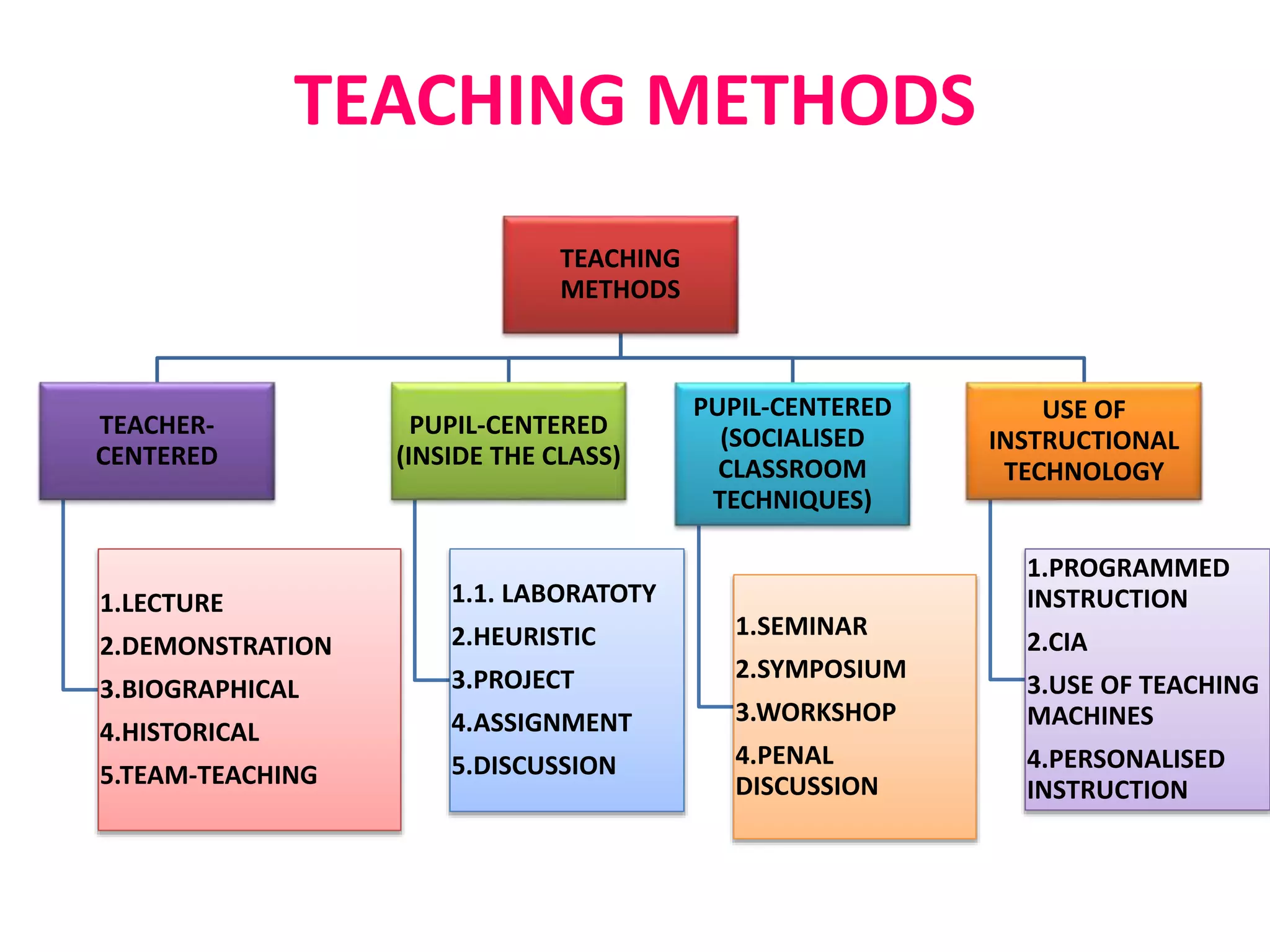
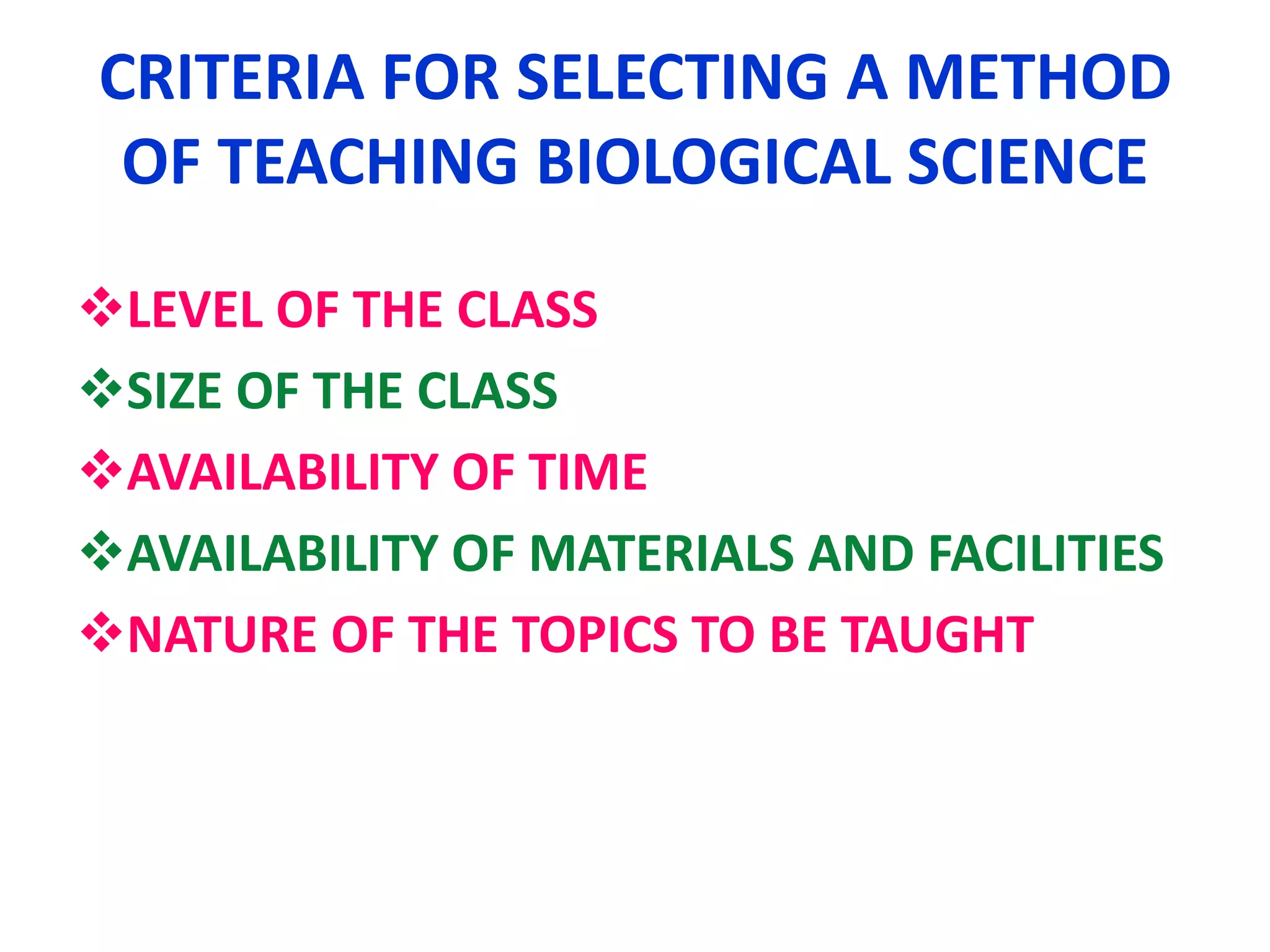
Criteria for selecting teaching methods including class size, availability of time, and nature of topics. Categorization of teaching methods into teacher-centered, pupil-centered, and instructional technology.
Contrasting the roles of teacher-centered and pupil-centered approaches in fostering learning.
Details about the lecture method, its merits, and demerits in the teaching process.
Overview of the lecture cum demonstration method, including its requisites, merits, and limitations.
Explanation of biographical and historical methods in teaching biology and their associated merits.
In-depth analysis of the heuristic method, its principles, strengths, and weaknesses in teaching.
Introduction and characteristics of team teaching, including its advantages and organization.
Definition and steps involved in the scientific method and its significance in problem-solving.
Explaining inductive and deductive methods with examples and discussing their merits and limitations.
Explanation and advantages of the project method in education, along with its demerits and challenges.
Brief overview of the assignment method in teaching, covering home and school assignments.
UNIT V :Methods of Teaching
Biological Science
Criteria for Selecting a Method of Teaching
Biological Science: Levels of the Class-Size of
the Class-Time Availability and Subject Matter-
General Methods of Teaching Biological
Science - Lecture Method - Demonstration
Method - Scientific Method - Project Method -
Heuristic Method - Biographical and
Assignment Method - Programmed Instruction
- Computer Assisted Instruction - Team
Teaching - Teaching Machines - Panel
Discussion - Seminar – Symposium - Work
3.
INTRODUCTION
• ‘Method’ –Latin – ‘Mode’ or
‘Way’
• In education it means the
mode by which the material is
communicated from the
teacher to the pupil.
4.
GOGE defined,
“Teaching methodsare patterns of
teacher behaviour that are
recurrent, applicable to various
subject matters, characteristic of
more than one teacher and
relevant to learning”
5.
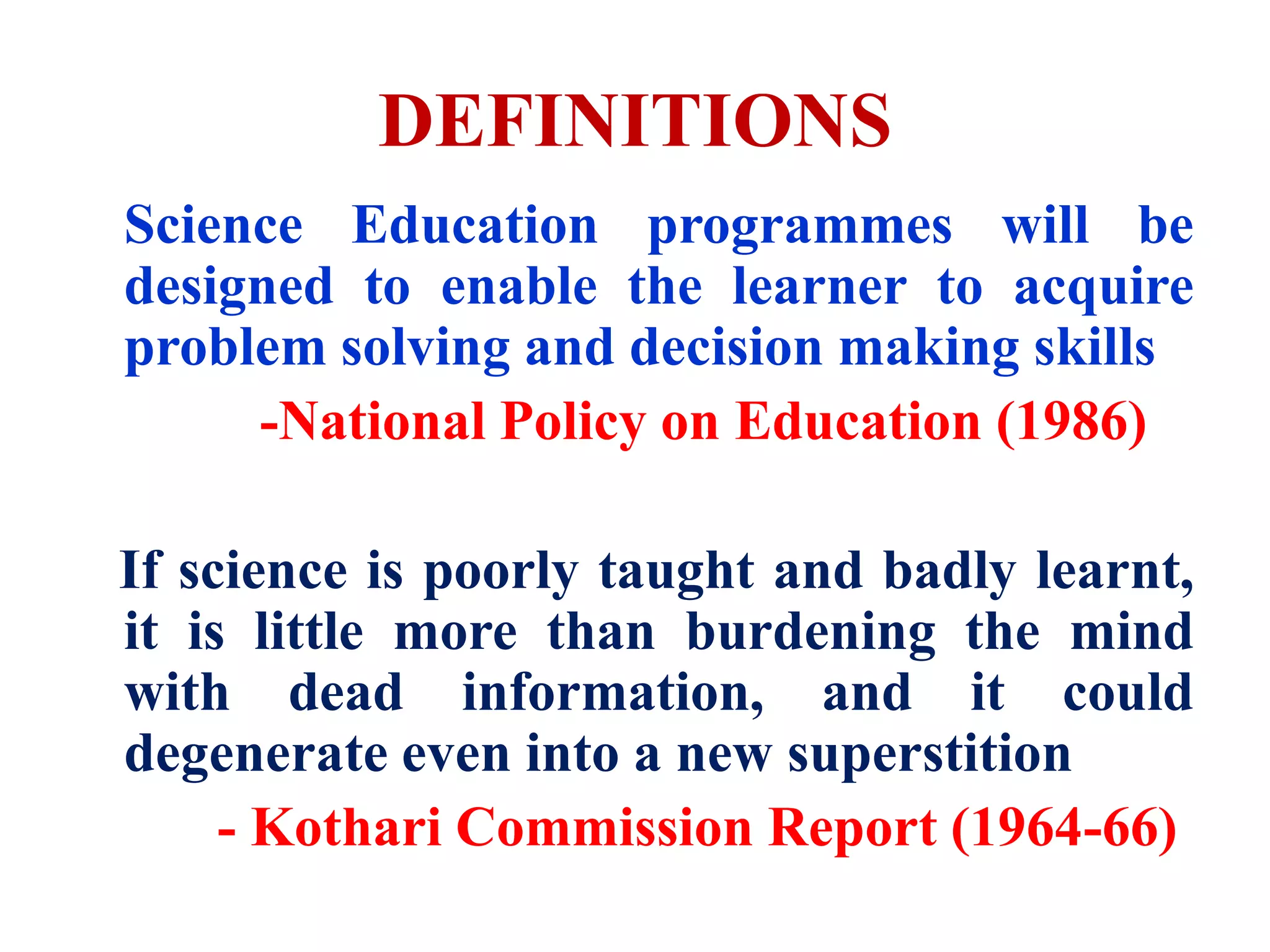
DEFINITIONS
Science Education programmeswill be
designed to enable the learner to acquire
problem solving and decision making skills
-National Policy on Education (1986)
If science is poorly taught and badly learnt,
it is little more than burdening the mind
with dead information, and it could
degenerate even into a new superstition
- Kothari Commission Report (1964-66)
CRITERIA FOR SELECTINGA METHOD
OF TEACHING BIOLOGICAL SCIENCE
LEVEL OF THE CLASS
SIZE OF THE CLASS
AVAILABILITY OF TIME
AVAILABILITY OF MATERIALS AND FACILITIES
NATURE OF THE TOPICS TO BE TAUGHT
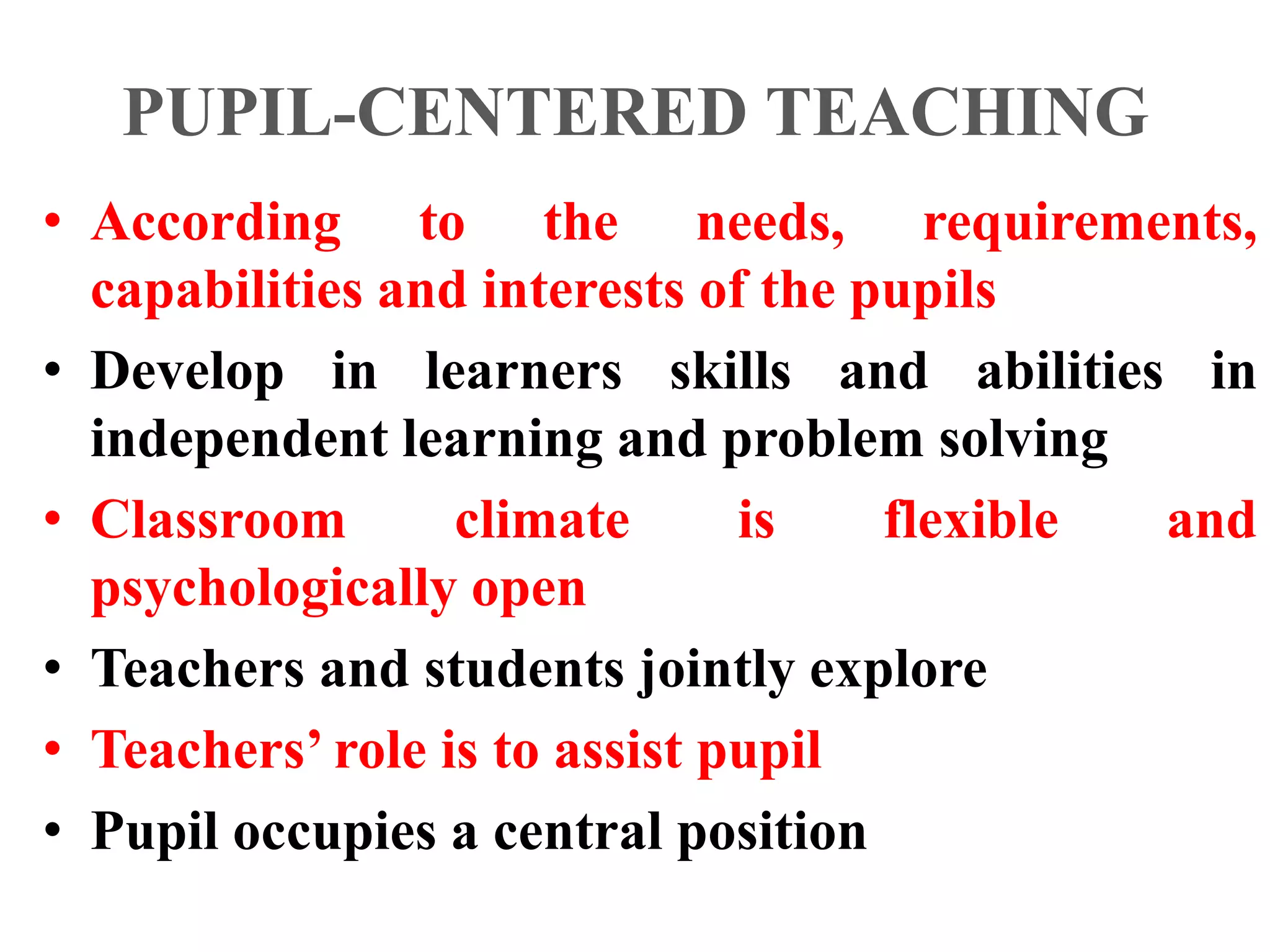
PUPIL-CENTERED TEACHING
• Accordingto the needs, requirements,
capabilities and interests of the pupils
• Develop in learners skills and abilities in
independent learning and problem solving
• Classroom climate is flexible and
psychologically open
• Teachers and students jointly explore
• Teachers’ role is to assist pupil
• Pupil occupies a central position
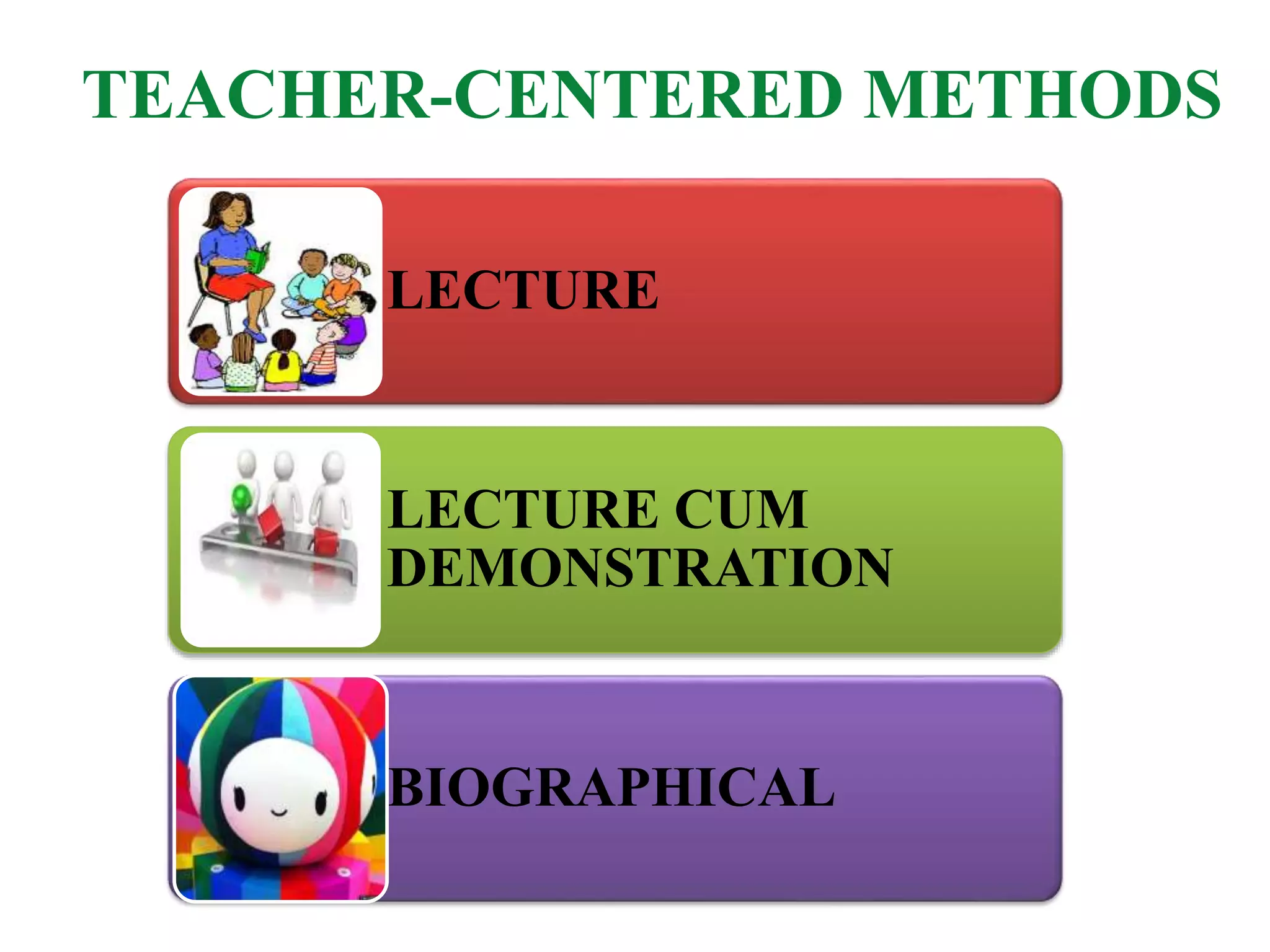
LECTURE METHOD
• Commonlyused method
• In colleges and big classes
• Teacher talks – Students listen passively
• Teacher controlled and information centred
• Own speed
• May make use of black board at times
• Dictate notes
• Does not expect any question or response
from the students
14.
Merits
• Economical
• Knowledgeimparted – quickly
• Syllabus covered – short time
• Quite attractive and easy to follow
• Impart factual information and historical
anecdoctes
• Teacher – own style
• Teacher dominates 70-85%
• Logical sequence of the subject
• Minimises – gaps or overlappings
15.
Demerits
• Students participationis negligible
• Passive recipients
• Never sure – concentrating or understanding
• Knowledge imparted rapidly; weak students
develop a for learning
• No place for learning by doing
• Does not provide for corrective feedback and
remedial help to slow learners
• Undemocratic and authoritarian method
16.
LECTURE CUM
DEMONSTRATION METHOD
•Includes lecture and demonstrate method
• From concrete to abstract
• Superior method of learning
• Combines instructional strategy of
information imparting and showing how
• Teacher performs experiment and explains
what he is doing
• Asks relevant questions
17.
Essential steps
• Planningand Preparation
• Introduction of the lesson
• Presentation
• Performance of Experiments
• Blackboard Summary
• Supervision
18.
Criteria of aGood Demonstration
• Planned and rehearsed
• Clear of the purpose
• Active participation of the
pupils and the teacher
• Apparatus arranged in order
• Visible to all
• Simple and speedy
• Fit in the sequence of experiments
• Impress the students to write what they observe
• Act as showman or actor
• Supplemented with other teaching aids
19.
Requisites for aGood
Demonstration
• Room and table
• Apparatus
• Spare apparatus
• Blackboard
• Well-versed in the handling the apparatus
• Time for recording
• Reflective type question
20.
Merits
• Economical intime and money
• Psychologically based
• Specially for:
-apparatus is costly
-danger
-difficult and complex
-special technique
-quick revision
-several experiments
21.
Demerits
• No scopefor learning by doing
• Not child centred – no individual differences
• Fails to develop laboratory skills
• Fails to impart training in scientific attitude
• Fail to observe many finer details
22.
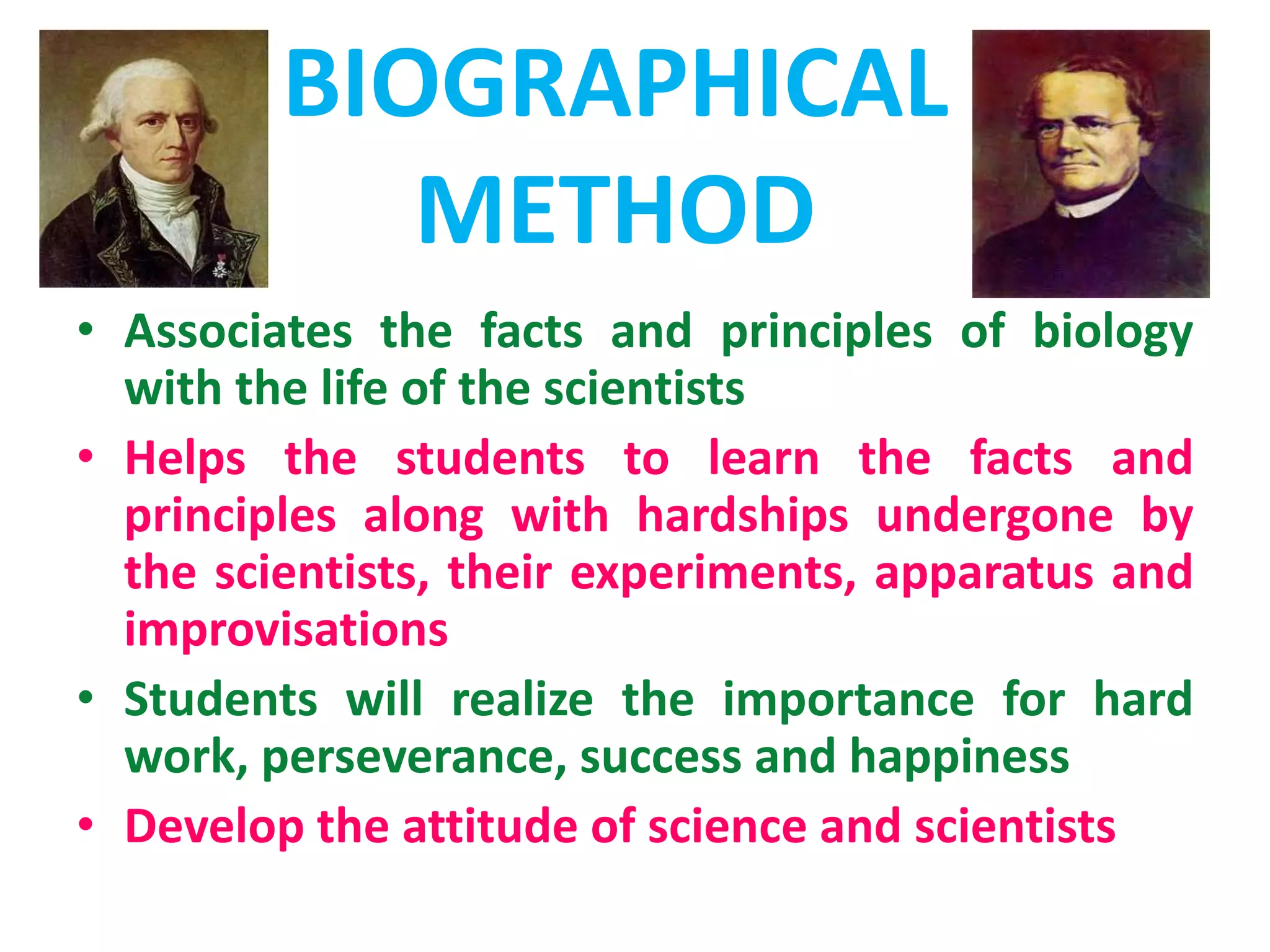
BIOGRAPHICAL
METHOD
• Associates thefacts and principles of biology
with the life of the scientists
• Helps the students to learn the facts and
principles along with hardships undergone by
the scientists, their experiments, apparatus and
improvisations
• Students will realize the importance for hard
work, perseverance, success and happiness
• Develop the attitude of science and scientists
23.
HISTORICAL METHOD
• INVENTION
•DISCOVERY
• ADVENTURES
• LIFE HISTORIES OF SCIENTISTS
• EXAMPLE :
• ARCHIMEDES AND HIS BATH
• PRINCIPLES OF ARCHIMEDES –
“EUREKA, EUREKA”
• NEWTON AND THE APPLE
• NEWTONS – GRAVITATIONAL FORCE
24.
Merits and Demerits
•Arouse interest
• Particularly suited for primary classes
• Cannot be adopted as a method of teaching
• Made wherever it is possible
25.
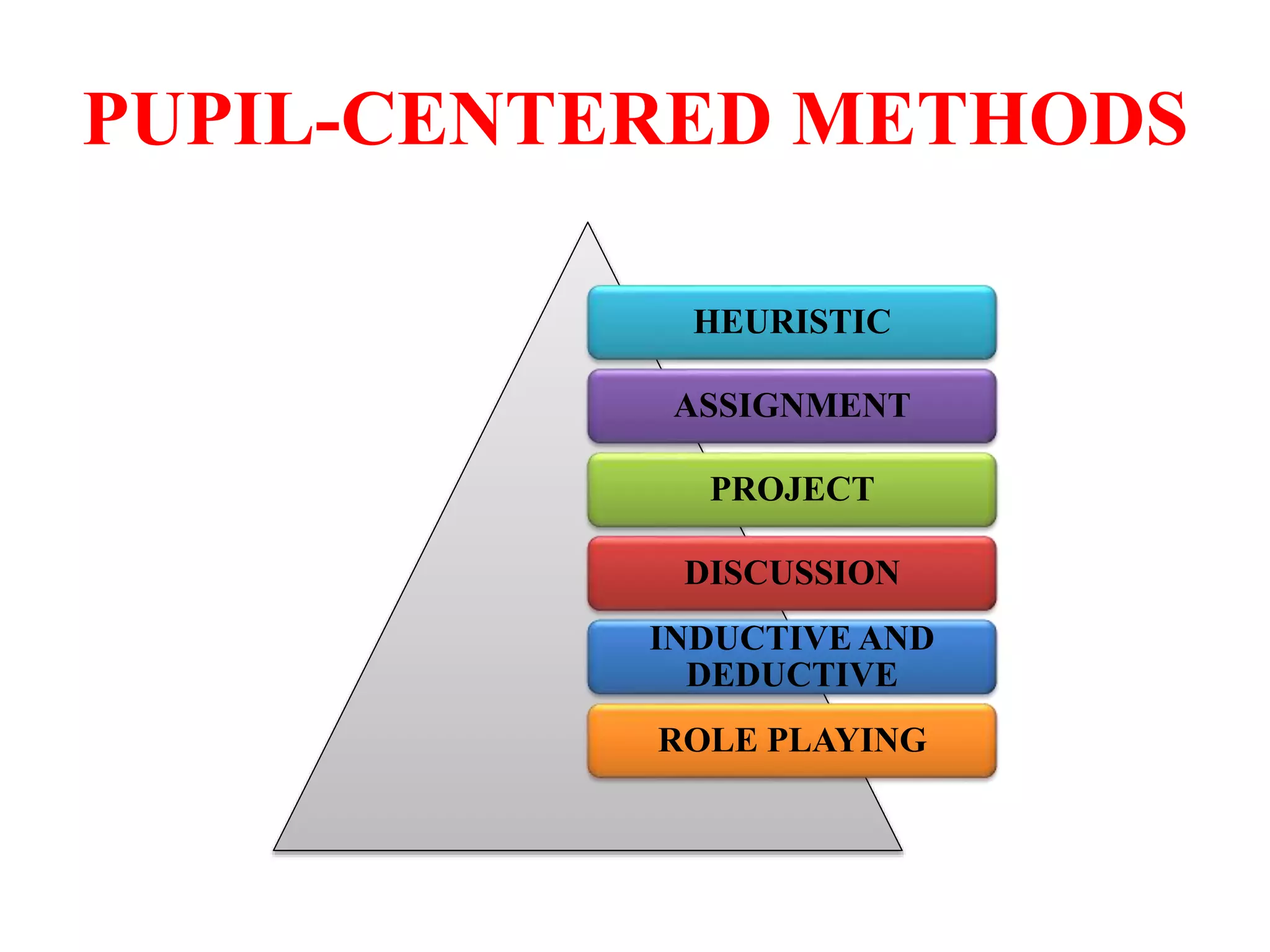
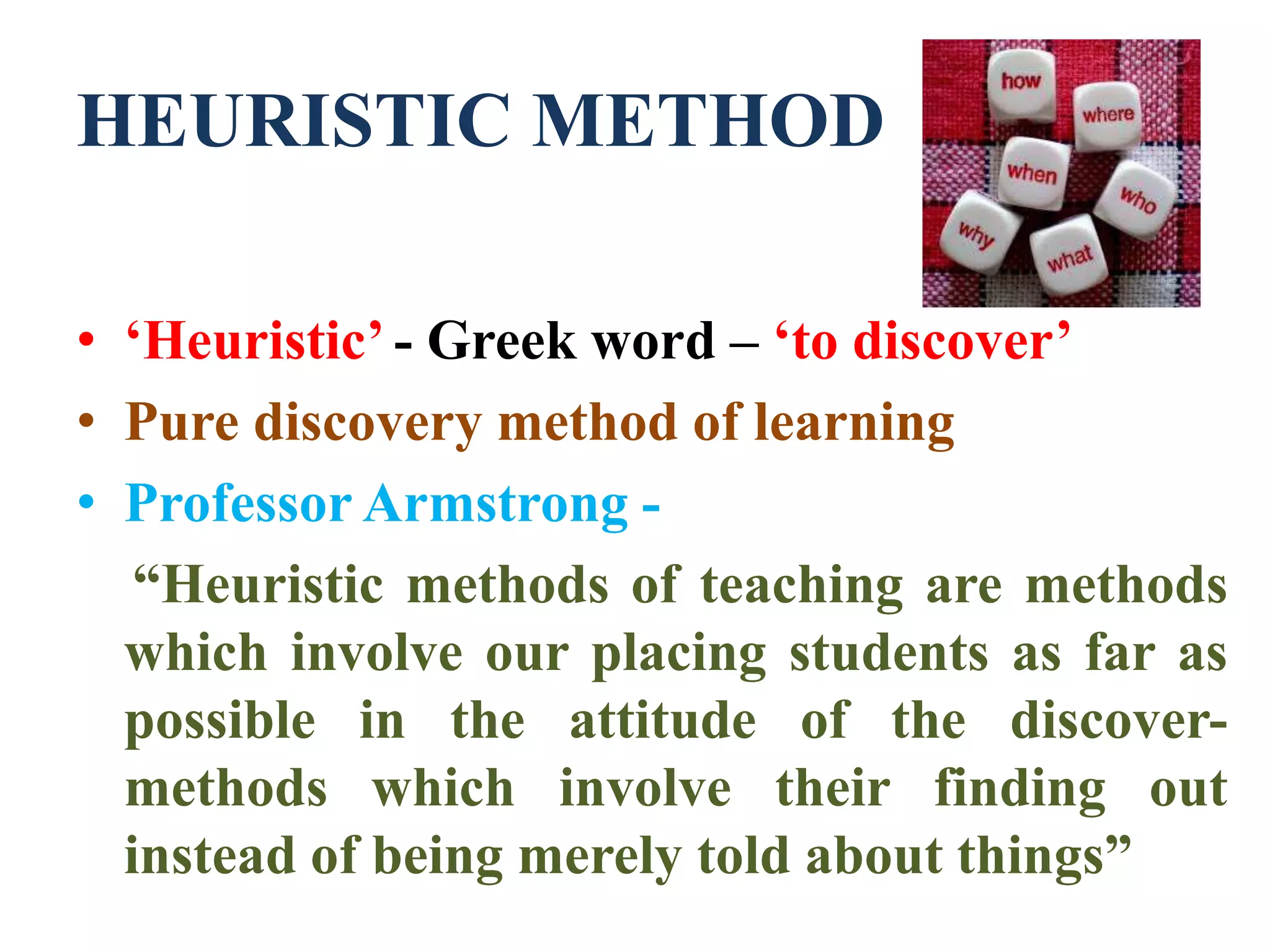
HEURISTIC METHOD
• ‘Heuristic’- Greek word – ‘to discover’
• Pure discovery method of learning
• Professor Armstrong -
“Heuristic methods of teaching are methods
which involve our placing students as far as
possible in the attitude of the discover-
methods which involve their finding out
instead of being merely told about things”
26.
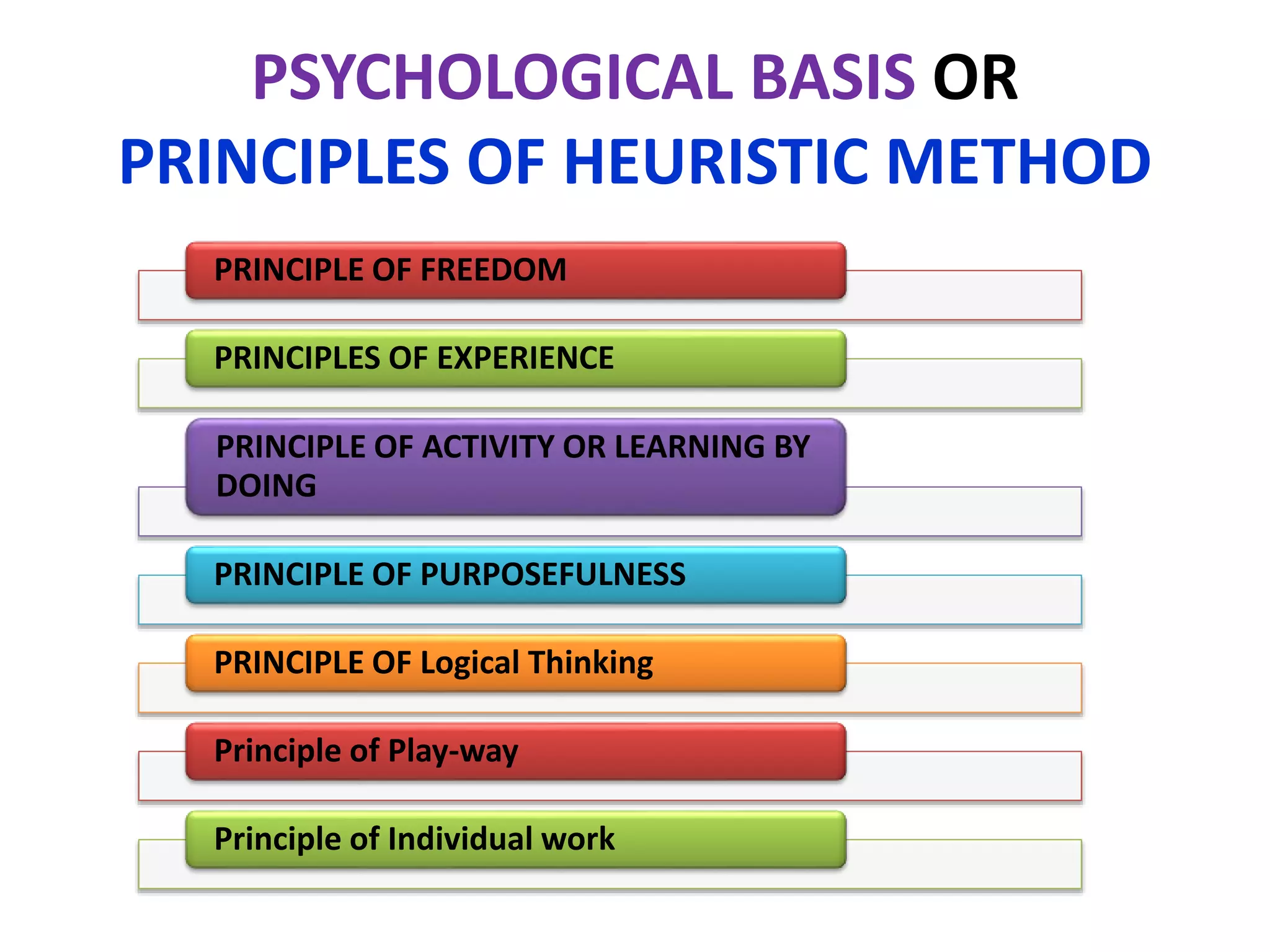
PSYCHOLOGICAL BASIS OR
PRINCIPLESOF HEURISTIC METHOD
PRINCIPLE OF FREEDOM
PRINCIPLES OF EXPERIENCE
PRINCIPLE OF ACTIVITY OR LEARNING BY
DOING
PRINCIPLE OF PURPOSEFULNESS
PRINCIPLE OF Logical Thinking
Principle of Play-way
Principle of Individual work
27.
Role of theteacher
• Knowledge
• Possess curiosity, interest and a spirit of
scientific investigation
• Art of asking questioning
• Guide, a working partner and a friend
• Provide free atmosphere
• Plan according to the age, ability and
interest of the pupils
28.
Procedure
• Students tosolve a number of problems
experimentally
• Required to discover for himself and is to be
told nothing
• Discover facts – experiments, apparatus and
books
• Behaves like a research scholar
29.
• Problem sheet– minimum instructions
• Enter in his notebook – work done, results,
conclusion
• Provide a training in method
• Searching is encouraged
• Creative thinking is respected
• Safe to investigate
• Try out ideas
• Even make mistakes
30.
Merits
• Habit ofenquiry and investigation
• Habit of self learning and self direction
• Develop scientific attitudes
• Psychological maximum – Learning by
doing
• Scope for individual attention
• Develops in the students a habit of diligency
31.
Demerits
• Long andtime consuming method
• Expects great efficiency and hard work,
experience and training
• Not suitable for beginners
• Formational rather than informational
• Too much stress
• Merely for sake of doing
• Evaluation is tedious
• Presently enough teachers are not available
32.
Team Teaching
• Arosein 1957
• Noall –
• “A combination of two or more teachers who
work with variable size groups of students
during an adjustable period which covers two or
more regular section”
• Best-known and commonly used plan is Trump
plan of team teaching
• Professor J. Lloyd Trump, Associate Secretary of
the National Association of Secondary School
Principals
33.
Meaning
• J. LloydTrump
• “An arrangement whereby two or more
teachers with assistants plan, instruct
and evaluate co-operatively two or
more classes in order to take advantage
of their respective special competencies
as teachers”
34.
Definition
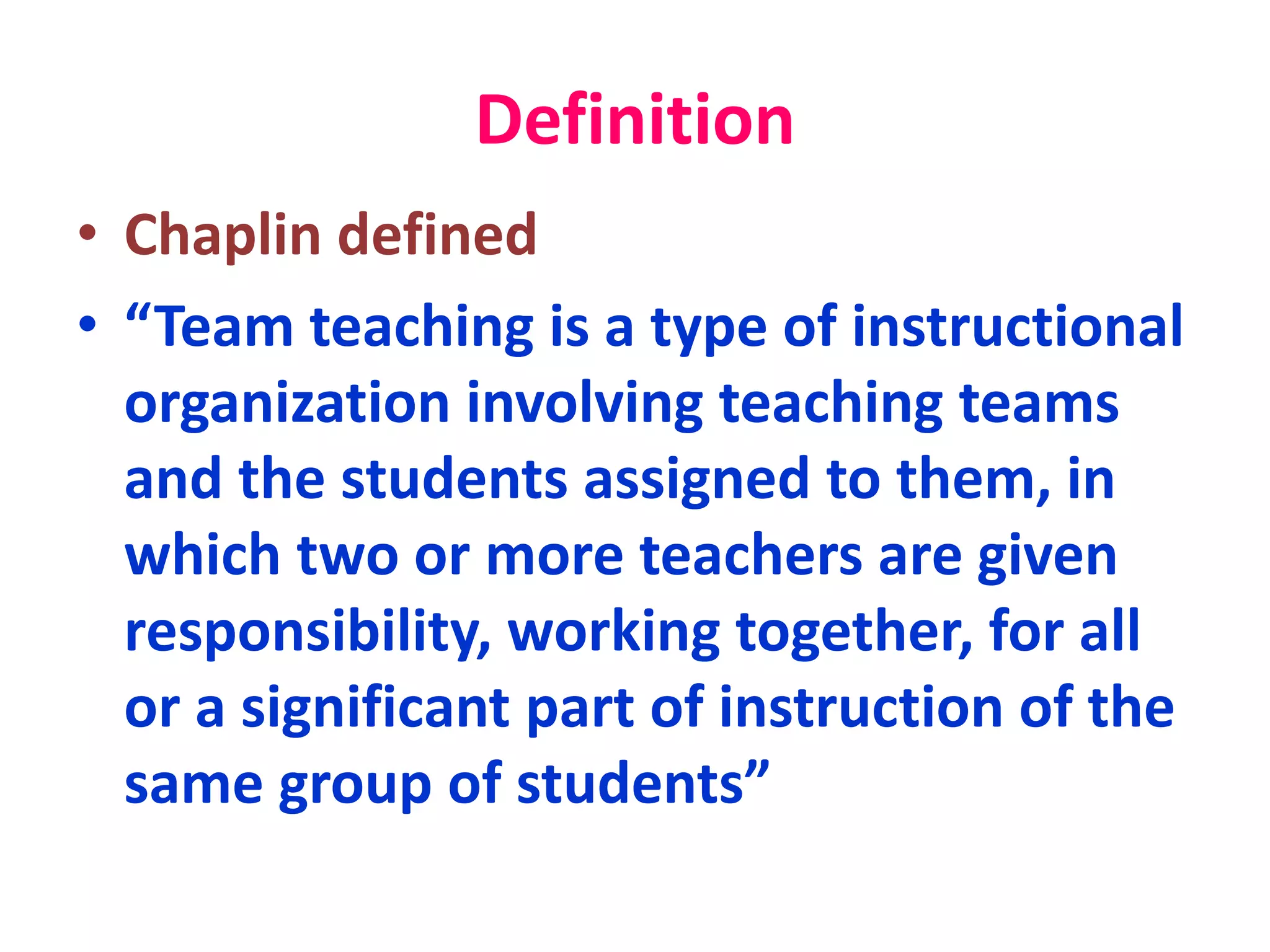
• Chaplin defined
•“Team teaching is a type of instructional
organization involving teaching teams
and the students assigned to them, in
which two or more teachers are given
responsibility, working together, for all
or a significant part of instruction of the
same group of students”
35.
Purpose of TeamTeaching
• Improvement of teaching through a better
utilization of a group of teachers
• Utilizes specialized expertise, interests,
instruction skills, time and energy
• Ensures preparation of lessons, materials and
other aids to create motivation among the
students and better learning situations
• Increases the possibility of variety of
instruction based on pooled talent to the
teachers
36.
Characteristics of TeamTeaching
• Role differentiation of team members
• Regrouping of students
• Rescheduling of time
• Redesign of teaching space
• Common time for planning
• Integration of learning in a meaningful way,
and
• Development of resource centres
37.
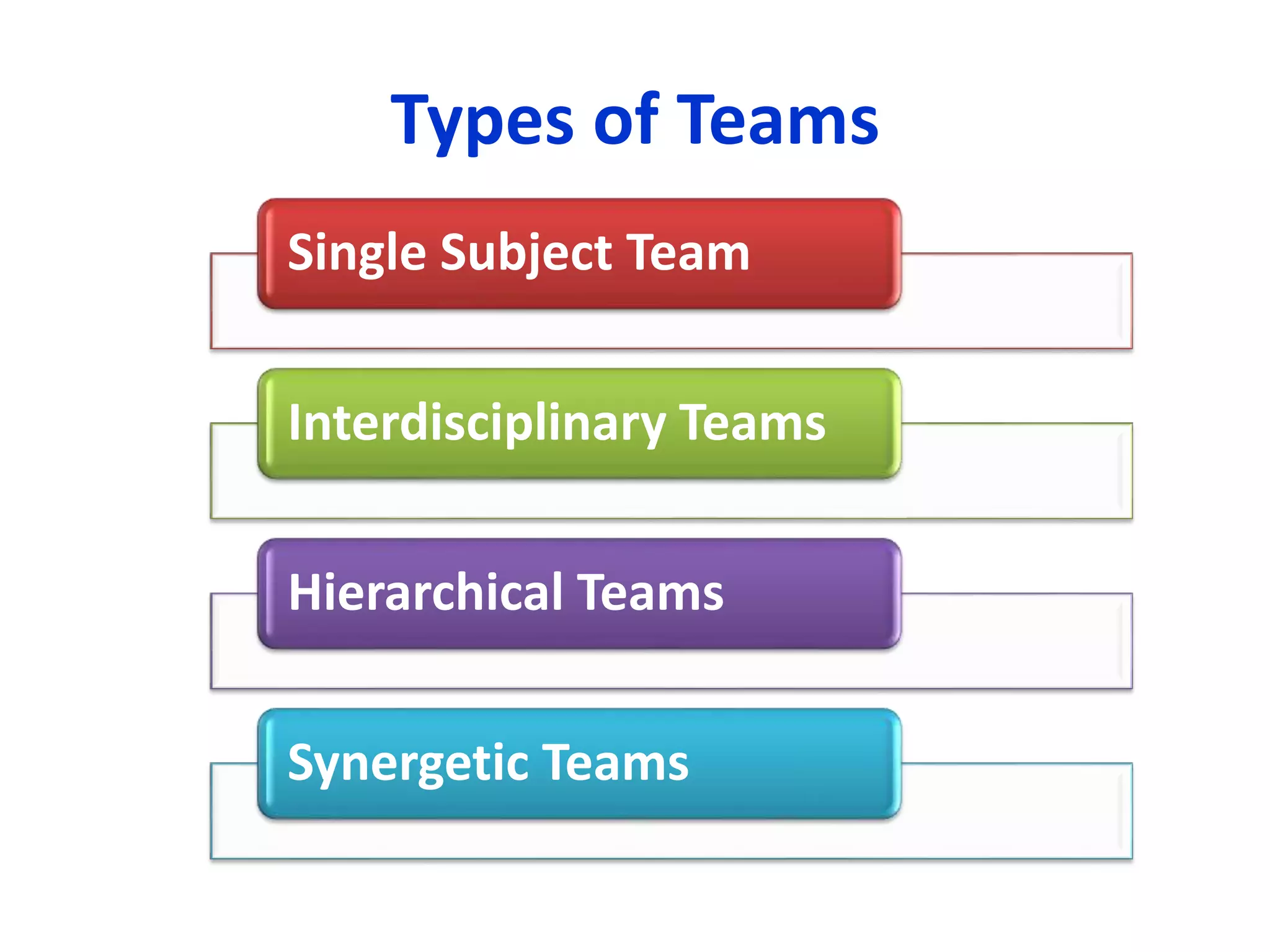
Types of Teams
SingleSubject Team
Interdisciplinary Teams
Hierarchical Teams
Synergetic Teams
SCIENTIFIC METHOD
• Itis a problem solving method
• Involves reflective thinking, reasoning and
results from the achievement of certain
abilities, skills and attitudes
• Any method of solving a problem
systematically and scientifically may be called
scientific method
• Also known as “the method of science” or
“the method of the scientist”
40.
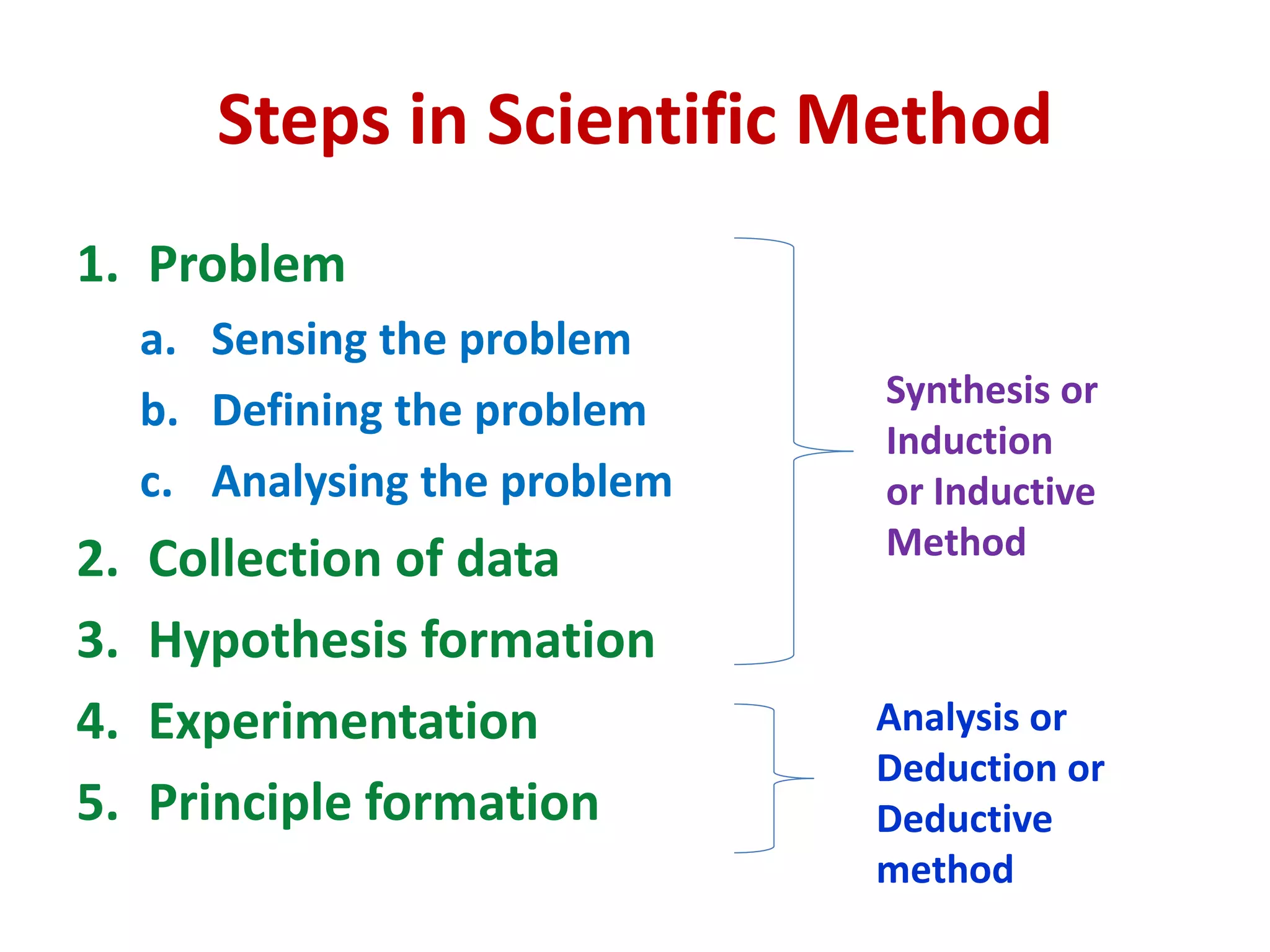
Steps in ScientificMethod
1. Problem
a. Sensing the problem
b. Defining the problem
c. Analysing the problem
2. Collection of data
3. Hypothesis formation
4. Experimentation
5. Principle formation
Synthesis or
Induction
or Inductive
Method
Analysis or
Deduction or
Deductive
method
INDUCTIVE METHOD
• SYNTHETICMETHOD
• Method of establishing general rules
and principles
• Requires the study and careful
examination of particular facts and
examples to enable one to deduce a
general principle or rule or a definition
43.
• Examples
• Epithelial’stissue cell is in the shape of a
pillar
• The red cell of human blood is round in
shape
• The cell of amoeba is irregular
• Paramecial cell is in the shape of a shoe
• From the above four facts, we infer that
cells are of different shape
DEDUCTIVE METHOD
• ANALYTICMETHOD OR RULEG
METHOD
• Opposite to the inductive method
• Calles for the verification or
validation of general principles,
rules and definitions already learnt
46.
• Examples
• Animalsare incapable of producing
themselves the food they need (General
Rule)
• Man gets his food from other sources only
(Examples)
• Therefore man is an organism belonging to
the animal kingdom
• Here the general rule is applied to a
particular case to validate the truth of the
rule or principle through an appropriate
illustration
PROJECT METHOD
• Devisedby Kilpatrick
• Given a project shape by Stevenson
• Based on the philosophy of
pragmatism
• John Dewey – education should be
for life and through life
• School – miniature society
49.
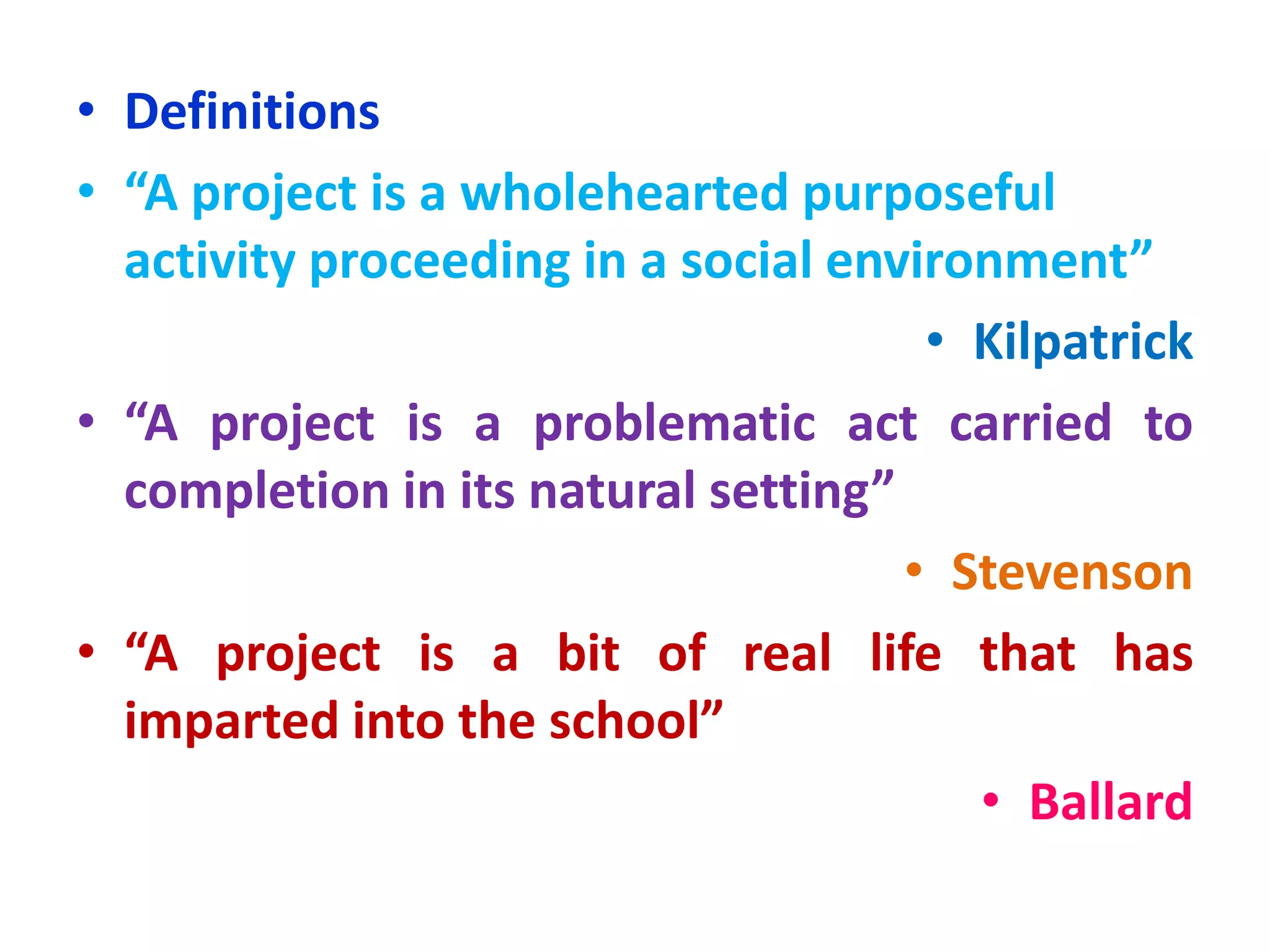
• Definitions
• “Aproject is a wholehearted purposeful
activity proceeding in a social environment”
• Kilpatrick
• “A project is a problematic act carried to
completion in its natural setting”
• Stevenson
• “A project is a bit of real life that has
imparted into the school”
• Ballard
50.
Based on theprinciples
• Students learn better through
association, co-operation and
activity
• Learning by doing
• Learning by living
51.
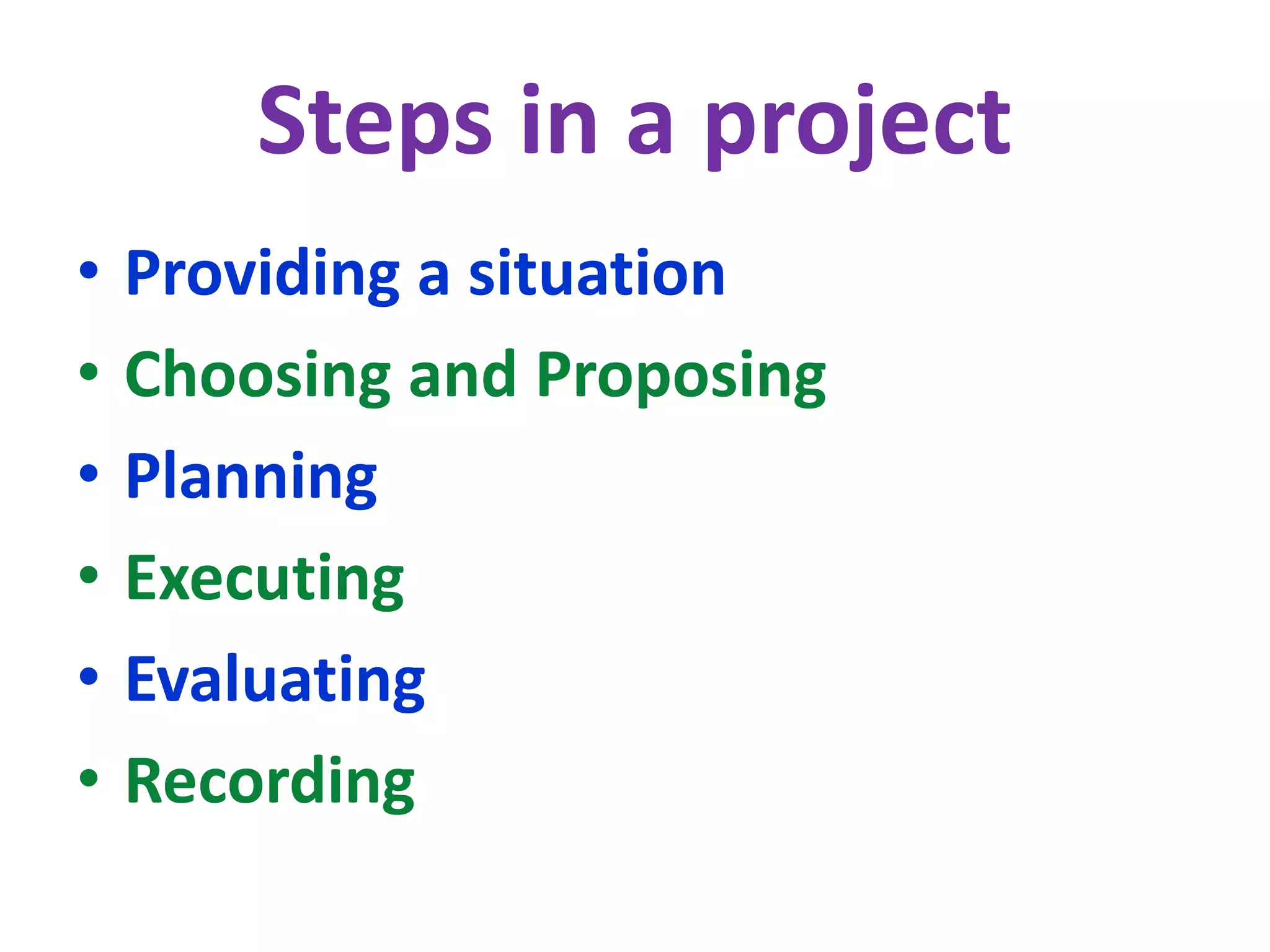
Steps in aproject
• Providing a situation
• Choosing and Proposing
• Planning
• Executing
• Evaluating
• Recording
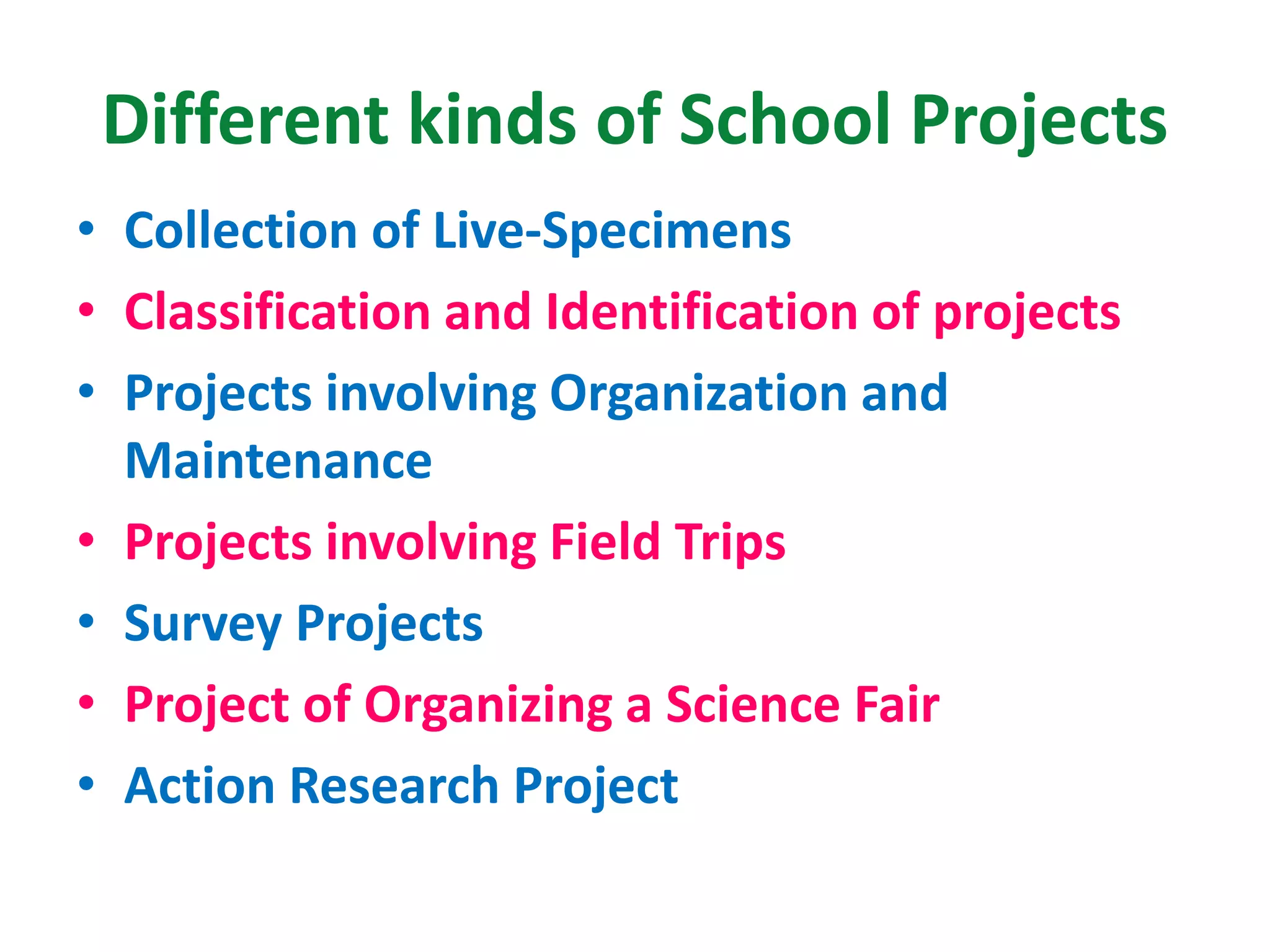
Different kinds ofSchool Projects
• Collection of Live-Specimens
• Classification and Identification of projects
• Projects involving Organization and
Maintenance
• Projects involving Field Trips
• Survey Projects
• Project of Organizing a Science Fair
• Action Research Project
55.
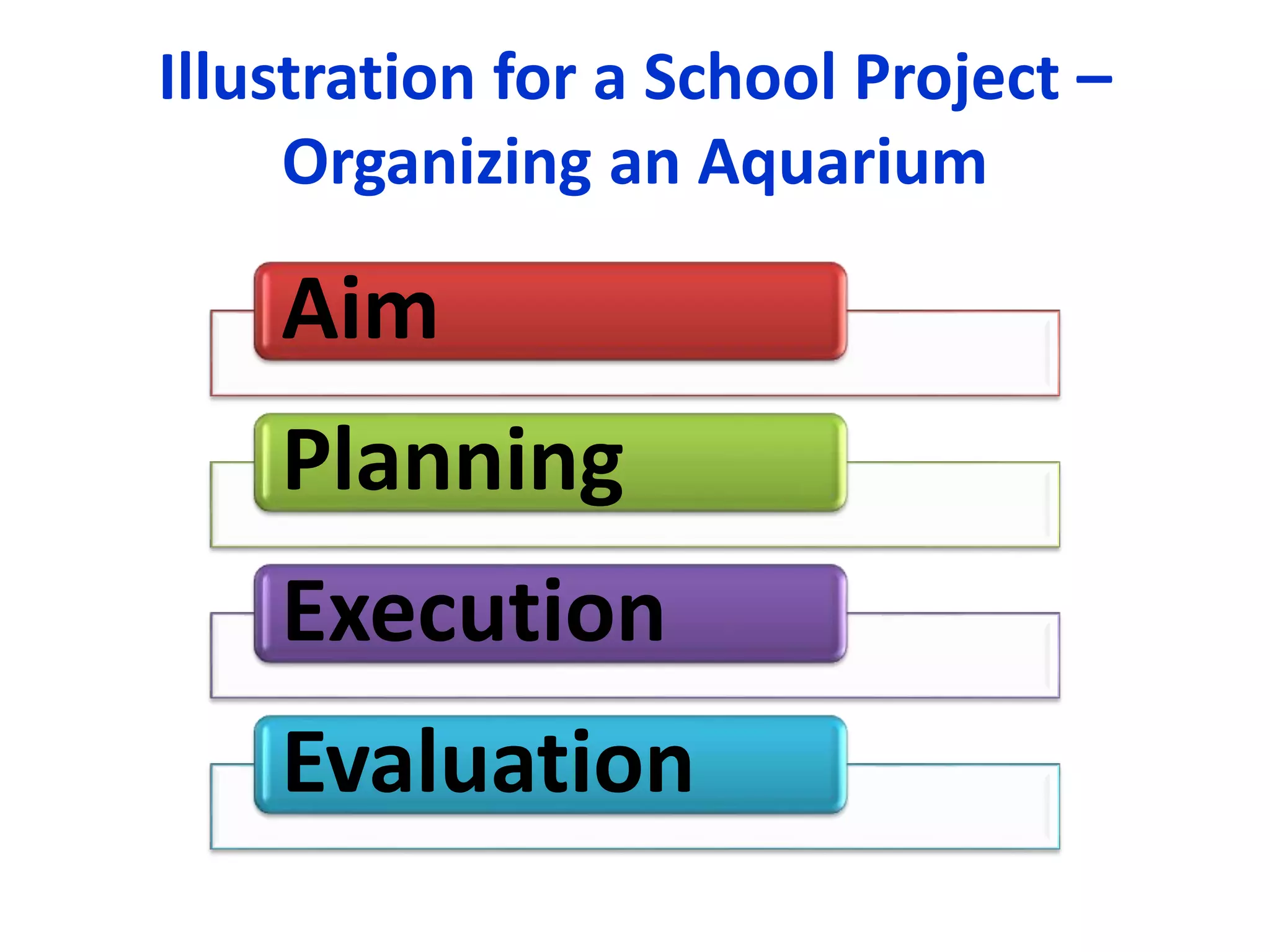
Illustration for aSchool Project –
Organizing an Aquarium
Aim
Planning
Execution
Evaluation
56.
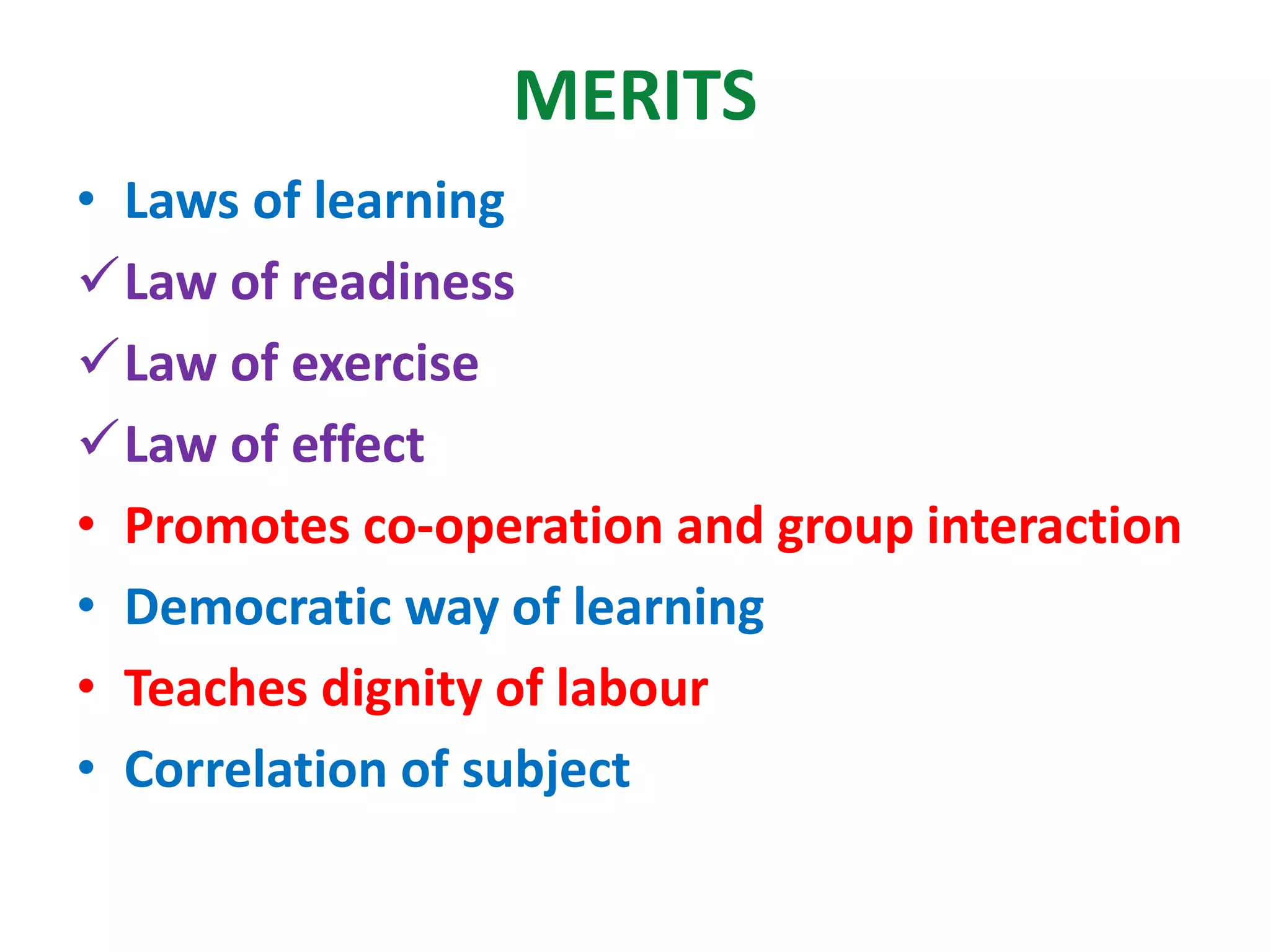
MERITS
• Laws oflearning
Law of readiness
Law of exercise
Law of effect
• Promotes co-operation and group interaction
• Democratic way of learning
• Teaches dignity of labour
• Correlation of subject
57.
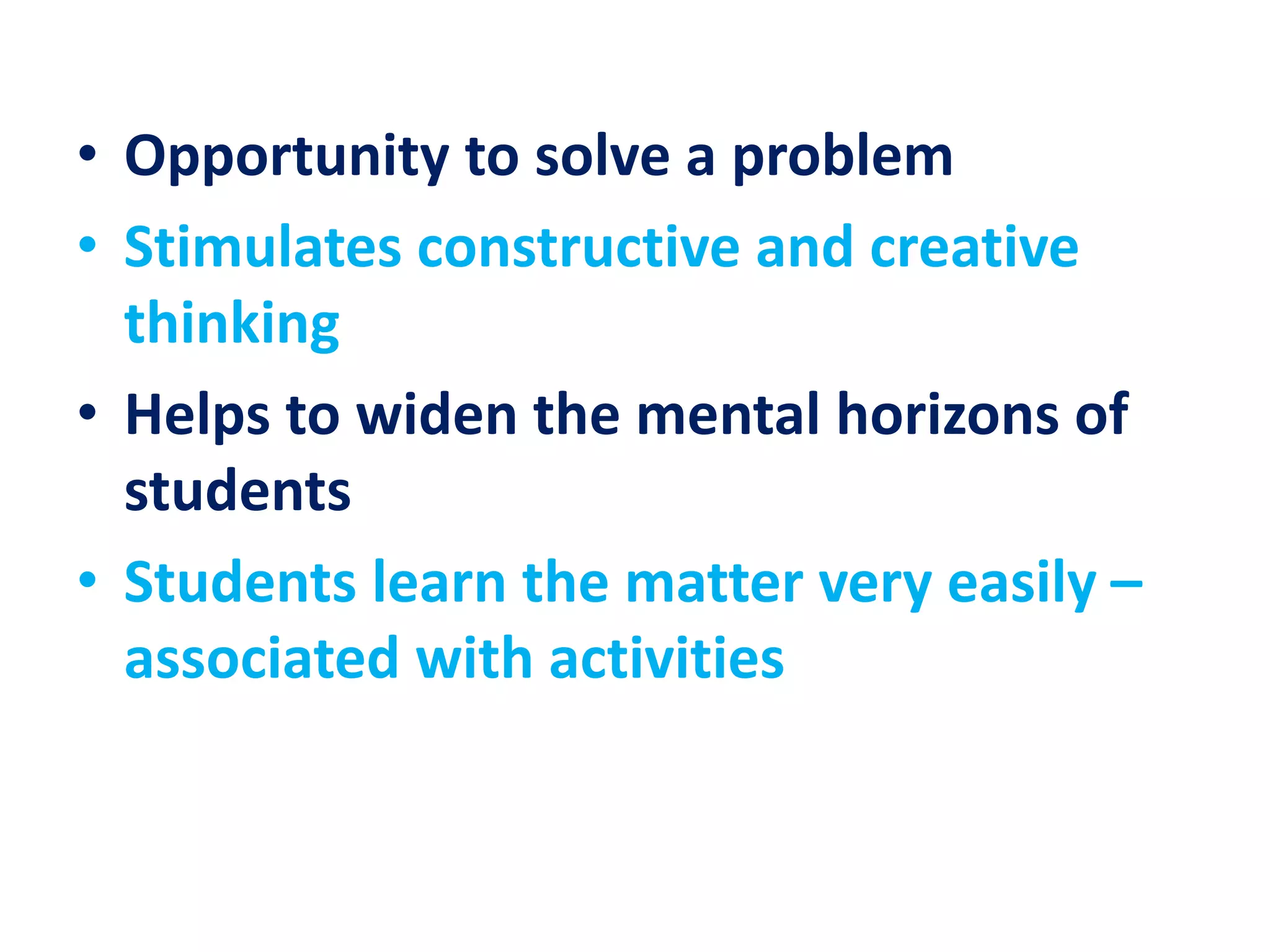
• Opportunity tosolve a problem
• Stimulates constructive and creative
thinking
• Helps to widen the mental horizons of
students
• Students learn the matter very easily –
associated with activities
58.
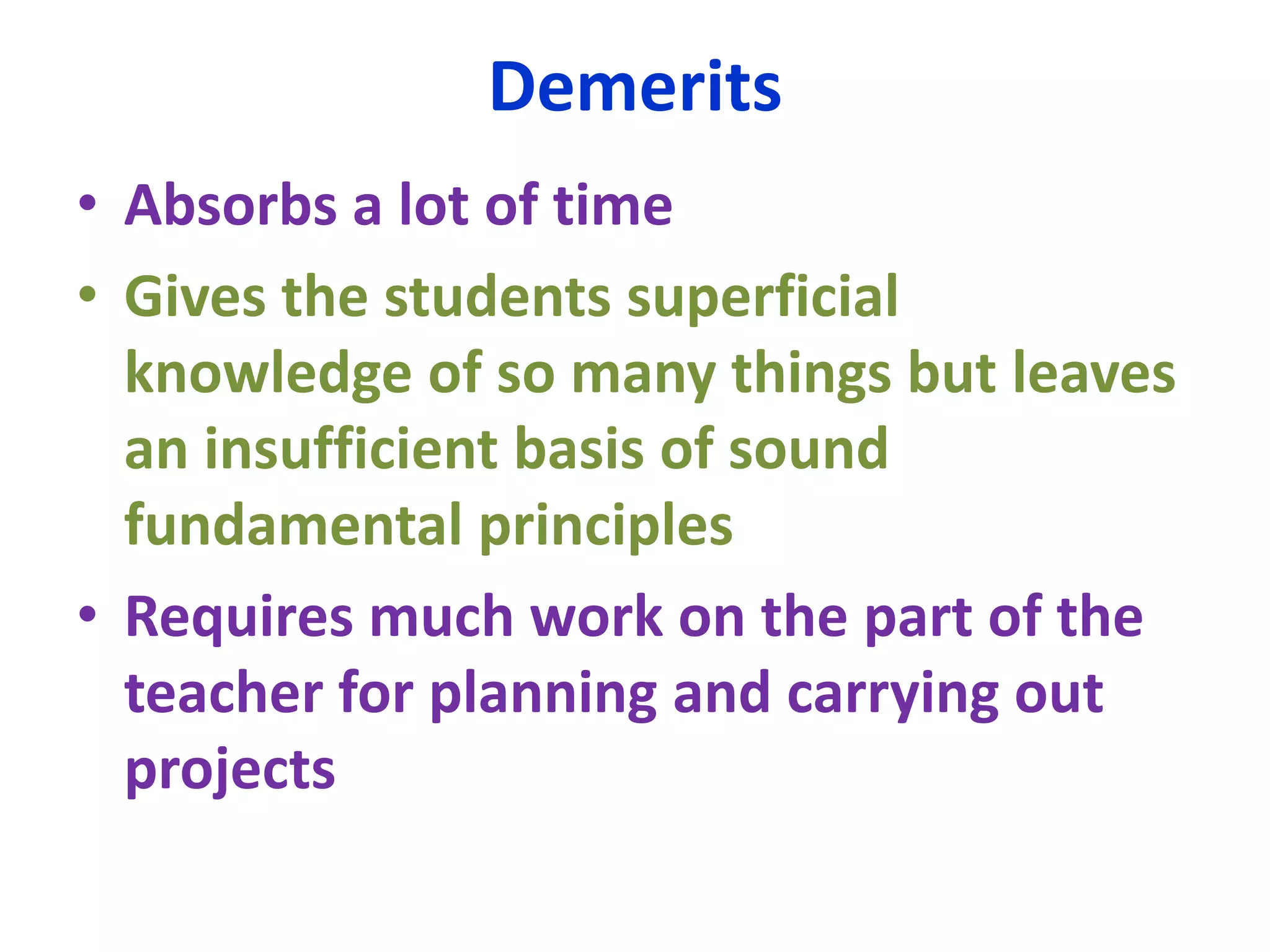
Demerits
• Absorbs alot of time
• Gives the students superficial
knowledge of so many things but leaves
an insufficient basis of sound
fundamental principles
• Requires much work on the part of the
teacher for planning and carrying out
projects
59.
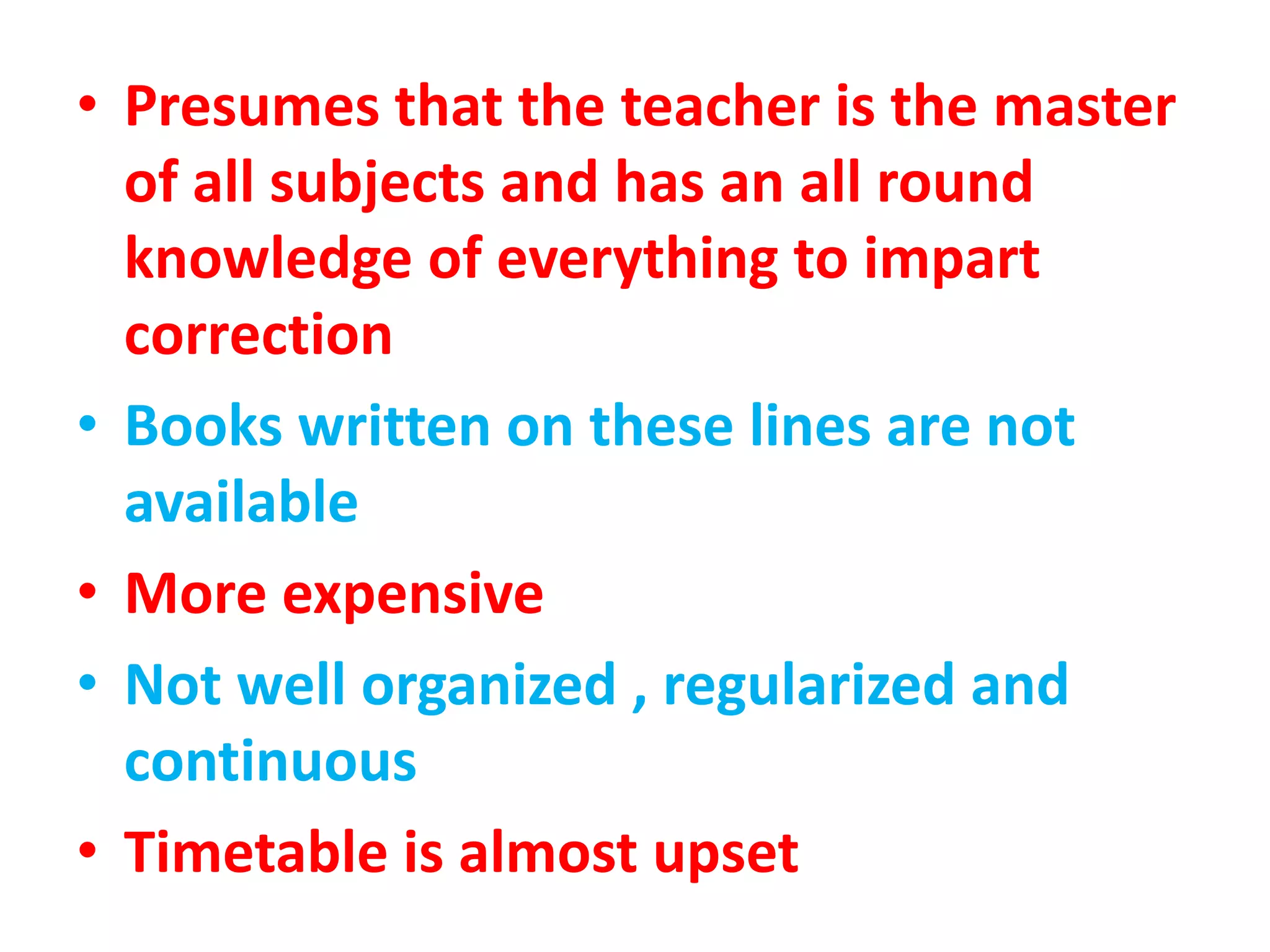
• Presumes thatthe teacher is the master
of all subjects and has an all round
knowledge of everything to impart
correction
• Books written on these lines are not
available
• More expensive
• Not well organized , regularized and
continuous
• Timetable is almost upset