Classical India
Various Influences
● Aryans (1500 - 400 BCE)
○ Cultural traditions laid the foundations for
Hinduism and Buddhism
● Persians (400 - 327 BCE)
○ Government structure adopted by early Indian rulers
● Greeks (327 BCE)
○ Alexander of Macedon
○ Conquered, destroyed and then left...
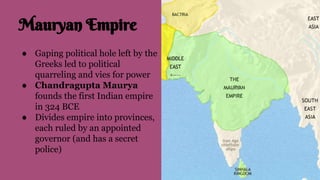
Mauryan Empire
● Gaping political hole left by the
Greeks led to political
quarreling and vies for power
● Chandragupta Maurya
founds the first Indian empire
in 324 BCE
● Divides empire into provinces,
each ruled by an appointed
governor (and has a secret
police)
Making Connections
Based on this knowledge, what can we assume
the Persian system of government was like?
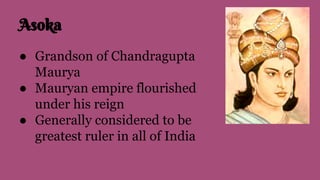
Asoka
● Grandson of Chandragupta
Maurya
● Mauryan empire flourished
under his reign
● Generally considered to be
greatest ruler in all of India
Asoka’s Achievements
● Contributed to the spread of Buddhism in SE
Asia
○ Gruesome Battle of Kalinga led him to convert
○ Ruled based on Buddhist principles
■ Built roads with shelters for weary travelers
■ Built hospitals
● Capitalized on India’s centralized position on
the Silk Road
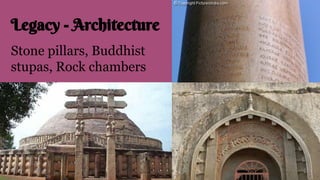
Legacy - Architecture
Stone pillars, Buddhist
stupas, Rock chambers
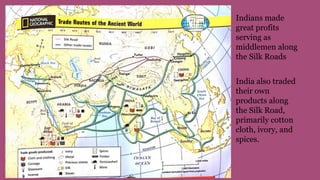
Indians made
great profits
serving as
middlemen along
the Silk Roads
India also traded
their own
products along
the Silk Road,
primarily cotton
cloth, ivory, and
spices.
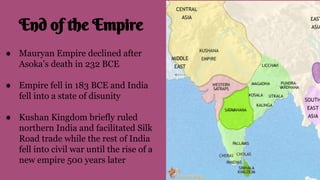
End of the Empire
● Mauryan Empire declined after
Asoka’s death in 232 BCE
● Empire fell in 183 BCE and India
fell into a state of disunity
● Kushan Kingdom briefly ruled
northern India and facilitated Silk
Road trade while the rest of India
fell into civil war until the rise of a
new empire 500 years later
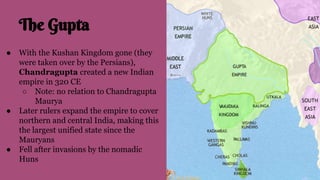
The Gupta
● With the Kushan Kingdom gone (they
were taken over by the Persians),
Chandragupta created a new Indian
empire in 320 CE
○ Note: no relation to Chandragupta
Maurya
● Later rulers expand the empire to cover
northern and central India, making this
the largest unified state since the
Mauryans
● Fell after invasions by the nomadic
Huns
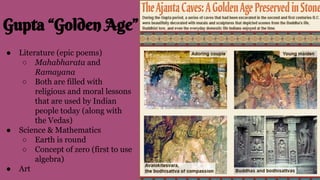
Gupta “Golden Age”
● Literature (epic poems)
○ Mahabharata and
Ramayana
○ Both are filled with
religious and moral lessons
that are used by Indian
people today (along with
the Vedas)
● Science & Mathematics
○ Earth is round
○ Concept of zero (first to use
algebra)
● Art
Chinese Dynasties
Shang; 1600-1300 BCE
Zhou; 1029-258 BCE
(Era of Warring States 402-201 BCE)
Qin; 221-207 BCE
Han; 206 BCE - 220 CE
Zhou
● Took over the Shang
● Longest lasting dynasty in Chinese history
(almost 800 years)
● Emperor divided kingdom into territories
which were controlled by appointed
aristocrats
● Justified rule with Mandate of Heaven
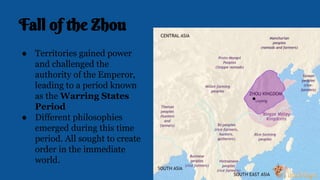
Fall of the Zhou
● Territories gained power
and challenged the
authority of the Emperor,
leading to a period known
as the Warring States
Period
● Different philosophies
emerged during this time
period. All sought to create
order in the immediate
world.
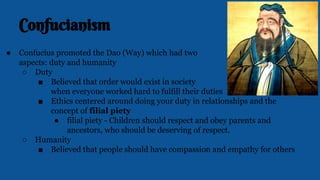
Confucianism
● Confucius promoted the Dao (Way) which had two
aspects: duty and humanity
○ Duty
■ Believed that order would exist in society
when everyone worked hard to fulfill their duties
■ Ethics centered around doing your duty in relationships and the
concept of filial piety
● filial piety - Children should respect and obey parents and
ancestors, who should be deserving of respect.
○ Humanity
■ Believed that people should have compassion and empathy for others
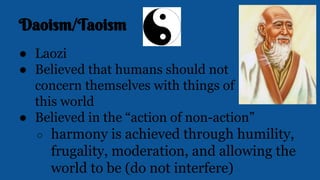
Daoism/Taoism
● Laozi
● Believed that humans should not
concern themselves with things of
this world
● Believed in the “action of non-action”
○ harmony is achieved through humility,
frugality, moderation, and allowing the
world to be (do not interfere)
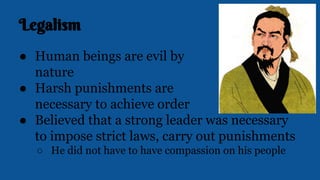
Legalism
● Human beings are evil by
nature
● Harsh punishments are
necessary to achieve order
● Believed that a strong leader was necessary
to impose strict laws, carry out punishments
○ He did not have to have compassion on his people
Predicting
One of these philosophies will eventually lead
to the unification of China and the end of the
Warring States Period. Which philosophy do
you think this is and why?
Qin Dynasty
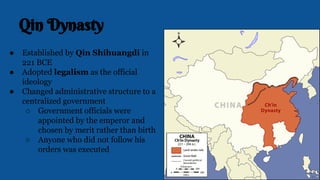
● Established by Qin Shihuangdi in
221 BCE
● Adopted legalism as the official
ideology
● Changed administrative structure to a
centralized government
○ Government officials were
appointed by the emperor and
chosen by merit rather than birth
○ Anyone who did not follow his
orders was executed
More of Qin’s Changes
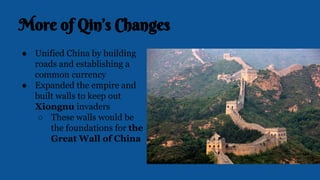
● Unified China by building
roads and establishing a
common currency
● Expanded the empire and
built walls to keep out
Xiongnu invaders
○ These walls would be
the foundations for the
Great Wall of China
Fall of the Qin
● The empire crumbled when Qin died in 210
BCE
○ People were sick of the harsh treatments
○ China fell into another period of civil war until the
rise of the Han Dynasty in 202 BCE
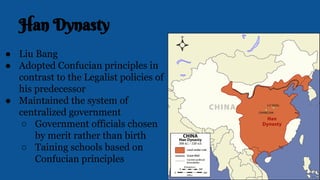
Han Dynasty
● Liu Bang
● Adopted Confucian principles in
contrast to the Legalist policies of
his predecessor
● Maintained the system of
centralized government
○ Government officials chosen
by merit rather than birth
○ Taining schools based on
Confucian principles
Peace and Prosperity?
● Han Wudi expanded the empire and drive
back the Xiongnu (150 years of peace)
● Massive increase in population
○ indicative of good times
○ led to peasant problems
■ More people = less land per person
■ Tenant farming to survive
■ Land belongs to a few landed elites who have
many poor farmers working for them
More problems for the Han
● Rise of rich landed families weakens
centralized state
● Weak rulers and corruption make state
vulnerable to nomadic invasions
● Ultimately, Han will fall due to peasant
rebellions
● Another dynasty will not come for 400 years
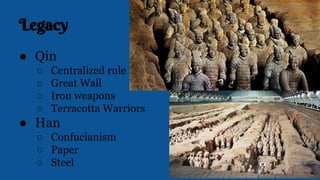
Legacy
● Qin
○ Centralized rule
○ Great Wall
○ Iron weapons
○ Terracotta Warriors
● Han
○ Confucianism
○ Paper
○ Steel

Notes on India & China

  • 1.
  • 2.
    Various Influences ● Aryans(1500 - 400 BCE) ○ Cultural traditions laid the foundations for Hinduism and Buddhism ● Persians (400 - 327 BCE) ○ Government structure adopted by early Indian rulers ● Greeks (327 BCE) ○ Alexander of Macedon ○ Conquered, destroyed and then left...
  • 3.
    Mauryan Empire ● Gapingpolitical hole left by the Greeks led to political quarreling and vies for power ● Chandragupta Maurya founds the first Indian empire in 324 BCE ● Divides empire into provinces, each ruled by an appointed governor (and has a secret police)
  • 4.
    Making Connections Based onthis knowledge, what can we assume the Persian system of government was like?
  • 5.
    Asoka ● Grandson ofChandragupta Maurya ● Mauryan empire flourished under his reign ● Generally considered to be greatest ruler in all of India
  • 6.
    Asoka’s Achievements ● Contributedto the spread of Buddhism in SE Asia ○ Gruesome Battle of Kalinga led him to convert ○ Ruled based on Buddhist principles ■ Built roads with shelters for weary travelers ■ Built hospitals ● Capitalized on India’s centralized position on the Silk Road
  • 7.
    Legacy - Architecture Stonepillars, Buddhist stupas, Rock chambers
  • 8.
    Indians made great profits servingas middlemen along the Silk Roads India also traded their own products along the Silk Road, primarily cotton cloth, ivory, and spices.
  • 9.
    End of theEmpire ● Mauryan Empire declined after Asoka’s death in 232 BCE ● Empire fell in 183 BCE and India fell into a state of disunity ● Kushan Kingdom briefly ruled northern India and facilitated Silk Road trade while the rest of India fell into civil war until the rise of a new empire 500 years later
  • 10.
    The Gupta ● Withthe Kushan Kingdom gone (they were taken over by the Persians), Chandragupta created a new Indian empire in 320 CE ○ Note: no relation to Chandragupta Maurya ● Later rulers expand the empire to cover northern and central India, making this the largest unified state since the Mauryans ● Fell after invasions by the nomadic Huns
  • 11.
    Gupta “Golden Age” ●Literature (epic poems) ○ Mahabharata and Ramayana ○ Both are filled with religious and moral lessons that are used by Indian people today (along with the Vedas) ● Science & Mathematics ○ Earth is round ○ Concept of zero (first to use algebra) ● Art
  • 12.
    Chinese Dynasties Shang; 1600-1300BCE Zhou; 1029-258 BCE (Era of Warring States 402-201 BCE) Qin; 221-207 BCE Han; 206 BCE - 220 CE
  • 13.
    Zhou ● Took overthe Shang ● Longest lasting dynasty in Chinese history (almost 800 years) ● Emperor divided kingdom into territories which were controlled by appointed aristocrats ● Justified rule with Mandate of Heaven
  • 15.
    Fall of theZhou ● Territories gained power and challenged the authority of the Emperor, leading to a period known as the Warring States Period ● Different philosophies emerged during this time period. All sought to create order in the immediate world.
  • 16.
    Confucianism ● Confucius promotedthe Dao (Way) which had two aspects: duty and humanity ○ Duty ■ Believed that order would exist in society when everyone worked hard to fulfill their duties ■ Ethics centered around doing your duty in relationships and the concept of filial piety ● filial piety - Children should respect and obey parents and ancestors, who should be deserving of respect. ○ Humanity ■ Believed that people should have compassion and empathy for others
  • 17.
    Daoism/Taoism ● Laozi ● Believedthat humans should not concern themselves with things of this world ● Believed in the “action of non-action” ○ harmony is achieved through humility, frugality, moderation, and allowing the world to be (do not interfere)
  • 18.
    Legalism ● Human beingsare evil by nature ● Harsh punishments are necessary to achieve order ● Believed that a strong leader was necessary to impose strict laws, carry out punishments ○ He did not have to have compassion on his people
  • 19.
    Predicting One of thesephilosophies will eventually lead to the unification of China and the end of the Warring States Period. Which philosophy do you think this is and why?
  • 20.
    Qin Dynasty ● Establishedby Qin Shihuangdi in 221 BCE ● Adopted legalism as the official ideology ● Changed administrative structure to a centralized government ○ Government officials were appointed by the emperor and chosen by merit rather than birth ○ Anyone who did not follow his orders was executed
  • 21.
    More of Qin’sChanges ● Unified China by building roads and establishing a common currency ● Expanded the empire and built walls to keep out Xiongnu invaders ○ These walls would be the foundations for the Great Wall of China
  • 22.
    Fall of theQin ● The empire crumbled when Qin died in 210 BCE ○ People were sick of the harsh treatments ○ China fell into another period of civil war until the rise of the Han Dynasty in 202 BCE
  • 23.
    Han Dynasty ● LiuBang ● Adopted Confucian principles in contrast to the Legalist policies of his predecessor ● Maintained the system of centralized government ○ Government officials chosen by merit rather than birth ○ Taining schools based on Confucian principles
  • 24.
    Peace and Prosperity? ●Han Wudi expanded the empire and drive back the Xiongnu (150 years of peace) ● Massive increase in population ○ indicative of good times ○ led to peasant problems ■ More people = less land per person ■ Tenant farming to survive ■ Land belongs to a few landed elites who have many poor farmers working for them
  • 25.
    More problems forthe Han ● Rise of rich landed families weakens centralized state ● Weak rulers and corruption make state vulnerable to nomadic invasions ● Ultimately, Han will fall due to peasant rebellions ● Another dynasty will not come for 400 years
  • 26.
    Legacy ● Qin ○ Centralizedrule ○ Great Wall ○ Iron weapons ○ Terracotta Warriors ● Han ○ Confucianism ○ Paper ○ Steel