1550-1789
Chapter 6
Enlightenment and Scientific
Revolution
The Scientific Revolution
● Renaissance, Reformation broke down medieval world view,
traditional beliefs
● Shift in scientific thinking
● By early 1600’s new approach based on hypothesis, observation
and experimentation (scientific method)
● Mathematics key to understanding truths, used to convert data
into information and scientific laws
● Christianity taught that God had placed the earth at the center
of the universe
● Earth- centered view (geocentric) idea came from Aristotle
● Beginning in mid-1500’s ideas were challenged by scientists
● Change was called the scientific revolution
● It was a new way of thinking based on observation and
willingness to question accepted beliefs
● Combination of discoveries and inventions led to Scientific
Revolution
◦ Discovery of new lands challenged old truths, led to new
observations that questioned world around them
◦ Ideas spread by printing press
Changing Thought
Medieval
● Earth centered solar
system
● Limits set by the
Church and theology,
faith
● Destiny is already set
from birth
● Time, society, world
seen as natural and
organic
● Scientific Revolution
● Sun centered solar
system
● Limits set by rational,
logical thought and
experiments
● Everything can be
explained and
improved- engineered
● Time, society and the
world seen as a
machine, mechanical, a
clock
The Enlightenment
● Philosophers and scholars also began to
question reason and order and began to
question long held beliefs about the human
condition
A. Wanted to change the ideas of rights and
liberties of ordinary citizens
B. Challenged relationship between government
and people
C. Brought new insights in government, religion,
economics and education
D. Stressed using reason and thought to solve
human problems
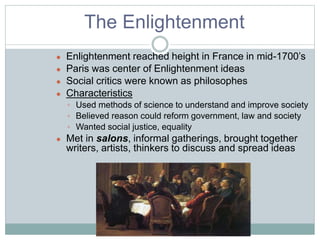
The Enlightenment
● Enlightenment reached height in France in mid-1700’s
● Paris was center of Enlightenment ideas
● Social critics were known as philosophes
● Characteristics
◦ Used methods of science to understand and improve society
◦ Believed reason could reform government, law and society
◦ Wanted social justice, equality
● Met in salons, informal gatherings, brought together
writers, artists, thinkers to discuss and spread ideas
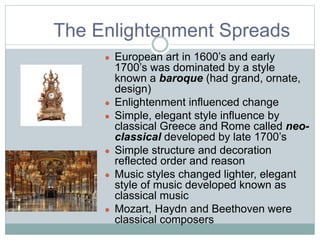
The Enlightenment Spreads
● European art in 1600’s and early
1700’s was dominated by a style
known a baroque (had grand, ornate,
design)
● Enlightenment influenced change
● Simple, elegant style influence by
classical Greece and Rome called neo-
classical developed by late 1700’s
● Simple structure and decoration
reflected order and reason
● Music styles changed lighter, elegant
style of music developed known as
classical music
● Mozart, Haydn and Beethoven were
classical composers
The Enlightenment
● Many philosophes thought the best form of
government was a monarchy
● They wanted rulers to respect individuals
rights
● Some monarchs made reforms that
reflected the Enlightenment (known as
enlightened despots)
● They did not want to give up power, but
made changes for two reasons:
1. To make their country stronger
2. to make their own rule more effective
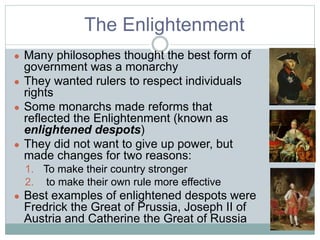
● Best examples of enlightened despots were
Fredrick the Great of Prussia, Joseph II of
Austria and Catherine the Great of Russia
The Enlightenment
Legacy of the Enlightenment
● Enlightenment thinkers challenged long held ideas
about society from religion to the role of government
● Theories inspired the American and French
Revolutions
● Three other long term effects of the Enlightenment
1. Belief in progress- idea that human thought, logic and
reason could solve social problems
2. More secular outlook- more non-religious viewpoint,
questioned the ideas of the church and promoted
religious tolerance
3. Importance of the individual- people looked to
themselves to solve problems, not government, or
church

Enlightenment and scientific revolution short

  • 1.
  • 2.
    The Scientific Revolution ●Renaissance, Reformation broke down medieval world view, traditional beliefs ● Shift in scientific thinking ● By early 1600’s new approach based on hypothesis, observation and experimentation (scientific method) ● Mathematics key to understanding truths, used to convert data into information and scientific laws ● Christianity taught that God had placed the earth at the center of the universe ● Earth- centered view (geocentric) idea came from Aristotle ● Beginning in mid-1500’s ideas were challenged by scientists ● Change was called the scientific revolution ● It was a new way of thinking based on observation and willingness to question accepted beliefs ● Combination of discoveries and inventions led to Scientific Revolution ◦ Discovery of new lands challenged old truths, led to new observations that questioned world around them ◦ Ideas spread by printing press
  • 3.
    Changing Thought Medieval ● Earthcentered solar system ● Limits set by the Church and theology, faith ● Destiny is already set from birth ● Time, society, world seen as natural and organic ● Scientific Revolution ● Sun centered solar system ● Limits set by rational, logical thought and experiments ● Everything can be explained and improved- engineered ● Time, society and the world seen as a machine, mechanical, a clock
  • 4.
    The Enlightenment ● Philosophersand scholars also began to question reason and order and began to question long held beliefs about the human condition A. Wanted to change the ideas of rights and liberties of ordinary citizens B. Challenged relationship between government and people C. Brought new insights in government, religion, economics and education D. Stressed using reason and thought to solve human problems
  • 5.
    The Enlightenment ● Enlightenmentreached height in France in mid-1700’s ● Paris was center of Enlightenment ideas ● Social critics were known as philosophes ● Characteristics ◦ Used methods of science to understand and improve society ◦ Believed reason could reform government, law and society ◦ Wanted social justice, equality ● Met in salons, informal gatherings, brought together writers, artists, thinkers to discuss and spread ideas
  • 6.
    The Enlightenment Spreads ●European art in 1600’s and early 1700’s was dominated by a style known a baroque (had grand, ornate, design) ● Enlightenment influenced change ● Simple, elegant style influence by classical Greece and Rome called neo- classical developed by late 1700’s ● Simple structure and decoration reflected order and reason ● Music styles changed lighter, elegant style of music developed known as classical music ● Mozart, Haydn and Beethoven were classical composers
  • 7.
    The Enlightenment ● Manyphilosophes thought the best form of government was a monarchy ● They wanted rulers to respect individuals rights ● Some monarchs made reforms that reflected the Enlightenment (known as enlightened despots) ● They did not want to give up power, but made changes for two reasons: 1. To make their country stronger 2. to make their own rule more effective ● Best examples of enlightened despots were Fredrick the Great of Prussia, Joseph II of Austria and Catherine the Great of Russia
  • 8.
    The Enlightenment Legacy ofthe Enlightenment ● Enlightenment thinkers challenged long held ideas about society from religion to the role of government ● Theories inspired the American and French Revolutions ● Three other long term effects of the Enlightenment 1. Belief in progress- idea that human thought, logic and reason could solve social problems 2. More secular outlook- more non-religious viewpoint, questioned the ideas of the church and promoted religious tolerance 3. Importance of the individual- people looked to themselves to solve problems, not government, or church