Scanning Electron Microscope
IH2652- Methods and Instruments of Analysis
Prof. Henry H Radamson
Prepared by:
Sumit Mohanty – Mohamed Atwa – Ahmed Al-Askalany
KTH Royal Institute of Technology
1
Agenda
Introduction and Applications
Environmental SEM
Complementarity of SEM and AFM
SEM vs. TEM
3D Imaging with SEM
2
Introduction and Applications
3
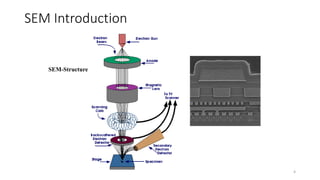
SEM-Structure
SEM Introduction
4
Interaction volume
• The generated radiation will not be detected unless
it escapes from the SP.
• Electrons will not backscattered out of SP if they
have penetrated more than a fraction of micrometers,
Therefore the BS signal come from a much smaller area
SEM Introduction
5
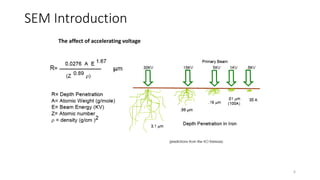
The affect of accelerating voltage
SEM Introduction
6
Biology
Lung tissue
Embryo limbs
Núria Cortadellas, Eva Fernández, and Almudena Garcia;Biomedical and Biological Applications of Scanning Electron Microscopy,
Handbook of instrumental techniques.
RBCs: Chris Toumey, Nature Nanotechnology 6, 191–193 (2011) doi:10.1038/nnano.2011.55
Parasites
Red blood cells
SEM Applications
7
Fig.1
Fig.1: S. Zhou et al. / Biomaterials 24 (2003) 3563–3570
Fig.2: D.R. Chen et al. / Polymer Degradation and Stability 67 (2000) 455-459
Fig.2 a
b
SEM Applications
8
Environmental SEM
9
Gaseous Electron Microscopy
• Conventional and Auger
SEM Require Vacuum
(Usually in the range of 10-5
mBar)
• Sample Charging
• Sample Bursting
http://www.ammrf.org.au/myscope/images/sem/pump-evac.png
10
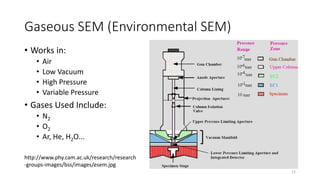
Gaseous SEM (Environmental SEM)
• Works in:
• Air
• Low Vacuum
• High Pressure
• Variable Pressure
• Gases Used Include:
• N2
• O2
• Ar, He, H2O...
http://www.phy.cam.ac.uk/research/research
-groups-images/bss/images/esem.jpg
11
GSEM Image Quality Factors
Image quality and microanalysis results depend on:
• The size of the electron beam
• The accelerating voltage
• Sample nature
• Pressure in different parts of the chamber
• Type of gas
12
Use of Gas in Imaging
• Gas atoms or molecules interact with
the primary electron beam and
produce positive ions.
• Positive ions neutralize the negative
charge on the surface of the insulating
sample
• Gas atoms can also aid the imaging
process through avalanche electron
generation http://www.azom.com/work/Environm
ental%20Scanning%20Electron%20Micr
oscopy%20-
%20ESEM_files/image004.gif 13
Typical Operation Parameters
“Wet” Mode (Condensed Water)
• Electron Beam Energy: 20 kV
• Emission Current: 49 μA.
• SE Detection Method: Gaseous detector
• Working distance: 19 mm (Compensates for Skirting Beam)
V. Kazmiruk -Scanning Electron Microscopy -Intech (2012)
14
Gaseous Detector
https://en.wikipedia.org/wiki/Gaseous_detection
_device#mediaviewer/File:GDD_principle.svg
• Probe electrons ionize gas
atoms/molecules
• Electric field “pulls”
secondary and backscattered
electrons towards plate
electrodes
• Electrons are multiplied in
collisions with gas
atoms/molecules
• Location and energy of
electrons used to form image
15
Skirting Beam Phenomenon
• PLA1: Final Aperture
• Z: Distance which electrons scatter
• Θ: Solid angle of scattering
• Sf: Scattered fraction of electrons
(Skirt)
• UnSf: Unscattered fraction of
electrons
• rs+dr: Scattering radius
V. Kazmiruk -Scanning Electron Microscopy -
Intech (2012)
16
Skirting Phenomenon (Continued)
V. Kazmiruk -Scanning Electron Microscopy -Intech (2012)
• rs is the skirt radius
• Z the gas atomic number
• E the incident beam energy
• P is the pressure
• T the temperature
• GPL the gas path length
17
Sample Image
• Plant material:
• Insulating
• Fragile
• White circles are “Stomata,” pores
for gas-exchange
• Imaged using the “wet mode”
parameters mentioned before
V. Kazmiruk -Scanning Electron Microscopy -
Intech (2012)
18
Complementary techniques AFM
and SEM
1. Surface Structure
2. Composition
3. Environment
19
Surface structure
Principle difference  process vertical changes in
topography
Atomically smooth surfaces
AFM
• Vertical resolution of <0.5Å
• Resolve the 1.4Å monoatomic
silicon steps
SEM
• Difficulty resolving these features due to the subtle
variations in height.
Russell, Phil, Dale Batchelor, and J. Thornton. "SEM and AFM: complementary techniques for high resolution surface investigations." Veeco
Instruments Inc., AN46, Rev A 1 (2001): 2004.
20
Subtle roughness (<1µm)
• AFM  3-D nature changes in roughness
• Surface area variations  differences in deposition
parameters (<0.5Å)
• SEM, a large area view of variations in surface structure
acquired all at once
Strausser, Y.E., Schroth, M., Sweeney, J.J., Characterization of the low-pressure chemical vapor deposition grown rugged polysilicon surface using
atomic force microscopy,” J. Vas. Sci. Technol. A 15, 1997, 1007
SEM and AFM (tapping mode) images of Poly-silicon thin film
21
SEM
• Depth of field and small beam size dominant
• Millimeters of vertical information
AFM
• Probe length 5-6 µm
• Obtuse angles, enclosed structures  vertical limitation
Not so subtle roughness!! (<1mm)
Russell, Phil, Dale Batchelor, and J. Thornton. "SEM and AFM: complementary techniques for high resolution surface investigations." Veeco
Instruments Inc., AN46, Rev A 1 (2001): 2004.
22
Bumps or Pits???
SEM
• Change in electron intensity  slope
• Sloping up or down? :/
AFM
• Subtle heights/depths  straightforward (e.g. 70nm)
SEM and AFM (tapping mode) showing growth of GaP by chemical beam epitaxy
Kelliher, J.T., Thornton, J., Dietz, N., Lucovsky, G., Bachmann, K.J., “Low temperature chemical beam epitaxy ofgallium phosphide/silicon
heterostrucutres, Materials Science and Engineering, B22 (1993) 97.
23
High aspect ratio structures
SEM
• Trenches and via holes
• Cleaving cross section of the wafer  destructive
AFM
• Scanning undercuts & section analysis
• Tip choice – crucial
Russell, Phil, Dale Batchelor, and J. Thornton. "SEM and AFM: complementary techniques for high resolution surface investigations." Veeco
Instruments Inc., AN46, Rev A 1 (2001): 2004.
SEM and AFM showing undercutting in Poly-silicon lines by reaction ion etching
24
Composition
AFM
• Compositional information based on physical properties
• Stiffness, elasticity, friction, adhesion, magnetic field
carrier concentration
SEM
• Elemental analysis using X-ray
detection
• Back scattered electrons 
Atomic number.
Backscattered SEM image of an PbSn
alloy showing contrast based on the atomic number
Russell, Phil, Dale Batchelor, and J. Thornton. "SEM and AFM: complementary techniques for high resolution surface investigations." Veeco
Instruments Inc., AN46, Rev A 1 (2001): 2004.
25
Environment
SEM
 Traditionally vacuum
 Hydrated environment –
scattering e beam
 Resolution degraded
AFM
 Traditionally ambient
 Hydrated environment –
scanning unperturbed
 Resolution preserved
Mou, J., Czajkowsky, D.M., Sheng, S., Ho, R., Shao, Z., “High resolution surface structure of E. coli GroeS Oligomer by Atomic Force Microscopy,”
FEBS Letters 381 (1996) 161.
Russell, Phil, Dale Batchelor, and J. Thornton. "SEM and AFM: complementary techniques for high resolution surface investigations." Veeco
Instruments Inc., AN46, Rev A 1 (2001): 2004.
26
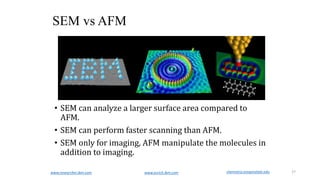
SEM vs AFM
• SEM can analyze a larger surface area compared to
AFM.
• SEM can perform faster scanning than AFM.
• SEM only for imaging, AFM manipulate the molecules in
addition to imaging.
www.researcher.ibm.com www.zurich.ibm.com chemistry.oregonstate.edu 27
SEM vs TEM
• 3-D
• Beam formation
• Magnification – 2 million
• Resolution – 0.4 nm
• Scans larger areas
• Limitations – conducting
samples, charging effect
http://www.ch.tum.de/em/emlabor/methoden/tem.htm
• 2-D
• Direct imaging
• Magnification – 50 million
• Resolution – 0.5 Å
• Scans thin samples
• Limitations – magnetic
samples
28
3D Images with SEM
29
Stereo-Photogrammetry
• Measurements from images,
• Failure micro-mechanisms,
• 3D multi-scale textured images,
• Global low resolution,
• High resolution for regions of
interest (ROI),
• Compared with predefined
failure models for analysis.
M. Khokhlov, A. Fischer, D. Rittel. „Multi-Scale Stereo-Photogrammetry System for Fractographic Analysis Using Scanning Electron Microscopy”. Experimental
Mechanics (2012) 52:975–991 DOI 10.1007/s11340-011-9582-0.
Stereo image
matching
30
Stereo-Photogrammetry
M. Khokhlov, A. Fischer, D. Rittel. „Multi-Scale Stereo-Photogrammetry System for Fractographic Analysis Using Scanning Electron Microscopy”. Experimental
Mechanics (2012) 52:975–991 DOI 10.1007/s11340-011-9582-0.
Stereo
images
3D points
3D mesh
3D textured
image
Multi-scale multi-resolution
3D image
31
Photometric Stereo – Shape From Shading
• SE directional acquisition,
• known angular distribution,
• Shape from signal distribution,
• DSP for detection error
correction,
• Lambert’s angular distribution,
J. Paluszyn´ ski, W. Slo´wko. “Surface reconstruction with the photometric method in SEM”. Vacuum 78 (2005) 533–537
Topo contrast
Compo contrast
Det. signal
Local inc.
32
Photometric Stereo – Shape From Shading
J. Paluszyn´ ski, W. Slo´wko. “Surface reconstruction with the photometric method in SEM”. Vacuum 78 (2005) 533–537
Eduard Reithmeier, Taras Vynnyk *, Thanin Schultheis. “3D-measurement using a scanning electron microscope”. Applied Mathematics and Computation 217 (2010) 1193–1201
Emission yield vs. inclination angle
33
3D-Like Animations from Vertical Stack of
SEM Images
• Bloodstain microarea (strongly
uneven surface),
• Out-of-focus problem,
• Stack of partial-focused scans,
• Macrophotography and light
microscope software (non-SEM
related),
• Topography and Texture,
• 3D-Like animation from vertical
stack of SE SEM micrographs.
Policarp Hortola. “Generating 3D and 3D-like animations of strongly uneven surface microareas of bloodstains from small series of partially out-of-focus digital SEM micrographs”. Micron 41 (2010) 1–6.
(1)
(2)
(3)
2000x WD=16mm 1024x832 pixels
34
3D-Like Animations from Vertical Stack of
SEM Images
Policarp Hortola. “Generating 3D and 3D-like animations of strongly uneven surface microareas of bloodstains from small series of partially out-of-focus digital SEM micrographs”. Micron 41 (2010) 1–6.
Texture to topography transition animation
35
Inverse Reconstruction – Simulated SEM
• Previous methods fail at nano-scale
due to edge and charging effects,
• Iterative update of surface,
• Refinement through comparison of
simulated and actual SEM images,
• Monte Carlo method: Models of SE
and BSE generation (statistical
measure),
• Library creation through
predefined samples,
• Forward and inverse mapping,
Leili Baghaei Rad, Hanying Feng, Jun Ye and R.F.W. Pease. “Computational Scanning Electron Microscopy”. AIP Conference Proceedings 931, 512 (2007); doi: 10.1063/1.2799427
36
Inverse Reconstruction – Simulated SEM
SEM
Image
Line
Strength
Image
Leili Baghaei Rad, Hanying Feng, Jun Ye and R.F.W. Pease. “Computational Scanning Electron Microscopy”. AIP Conference Proceedings 931, 512 (2007); doi: 10.1063/1.2799427
Z. J. Ding∗ and H. M. Li. “Application of Monte Carlo simulation to SEM image contrast of complex structures”. Surf. Interface Anal. 2005; 37: 912–918 DOI: 10.1002/sia.2109
37
38

Scanning Electron Microscope

  • 1.
    Scanning Electron Microscope IH2652-Methods and Instruments of Analysis Prof. Henry H Radamson Prepared by: Sumit Mohanty – Mohamed Atwa – Ahmed Al-Askalany KTH Royal Institute of Technology 1
  • 2.
    Agenda Introduction and Applications EnvironmentalSEM Complementarity of SEM and AFM SEM vs. TEM 3D Imaging with SEM 2
  • 3.
  • 4.
  • 5.
    Interaction volume • Thegenerated radiation will not be detected unless it escapes from the SP. • Electrons will not backscattered out of SP if they have penetrated more than a fraction of micrometers, Therefore the BS signal come from a much smaller area SEM Introduction 5
  • 6.
    The affect ofaccelerating voltage SEM Introduction 6
  • 7.
    Biology Lung tissue Embryo limbs NúriaCortadellas, Eva Fernández, and Almudena Garcia;Biomedical and Biological Applications of Scanning Electron Microscopy, Handbook of instrumental techniques. RBCs: Chris Toumey, Nature Nanotechnology 6, 191–193 (2011) doi:10.1038/nnano.2011.55 Parasites Red blood cells SEM Applications 7
  • 8.
    Fig.1 Fig.1: S. Zhouet al. / Biomaterials 24 (2003) 3563–3570 Fig.2: D.R. Chen et al. / Polymer Degradation and Stability 67 (2000) 455-459 Fig.2 a b SEM Applications 8
  • 9.
  • 10.
    Gaseous Electron Microscopy •Conventional and Auger SEM Require Vacuum (Usually in the range of 10-5 mBar) • Sample Charging • Sample Bursting http://www.ammrf.org.au/myscope/images/sem/pump-evac.png 10
  • 11.
    Gaseous SEM (EnvironmentalSEM) • Works in: • Air • Low Vacuum • High Pressure • Variable Pressure • Gases Used Include: • N2 • O2 • Ar, He, H2O... http://www.phy.cam.ac.uk/research/research -groups-images/bss/images/esem.jpg 11
  • 12.
    GSEM Image QualityFactors Image quality and microanalysis results depend on: • The size of the electron beam • The accelerating voltage • Sample nature • Pressure in different parts of the chamber • Type of gas 12
  • 13.
    Use of Gasin Imaging • Gas atoms or molecules interact with the primary electron beam and produce positive ions. • Positive ions neutralize the negative charge on the surface of the insulating sample • Gas atoms can also aid the imaging process through avalanche electron generation http://www.azom.com/work/Environm ental%20Scanning%20Electron%20Micr oscopy%20- %20ESEM_files/image004.gif 13
  • 14.
    Typical Operation Parameters “Wet”Mode (Condensed Water) • Electron Beam Energy: 20 kV • Emission Current: 49 μA. • SE Detection Method: Gaseous detector • Working distance: 19 mm (Compensates for Skirting Beam) V. Kazmiruk -Scanning Electron Microscopy -Intech (2012) 14
  • 15.
    Gaseous Detector https://en.wikipedia.org/wiki/Gaseous_detection _device#mediaviewer/File:GDD_principle.svg • Probeelectrons ionize gas atoms/molecules • Electric field “pulls” secondary and backscattered electrons towards plate electrodes • Electrons are multiplied in collisions with gas atoms/molecules • Location and energy of electrons used to form image 15
  • 16.
    Skirting Beam Phenomenon •PLA1: Final Aperture • Z: Distance which electrons scatter • Θ: Solid angle of scattering • Sf: Scattered fraction of electrons (Skirt) • UnSf: Unscattered fraction of electrons • rs+dr: Scattering radius V. Kazmiruk -Scanning Electron Microscopy - Intech (2012) 16
  • 17.
    Skirting Phenomenon (Continued) V.Kazmiruk -Scanning Electron Microscopy -Intech (2012) • rs is the skirt radius • Z the gas atomic number • E the incident beam energy • P is the pressure • T the temperature • GPL the gas path length 17
  • 18.
    Sample Image • Plantmaterial: • Insulating • Fragile • White circles are “Stomata,” pores for gas-exchange • Imaged using the “wet mode” parameters mentioned before V. Kazmiruk -Scanning Electron Microscopy - Intech (2012) 18
  • 19.
    Complementary techniques AFM andSEM 1. Surface Structure 2. Composition 3. Environment 19
  • 20.
    Surface structure Principle difference process vertical changes in topography Atomically smooth surfaces AFM • Vertical resolution of <0.5Å • Resolve the 1.4Å monoatomic silicon steps SEM • Difficulty resolving these features due to the subtle variations in height. Russell, Phil, Dale Batchelor, and J. Thornton. "SEM and AFM: complementary techniques for high resolution surface investigations." Veeco Instruments Inc., AN46, Rev A 1 (2001): 2004. 20
  • 21.
    Subtle roughness (<1µm) •AFM  3-D nature changes in roughness • Surface area variations  differences in deposition parameters (<0.5Å) • SEM, a large area view of variations in surface structure acquired all at once Strausser, Y.E., Schroth, M., Sweeney, J.J., Characterization of the low-pressure chemical vapor deposition grown rugged polysilicon surface using atomic force microscopy,” J. Vas. Sci. Technol. A 15, 1997, 1007 SEM and AFM (tapping mode) images of Poly-silicon thin film 21
  • 22.
    SEM • Depth offield and small beam size dominant • Millimeters of vertical information AFM • Probe length 5-6 µm • Obtuse angles, enclosed structures  vertical limitation Not so subtle roughness!! (<1mm) Russell, Phil, Dale Batchelor, and J. Thornton. "SEM and AFM: complementary techniques for high resolution surface investigations." Veeco Instruments Inc., AN46, Rev A 1 (2001): 2004. 22
  • 23.
    Bumps or Pits??? SEM •Change in electron intensity  slope • Sloping up or down? :/ AFM • Subtle heights/depths  straightforward (e.g. 70nm) SEM and AFM (tapping mode) showing growth of GaP by chemical beam epitaxy Kelliher, J.T., Thornton, J., Dietz, N., Lucovsky, G., Bachmann, K.J., “Low temperature chemical beam epitaxy ofgallium phosphide/silicon heterostrucutres, Materials Science and Engineering, B22 (1993) 97. 23
  • 24.
    High aspect ratiostructures SEM • Trenches and via holes • Cleaving cross section of the wafer  destructive AFM • Scanning undercuts & section analysis • Tip choice – crucial Russell, Phil, Dale Batchelor, and J. Thornton. "SEM and AFM: complementary techniques for high resolution surface investigations." Veeco Instruments Inc., AN46, Rev A 1 (2001): 2004. SEM and AFM showing undercutting in Poly-silicon lines by reaction ion etching 24
  • 25.
    Composition AFM • Compositional informationbased on physical properties • Stiffness, elasticity, friction, adhesion, magnetic field carrier concentration SEM • Elemental analysis using X-ray detection • Back scattered electrons  Atomic number. Backscattered SEM image of an PbSn alloy showing contrast based on the atomic number Russell, Phil, Dale Batchelor, and J. Thornton. "SEM and AFM: complementary techniques for high resolution surface investigations." Veeco Instruments Inc., AN46, Rev A 1 (2001): 2004. 25
  • 26.
    Environment SEM  Traditionally vacuum Hydrated environment – scattering e beam  Resolution degraded AFM  Traditionally ambient  Hydrated environment – scanning unperturbed  Resolution preserved Mou, J., Czajkowsky, D.M., Sheng, S., Ho, R., Shao, Z., “High resolution surface structure of E. coli GroeS Oligomer by Atomic Force Microscopy,” FEBS Letters 381 (1996) 161. Russell, Phil, Dale Batchelor, and J. Thornton. "SEM and AFM: complementary techniques for high resolution surface investigations." Veeco Instruments Inc., AN46, Rev A 1 (2001): 2004. 26
  • 27.
    SEM vs AFM •SEM can analyze a larger surface area compared to AFM. • SEM can perform faster scanning than AFM. • SEM only for imaging, AFM manipulate the molecules in addition to imaging. www.researcher.ibm.com www.zurich.ibm.com chemistry.oregonstate.edu 27
  • 28.
    SEM vs TEM •3-D • Beam formation • Magnification – 2 million • Resolution – 0.4 nm • Scans larger areas • Limitations – conducting samples, charging effect http://www.ch.tum.de/em/emlabor/methoden/tem.htm • 2-D • Direct imaging • Magnification – 50 million • Resolution – 0.5 Å • Scans thin samples • Limitations – magnetic samples 28
  • 29.
  • 30.
    Stereo-Photogrammetry • Measurements fromimages, • Failure micro-mechanisms, • 3D multi-scale textured images, • Global low resolution, • High resolution for regions of interest (ROI), • Compared with predefined failure models for analysis. M. Khokhlov, A. Fischer, D. Rittel. „Multi-Scale Stereo-Photogrammetry System for Fractographic Analysis Using Scanning Electron Microscopy”. Experimental Mechanics (2012) 52:975–991 DOI 10.1007/s11340-011-9582-0. Stereo image matching 30
  • 31.
    Stereo-Photogrammetry M. Khokhlov, A.Fischer, D. Rittel. „Multi-Scale Stereo-Photogrammetry System for Fractographic Analysis Using Scanning Electron Microscopy”. Experimental Mechanics (2012) 52:975–991 DOI 10.1007/s11340-011-9582-0. Stereo images 3D points 3D mesh 3D textured image Multi-scale multi-resolution 3D image 31
  • 32.
    Photometric Stereo –Shape From Shading • SE directional acquisition, • known angular distribution, • Shape from signal distribution, • DSP for detection error correction, • Lambert’s angular distribution, J. Paluszyn´ ski, W. Slo´wko. “Surface reconstruction with the photometric method in SEM”. Vacuum 78 (2005) 533–537 Topo contrast Compo contrast Det. signal Local inc. 32
  • 33.
    Photometric Stereo –Shape From Shading J. Paluszyn´ ski, W. Slo´wko. “Surface reconstruction with the photometric method in SEM”. Vacuum 78 (2005) 533–537 Eduard Reithmeier, Taras Vynnyk *, Thanin Schultheis. “3D-measurement using a scanning electron microscope”. Applied Mathematics and Computation 217 (2010) 1193–1201 Emission yield vs. inclination angle 33
  • 34.
    3D-Like Animations fromVertical Stack of SEM Images • Bloodstain microarea (strongly uneven surface), • Out-of-focus problem, • Stack of partial-focused scans, • Macrophotography and light microscope software (non-SEM related), • Topography and Texture, • 3D-Like animation from vertical stack of SE SEM micrographs. Policarp Hortola. “Generating 3D and 3D-like animations of strongly uneven surface microareas of bloodstains from small series of partially out-of-focus digital SEM micrographs”. Micron 41 (2010) 1–6. (1) (2) (3) 2000x WD=16mm 1024x832 pixels 34
  • 35.
    3D-Like Animations fromVertical Stack of SEM Images Policarp Hortola. “Generating 3D and 3D-like animations of strongly uneven surface microareas of bloodstains from small series of partially out-of-focus digital SEM micrographs”. Micron 41 (2010) 1–6. Texture to topography transition animation 35
  • 36.
    Inverse Reconstruction –Simulated SEM • Previous methods fail at nano-scale due to edge and charging effects, • Iterative update of surface, • Refinement through comparison of simulated and actual SEM images, • Monte Carlo method: Models of SE and BSE generation (statistical measure), • Library creation through predefined samples, • Forward and inverse mapping, Leili Baghaei Rad, Hanying Feng, Jun Ye and R.F.W. Pease. “Computational Scanning Electron Microscopy”. AIP Conference Proceedings 931, 512 (2007); doi: 10.1063/1.2799427 36
  • 37.
    Inverse Reconstruction –Simulated SEM SEM Image Line Strength Image Leili Baghaei Rad, Hanying Feng, Jun Ye and R.F.W. Pease. “Computational Scanning Electron Microscopy”. AIP Conference Proceedings 931, 512 (2007); doi: 10.1063/1.2799427 Z. J. Ding∗ and H. M. Li. “Application of Monte Carlo simulation to SEM image contrast of complex structures”. Surf. Interface Anal. 2005; 37: 912–918 DOI: 10.1002/sia.2109 37
  • 38.

Editor's Notes

  • #8 visualize external morphological characteristics and is a very useful tool for obtaining data on systematic and taxonomic studies of parasites in general
  • #11 Atmospheric Pressure = 1 Bar Bursting Pressure for Water in Cells = Roughly 500 Pa = 0.05 Bar
  • #15 Skirting is not a serious problem. Skirted electrons are spread over an area orders of magnitudes larger than the beam, have orders of magnitude current intensity. Typical energies are mid-range for SEM (too low  not enough energy to reach sample) (too high more gas ionization)
  • #18 Modeled using Electron Flight Simulator Software