Introduction to
Atomic Force
Microscopy
Dr. Janelle Gunther
March 10, 1998
ACS Group and MENs, Beckman Institute
adapted from the world wide web page at http://www.di.com Digital
Instruments, Santa Barbara, CA
Scanning Probe
Microscopy (SPM)
A family of microscopy forms where a
sharp probe is scanned across a surface
and some tip/sample interactions are
monitored
Scanning tunneling Microscopy (STM)
Atomic Force Microscopy (AFM)
• contact mode
• non-contact mode
• TappingMode
Other forms of SPM
• Lateral force
• Force modulation
• Magnetic or electric force
• surface potential
• scanning thermal
• phase imaging
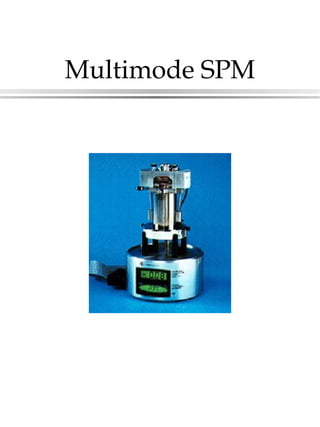
Multimode SPM
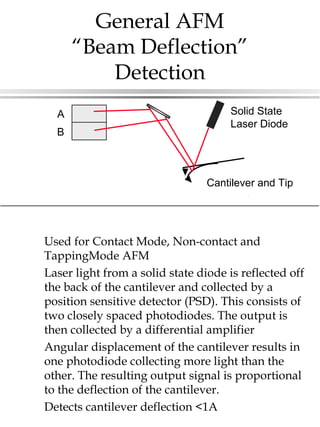
General AFM
“Beam Deflection”
Detection
Used for Contact Mode, Non-contact and
TappingMode AFM
Laser light from a solid state diode is reflected off
the back of the cantilever and collected by a
position sensitive detector (PSD). This consists of
two closely spaced photodiodes. The output is
then collected by a differential amplifier
Angular displacement of the cantilever results in
one photodiode collecting more light than the
other. The resulting output signal is proportional
to the deflection of the cantilever.
Detects cantilever deflection <1A
Solid State
Laser Diode
Cantilever and Tip
A
B
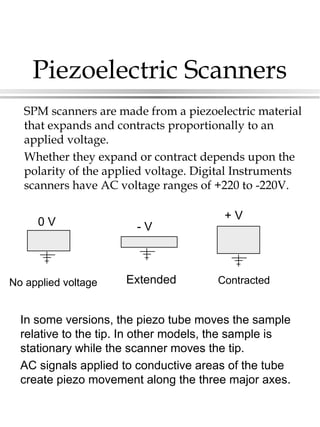
Piezoelectric Scanners
SPM scanners are made from a piezoelectric material
that expands and contracts proportionally to an
applied voltage.
Whether they expand or contract depends upon the
polarity of the applied voltage. Digital Instruments
scanners have AC voltage ranges of +220 to -220V.
0 V - V
+ V
No applied voltage Extended Contracted
In some versions, the piezo tube moves the sample
relative to the tip. In other models, the sample is
stationary while the scanner moves the tip.
AC signals applied to conductive areas of the tube
create piezo movement along the three major axes.
Contact Mode AFM
A tip is scanned across the sample while a feedback
loop maintains a constant cantilever deflection (and
force)
The tip contacts the surface through the adsorbed fluid
layer.
Forces range from nano to micro N in ambient
conditions and even lower (0.1 nN or less) in liquids.
Tapping Mode™ AFM
A cantilever with attached tip is oscillated at its
resonant frequency and scanned across the sample
surface.
A constant oscillation amplitude (and thus a constant
tip-sample interaction) are maintained during
scanning. Typical amplitudes are 20-100nm.
Forces can be 200 pN or less
The amplitude of the oscillations changes when the tip
scans over bumps or depressions on a surface.
Non-contact Mode
AFM
The cantilever is oscillated slightly above its resonant
frequency.
Oscillations <10nm
The tip does not touch the sample. Instead, it oscillates above
the adsorbed fluid layer.
A constant oscillation amplitude is maintained.
The resonant frequency of the cantilever is decreased by the
van der Waals forces which extend from 1-10nm above the
adsorbed fluid layer. This in turn changes the amplitude of
oscillation.
Advantages and
Disadvantages of the 3
main types of AFM
Contact Mode
» Advantages:
– High scan speeds
– The only mode that can obtain “atomic resolution” images
– Rough samples with extreme changes in topography can
sometimes be scanned more easily
» Disadvantages:
– Lateral (shear) forces can distort features in the image
– The forces normal to the tip-sample interaction can be high
in air due to capillary forces from the adsorbed fluid layer on
the sample surface.
– The combination of lateral forces and high normal forces can
result in reduced spatial resolution and may damage soft
samples (i.e. biological samples, polymers, silicon) due to
scraping
TappingMode AFM
» Advantages:
– Higher lateral resolution on most samples (1 to 5nm)
– Lower forces and less damage to soft samples imaged in air
– Lateral forces are virtually eliminated so there is no scraping
» Disadvantages:
– Slightly lower scan speed than contact mode AFM
Lateral Force
Microscopy
The probe is scanned sideways. The degree of torsion
of the cantilever is used as a relative measure of
surface friction caused by the lateral force exerted on
the probe.
Identify transitions between different components in a
polymer blend, in composites or other mixtures
This mode can also be used to reveal fine structural
details in the sample.
Lateral Force
Microscopy
Magnetic recording
head
Al oxide grains
and contamination
800nm scan
Natural rubber/
EDPM blend
20 micron scan
Polished poly-
crystalle silicon
carbide film.
Grain structures
30 micron scan
Images/photo taken with NanoScope® SPM, courtesy Digital Instruments, Santa Barbara ,CA
Phase Imaging
Accessible via TappingMode
Oscillate the cantilever at its resonant frequency. The
amplitude is used as a feedback signal. The phase lag
is dependent on several things, including composition,
adhesion, friction and viscoelastic properties.
Identify two-phase structure of polymer blends
Identify surface contaminants that are not seen in
height images
Less damaging to soft samples than lateral force
microscopy
Phase Imaging
Compositepolymer
imbedded in a matrix
1 micron scan
Bond pad on an
integrated circuit
Contamination
1.5 micron scan
MoO3 crystallites
on a MoS2 substrate
6 micron scan
Image/photo taken with NanoScope® SPM, courtesy Digital Instruments, Santa Barbara ,CA
Magnetic Force
Microscopy
Special probes are used for MFM. These are
magnetically sensitized by sputter coating with a
ferromagnetic material.
The cantilever is oscillated near its resonant frequency
(around 100 kHz).
The tip is oscillated 10’s to 100’s of nm above the
surface
Gradients in the magnetic forces on the tip shift the
resonant frequency of the cantilever .
Monitoring this shift, or related changes in oscillation
amplitude or phase, produces a magnetic force image.
Many applications for data storage technology
Magnetic Force
Microscopy
Overwritten tracks on a textured hard disk, 25 micron scan
Domains in a 80 micron garnet film
Image/photo taken with NanoScope® SPM, courtesy Digital Instruments, Santa Barbara ,CA
LiftMode
•Two passes are made over the sample. The first measures
topography while the second measures a material property
(magnetic, electric, etc.)
•Eliminates “cross-contamination” of the images.
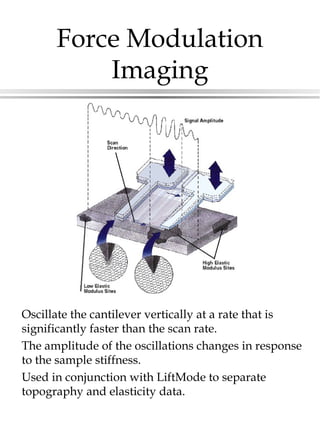
Force Modulation
Imaging
Oscillate the cantilever vertically at a rate that is
significantly faster than the scan rate.
The amplitude of the oscillations changes in response
to the sample stiffness.
Used in conjunction with LiftMode to separate
topography and elasticity data.
Force Modulation
Imaging
Other Techniques
Scanning capacitance microscopy
» Apply a constant amplitude sine wave voltage to
the sample. The image is then reconstructed from
the changes in the amplitude of the capacitance
oscillations.
» Location of defects in wafers (pinning of electrical
carriers)
» Image carrier concentration
Scanning thermal microscopy
» Uses a temperature sensitive probe with a special
holder.
» Location of “hot-spot” defects in semiconductor
wafers
90 micron
scan size
Image/photo taken with NanoScope® SPM, courtesy Digital Instruments, Santa Barbara ,CA
Other Techniques
Nanoindenting and scratching
» A diamond tip is mounted on a metal cantilever
and scanned either with contact or TappingMode.
» Indenting mode presses the tip into the sample
» Scratch mode drags the tip across the sample at a
specific rate and with a specified force.
» The use of TappingMode makes it possible to
simultaneously image soft samples.
Imaging of biological samples
» cells, DNA (TappingMode in solution)

Atomic force microscopy

  • 1.
    Introduction to Atomic Force Microscopy Dr.Janelle Gunther March 10, 1998 ACS Group and MENs, Beckman Institute adapted from the world wide web page at http://www.di.com Digital Instruments, Santa Barbara, CA
  • 2.
    Scanning Probe Microscopy (SPM) Afamily of microscopy forms where a sharp probe is scanned across a surface and some tip/sample interactions are monitored Scanning tunneling Microscopy (STM) Atomic Force Microscopy (AFM) • contact mode • non-contact mode • TappingMode Other forms of SPM • Lateral force • Force modulation • Magnetic or electric force • surface potential • scanning thermal • phase imaging
  • 3.
  • 4.
    General AFM “Beam Deflection” Detection Usedfor Contact Mode, Non-contact and TappingMode AFM Laser light from a solid state diode is reflected off the back of the cantilever and collected by a position sensitive detector (PSD). This consists of two closely spaced photodiodes. The output is then collected by a differential amplifier Angular displacement of the cantilever results in one photodiode collecting more light than the other. The resulting output signal is proportional to the deflection of the cantilever. Detects cantilever deflection <1A Solid State Laser Diode Cantilever and Tip A B
  • 5.
    Piezoelectric Scanners SPM scannersare made from a piezoelectric material that expands and contracts proportionally to an applied voltage. Whether they expand or contract depends upon the polarity of the applied voltage. Digital Instruments scanners have AC voltage ranges of +220 to -220V. 0 V - V + V No applied voltage Extended Contracted In some versions, the piezo tube moves the sample relative to the tip. In other models, the sample is stationary while the scanner moves the tip. AC signals applied to conductive areas of the tube create piezo movement along the three major axes.
  • 6.
    Contact Mode AFM Atip is scanned across the sample while a feedback loop maintains a constant cantilever deflection (and force) The tip contacts the surface through the adsorbed fluid layer. Forces range from nano to micro N in ambient conditions and even lower (0.1 nN or less) in liquids.
  • 7.
    Tapping Mode™ AFM Acantilever with attached tip is oscillated at its resonant frequency and scanned across the sample surface. A constant oscillation amplitude (and thus a constant tip-sample interaction) are maintained during scanning. Typical amplitudes are 20-100nm. Forces can be 200 pN or less The amplitude of the oscillations changes when the tip scans over bumps or depressions on a surface.
  • 8.
    Non-contact Mode AFM The cantileveris oscillated slightly above its resonant frequency. Oscillations <10nm The tip does not touch the sample. Instead, it oscillates above the adsorbed fluid layer. A constant oscillation amplitude is maintained. The resonant frequency of the cantilever is decreased by the van der Waals forces which extend from 1-10nm above the adsorbed fluid layer. This in turn changes the amplitude of oscillation.
  • 9.
    Advantages and Disadvantages ofthe 3 main types of AFM Contact Mode » Advantages: – High scan speeds – The only mode that can obtain “atomic resolution” images – Rough samples with extreme changes in topography can sometimes be scanned more easily » Disadvantages: – Lateral (shear) forces can distort features in the image – The forces normal to the tip-sample interaction can be high in air due to capillary forces from the adsorbed fluid layer on the sample surface. – The combination of lateral forces and high normal forces can result in reduced spatial resolution and may damage soft samples (i.e. biological samples, polymers, silicon) due to scraping TappingMode AFM » Advantages: – Higher lateral resolution on most samples (1 to 5nm) – Lower forces and less damage to soft samples imaged in air – Lateral forces are virtually eliminated so there is no scraping » Disadvantages: – Slightly lower scan speed than contact mode AFM
  • 10.
    Lateral Force Microscopy The probeis scanned sideways. The degree of torsion of the cantilever is used as a relative measure of surface friction caused by the lateral force exerted on the probe. Identify transitions between different components in a polymer blend, in composites or other mixtures This mode can also be used to reveal fine structural details in the sample.
  • 11.
    Lateral Force Microscopy Magnetic recording head Aloxide grains and contamination 800nm scan Natural rubber/ EDPM blend 20 micron scan Polished poly- crystalle silicon carbide film. Grain structures 30 micron scan Images/photo taken with NanoScope® SPM, courtesy Digital Instruments, Santa Barbara ,CA
  • 12.
    Phase Imaging Accessible viaTappingMode Oscillate the cantilever at its resonant frequency. The amplitude is used as a feedback signal. The phase lag is dependent on several things, including composition, adhesion, friction and viscoelastic properties. Identify two-phase structure of polymer blends Identify surface contaminants that are not seen in height images Less damaging to soft samples than lateral force microscopy
  • 13.
    Phase Imaging Compositepolymer imbedded ina matrix 1 micron scan Bond pad on an integrated circuit Contamination 1.5 micron scan MoO3 crystallites on a MoS2 substrate 6 micron scan Image/photo taken with NanoScope® SPM, courtesy Digital Instruments, Santa Barbara ,CA
  • 14.
    Magnetic Force Microscopy Special probesare used for MFM. These are magnetically sensitized by sputter coating with a ferromagnetic material. The cantilever is oscillated near its resonant frequency (around 100 kHz). The tip is oscillated 10’s to 100’s of nm above the surface Gradients in the magnetic forces on the tip shift the resonant frequency of the cantilever . Monitoring this shift, or related changes in oscillation amplitude or phase, produces a magnetic force image. Many applications for data storage technology
  • 15.
    Magnetic Force Microscopy Overwritten trackson a textured hard disk, 25 micron scan Domains in a 80 micron garnet film Image/photo taken with NanoScope® SPM, courtesy Digital Instruments, Santa Barbara ,CA
  • 16.
    LiftMode •Two passes aremade over the sample. The first measures topography while the second measures a material property (magnetic, electric, etc.) •Eliminates “cross-contamination” of the images.
  • 17.
    Force Modulation Imaging Oscillate thecantilever vertically at a rate that is significantly faster than the scan rate. The amplitude of the oscillations changes in response to the sample stiffness. Used in conjunction with LiftMode to separate topography and elasticity data.
  • 18.
  • 19.
    Other Techniques Scanning capacitancemicroscopy » Apply a constant amplitude sine wave voltage to the sample. The image is then reconstructed from the changes in the amplitude of the capacitance oscillations. » Location of defects in wafers (pinning of electrical carriers) » Image carrier concentration Scanning thermal microscopy » Uses a temperature sensitive probe with a special holder. » Location of “hot-spot” defects in semiconductor wafers 90 micron scan size Image/photo taken with NanoScope® SPM, courtesy Digital Instruments, Santa Barbara ,CA
  • 20.
    Other Techniques Nanoindenting andscratching » A diamond tip is mounted on a metal cantilever and scanned either with contact or TappingMode. » Indenting mode presses the tip into the sample » Scratch mode drags the tip across the sample at a specific rate and with a specified force. » The use of TappingMode makes it possible to simultaneously image soft samples. Imaging of biological samples » cells, DNA (TappingMode in solution)