Characterization of
Materials (MT 606)
MME 6th SEMESTER, NIFFT, 2020
ScanningElectronMicroscopy(SEM) 1.2.2
The Scanning Electron Microscope (SEM) is often the first analytical instrument
used when a "quick look" at a material is required and the light microscope no
longerprovides adequateresolution. In the SEMan electron beam is focusedinto a
fine probe and subsequently raster scanned over a small rectangular area. As the
beam interactswith the sampleit createsvarioussignals(secondaryelectrons,inter-
nal currents, photon emission, etc.), all of which can be appropriately detected.
These signals are highly localized to the area directly under the beam. By using
these signals to modulate the brightness of a cathode ray tube, which is raster
scanned in synchronismwith the electronbeam, an image is formed on the screen.
This image is highly magnified and usually has the U 1 ~ ~ k "of a traditional micro-
scopic image but with a much greater depth of field. With ancillary detectors, the
instrument is capableof elementalanalysis.
Main use High magnification imaging and composition
(elemental) mapping
No, some electron beam damage
10~-300,000~;5000~-100,000~is the typical
operating range
500eV-50 keV; typically,20-30 keV
conducting film; must be vacuum compatible
Less thanO.lmm, up to 10cm or more
1-50 nm in secondaryelectron mode
Varies from a few nm to a few pm, depending upon
the acceleratingvoltageand the mode of analysis
Destructive
Magnification range
Beam energy range
Samplerequirements Minimal, occasionally must be coated with a
Samplesize
Lateralresolution
Depth sampled
Bonding information No
Depth profiling Only indirect
capabilities
Instrument cost $100,000-$300,000is typical
Size Electronicsconsole3ft. x 5 fi.;electron beam column
3 ft. x 3 ft.
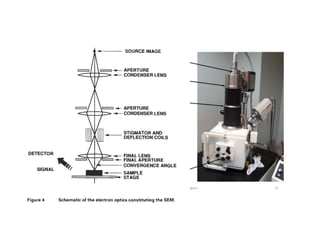
-SOURCEIMAGE
-CONDENSERLENS
APERTURE
CONDENSER LENS
f-- STIGMATOR AND
DEFLECTIONCOILS
FINAL LENS
FINALAPERTURE
CONVERGENCEANGLE
SAMPLE
STAGE
DETECTOR
Figure4 Schematicof the electronopticsconstitutingthe SEM.
effects. The depth of focus in the SEM is compared in Figure 5 with that of an opti-
cal microscope operated at the same magnification for viewing the top of a com-
Scanning Tunneling Microscopy and
Scanning Force Microscopy (STMand SFM) 1.2.3
In ScanningTunneling Microscopy(STM) or Scanning Force Microscopy(SFM),
a solid specimenin air, liquid or vacuum is scanned by a sharp tip locatedwithin a
few A of the surface. In STM, a quantum-mechanical tunneling current flows
between atoms on the surface and those on the tip. In SFM, also known as Atomic
Force Microscopy(AFM), interatomic forcesbetween the atoms on the surfaceand
those on the tip cause the deflection of a microfabricated cantilever. Because the
magnitude of the tunneling current or cantileverdeflectiondepends stronglyupon
the separation between the surfaceand tip atoms, they can be used to map out sur-
facetopography with atomic resolution in all three dimensions.The tunneling cur-
rent in STM is also a function of local electronic structure so that atomic-scale
spectroscopyis possible. Both STM and SFM are unsurpassed as high-resolution,
three-dimensional profilometers.
Parametersmeasured Surface topography (SFM and STM); local electronic
Destructive No
Vertical resolution
Lateral resolution
Quantification Yes; three-dimensional
Accuracy
Imaging/mapping Yes
Field of view From atoms to > 250 pm
Samplerequirements STM-solid conductorsand semiconductors,conductive
coating required for insulators; SFM-solid conductors,
semiconductorsand insulators
structure (STM)
STM, 0.01 8;SFM, 0.1 A
STM, atomic; SFM, atomic to 1nm
Better than 10%in distance
Main uses Real-space three-dimensional imaging in air,
vacuum, or solution with unsurpassed resolu-
tion; high-resolution profilometry; imaging of
nonconductors (SFM).
Instrument cost
Size
$65,000 (ambient) to $200,000 (ultrahigh vacuum)
Table-top (ambient), 2.27-12 inch bolt-on flange
(ultrahighvacuum)
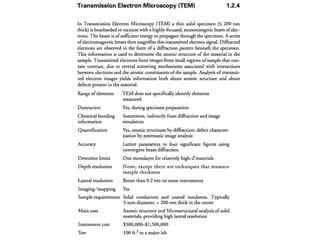
Transmission Electron Microscopy (TEM) 1.2.4
In Transmission Electron Microscopy (TEM) a thin solid specimen (5 200 nm
thick) is bombarded in vacuumwith a highly-focused,monoenergeticbeam of elec-
trons. The beam is of sufficient energyto propagate through the specimen.A series
of electromagneticlensesthen magnifies this transmitted electron signal. Diffracted
electrons are observed in the form of a diffraction pattern beneath the specimen.
This information is used to determine the atomic structure of the material in the
sample. Transmitted electrons form images from small regions of samplethat con-
tain contrast, due to several scattering mechanisms associated with interactions
between electronsand the atomic constituents of the sample.Analysis of transmit-
ted electron images yields information both about atomic structure and about
defects present in the material.
Range of elements
Destructive
Chemical bonding
information
Quantification
Accuracy
Detection limits
Depth resolution
Lateral resolution
Imaging/mapping
TEM does not specificallyidentifyelements
measured
Yes, during specimen preparation
Sometimes, indirectlyfrom diffractionand image
simulation
Yes, atomic structures by diffraction;defect character-
ization by systematicimage analysis
Lattice parameters to four significant figures using
convergentbeam diffraction
One monolayer for relativelyhigh-Zmaterials
None, except there are techniques that measure
sample thickness
Better than 0.2 nm on some instruments
Yes
Samplerequirements Solid conductors and coated insulators. Typically
3-mm diameter, c 200-nm thick in the center
Main uses Atomic structure and Microstructural analysisof solid
materials, providinghigh lateral resolution
Instrument cost $300,000-$1,500,000
Size 100 fL2to a major lab
Gunalignment coils
1st Condenserlens
2nd Condenserlens
Beamtilt coils
Condenser2 aperture
Diffractionaperture
Diffractionlens
Intermediatelens
1st Projectorlens
2nd Projectorlens
Columnvacuum block
35 mm Roll film camera
Focussingscreen
Platecamera
16 cm Main screen
Figurela Schematic diagram of a TEM instrument, showing the location of a thin
sample andthe principallenseswithin a TEM column.
Energy-Dispersive X-Ray Spectroscopy (EDS) 1.3.1
When the atomsin a materialareionizedbya high-energyradiation they emit char-
acteristicX rays. EDS is an acronym describinga technique of X-ray spectroscopy
that is based on the collection and energy dispersion of characteristic X rays. An
EDS system consistsofa sourceofhigh-energy radiation, usually electrons; a sam-
ple; a solid state detector, usually made from lithium-drifted silicon, Si (Li); and
signal processing electronics. EDS spectrometersare most frequently attached to
electron column instruments. X rays that enter the Si (Li) detector are converted
into signalswhich can be processed by the electronics into an X-ray energy histo-
gram. This X-ray spectrum consists of a series of peaks representative of the type
and relative amount ofeach element in the sample. The number of counts in each
peak may be furtherconvertedinto elementalweight concentration either by com-
parison with standardsor by standardlesscalculations.
Range of elements
Destructive
Chemical bonding
information
Quantification
Detection limits
Lateralresolution
Depth sampled
Imaging/mapping
Boron to uranium
No
Not readilyavailable
Best with standards, although standardless methods
arewidelyused
Nominally P5%, relative, for concentrations
> 5yo wt.
100-200 ppm for isolated peaks in elements with
Z>11,1-2% wt. for low-Zand overlappedpeaks
-5-1 pm for bulk samples; as small as 1 nm for thin
samplesin STEM
0.02 to pm, depending on Z and keV
In SEM, EPMA, and STEM
Samplerequirements Solids, powders, and composites; size limited only by
the stage in SEM, EPMA and XRF; liquids in XRF;
3 mm diameter thin foils in TEM
To add analytical capability to SEM, EPMA and
TEM
$25,000-$100,000, depending on accessories (not
including the electron microscope)
Main use
cost
ScanningTransmission
Electron Microscopy (STEM) 1.3.4
In Scanning Transmission Electron Microscopy (STEM) a solid specimen, 5-
500 nm thick, is bombarded in vacuum by a beam (0.3-50 nm in diameter) of
monoenergeticelectrons. STEM imagesare formedby scanningthis beam in a ras-
ter acrossthe specimenand collectingthe transmitted or scattered electrons.Com-
pared to the TEM an advantageof the STEM is that manysignalsmay be collected
simultaneously:bright- and dark-field images;Convergent Beam Electron Diffrac-
tion (CBED) patterns fbr structure analysis; and energy-dispersive X-Ray Spec-
trometry (EDS) and Electron Energy-Loss Spectrometry (EELS) signals for
compositional analysis. Taken together, these analysis techniques are termed Ana-
lyticalElectron Microscopy (AEM).STEM provides about 100times better spatial
resolution of analysis than conventionalTEM. When electronsscattered into high
angles are collected, extremely high-resolution images of atomic planes and even
individual heavy atomsmay be obtained.
Range of elements
Destructive
Chemical bonding
information
Quantification
Accuracy
Detection limits
Lateral resolution
Imaging/mapping
capabilities
Lithium to uranium
Yes, during specimenpreparation
Sometimes,from EELS
Quantitative cornpositional analysis from EDS or
EELS, and crystal structure analysis from CBED
5-10% relativefor EDS and EELS
0.1-3.0% wt. for EDS and EELS
Imaging,0.2-10 nm; EELS, 0.5-10 nm; EDS, 3-30 nm
Yes, lateralresolution down to < 5 nm
Samplerequirements Solidconductorsand coated insulatorstypically 3 mm
in diameter and c 200 nm thick at the analysis point
b r imaging and EDS, but < 50 nm thick for EELS
Microstructural,crystallographic,and compositionalanal-
ysis; highspatial resolution with @elemental detection
and accuracyjuniquestructural analysiswithCBED
Main uses
Instrument cost $500,000-$2,000,000
Electron
Secondary Characteristic
,Energy loss electrons
scatteredelectrons
Diffractedand
Zero loss and
undeviatedelectrons
Figure1 Signals generated when the focussed electron beam interacts with a thin
specimen in a scanningtransmissionelectron microscope(STEM).
and packaging,joining methods, coatings, compositematerials, catalysts, minerals,
and biological tissues.
There are three typesof instruments that provideSTEM imagingand analysisto
various degrees: the TEM /STEM, in which a TEM instrument is modified to
operatein STEM mode; the SEM/STEM, which is a SEM instrument with STEM
imaging capabilities;and dedicated STEM instruments that are built expressly for
STEM operation. The STEM modes of TEM/STEM and SEM/STEM instru-
ments provide useful information to supplement the main TEM and SEM modes,
but only the dedicated STEM with a field emissionelectronsourcecan provide the
highest resolution and elementalsensitivity.
Analysis capabilities in the STEM vary with the technique used. Crystallo-
graphic information may be obtained, including lattice parameters, Bravais lattice
types, point groups, and spacegroups (in some cases), from crystalvolumes on the
order of m3 using CBED. Elemental identification and quantitative
ELECTRON BEAM
SCANMIN A
RASTERON SPECINEN
hision
berm-
Figure2 Schematicof a STEM instrumentshowingthe principalsignaldetectors.The
electron gun and lensesat the bottomof thefigure are notshown.
X-Ray Diffraction(XRD) 1.4.1
In X-Ray Diffraction(XRD)a collimatedbeam ofX rays,withwavelengthh- 0.5-
2 8,is incidenton a specimenand isdiffractedby the crystallinephasesin thespec-
imen accordingto Bragg's law (h = 2dsin0, where dis the spacingbetween atomic
planes in the crystallinephase).The intensityof the diffractedX rays is measuredas
a hnction of the diffractionangle 28 and the specimen'sorientation. This diffrac-
tion pattern is used to identifythe specimen'scrystallinephases and to measure its
structuralproperties, includingstrain (which is measuredwith great accuracy),epi-
taxy,andthesizeand orientationof crystallites(smallcrystallineregions).XRDcan
also determineconcentration profiles, film thicknesses, and atomic arrangements
in amorphousmaterialsand multilayers. It as0can characterized&ts. Toobtain
this structural and physical information ftom thin films, XRD instruments and
techniquesare designedto maximizethe diffractedX-ray intensities, since the dif-
fractingpower of thin filmsis small.
Rangeof elements
Probingdepth
Detection Limits
Destructive
Depth profiling
All, but not element specific. Low-Zelementsmay be
difficult to detect
Typically a few pm but material dependent; mono-
layer sensitivitywith synchrotronradiation
Material dependent,but -3%in a two phase mixture;
with synchrotronradiationcan be -0.1%
No, for most materials
Normallyno; but thiscanbe achieved.
Samplerequirements Any material, greater than -0.5 an,althoughsmaller
Lateral resolution Normallynone; although 10pmwith microfbcus
Main use
with microfocus
Identification of crystalline phases; determination of
strain, and crystallite orientation and size; accurate
determination of atomicarrangements
Defect imaging and characterization; atomic arrange-
ments in amorphous materials and multilayers; con-
centration profiles with depth; film thickness
measurements
Specializeduses
Instrumentcost $70,000-$200,000
incident
X-rays
I------
diffractedF
Figure 1 Basicfeaturesof a typicalXRD experiment.
experiment, the diffracted intensityis measured as a function of 28and the orienta-
tion of the specimen,which yields the diffractionpattern. The X-ray wavelength A
is typically 0.7-2 A, which correspondsto X-ray energies (E = 12.4 keV/A) of 6-
X-Ray Photoelectronand
Auger ElectronDiffraction (XPDandAED) 1.4.4
In X-Ray Photoelectron Diffraction (XPD) and Auger Electron Diffraction
(AED), a single crystalor a textured polycrystallinesample is struck by photons or
electrons to produce outgoing electrons that contain surface chemical and struc-
tural information. The focus of XPD and AED is structural information, which
originates from interference effects as the outbound electrons from a particular
atom are scattered by neighboringatomsin the solid. The electron-atom scattering
processstronglyincreasesthe electron intensityin the forward direction, leadingto
the simpleobservation that intensity maxima occur in directionscorrespondingto
rows of atoms. An energy dispersive angle-resolved analyzer is used to map the
intensity distribution as a function of anglefor elements of interest.
Range of elements
Destructive
Element specific
Chemicalstate
specific
Accuracy
Sitesymmetry
Depth Probed
Depth profiling
Detection limits
Lateral resolution
Imaging/ mapping
All except H and He
XPD no; AED may cause e-beam damage
YeS
Yes,XPD is better than AED
Bond angles to within lo; atomic positions to within
0.05 A
Yes, and usually quickly
5-50 A
Yes, to 30A beneath the surface
0.2 at.%
150A (AED), 150pm (XPD)
Yes
Samplerequirements Primarily single crystals,but also textured samples
Main use To determine adsorption sites and thin-film growth
modes in a chemicallyspecificmanner
Instrument cost $300,000-$600,000
Size 4 m x 4 m x 3 m
Auger Electron Spectroscopy (AES) 1.5.3
Auger Electron Spectroscopy(AES) uses a focusedelectron beam to createsecond-
ary electronsnear the surfaceof a solid sample. Some of these (theAuger electrons)
have energies characteristic of the elements and, in many cases, of the chemical
bonding of the atoms from which they are released. Because of their characteristic
energies and the shallowdepth from which they escapewithout energy loss, Auger
electrons are able to characterize the elemental composition and, at times, the
chemistryof the surfaces of samples.When used in combination with ion sputter-
ing to gradually remove the surface, Auger spectroscopy can similarly characterize
the samplein depth. The high spacial resolution of the electron beam and the pro-
cessallowsmicroanalysisofthree-dimensionalregionsofsolidsamples.AEShas the
attributes of high lateral resolution, relatively high sensitivity, standardless semi-
quantitative analysis, and chemical bonding information in somecases.
Range of elements
Destructive
All except H and He
No, except to electron beam-sensitive materials and
during depth profiling
Yes, semiquantitative without standards; quantitative
with standards
100ppm for most elements,depending on the matrix
Yes, in many materials
ElementalAnalysis
Absolutesensitivity
Chemicalstate
information?
Depth probed 5-1 00 a
Depth profiling
Lateral resolution
Imaging/mapping
Samplerequirements Vacuum-compatiblematerials
Main use
Instrument cost $100,000-$800,000
Size
Yes, in combination with ion-beam sputtering
300A forAuger analysis, even less for imaging
Yes, called ScanningAuger Microscopy, S A M
Elementalcomposition of inorganicmaterials
10ft. x 15 ft.
X-Ray Fluorescence(XRF) 1.6.1
In X-Ray Fluorescence (XRF), an X-ray beam is used to irradiatea specimen, and
the emitted fluorescentX rays are analyzedwith a crystal spectrometer and scintil-
lation or proportional counter. The fluorescentradiation normallyis diffractedby a
crystalat differentanglesto separatetheX-raywavelengthsand thereforeto identify
the elements; concentrations are determined from the peak intensities. For thin
filmsXRF intensity-composition-thickness equationsderivedfrom first principles
are used for the precision determination of compositionand thickness. This can be
done also for each individuallayer of multiple-layerfilms.
Range of elements All but low-Zelements: H, He, and Li
Accuracy kl%for composition, 3%for thickness
Destructive No
Depth sampled
Depth profiling
Detection limits
Sensitivity
Lateral resolution
Chemical bond
information spectra
Samplerequirements 15.0 cm in diameter
Main use Identification of elements; determination of
composition and thickness
Instrument cost $50,000-$300,000
Size
Normally in the 10-pm range, but can be a fewtens of
A in the total-reflection range
Normally no, but possible using variable-inci-
dence X rays
Normally 0.1% in concentration.
10-1 O5 A in thickness can be examined
Normally none, but down to 10 pm using a
microbeam
Normally no, but can be obtained from softX-ray
5 ft. x 8 fi.
1.11.1
Diffractionis a technique that uses interferenceof shortwavelength particles (such
as neutrons or electrons)or photons (Xor y rays) reflected from planes of atoms in
crystallinematerials to yield three-dimensionalstructural informationat the atomic
level. Neutron diffraction,likeX-ray diffraction is a nondestructivetechnique that
can be used for atomicallyresolved structure determination and refinement, phase
identificationand quantification, residual stress measurements, and average parti-
cle-size determination of crystalline materials. The major advantages of neutron
diffraction compared to other diffraction techniques, namely the extraordinarily
greaterpenetratingnature of the neutron and its direct interactionwith nuclei, lead
to its use in measurements under special environments, experiments on materials
requiringadepth of penetration greaterthan about 50pm, or structure refinements
of phases containingatoms of widelyvarying atomic numbers.
Range of elements
Destructive No
Bonding information No
Depth probed
Lateral resolution None
Quantitation
Structuralaccuracy
Imaging capabilities None to date
Samplerequirements Material must be crystalline at data collection
temperatures
Main uses Atomic structure refinements or determinations and
residual stress measurements,all in bulk materials
Instruments are at government-funded facilities; cost
for proprietaryexperiments $1000-$9000 per day
All elements detected approximately equally, except
vanadium
Yields bulk information of macro-sized samples (thin
films for determiningmagnetic ordering)
Can be used to quantift crystalline phases
Atomic positions to lO-l3 my accuracy of phase
quantitation -1Yomolar
Instrument cost
–T Maity
To be continued…

Materials Characterization

  • 1.
    Characterization of Materials (MT606) MME 6th SEMESTER, NIFFT, 2020
  • 2.
    ScanningElectronMicroscopy(SEM) 1.2.2 The ScanningElectron Microscope (SEM) is often the first analytical instrument used when a "quick look" at a material is required and the light microscope no longerprovides adequateresolution. In the SEMan electron beam is focusedinto a fine probe and subsequently raster scanned over a small rectangular area. As the beam interactswith the sampleit createsvarioussignals(secondaryelectrons,inter- nal currents, photon emission, etc.), all of which can be appropriately detected. These signals are highly localized to the area directly under the beam. By using these signals to modulate the brightness of a cathode ray tube, which is raster scanned in synchronismwith the electronbeam, an image is formed on the screen. This image is highly magnified and usually has the U 1 ~ ~ k "of a traditional micro- scopic image but with a much greater depth of field. With ancillary detectors, the instrument is capableof elementalanalysis. Main use High magnification imaging and composition (elemental) mapping No, some electron beam damage 10~-300,000~;5000~-100,000~is the typical operating range 500eV-50 keV; typically,20-30 keV conducting film; must be vacuum compatible Less thanO.lmm, up to 10cm or more 1-50 nm in secondaryelectron mode Varies from a few nm to a few pm, depending upon the acceleratingvoltageand the mode of analysis Destructive Magnification range Beam energy range Samplerequirements Minimal, occasionally must be coated with a Samplesize Lateralresolution Depth sampled Bonding information No Depth profiling Only indirect capabilities Instrument cost $100,000-$300,000is typical Size Electronicsconsole3ft. x 5 fi.;electron beam column 3 ft. x 3 ft.
  • 3.
    -SOURCEIMAGE -CONDENSERLENS APERTURE CONDENSER LENS f-- STIGMATORAND DEFLECTIONCOILS FINAL LENS FINALAPERTURE CONVERGENCEANGLE SAMPLE STAGE DETECTOR Figure4 Schematicof the electronopticsconstitutingthe SEM. effects. The depth of focus in the SEM is compared in Figure 5 with that of an opti- cal microscope operated at the same magnification for viewing the top of a com-
  • 4.
    Scanning Tunneling Microscopyand Scanning Force Microscopy (STMand SFM) 1.2.3 In ScanningTunneling Microscopy(STM) or Scanning Force Microscopy(SFM), a solid specimenin air, liquid or vacuum is scanned by a sharp tip locatedwithin a few A of the surface. In STM, a quantum-mechanical tunneling current flows between atoms on the surface and those on the tip. In SFM, also known as Atomic Force Microscopy(AFM), interatomic forcesbetween the atoms on the surfaceand those on the tip cause the deflection of a microfabricated cantilever. Because the magnitude of the tunneling current or cantileverdeflectiondepends stronglyupon the separation between the surfaceand tip atoms, they can be used to map out sur- facetopography with atomic resolution in all three dimensions.The tunneling cur- rent in STM is also a function of local electronic structure so that atomic-scale spectroscopyis possible. Both STM and SFM are unsurpassed as high-resolution, three-dimensional profilometers. Parametersmeasured Surface topography (SFM and STM); local electronic Destructive No Vertical resolution Lateral resolution Quantification Yes; three-dimensional Accuracy Imaging/mapping Yes Field of view From atoms to > 250 pm Samplerequirements STM-solid conductorsand semiconductors,conductive coating required for insulators; SFM-solid conductors, semiconductorsand insulators structure (STM) STM, 0.01 8;SFM, 0.1 A STM, atomic; SFM, atomic to 1nm Better than 10%in distance Main uses Real-space three-dimensional imaging in air, vacuum, or solution with unsurpassed resolu- tion; high-resolution profilometry; imaging of nonconductors (SFM). Instrument cost Size $65,000 (ambient) to $200,000 (ultrahigh vacuum) Table-top (ambient), 2.27-12 inch bolt-on flange (ultrahighvacuum)
  • 5.
    Transmission Electron Microscopy(TEM) 1.2.4 In Transmission Electron Microscopy (TEM) a thin solid specimen (5 200 nm thick) is bombarded in vacuumwith a highly-focused,monoenergeticbeam of elec- trons. The beam is of sufficient energyto propagate through the specimen.A series of electromagneticlensesthen magnifies this transmitted electron signal. Diffracted electrons are observed in the form of a diffraction pattern beneath the specimen. This information is used to determine the atomic structure of the material in the sample. Transmitted electrons form images from small regions of samplethat con- tain contrast, due to several scattering mechanisms associated with interactions between electronsand the atomic constituents of the sample.Analysis of transmit- ted electron images yields information both about atomic structure and about defects present in the material. Range of elements Destructive Chemical bonding information Quantification Accuracy Detection limits Depth resolution Lateral resolution Imaging/mapping TEM does not specificallyidentifyelements measured Yes, during specimen preparation Sometimes, indirectlyfrom diffractionand image simulation Yes, atomic structures by diffraction;defect character- ization by systematicimage analysis Lattice parameters to four significant figures using convergentbeam diffraction One monolayer for relativelyhigh-Zmaterials None, except there are techniques that measure sample thickness Better than 0.2 nm on some instruments Yes Samplerequirements Solid conductors and coated insulators. Typically 3-mm diameter, c 200-nm thick in the center Main uses Atomic structure and Microstructural analysisof solid materials, providinghigh lateral resolution Instrument cost $300,000-$1,500,000 Size 100 fL2to a major lab
  • 6.
    Gunalignment coils 1st Condenserlens 2ndCondenserlens Beamtilt coils Condenser2 aperture Diffractionaperture Diffractionlens Intermediatelens 1st Projectorlens 2nd Projectorlens Columnvacuum block 35 mm Roll film camera Focussingscreen Platecamera 16 cm Main screen Figurela Schematic diagram of a TEM instrument, showing the location of a thin sample andthe principallenseswithin a TEM column.
  • 7.
    Energy-Dispersive X-Ray Spectroscopy(EDS) 1.3.1 When the atomsin a materialareionizedbya high-energyradiation they emit char- acteristicX rays. EDS is an acronym describinga technique of X-ray spectroscopy that is based on the collection and energy dispersion of characteristic X rays. An EDS system consistsofa sourceofhigh-energy radiation, usually electrons; a sam- ple; a solid state detector, usually made from lithium-drifted silicon, Si (Li); and signal processing electronics. EDS spectrometersare most frequently attached to electron column instruments. X rays that enter the Si (Li) detector are converted into signalswhich can be processed by the electronics into an X-ray energy histo- gram. This X-ray spectrum consists of a series of peaks representative of the type and relative amount ofeach element in the sample. The number of counts in each peak may be furtherconvertedinto elementalweight concentration either by com- parison with standardsor by standardlesscalculations. Range of elements Destructive Chemical bonding information Quantification Detection limits Lateralresolution Depth sampled Imaging/mapping Boron to uranium No Not readilyavailable Best with standards, although standardless methods arewidelyused Nominally P5%, relative, for concentrations > 5yo wt. 100-200 ppm for isolated peaks in elements with Z>11,1-2% wt. for low-Zand overlappedpeaks -5-1 pm for bulk samples; as small as 1 nm for thin samplesin STEM 0.02 to pm, depending on Z and keV In SEM, EPMA, and STEM Samplerequirements Solids, powders, and composites; size limited only by the stage in SEM, EPMA and XRF; liquids in XRF; 3 mm diameter thin foils in TEM To add analytical capability to SEM, EPMA and TEM $25,000-$100,000, depending on accessories (not including the electron microscope) Main use cost
  • 8.
    ScanningTransmission Electron Microscopy (STEM)1.3.4 In Scanning Transmission Electron Microscopy (STEM) a solid specimen, 5- 500 nm thick, is bombarded in vacuum by a beam (0.3-50 nm in diameter) of monoenergeticelectrons. STEM imagesare formedby scanningthis beam in a ras- ter acrossthe specimenand collectingthe transmitted or scattered electrons.Com- pared to the TEM an advantageof the STEM is that manysignalsmay be collected simultaneously:bright- and dark-field images;Convergent Beam Electron Diffrac- tion (CBED) patterns fbr structure analysis; and energy-dispersive X-Ray Spec- trometry (EDS) and Electron Energy-Loss Spectrometry (EELS) signals for compositional analysis. Taken together, these analysis techniques are termed Ana- lyticalElectron Microscopy (AEM).STEM provides about 100times better spatial resolution of analysis than conventionalTEM. When electronsscattered into high angles are collected, extremely high-resolution images of atomic planes and even individual heavy atomsmay be obtained. Range of elements Destructive Chemical bonding information Quantification Accuracy Detection limits Lateral resolution Imaging/mapping capabilities Lithium to uranium Yes, during specimenpreparation Sometimes,from EELS Quantitative cornpositional analysis from EDS or EELS, and crystal structure analysis from CBED 5-10% relativefor EDS and EELS 0.1-3.0% wt. for EDS and EELS Imaging,0.2-10 nm; EELS, 0.5-10 nm; EDS, 3-30 nm Yes, lateralresolution down to < 5 nm Samplerequirements Solidconductorsand coated insulatorstypically 3 mm in diameter and c 200 nm thick at the analysis point b r imaging and EDS, but < 50 nm thick for EELS Microstructural,crystallographic,and compositionalanal- ysis; highspatial resolution with @elemental detection and accuracyjuniquestructural analysiswithCBED Main uses Instrument cost $500,000-$2,000,000
  • 9.
    Electron Secondary Characteristic ,Energy losselectrons scatteredelectrons Diffractedand Zero loss and undeviatedelectrons Figure1 Signals generated when the focussed electron beam interacts with a thin specimen in a scanningtransmissionelectron microscope(STEM). and packaging,joining methods, coatings, compositematerials, catalysts, minerals, and biological tissues. There are three typesof instruments that provideSTEM imagingand analysisto various degrees: the TEM /STEM, in which a TEM instrument is modified to operatein STEM mode; the SEM/STEM, which is a SEM instrument with STEM imaging capabilities;and dedicated STEM instruments that are built expressly for STEM operation. The STEM modes of TEM/STEM and SEM/STEM instru- ments provide useful information to supplement the main TEM and SEM modes, but only the dedicated STEM with a field emissionelectronsourcecan provide the highest resolution and elementalsensitivity. Analysis capabilities in the STEM vary with the technique used. Crystallo- graphic information may be obtained, including lattice parameters, Bravais lattice types, point groups, and spacegroups (in some cases), from crystalvolumes on the order of m3 using CBED. Elemental identification and quantitative ELECTRON BEAM SCANMIN A RASTERON SPECINEN hision berm- Figure2 Schematicof a STEM instrumentshowingthe principalsignaldetectors.The electron gun and lensesat the bottomof thefigure are notshown.
  • 10.
    X-Ray Diffraction(XRD) 1.4.1 InX-Ray Diffraction(XRD)a collimatedbeam ofX rays,withwavelengthh- 0.5- 2 8,is incidenton a specimenand isdiffractedby the crystallinephasesin thespec- imen accordingto Bragg's law (h = 2dsin0, where dis the spacingbetween atomic planes in the crystallinephase).The intensityof the diffractedX rays is measuredas a hnction of the diffractionangle 28 and the specimen'sorientation. This diffrac- tion pattern is used to identifythe specimen'scrystallinephases and to measure its structuralproperties, includingstrain (which is measuredwith great accuracy),epi- taxy,andthesizeand orientationof crystallites(smallcrystallineregions).XRDcan also determineconcentration profiles, film thicknesses, and atomic arrangements in amorphousmaterialsand multilayers. It as0can characterized&ts. Toobtain this structural and physical information ftom thin films, XRD instruments and techniquesare designedto maximizethe diffractedX-ray intensities, since the dif- fractingpower of thin filmsis small. Rangeof elements Probingdepth Detection Limits Destructive Depth profiling All, but not element specific. Low-Zelementsmay be difficult to detect Typically a few pm but material dependent; mono- layer sensitivitywith synchrotronradiation Material dependent,but -3%in a two phase mixture; with synchrotronradiationcan be -0.1% No, for most materials Normallyno; but thiscanbe achieved. Samplerequirements Any material, greater than -0.5 an,althoughsmaller Lateral resolution Normallynone; although 10pmwith microfbcus Main use with microfocus Identification of crystalline phases; determination of strain, and crystallite orientation and size; accurate determination of atomicarrangements Defect imaging and characterization; atomic arrange- ments in amorphous materials and multilayers; con- centration profiles with depth; film thickness measurements Specializeduses Instrumentcost $70,000-$200,000
  • 11.
    incident X-rays I------ diffractedF Figure 1 Basicfeaturesofa typicalXRD experiment. experiment, the diffracted intensityis measured as a function of 28and the orienta- tion of the specimen,which yields the diffractionpattern. The X-ray wavelength A is typically 0.7-2 A, which correspondsto X-ray energies (E = 12.4 keV/A) of 6-
  • 12.
    X-Ray Photoelectronand Auger ElectronDiffraction(XPDandAED) 1.4.4 In X-Ray Photoelectron Diffraction (XPD) and Auger Electron Diffraction (AED), a single crystalor a textured polycrystallinesample is struck by photons or electrons to produce outgoing electrons that contain surface chemical and struc- tural information. The focus of XPD and AED is structural information, which originates from interference effects as the outbound electrons from a particular atom are scattered by neighboringatomsin the solid. The electron-atom scattering processstronglyincreasesthe electron intensityin the forward direction, leadingto the simpleobservation that intensity maxima occur in directionscorrespondingto rows of atoms. An energy dispersive angle-resolved analyzer is used to map the intensity distribution as a function of anglefor elements of interest. Range of elements Destructive Element specific Chemicalstate specific Accuracy Sitesymmetry Depth Probed Depth profiling Detection limits Lateral resolution Imaging/ mapping All except H and He XPD no; AED may cause e-beam damage YeS Yes,XPD is better than AED Bond angles to within lo; atomic positions to within 0.05 A Yes, and usually quickly 5-50 A Yes, to 30A beneath the surface 0.2 at.% 150A (AED), 150pm (XPD) Yes Samplerequirements Primarily single crystals,but also textured samples Main use To determine adsorption sites and thin-film growth modes in a chemicallyspecificmanner Instrument cost $300,000-$600,000 Size 4 m x 4 m x 3 m
  • 13.
    Auger Electron Spectroscopy(AES) 1.5.3 Auger Electron Spectroscopy(AES) uses a focusedelectron beam to createsecond- ary electronsnear the surfaceof a solid sample. Some of these (theAuger electrons) have energies characteristic of the elements and, in many cases, of the chemical bonding of the atoms from which they are released. Because of their characteristic energies and the shallowdepth from which they escapewithout energy loss, Auger electrons are able to characterize the elemental composition and, at times, the chemistryof the surfaces of samples.When used in combination with ion sputter- ing to gradually remove the surface, Auger spectroscopy can similarly characterize the samplein depth. The high spacial resolution of the electron beam and the pro- cessallowsmicroanalysisofthree-dimensionalregionsofsolidsamples.AEShas the attributes of high lateral resolution, relatively high sensitivity, standardless semi- quantitative analysis, and chemical bonding information in somecases. Range of elements Destructive All except H and He No, except to electron beam-sensitive materials and during depth profiling Yes, semiquantitative without standards; quantitative with standards 100ppm for most elements,depending on the matrix Yes, in many materials ElementalAnalysis Absolutesensitivity Chemicalstate information? Depth probed 5-1 00 a Depth profiling Lateral resolution Imaging/mapping Samplerequirements Vacuum-compatiblematerials Main use Instrument cost $100,000-$800,000 Size Yes, in combination with ion-beam sputtering 300A forAuger analysis, even less for imaging Yes, called ScanningAuger Microscopy, S A M Elementalcomposition of inorganicmaterials 10ft. x 15 ft.
  • 14.
    X-Ray Fluorescence(XRF) 1.6.1 InX-Ray Fluorescence (XRF), an X-ray beam is used to irradiatea specimen, and the emitted fluorescentX rays are analyzedwith a crystal spectrometer and scintil- lation or proportional counter. The fluorescentradiation normallyis diffractedby a crystalat differentanglesto separatetheX-raywavelengthsand thereforeto identify the elements; concentrations are determined from the peak intensities. For thin filmsXRF intensity-composition-thickness equationsderivedfrom first principles are used for the precision determination of compositionand thickness. This can be done also for each individuallayer of multiple-layerfilms. Range of elements All but low-Zelements: H, He, and Li Accuracy kl%for composition, 3%for thickness Destructive No Depth sampled Depth profiling Detection limits Sensitivity Lateral resolution Chemical bond information spectra Samplerequirements 15.0 cm in diameter Main use Identification of elements; determination of composition and thickness Instrument cost $50,000-$300,000 Size Normally in the 10-pm range, but can be a fewtens of A in the total-reflection range Normally no, but possible using variable-inci- dence X rays Normally 0.1% in concentration. 10-1 O5 A in thickness can be examined Normally none, but down to 10 pm using a microbeam Normally no, but can be obtained from softX-ray 5 ft. x 8 fi.
  • 15.
    1.11.1 Diffractionis a techniquethat uses interferenceof shortwavelength particles (such as neutrons or electrons)or photons (Xor y rays) reflected from planes of atoms in crystallinematerials to yield three-dimensionalstructural informationat the atomic level. Neutron diffraction,likeX-ray diffraction is a nondestructivetechnique that can be used for atomicallyresolved structure determination and refinement, phase identificationand quantification, residual stress measurements, and average parti- cle-size determination of crystalline materials. The major advantages of neutron diffraction compared to other diffraction techniques, namely the extraordinarily greaterpenetratingnature of the neutron and its direct interactionwith nuclei, lead to its use in measurements under special environments, experiments on materials requiringadepth of penetration greaterthan about 50pm, or structure refinements of phases containingatoms of widelyvarying atomic numbers. Range of elements Destructive No Bonding information No Depth probed Lateral resolution None Quantitation Structuralaccuracy Imaging capabilities None to date Samplerequirements Material must be crystalline at data collection temperatures Main uses Atomic structure refinements or determinations and residual stress measurements,all in bulk materials Instruments are at government-funded facilities; cost for proprietaryexperiments $1000-$9000 per day All elements detected approximately equally, except vanadium Yields bulk information of macro-sized samples (thin films for determiningmagnetic ordering) Can be used to quantift crystalline phases Atomic positions to lO-l3 my accuracy of phase quantitation -1Yomolar Instrument cost
  • 16.
    –T Maity To becontinued…