SHRI VAISHNAV INSTITUTE OF FORENSIC
SCIENCE
SCANNING ELECTRON MICROSCOPE
PRESENTED TO : PRESENTED
BY:
KETAN SIR VAIDIK GOUD
CONTENT
 WHAT IS A MICROSCOPE ?
 WHAT IS MICROSCOPY ?
 ELECTRON MICROSCOPY
 BASIC TYPES OF ELECTRON MICROSCOPY
 DIFFERENCES BETWEEN ELECTRON MICROSCOPY & OPTICAL MICROSCOPY
 INTRODUCTION TO SCANNING ELECTRON MICROSCOPY
 CHARACTERSTICS THAT CAN BE VIEWED ON SEM
 ADVANTAGES OF SCANNING ELECTRON MICROSCOPY
 DISADVANTAGES OF SCANNING ELECTRON MICROSCOPY
 SAMPLE PREPARATION
 STRUCTURE OF SCANNING ELECTRON MICROSCOPE
 WORKING OF SCANNING ELECTRON MICROSCOPE
 IMAGE PRODUCED BY SCANNING ELECTRON MICROSCOPE
 CONCLUSION
WHAT IS MICROSCOPE?
 A microscope is an optical instrument used to see objects that are to small to be
seen by naked eye.
 It helps in detailed examination of the sample by producing an enlarged image.
 The magnified image is always bigger than the object.
What is Microscopy?
 Microscopy is the technical field of investigation using microscopes to view objects
and areas of objects that cant be seen by naked eye.
 Term microscopic means invisible to the eye ,unless aided by a microscope
 There are three well known branches of microscopy :
1. Optical microscopy
2. Electron microscopy
3. Scanning probe microscopy
Electron Microscopy.
 Electron microscopes are scientific instruments that use a beam of energetic
electrons to examine objects on very fine scale.
 Electron microscopes were developed due to the limitations of light microscopes
which are limited by the physics of light.
 In the early 1930’s this theoretical limit had been reached and there was a
scientific desire to see the fine details of interior structures of organic cells(eg.
nucleus , mitochondria etc..)
Basic types of Electron microscopy
 TEM – The Transmission Electron Microscope was the first type of Electron
microscope to be developed and is patterned exactly on the light transmission
microscope except that a focused beam of electrons is used instead of light to see
through the specimen. It was developed by MAX KNOLL and ERNST RUSKA in
Germany in 1931.
 SEM – The first Scanning Electron Microscope debuted in 1938 (MANFRED VON
ARDENNE ) with the first commercial instruments around 1965. its late
development was due to the electronics involved in scanning the beam of
electron across the sample.
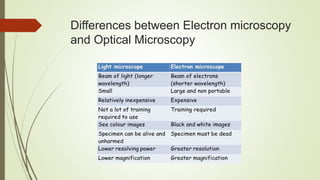
Differences between Electron microscopy
and Optical Microscopy
Introduction to Scanning Electron
Microscopy
 A scanning electron microscope is a type of electron microscope that images a
sample by scanning it with a high energy beam of electrons in a raster scan
pattern.
 The electrons interact with the atoms that make up the sample producing signals
that contain information about the samples surface topography, composition and
other properties.
Characteristics that can be viewed on
SEM.
 Topography – The surface features of an object or “how it looks” ,its texture.
 Morphology – The shape and size of the particles making up the object .
 Composition – The element and compounds that the object is composed of and
the relative amounts of them.
 Crystallographic information – How the atoms are arranged In the atoms.
Advantages of SEM
 Its wide array of applications , the detailed three dimensional and topographical
imaging.
 SEMs are also easy to operate with the proper training and advances in computer
technology.
 In addition , the technological advances in modern SEMs allow for the generation
of data in digital form.
 Although all samples must be prepared before placed in the vacuum chamber,
most SEM samples require minimal preparation actions.
DISADVANTAGES OF SCANNING ELECTRON
MICROSCOPY
 SEMs are expensive, large and must be housed in an area free of any possible
electric, magnetic and vibration interference.
 Maintenance involves keeping a steady voltage, currents to electro magnetic coils
and circulation of cool water.
 The preparation of samples can result in artifacts as a result of preparation errors.
 In addition ,SEMs are limited to solid ,inorganic samples small enough to fit inside
the vacuum chamber.
 Finally SEMs carry a small risk of radiation exposure associate with the electrons
that scatter.
Sample Preparation
 Cleaning the surface of specimen- the proper cleaning of the surface of the
sample is important because the surface can contain a variety of unwanted
deposits such as dust ,silt , detritus or other components, depending on the source
of biological material and the experiment that may have been conducted prior to
SEM specimen preparation.
 Stabilizing the Specimen – Stabilization is typically done with fixatives. Fixation
can be achieved , for eg, by perfusion and micro injection , immersions or vapors
using various fixatives including aldehydes, osmium tetroxide, tannic acid,
thiocarbohydrazide.
 Rinsing the specimen – After the fixation step , samples must be rinsed in order
to remove the excess fixative.
 Dehydrating the Specimen – The dehydration process of a biological sample
needs to be done very carefully. It is typically performed with either a graded
series of acetone or ethanol
 Drying the Specimen – The SEM (like the TEM) operates with a vacuum . Thus ,
specimens must be dry or the sample will be destroyed in the electron microscope
chamber.
 Mounting the specimen – After the sample has been cleaned , fixed , rinsed ,
dehydrated and dried using an appropriate protocol , specimens must be
mounted on a holder that can be inserted into the scanning electron microscope.
Samples are typically mounted on metallic (aluminum) stubs using a double sticky
tape
 Coating the specimen – The idea of coating the specimen is to increase its
conductivity in the scanning electron microscope and to prevent the build up of
high voltage charges on the specimen by conducting the charge to ground.
Typically , specimens are coated with a thin layer of approx. 20-30nm of a
conducting metal , e.g. GOLD , PLATINUM etc….
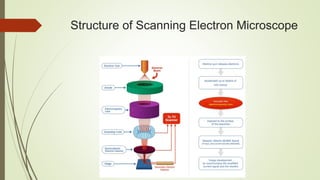
Structure of Scanning Electron Microscope
Working of Scanning Electron Microscope.
 The basic principle is that a beam of electron is generated by a suitable source,
typically a tungsten filament or a field emission gun.
 The electron beam is accelerated through a high voltage and pass through a
system apertures and electro magnetic lenses to produce a thin beam of electron.
 Then the beam scans the surface of the specimen, the electrons are emitted from
the specimen by the action of the scanning beam and collected by a suitably
positioned detector.
 Low energy secondary electrons excited on the sample’s surface are the most
common signal detected.
Image produced by SEM
CONCLUSION
 The SEM is a technologically advanced piece of instrument
that uses electron beam to produce a detailed image of the
object . It has its certain limitations along with many more
advantages and is being used very extensively in the modern
times for investigation and analysis of the sample in the
scientific labs. It has to be used be very judiciously by a
trained expert and helps him/her to give supportive aid to his
or her opinion.
THANK YOU

Scanning Electron Microscope

  • 1.
    SHRI VAISHNAV INSTITUTEOF FORENSIC SCIENCE SCANNING ELECTRON MICROSCOPE PRESENTED TO : PRESENTED BY: KETAN SIR VAIDIK GOUD
  • 2.
    CONTENT  WHAT ISA MICROSCOPE ?  WHAT IS MICROSCOPY ?  ELECTRON MICROSCOPY  BASIC TYPES OF ELECTRON MICROSCOPY  DIFFERENCES BETWEEN ELECTRON MICROSCOPY & OPTICAL MICROSCOPY  INTRODUCTION TO SCANNING ELECTRON MICROSCOPY  CHARACTERSTICS THAT CAN BE VIEWED ON SEM  ADVANTAGES OF SCANNING ELECTRON MICROSCOPY  DISADVANTAGES OF SCANNING ELECTRON MICROSCOPY  SAMPLE PREPARATION  STRUCTURE OF SCANNING ELECTRON MICROSCOPE  WORKING OF SCANNING ELECTRON MICROSCOPE  IMAGE PRODUCED BY SCANNING ELECTRON MICROSCOPE  CONCLUSION
  • 3.
    WHAT IS MICROSCOPE? A microscope is an optical instrument used to see objects that are to small to be seen by naked eye.  It helps in detailed examination of the sample by producing an enlarged image.  The magnified image is always bigger than the object.
  • 4.
    What is Microscopy? Microscopy is the technical field of investigation using microscopes to view objects and areas of objects that cant be seen by naked eye.  Term microscopic means invisible to the eye ,unless aided by a microscope  There are three well known branches of microscopy : 1. Optical microscopy 2. Electron microscopy 3. Scanning probe microscopy
  • 5.
    Electron Microscopy.  Electronmicroscopes are scientific instruments that use a beam of energetic electrons to examine objects on very fine scale.  Electron microscopes were developed due to the limitations of light microscopes which are limited by the physics of light.  In the early 1930’s this theoretical limit had been reached and there was a scientific desire to see the fine details of interior structures of organic cells(eg. nucleus , mitochondria etc..)
  • 6.
    Basic types ofElectron microscopy  TEM – The Transmission Electron Microscope was the first type of Electron microscope to be developed and is patterned exactly on the light transmission microscope except that a focused beam of electrons is used instead of light to see through the specimen. It was developed by MAX KNOLL and ERNST RUSKA in Germany in 1931.  SEM – The first Scanning Electron Microscope debuted in 1938 (MANFRED VON ARDENNE ) with the first commercial instruments around 1965. its late development was due to the electronics involved in scanning the beam of electron across the sample.
  • 7.
    Differences between Electronmicroscopy and Optical Microscopy
  • 8.
    Introduction to ScanningElectron Microscopy  A scanning electron microscope is a type of electron microscope that images a sample by scanning it with a high energy beam of electrons in a raster scan pattern.  The electrons interact with the atoms that make up the sample producing signals that contain information about the samples surface topography, composition and other properties.
  • 9.
    Characteristics that canbe viewed on SEM.  Topography – The surface features of an object or “how it looks” ,its texture.  Morphology – The shape and size of the particles making up the object .  Composition – The element and compounds that the object is composed of and the relative amounts of them.  Crystallographic information – How the atoms are arranged In the atoms.
  • 10.
    Advantages of SEM Its wide array of applications , the detailed three dimensional and topographical imaging.  SEMs are also easy to operate with the proper training and advances in computer technology.  In addition , the technological advances in modern SEMs allow for the generation of data in digital form.  Although all samples must be prepared before placed in the vacuum chamber, most SEM samples require minimal preparation actions.
  • 11.
    DISADVANTAGES OF SCANNINGELECTRON MICROSCOPY  SEMs are expensive, large and must be housed in an area free of any possible electric, magnetic and vibration interference.  Maintenance involves keeping a steady voltage, currents to electro magnetic coils and circulation of cool water.  The preparation of samples can result in artifacts as a result of preparation errors.  In addition ,SEMs are limited to solid ,inorganic samples small enough to fit inside the vacuum chamber.  Finally SEMs carry a small risk of radiation exposure associate with the electrons that scatter.
  • 12.
    Sample Preparation  Cleaningthe surface of specimen- the proper cleaning of the surface of the sample is important because the surface can contain a variety of unwanted deposits such as dust ,silt , detritus or other components, depending on the source of biological material and the experiment that may have been conducted prior to SEM specimen preparation.  Stabilizing the Specimen – Stabilization is typically done with fixatives. Fixation can be achieved , for eg, by perfusion and micro injection , immersions or vapors using various fixatives including aldehydes, osmium tetroxide, tannic acid, thiocarbohydrazide.  Rinsing the specimen – After the fixation step , samples must be rinsed in order to remove the excess fixative.
  • 13.
     Dehydrating theSpecimen – The dehydration process of a biological sample needs to be done very carefully. It is typically performed with either a graded series of acetone or ethanol  Drying the Specimen – The SEM (like the TEM) operates with a vacuum . Thus , specimens must be dry or the sample will be destroyed in the electron microscope chamber.  Mounting the specimen – After the sample has been cleaned , fixed , rinsed , dehydrated and dried using an appropriate protocol , specimens must be mounted on a holder that can be inserted into the scanning electron microscope. Samples are typically mounted on metallic (aluminum) stubs using a double sticky tape  Coating the specimen – The idea of coating the specimen is to increase its conductivity in the scanning electron microscope and to prevent the build up of high voltage charges on the specimen by conducting the charge to ground. Typically , specimens are coated with a thin layer of approx. 20-30nm of a conducting metal , e.g. GOLD , PLATINUM etc….
  • 14.
    Structure of ScanningElectron Microscope
  • 15.
    Working of ScanningElectron Microscope.  The basic principle is that a beam of electron is generated by a suitable source, typically a tungsten filament or a field emission gun.  The electron beam is accelerated through a high voltage and pass through a system apertures and electro magnetic lenses to produce a thin beam of electron.  Then the beam scans the surface of the specimen, the electrons are emitted from the specimen by the action of the scanning beam and collected by a suitably positioned detector.  Low energy secondary electrons excited on the sample’s surface are the most common signal detected.
  • 16.
  • 17.
    CONCLUSION  The SEMis a technologically advanced piece of instrument that uses electron beam to produce a detailed image of the object . It has its certain limitations along with many more advantages and is being used very extensively in the modern times for investigation and analysis of the sample in the scientific labs. It has to be used be very judiciously by a trained expert and helps him/her to give supportive aid to his or her opinion.
  • 18.