

SHRI VAISHNAV VIDHYAPEETH VISHWAVIDHYALAYA
SESSION – 2019-20
ANTHROPOLOGY
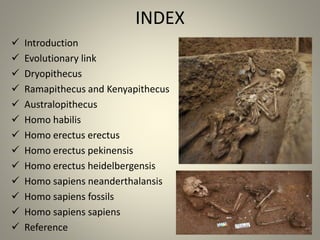
HUMAN EVOLUTION
GUIDED BY, PREPARED BY,
Mr. KETAN PATIL SIR MUSKAN NEEMA
Asst. Prof. SVIFS B.Sc ( IV Sem )
1706DBSFS02118
INDEX
 Introduction
 Evolutionary link
 Dryopithecus
 Ramapithecus and Kenyapithecus
 Australopithecus
 Homo habilis
 Homo erectus erectus
 Homo erectus pekinensis
 Homo erectus heidelbergensis
 Homo sapiens neanderthalansis
 Homo sapiens fossils
 Homo sapiens sapiens
 Reference
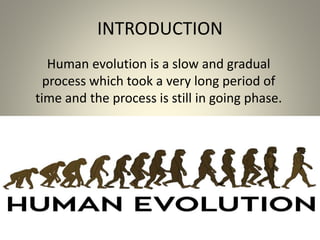
INTRODUCTION
Human evolution is a slow and gradual
process which took a very long period of
time and the process is still in going phase.
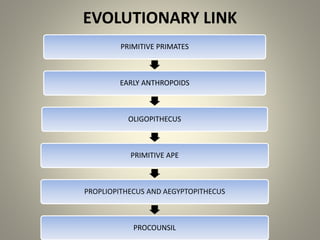
EVOLUTIONARY LINK
PRIMITIVE PRIMATES
EARLY ANTHROPOIDS
OLIGOPITHECUS
PRIMITIVE APE
PROPLIOPITHECUS AND AEGYPTOPITHECUS
PROCOUNSIL
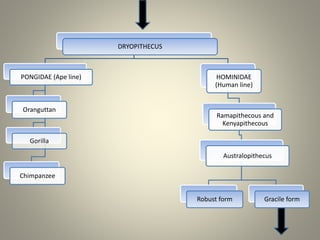
DRYOPITHECUS
PONGIDAE (Ape line)
Oranguttan
Gorilla
Chimpanzee
HOMINIDAE
(Human line)
Ramapithecous and
Kenyapithecous
Australopithecus
Robust form Gracile form
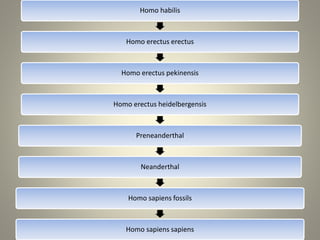
Homo habilis
Homo erectus erectus
Homo erectus pekinensis
Homo erectus heidelbergensis
Preneanderthal
Neanderthal
Homo sapiens fossils
Homo sapiens sapiens
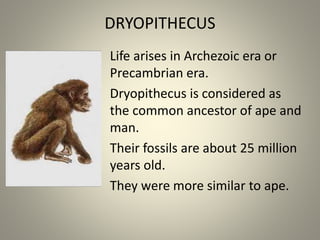
DRYOPITHECUS
Life arises in Archezoic era or
Precambrian era.
Dryopithecus is considered as
the common ancestor of ape and
man.
Their fossils are about 25 million
years old.
They were more similar to ape.
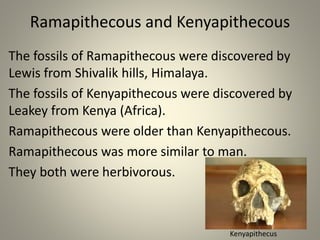
Ramapithecous and Kenyapithecous
The fossils of Ramapithecous were discovered by
Lewis from Shivalik hills, Himalaya.
The fossils of Kenyapithecous were discovered by
Leakey from Kenya (Africa).
Ramapithecous were older than Kenyapithecous.
Ramapithecous was more similar to man.
They both were herbivorous.
Kenyapithecus
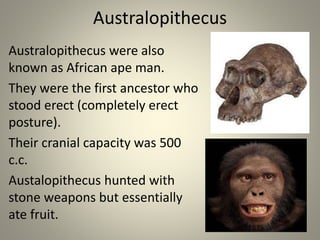
Australopithecus
Australopithecus were also
known as African ape man.
They were the first ancestor who
stood erect (completely erect
posture).
Their cranial capacity was 500
c.c.
Austalopithecus hunted with
stone weapons but essentially
ate fruit.
Homo habilis
They were also known as
Handy man or Tool maker.
They were the first Tool
making ancestor.
Their fossils were
discovered by Leaky from
Africa.
Their cranial capacity was
700 c.c.
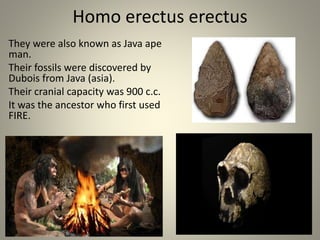
Homo erectus erectus
They were also known as Java ape
man.
Their fossils were discovered by
Dubois from Java (asia).
Their cranial capacity was 900 c.c.
It was the ancestor who first used
FIRE.
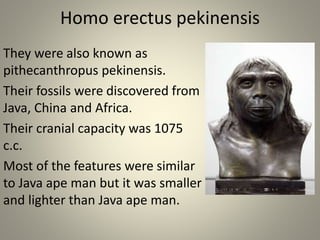
Homo erectus pekinensis
They were also known as
pithecanthropus pekinensis.
Their fossils were discovered from
Java, China and Africa.
Their cranial capacity was 1075
c.c.
Most of the features were similar
to Java ape man but it was smaller
and lighter than Java ape man.
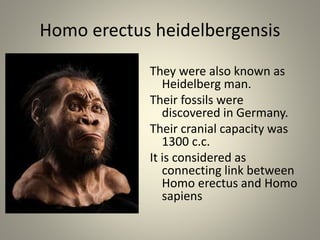
Homo erectus heidelbergensis
They were also known as
Heidelberg man.
Their fossils were
discovered in Germany.
Their cranial capacity was
1300 c.c.
It is considered as
connecting link between
Homo erectus and Homo
sapiens
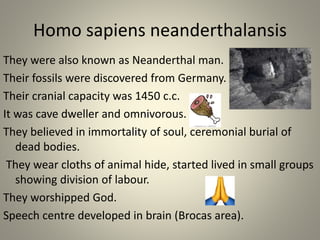
Homo sapiens neanderthalansis
They were also known as Neanderthal man.
Their fossils were discovered from Germany.
Their cranial capacity was 1450 c.c.
It was cave dweller and omnivorous.
They believed in immortality of soul, ceremonial burial of
dead bodies.
They wear cloths of animal hide, started lived in small groups
showing division of labour.
They worshipped God.
Speech centre developed in brain (Brocas area).
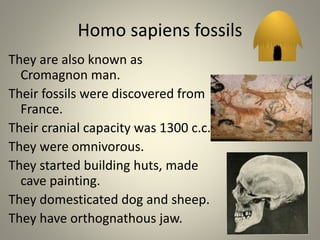
Homo sapiens fossils
They are also known as
Cromagnon man.
Their fossils were discovered from
France.
Their cranial capacity was 1300 c.c.
They were omnivorous.
They started building huts, made
cave painting.
They domesticated dog and sheep.
They have orthognathous jaw.
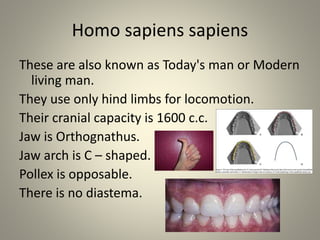
Homo sapiens sapiens
These are also known as Today's man or Modern
living man.
They use only hind limbs for locomotion.
Their cranial capacity is 1600 c.c.
Jaw is Orthognathus.
Jaw arch is C – shaped.
Pollex is opposable.
There is no diastema.
REFERENCE
Origin of life and Evolution – subject matter.
Images – Internet.
Anthropology

Anthropology

  • 1.
    SHRI VAISHNAV VIDHYAPEETHVISHWAVIDHYALAYA SESSION – 2019-20 ANTHROPOLOGY HUMAN EVOLUTION GUIDED BY, PREPARED BY, Mr. KETAN PATIL SIR MUSKAN NEEMA Asst. Prof. SVIFS B.Sc ( IV Sem ) 1706DBSFS02118
  • 2.
    INDEX  Introduction  Evolutionarylink  Dryopithecus  Ramapithecus and Kenyapithecus  Australopithecus  Homo habilis  Homo erectus erectus  Homo erectus pekinensis  Homo erectus heidelbergensis  Homo sapiens neanderthalansis  Homo sapiens fossils  Homo sapiens sapiens  Reference
  • 3.
    INTRODUCTION Human evolution isa slow and gradual process which took a very long period of time and the process is still in going phase.
  • 4.
    EVOLUTIONARY LINK PRIMITIVE PRIMATES EARLYANTHROPOIDS OLIGOPITHECUS PRIMITIVE APE PROPLIOPITHECUS AND AEGYPTOPITHECUS PROCOUNSIL
  • 5.
    DRYOPITHECUS PONGIDAE (Ape line) Oranguttan Gorilla Chimpanzee HOMINIDAE (Humanline) Ramapithecous and Kenyapithecous Australopithecus Robust form Gracile form
  • 6.
    Homo habilis Homo erectuserectus Homo erectus pekinensis Homo erectus heidelbergensis Preneanderthal Neanderthal Homo sapiens fossils Homo sapiens sapiens
  • 7.
    DRYOPITHECUS Life arises inArchezoic era or Precambrian era. Dryopithecus is considered as the common ancestor of ape and man. Their fossils are about 25 million years old. They were more similar to ape.
  • 8.
    Ramapithecous and Kenyapithecous Thefossils of Ramapithecous were discovered by Lewis from Shivalik hills, Himalaya. The fossils of Kenyapithecous were discovered by Leakey from Kenya (Africa). Ramapithecous were older than Kenyapithecous. Ramapithecous was more similar to man. They both were herbivorous. Kenyapithecus
  • 9.
    Australopithecus Australopithecus were also knownas African ape man. They were the first ancestor who stood erect (completely erect posture). Their cranial capacity was 500 c.c. Austalopithecus hunted with stone weapons but essentially ate fruit.
  • 10.
    Homo habilis They werealso known as Handy man or Tool maker. They were the first Tool making ancestor. Their fossils were discovered by Leaky from Africa. Their cranial capacity was 700 c.c.
  • 11.
    Homo erectus erectus Theywere also known as Java ape man. Their fossils were discovered by Dubois from Java (asia). Their cranial capacity was 900 c.c. It was the ancestor who first used FIRE.
  • 12.
    Homo erectus pekinensis Theywere also known as pithecanthropus pekinensis. Their fossils were discovered from Java, China and Africa. Their cranial capacity was 1075 c.c. Most of the features were similar to Java ape man but it was smaller and lighter than Java ape man.
  • 13.
    Homo erectus heidelbergensis Theywere also known as Heidelberg man. Their fossils were discovered in Germany. Their cranial capacity was 1300 c.c. It is considered as connecting link between Homo erectus and Homo sapiens
  • 14.
    Homo sapiens neanderthalansis Theywere also known as Neanderthal man. Their fossils were discovered from Germany. Their cranial capacity was 1450 c.c. It was cave dweller and omnivorous. They believed in immortality of soul, ceremonial burial of dead bodies. They wear cloths of animal hide, started lived in small groups showing division of labour. They worshipped God. Speech centre developed in brain (Brocas area).
  • 15.
    Homo sapiens fossils Theyare also known as Cromagnon man. Their fossils were discovered from France. Their cranial capacity was 1300 c.c. They were omnivorous. They started building huts, made cave painting. They domesticated dog and sheep. They have orthognathous jaw.
  • 16.
    Homo sapiens sapiens Theseare also known as Today's man or Modern living man. They use only hind limbs for locomotion. Their cranial capacity is 1600 c.c. Jaw is Orthognathus. Jaw arch is C – shaped. Pollex is opposable. There is no diastema.
  • 17.
    REFERENCE Origin of lifeand Evolution – subject matter. Images – Internet.