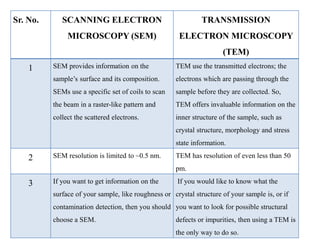
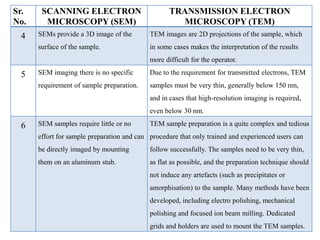
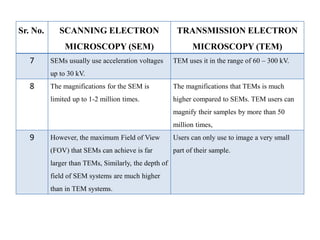
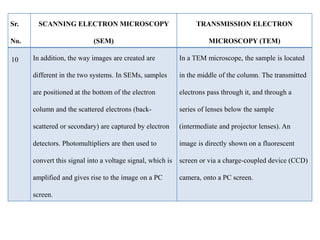
SEM provides information on a sample's surface composition through backscattered and secondary electrons. It has lower resolution than TEM but requires little sample preparation. TEM uses transmitted electrons to view a sample's inner structure and crystal structure at atomic resolution, but requires complex preparation of very thin samples and specialized grids for mounting. While TEM enables higher magnification and resolution, SEM operation is simpler and provides a larger field of view and depth of field.