Barbiturates
What are Barbiturates?
• Barbiturates are multi-colored pills and tablets that
are classified as CNS Depressants.
• Barbiturates are often identified on the street by
the color of the pill/tablet but are most often known
as “Downers”.
• The most common type of synthetic sedatives.
Uses of Barbiturates
• Barbiturates are prescribed to treat several medical
conditions.
• Anxiety
• Depression
• Insomnia
• Alcohol and other drug abuse withdrawal
• Barbiturates are also consumed to get “high”.
• Used by drug users to treat the unpleasant effects of
other drugs.
Barbiturates Consumption
• Orally – In pill, tablet or liquid form
• Injection –
• Into the blood stream
• Into muscle tissue
• Directly under the skin
• Inserted into the body via suppository.
Effects of Barbiturates
•Physical Effects
• Sleepiness
• Nausea
• Slurred Speech
• Breathing Disorders
• Reduced Sex Drive
• Coma
•Psychological Effects
• Mild Euphoria
• Memory Impairment
• Increased Irritability
• Severe Paranoia
• Suicidal Thoughts
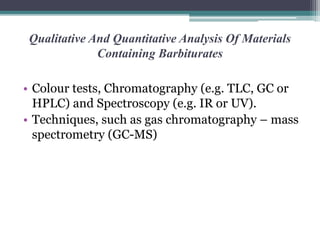
Qualitative And Quantitative Analysis Of Materials
Containing Barbiturates
• Colour tests, Chromatography (e.g. TLC, GC or
HPLC) and Spectroscopy (e.g. IR or UV).
• Techniques, such as gas chromatography – mass
spectrometry (GC-MS)
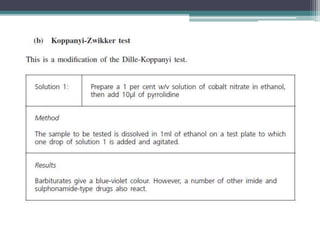
Colour test
• A positive result from a colour test is only a presumptive indication of
the possible presence of a barbiturate derivative
• However, no information as to which particular barbiturate is
present can be obtained with this colour test.
• Colour test performed are
• Dille Koppanyi Test &
• Koppanyi Zwikker Test
SA LTS DETERMINATION
• For quantitative purposes, it is necessary to
know whether the barbiturate is present as a free
acid or in a salt form.
• Test (a) is mainly applicable to bulk powder.
• Test (b) may be more appropriate for those
preparations.
(A) SOLUBILITY
• Place small amounts of the suspect material in each
of two test tubes. Add several drops of water to the
first test tube and several drops of ethyl acetate to
the second.
• Observe in which solvent the material dissolves.
Free acids are soluble in organic solvents such as
ethyl acetate, but are insoluble in water.
• The salt forms of the barbiturates are readily soluble
in water, but are insoluble in ethyl acetate.
• Other organic solvents such as ether and chloroform
may substitute the ethyl acetate.
(B) PH DETERMINATION
• Place a small amount (calcium.10-20 mg) of the
suspected barbiturate in a test tube
• Add 1 ml of water. Determine the pH. A pH
greater than 8.0 indicates that the barbiturate is
present as the sodium or calcium salt.
REFERENCES:
• Recommended Methods For The Identification And
Analysis Of Barbiturates And Benzodiazepines
Under International Control
THANK YOU !!

Barbiturates

  • 1.
  • 2.
    What are Barbiturates? •Barbiturates are multi-colored pills and tablets that are classified as CNS Depressants. • Barbiturates are often identified on the street by the color of the pill/tablet but are most often known as “Downers”. • The most common type of synthetic sedatives.
  • 3.
    Uses of Barbiturates •Barbiturates are prescribed to treat several medical conditions. • Anxiety • Depression • Insomnia • Alcohol and other drug abuse withdrawal • Barbiturates are also consumed to get “high”. • Used by drug users to treat the unpleasant effects of other drugs.
  • 4.
    Barbiturates Consumption • Orally– In pill, tablet or liquid form • Injection – • Into the blood stream • Into muscle tissue • Directly under the skin • Inserted into the body via suppository.
  • 5.
    Effects of Barbiturates •PhysicalEffects • Sleepiness • Nausea • Slurred Speech • Breathing Disorders • Reduced Sex Drive • Coma
  • 6.
    •Psychological Effects • MildEuphoria • Memory Impairment • Increased Irritability • Severe Paranoia • Suicidal Thoughts
  • 7.
    Qualitative And QuantitativeAnalysis Of Materials Containing Barbiturates • Colour tests, Chromatography (e.g. TLC, GC or HPLC) and Spectroscopy (e.g. IR or UV). • Techniques, such as gas chromatography – mass spectrometry (GC-MS)
  • 8.
    Colour test • Apositive result from a colour test is only a presumptive indication of the possible presence of a barbiturate derivative • However, no information as to which particular barbiturate is present can be obtained with this colour test. • Colour test performed are • Dille Koppanyi Test & • Koppanyi Zwikker Test
  • 11.
    SA LTS DETERMINATION •For quantitative purposes, it is necessary to know whether the barbiturate is present as a free acid or in a salt form. • Test (a) is mainly applicable to bulk powder. • Test (b) may be more appropriate for those preparations.
  • 12.
    (A) SOLUBILITY • Placesmall amounts of the suspect material in each of two test tubes. Add several drops of water to the first test tube and several drops of ethyl acetate to the second. • Observe in which solvent the material dissolves. Free acids are soluble in organic solvents such as ethyl acetate, but are insoluble in water. • The salt forms of the barbiturates are readily soluble in water, but are insoluble in ethyl acetate. • Other organic solvents such as ether and chloroform may substitute the ethyl acetate.
  • 13.
    (B) PH DETERMINATION •Place a small amount (calcium.10-20 mg) of the suspected barbiturate in a test tube • Add 1 ml of water. Determine the pH. A pH greater than 8.0 indicates that the barbiturate is present as the sodium or calcium salt.
  • 14.
    REFERENCES: • Recommended MethodsFor The Identification And Analysis Of Barbiturates And Benzodiazepines Under International Control
  • 15.