
TERMINAL BALLISTICS
DEFINITION
AND
DIFFERENT TYPES OF INJURY CAUSED
BY FIREARM
DEFINITION
Terminal ballistics is the study of bullet
behaviour once it impacts the target.
OR
Terminal ballistics is that branch of science
which concern itself with the effect of
moving projectiles on the target. If the target
is living body, the study is known by the
subject is wound ballistics.
FACTORS WHICH AFFECT THE DEGREE
OF INJURY
O Velocity of the bullet
O Mass of bullet
O Size of the bullet
O Drag and retardation
O Composition and shape of the bullet
O Extent of the cavitation
O Extent of deviation (yaw) of the bullet
SHOCK WAVE AND STRESS
WAVE
O While passing through the body tissue
high velocity projectiles compress the
medium and the region of compression
moves away as a shock wave in all
direction in spherical form.
O Precedes the cavitation phenomenon. It
transmitted through fluid filled structure.
RIFLED AND SHOTGUN FIREARM AND
ITS RANGE
O Rifled firearm –
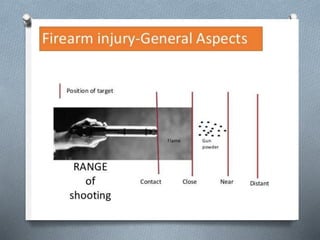
The distance between the muzzle end of the
firearm and the target is called range. This
may be:
O Contact range- if the muzzle end is in the
contact with the body.
O Close shot- if the range is within the distance travelled
by the flame.
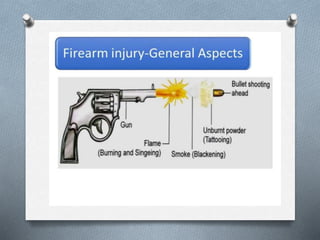
up to 8cm- effect of flame
up to 15cm- effect of smoke
Abrasion collar, grease collar and tattooing present.
Wound track- pink colour
O Near shot- tattooing is present
Abrasion and grease collar is present
Up to 50cm
O Distant shot(>50cm)- abrasion and grease collar
is present
IN SHOT GUNS
O The mass of shot leaves the weapon
initially as a solid mass, which
progressively diverges from the weapon.
Contact shot-
pink red staining of the skin, gun powder
blackening of the wound edges, circular
bruise , redness from CO gases.
O Intermediate range- within 20cm to 1m.
burning will be present
the rim of the wound is irregular forming what is
called rat hole.
O Long range- beyond 2m
tissue displacement
rarely fatal
O Near shot- up to 2m
tattooing is present
sometimes wad produces mild abrasion if
fired within a range of 30cm.
ENTRANCE AND EXIT WOUND OF
PROJECTILE
In case of shot gun-
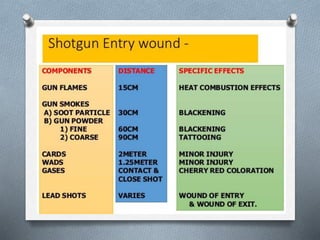
O Entry wound- heat combustion effect,
blackening, tattooing, cherry red
coloration etc.
O Exit wound- rarely produce exit wound
because they traverse the body, but if
happened it may cause a huge ragged
aperture wound.
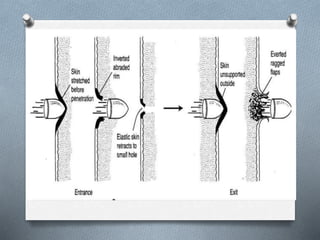
In case of rifled firearm
O Entry wound- show increased amount of
tissue destruction due to the high velocity.
O Exit wound is usually everted with split
flaps, they are usually larger than the
corresponding wound of entry.
NATUREOF INJURY
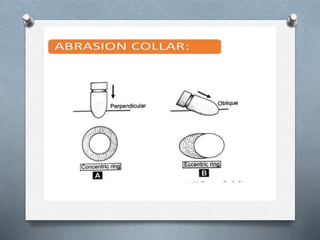
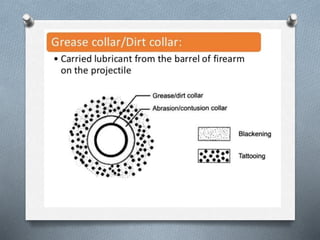
O Abrasion collar- during the bullet’s
attempt at perforating the skin while
entering due to the spine the edge of the
entrance wound may be abraded in the
form of collar called abrasion collar or
areola.
contusion
In some cases there is a contusion instead
of abrasion , in which case it is more
appropriately called contusion collar.
Grease or dirt collar
the bullet as it propelled through the barrel
would naturally carry this grease used as a
lubricant on it, which subsequently get
deposited on the skin around the entrance
wound.
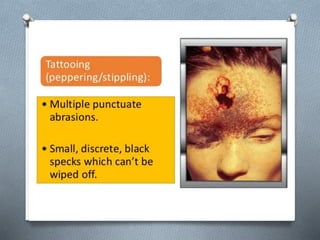
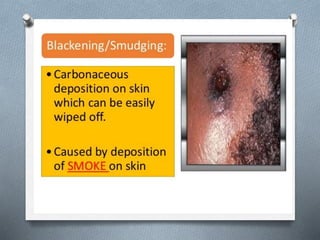
Tattooing and blackening effect
O Tattooing is small, discrete, black specks
which can’t be wiped off.
O Blackening is carbonaceous deposition on
the skin which can be easily wiped off.
WOUND CAUSED BY
MACHINE GUN
O The projectiles used are jacketed bullets and
multiple wounds are caused by machine gun.
WOUND CAUSED BY AIR GUN
O The projectile used is slug of diameter
0.177 and cause dangerous wound even
at range of 50 yards.
Terminal ballistics

Terminal ballistics

  • 1.
  • 2.
    DEFINITION Terminal ballistics isthe study of bullet behaviour once it impacts the target. OR Terminal ballistics is that branch of science which concern itself with the effect of moving projectiles on the target. If the target is living body, the study is known by the subject is wound ballistics.
  • 3.
    FACTORS WHICH AFFECTTHE DEGREE OF INJURY O Velocity of the bullet O Mass of bullet O Size of the bullet O Drag and retardation O Composition and shape of the bullet O Extent of the cavitation O Extent of deviation (yaw) of the bullet
  • 5.
    SHOCK WAVE ANDSTRESS WAVE O While passing through the body tissue high velocity projectiles compress the medium and the region of compression moves away as a shock wave in all direction in spherical form. O Precedes the cavitation phenomenon. It transmitted through fluid filled structure.
  • 7.
    RIFLED AND SHOTGUNFIREARM AND ITS RANGE O Rifled firearm – The distance between the muzzle end of the firearm and the target is called range. This may be: O Contact range- if the muzzle end is in the contact with the body.
  • 8.
    O Close shot-if the range is within the distance travelled by the flame. up to 8cm- effect of flame up to 15cm- effect of smoke Abrasion collar, grease collar and tattooing present. Wound track- pink colour
  • 9.
    O Near shot-tattooing is present Abrasion and grease collar is present Up to 50cm O Distant shot(>50cm)- abrasion and grease collar is present
  • 10.
    IN SHOT GUNS OThe mass of shot leaves the weapon initially as a solid mass, which progressively diverges from the weapon. Contact shot- pink red staining of the skin, gun powder blackening of the wound edges, circular bruise , redness from CO gases.
  • 11.
    O Intermediate range-within 20cm to 1m. burning will be present the rim of the wound is irregular forming what is called rat hole. O Long range- beyond 2m tissue displacement rarely fatal
  • 12.
    O Near shot-up to 2m tattooing is present sometimes wad produces mild abrasion if fired within a range of 30cm.
  • 13.
    ENTRANCE AND EXITWOUND OF PROJECTILE In case of shot gun- O Entry wound- heat combustion effect, blackening, tattooing, cherry red coloration etc. O Exit wound- rarely produce exit wound because they traverse the body, but if happened it may cause a huge ragged aperture wound.
  • 14.
    In case ofrifled firearm O Entry wound- show increased amount of tissue destruction due to the high velocity. O Exit wound is usually everted with split flaps, they are usually larger than the corresponding wound of entry.
  • 17.
    NATUREOF INJURY O Abrasioncollar- during the bullet’s attempt at perforating the skin while entering due to the spine the edge of the entrance wound may be abraded in the form of collar called abrasion collar or areola.
  • 19.
    contusion In some casesthere is a contusion instead of abrasion , in which case it is more appropriately called contusion collar. Grease or dirt collar the bullet as it propelled through the barrel would naturally carry this grease used as a lubricant on it, which subsequently get deposited on the skin around the entrance wound.
  • 21.
    Tattooing and blackeningeffect O Tattooing is small, discrete, black specks which can’t be wiped off. O Blackening is carbonaceous deposition on the skin which can be easily wiped off.
  • 24.
    WOUND CAUSED BY MACHINEGUN O The projectiles used are jacketed bullets and multiple wounds are caused by machine gun.
  • 25.
    WOUND CAUSED BYAIR GUN O The projectile used is slug of diameter 0.177 and cause dangerous wound even at range of 50 yards.