HAMMETT AND 
HANSCH PLOT 
IN DRUG 
FORMULATION 
Presented by Naraino Majie Nabiilah 
and Joorawon Svenia 
Date: 10th November 2014
Table of Content 
• Introduction 
• Modification of lead compound 
• Drug design 
– a) Lipophilicity 
– b) Electronic effects (Hammett plot) 
– c) Steric effects 
– d) Hansch analysis 
• Morphine as example 
• Conclusion 
• References
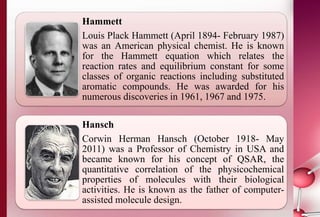
Hammett 
Louis Plack Hammett (April 1894- February 1987) 
was an American physical chemist. He is known 
for the Hammett equation which relates the 
reaction rates and equilibrium constant for some 
classes of organic reactions including substituted 
aromatic compounds. He was awarded for his 
numerous discoveries in 1961, 1967 and 1975. 
Hansch 
Corwin Herman Hansch (October 1918- May 
2011) was a Professor of Chemistry in USA and 
became known for his concept of QSAR, the 
quantitative correlation of the physicochemical 
properties of molecules with their biological 
activities. He is known as the father of computer-assisted 
molecule design.
INTRODUCTION
INTRODUCTION 
• SAR is an advance designed to find the relationships 
between chemical structure and biological activity of 
studied compounds. 
• Therefore it is the concept of linking chemical structure to 
a chemical property or biological activity including 
toxicity. 
• The theory of SARs is to produce new drugs with similar 
structure and effects as the original one but with having 
more potency and improved side-effects. 
• Moreover, SARs are essential for toxicological studies on a 
compound. 
• SARs have been used since long ago to design chemicals 
with the commercially wanted properties and thus they are 
important while designing drugs as the chemicals with 
desired pharmacological and therapeutic activities are 
known.
INTRODUCTION 
• There are various factors that should be considered 
while developing the mechanism of SARs, these are: 
– the size and shape of the carbon skeleton, 
– the nature and degree of substitution and 
– the stereochemistry. 
• During modifications on a drug analogue, effects on 
water solubility, transport through membranes, receptor 
binding, metabolism and other pharmacokinetics 
properties should be considered. 
• Computer assisted molecular modelling helps to solve 
this problem by providing accurate targeting.
MODIFICATION 
OF LEAD
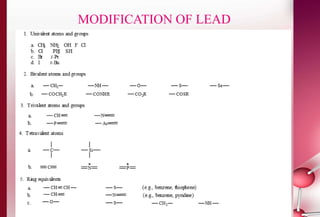
MODIFICATION OF LEAD 
• Varying size and shape 
– Changing the number of methylene groups in chains and 
rings 
• This increases lipophilicity which results in an increased in activity 
• Water solubility is reduced as well as activity 
• No selective binding due to micelle formation in aliphatic 
compounds 
– Increasing or decreasing the degree of unsaturation 
• A change in the degree of unsaturation causes an increase in 
rigidity, complication of E-Z isomers, more sensitivity and 
increased toxicity. 
– Introducing or removing a ring system 
• This results to an increase in size, shape changes and stability of 
structure with the substitution of C=C double bonds.
MODIFICATION OF LEAD 
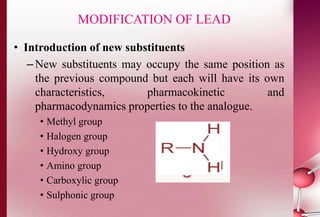
• Introduction of new substituents 
–New substituents may occupy the same position as 
the previous compound but each will have its own 
characteristics, pharmacokinetic and 
pharmacodynamics properties to the analogue. 
• Methyl group 
• Halogen group 
• Hydroxy group 
• Amino group 
• Carboxylic group 
• Sulphonic group
MODIFICATION OF LEAD 
• Bioisosterism 
– Substituents or groups with chemical and physical 
properties. 
– Can attenuate toxicity, modify activity of a lead and 
– Alter the pharmacokinetics profile of the lead. 
– There are two types of bioisosterism: 
• Classical isosteres- have same number of atoms and fit 
the steric and electronic rules and have similar biological 
activity 
• Non- Classical isosteres- do not have same number of 
atoms and do not fit the steric and electronic rules but 
have similar biological activity
DRUG DESIGN
DRUG DESIGN 
• SAR general equation is: 
Biological activity = function {parameter(s)} 
The following should be considered for drug design 
a) Lipophilicity 
Partition coefficient (P) and lipophilicity substituent constant 
(π) are the two parameters that represent lipophilicity. 
i) Partition coefficients (P) 
P is used to measure the movement of drug through membranes. The 
accuracy of the correlation of drug activity with P depends on the solvent 
system used. The equation below shows the relationship between P and drug 
activity: 
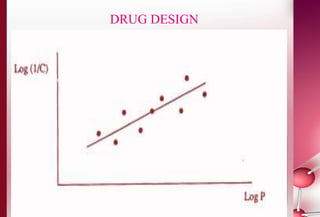
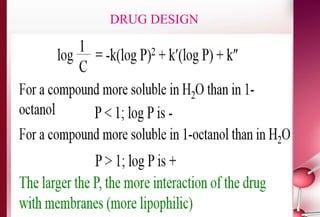
log (1/C) = k1 log P + k2 
k1 and k2 are constants and the equation indicates a linear relationship 
between the activity of the drug and its partition coefficient.
DRUG DESIGN 
ii) Lipophilic substituent constants (π) 
The lipophilic substituent constant (π) can be calculated to 
determine the contribution that different substituents make to 
the hydrophobicity of the compound. 
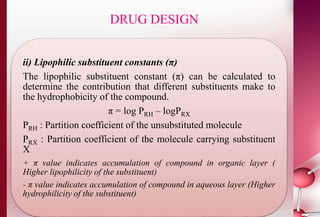
π = log PRH – logPRX 
PRH : Partition coefficient of the unsubstituted molecule 
PRX : Partition coefficient of the molecule carrying substituent 
X 
+ π value indicates accumulation of compound in organic layer ( 
Higher lipophilicity of the substituent) 
- π value indicates accumulation of compound in aqueous layer (Higher 
hydrophilicity of the substituent)
DRUG DESIGN 
b) Electronic effects 
• The activity of a drug is also affected by the distribution of 
electrons in the molecule. 
• Drugs in unionised form are carried easier through the 
membranes compared to drugs in ionised form. 
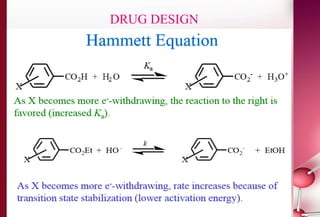
• The Hammett constant is used to quantify the electronic effects. 
i) Hammett constant (σ) 
σX = log (KBX/KB) 
The distribution of electrons in a molecule depends on the nature 
of the electron withdrawing or donating group present in that 
drug. The Hammett constant calculates the equilibrium and rate 
of chemical reactions.
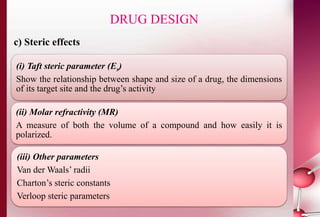
c) Steric effects 
DRUG DESIGN 
(i) Taft steric parameter (Es) 
Show the relationship between shape and size of a drug, the dimensions 
of its target site and the drug’s activity 
(ii) Molar refractivity (MR) 
A measure of both the volume of a compound and how easily it is 
polarized. 
(iii) Other parameters 
Van der Waals’ radii 
Charton’s steric constants 
Verloop steric parameters
DRUG DESIGN 
d) Hansch analysis 
• It tries to relate drug activity to measurable chemical 
properties. According to Hansch, drug action is divided into 2 
stages: 
– Transport of drug to its site of action 
– Binding of drug to target site 
• Each stage depends on chemical and physical properties of 
drug and target site. 
• Hansch suggested that biological activity of drug is related to 
parameters by the mathematical equation:
DRUG DESIGN 
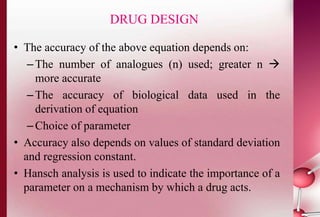
• The accuracy of the above equation depends on: 
– The number of analogues (n) used; greater n  
more accurate 
– The accuracy of biological data used in the 
derivation of equation 
– Choice of parameter 
• Accuracy also depends on values of standard deviation 
and regression constant. 
• Hansch analysis is used to indicate the importance of a 
parameter on a mechanism by which a drug acts.
CRAIG PLOTS 
• Helps in determining suitable susbtituents to 
quickly decide which analogs to synthesize. 
• Plots of one parameter against another. 
–For example, p vs. s 
• Once the Hansch equation has been derived, it 
will show whether p or s should be negative or 
positive in order to get good biological 
activity.
MORPHINE
MORPHINE 
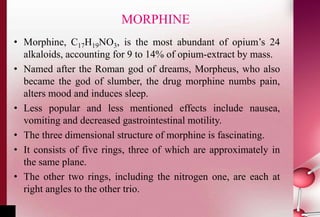
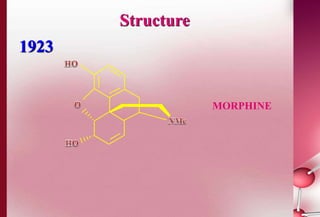
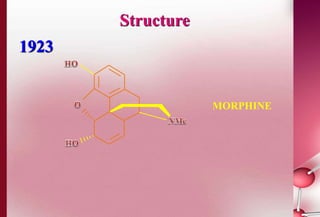
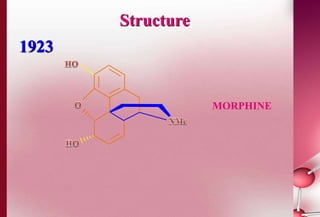
• Morphine, C17H19NO3, is the most abundant of opium’s 24 
alkaloids, accounting for 9 to 14% of opium-extract by mass. 
• Named after the Roman god of dreams, Morpheus, who also 
became the god of slumber, the drug morphine numbs pain, 
alters mood and induces sleep. 
• Less popular and less mentioned effects include nausea, 
vomiting and decreased gastrointestinal motility. 
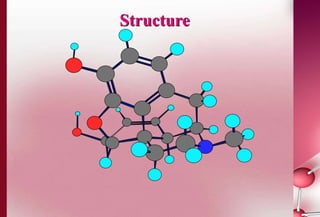
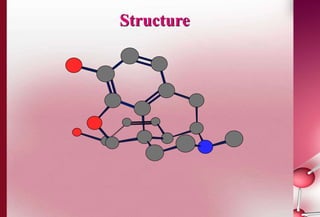
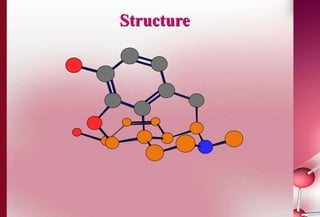
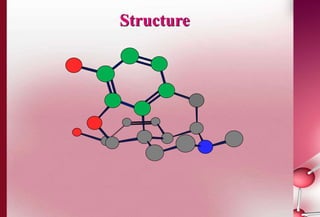
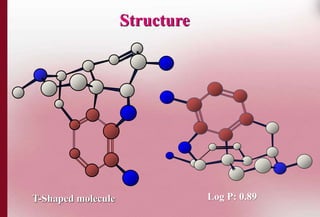
• The three dimensional structure of morphine is fascinating. 
• It consists of five rings, three of which are approximately in 
the same plane. 
• The other two rings, including the nitrogen one, are each at 
right angles to the other trio.
1923 
MORPHINE 
Structure
MORPHINE 
1923 
Structure
MORPHINE 
1923 
Structure
Structure
Structure
Structure
Structure
T-Shaped molecule 
Structure 
Log P: 0.89
Potential Binding Groups 
Functional groups 
Carbon skeleton
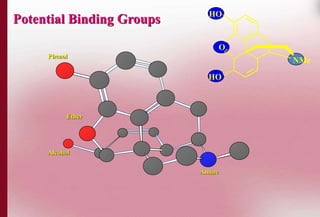
Phenol 
Ether 
Alcohol 
Amine 
O 
NMe 
HO 
HO 
Potential Binding Groups
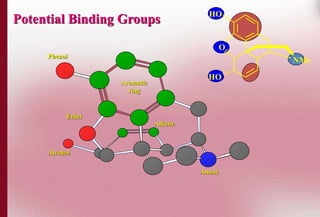
Phenol 
Ether 
Alcohol 
Aromatic 
ring 
Alkene 
Amine 
O 
NMe 
HO 
HO 
Potential Binding Groups
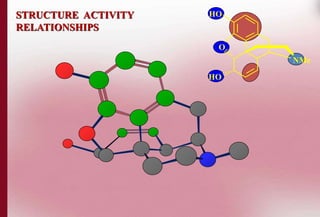
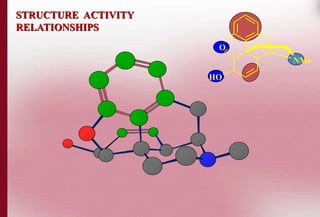
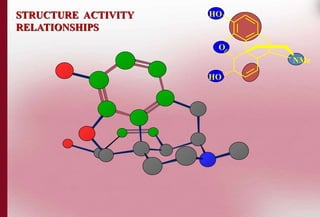
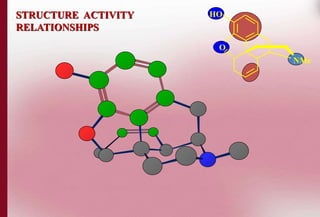
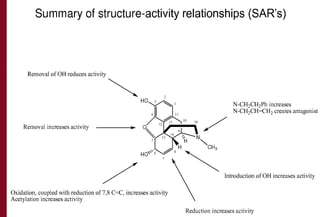
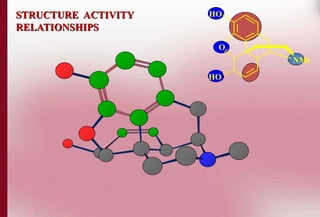
Structure Activity Relationships 
• Mask or remove a functional group 
• Test the analogue for activity 
• Determines the importance or other wise of a 
functional group for activity
STRUCTURE ACTIVITY 
RELATIONSHIPS 
O 
NMe 
HO 
HO
O 
NMe 
HO 
STRUCTURE ACTIVITY 
RELATIONSHIPS
O 
NMe 
HO 
HO 
STRUCTURE ACTIVITY 
RELATIONSHIPS
O 
NMe 
STRUCTURE ACTIVITY HO 
RELATIONSHIPS
O 
NMe 
HO 
HO 
STRUCTURE ACTIVITY 
RELATIONSHIPS
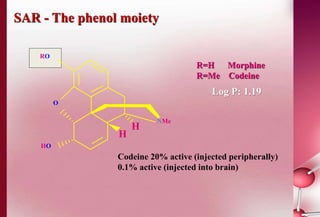
SAR - The phenol moiety 
R=H Morphine 
R=Me Codeine 
NMe 
Codeine 20% active (injected peripherally) 
0.1% active (injected into brain) 
O 
RO 
HO 
H 
H 
Log P: 1.19
SAR - The phenol moiety 
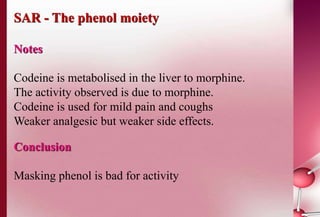
Notes 
Codeine is metabolised in the liver to morphine. 
The activity observed is due to morphine. 
Codeine is used for mild pain and coughs 
Weaker analgesic but weaker side effects. 
Conclusion 
Masking phenol is bad for activity
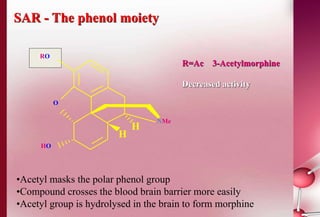
SAR - The phenol moiety 
R=Ac 3-Acetylmorphine 
Decreased activity 
NMe 
O 
RO 
HO 
H 
H 
•Acetyl masks the polar phenol group 
•Compound crosses the blood brain barrier more easily 
•Acetyl group is hydrolysed in the brain to form morphine
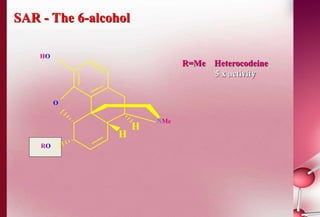
SAR - The 6-alcohol 
R=Me Heterocodeine 
5 x activity 
NMe 
O 
HO 
RO 
H 
H
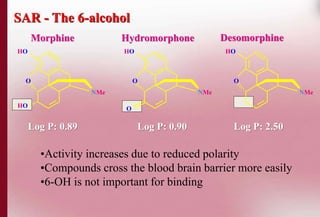
SAR - The 6-alcohol 
Morphine Hydromorphone 
NMe 
HO 
HO 
•Activity increases due to reduced polarity 
•Compounds cross the blood brain barrier more easily 
•6-OH is not important for binding 
HO 
O 
HO 
NMe 
O 
O 
NMe 
O 
Log P: 0.89 Log P: 0.90 
Log P: 2.50 
Desomorphine
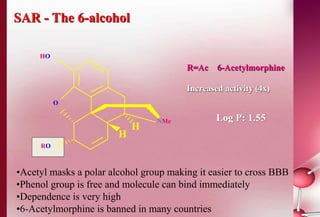
SAR - The 6-alcohol 
R=Ac 6-Acetylmorphine 
Increased activity (4x) 
NMe 
O 
HO 
RO 
H 
H 
Log P: 1.55 
•Acetyl masks a polar alcohol group making it easier to cross BBB 
•Phenol group is free and molecule can bind immediately 
•Dependence is very high 
•6-Acetylmorphine is banned in many countries
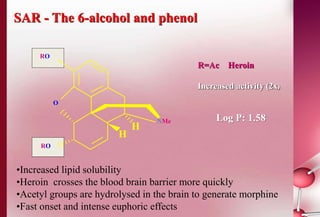
SAR - The 6-alcohol and phenol 
R=Ac Heroin 
Increased activity (2x) 
NMe 
O 
RO 
RO 
H 
H 
Log P: 1.58 
•Increased lipid solubility 
•Heroin crosses the blood brain barrier more quickly 
•Acetyl groups are hydrolysed in the brain to generate morphine 
•Fast onset and intense euphoric effects
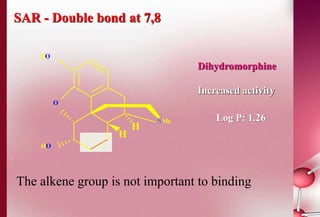
SAR - Double bond at 7,8 
Dihydromorphine 
Increased activity 
NMe 
O 
HO 
HO 
H 
H 
Log P: 1.26 
The alkene group is not important to binding
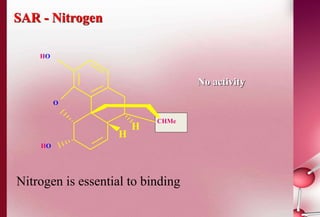
SAR - Nitrogen 
No activity 
CHMe 
O 
HO 
HO 
H 
H 
Nitrogen is essential to binding
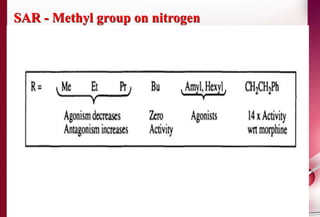
SAR - Methyl group on nitrogen 
NR= NH Normorphine 
Reduced activity (25%) 
+ 
NR= NMe 
- 
O 
N-Oxide 
No activity 
NR= N+Me2 
No activity 
Log P: -1.56 
NR 
O 
HO 
HO 
H 
H 
Quaternary 
salt 
•Normorphine is more polar and crosses the BBB slowly 
•Ionized molecules cannot cross the BBB and are inactive 
•Ionized structures are active if injected directly into brain 
•R affects whether the analogue is an agonist or an antagonist
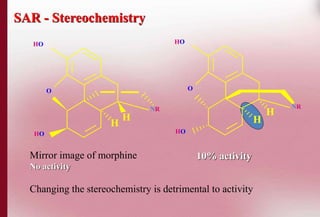
SAR - Stereochemistry 
Mirror image of morphine 
No activity 
H NR 
10% activity 
Changing the stereochemistry is detrimental to activity 
NR 
O 
HO 
HO 
H 
O 
HO 
HO 
H 
H
SAR - Important binding interactions 
HBD or HBA 
van derWaals 
NMe 
Ionic 
(N is protonated) 
O 
HO 
HO 
H 
H
CONCLUSION
CONCLUSION 
• Medicinal chemistry has and will continue to play an important 
role in today's society as it deals with development, synthesis 
and design of pharmaceutical drugs. 
• These results are then used to give us a better understanding of 
diseases as well as giving us ways of preventing and curing 
them. 
• Although medicinal chemistry is about creating new drugs, the 
properties and quantitative structure activity relationships 
(QSAR) of existing drugs is important to see if a combination 
of these biological properties can be mixed with a new hit to 
produce the latest drug that will help fight against various 
diseases.
CONCLUSION 
• As the majority of medicinal chemistry is based around the 
discovery of new drugs and development many companies 
spend a considerable amount of money and maintaining and 
improving their database of information to ensure that each 
test is run as efficient as possible. 
• Of course, thousands of compounds related to the morphine 
structure have been prepared and many without activity, and 
no compound has been found to halt the terrible addictive 
morphine properties. 
• Used correctly, the morphine family is an important class of 
analgesics, and their study represents an important 
contribution to the understanding of medicinal activity.
REFERENCES 
• ANON, 2014. Assessment of chemicals. Introduction to (Quantitative) 
structure activity relationships [online]. Available from: 
http://www.oecd.org/chemicalsafety/risk-assessment/ 
introductiontoquantitativestructureactivityrelationships.htm 
• MCKINNEY, J.D. et al, 2000. Toxicological sciences. The practice of 
structure activity relationships (SAR) in toxicology [online], 56(1), 8-17. 
Available from: http://toxsci.oxfordjournals.org/content/56/1/8.full 
• PARIKH, 2009. Medicinal Chemistry. The SAR & QSAR approaches to 
drug design [online]. Available from: 
http://faculty.mville.edu/parikhs/courses/chm2004/lecture%20notes/CHM 
%202004%20Lectures%20-%20Chapter%204.pdf 
• TOROK, B. Medicinal chemistry. SAR and QSAR [online]. Available 
from: 
http://alpha.chem.umb.edu/chemistry/ch458/files/Lecture_Slides/Lecture_ 
Chapter_3.pdf [Accessed on 8 November 2014]. 
• MANIBUSAN, M. et al, 2012. Technical working group on pesticides. 
(Quantitative) structure activity relationship [(Q)SAR] guidance 
document [online]. Available from: 
http://www.epa.gov/oppfead1/international/naftatwg/guidance/qsar-guidance. 
pdf
REFERENCES 
• ANON, 2014. Wikipedia. Louis Plack Hammett [online]. Available 
from: http://en.wikipedia.org/wiki/Louis_Plack_Hammett 
• ANON, 2014. Wikipedia. Corwin Hansch [online]. Available from: 
http://en.wikipedia.org/wiki/Corwin_Hansch 
• Medicinal Chemistry- Chapter 3, QSAR of Morphine. Available at: 
http://carbon.indstate.edu/rfitch/CHEM%20452/Chapter_3.pdf 
• Anon, Morphine Chemistry, Online. Available at: 
http://www.emsb.qc.ca/laurenhill/science/morphine.html 
• Anon, 2012, A Look at the Morphinan Structure Activity 
Relationships of Six Popular Opiates, Online. Available at: 
http://opiophilia.blogspot.com/2012/12/opiate-structure-activity-relationship. 
html 
• Florencio Zaragoza Dörwald : Lead Optimization for Medicinal 
Chemists: Pharmacokinetic Properties of Functional Groups and 
Organic Compounds
SAR of Morphine

SAR of Morphine

  • 1.
    HAMMETT AND HANSCHPLOT IN DRUG FORMULATION Presented by Naraino Majie Nabiilah and Joorawon Svenia Date: 10th November 2014
  • 2.
    Table of Content • Introduction • Modification of lead compound • Drug design – a) Lipophilicity – b) Electronic effects (Hammett plot) – c) Steric effects – d) Hansch analysis • Morphine as example • Conclusion • References
  • 3.
    Hammett Louis PlackHammett (April 1894- February 1987) was an American physical chemist. He is known for the Hammett equation which relates the reaction rates and equilibrium constant for some classes of organic reactions including substituted aromatic compounds. He was awarded for his numerous discoveries in 1961, 1967 and 1975. Hansch Corwin Herman Hansch (October 1918- May 2011) was a Professor of Chemistry in USA and became known for his concept of QSAR, the quantitative correlation of the physicochemical properties of molecules with their biological activities. He is known as the father of computer-assisted molecule design.
  • 4.
  • 5.
    INTRODUCTION • SARis an advance designed to find the relationships between chemical structure and biological activity of studied compounds. • Therefore it is the concept of linking chemical structure to a chemical property or biological activity including toxicity. • The theory of SARs is to produce new drugs with similar structure and effects as the original one but with having more potency and improved side-effects. • Moreover, SARs are essential for toxicological studies on a compound. • SARs have been used since long ago to design chemicals with the commercially wanted properties and thus they are important while designing drugs as the chemicals with desired pharmacological and therapeutic activities are known.
  • 6.
    INTRODUCTION • Thereare various factors that should be considered while developing the mechanism of SARs, these are: – the size and shape of the carbon skeleton, – the nature and degree of substitution and – the stereochemistry. • During modifications on a drug analogue, effects on water solubility, transport through membranes, receptor binding, metabolism and other pharmacokinetics properties should be considered. • Computer assisted molecular modelling helps to solve this problem by providing accurate targeting.
  • 7.
  • 8.
    MODIFICATION OF LEAD • Varying size and shape – Changing the number of methylene groups in chains and rings • This increases lipophilicity which results in an increased in activity • Water solubility is reduced as well as activity • No selective binding due to micelle formation in aliphatic compounds – Increasing or decreasing the degree of unsaturation • A change in the degree of unsaturation causes an increase in rigidity, complication of E-Z isomers, more sensitivity and increased toxicity. – Introducing or removing a ring system • This results to an increase in size, shape changes and stability of structure with the substitution of C=C double bonds.
  • 9.
    MODIFICATION OF LEAD • Introduction of new substituents –New substituents may occupy the same position as the previous compound but each will have its own characteristics, pharmacokinetic and pharmacodynamics properties to the analogue. • Methyl group • Halogen group • Hydroxy group • Amino group • Carboxylic group • Sulphonic group
  • 10.
    MODIFICATION OF LEAD • Bioisosterism – Substituents or groups with chemical and physical properties. – Can attenuate toxicity, modify activity of a lead and – Alter the pharmacokinetics profile of the lead. – There are two types of bioisosterism: • Classical isosteres- have same number of atoms and fit the steric and electronic rules and have similar biological activity • Non- Classical isosteres- do not have same number of atoms and do not fit the steric and electronic rules but have similar biological activity
  • 11.
  • 12.
    DRUG DESIGN •SAR general equation is: Biological activity = function {parameter(s)} The following should be considered for drug design a) Lipophilicity Partition coefficient (P) and lipophilicity substituent constant (π) are the two parameters that represent lipophilicity. i) Partition coefficients (P) P is used to measure the movement of drug through membranes. The accuracy of the correlation of drug activity with P depends on the solvent system used. The equation below shows the relationship between P and drug activity: log (1/C) = k1 log P + k2 k1 and k2 are constants and the equation indicates a linear relationship between the activity of the drug and its partition coefficient.
  • 13.
    DRUG DESIGN ii)Lipophilic substituent constants (π) The lipophilic substituent constant (π) can be calculated to determine the contribution that different substituents make to the hydrophobicity of the compound. π = log PRH – logPRX PRH : Partition coefficient of the unsubstituted molecule PRX : Partition coefficient of the molecule carrying substituent X + π value indicates accumulation of compound in organic layer ( Higher lipophilicity of the substituent) - π value indicates accumulation of compound in aqueous layer (Higher hydrophilicity of the substituent)
  • 14.
    DRUG DESIGN b)Electronic effects • The activity of a drug is also affected by the distribution of electrons in the molecule. • Drugs in unionised form are carried easier through the membranes compared to drugs in ionised form. • The Hammett constant is used to quantify the electronic effects. i) Hammett constant (σ) σX = log (KBX/KB) The distribution of electrons in a molecule depends on the nature of the electron withdrawing or donating group present in that drug. The Hammett constant calculates the equilibrium and rate of chemical reactions.
  • 15.
    c) Steric effects DRUG DESIGN (i) Taft steric parameter (Es) Show the relationship between shape and size of a drug, the dimensions of its target site and the drug’s activity (ii) Molar refractivity (MR) A measure of both the volume of a compound and how easily it is polarized. (iii) Other parameters Van der Waals’ radii Charton’s steric constants Verloop steric parameters
  • 16.
    DRUG DESIGN d)Hansch analysis • It tries to relate drug activity to measurable chemical properties. According to Hansch, drug action is divided into 2 stages: – Transport of drug to its site of action – Binding of drug to target site • Each stage depends on chemical and physical properties of drug and target site. • Hansch suggested that biological activity of drug is related to parameters by the mathematical equation:
  • 17.
    DRUG DESIGN •The accuracy of the above equation depends on: – The number of analogues (n) used; greater n  more accurate – The accuracy of biological data used in the derivation of equation – Choice of parameter • Accuracy also depends on values of standard deviation and regression constant. • Hansch analysis is used to indicate the importance of a parameter on a mechanism by which a drug acts.
  • 18.
    CRAIG PLOTS •Helps in determining suitable susbtituents to quickly decide which analogs to synthesize. • Plots of one parameter against another. –For example, p vs. s • Once the Hansch equation has been derived, it will show whether p or s should be negative or positive in order to get good biological activity.
  • 19.
  • 20.
    MORPHINE • Morphine,C17H19NO3, is the most abundant of opium’s 24 alkaloids, accounting for 9 to 14% of opium-extract by mass. • Named after the Roman god of dreams, Morpheus, who also became the god of slumber, the drug morphine numbs pain, alters mood and induces sleep. • Less popular and less mentioned effects include nausea, vomiting and decreased gastrointestinal motility. • The three dimensional structure of morphine is fascinating. • It consists of five rings, three of which are approximately in the same plane. • The other two rings, including the nitrogen one, are each at right angles to the other trio.
  • 21.
  • 22.
  • 23.
  • 24.
  • 25.
  • 26.
  • 27.
  • 28.
  • 29.
    Potential Binding Groups Functional groups Carbon skeleton
  • 30.
    Phenol Ether Alcohol Amine O NMe HO HO Potential Binding Groups
  • 31.
    Phenol Ether Alcohol Aromatic ring Alkene Amine O NMe HO HO Potential Binding Groups
  • 32.
    Structure Activity Relationships • Mask or remove a functional group • Test the analogue for activity • Determines the importance or other wise of a functional group for activity
  • 33.
  • 34.
    O NMe HO STRUCTURE ACTIVITY RELATIONSHIPS
  • 35.
    O NMe HO HO STRUCTURE ACTIVITY RELATIONSHIPS
  • 36.
    O NMe STRUCTUREACTIVITY HO RELATIONSHIPS
  • 37.
    O NMe HO HO STRUCTURE ACTIVITY RELATIONSHIPS
  • 38.
    SAR - Thephenol moiety R=H Morphine R=Me Codeine NMe Codeine 20% active (injected peripherally) 0.1% active (injected into brain) O RO HO H H Log P: 1.19
  • 39.
    SAR - Thephenol moiety Notes Codeine is metabolised in the liver to morphine. The activity observed is due to morphine. Codeine is used for mild pain and coughs Weaker analgesic but weaker side effects. Conclusion Masking phenol is bad for activity
  • 40.
    SAR - Thephenol moiety R=Ac 3-Acetylmorphine Decreased activity NMe O RO HO H H •Acetyl masks the polar phenol group •Compound crosses the blood brain barrier more easily •Acetyl group is hydrolysed in the brain to form morphine
  • 41.
    SAR - The6-alcohol R=Me Heterocodeine 5 x activity NMe O HO RO H H
  • 42.
    SAR - The6-alcohol Morphine Hydromorphone NMe HO HO •Activity increases due to reduced polarity •Compounds cross the blood brain barrier more easily •6-OH is not important for binding HO O HO NMe O O NMe O Log P: 0.89 Log P: 0.90 Log P: 2.50 Desomorphine
  • 43.
    SAR - The6-alcohol R=Ac 6-Acetylmorphine Increased activity (4x) NMe O HO RO H H Log P: 1.55 •Acetyl masks a polar alcohol group making it easier to cross BBB •Phenol group is free and molecule can bind immediately •Dependence is very high •6-Acetylmorphine is banned in many countries
  • 44.
    SAR - The6-alcohol and phenol R=Ac Heroin Increased activity (2x) NMe O RO RO H H Log P: 1.58 •Increased lipid solubility •Heroin crosses the blood brain barrier more quickly •Acetyl groups are hydrolysed in the brain to generate morphine •Fast onset and intense euphoric effects
  • 45.
    SAR - Doublebond at 7,8 Dihydromorphine Increased activity NMe O HO HO H H Log P: 1.26 The alkene group is not important to binding
  • 46.
    SAR - Nitrogen No activity CHMe O HO HO H H Nitrogen is essential to binding
  • 47.
    SAR - Methylgroup on nitrogen NR= NH Normorphine Reduced activity (25%) + NR= NMe - O N-Oxide No activity NR= N+Me2 No activity Log P: -1.56 NR O HO HO H H Quaternary salt •Normorphine is more polar and crosses the BBB slowly •Ionized molecules cannot cross the BBB and are inactive •Ionized structures are active if injected directly into brain •R affects whether the analogue is an agonist or an antagonist
  • 48.
    SAR - Stereochemistry Mirror image of morphine No activity H NR 10% activity Changing the stereochemistry is detrimental to activity NR O HO HO H O HO HO H H
  • 49.
    SAR - Importantbinding interactions HBD or HBA van derWaals NMe Ionic (N is protonated) O HO HO H H
  • 50.
  • 51.
    CONCLUSION • Medicinalchemistry has and will continue to play an important role in today's society as it deals with development, synthesis and design of pharmaceutical drugs. • These results are then used to give us a better understanding of diseases as well as giving us ways of preventing and curing them. • Although medicinal chemistry is about creating new drugs, the properties and quantitative structure activity relationships (QSAR) of existing drugs is important to see if a combination of these biological properties can be mixed with a new hit to produce the latest drug that will help fight against various diseases.
  • 52.
    CONCLUSION • Asthe majority of medicinal chemistry is based around the discovery of new drugs and development many companies spend a considerable amount of money and maintaining and improving their database of information to ensure that each test is run as efficient as possible. • Of course, thousands of compounds related to the morphine structure have been prepared and many without activity, and no compound has been found to halt the terrible addictive morphine properties. • Used correctly, the morphine family is an important class of analgesics, and their study represents an important contribution to the understanding of medicinal activity.
  • 53.
    REFERENCES • ANON,2014. Assessment of chemicals. Introduction to (Quantitative) structure activity relationships [online]. Available from: http://www.oecd.org/chemicalsafety/risk-assessment/ introductiontoquantitativestructureactivityrelationships.htm • MCKINNEY, J.D. et al, 2000. Toxicological sciences. The practice of structure activity relationships (SAR) in toxicology [online], 56(1), 8-17. Available from: http://toxsci.oxfordjournals.org/content/56/1/8.full • PARIKH, 2009. Medicinal Chemistry. The SAR & QSAR approaches to drug design [online]. Available from: http://faculty.mville.edu/parikhs/courses/chm2004/lecture%20notes/CHM %202004%20Lectures%20-%20Chapter%204.pdf • TOROK, B. Medicinal chemistry. SAR and QSAR [online]. Available from: http://alpha.chem.umb.edu/chemistry/ch458/files/Lecture_Slides/Lecture_ Chapter_3.pdf [Accessed on 8 November 2014]. • MANIBUSAN, M. et al, 2012. Technical working group on pesticides. (Quantitative) structure activity relationship [(Q)SAR] guidance document [online]. Available from: http://www.epa.gov/oppfead1/international/naftatwg/guidance/qsar-guidance. pdf
  • 54.
    REFERENCES • ANON,2014. Wikipedia. Louis Plack Hammett [online]. Available from: http://en.wikipedia.org/wiki/Louis_Plack_Hammett • ANON, 2014. Wikipedia. Corwin Hansch [online]. Available from: http://en.wikipedia.org/wiki/Corwin_Hansch • Medicinal Chemistry- Chapter 3, QSAR of Morphine. Available at: http://carbon.indstate.edu/rfitch/CHEM%20452/Chapter_3.pdf • Anon, Morphine Chemistry, Online. Available at: http://www.emsb.qc.ca/laurenhill/science/morphine.html • Anon, 2012, A Look at the Morphinan Structure Activity Relationships of Six Popular Opiates, Online. Available at: http://opiophilia.blogspot.com/2012/12/opiate-structure-activity-relationship. html • Florencio Zaragoza Dörwald : Lead Optimization for Medicinal Chemists: Pharmacokinetic Properties of Functional Groups and Organic Compounds

Editor's Notes

  • #11 Classical isoteres: here are some examples of classical isosteres: the CH3 can be replaced by NH2, OH etc CH2 can be replaced ny NH, O and other groups.
  • #13 This graph denotes the linear relationship between log (1/C) and log P.
  • #15 The first equation indicate effect of an electron withdrawing group on equilibria and rate(seond equation-below).
  • #17 The first equation can be further derived into (second equation)
  • #19 Here is an example of craig plot, there are four quadrant with difference in their positivity and negativity. These chemical groups are found in these quadrants.
  • #22 MOR025.WAV
  • #23 mor026 .WAV
  • #24 mor027 .WAV
  • #25 MOR028.WAV
  • #26 MOR029.WAV
  • #27 MOR029.WAV
  • #28 MOR029.WAV
  • #29 Turned the other way to show the T-shape
  • #30 MOR039.WAV
  • #31 MOR042.WAV
  • #32 MOR043.WAV
  • #33 MOR044.WAV
  • #34 MOR045.WAV
  • #35 MOR046.WAV
  • #36 MOR047.WAV
  • #37 MOR048.WAV
  • #38 MOR049.WAV
  • #39 mor053 .WAV
  • #40 mor053 .WAV
  • #41 mor053 .WAV
  • #42 mor053 .WAV
  • #43 mor053 .WAV
  • #44 mor053 .WAV
  • #45 mor053 .WAV
  • #46 mor053 .WAV
  • #47 mor053 .WAV
  • #48 mor053 .WAV
  • #49 mor053 .WAV
  • #50 mor053 .WAV