Microwave-assisted 
Extraction (MAE) 
Presented by: Naraino Majie Nabiilah 
Date: 28th August 2014
Table of Content 
• Introduction 
• Microwave theory 
• Extraction principle 
• Instruments 
– Closed vessel 
– Open vessel 
• Application of MAE 
• Factors affecting MAE 
• Conclusion
INTRODUCTION 
• Microwave-assisted extraction is an efficient 
method which involves deriving natural 
compounds from raw plants. 
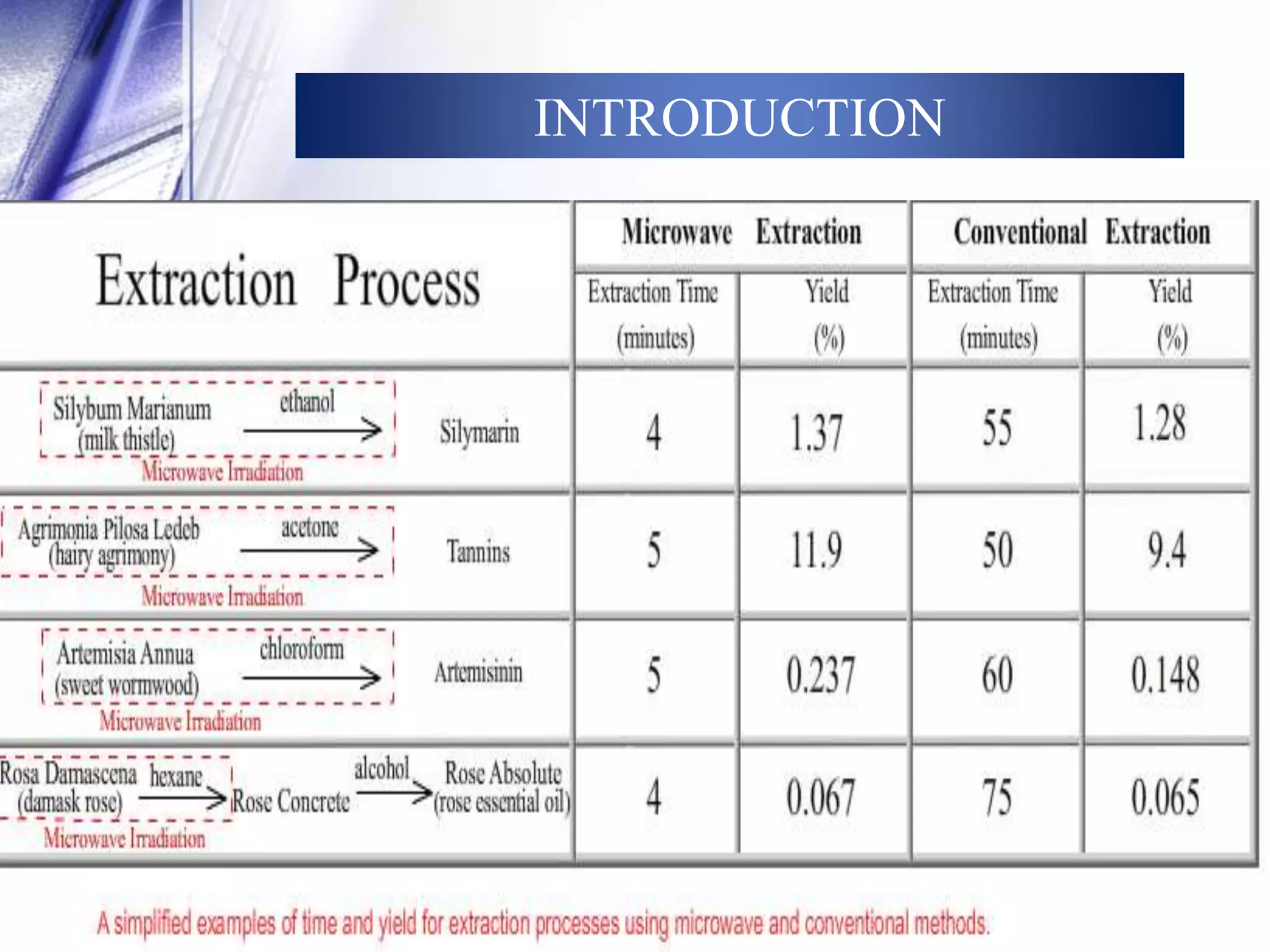
• Microwave extraction allows organic 
compounds to be extracted more rapidly, with 
similar or better yield as compared to 
conventional extraction methods.
INTRODUCTION 
• MAE of anthraquinone in pure alcohol at 
60°C for 30mins gave a recovery of 65% 
which resulted from 3 days maceration in pure 
ethanol at room temperature. 
• The advantages that MAE has over Soxhlet 
are: 
– Reduction in extraction time 
– Improved yield 
– Better accuracy 
– Suitable for thermolabile substances
INTRODUCTION
MICROWAVE THEORY 
• Microwaves are non-ionizing electromagnetic 
waves of frequency between 300MHz to 300 
GHz and positioned between the X-ray and 
infrared rays in the electromagnetic spectrum. 
• Microwaves serves two major purposes: 
– Communication 
– Energy vectors
MICROWAVE THEORY 
• The energy vector application is the direct 
action of waves on materials that has the 
ability to convert a part of the absorbed 
electromagnetic energy to heat energy. 
• Microwaves are made up of two oscillating 
perpendicular field’s i.e. 
– Electric field 
– Magnetic field
MICROWAVE THEORY 
• In MAE, heating occurs in a targeted and 
selective manner with practically no heat 
being lost to the environment as the heating 
occurs in a closed system. 
• This unique heating mechanism significantly 
reduces the extraction time (usually less than 
30min) as compared to Soxhlet.
EXTRACTION PRINCIPLE 
• Dried plants contain a minute microscopic 
trace of moisture which serves as target for 
microwave heating. 
• High temperature and pressure is generated 
inside the oven. 
• High temperature causes dehydration of 
cellulose which accounts for its reduction of 
mechanical strength.
EXTRACTION PRINCIPLE 
• The MAE process is as follows: 
– Microwave radiation 
– Moisture get heated up 
– Moisture evaporates 
– Generation of tremendous pressure on cell 
wall 
– Swelling of plant cell 
– Rupture of the cell 
– Leaching out of phyto-constituents 
• This phenomenon can be intensified if the plant 
matrix is impregnated with solvents with higher 
heating efficiency under microwave.
INSTRUMENTS 
• There are two types of commercially available 
MAE systems: 
– Closed extraction vessels 
– Focused microwave ovens 
• The former performs extraction under 
controlled pressure and temperature. 
• In the latter, only a part of the extraction 
vessel containing the sample is irradiated with 
microwave.
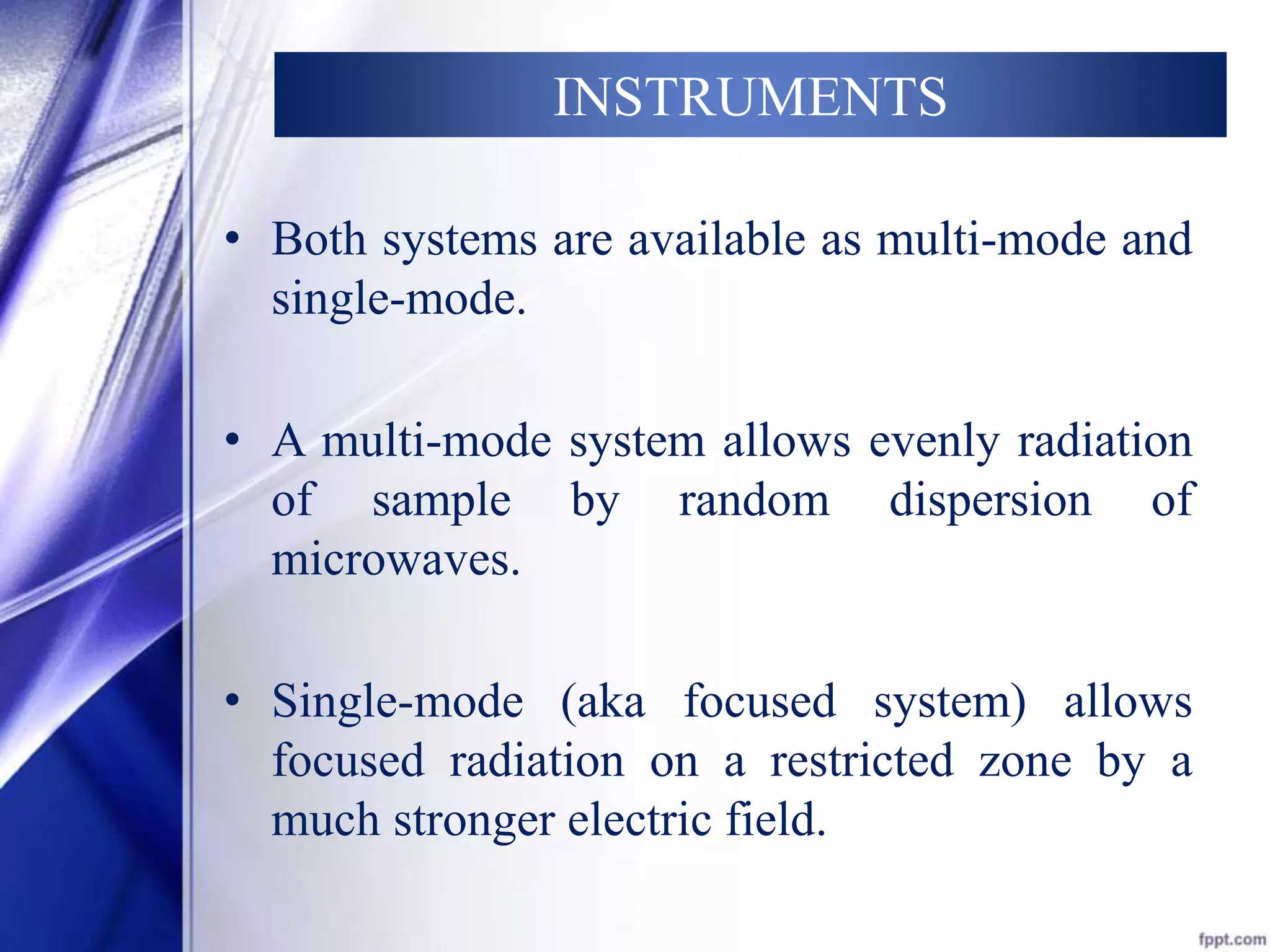
Open and Closed-vessel system
INSTRUMENTS 
• Both systems are available as multi-mode and 
single-mode. 
• A multi-mode system allows evenly radiation 
of sample by random dispersion of 
microwaves. 
• Single-mode (aka focused system) allows 
focused radiation on a restricted zone by a 
much stronger electric field.
INSTRUMENTS 
• Both multi-mode and focused system 
comprises of the following four components: 
– Microwave generator: magnetron which 
generates microwave energy 
– Wave guide: propagate microwave to 
microwave cavity 
– The applicator: where the sample is placed 
– Circulator : allow microwave to move in 
forward direction
CLOSED VESSEL 
• With closed vessel extraction, pressurised 
microwave assisted extraction is performed under 
pressure (with or without regulation). 
• The pressure allows temperatures above boiling 
points of the solvents to be reached enhancing 
speed and efficiency. 
• To avoid overpressure, power, temperature and 
pressure can be controlled. 
• When dealing with thermolabile compounds, high 
temperature causes degradation of analytes. 
Therefore, the open system is chosen.
Advantages of closed-vessel system 
• Decreased in extraction time 
• Loss of volatile substances is avoided 
• Less solvent is required because no 
evaporation occurs 
• No hazardous fumes during acid 
microwave since it is a closed vessel
Disadvantages of closed-vessel system 
• High pressure used pose safety risks 
• The usual constituent material of the vessel 
does not allow high solution temperatures 
• Addition of reagents is impossible since it is 
a single step procedure 
• Vessel must be cooled down before it can be 
opened to prevent loss of volatile 
constituents.
OPEN VESSEL 
• Extraction is made at atmospheric pressure. 
• The maximum possible temperature is 
determined by the boiling point of the solvent 
at that pressure. 
• Losses of vapours are prevented by the 
presence of a cooling system on the top of the 
extraction vessel that causes condensation of 
solvent vapours. 
• Heating is homogenous and efficient.
Advantages of open-vessel system 
• Increased safety 
• Addition of reagent is possible 
• Vessels made of various material can be 
used 
• Excess solvent can be removed easily 
• Ability to process large samples 
• No requirement for cooling down or 
depressurisation 
• Low cost of equipment 
• Suitable for thermolabile products
Disadvantages of open-vessel system 
• The ensuing method are less precise than 
in close-vessel system 
• The sample throughput is lower as open 
system cannot process many samples 
simultaneously 
• Require longer time to achieve same 
results as for closed system
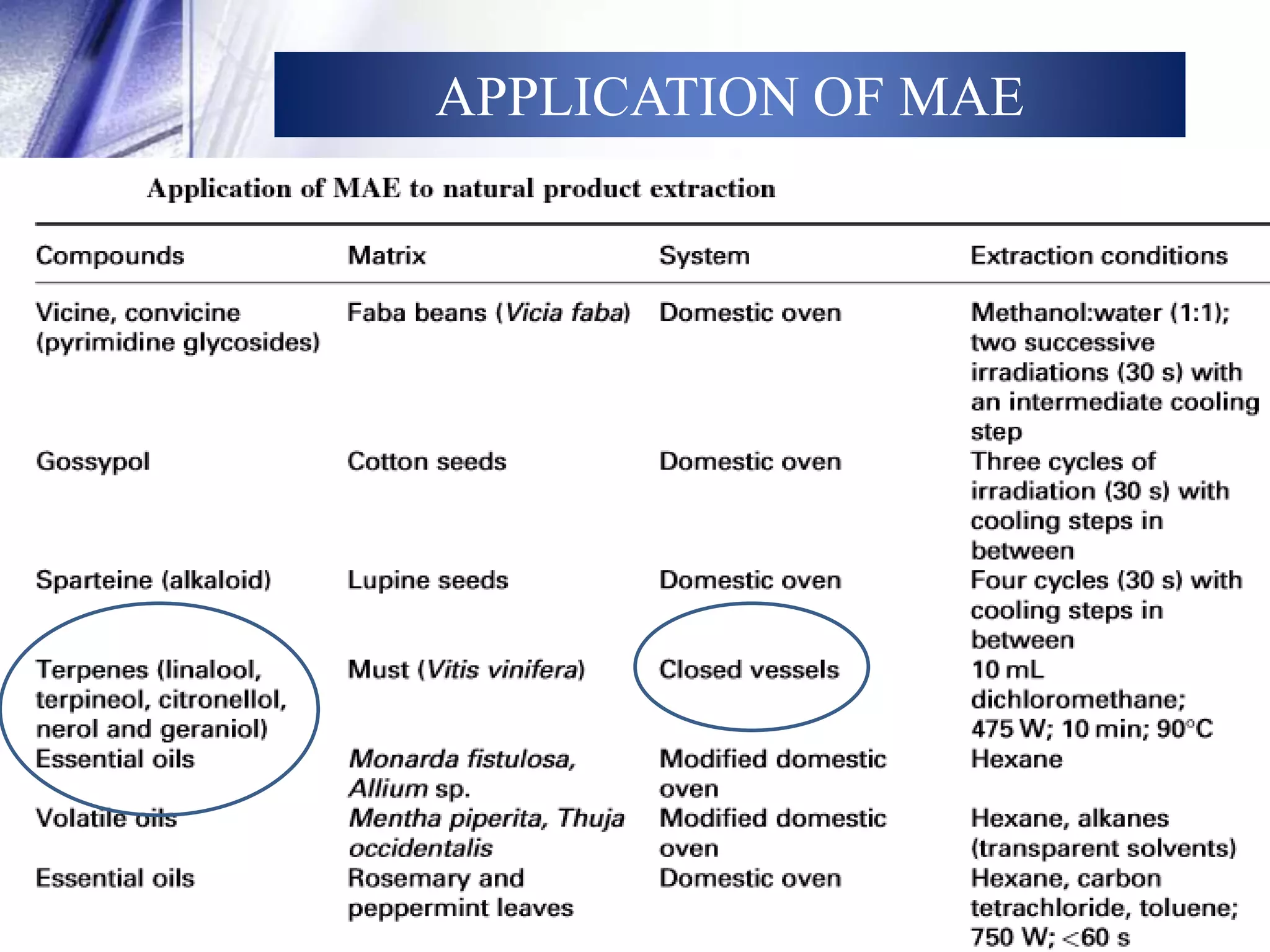
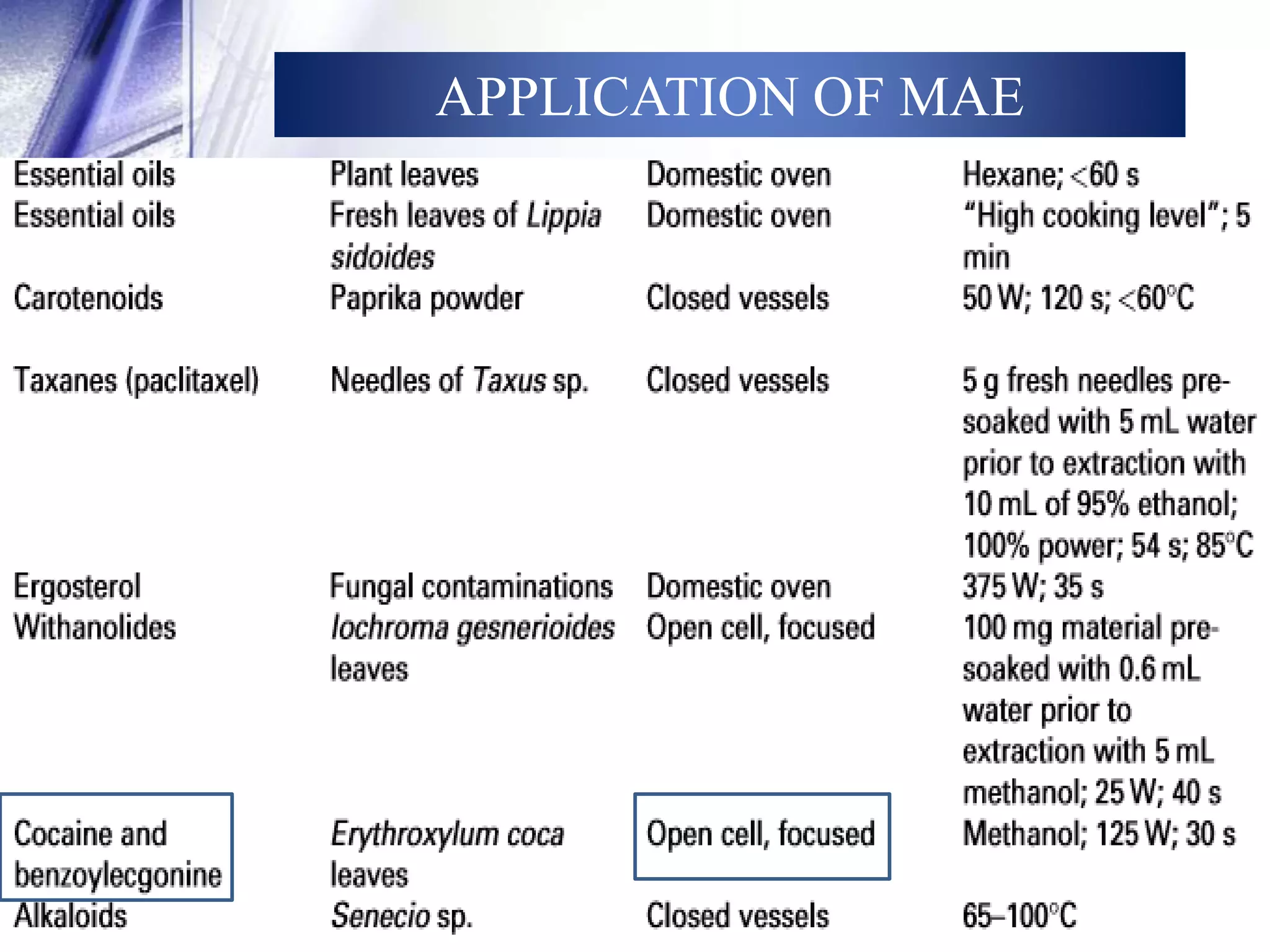
APPLICATION OF MAE
APPLICATION OF MAE
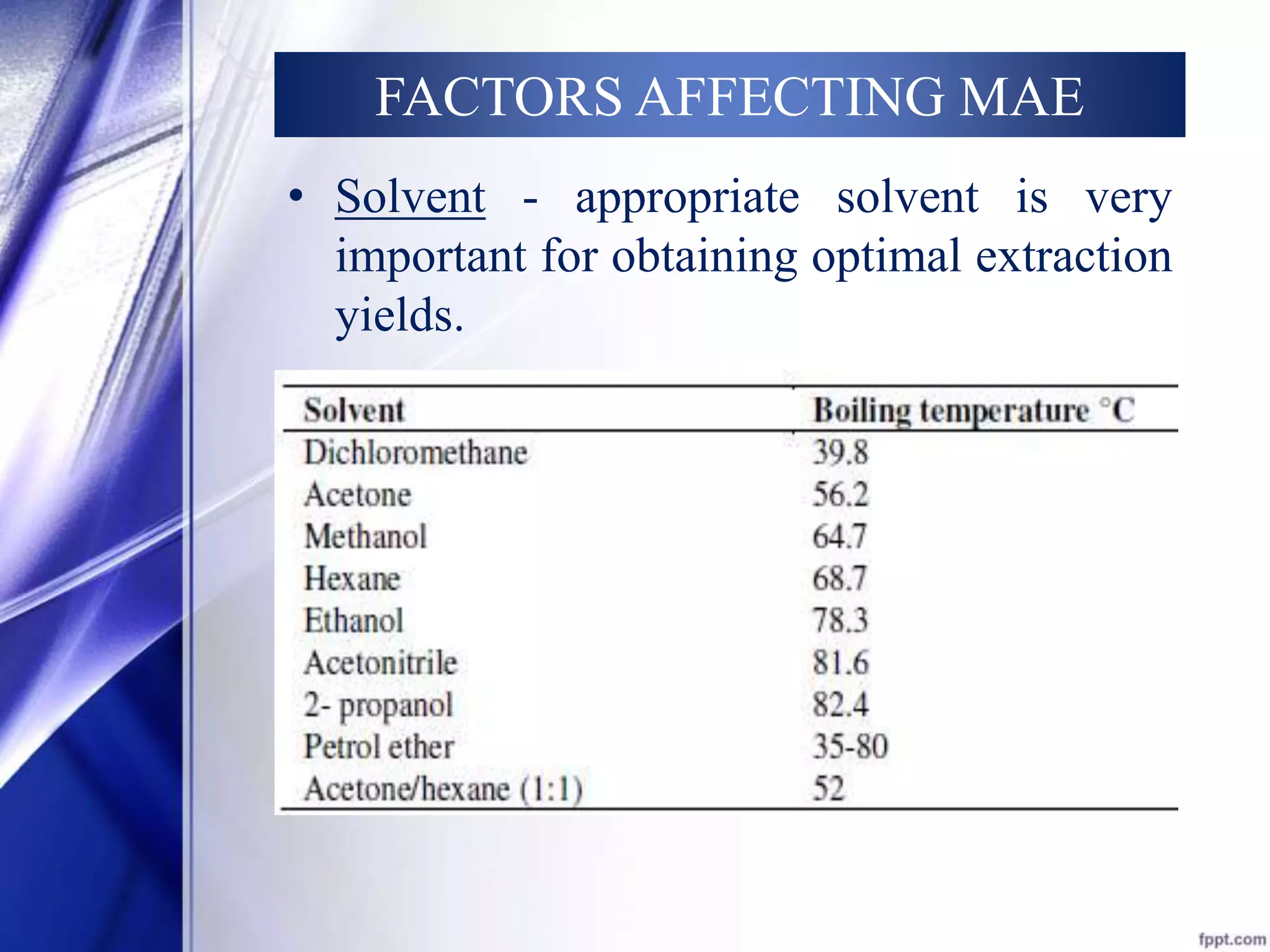
FACTORS AFFECTING MAE 
• Solvent - appropriate solvent is very 
important for obtaining optimal extraction 
yields.
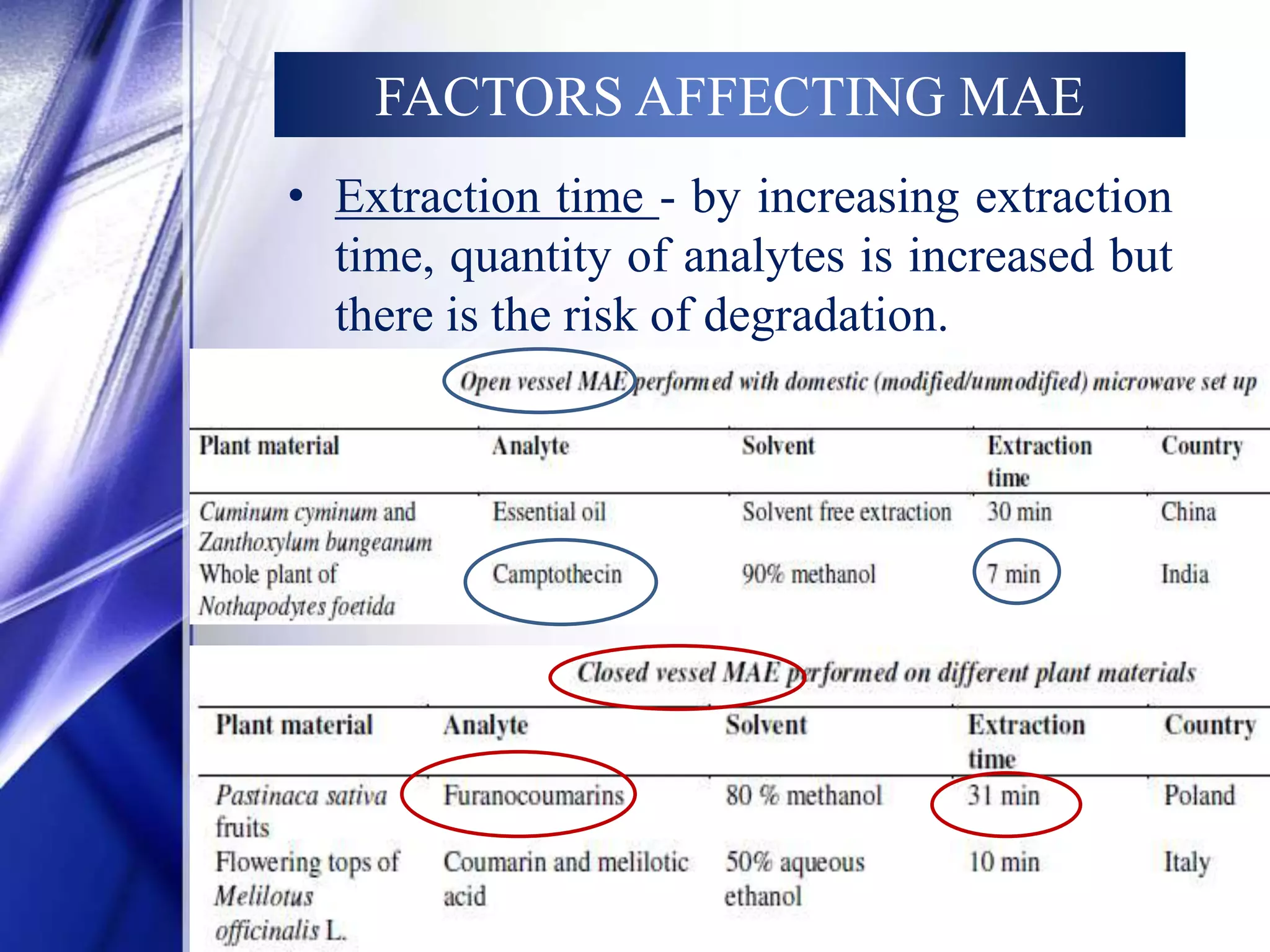
FACTORS AFFECTING MAE 
• Extraction time - by increasing extraction 
time, quantity of analytes is increased but 
there is the risk of degradation.
FACTORS AFFECTING MAE 
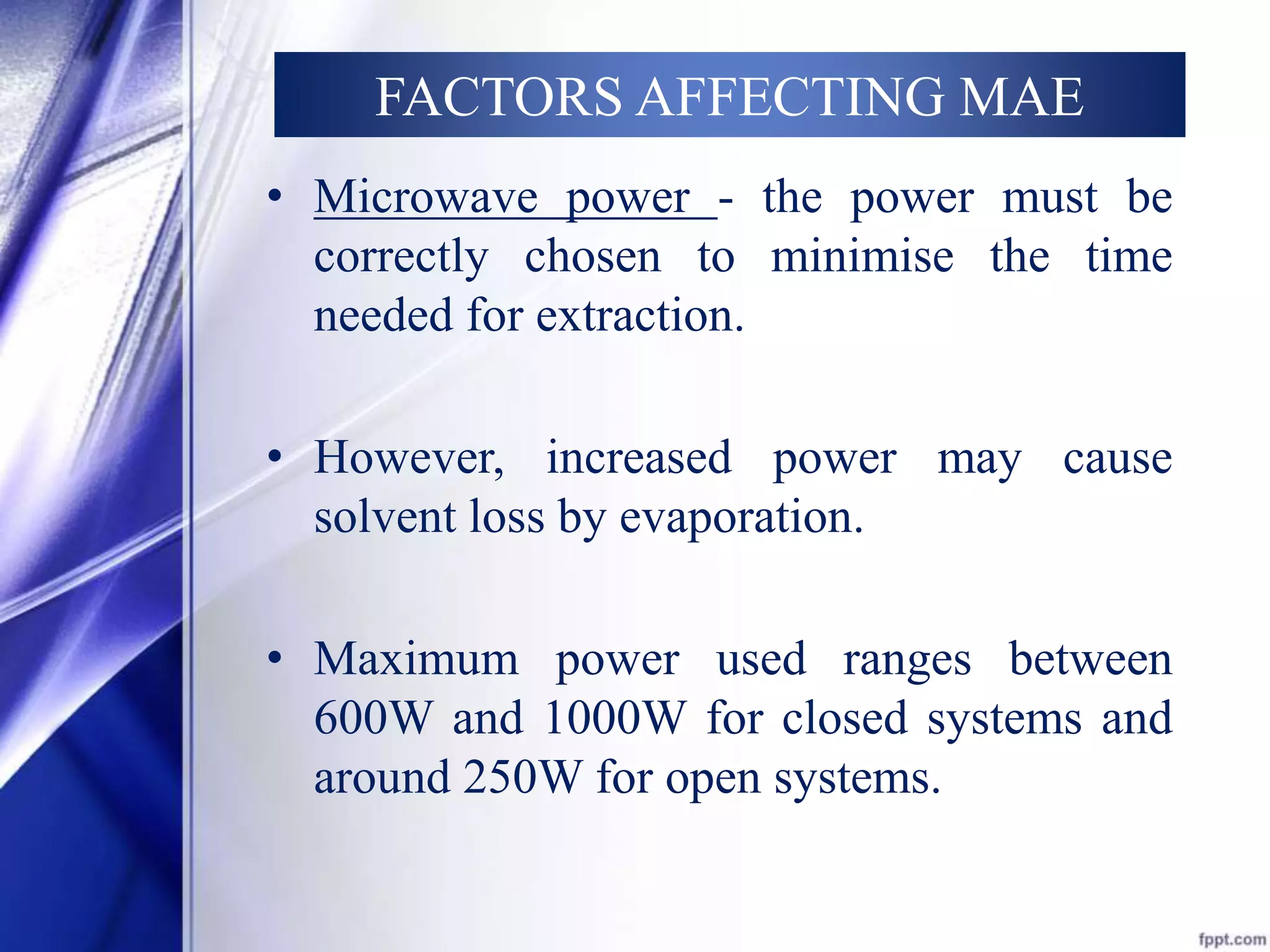
• Microwave power - the power must be 
correctly chosen to minimise the time 
needed for extraction. 
• However, increased power may cause 
solvent loss by evaporation. 
• Maximum power used ranges between 
600W and 1000W for closed systems and 
around 250Wfor open systems.
FACTORS AFFECTING MAE 
• Matrix characteristics - the plant particle size 
and the status in which it is presented for 
MAE can affect the recoveries of 
compounds. 
• The particle sizes of the extracted materials 
are generally in the range of 100m – 2mm. 
• Fine powders enhance extraction as they 
provide a larger surface area.
FACTORS AFFECTING MAE 
• Temperature - temperature should be 
sufficient to ensure good solubility of 
compounds and a good penetration of 
solvent in the plant matrix to enhance 
extraction yield. 
• However, it should not be too high 
enough to degrade the target compounds.
CONCLUSION 
• Chemical analysis of extracts from plant 
material plays a central role in development 
and modernization of herbal medicine. 
• MAE has proven to be effective in all aspects 
compared to traditional extraction techniques. 
• More research is needed to improve the design 
and scale up of the novel extraction systems for 
their better industrial applications.
REFERENCES 
• S. Hemalatha, 2007, Microwave Assisted Extraction 
– An innovative and promising Extraction Tool for 
Medical, Pharmacognosy Reviews, Vol 1-Issue 1 
• Farid Chemat, Giancarlo Cravotto, 2012, 
Microwave-assisted Extraction for Bioactive 
Compounds: Theory and Practice, Ebook 
• Mauricio A. Rostagno, Juliana M. Prado, 2013, 
Natural Product Extraction: Principles and 
Applications, Ebook 
• YouTube videos: 
– https://www.youtube.com/watch?v=oFSe4HaPgg 
o 
– https://www.youtube.com/watch?v=3Em9qU4_2 
YE
THANK YOU

Microwave Assisted Extraction

  • 1.
    Microwave-assisted Extraction (MAE) Presented by: Naraino Majie Nabiilah Date: 28th August 2014
  • 2.
    Table of Content • Introduction • Microwave theory • Extraction principle • Instruments – Closed vessel – Open vessel • Application of MAE • Factors affecting MAE • Conclusion
  • 3.
    INTRODUCTION • Microwave-assistedextraction is an efficient method which involves deriving natural compounds from raw plants. • Microwave extraction allows organic compounds to be extracted more rapidly, with similar or better yield as compared to conventional extraction methods.
  • 4.
    INTRODUCTION • MAEof anthraquinone in pure alcohol at 60°C for 30mins gave a recovery of 65% which resulted from 3 days maceration in pure ethanol at room temperature. • The advantages that MAE has over Soxhlet are: – Reduction in extraction time – Improved yield – Better accuracy – Suitable for thermolabile substances
  • 5.
  • 6.
    MICROWAVE THEORY •Microwaves are non-ionizing electromagnetic waves of frequency between 300MHz to 300 GHz and positioned between the X-ray and infrared rays in the electromagnetic spectrum. • Microwaves serves two major purposes: – Communication – Energy vectors
  • 7.
    MICROWAVE THEORY •The energy vector application is the direct action of waves on materials that has the ability to convert a part of the absorbed electromagnetic energy to heat energy. • Microwaves are made up of two oscillating perpendicular field’s i.e. – Electric field – Magnetic field
  • 8.
    MICROWAVE THEORY •In MAE, heating occurs in a targeted and selective manner with practically no heat being lost to the environment as the heating occurs in a closed system. • This unique heating mechanism significantly reduces the extraction time (usually less than 30min) as compared to Soxhlet.
  • 9.
    EXTRACTION PRINCIPLE •Dried plants contain a minute microscopic trace of moisture which serves as target for microwave heating. • High temperature and pressure is generated inside the oven. • High temperature causes dehydration of cellulose which accounts for its reduction of mechanical strength.
  • 10.
    EXTRACTION PRINCIPLE •The MAE process is as follows: – Microwave radiation – Moisture get heated up – Moisture evaporates – Generation of tremendous pressure on cell wall – Swelling of plant cell – Rupture of the cell – Leaching out of phyto-constituents • This phenomenon can be intensified if the plant matrix is impregnated with solvents with higher heating efficiency under microwave.
  • 11.
    INSTRUMENTS • Thereare two types of commercially available MAE systems: – Closed extraction vessels – Focused microwave ovens • The former performs extraction under controlled pressure and temperature. • In the latter, only a part of the extraction vessel containing the sample is irradiated with microwave.
  • 12.
  • 13.
    INSTRUMENTS • Bothsystems are available as multi-mode and single-mode. • A multi-mode system allows evenly radiation of sample by random dispersion of microwaves. • Single-mode (aka focused system) allows focused radiation on a restricted zone by a much stronger electric field.
  • 14.
    INSTRUMENTS • Bothmulti-mode and focused system comprises of the following four components: – Microwave generator: magnetron which generates microwave energy – Wave guide: propagate microwave to microwave cavity – The applicator: where the sample is placed – Circulator : allow microwave to move in forward direction
  • 15.
    CLOSED VESSEL •With closed vessel extraction, pressurised microwave assisted extraction is performed under pressure (with or without regulation). • The pressure allows temperatures above boiling points of the solvents to be reached enhancing speed and efficiency. • To avoid overpressure, power, temperature and pressure can be controlled. • When dealing with thermolabile compounds, high temperature causes degradation of analytes. Therefore, the open system is chosen.
  • 17.
    Advantages of closed-vesselsystem • Decreased in extraction time • Loss of volatile substances is avoided • Less solvent is required because no evaporation occurs • No hazardous fumes during acid microwave since it is a closed vessel
  • 18.
    Disadvantages of closed-vesselsystem • High pressure used pose safety risks • The usual constituent material of the vessel does not allow high solution temperatures • Addition of reagents is impossible since it is a single step procedure • Vessel must be cooled down before it can be opened to prevent loss of volatile constituents.
  • 19.
    OPEN VESSEL •Extraction is made at atmospheric pressure. • The maximum possible temperature is determined by the boiling point of the solvent at that pressure. • Losses of vapours are prevented by the presence of a cooling system on the top of the extraction vessel that causes condensation of solvent vapours. • Heating is homogenous and efficient.
  • 21.
    Advantages of open-vesselsystem • Increased safety • Addition of reagent is possible • Vessels made of various material can be used • Excess solvent can be removed easily • Ability to process large samples • No requirement for cooling down or depressurisation • Low cost of equipment • Suitable for thermolabile products
  • 22.
    Disadvantages of open-vesselsystem • The ensuing method are less precise than in close-vessel system • The sample throughput is lower as open system cannot process many samples simultaneously • Require longer time to achieve same results as for closed system
  • 23.
  • 24.
  • 25.
    FACTORS AFFECTING MAE • Solvent - appropriate solvent is very important for obtaining optimal extraction yields.
  • 26.
    FACTORS AFFECTING MAE • Extraction time - by increasing extraction time, quantity of analytes is increased but there is the risk of degradation.
  • 27.
    FACTORS AFFECTING MAE • Microwave power - the power must be correctly chosen to minimise the time needed for extraction. • However, increased power may cause solvent loss by evaporation. • Maximum power used ranges between 600W and 1000W for closed systems and around 250Wfor open systems.
  • 28.
    FACTORS AFFECTING MAE • Matrix characteristics - the plant particle size and the status in which it is presented for MAE can affect the recoveries of compounds. • The particle sizes of the extracted materials are generally in the range of 100m – 2mm. • Fine powders enhance extraction as they provide a larger surface area.
  • 29.
    FACTORS AFFECTING MAE • Temperature - temperature should be sufficient to ensure good solubility of compounds and a good penetration of solvent in the plant matrix to enhance extraction yield. • However, it should not be too high enough to degrade the target compounds.
  • 30.
    CONCLUSION • Chemicalanalysis of extracts from plant material plays a central role in development and modernization of herbal medicine. • MAE has proven to be effective in all aspects compared to traditional extraction techniques. • More research is needed to improve the design and scale up of the novel extraction systems for their better industrial applications.
  • 31.
    REFERENCES • S.Hemalatha, 2007, Microwave Assisted Extraction – An innovative and promising Extraction Tool for Medical, Pharmacognosy Reviews, Vol 1-Issue 1 • Farid Chemat, Giancarlo Cravotto, 2012, Microwave-assisted Extraction for Bioactive Compounds: Theory and Practice, Ebook • Mauricio A. Rostagno, Juliana M. Prado, 2013, Natural Product Extraction: Principles and Applications, Ebook • YouTube videos: – https://www.youtube.com/watch?v=oFSe4HaPgg o – https://www.youtube.com/watch?v=3Em9qU4_2 YE
  • 32.