SUDHAKAR LAKAVATH
Non Medical Assistant
Department Of Pharmacology
Kakatiya Medical College
WARANGAL.
DOSE RESPONSE CURVE
What is DRC.
Types
Advantages
STRUCTURE ACTIVITY RELATIONSHIP
1. What is a chemical structure.
2. What is activity.
3. What is SAR.
4. why SAR exists.
5. What are the structural factors that influence the
physicochemical properties.
6. How the physicochemical properties influence the
activity of a molecule.
7. What are SAR studies and why are they done for a
chemical structure.
8. When SAR studies are done.
9. How SAR studies are done.
Relation between drug concentration & Response
It may be:
• Complex as observed clinically in patients.
• Simple in carefully controlled in vitro systems.
• It can be described mathematically & represented
graphically.
Dose Response Curves/ Concentration Effect Curve
Definition: A graph between doses of a drug & responses produced , using an
in vitro /in vivo biological system.
Doses are plotted along X-axis/ abscissa.
Responses are plotted along Y-axis/ordinate.
Types: i. Graded DRC ii. Quantal DRC
Graded dose response curve:
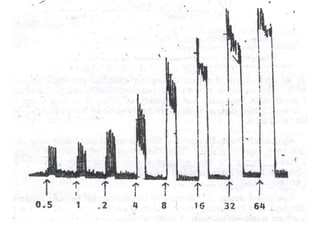
Definition: It is a quantitative curve between increasing
doses/concentration of drug and varying responses .
Thresh hold dose: The minimum dose which produces an observable
response
Maximum/ ceiling dose: The dose which produces maximum response
& even with further increase in dose , there is no increase in response.
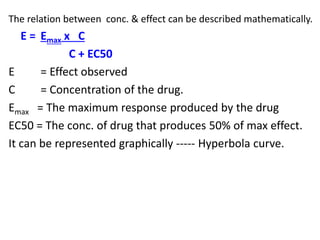
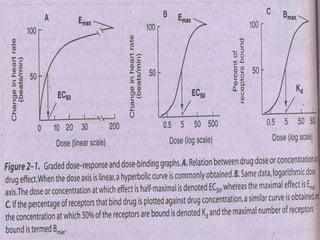
The relation between conc. & effect can be described mathematically.
E = Emax x C
C + EC50
E = Effect observed
C = Concentration of the drug.
Emax = The maximum response produced by the drug
EC50 = The conc. of drug that produces 50% of max effect.
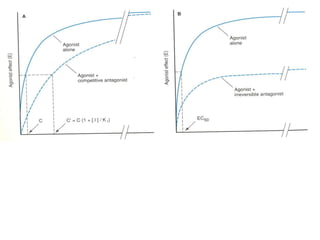
It can be represented graphically ----- Hyperbola curve.
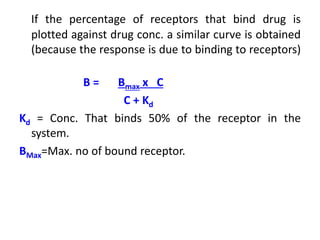
If the percentage of receptors that bind drug is
plotted against drug conc. a similar curve is obtained
(because the response is due to binding to receptors)
B = Bmax x C
C + Kd
Kd = Conc. That binds 50% of the receptor in the
system.
BMax=Max. no of bound receptor.
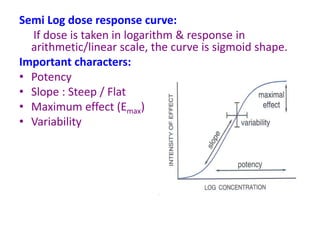
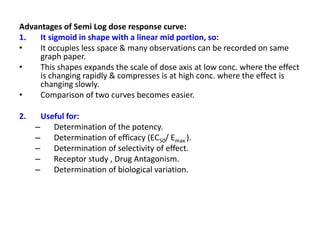
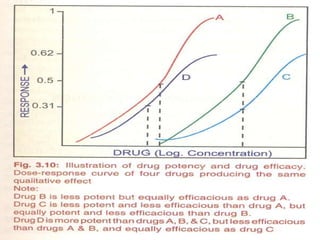
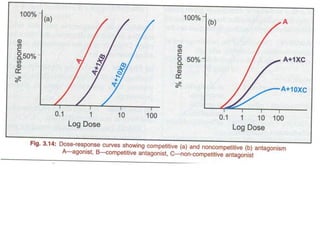
Semi Log dose response curve:
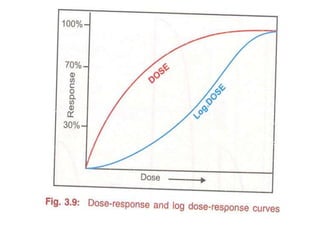
If dose is taken in logarithm & response in
arithmetic/linear scale, the curve is sigmoid shape.
Important characters:
• Potency
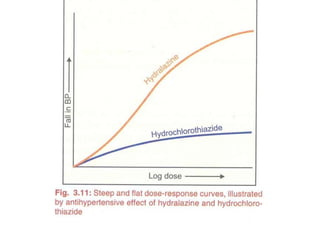
• Slope : Steep / Flat
• Maximum effect (Emax)
• Variability
Advantages of Semi Log dose response curve:
1. It sigmoid in shape with a linear mid portion, so:
• It occupies less space & many observations can be recorded on same
graph paper.
• This shapes expands the scale of dose axis at low conc. where the effect
is changing rapidly & compresses is at high conc. where the effect is
changing slowly.
• Comparison of two curves becomes easier.
2. Useful for:
– Determination of the potency.
– Determination of efficacy (EC50/ Emax ).
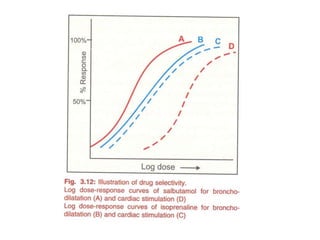
– Determination of selectivity of effect.
– Receptor study , Drug Antagonism.
– Determination of biological variation.
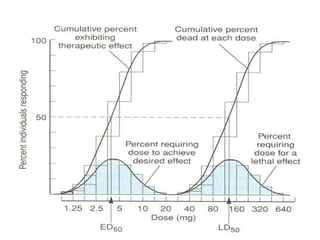
Quantal dose response curve (dose Percent curve)
Definition: Quantal DRC is a curve/graph plotted between the percentage or
fraction of a population that shows a specified all or none response & doses of
a drug.
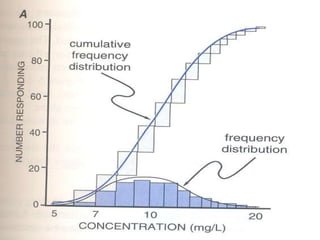
QDRC is a cumulative graph of the frequency distribution of responders versus
the log dose .
On Y-axis is recorded % of responders & on X-axis log. doses are plotted.
Parameter: Pre- determined criterion
i.e production of convulsions , foot withdrawal
Quantal response: An all or none response.
• Either drug can produce convulsions / no convulsions.
• Either drug can produce foot withdrawal/ no foot withdrawal.
• Either at specific dose a drug can produce death / no animal dies
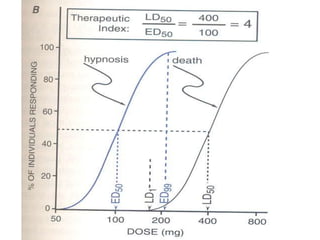
Median effective dose (ED50): It is the dose that is
required to produce the specified response in 50 % of
population under study.
Median Toxic dose (TD50): It is the dose that is required
to produce the specified toxic effect in 50 % of
population under study.
Median lethal dose (LD50): It is the dose of the drug
required to kill 50% of animals under study.
Uses of QDRC:
• Indicates the potential variability of responsiveness
among the population.
• Calculation of therapeutic index
• Comparing the potencies of drugs in experimental &
clinical settings.
• It can provide a valuable index of the selectivity of
drug’s action by comparing its ED50 for two different
quantal responses in a population.
Therapeutic index: It is the ratio of median toxic dose or median
lethal dose to median effective dose.
Therapeutic Index (T.I) = LD50 [ Median letal dose]
ED50 [Median effective dose]
TI indicates that safely the dose can be increased without fear of
toxicity.
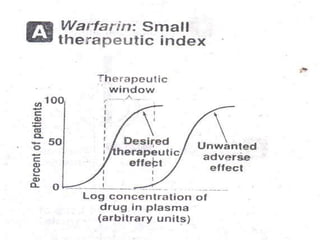
Drugs with LOW TI--- less safe ,require monitoring of plasma
concentration. Digoxin , Lithium phenytoin, digitalis.
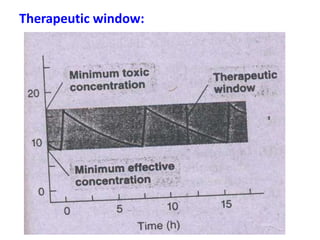
They have narrow Therapeutic window .
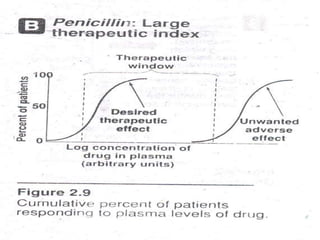
Drugs with HIGH TI: Safer , They have wide Therapeutic window
Eg: Penicillin have high TI.
•
Margin of safety: LD 0.1
ED 99.9
LD 0.1 is the minimum lethal dose for 0.1% of the population
ED 99.9 is the minimum effective dose for 99.9% of population
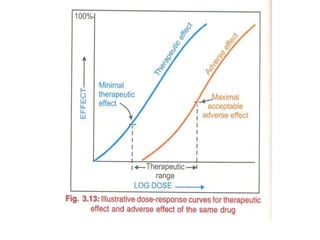
Therapeutic window:
STRUCTURE
ACTIVITY
RELATIONSHIP
STRUCTURE ACTIVITY RELATIONSHIP
1. What is a chemical structure. ?
2. What is activity. ?
3. What is SAR. ?
4. why SAR exists. ?
5. What are the structural factors that influence the
physicochemical properties. ?
6. How the physicochemical properties influence the
activity of a molecule. ?
7. What are SAR studies and why are they done for a
chemical structure. ?
8. When SAR studies are done. ?
9. How SAR studies are done. ?
Structure Activity Relationship
I- Synthesis Of New Compounds With More Specific
Actions And Fewer Adverse Effects
Examples:-
1. Chlorpromazine & Trifluoperazine
2. Procaine & Procainamide
3. Benzyl Penicillin & ampicillin
4. Chlorothiazide & Bendoflumethiazide
5. Atropine & homatropine
II. Synthesis of structurally related competitive antagonist
• PABA & Sulfonamides
• Morphine & Naloxone
III- Understanding the Mechanism of Drug Action
Example:
Epinephrine & Isoprenaline
CHEMICAL STRUCTURE: ?
A chemical structure includes molecular
geometry, electronic structure, and crystal
structure of a molecule.
BIOLOGICAL ACTIVITY: ?
Biological activity is an expression describing
the beneficial or adverse effects of a drug on
living matter.
36
WHAT IS SAR ?
• SAR is the relationship between chemical
structure and pharmacological activity of a
drug. The analysis of SAR enables the
determination of the chemical groups
responsible for evoking a target biological
effect in the organism.
WHY SAR EXIST ? :
The interaction of the drug molecule with a
protein depends on its chemical structure.
WHAT ARE SAR STUDIES. ?
• The studies involving the modification of the
drug molecule in a systemic fashion and
determination of how these changes affect
biological activity.
WHY SAR STUDIES ARE DONE ?
• IT HAS ADVANTAGES LIKE:
1. Increased potency .
2. Greater selectivity.
3. Increase or decrease the duration of action.
4. Low toxicity.
5. Increased stability.
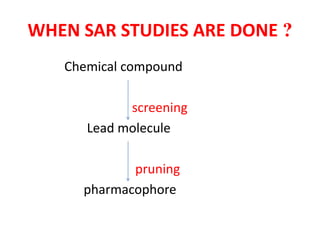
WHEN SAR STUDIES ARE DONE ?
Chemical compound
screening
Lead molecule
pruning
pharmacophore
SCREENING
Screening is the systematic examination of a
chemical molecule to identify the lead
molecule.
METHODS OF SCREENING:
1. Identification by random screening.
2. Identification by non random screening
studies.
3. Identification by observing side effect.
PRUNING
• Pruning is the refinement of lead structure .
• It is done to determine the pharmacophore.
PHARMACOPHORE:
A pharmacophore is a spatial arrangement of
functional groups essential for biological
activity.
It is a pattern that emerges from a set of
molecule with a common biological activity.
NEED OF SAR STUDY ?
A study of the structure–activity relationship is
mainly done on lead molecule.
1. It is used to determine the parts of the
structure of the lead compound that are
responsible for both its beneficial biological
activity, that is pharmacophore and also its
unwanted side effects
43
2. This is used to develop a new drug that has increased
activity.
3. To determine some different activity from an existing
drug and fewer unwanted side effects.
4. To know the changes in pharmacological properties by
performing minor changes in the drug molecule.
Contd…
44
EFECT OF CHEMICAL STRUCTURE
ON PHARMACOLOGICAL ACTION
1. Drug action is according to the theory proposed
by EARLICH i.e
2. Corpora non agunt nisi fixata (A drug will not work
unless it is bound)
3. It means the drug should be non-uniformly
distributed in the body i.e towards a targeted
portion to elicit the pharmacological action.
4. In other words when the drug molecule get close
to the cellular molecules and binds with it to alter
its activity.
45
 Structure–activity relationships are usually determined
by making minor changes to the structure of a lead to
produce analogues
• Those changes are..
1.the size and shape of the carbon skeleton
2. the nature and degree of substitution and
3. the stereochemistry of the lead
46
1. Pharmaco dynamic: Substitution of a larger moiety(alyl or methyl
cyclopropyl group) for N-methyl group trns form Morphine to
Nalorphine, Oxy morphine to Naloxone, Introduction of additional
double bond in 1,2 position of two steroid ring increases
Glucocorticoid activity of Corticosteroids eg: Prednisolone.
2. Pharmacokinetic: Omeprazole-Esomeprazole(long t 1/2), etc.
3. To improve side effect profile eg: Phenytoin-FosPhenytoin,
Citalopram-Escitalopram, Amlodipine-S Amlodipine, etc.
47
CONCLUSION
1. SAR deals with the influence of the
functional groups present in the drug
on its biological activity
2. SAR studies are done to determine
the pattern of this influence which is
employed in the drug design and in the
synthesis of many drugs of desired
pharmacological activity.
48

Dose Response Curve & SAR.ppt for students

  • 1.
    SUDHAKAR LAKAVATH Non MedicalAssistant Department Of Pharmacology Kakatiya Medical College WARANGAL.
  • 2.
    DOSE RESPONSE CURVE Whatis DRC. Types Advantages
  • 3.
    STRUCTURE ACTIVITY RELATIONSHIP 1.What is a chemical structure. 2. What is activity. 3. What is SAR. 4. why SAR exists. 5. What are the structural factors that influence the physicochemical properties. 6. How the physicochemical properties influence the activity of a molecule. 7. What are SAR studies and why are they done for a chemical structure. 8. When SAR studies are done. 9. How SAR studies are done.
  • 4.
    Relation between drugconcentration & Response It may be: • Complex as observed clinically in patients. • Simple in carefully controlled in vitro systems. • It can be described mathematically & represented graphically.
  • 5.
    Dose Response Curves/Concentration Effect Curve Definition: A graph between doses of a drug & responses produced , using an in vitro /in vivo biological system. Doses are plotted along X-axis/ abscissa. Responses are plotted along Y-axis/ordinate. Types: i. Graded DRC ii. Quantal DRC
  • 6.
    Graded dose responsecurve: Definition: It is a quantitative curve between increasing doses/concentration of drug and varying responses . Thresh hold dose: The minimum dose which produces an observable response Maximum/ ceiling dose: The dose which produces maximum response & even with further increase in dose , there is no increase in response.
  • 8.
    The relation betweenconc. & effect can be described mathematically. E = Emax x C C + EC50 E = Effect observed C = Concentration of the drug. Emax = The maximum response produced by the drug EC50 = The conc. of drug that produces 50% of max effect. It can be represented graphically ----- Hyperbola curve.
  • 9.
    If the percentageof receptors that bind drug is plotted against drug conc. a similar curve is obtained (because the response is due to binding to receptors) B = Bmax x C C + Kd Kd = Conc. That binds 50% of the receptor in the system. BMax=Max. no of bound receptor.
  • 11.
    Semi Log doseresponse curve: If dose is taken in logarithm & response in arithmetic/linear scale, the curve is sigmoid shape. Important characters: • Potency • Slope : Steep / Flat • Maximum effect (Emax) • Variability
  • 14.
    Advantages of SemiLog dose response curve: 1. It sigmoid in shape with a linear mid portion, so: • It occupies less space & many observations can be recorded on same graph paper. • This shapes expands the scale of dose axis at low conc. where the effect is changing rapidly & compresses is at high conc. where the effect is changing slowly. • Comparison of two curves becomes easier. 2. Useful for: – Determination of the potency. – Determination of efficacy (EC50/ Emax ). – Determination of selectivity of effect. – Receptor study , Drug Antagonism. – Determination of biological variation.
  • 20.
    Quantal dose responsecurve (dose Percent curve) Definition: Quantal DRC is a curve/graph plotted between the percentage or fraction of a population that shows a specified all or none response & doses of a drug. QDRC is a cumulative graph of the frequency distribution of responders versus the log dose . On Y-axis is recorded % of responders & on X-axis log. doses are plotted. Parameter: Pre- determined criterion i.e production of convulsions , foot withdrawal Quantal response: An all or none response. • Either drug can produce convulsions / no convulsions. • Either drug can produce foot withdrawal/ no foot withdrawal. • Either at specific dose a drug can produce death / no animal dies
  • 23.
    Median effective dose(ED50): It is the dose that is required to produce the specified response in 50 % of population under study. Median Toxic dose (TD50): It is the dose that is required to produce the specified toxic effect in 50 % of population under study. Median lethal dose (LD50): It is the dose of the drug required to kill 50% of animals under study.
  • 24.
    Uses of QDRC: •Indicates the potential variability of responsiveness among the population. • Calculation of therapeutic index • Comparing the potencies of drugs in experimental & clinical settings. • It can provide a valuable index of the selectivity of drug’s action by comparing its ED50 for two different quantal responses in a population.
  • 25.
    Therapeutic index: Itis the ratio of median toxic dose or median lethal dose to median effective dose. Therapeutic Index (T.I) = LD50 [ Median letal dose] ED50 [Median effective dose] TI indicates that safely the dose can be increased without fear of toxicity. Drugs with LOW TI--- less safe ,require monitoring of plasma concentration. Digoxin , Lithium phenytoin, digitalis. They have narrow Therapeutic window . Drugs with HIGH TI: Safer , They have wide Therapeutic window Eg: Penicillin have high TI. •
  • 26.
    Margin of safety:LD 0.1 ED 99.9 LD 0.1 is the minimum lethal dose for 0.1% of the population ED 99.9 is the minimum effective dose for 99.9% of population
  • 28.
  • 31.
  • 32.
    STRUCTURE ACTIVITY RELATIONSHIP 1.What is a chemical structure. ? 2. What is activity. ? 3. What is SAR. ? 4. why SAR exists. ? 5. What are the structural factors that influence the physicochemical properties. ? 6. How the physicochemical properties influence the activity of a molecule. ? 7. What are SAR studies and why are they done for a chemical structure. ? 8. When SAR studies are done. ? 9. How SAR studies are done. ?
  • 33.
    Structure Activity Relationship I-Synthesis Of New Compounds With More Specific Actions And Fewer Adverse Effects Examples:- 1. Chlorpromazine & Trifluoperazine 2. Procaine & Procainamide 3. Benzyl Penicillin & ampicillin 4. Chlorothiazide & Bendoflumethiazide 5. Atropine & homatropine
  • 34.
    II. Synthesis ofstructurally related competitive antagonist • PABA & Sulfonamides • Morphine & Naloxone
  • 35.
    III- Understanding theMechanism of Drug Action Example: Epinephrine & Isoprenaline
  • 36.
    CHEMICAL STRUCTURE: ? Achemical structure includes molecular geometry, electronic structure, and crystal structure of a molecule. BIOLOGICAL ACTIVITY: ? Biological activity is an expression describing the beneficial or adverse effects of a drug on living matter. 36
  • 37.
    WHAT IS SAR? • SAR is the relationship between chemical structure and pharmacological activity of a drug. The analysis of SAR enables the determination of the chemical groups responsible for evoking a target biological effect in the organism. WHY SAR EXIST ? : The interaction of the drug molecule with a protein depends on its chemical structure.
  • 38.
    WHAT ARE SARSTUDIES. ? • The studies involving the modification of the drug molecule in a systemic fashion and determination of how these changes affect biological activity.
  • 39.
    WHY SAR STUDIESARE DONE ? • IT HAS ADVANTAGES LIKE: 1. Increased potency . 2. Greater selectivity. 3. Increase or decrease the duration of action. 4. Low toxicity. 5. Increased stability.
  • 40.
    WHEN SAR STUDIESARE DONE ? Chemical compound screening Lead molecule pruning pharmacophore
  • 41.
    SCREENING Screening is thesystematic examination of a chemical molecule to identify the lead molecule. METHODS OF SCREENING: 1. Identification by random screening. 2. Identification by non random screening studies. 3. Identification by observing side effect.
  • 42.
    PRUNING • Pruning isthe refinement of lead structure . • It is done to determine the pharmacophore. PHARMACOPHORE: A pharmacophore is a spatial arrangement of functional groups essential for biological activity. It is a pattern that emerges from a set of molecule with a common biological activity.
  • 43.
    NEED OF SARSTUDY ? A study of the structure–activity relationship is mainly done on lead molecule. 1. It is used to determine the parts of the structure of the lead compound that are responsible for both its beneficial biological activity, that is pharmacophore and also its unwanted side effects 43
  • 44.
    2. This isused to develop a new drug that has increased activity. 3. To determine some different activity from an existing drug and fewer unwanted side effects. 4. To know the changes in pharmacological properties by performing minor changes in the drug molecule. Contd… 44
  • 45.
    EFECT OF CHEMICALSTRUCTURE ON PHARMACOLOGICAL ACTION 1. Drug action is according to the theory proposed by EARLICH i.e 2. Corpora non agunt nisi fixata (A drug will not work unless it is bound) 3. It means the drug should be non-uniformly distributed in the body i.e towards a targeted portion to elicit the pharmacological action. 4. In other words when the drug molecule get close to the cellular molecules and binds with it to alter its activity. 45
  • 46.
     Structure–activity relationshipsare usually determined by making minor changes to the structure of a lead to produce analogues • Those changes are.. 1.the size and shape of the carbon skeleton 2. the nature and degree of substitution and 3. the stereochemistry of the lead 46
  • 47.
    1. Pharmaco dynamic:Substitution of a larger moiety(alyl or methyl cyclopropyl group) for N-methyl group trns form Morphine to Nalorphine, Oxy morphine to Naloxone, Introduction of additional double bond in 1,2 position of two steroid ring increases Glucocorticoid activity of Corticosteroids eg: Prednisolone. 2. Pharmacokinetic: Omeprazole-Esomeprazole(long t 1/2), etc. 3. To improve side effect profile eg: Phenytoin-FosPhenytoin, Citalopram-Escitalopram, Amlodipine-S Amlodipine, etc. 47
  • 48.
    CONCLUSION 1. SAR dealswith the influence of the functional groups present in the drug on its biological activity 2. SAR studies are done to determine the pattern of this influence which is employed in the drug design and in the synthesis of many drugs of desired pharmacological activity. 48