Antihistaminic agents
Dr Gopal Krishna PadhyDr. Gopal Krishna Padhy
Introduction
Histamine [4-(2-aminoethyl)imidazole]occurs in mast cell ,
blood basophiles and acid secreting parietal cells.p g p
H2C CH2
NH2
4
N
H
N
2
3
5
Antigens derived from food products, pollens, dust and human
H
1
hair releases histamine and causes serious allergic reaction.
Th h i l i l ti f hi t i i d t th i tiThe physiological action of histamine is due to their action on
histamine receptors (H1, H2, H3 & H4).
Definition
Antihistaminic agents:
These are drugs which competitively antagonise the
action of histamine at H1 receptor.
Classification of Histamine H1 receptor antagonist1 p g
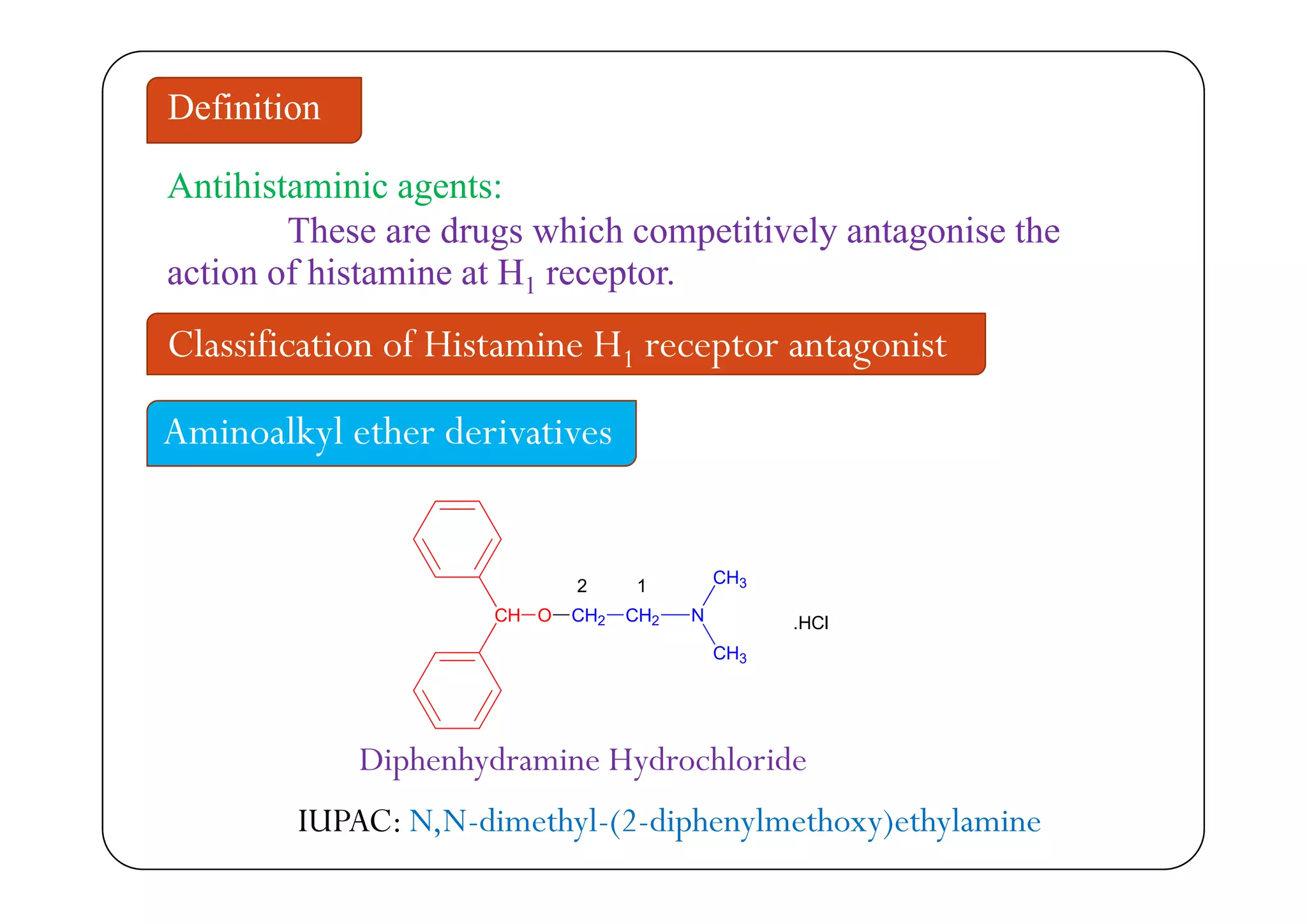
Aminoalkyl ether derivatives:
CH O CH2 CH2 N
CH3
CH3
.HCl
12
Diphenhydramine Hydrochloridep y y
IUPAC: N,N-dimethyl-(2-diphenylmethoxy)ethylamine
Dimenhydrinate
Complex of N, N-dimethyl (2-diphenylmethoxy) ethylamine
and 8-chlorotheophylline
IUPAC: 2-[2-[1-(4-chlorophenyl)-1-
Clemastine Fumarate
: [ [ ( p y )
phenylethoxy]ethyl]-1-methylpyrrolidine
Diphenylpyraline hydrochloride
IUPAC: 4-(benzhydryloxy)-N-methylpiperidine
2 2
3
3 2 2
3
3
Doxylamines Scuccinate
IUPAC: N N-dimethyl-2-(1-phenyl-1-pyridin-2-ylethoxy)IUPAC: N,N-dimethyl-2-(1-phenyl-1-pyridin-2-ylethoxy)
ethanamine
Ethylenediamine derivatives
Tripelennamine
IUPAC: N-benzyl-N′,N′-dimethyl-N-2-pyridylethylenediaminey , y py y y
Piperazine derivatives:
Cl
2 3 56
2
34
5
2 3
Cl
CH N N CH2
CH3
1
2 3
4
56
1
2 3
4
561
6 .HCl
CH N N CH3
1 2 3 4
56
.HCl
CH3
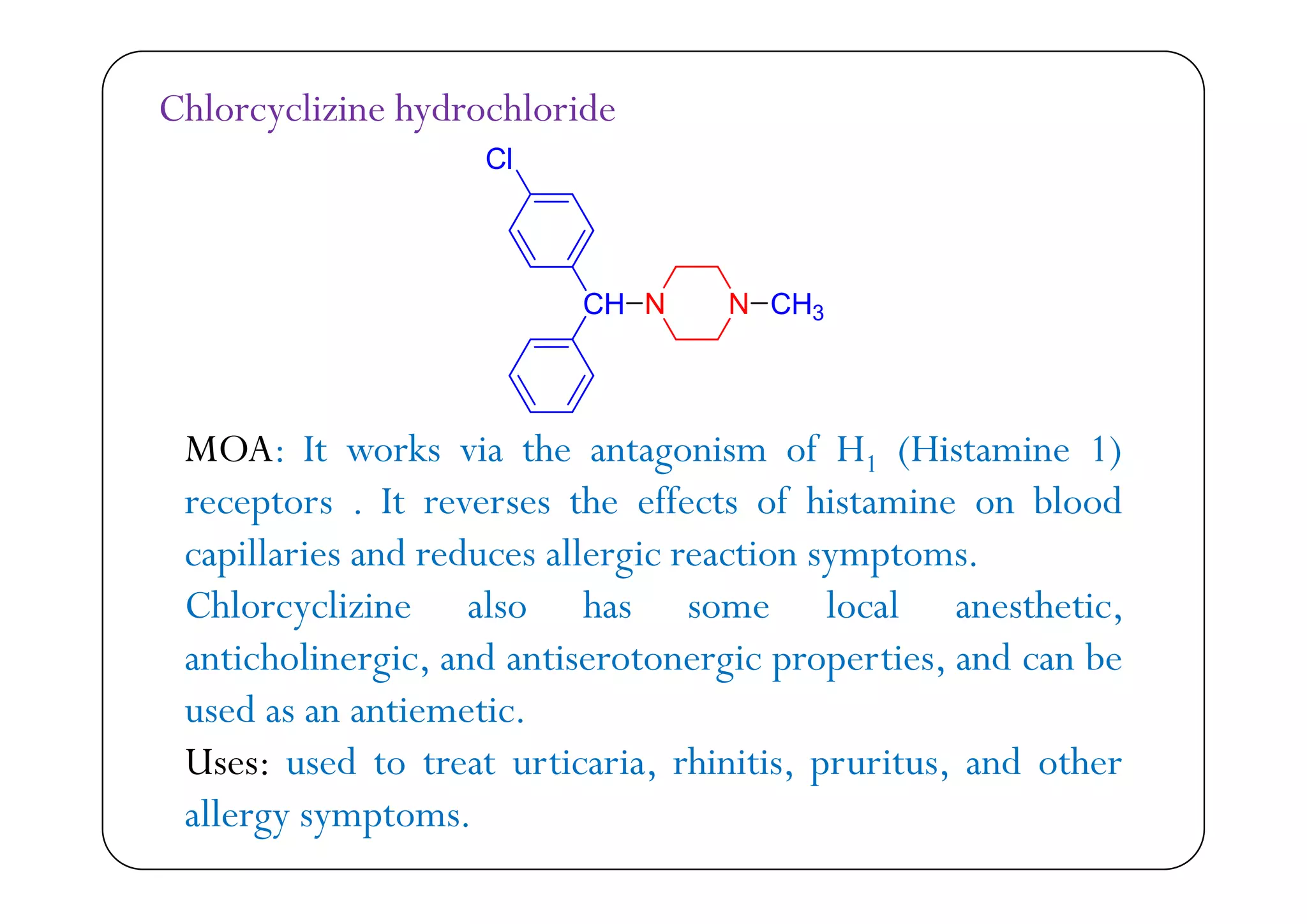
Chlorcyclizine hydrochloride Meclizine hydrochloride
56
IUPAC: 1-[(4-chlorophenyl)-
phenylmethyl]-4-
IUPAC:1-[(4˝-chlorphenyl)
phenylmethyl]-4-[(3´-methylbenzyl)
h l
p y y
methylpiperazine phenyl]piperazine
Buclizine Hydrochloride
IUPAC: 1-[(4-chlorophenyl)-
h l th l] 4 [(4 t tphenylmethyl]-4-[(4-tert-
butylphenyl)methyl]piperazine
ClCl
CH N N CH2 CH2 O CH2COOH
Cetirizine
IUPAC: 2-[2-[4-[(4-chlorophenyl)-
phenylmethyl]piperazin-1-yl]ethoxy]acetic acidp y y ]p p y ] y]
ClCl
C N N CH2 CH2 O CH2COOHH
Levocetirizine
2-[2-[4-[(R)-(4-chlorophenyl)-
phenylmethyl]piperazin-1-yl]ethoxy]acetic acidphenylmethyl]piperazin-1-yl]ethoxy]acetic acid
Propylamine derivatives
Saturated analogs
Chlorpheniramine maleate
C 3 hl h l 3 2´ d l ld h lIUPAC: 3-(p-chlorophenyl)-3-(2´-pyridyl)propyldimethylamine
Unsaturated derivatives
Triprolidinep
Ph thi i d i ti
IUPAC: trans-1-(4˝-methylphenyl)-1-(2´-pyridyl)-3-
pyrrolidinoprop-1-ene
Phenothizine derivatives:
3
2
3
33
P th iPromethazine
10-(2´-dimethylaminopropyl)phenothiazine
S
1
8
9
N
S
CH3
2
3
4
5
6
7
8
10
CH2 CH CH2
CH3
N
CH3
CH3
4
5 10
1 2 3
Trimeprazine
IUPAC: 10 (3´ dimethylamino 2´IUPAC: 10-(3 -dimethylamino-2 -
methylpropyl) phenothiazine
Tricyclic derivatives:
1
28
9
10 11
Cyproheptadine
N 1
2
3
4
5
6
3
4
5
67
yp p
hydrochloride
N
CH3
1
IUPAC: 4-(dibenzo[a,d]cyclohepten-5-ylidene)-
1-methylpiperidine
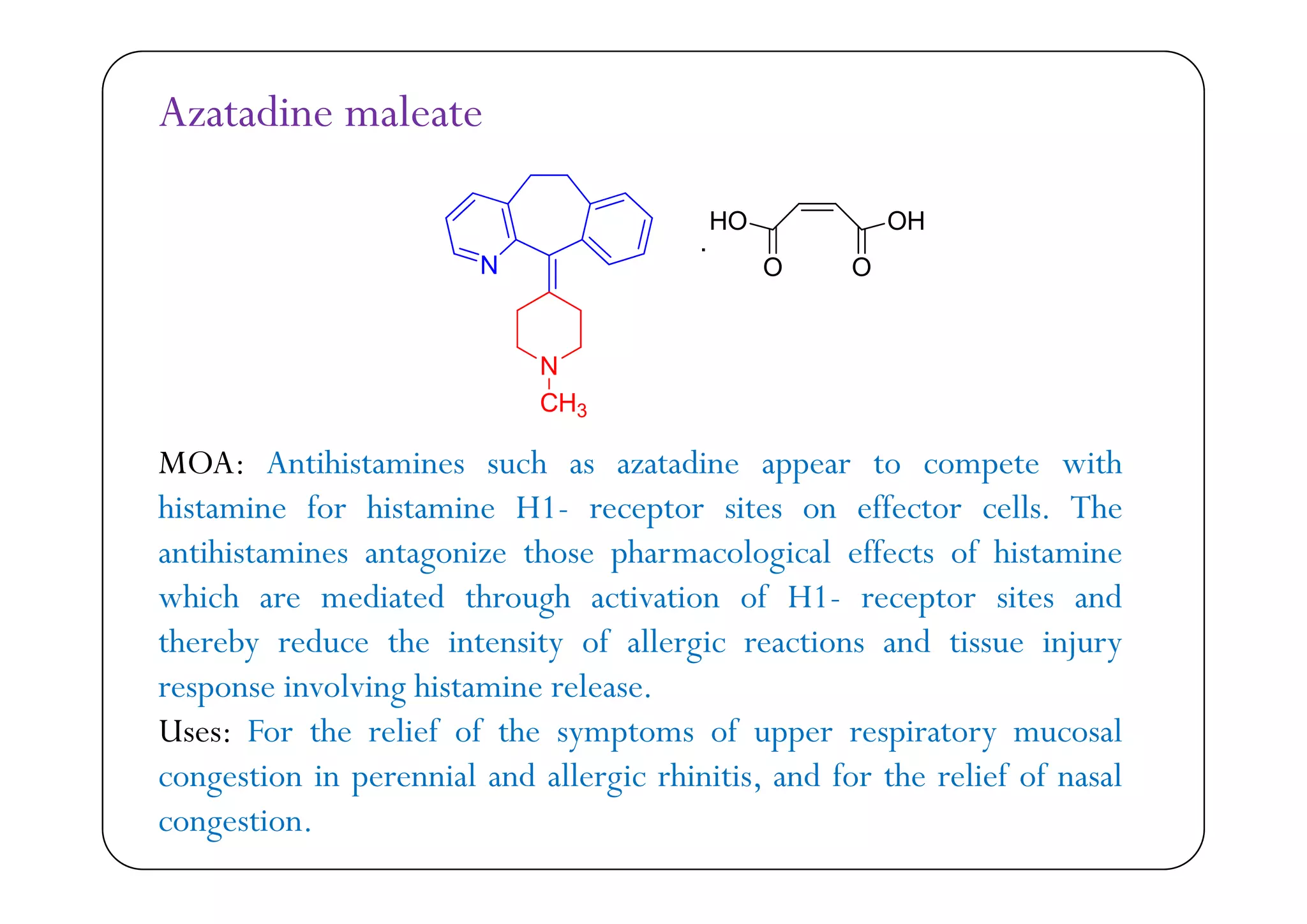
Azatidine
maleate
IUPAC: 11 (1 Methyl 4 piperidinylidene) 5 6 dihydro 5HIUPAC: 11-(1-Methyl-4-piperidinylidene)-5,6-dihydro-5H-
benzo[1,2]cyclohepta[3,4-b]pyridine
Loratadine
IUPAC 1 Pi idi b li id 4 (8IUPAC: 1-Piperidinecarboxylic acid, 4-(8-
chloro-5,6-dihydro-11H-
b [5 6] l h t [1 2 b] idi 11benzo[5,6]cyclohepta[1,2-b]pyridin-11-
ylidene)-, etyl ester
Miscellaneous compounds
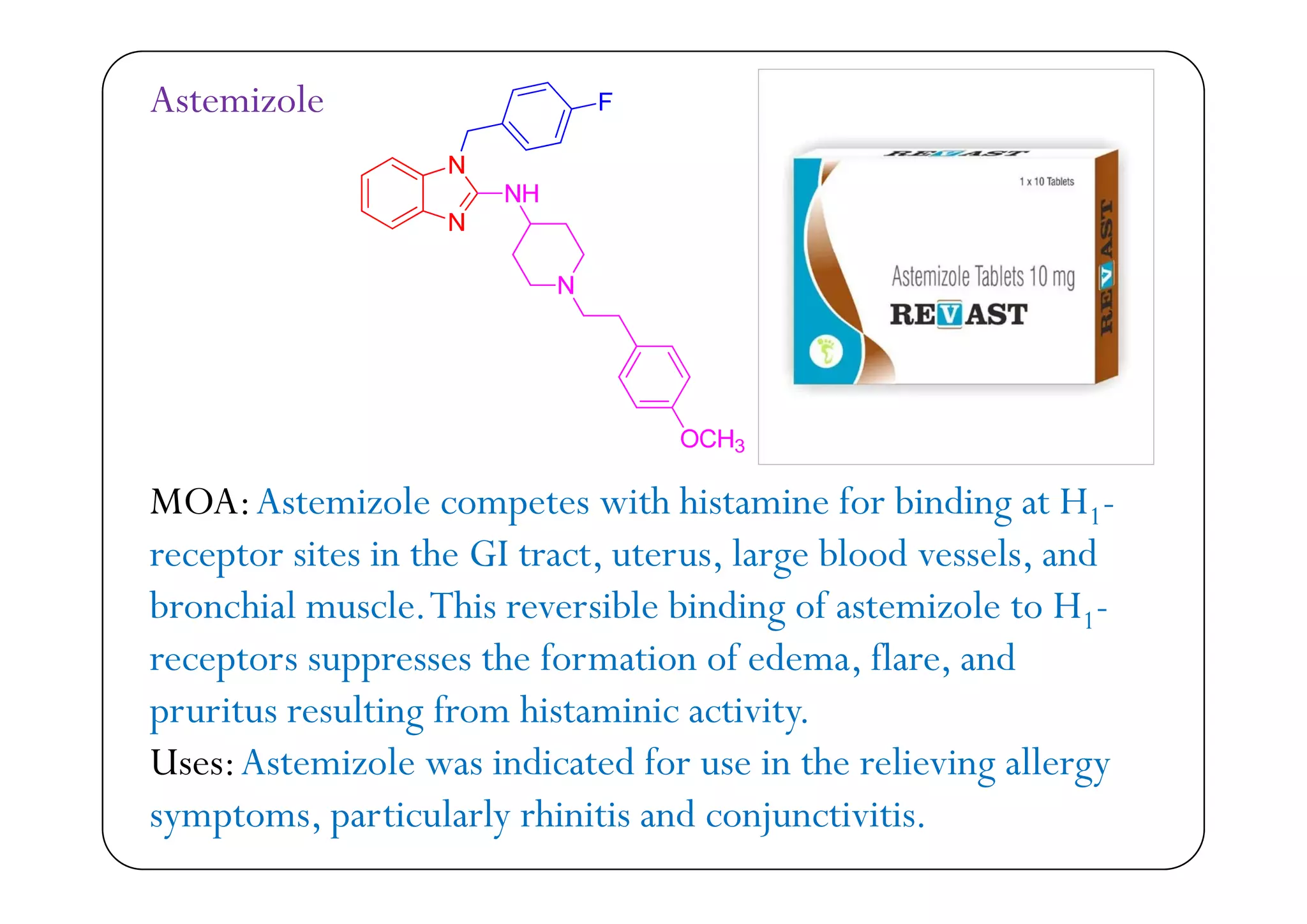
Astemizole
IUPAC: 1-[(4-fluorophenyl)methyl]-N-[1-[2-(4-
methoxyphenyl) ethyl]-4-piperidinyl]-benzimidazol-2-methoxyphenyl) ethyl]-4-piperidinyl]-benzimidazol-2-
amine
Cromolyn sodiumCromolyn sodium
IUPAC: disodium;5-[3-(2-carboxylato-4-
oxochromen 5 yl)oxy 2 hydroxypropoxy] 4oxochromen-5-yl)oxy-2-hydroxypropoxy]-4-
oxochromene-2-carboxylate
Hi t i t t i t i i t f th
Histamine receptors
Histamine receptors are proteins present in various parts of the
body that bind with histamine to produce a specific outcome.
There are four known receptors designated H1 H4There are four known receptors, designated H1 - H4.
H1 Receptor
This is one of the most important receptors for modulating yourThis is one of the most important receptors for modulating your
internal clock, and are target for many clinical drugs.
When histamine reacts with these receptors in your brain it makeWhen histamine reacts with these receptors in your brain it make
you more awake and alert.This is why antihistamines cause
drowsiness.
 In other areas of the body, stimulation of these receptors
causes skin rashes, broncho-constriction, motion sickness, and, , ,
smooth muscle relaxation (consequently vasodilation - the widening
of blood vessels leading to redness of the skin).g
Excess activation of these receptors triggers the symptoms of hay
fever and other seasonal allergies.
H2 Receptor
Th f d i l ll l d i h h li iThese are found on parietal cells located in the stomach lining.
Histamine action at these receptors stimulates the release of gastric
id f hi h lt i t t itiacid, excess of which can result in gastroenteritis.
These receptors are also found on heart, uterus and vascular
smooth muscle cells Histamine reacting with the receptor at thesesmooth muscle cells. Histamine reacting with the receptor at these
places encourages smooth muscle relaxation.
This also found on neutrophils (one type of white blood cell)This also found on neutrophils (one type of white blood cell).
Histamine inhibits antibody and cytokine production by reacting
with these receptorswith these receptors.
H3 Receptor
These are present throughout the nervous system, though mostThese are present throughout the nervous system, though most
notably in the central nervous system.
They regulate histamine in the body, by inhibiting the furthery g y, y g
synthesis of histamine.
H4 Receptor
Discovered in 2001, these receptors regulate the levels of
white blood cell release from bone marrow.
They are located in the thymus, small intestine, spleen, the
colon, bone marrow and basophils.
Diphenhydramine
o Diphenhydramine predominantly works via the antagonism
Mechanism of action
p y p y g
of H1 (Histamine 1) receptors . It reverses the effects of
histamine on blood capillaries, reducing allergic reactionp , g g
symptoms .
o Moreover, it readily crosses the blood-brain barrier and, y
inversely agonizes the H1 CNS receptors, resulting in
drowsiness, and suppress the medullary cough center.pp y g
o Furthermore, diphenhydramine also acts as an
antimuscarinic . It behave as a competitive antagonist ofp g
muscarinic acetylcholine receptors, resulting in its use as an
antiparkinson medication.
Uses: Indicated for use in treating sneezing, runny nose,
itchy/watery eyes, itching of nose or throat, insomnia,
p
pruritis, urticaria, insect bites/stings, allergic rashes, and
nausea
Dimenhydrinate
MOA: Dimenhydrinate is a competitive antagonist at theMOA: Dimenhydrinate is a competitive antagonist at the
histamine H1 receptor, which is widely distributed in the
human brain Dimenhydrinate's anti-emetic effect is probablyhuman brain. Dimenhydrinate s anti-emetic effect is probably
due to H1 antagonism in the vestibular system in the brain.
Uses: Dimenhydrinate is indicated for the prevention and
treatment of nausea, vomiting, or vertigo of motion sickness.
Doxylamines Scuccinate
3
2 2
3
3
3
IUPAC N N di th l 2 (1 h l 1 idi 2 l th )IUPAC: N,N-dimethyl-2-(1-phenyl-1-pyridin-2-ylethoxy)
ethanamine
MOA: Dimenhydrinate is a competitive antagonist at theMOA: Dimenhydrinate is a competitive antagonist at the
histamine H1 receptor. It has pronounced sedative properties.
Uses: It is used in allergies and as an antitussive antiemeticUses: It is used in allergies and as an antitussive, antiemetic,
and hypnotic.
Clemastine fumarate
MOA: It works via the antagonism of H1 (Histamine 1)
h ff f h bl dreceptors . It reverses the effects of histamine on blood
capillaries and reduces allergic reaction symptoms.
Uses: Used in hay fever, rhinitis, allergic skin conditions, and
I dpruritus. It causes drowsiness.
Diphenylpyraline hydrochloride
MOA: It works via the antagonism of H1 (Histamine 1)g 1 ( )
receptors . It reverses the effects of histamine on blood
capillaries and reduces allergic reaction symptoms.p g y p
Uses: allergic rhinitis, hay fever, and allergic skin disorders.g y g
Tripelennamine
MOA: Tripelennamine binds to the histamine H1
Th bl k h f d hreceptor. This blocks the action of endogenous histamine,
which subsequently leads to temporary relief of the
b h b hnegative symptoms brought on by histamine.
Uses: Used for the symptomatic relief of hypersensitivity
h d h ldreactions, coughs, and the common cold.
Chlorcyclizine hydrochloride
3
MOA: It works via the antagonism of H1 (Histamine 1): g 1 ( )
receptors . It reverses the effects of histamine on blood
capillaries and reduces allergic reaction symptoms.p g y p
Chlorcyclizine also has some local anesthetic,
anticholinergic, and antiserotonergic properties, and can beg , g p p ,
used as an antiemetic.
Uses: used to treat urticaria, rhinitis, pruritus, and other, , p ,
allergy symptoms.
Meclizine hydrochloride
MOA: Meclizine is a histamine H1 antagonist with antiemetic
d l h b h land antivertigo properties. It also exhibits anticholinergic,
central nervous system depressant, and local anesthetic effects.
Uses: It is used in the symptomatic treatment of motion
k d l f d h b lsickness and control of vertigo associated with vestibular
system diseases.
Buclizine Hydrochloride
MOA B li i i hi t i H t i t ith ti tiMOA: Buclizine is a histamine H1 antagonist with antiemetic
and antivertigo properties. It also exhibits anticholinergic,
t l t d t d l l th ti ff tcentral nervous system depressant, and local anesthetic effects.
U It i d i th t ti t t t f tiUses: It is used in the symptomatic treatment of motion
sickness and control of vertigo associated with vestibular
s stem diseasessystem diseases.
Chlorpheniramine maleate
MOA: Chlorpheniramine binds to the histamine H1 receptor.
Th bl k h f d h h hThis blocks the action of endogenous histamine, which
subsequently leads to temporary relief of the negative
b h b hsymptoms brought on by histamine.
Uses: Used for the symptomatic relief of hypersensitivity
h d h ldreactions, coughs, and the common cold.
Triprolidine
MOA: Triprolidine binds to the histamine H1 receptor. This: p p .
blocks the action of endogenous histamine, which
subsequently leads to temporary relief of the negativeq y p y g
symptoms brought on by histamine.
Uses: Used for the symptomatic relief of hypersensitivityy p yp y
reactions, coughs, and the common cold.
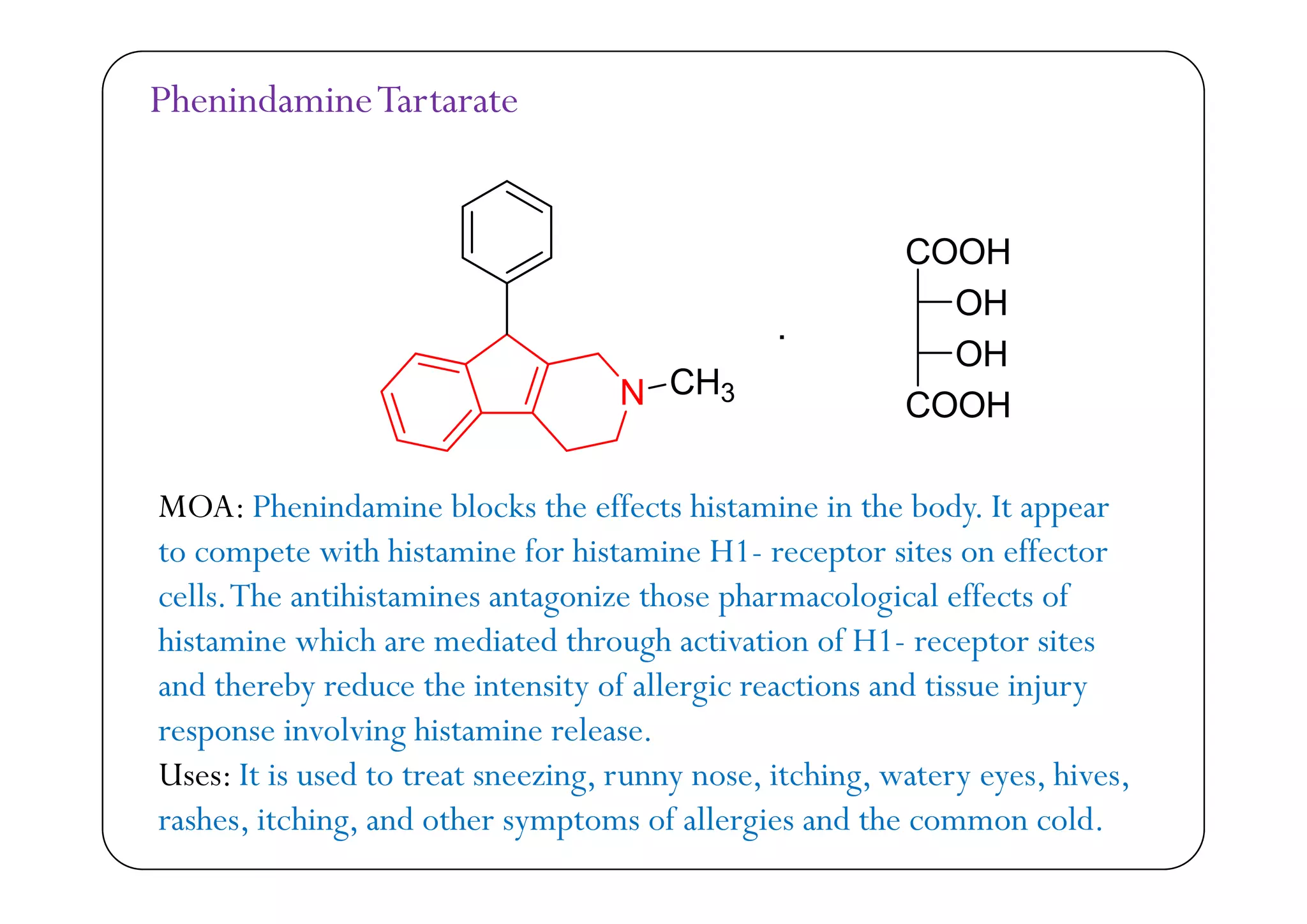
PhenindamineTartarate
3
MOA: Phenindamine blocks the effects histamine in the body. It appear
to compete with histamine for histamine H1- receptor sites on effectorp p
cells.The antihistamines antagonize those pharmacological effects of
histamine which are mediated through activation of H1- receptor sites
and thereby reduce the intensity of allergic reactions and tissue injury
response involving histamine release.
Uses: It is used to treat sneezing runny nose itching watery eyes hivesUses: It is used to treat sneezing, runny nose, itching, watery eyes, hives,
rashes, itching, and other symptoms of allergies and the common cold.
Promethazine Hydrochloride
MOA:
h f h 1oPromethazine is a an antagonist of histamine H1, post-
synaptic mesolimbic dopamine, alpha adrenergic, muscarinic,
d NMDAand NMDA receptors.
oThe antihistamine action is used to treat allergic reactions.
A f d NMDA bAntagonism of muscarinic and NMDA receptors contribute to
its use as a sleep aid, as well as for anxiety and tension.
A f h H1 d doAntagonism of histamine H1, muscarinic, and dopamine
receptors in the medullary vomiting center make
h i f l i h f d i ipromethazine useful in the treatment of nausea and vomiting.
Uses: to treat rhinitis, allergic conjunctivitis, allergic: , g j , g
reactions to blood or plasma, dermographism, anaphylactic
reactions, sedation, nausea, vomiting, pain, motion sickness,, , , g, p , ,
and allergic skin reactions.
Trimeprazine Tartarate
MOA: Trimeprazine binds to the histamine H1 receptor. This
blocks the action of endogenous histamine, whichg ,
subsequently leads to temporary relief of the negative
symptoms brought on by histamine.y p g y
Uses: Used for the symptomatic relief of hypersensitivity
reactions, pruritus (itching) and urticaria (some allergic skin, p ( g) ( g
reactions).
Cyproheptadine hydrochloride
NN
CH3
MOA C h di i h f hi i f bi di HAMOA: Cyproheptadine competes with free histamine for binding at HA-
receptor sites.This antagonizes the effects of histamine on HA-receptors,
leading to a reduction of the negative symptoms brought on by histamineleading to a reduction of the negative symptoms brought on by histamine
HA-receptor binding. Cyproheptadine also competes with serotonin at
receptor sites in smooth muscle in the intestines and other locations.
Antagonism of serotonin on the appetite center of the hypothalamus may
account for Cyproheptadine's ability to stimulate appetite.
U All i hi i i hi i i i i d i d dUses:Allergic rhinitis, rhinitis, urticaria and angioedema and
dermatographism.
Azatadine maleate
HO OH
.
N
N
O O
N
CH3
MOA: Antihistamines such as azatadine appear to compete withMOA: Antihistamines such as azatadine appear to compete with
histamine for histamine H1- receptor sites on effector cells. The
antihistamines antagonize those pharmacological effects of histamineg p g
which are mediated through activation of H1- receptor sites and
thereby reduce the intensity of allergic reactions and tissue injury
response involving histamine release.
Uses: For the relief of the symptoms of upper respiratory mucosal
congestion in perennial and allergic rhinitis and for the relief of nasalcongestion in perennial and allergic rhinitis, and for the relief of nasal
congestion.
Astemizole
MOA:Astemizole competes with histamine for binding at H1-
receptor sites in the GI tract, uterus, large blood vessels, andp , , g ,
bronchial muscle.This reversible binding of astemizole to H1-
receptors suppresses the formation of edema, flare, andp pp , ,
pruritus resulting from histaminic activity.
Uses:Astemizole was indicated for use in the relieving allergyg gy
symptoms, particularly rhinitis and conjunctivitis.
Loratadine
MOA: Antihistamines such as Loratadine appear to compete with
histamine for histamine H1- receptor sites on effector cells. The
tihi t i t i th h l i l ff t f hi t iantihistamines antagonize those pharmacological effects of histamine
which are mediated through activation of H1- receptor sites and
thereby reduce the intensity of allergic reactions and tissue injurythereby reduce the intensity of allergic reactions and tissue injury
response involving histamine release.
Uses: For the relief of the symptoms of upper respiratory mucosal
congestion in perennial and allergic rhinitis, and for the relief of nasal
congestion.
Cl
Cetirizine
Cl
CH N N CH2 CH2 O CH2COOH
MOA: Cetirizine, a metabolite of hydroxyzine, is an antihistamine drug.
I ff h d h h l h b f h lIts main effects are achieved through selective inhibition of peripheral
H1 receptors. It compete with histamine for histamine H1- receptor
sites on effector cells The antihistamines antagonize thosesites on effector cells. The antihistamines antagonize those
pharmacological effects of histamine which are mediated through
activation of H1- receptor sites and thereby reduce the intensity ofp y y
allergic reactions and tissue injury response involving histamine release.
Uses: For the relief of the symptoms of upper respiratory mucosal
i i i l d ll i hi i i d f h li f f lcongestion in perennial and allergic rhinitis, and for the relief of nasal
congestion, Chronic urticaria.
Cl
Levocetirizine
Cl
C N N CH2 CH2 O CH2COOHH
MOA: It compete with histamine for histamine H1- receptor sites onp p
effector cells. The antihistamines antagonize those pharmacological
effects of histamine which are mediated through activation of H1-
d h b d h f ll dreceptor sites and thereby reduce the intensity of allergic reactions and
tissue injury response involving histamine release.
Uses: For the relief of the symptoms of upper respiratory mucosalUses: For the relief of the symptoms of upper respiratory mucosal
congestion in perennial and allergic rhinitis, and for the relief of nasal
congestion, Chronic urticaria.g
Cromolyn sodium
O h b d l f ll b lMOA: It inhibits degranulation of mast cells, subsequently
preventing the release of histamine and slow-reacting substance
f h l S S A d f llof anaphylaxis (SRS-A), mediators of type I allergic reactions. It
also may reduce the release of inflammatory leukotrienes. It
b h b l flmay act by inhibiting calcium influx.
Uses: For the management of patients with bronchial asthma.
Al d h f l k lAlso used in the treatment of vernal keratoconjunctivitis, vernal
conjunctivitis, and vernal keratitis.
Ranitidine
H2 receptor antagonist
3
3
3
MOA
2
IUPAC: 1-N'-[2-[[5-[(dimethylamino)methyl]furan-2-
yl]methylsulfanyl]ethyl]-1-N-methyl-2-nitroethene-1,1-
diamine
MOA: It antagonise the action of histamine at its H2 receptor.
Ranitidine reduces the secretion of gastric acid by reversible
bi di hi i (H2) hi h f dbinding to histamine (H2) receptors, which are found on
gastric parietal cells. This process leads to the inhibition of
hi t i bi di t thi t i th d ti fhistamine binding to this receptor, causing the reduction of
gastric acid secretion.
Uses: It is used in the treatment of duodenal ulcer gastricUses: It is used in the treatment of duodenal ulcer, gastric
ulcer, gastroesophageal reflux disease (GERD) and acid
indigestion It is also used in multi drug treatment protocolindigestion. It is also used in multi drug treatment protocol
for eradication of H.pyroli in treatment of peptic ulcer.
Cimetidine
IUPAC: 1-cyano-2-methyl-3-[2-[(5-methyl-1H-
d l 4 l) h l lf l] h l] d
N
OH
HS CH2 CH2 NH2 N
S CH2 CH2 NH2
S
S
N CN
H3C
H3C
imidazol-4-yl)methylsulfanyl]ethyl]guanidine
N
H
CH3
N
N
H
CH3
SH3C
H2O
SHCH3
N
S CH2 CH2 NH C
N
S CH3
CN
N
S CH2 CH2 NH C
N
H
N CH3
CN
CH3NH2
3
N
H
CH3N
H
CH3
SHCH3
MOA: It antagonise the action of histamine at its H receptorMOA: It antagonise the action of histamine at its H2 receptor.
Cimetidine reduces the secretion of gastric acid by reversible
binding to histamine (H2) receptors which are found onbinding to histamine (H2) receptors, which are found on
gastric parietal cells. This process leads to the inhibition of
histamine binding to this receptor, causing the reduction ofhistamine binding to this receptor, causing the reduction of
gastric acid secretion.
Uses: It is used in the treatment of duodenal ulcer, gastric
ulcer, gastroesophageal reflux disease (GERD) and acid, g p g ( )
indigestion. It is also used in multi drug treatment protocol
for eradication of H.pyroli in treatment of peptic ulcer.py p p
Famotidine
IUPAC 3 [[2 (di i h lid i ) 1 3 hi l 4
MOA: It t i th ti f hi t i t it H t
IUPAC: 3-[[2-(diaminomethylideneamino)-1,3-thiazol-4-
yl]methylsulfanyl]-N'-sulfamoylpropanimidamide
MOA: It antagonise the action of histamine at its H2 receptor.
Famotidine reduces the secretion of gastric acid by reversible
binding to histamine (H2) receptors which are found onbinding to histamine (H2) receptors, which are found on
gastric parietal cells. This process leads to the inhibition of
histamine binding to this receptor causing the reduction ofhistamine binding to this receptor, causing the reduction of
gastric acid secretion.
Uses: It is used in the treatment of duodenal ulcer gastricUses: It is used in the treatment of duodenal ulcer, gastric
ulcer, gastroesophageal reflux disease (GERD) and acid
indigestion It is also used in multi drug treatment protocolindigestion. It is also used in multi drug treatment protocol
for eradication of H.pyroli in treatment of peptic ulcer.
Omeprazole
Proton pump inhibitors
N
H3CO 3
4
5
Omeprazole
N
H
S
N
CH2 CH3
OCHH CO1
2
5
6
7
OCH3H3CO1
IUPAC: 5-methoxy-2-{[(4-methoxy-3,5-dimethylpyridin-2-
Mode of action
y {[( y , y py
yl)methyl]sulfinyl}-1H-benzimidazole
Hydrochloric acid (HCl) secretion into the gastric lumen is a
process regulated mainly by the H(+)/K(+)-ATPase of thep g y y
proton pump. Omeprazole inhibits secretion of acid from the
gastric parietal cells by irreversibly inhibiting the enzyme H+-K+g p y y g y
ATPase.
UsesUses
Omeprazole is used in the treatment of duodenal ulcer, gastric
ulcer gastroesophageal reflux disease (GERD) and acidulcer, gastroesophageal reflux disease (GERD) and acid
indigestion. Omeprazole is also used in multi drug treatment
protocol for eradication of H pyroli in treatment of peptic ulcerprotocol for eradication of H.pyroli in treatment of peptic ulcer.
1
Lansoprazole
S
O
H
N
N
N
1
25
6
7
1
2 5
6
F
F
O
N 2
34
5 2
3 4
5
F
F
IUPAC: 2-({[3-Methyl-4-(2,2,2-trifluoroethoxy)-2-
Mode of action
d hl d Cl h l
pyridinyl]methyl}sulfinyl)-1H-benzimidazole
Hydrochloric acid (HCl) secretion into the gastric lumen is a
process regulated mainly by the H(+)/K(+)-ATPase of the
L l h b f d f hproton pump. Lansoprazole inhibits secretion of acid from the
gastric parietal cells by irreversibly inhibiting the enzyme H+-K+
ATPATPase.
Uses: Lansoprazole is used to reduce gastric acid secretion
d d f h fand is approved for short term treatment of active gastric
ulcers, active duodenal ulcers and gastroesophageal reflux
d (GERD) d d ddisease (GERD) and acid indigestion.
Rabeprazolep
IUPAC: 2-[[4-(3-methoxypropoxy)-3-
h l idi 2 l] h l lfi l] 1Hmethylpyridin-2-yl]methylsulfinyl]-1H-
benzimidazole
Mode of action
Hydrochloric acid (HCl) secretion into the gastric lumen is a
process regulated mainly by the H(+)/K(+)-ATPase of thep g y y
proton pump. Rabeprazole inhibits secretion of acid from the
gastric parietal cells by irreversibly inhibiting the enzyme H+-
U R b l i d t d t i id ti d
g p y y g y
K+ ATPase.
Uses: Rabeprazole is used to reduce gastric acid secretion and
is approved for short term treatment of active gastric ulcers,
ti d d l l d t h l fl diactive duodenal ulcers and gastroesophageal reflux disease
(GERD) and acid indigestion.
Pantoprazole
F OO O O
H
N
1
7
S
F
F OO O ON
N
N
2
34
5
6
N3
IUPAC: 6-(difluoromethoxy)-2-[(3 4-dimethoxypyridin-2-
Mode of action
IUPAC: 6 (difluoromethoxy) 2 [(3,4 dimethoxypyridin 2
yl)methylsulfinyl]-1H-benzimidazole
Hydrochloric acid (HCl) secretion into the gastric lumen is a
process regulated mainly by the H(+)/K(+)-ATPase of thep g y y
proton pump. Pantoprazole inhibits secretion of acid from the
gastric parietal cells by irreversibly inhibiting the enzyme H+-K+g p y y g y
ATPase.
U P t l i d t d t i id tiUses: Pantoprazole is used to reduce gastric acid secretion
and is approved for short term treatment of active gastric
l ti d d l l d t h l flulcers, active duodenal ulcers and gastroesophageal reflux
disease (GERD) and acid indigestion.

Antihistaminics-Medicinal Chemistry

  • 1.
    Antihistaminic agents Dr GopalKrishna PadhyDr. Gopal Krishna Padhy
  • 2.
    Introduction Histamine [4-(2-aminoethyl)imidazole]occurs inmast cell , blood basophiles and acid secreting parietal cells.p g p H2C CH2 NH2 4 N H N 2 3 5 Antigens derived from food products, pollens, dust and human H 1 hair releases histamine and causes serious allergic reaction. Th h i l i l ti f hi t i i d t th i tiThe physiological action of histamine is due to their action on histamine receptors (H1, H2, H3 & H4).
  • 3.
    Definition Antihistaminic agents: These aredrugs which competitively antagonise the action of histamine at H1 receptor. Classification of Histamine H1 receptor antagonist1 p g Aminoalkyl ether derivatives: CH O CH2 CH2 N CH3 CH3 .HCl 12 Diphenhydramine Hydrochloridep y y IUPAC: N,N-dimethyl-(2-diphenylmethoxy)ethylamine
  • 4.
    Dimenhydrinate Complex of N,N-dimethyl (2-diphenylmethoxy) ethylamine and 8-chlorotheophylline IUPAC: 2-[2-[1-(4-chlorophenyl)-1- Clemastine Fumarate : [ [ ( p y ) phenylethoxy]ethyl]-1-methylpyrrolidine
  • 5.
    Diphenylpyraline hydrochloride IUPAC: 4-(benzhydryloxy)-N-methylpiperidine 22 3 3 2 2 3 3 Doxylamines Scuccinate IUPAC: N N-dimethyl-2-(1-phenyl-1-pyridin-2-ylethoxy)IUPAC: N,N-dimethyl-2-(1-phenyl-1-pyridin-2-ylethoxy) ethanamine
  • 6.
  • 7.
    Piperazine derivatives: Cl 2 356 2 34 5 2 3 Cl CH N N CH2 CH3 1 2 3 4 56 1 2 3 4 561 6 .HCl CH N N CH3 1 2 3 4 56 .HCl CH3 Chlorcyclizine hydrochloride Meclizine hydrochloride 56 IUPAC: 1-[(4-chlorophenyl)- phenylmethyl]-4- IUPAC:1-[(4˝-chlorphenyl) phenylmethyl]-4-[(3´-methylbenzyl) h l p y y methylpiperazine phenyl]piperazine
  • 8.
    Buclizine Hydrochloride IUPAC: 1-[(4-chlorophenyl)- hl th l] 4 [(4 t tphenylmethyl]-4-[(4-tert- butylphenyl)methyl]piperazine
  • 9.
    ClCl CH N NCH2 CH2 O CH2COOH Cetirizine IUPAC: 2-[2-[4-[(4-chlorophenyl)- phenylmethyl]piperazin-1-yl]ethoxy]acetic acidp y y ]p p y ] y]
  • 10.
    ClCl C N NCH2 CH2 O CH2COOHH Levocetirizine 2-[2-[4-[(R)-(4-chlorophenyl)- phenylmethyl]piperazin-1-yl]ethoxy]acetic acidphenylmethyl]piperazin-1-yl]ethoxy]acetic acid
  • 11.
    Propylamine derivatives Saturated analogs Chlorpheniraminemaleate C 3 hl h l 3 2´ d l ld h lIUPAC: 3-(p-chlorophenyl)-3-(2´-pyridyl)propyldimethylamine
  • 12.
    Unsaturated derivatives Triprolidinep Ph thii d i ti IUPAC: trans-1-(4˝-methylphenyl)-1-(2´-pyridyl)-3- pyrrolidinoprop-1-ene Phenothizine derivatives: 3 2 3 33 P th iPromethazine 10-(2´-dimethylaminopropyl)phenothiazine
  • 13.
    S 1 8 9 N S CH3 2 3 4 5 6 7 8 10 CH2 CH CH2 CH3 N CH3 CH3 4 510 1 2 3 Trimeprazine IUPAC: 10 (3´ dimethylamino 2´IUPAC: 10-(3 -dimethylamino-2 - methylpropyl) phenothiazine
  • 14.
    Tricyclic derivatives: 1 28 9 10 11 Cyproheptadine N1 2 3 4 5 6 3 4 5 67 yp p hydrochloride N CH3 1 IUPAC: 4-(dibenzo[a,d]cyclohepten-5-ylidene)- 1-methylpiperidine Azatidine maleate IUPAC: 11 (1 Methyl 4 piperidinylidene) 5 6 dihydro 5HIUPAC: 11-(1-Methyl-4-piperidinylidene)-5,6-dihydro-5H- benzo[1,2]cyclohepta[3,4-b]pyridine
  • 15.
    Loratadine IUPAC 1 Piidi b li id 4 (8IUPAC: 1-Piperidinecarboxylic acid, 4-(8- chloro-5,6-dihydro-11H- b [5 6] l h t [1 2 b] idi 11benzo[5,6]cyclohepta[1,2-b]pyridin-11- ylidene)-, etyl ester
  • 16.
    Miscellaneous compounds Astemizole IUPAC: 1-[(4-fluorophenyl)methyl]-N-[1-[2-(4- methoxyphenyl)ethyl]-4-piperidinyl]-benzimidazol-2-methoxyphenyl) ethyl]-4-piperidinyl]-benzimidazol-2- amine
  • 17.
    Cromolyn sodiumCromolyn sodium IUPAC:disodium;5-[3-(2-carboxylato-4- oxochromen 5 yl)oxy 2 hydroxypropoxy] 4oxochromen-5-yl)oxy-2-hydroxypropoxy]-4- oxochromene-2-carboxylate
  • 18.
    Hi t it t i t i i t f th Histamine receptors Histamine receptors are proteins present in various parts of the body that bind with histamine to produce a specific outcome. There are four known receptors designated H1 H4There are four known receptors, designated H1 - H4. H1 Receptor This is one of the most important receptors for modulating yourThis is one of the most important receptors for modulating your internal clock, and are target for many clinical drugs. When histamine reacts with these receptors in your brain it makeWhen histamine reacts with these receptors in your brain it make you more awake and alert.This is why antihistamines cause drowsiness.  In other areas of the body, stimulation of these receptors causes skin rashes, broncho-constriction, motion sickness, and, , , smooth muscle relaxation (consequently vasodilation - the widening of blood vessels leading to redness of the skin).g Excess activation of these receptors triggers the symptoms of hay fever and other seasonal allergies.
  • 19.
    H2 Receptor Th fd i l ll l d i h h li iThese are found on parietal cells located in the stomach lining. Histamine action at these receptors stimulates the release of gastric id f hi h lt i t t itiacid, excess of which can result in gastroenteritis. These receptors are also found on heart, uterus and vascular smooth muscle cells Histamine reacting with the receptor at thesesmooth muscle cells. Histamine reacting with the receptor at these places encourages smooth muscle relaxation. This also found on neutrophils (one type of white blood cell)This also found on neutrophils (one type of white blood cell). Histamine inhibits antibody and cytokine production by reacting with these receptorswith these receptors. H3 Receptor These are present throughout the nervous system, though mostThese are present throughout the nervous system, though most notably in the central nervous system. They regulate histamine in the body, by inhibiting the furthery g y, y g synthesis of histamine.
  • 20.
    H4 Receptor Discovered in2001, these receptors regulate the levels of white blood cell release from bone marrow. They are located in the thymus, small intestine, spleen, the colon, bone marrow and basophils.
  • 22.
  • 23.
    o Diphenhydramine predominantlyworks via the antagonism Mechanism of action p y p y g of H1 (Histamine 1) receptors . It reverses the effects of histamine on blood capillaries, reducing allergic reactionp , g g symptoms . o Moreover, it readily crosses the blood-brain barrier and, y inversely agonizes the H1 CNS receptors, resulting in drowsiness, and suppress the medullary cough center.pp y g o Furthermore, diphenhydramine also acts as an antimuscarinic . It behave as a competitive antagonist ofp g muscarinic acetylcholine receptors, resulting in its use as an antiparkinson medication. Uses: Indicated for use in treating sneezing, runny nose, itchy/watery eyes, itching of nose or throat, insomnia, p pruritis, urticaria, insect bites/stings, allergic rashes, and nausea
  • 24.
    Dimenhydrinate MOA: Dimenhydrinate isa competitive antagonist at theMOA: Dimenhydrinate is a competitive antagonist at the histamine H1 receptor, which is widely distributed in the human brain Dimenhydrinate's anti-emetic effect is probablyhuman brain. Dimenhydrinate s anti-emetic effect is probably due to H1 antagonism in the vestibular system in the brain. Uses: Dimenhydrinate is indicated for the prevention and treatment of nausea, vomiting, or vertigo of motion sickness.
  • 25.
    Doxylamines Scuccinate 3 2 2 3 3 3 IUPACN N di th l 2 (1 h l 1 idi 2 l th )IUPAC: N,N-dimethyl-2-(1-phenyl-1-pyridin-2-ylethoxy) ethanamine MOA: Dimenhydrinate is a competitive antagonist at theMOA: Dimenhydrinate is a competitive antagonist at the histamine H1 receptor. It has pronounced sedative properties. Uses: It is used in allergies and as an antitussive antiemeticUses: It is used in allergies and as an antitussive, antiemetic, and hypnotic.
  • 26.
    Clemastine fumarate MOA: Itworks via the antagonism of H1 (Histamine 1) h ff f h bl dreceptors . It reverses the effects of histamine on blood capillaries and reduces allergic reaction symptoms. Uses: Used in hay fever, rhinitis, allergic skin conditions, and I dpruritus. It causes drowsiness.
  • 27.
    Diphenylpyraline hydrochloride MOA: Itworks via the antagonism of H1 (Histamine 1)g 1 ( ) receptors . It reverses the effects of histamine on blood capillaries and reduces allergic reaction symptoms.p g y p Uses: allergic rhinitis, hay fever, and allergic skin disorders.g y g
  • 28.
    Tripelennamine MOA: Tripelennamine bindsto the histamine H1 Th bl k h f d hreceptor. This blocks the action of endogenous histamine, which subsequently leads to temporary relief of the b h b hnegative symptoms brought on by histamine. Uses: Used for the symptomatic relief of hypersensitivity h d h ldreactions, coughs, and the common cold.
  • 29.
    Chlorcyclizine hydrochloride 3 MOA: Itworks via the antagonism of H1 (Histamine 1): g 1 ( ) receptors . It reverses the effects of histamine on blood capillaries and reduces allergic reaction symptoms.p g y p Chlorcyclizine also has some local anesthetic, anticholinergic, and antiserotonergic properties, and can beg , g p p , used as an antiemetic. Uses: used to treat urticaria, rhinitis, pruritus, and other, , p , allergy symptoms.
  • 30.
    Meclizine hydrochloride MOA: Meclizineis a histamine H1 antagonist with antiemetic d l h b h land antivertigo properties. It also exhibits anticholinergic, central nervous system depressant, and local anesthetic effects. Uses: It is used in the symptomatic treatment of motion k d l f d h b lsickness and control of vertigo associated with vestibular system diseases.
  • 31.
    Buclizine Hydrochloride MOA Bli i i hi t i H t i t ith ti tiMOA: Buclizine is a histamine H1 antagonist with antiemetic and antivertigo properties. It also exhibits anticholinergic, t l t d t d l l th ti ff tcentral nervous system depressant, and local anesthetic effects. U It i d i th t ti t t t f tiUses: It is used in the symptomatic treatment of motion sickness and control of vertigo associated with vestibular s stem diseasessystem diseases.
  • 32.
    Chlorpheniramine maleate MOA: Chlorpheniraminebinds to the histamine H1 receptor. Th bl k h f d h h hThis blocks the action of endogenous histamine, which subsequently leads to temporary relief of the negative b h b hsymptoms brought on by histamine. Uses: Used for the symptomatic relief of hypersensitivity h d h ldreactions, coughs, and the common cold.
  • 33.
    Triprolidine MOA: Triprolidine bindsto the histamine H1 receptor. This: p p . blocks the action of endogenous histamine, which subsequently leads to temporary relief of the negativeq y p y g symptoms brought on by histamine. Uses: Used for the symptomatic relief of hypersensitivityy p yp y reactions, coughs, and the common cold.
  • 34.
    PhenindamineTartarate 3 MOA: Phenindamine blocksthe effects histamine in the body. It appear to compete with histamine for histamine H1- receptor sites on effectorp p cells.The antihistamines antagonize those pharmacological effects of histamine which are mediated through activation of H1- receptor sites and thereby reduce the intensity of allergic reactions and tissue injury response involving histamine release. Uses: It is used to treat sneezing runny nose itching watery eyes hivesUses: It is used to treat sneezing, runny nose, itching, watery eyes, hives, rashes, itching, and other symptoms of allergies and the common cold.
  • 35.
  • 36.
    MOA: h f h1oPromethazine is a an antagonist of histamine H1, post- synaptic mesolimbic dopamine, alpha adrenergic, muscarinic, d NMDAand NMDA receptors. oThe antihistamine action is used to treat allergic reactions. A f d NMDA bAntagonism of muscarinic and NMDA receptors contribute to its use as a sleep aid, as well as for anxiety and tension. A f h H1 d doAntagonism of histamine H1, muscarinic, and dopamine receptors in the medullary vomiting center make h i f l i h f d i ipromethazine useful in the treatment of nausea and vomiting. Uses: to treat rhinitis, allergic conjunctivitis, allergic: , g j , g reactions to blood or plasma, dermographism, anaphylactic reactions, sedation, nausea, vomiting, pain, motion sickness,, , , g, p , , and allergic skin reactions.
  • 37.
    Trimeprazine Tartarate MOA: Trimeprazinebinds to the histamine H1 receptor. This blocks the action of endogenous histamine, whichg , subsequently leads to temporary relief of the negative symptoms brought on by histamine.y p g y Uses: Used for the symptomatic relief of hypersensitivity reactions, pruritus (itching) and urticaria (some allergic skin, p ( g) ( g reactions).
  • 38.
    Cyproheptadine hydrochloride NN CH3 MOA Ch di i h f hi i f bi di HAMOA: Cyproheptadine competes with free histamine for binding at HA- receptor sites.This antagonizes the effects of histamine on HA-receptors, leading to a reduction of the negative symptoms brought on by histamineleading to a reduction of the negative symptoms brought on by histamine HA-receptor binding. Cyproheptadine also competes with serotonin at receptor sites in smooth muscle in the intestines and other locations. Antagonism of serotonin on the appetite center of the hypothalamus may account for Cyproheptadine's ability to stimulate appetite. U All i hi i i hi i i i i d i d dUses:Allergic rhinitis, rhinitis, urticaria and angioedema and dermatographism.
  • 39.
    Azatadine maleate HO OH . N N OO N CH3 MOA: Antihistamines such as azatadine appear to compete withMOA: Antihistamines such as azatadine appear to compete with histamine for histamine H1- receptor sites on effector cells. The antihistamines antagonize those pharmacological effects of histamineg p g which are mediated through activation of H1- receptor sites and thereby reduce the intensity of allergic reactions and tissue injury response involving histamine release. Uses: For the relief of the symptoms of upper respiratory mucosal congestion in perennial and allergic rhinitis and for the relief of nasalcongestion in perennial and allergic rhinitis, and for the relief of nasal congestion.
  • 40.
    Astemizole MOA:Astemizole competes withhistamine for binding at H1- receptor sites in the GI tract, uterus, large blood vessels, andp , , g , bronchial muscle.This reversible binding of astemizole to H1- receptors suppresses the formation of edema, flare, andp pp , , pruritus resulting from histaminic activity. Uses:Astemizole was indicated for use in the relieving allergyg gy symptoms, particularly rhinitis and conjunctivitis.
  • 41.
    Loratadine MOA: Antihistamines suchas Loratadine appear to compete with histamine for histamine H1- receptor sites on effector cells. The tihi t i t i th h l i l ff t f hi t iantihistamines antagonize those pharmacological effects of histamine which are mediated through activation of H1- receptor sites and thereby reduce the intensity of allergic reactions and tissue injurythereby reduce the intensity of allergic reactions and tissue injury response involving histamine release. Uses: For the relief of the symptoms of upper respiratory mucosal congestion in perennial and allergic rhinitis, and for the relief of nasal congestion.
  • 42.
    Cl Cetirizine Cl CH N NCH2 CH2 O CH2COOH MOA: Cetirizine, a metabolite of hydroxyzine, is an antihistamine drug. I ff h d h h l h b f h lIts main effects are achieved through selective inhibition of peripheral H1 receptors. It compete with histamine for histamine H1- receptor sites on effector cells The antihistamines antagonize thosesites on effector cells. The antihistamines antagonize those pharmacological effects of histamine which are mediated through activation of H1- receptor sites and thereby reduce the intensity ofp y y allergic reactions and tissue injury response involving histamine release. Uses: For the relief of the symptoms of upper respiratory mucosal i i i l d ll i hi i i d f h li f f lcongestion in perennial and allergic rhinitis, and for the relief of nasal congestion, Chronic urticaria.
  • 43.
    Cl Levocetirizine Cl C N NCH2 CH2 O CH2COOHH MOA: It compete with histamine for histamine H1- receptor sites onp p effector cells. The antihistamines antagonize those pharmacological effects of histamine which are mediated through activation of H1- d h b d h f ll dreceptor sites and thereby reduce the intensity of allergic reactions and tissue injury response involving histamine release. Uses: For the relief of the symptoms of upper respiratory mucosalUses: For the relief of the symptoms of upper respiratory mucosal congestion in perennial and allergic rhinitis, and for the relief of nasal congestion, Chronic urticaria.g
  • 44.
    Cromolyn sodium O hb d l f ll b lMOA: It inhibits degranulation of mast cells, subsequently preventing the release of histamine and slow-reacting substance f h l S S A d f llof anaphylaxis (SRS-A), mediators of type I allergic reactions. It also may reduce the release of inflammatory leukotrienes. It b h b l flmay act by inhibiting calcium influx. Uses: For the management of patients with bronchial asthma. Al d h f l k lAlso used in the treatment of vernal keratoconjunctivitis, vernal conjunctivitis, and vernal keratitis.
  • 45.
    Ranitidine H2 receptor antagonist 3 3 3 MOA 2 IUPAC:1-N'-[2-[[5-[(dimethylamino)methyl]furan-2- yl]methylsulfanyl]ethyl]-1-N-methyl-2-nitroethene-1,1- diamine MOA: It antagonise the action of histamine at its H2 receptor. Ranitidine reduces the secretion of gastric acid by reversible bi di hi i (H2) hi h f dbinding to histamine (H2) receptors, which are found on gastric parietal cells. This process leads to the inhibition of hi t i bi di t thi t i th d ti fhistamine binding to this receptor, causing the reduction of gastric acid secretion. Uses: It is used in the treatment of duodenal ulcer gastricUses: It is used in the treatment of duodenal ulcer, gastric ulcer, gastroesophageal reflux disease (GERD) and acid indigestion It is also used in multi drug treatment protocolindigestion. It is also used in multi drug treatment protocol for eradication of H.pyroli in treatment of peptic ulcer.
  • 46.
    Cimetidine IUPAC: 1-cyano-2-methyl-3-[2-[(5-methyl-1H- d l4 l) h l lf l] h l] d N OH HS CH2 CH2 NH2 N S CH2 CH2 NH2 S S N CN H3C H3C imidazol-4-yl)methylsulfanyl]ethyl]guanidine N H CH3 N N H CH3 SH3C H2O SHCH3 N S CH2 CH2 NH C N S CH3 CN N S CH2 CH2 NH C N H N CH3 CN CH3NH2 3 N H CH3N H CH3 SHCH3
  • 47.
    MOA: It antagonisethe action of histamine at its H receptorMOA: It antagonise the action of histamine at its H2 receptor. Cimetidine reduces the secretion of gastric acid by reversible binding to histamine (H2) receptors which are found onbinding to histamine (H2) receptors, which are found on gastric parietal cells. This process leads to the inhibition of histamine binding to this receptor, causing the reduction ofhistamine binding to this receptor, causing the reduction of gastric acid secretion. Uses: It is used in the treatment of duodenal ulcer, gastric ulcer, gastroesophageal reflux disease (GERD) and acid, g p g ( ) indigestion. It is also used in multi drug treatment protocol for eradication of H.pyroli in treatment of peptic ulcer.py p p
  • 48.
    Famotidine IUPAC 3 [[2(di i h lid i ) 1 3 hi l 4 MOA: It t i th ti f hi t i t it H t IUPAC: 3-[[2-(diaminomethylideneamino)-1,3-thiazol-4- yl]methylsulfanyl]-N'-sulfamoylpropanimidamide MOA: It antagonise the action of histamine at its H2 receptor. Famotidine reduces the secretion of gastric acid by reversible binding to histamine (H2) receptors which are found onbinding to histamine (H2) receptors, which are found on gastric parietal cells. This process leads to the inhibition of histamine binding to this receptor causing the reduction ofhistamine binding to this receptor, causing the reduction of gastric acid secretion. Uses: It is used in the treatment of duodenal ulcer gastricUses: It is used in the treatment of duodenal ulcer, gastric ulcer, gastroesophageal reflux disease (GERD) and acid indigestion It is also used in multi drug treatment protocolindigestion. It is also used in multi drug treatment protocol for eradication of H.pyroli in treatment of peptic ulcer.
  • 49.
    Omeprazole Proton pump inhibitors N H3CO3 4 5 Omeprazole N H S N CH2 CH3 OCHH CO1 2 5 6 7 OCH3H3CO1 IUPAC: 5-methoxy-2-{[(4-methoxy-3,5-dimethylpyridin-2- Mode of action y {[( y , y py yl)methyl]sulfinyl}-1H-benzimidazole Hydrochloric acid (HCl) secretion into the gastric lumen is a process regulated mainly by the H(+)/K(+)-ATPase of thep g y y proton pump. Omeprazole inhibits secretion of acid from the gastric parietal cells by irreversibly inhibiting the enzyme H+-K+g p y y g y ATPase.
  • 50.
    UsesUses Omeprazole is usedin the treatment of duodenal ulcer, gastric ulcer gastroesophageal reflux disease (GERD) and acidulcer, gastroesophageal reflux disease (GERD) and acid indigestion. Omeprazole is also used in multi drug treatment protocol for eradication of H pyroli in treatment of peptic ulcerprotocol for eradication of H.pyroli in treatment of peptic ulcer.
  • 51.
    1 Lansoprazole S O H N N N 1 25 6 7 1 2 5 6 F F O N 2 34 52 3 4 5 F F IUPAC: 2-({[3-Methyl-4-(2,2,2-trifluoroethoxy)-2- Mode of action d hl d Cl h l pyridinyl]methyl}sulfinyl)-1H-benzimidazole Hydrochloric acid (HCl) secretion into the gastric lumen is a process regulated mainly by the H(+)/K(+)-ATPase of the L l h b f d f hproton pump. Lansoprazole inhibits secretion of acid from the gastric parietal cells by irreversibly inhibiting the enzyme H+-K+ ATPATPase.
  • 52.
    Uses: Lansoprazole isused to reduce gastric acid secretion d d f h fand is approved for short term treatment of active gastric ulcers, active duodenal ulcers and gastroesophageal reflux d (GERD) d d ddisease (GERD) and acid indigestion. Rabeprazolep IUPAC: 2-[[4-(3-methoxypropoxy)-3- h l idi 2 l] h l lfi l] 1Hmethylpyridin-2-yl]methylsulfinyl]-1H- benzimidazole
  • 53.
    Mode of action Hydrochloricacid (HCl) secretion into the gastric lumen is a process regulated mainly by the H(+)/K(+)-ATPase of thep g y y proton pump. Rabeprazole inhibits secretion of acid from the gastric parietal cells by irreversibly inhibiting the enzyme H+- U R b l i d t d t i id ti d g p y y g y K+ ATPase. Uses: Rabeprazole is used to reduce gastric acid secretion and is approved for short term treatment of active gastric ulcers, ti d d l l d t h l fl diactive duodenal ulcers and gastroesophageal reflux disease (GERD) and acid indigestion.
  • 54.
    Pantoprazole F OO OO H N 1 7 S F F OO O ON N N 2 34 5 6 N3 IUPAC: 6-(difluoromethoxy)-2-[(3 4-dimethoxypyridin-2- Mode of action IUPAC: 6 (difluoromethoxy) 2 [(3,4 dimethoxypyridin 2 yl)methylsulfinyl]-1H-benzimidazole Hydrochloric acid (HCl) secretion into the gastric lumen is a process regulated mainly by the H(+)/K(+)-ATPase of thep g y y proton pump. Pantoprazole inhibits secretion of acid from the gastric parietal cells by irreversibly inhibiting the enzyme H+-K+g p y y g y ATPase.
  • 55.
    U P tl i d t d t i id tiUses: Pantoprazole is used to reduce gastric acid secretion and is approved for short term treatment of active gastric l ti d d l l d t h l flulcers, active duodenal ulcers and gastroesophageal reflux disease (GERD) and acid indigestion.