Acetate Pathway
Presented by
Sonali S Gadge
Lecturer
P R Patil Institute of Pharmacy, Talegaon (SP), Dist-Wardha.
• The acetate pathway, is also known as Mevalonate pathway or
HMG-CoA reductase pathway, is an essential metabolic
pathway present in Eukaryotes, archaea, and some bacteria.
• The pathway produces two five – carbon building blocks
called Isopentenyl Pyrophosphate (IPP) and Dimethylallyl
Pyrophosphate (DMAPP)
• The Mavalonate pathway begins with Acetyl CoA and ends
with the production of IPP and DMAPP.
• It is best known as the target of statins, a class of cholesterol
lowering agent.
Types of Mevalonate Pathway
1. Upper Mevalonate Pathway/Acetate Mevalonate Pathway
• The Mevalonate pathway of Eukaryotes archaea and bacteria
all begin the same way.
• The sole carbon feed stock of the pathway is Acetyl CoA. The
first step condenses two Acetyl CoA molecules to yeild
Acetoacetyl CoA. This followed by a second condensation to
form HMG-CoA (3-Hydroxy-3-Methyl-glutaryl-CoA).
• Reduction of HMG-CoA yeilds Mevalonate. These first three
Enzymatic steps are called the upper Mevalonic pathway.
2. Lower Mevalonic Pathway/ Acetate Mevalonic
pathway
• The lower mevalonate pathway which converts Mevalonate
into IPP and DMAPP has 3 variants. In Eukaryotes,
Mevalonate is phosphorylated twice in the 5-OH position, then
decarboxylated to yeild IPP.
• In some archaea such as Haloferax volcanii, Mevalonate is
phosphorylated once in the 5-OH position, decarboxylated to
yeild Isopentenyl Phosphate (IP), and finally phosphorylated
again to yeild IPP.
• A third Mevalonate pathway variant found in Thermoplasma
acidophilum, phosphorylates Mevalonate at the 3-OH position
followed by phosphorylation at the 5-OH position.
• The resulting metabolite, Mevalonate-3,5-bisphosphate, is
decarboxylated to IP and finally phosphorylated to yeild IPP.
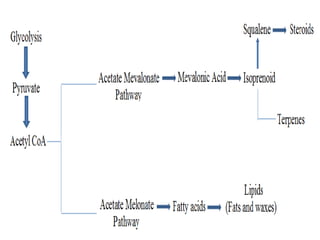
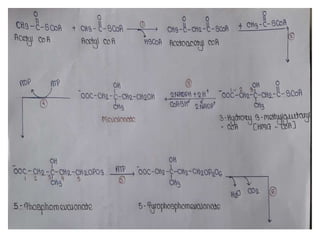
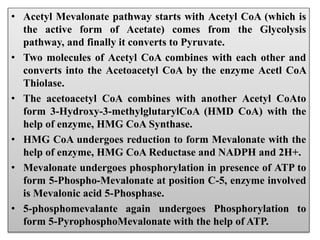
• Acetyl Mevalonate pathway starts with Acetyl CoA (which is
the active form of Acetate) comes from the Glycolysis
pathway, and finally it converts to Pyruvate.
• Two molecules of Acetyl CoA combines with each other and
converts into the Acetoacetyl CoA by the enzyme Acetl CoA
Thiolase.
• The acetoacetyl CoA combines with another Acetyl CoAto
form 3-Hydroxy-3-methylglutarylCoA (HMD CoA) with the
help of enzyme, HMG CoA Synthase.
• HMG CoA undergoes reduction to form Mevalonate with the
help of enzyme, HMG CoA Reductase and NADPH and 2H+.
• Mevalonate undergoes phosphorylation in presence of ATP to
form 5-Phospho-Mevalonate at position C-5, enzyme involved
is Mevalonic acid 5-Phosphase.
• 5-phosphomevalante again undergoes Phosphorylation to
form 5-PyrophosphoMevalonate with the help of ATP.
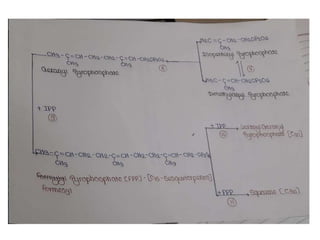
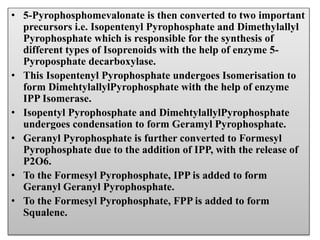
• 5-Pyrophosphomevalonate is then converted to two important
precursors i.e. Isopentenyl Pyrophosphate and Dimethylallyl
Pyrophosphate which is responsible for the synthesis of
different types of Isoprenoids with the help of enzyme 5-
Pyroposphate decarboxylase.
• This Isopentenyl Pyrophosphate undergoes Isomerisation to
form DimehtylallylPyrophosphate with the help of enzyme
IPP Isomerase.
• Isopentyl Pyrophosphate and DimehtylallylPyrophosphate
undergoes condensation to form Geramyl Pyrophosphate.
• Geranyl Pyrophosphate is further converted to Formesyl
Pyrophosphate due to the addition of IPP, with the release of
P2O6.
• To the Formesyl Pyrophosphate, IPP is added to form
Geranyl Geranyl Pyrophosphate.
• To the Formesyl Pyrophosphate, FPP is added to form
Squalene.
Acetate acid pathway

Acetate acid pathway

  • 1.
    Acetate Pathway Presented by SonaliS Gadge Lecturer P R Patil Institute of Pharmacy, Talegaon (SP), Dist-Wardha.
  • 2.
    • The acetatepathway, is also known as Mevalonate pathway or HMG-CoA reductase pathway, is an essential metabolic pathway present in Eukaryotes, archaea, and some bacteria. • The pathway produces two five – carbon building blocks called Isopentenyl Pyrophosphate (IPP) and Dimethylallyl Pyrophosphate (DMAPP) • The Mavalonate pathway begins with Acetyl CoA and ends with the production of IPP and DMAPP. • It is best known as the target of statins, a class of cholesterol lowering agent.
  • 3.
    Types of MevalonatePathway 1. Upper Mevalonate Pathway/Acetate Mevalonate Pathway • The Mevalonate pathway of Eukaryotes archaea and bacteria all begin the same way. • The sole carbon feed stock of the pathway is Acetyl CoA. The first step condenses two Acetyl CoA molecules to yeild Acetoacetyl CoA. This followed by a second condensation to form HMG-CoA (3-Hydroxy-3-Methyl-glutaryl-CoA). • Reduction of HMG-CoA yeilds Mevalonate. These first three Enzymatic steps are called the upper Mevalonic pathway.
  • 4.
    2. Lower MevalonicPathway/ Acetate Mevalonic pathway • The lower mevalonate pathway which converts Mevalonate into IPP and DMAPP has 3 variants. In Eukaryotes, Mevalonate is phosphorylated twice in the 5-OH position, then decarboxylated to yeild IPP. • In some archaea such as Haloferax volcanii, Mevalonate is phosphorylated once in the 5-OH position, decarboxylated to yeild Isopentenyl Phosphate (IP), and finally phosphorylated again to yeild IPP. • A third Mevalonate pathway variant found in Thermoplasma acidophilum, phosphorylates Mevalonate at the 3-OH position followed by phosphorylation at the 5-OH position. • The resulting metabolite, Mevalonate-3,5-bisphosphate, is decarboxylated to IP and finally phosphorylated to yeild IPP.
  • 8.
    • Acetyl Mevalonatepathway starts with Acetyl CoA (which is the active form of Acetate) comes from the Glycolysis pathway, and finally it converts to Pyruvate. • Two molecules of Acetyl CoA combines with each other and converts into the Acetoacetyl CoA by the enzyme Acetl CoA Thiolase. • The acetoacetyl CoA combines with another Acetyl CoAto form 3-Hydroxy-3-methylglutarylCoA (HMD CoA) with the help of enzyme, HMG CoA Synthase. • HMG CoA undergoes reduction to form Mevalonate with the help of enzyme, HMG CoA Reductase and NADPH and 2H+. • Mevalonate undergoes phosphorylation in presence of ATP to form 5-Phospho-Mevalonate at position C-5, enzyme involved is Mevalonic acid 5-Phosphase. • 5-phosphomevalante again undergoes Phosphorylation to form 5-PyrophosphoMevalonate with the help of ATP.
  • 9.
    • 5-Pyrophosphomevalonate isthen converted to two important precursors i.e. Isopentenyl Pyrophosphate and Dimethylallyl Pyrophosphate which is responsible for the synthesis of different types of Isoprenoids with the help of enzyme 5- Pyroposphate decarboxylase. • This Isopentenyl Pyrophosphate undergoes Isomerisation to form DimehtylallylPyrophosphate with the help of enzyme IPP Isomerase. • Isopentyl Pyrophosphate and DimehtylallylPyrophosphate undergoes condensation to form Geramyl Pyrophosphate. • Geranyl Pyrophosphate is further converted to Formesyl Pyrophosphate due to the addition of IPP, with the release of P2O6. • To the Formesyl Pyrophosphate, IPP is added to form Geranyl Geranyl Pyrophosphate. • To the Formesyl Pyrophosphate, FPP is added to form Squalene.