Structure Activity
Relationship
Dr AKSHIL
22-04-2016 1
22-04-2016 2
22-04-2016 3
• Medicinal chemistry is a chemistry-based discipline,
involving aspects of biological, medical and
pharmaceutical sciences. It is concerned with the
invention, discovery, design, identification and
preparation of biologically active compounds, the
study of their metabolism, the interpretation of their
mode of action at the molecular level and the
construction of structure-activity relationships (SARs).
Structure activity relationship
(SAR)
• SAR is the relationship between the chemical or 3D
structure of a molecule and its biological activity.
• The analysis of the dependence of biological effects
of a chemical upon its molecular structure.
• Molecular structure and biological activity are
correlated by observing the results of systematic
structural modification on defined biological
endpoints.
22-04-2016 5
• Determination of the chemical groups responsible
for evoking a target biological effect in the
organism.
• Quantitative SARs (QSAR)as a special case of SARs
(when relationships become quantified)
22-04-2016 6
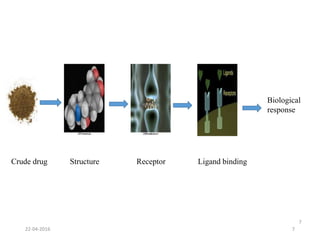
7
Crude drug Structure Ligand bindingReceptor
Biological
response
22-04-2016 7
8
WHY SAR Exist?
• The interaction of the drug molecule with protein depends
on its chemical structure
NEED OF SAR STUDY
• A study of the structure–activity relationship is mainly
done by lead molecule.
• It is used to determine pharmacophore, unwanted side
effects
• To develop a new drug that has increased activity.
22-04-2016
9
Cont.…..
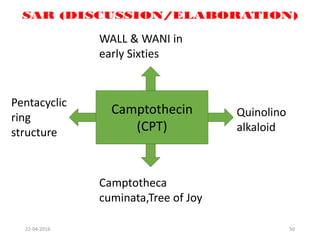
• To determine some different activity from an
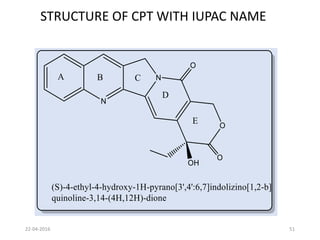
existing drug
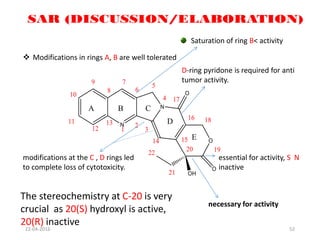
• To fewer unwanted side effects
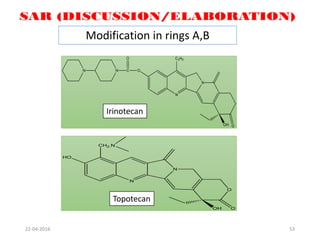
• To know the changes in pharmacological properties
by performing minor changes in the drug molecule
22-04-2016
QSAR
• Attempts to find consistent relationship between
the variations in the values of molecular properties
& the biological activities for a series of compounds
so that these “rules” can be used to evaluate new
chemical entities.
• 3D QSAR –most powerful technique available for
analog – based drug design.
22-04-2016 10
History of Medicinal Chemistry
Early investigations of natural products
In the so-called pre-scientific era
• Natural products having a history as folk remedies
were in use. Fore examples, opium, belladonna,
cinchona bark, etc. Many drugs originally used as
folk remedies, nowadays, have been abandoned.
• In the late eighteenth and early nineteenth centuries,
chemical experimentation led ultimately to its use in
the discovery of new drugs.
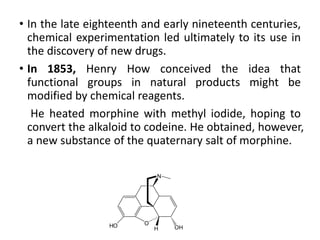
• In 1853, Henry How conceived the idea that
functional groups in natural products might be
modified by chemical reagents.
He heated morphine with methyl iodide, hoping to
convert the alkaloid to codeine. He obtained, however,
a new substance of the quaternary salt of morphine.
HO O
H OH
N
• In 1898, the first commercially available semisynthetic
morphine derivative (ethyl ether) was introduced as a
cough sedative in preference to codeine or other
opiates.
• Meanwhile, diacetylmorphine was introduced as a
safer pain reliever than morphine. It quickly became
popular throughout the world.
• Four years passed before its addictive properties of heroin were
recognized. Laws were later passed by governments to restrict its
use.
• During the 1840s, the first use of synthetic organic
chemicals were introduced for anesthesia during a
tooth removal, such as nitrous oxide, ether, and
chloroform.
• In 1864, barbituric acid had been synthesized as a
useful hypnotic.
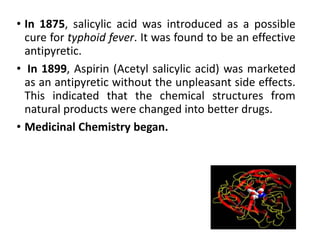
• In 1875, salicylic acid was introduced as a possible
cure for typhoid fever. It was found to be an effective
antipyretic.
• In 1899, Aspirin (Acetyl salicylic acid) was marketed
as an antipyretic without the unpleasant side effects.
This indicated that the chemical structures from
natural products were changed into better drugs.
• Medicinal Chemistry began.
Selectivity of Drug Action and
Drug Receptors
• Similar molecules exert similar biological actions in
a qualitative sense.
• Both agonists and antagonists share common
structural features.
• Composition and arrangement of chemical
functional groups, determines the type of
pharmacologic effect it possesses.
22-04-2016 16
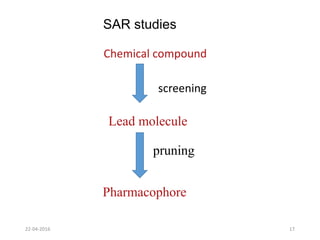
Chemical compound
Lead molecule
screening
SAR studies
pruning
Pharmacophore
22-04-2016 17
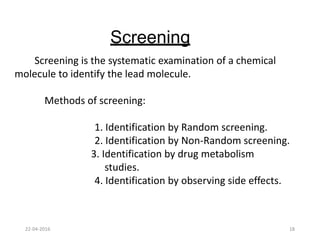
Screening
Screening is the systematic examination of a chemical
molecule to identify the lead molecule.
Methods of screening:
1. Identification by Random screening.
2. Identification by Non-Random screening.
3. Identification by drug metabolism
studies.
4. Identification by observing side effects.
22-04-2016 18
Random Screening
The lead compound for the development of most drugs
is found by screening thousands of compounds
randomly
A random screen is a search for a pharmacologically
active lead compound without any information about
what structures might show activity
22-04-2016 19
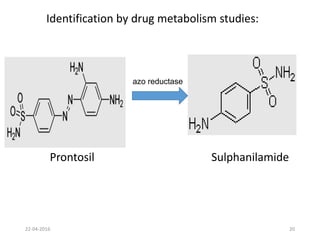
Identification by drug metabolism studies:
azo reductase
Prontosil Sulphanilamide
22-04-2016 20
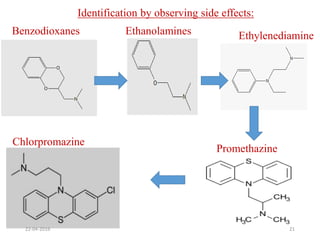
Identification by observing side effects:
Benzodioxanes Ethanolamines Ethylenediamine
Promethazine
Chlorpromazine
22-04-2016 21
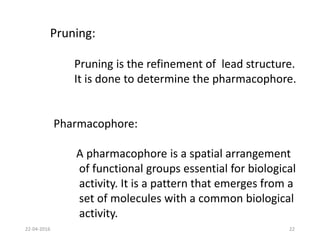
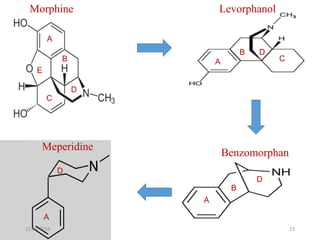
Pruning:
Pruning is the refinement of lead structure.
It is done to determine the pharmacophore.
Pharmacophore:
A pharmacophore is a spatial arrangement
of functional groups essential for biological
activity. It is a pattern that emerges from a
set of molecules with a common biological
activity.
22-04-2016 22
A
C
D
E
Benzomorphan
Meperidine
Morphine Levorphanol
B A
B D
C
A
D
A
D
B
22-04-2016 23
PHYSICOCHEMICAL PROPERTIES OF
DRUGS:
• Acid-Base Properties
• Water Solubility of Drugs
• Stereochemistry
• Electronic parameters
22-04-2016 24
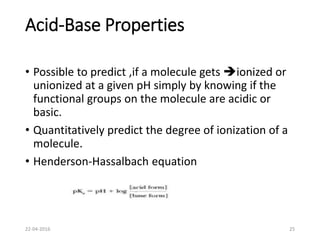
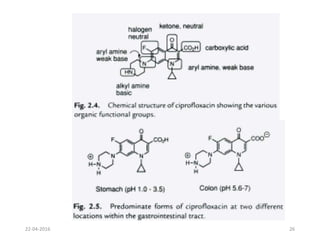
Acid-Base Properties
• Possible to predict ,if a molecule gets ionized or
unionized at a given pH simply by knowing if the
functional groups on the molecule are acidic or
basic.
• Quantitatively predict the degree of ionization of a
molecule.
• Henderson-Hassalbach equation
22-04-2016 25
22-04-2016 26
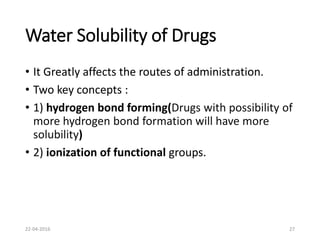
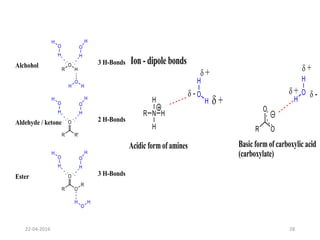
Water Solubility of Drugs
• It Greatly affects the routes of administration.
• Two key concepts :
• 1) hydrogen bond forming(Drugs with possibility of
more hydrogen bond formation will have more
solubility)
• 2) ionization of functional groups.
22-04-2016 27
R
O
H
Alchohol
O
HH
H
O
H
O
H
H
3 H-Bonds
OAldehyde / ketone
HH
O
H
O
H
2 H-Bonds
R R'
OEster
HH
O
H
O
H
3 H-Bonds
R O
R
H
O
H
Ion - dipole bonds
H
N HR
H
Acidic form of amines
H
O
H
-
+
+
R
O
O
Basic form of carboxylic acid
(carboxylate)
H
O
H
+
+ -
22-04-2016 28
Predicting Water Solubility:
Empiric Approach
• Based on carbon- solubilising potential of several
organic functional groups.
• Solubilising potential of the functional groups
exceeds the total number of carbon atoms present,
then the molecule is considered to be water
soluble. Otherwise, its water insoluble.
22-04-2016 29
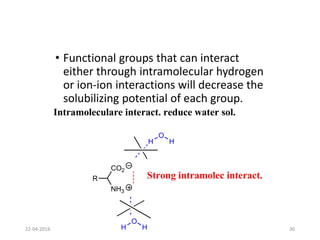
• Functional groups that can interact
either through intramolecular hydrogen
or ion-ion interactions will decrease the
solubilizing potential of each group.
Intramoleculare interact. reduce water sol.
R
CO2
NH3
Strong intramolec interact.
O
H H
O
HH22-04-2016 30
Predicting Water Solubility:
Analytical Approach
• PARTITION CO-EFFICIENT- It is the extent of distribution
of drug between oil phase and water phase.
• If the drug is more hydrophobic it will have high p
value and it can cross biological membranes easily.
• Partition co-effecient of a drug can be determined by
its distribution in an octanol-water mixture.
P= Concentration of drug in octanol
Concentration of drug in aqueous solution
22-04-2016 31
Log P =Σπ(fragments)
• Log of the partition coefficient for a molecule
Predicts Water Solubility
• Log P is the sum of the hydrophobic and
hydriophilic characteristics of the organic functional
groups making up the structure of the molecule.
• Thus, logP is a measure of the solubility
characteristics of the entire molecule.
22-04-2016 32
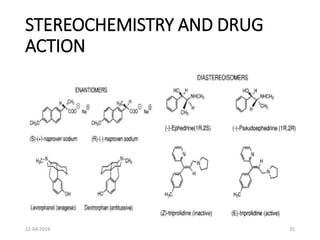
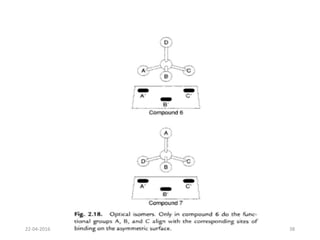
STEREOCHEMISTRY AND DRUG
ACTION
• Stereo isomers are compounds containing
the same number and kinds of atoms, the
same arrangement of bonds, but different
three-dimensional structures.
• 2 types  enantiomers and
diastereoisomers
• If functional groups are in the proper 3D
orientation, the drug can produce a very
strong interaction with its receptor.
22-04-2016 34
STEREOCHEMISTRY AND DRUG
ACTION
22-04-2016 35
• The physiochemical properties of a drug molecule
dependent on (a) functional groups in the molecule
(b)spatial arrangement of these groups.
• Enantiomers when introduced into an Asymmetric
environment(human body) ,it will display different
physiochemical properties, producing significant
differences in their pharmacokinetic and
pharmacodynamics behavior.
22-04-2016 36
Easson and Stedman Hypothesis
• reasoned that differences in biological activity
between enantiomers resulted from selective
reactivity of one enantiomer with its receptor.
• They postulated that such interactions require a
minimum of a three-point fit to the receptor.
(incerase potency of enantiomers)
22-04-2016 37
22-04-2016 38
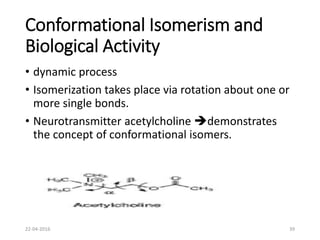
Conformational Isomerism and
Biological Activity
• dynamic process
• Isomerization takes place via rotation about one or
more single bonds.
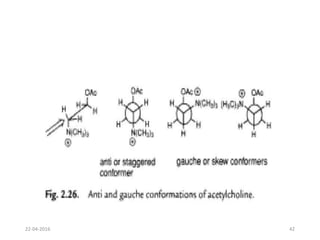
• Neurotransmitter acetylcholine demonstrates
the concept of conformational isomers.
22-04-2016 39
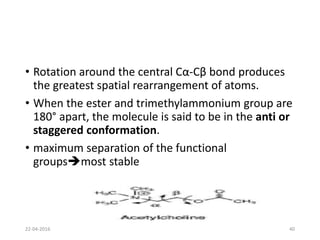
• Rotation around the central Cα-Cβ bond produces
the greatest spatial rearrangement of atoms.
• When the ester and trimethylammonium group are
180° apart, the molecule is said to be in the anti or
staggered conformation.
• maximum separation of the functional
groupsmost stable
22-04-2016 40
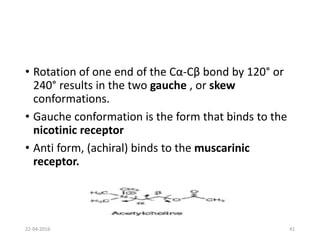
• Rotation of one end of the Cα-Cβ bond by 120° or
240° results in the two gauche , or skew
conformations.
• Gauche conformation is the form that binds to the
nicotinic receptor
• Anti form, (achiral) binds to the muscarinic
receptor.
22-04-2016 41
22-04-2016 42
Electronic parameters
• The electronic effects of various substituents will
clearly have an effect on a drug's ionization or
polarity.
• This in turn may have an effect on how easily a
drug can pass through cell membranes or how
strongly it can bind to a receptor.
• After drug reaching its target site distribution of
electrons in its structure will control the type of
bond between them.
22-04-2016 43
These SAR studies are done through Analog Approach.
ANALOG APPROACH:
1. Homologs.
2. Molecular fragmentation.
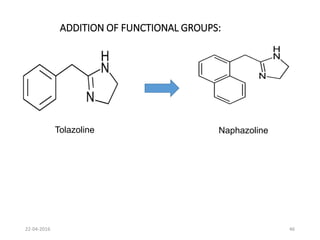
3. Addition of functional groups.
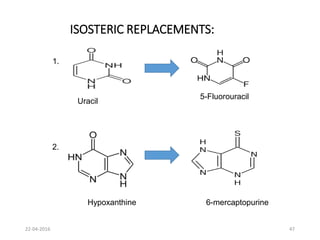
4. Isosteric Replacements.
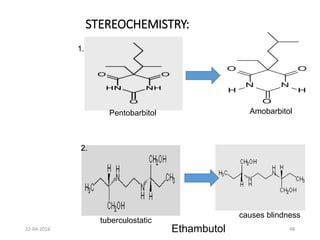
5. Stereochemistry.
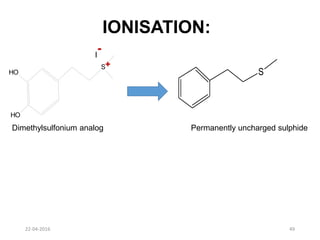
6. Ionisation.
22-04-2016 44
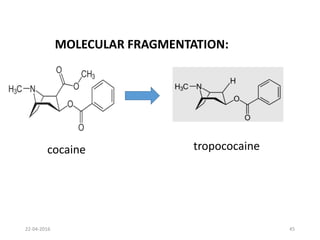
MOLECULAR FRAGMENTATION:
H
cocaine tropococaine
22-04-2016 45
ADDITION OF FUNCTIONAL GROUPS:
Tolazoline Naphazoline
22-04-2016 46
ISOSTERIC REPLACEMENTS:
1.
Uracil
5-Fluorouracil
2.
Hypoxanthine 6-mercaptopurine
22-04-2016 47
STEREOCHEMISTRY:
Pentobarbitol Amobarbitol
tuberculostatic
causes blindness
Ethambutol
1.
2.
22-04-2016 48
OH
OH
S+
Dimethylsulfonium analog
S
Permanently uncharged sulphide
I
-
IONISATION:
22-04-2016 49
50
Camptothecin
(CPT)
WALL & WANI in
early Sixties
Camptotheca
cuminata,Tree of Joy
Quinolino
alkaloid
Pentacyclic
ring
structure
22-04-2016
51
STRUCTURE OF CPT WITH IUPAC NAME
22-04-2016
52
A B C
D
E
Saturation of ring B< activity
necessary for activity
essential for activity, S N
inactive
D-ring pyridone is required for anti
tumor activity.
 Modifications in rings A, B are well tolerated
The stereochemistry at C-20 is very
crucial as 20(S) hydroxyl is active,
20(R) inactive
modifications at the C , D rings led
to complete loss of cytotoxicity.
22-04-2016
53
Modification in rings A,B
Topotecan
Irinotecan
22-04-2016
54
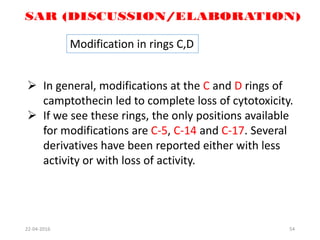
Modification in rings C,D
 In general, modifications at the C and D rings of
camptothecin led to complete loss of cytotoxicity.
 If we see these rings, the only positions available
for modifications are C-5, C-14 and C-17. Several
derivatives have been reported either with less
activity or with loss of activity.
22-04-2016
55
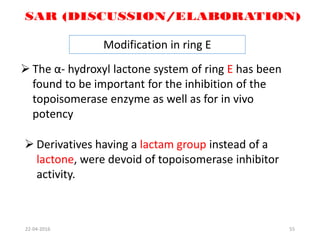
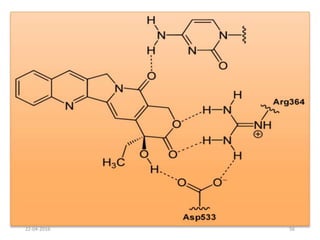
Modification in ring E
 The α- hydroxyl lactone system of ring E has been
found to be important for the inhibition of the
topoisomerase enzyme as well as for in vivo
potency
 Derivatives having a lactam group instead of a
lactone, were devoid of topoisomerase inhibitor
activity.
22-04-2016
5622-04-2016
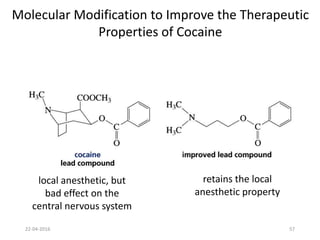
Molecular Modification to Improve the Therapeutic
Properties of Cocaine
local anesthetic, but
bad effect on the
central nervous system
retains the local
anesthetic property
22-04-2016 57
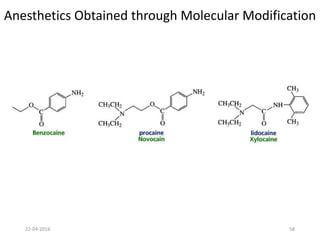
Anesthetics Obtained through Molecular Modification
22-04-2016 58
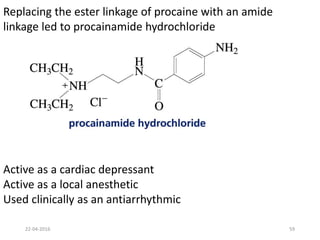
Replacing the ester linkage of procaine with an amide
linkage led to procainamide hydrochloride
Active as a cardiac depressant
Active as a local anesthetic
Used clinically as an antiarrhythmic
22-04-2016 59
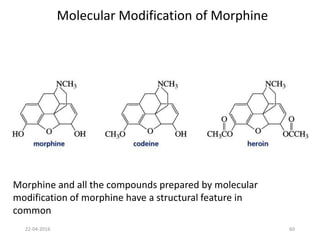
Molecular Modification of Morphine
Morphine and all the compounds prepared by molecular
modification of morphine have a structural feature in
common
22-04-2016 60
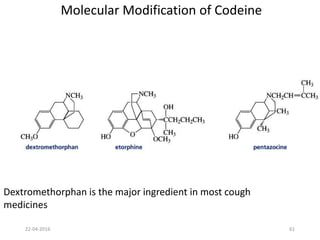
Molecular Modification of Codeine
Dextromethorphan is the major ingredient in most cough
medicines
22-04-2016 61
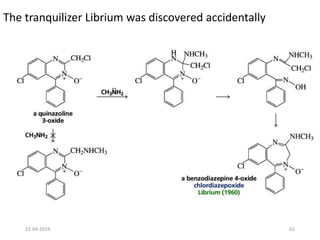
The tranquilizer Librium was discovered accidentally
22-04-2016 62
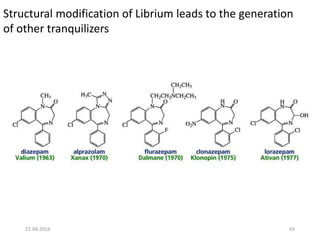
Structural modification of Librium leads to the generation
of other tranquilizers
22-04-2016 63
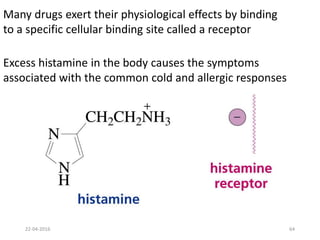
Many drugs exert their physiological effects by binding
to a specific cellular binding site called a receptor
Excess histamine in the body causes the symptoms
associated with the common cold and allergic responses
22-04-2016 64
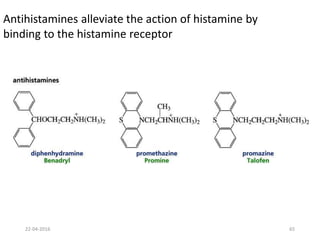
Antihistamines alleviate the action of histamine by
binding to the histamine receptor
22-04-2016 65
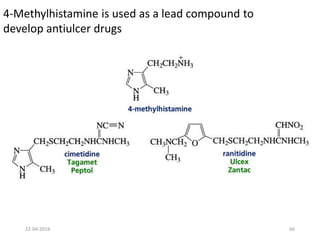
4-Methylhistamine is used as a lead compound to
develop antiulcer drugs
22-04-2016 66
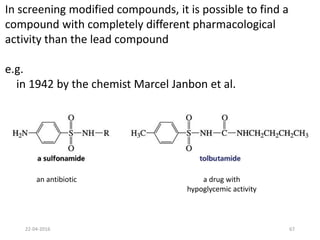
In screening modified compounds, it is possible to find a
compound with completely different pharmacological
activity than the lead compound
e.g.
in 1942 by the chemist Marcel Janbon et al.
an antibiotic a drug with
hypoglycemic activity
22-04-2016 67
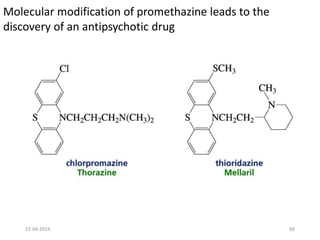
Molecular modification of promethazine leads to the
discovery of an antipsychotic drug
22-04-2016 68
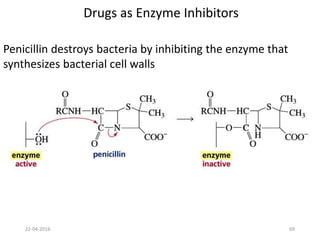
Drugs as Enzyme Inhibitors
Penicillin destroys bacteria by inhibiting the enzyme that
synthesizes bacterial cell walls
22-04-2016 69
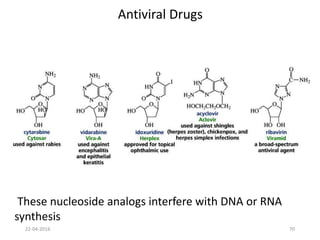
Antiviral Drugs
These nucleoside analogs interfere with DNA or RNA
synthesis
22-04-2016 70
- Quantitative structure-activity relationships
are mathematical relationships linking chemical
structure and pharmacological activity in a
quantitative manner for a series of compounds
- Biological activity can be expressed
quantitatively as the concentration of a substance
required to give a certain biological response
- When physicochemical properties or structures
are expressed by numbers, one can find a
mathematical relationship, or quantitative
structure-activity relationship, between the two
QSAR
4/22/2016 71
Conclusion :
• SAR deals with the influence of the functional
groups present in the drug on its biological activity
• SAR studies are done to determine the pattern of
this influence which is employed in the drug design
and in the synthesis of many drugs of desired
pharmacological activity.
22-04-2016 72
References:
• Medicinal Chemistry, Ashutosh Kar , 4th edi.
• Essentials of drug designing . V kothekar 1st Edition
2005
• Paul Beringer, Linda Felton et al. The Science and
Practice of Pharmacy, 21st ed, Vol.1,
• Drug design vol.10, Ariens et al.
• Goodman & gillman’s the pharmacological basis of
therapeutics, 12th edition.
22-04-2016 73
22-04-2016 74

Structure activity relation ship

  • 1.
  • 2.
  • 3.
  • 4.
    • Medicinal chemistryis a chemistry-based discipline, involving aspects of biological, medical and pharmaceutical sciences. It is concerned with the invention, discovery, design, identification and preparation of biologically active compounds, the study of their metabolism, the interpretation of their mode of action at the molecular level and the construction of structure-activity relationships (SARs).
  • 5.
    Structure activity relationship (SAR) •SAR is the relationship between the chemical or 3D structure of a molecule and its biological activity. • The analysis of the dependence of biological effects of a chemical upon its molecular structure. • Molecular structure and biological activity are correlated by observing the results of systematic structural modification on defined biological endpoints. 22-04-2016 5
  • 6.
    • Determination ofthe chemical groups responsible for evoking a target biological effect in the organism. • Quantitative SARs (QSAR)as a special case of SARs (when relationships become quantified) 22-04-2016 6
  • 7.
    7 Crude drug StructureLigand bindingReceptor Biological response 22-04-2016 7
  • 8.
    8 WHY SAR Exist? •The interaction of the drug molecule with protein depends on its chemical structure NEED OF SAR STUDY • A study of the structure–activity relationship is mainly done by lead molecule. • It is used to determine pharmacophore, unwanted side effects • To develop a new drug that has increased activity. 22-04-2016
  • 9.
    9 Cont.….. • To determinesome different activity from an existing drug • To fewer unwanted side effects • To know the changes in pharmacological properties by performing minor changes in the drug molecule 22-04-2016
  • 10.
    QSAR • Attempts tofind consistent relationship between the variations in the values of molecular properties & the biological activities for a series of compounds so that these “rules” can be used to evaluate new chemical entities. • 3D QSAR –most powerful technique available for analog – based drug design. 22-04-2016 10
  • 11.
    History of MedicinalChemistry Early investigations of natural products In the so-called pre-scientific era • Natural products having a history as folk remedies were in use. Fore examples, opium, belladonna, cinchona bark, etc. Many drugs originally used as folk remedies, nowadays, have been abandoned.
  • 12.
    • In thelate eighteenth and early nineteenth centuries, chemical experimentation led ultimately to its use in the discovery of new drugs. • In 1853, Henry How conceived the idea that functional groups in natural products might be modified by chemical reagents. He heated morphine with methyl iodide, hoping to convert the alkaloid to codeine. He obtained, however, a new substance of the quaternary salt of morphine. HO O H OH N
  • 13.
    • In 1898,the first commercially available semisynthetic morphine derivative (ethyl ether) was introduced as a cough sedative in preference to codeine or other opiates. • Meanwhile, diacetylmorphine was introduced as a safer pain reliever than morphine. It quickly became popular throughout the world. • Four years passed before its addictive properties of heroin were recognized. Laws were later passed by governments to restrict its use.
  • 14.
    • During the1840s, the first use of synthetic organic chemicals were introduced for anesthesia during a tooth removal, such as nitrous oxide, ether, and chloroform. • In 1864, barbituric acid had been synthesized as a useful hypnotic.
  • 15.
    • In 1875,salicylic acid was introduced as a possible cure for typhoid fever. It was found to be an effective antipyretic. • In 1899, Aspirin (Acetyl salicylic acid) was marketed as an antipyretic without the unpleasant side effects. This indicated that the chemical structures from natural products were changed into better drugs. • Medicinal Chemistry began.
  • 16.
    Selectivity of DrugAction and Drug Receptors • Similar molecules exert similar biological actions in a qualitative sense. • Both agonists and antagonists share common structural features. • Composition and arrangement of chemical functional groups, determines the type of pharmacologic effect it possesses. 22-04-2016 16
  • 17.
    Chemical compound Lead molecule screening SARstudies pruning Pharmacophore 22-04-2016 17
  • 18.
    Screening Screening is thesystematic examination of a chemical molecule to identify the lead molecule. Methods of screening: 1. Identification by Random screening. 2. Identification by Non-Random screening. 3. Identification by drug metabolism studies. 4. Identification by observing side effects. 22-04-2016 18
  • 19.
    Random Screening The leadcompound for the development of most drugs is found by screening thousands of compounds randomly A random screen is a search for a pharmacologically active lead compound without any information about what structures might show activity 22-04-2016 19
  • 20.
    Identification by drugmetabolism studies: azo reductase Prontosil Sulphanilamide 22-04-2016 20
  • 21.
    Identification by observingside effects: Benzodioxanes Ethanolamines Ethylenediamine Promethazine Chlorpromazine 22-04-2016 21
  • 22.
    Pruning: Pruning is therefinement of lead structure. It is done to determine the pharmacophore. Pharmacophore: A pharmacophore is a spatial arrangement of functional groups essential for biological activity. It is a pattern that emerges from a set of molecules with a common biological activity. 22-04-2016 22
  • 23.
  • 24.
    PHYSICOCHEMICAL PROPERTIES OF DRUGS: •Acid-Base Properties • Water Solubility of Drugs • Stereochemistry • Electronic parameters 22-04-2016 24
  • 25.
    Acid-Base Properties • Possibleto predict ,if a molecule gets ionized or unionized at a given pH simply by knowing if the functional groups on the molecule are acidic or basic. • Quantitatively predict the degree of ionization of a molecule. • Henderson-Hassalbach equation 22-04-2016 25
  • 26.
  • 27.
    Water Solubility ofDrugs • It Greatly affects the routes of administration. • Two key concepts : • 1) hydrogen bond forming(Drugs with possibility of more hydrogen bond formation will have more solubility) • 2) ionization of functional groups. 22-04-2016 27
  • 28.
    R O H Alchohol O HH H O H O H H 3 H-Bonds OAldehyde /ketone HH O H O H 2 H-Bonds R R' OEster HH O H O H 3 H-Bonds R O R H O H Ion - dipole bonds H N HR H Acidic form of amines H O H - + + R O O Basic form of carboxylic acid (carboxylate) H O H + + - 22-04-2016 28
  • 29.
    Predicting Water Solubility: EmpiricApproach • Based on carbon- solubilising potential of several organic functional groups. • Solubilising potential of the functional groups exceeds the total number of carbon atoms present, then the molecule is considered to be water soluble. Otherwise, its water insoluble. 22-04-2016 29
  • 30.
    • Functional groupsthat can interact either through intramolecular hydrogen or ion-ion interactions will decrease the solubilizing potential of each group. Intramoleculare interact. reduce water sol. R CO2 NH3 Strong intramolec interact. O H H O HH22-04-2016 30
  • 31.
    Predicting Water Solubility: AnalyticalApproach • PARTITION CO-EFFICIENT- It is the extent of distribution of drug between oil phase and water phase. • If the drug is more hydrophobic it will have high p value and it can cross biological membranes easily. • Partition co-effecient of a drug can be determined by its distribution in an octanol-water mixture. P= Concentration of drug in octanol Concentration of drug in aqueous solution 22-04-2016 31
  • 32.
    Log P =Σπ(fragments) •Log of the partition coefficient for a molecule Predicts Water Solubility • Log P is the sum of the hydrophobic and hydriophilic characteristics of the organic functional groups making up the structure of the molecule. • Thus, logP is a measure of the solubility characteristics of the entire molecule. 22-04-2016 32
  • 33.
    STEREOCHEMISTRY AND DRUG ACTION •Stereo isomers are compounds containing the same number and kinds of atoms, the same arrangement of bonds, but different three-dimensional structures. • 2 types  enantiomers and diastereoisomers • If functional groups are in the proper 3D orientation, the drug can produce a very strong interaction with its receptor. 22-04-2016 34
  • 34.
  • 35.
    • The physiochemicalproperties of a drug molecule dependent on (a) functional groups in the molecule (b)spatial arrangement of these groups. • Enantiomers when introduced into an Asymmetric environment(human body) ,it will display different physiochemical properties, producing significant differences in their pharmacokinetic and pharmacodynamics behavior. 22-04-2016 36
  • 36.
    Easson and StedmanHypothesis • reasoned that differences in biological activity between enantiomers resulted from selective reactivity of one enantiomer with its receptor. • They postulated that such interactions require a minimum of a three-point fit to the receptor. (incerase potency of enantiomers) 22-04-2016 37
  • 37.
  • 38.
    Conformational Isomerism and BiologicalActivity • dynamic process • Isomerization takes place via rotation about one or more single bonds. • Neurotransmitter acetylcholine demonstrates the concept of conformational isomers. 22-04-2016 39
  • 39.
    • Rotation aroundthe central Cα-Cβ bond produces the greatest spatial rearrangement of atoms. • When the ester and trimethylammonium group are 180° apart, the molecule is said to be in the anti or staggered conformation. • maximum separation of the functional groupsmost stable 22-04-2016 40
  • 40.
    • Rotation ofone end of the Cα-Cβ bond by 120° or 240° results in the two gauche , or skew conformations. • Gauche conformation is the form that binds to the nicotinic receptor • Anti form, (achiral) binds to the muscarinic receptor. 22-04-2016 41
  • 41.
  • 42.
    Electronic parameters • Theelectronic effects of various substituents will clearly have an effect on a drug's ionization or polarity. • This in turn may have an effect on how easily a drug can pass through cell membranes or how strongly it can bind to a receptor. • After drug reaching its target site distribution of electrons in its structure will control the type of bond between them. 22-04-2016 43
  • 43.
    These SAR studiesare done through Analog Approach. ANALOG APPROACH: 1. Homologs. 2. Molecular fragmentation. 3. Addition of functional groups. 4. Isosteric Replacements. 5. Stereochemistry. 6. Ionisation. 22-04-2016 44
  • 44.
  • 45.
    ADDITION OF FUNCTIONALGROUPS: Tolazoline Naphazoline 22-04-2016 46
  • 46.
  • 47.
  • 48.
    OH OH S+ Dimethylsulfonium analog S Permanently unchargedsulphide I - IONISATION: 22-04-2016 49
  • 49.
    50 Camptothecin (CPT) WALL & WANIin early Sixties Camptotheca cuminata,Tree of Joy Quinolino alkaloid Pentacyclic ring structure 22-04-2016
  • 50.
    51 STRUCTURE OF CPTWITH IUPAC NAME 22-04-2016
  • 51.
    52 A B C D E Saturationof ring B< activity necessary for activity essential for activity, S N inactive D-ring pyridone is required for anti tumor activity.  Modifications in rings A, B are well tolerated The stereochemistry at C-20 is very crucial as 20(S) hydroxyl is active, 20(R) inactive modifications at the C , D rings led to complete loss of cytotoxicity. 22-04-2016
  • 52.
    53 Modification in ringsA,B Topotecan Irinotecan 22-04-2016
  • 53.
    54 Modification in ringsC,D  In general, modifications at the C and D rings of camptothecin led to complete loss of cytotoxicity.  If we see these rings, the only positions available for modifications are C-5, C-14 and C-17. Several derivatives have been reported either with less activity or with loss of activity. 22-04-2016
  • 54.
    55 Modification in ringE  The α- hydroxyl lactone system of ring E has been found to be important for the inhibition of the topoisomerase enzyme as well as for in vivo potency  Derivatives having a lactam group instead of a lactone, were devoid of topoisomerase inhibitor activity. 22-04-2016
  • 55.
  • 56.
    Molecular Modification toImprove the Therapeutic Properties of Cocaine local anesthetic, but bad effect on the central nervous system retains the local anesthetic property 22-04-2016 57
  • 57.
    Anesthetics Obtained throughMolecular Modification 22-04-2016 58
  • 58.
    Replacing the esterlinkage of procaine with an amide linkage led to procainamide hydrochloride Active as a cardiac depressant Active as a local anesthetic Used clinically as an antiarrhythmic 22-04-2016 59
  • 59.
    Molecular Modification ofMorphine Morphine and all the compounds prepared by molecular modification of morphine have a structural feature in common 22-04-2016 60
  • 60.
    Molecular Modification ofCodeine Dextromethorphan is the major ingredient in most cough medicines 22-04-2016 61
  • 61.
    The tranquilizer Libriumwas discovered accidentally 22-04-2016 62
  • 62.
    Structural modification ofLibrium leads to the generation of other tranquilizers 22-04-2016 63
  • 63.
    Many drugs exerttheir physiological effects by binding to a specific cellular binding site called a receptor Excess histamine in the body causes the symptoms associated with the common cold and allergic responses 22-04-2016 64
  • 64.
    Antihistamines alleviate theaction of histamine by binding to the histamine receptor 22-04-2016 65
  • 65.
    4-Methylhistamine is usedas a lead compound to develop antiulcer drugs 22-04-2016 66
  • 66.
    In screening modifiedcompounds, it is possible to find a compound with completely different pharmacological activity than the lead compound e.g. in 1942 by the chemist Marcel Janbon et al. an antibiotic a drug with hypoglycemic activity 22-04-2016 67
  • 67.
    Molecular modification ofpromethazine leads to the discovery of an antipsychotic drug 22-04-2016 68
  • 68.
    Drugs as EnzymeInhibitors Penicillin destroys bacteria by inhibiting the enzyme that synthesizes bacterial cell walls 22-04-2016 69
  • 69.
    Antiviral Drugs These nucleosideanalogs interfere with DNA or RNA synthesis 22-04-2016 70
  • 70.
    - Quantitative structure-activityrelationships are mathematical relationships linking chemical structure and pharmacological activity in a quantitative manner for a series of compounds - Biological activity can be expressed quantitatively as the concentration of a substance required to give a certain biological response - When physicochemical properties or structures are expressed by numbers, one can find a mathematical relationship, or quantitative structure-activity relationship, between the two QSAR 4/22/2016 71
  • 71.
    Conclusion : • SARdeals with the influence of the functional groups present in the drug on its biological activity • SAR studies are done to determine the pattern of this influence which is employed in the drug design and in the synthesis of many drugs of desired pharmacological activity. 22-04-2016 72
  • 72.
    References: • Medicinal Chemistry,Ashutosh Kar , 4th edi. • Essentials of drug designing . V kothekar 1st Edition 2005 • Paul Beringer, Linda Felton et al. The Science and Practice of Pharmacy, 21st ed, Vol.1, • Drug design vol.10, Ariens et al. • Goodman & gillman’s the pharmacological basis of therapeutics, 12th edition. 22-04-2016 73
  • 73.