Narcotic Analgesicsg
Dr Gopal Krishna PadhyDr. Gopal Krishna Padhy
4/8/2020
Definition
Analgesics are defined as drugs that selectively relieve paing g y p
by acting in the central nervous system or on peripheral pain
mechanism without disturbing consciousness.
These are mainly divided into two types.
o Narcotic analgesicso Narcotic analgesics
o Non-narcotic analgesics
4/8/2020
N ti l iNarcotic analgesics
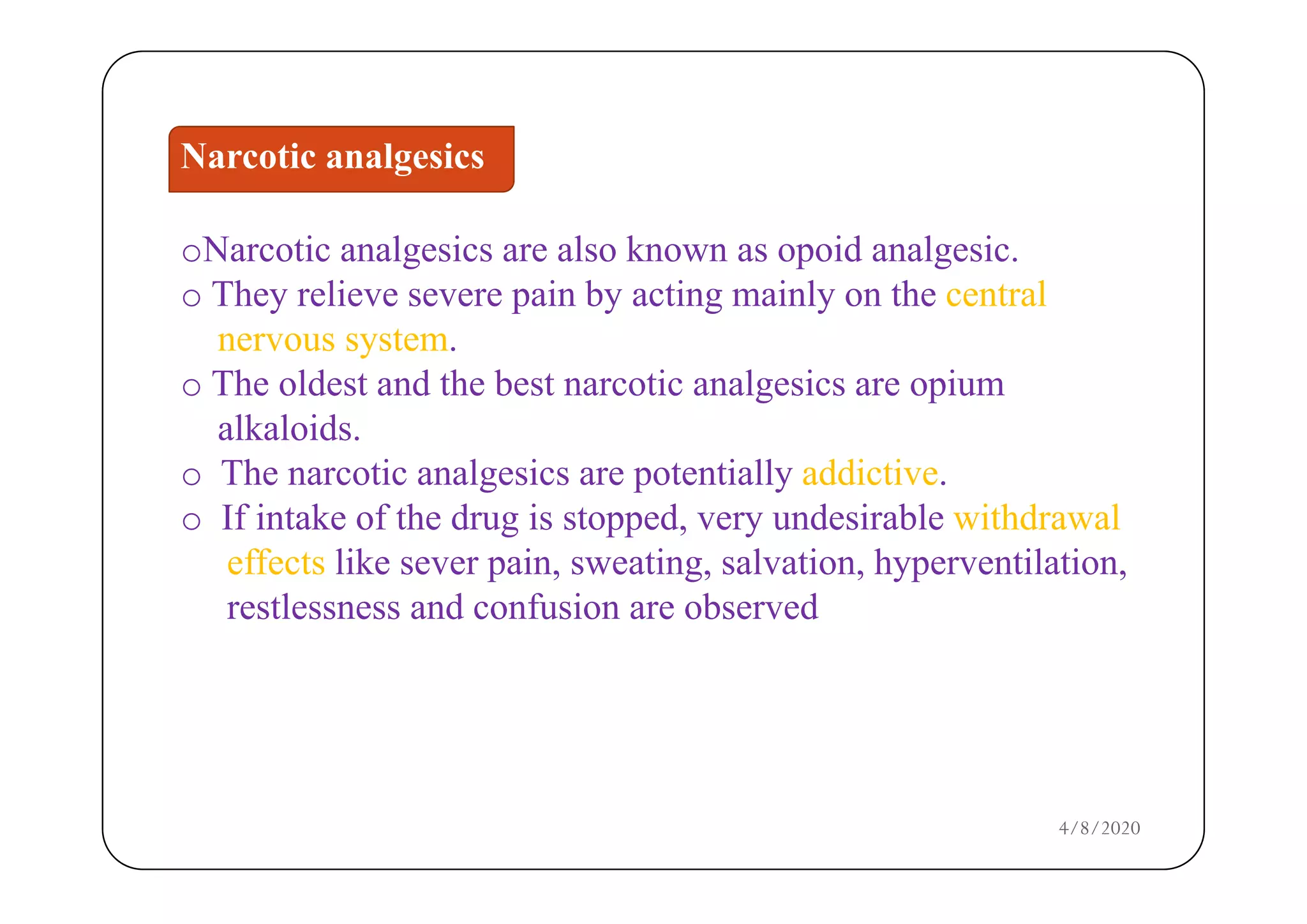
oNarcotic analgesics are also known as opoid analgesicoNarcotic analgesics are also known as opoid analgesic.
o They relieve severe pain by acting mainly on the central
nervous system.y
o The oldest and the best narcotic analgesics are opium
alkaloids.
Th i l i i ll ddi io The narcotic analgesics are potentially addictive.
o If intake of the drug is stopped, very undesirable withdrawal
effects like sever pain sweating salvation hyperventilationeffects like sever pain, sweating, salvation, hyperventilation,
restlessness and confusion are observed
4/8/2020
ClassificationClassification
Morphine analoguesp g
3
Morphine Heroinp
Codeine 4/8/2020
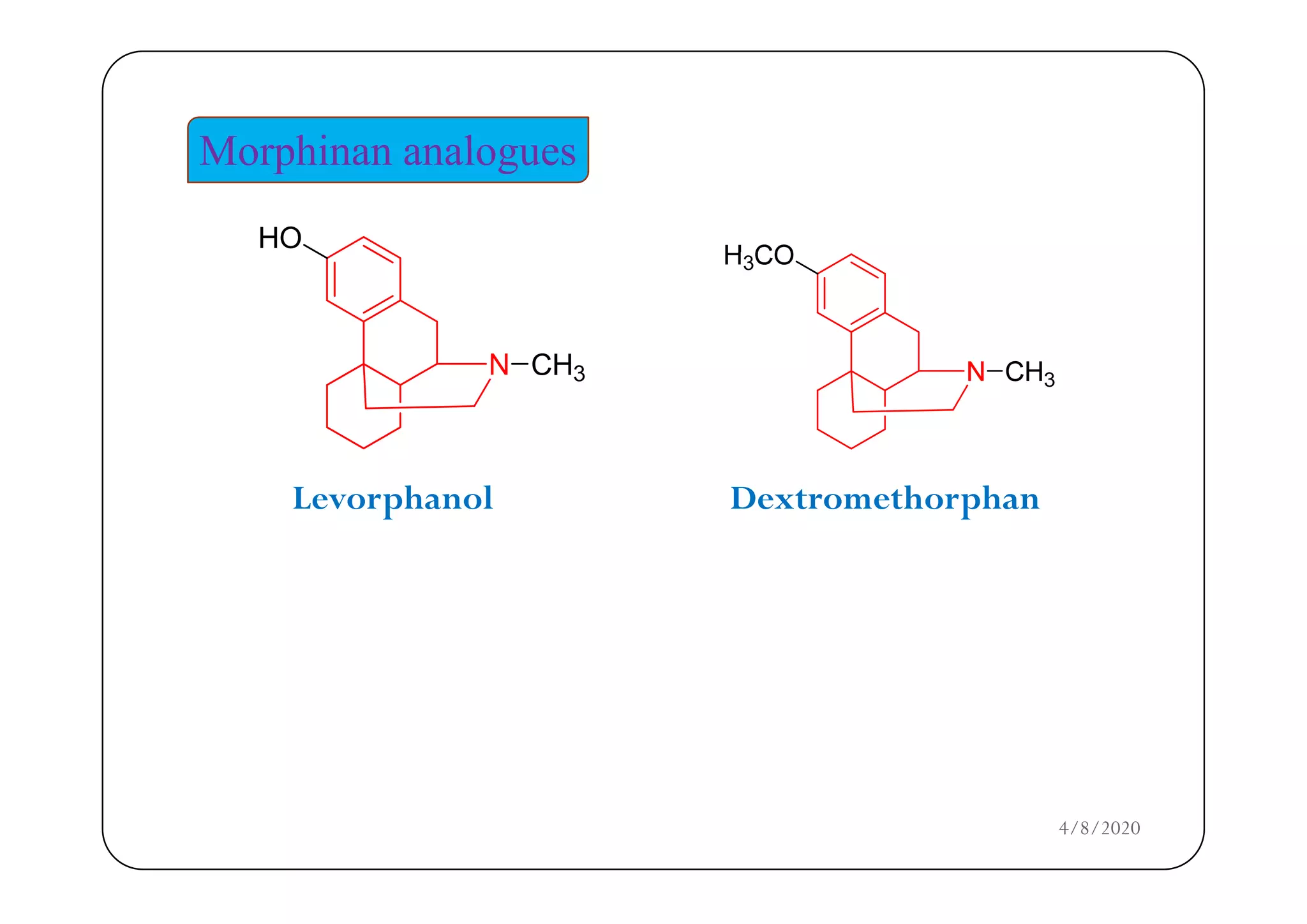
Morphinan analoguesMorphinan analogues
Levorphanol Dextromethorphan
4/8/2020
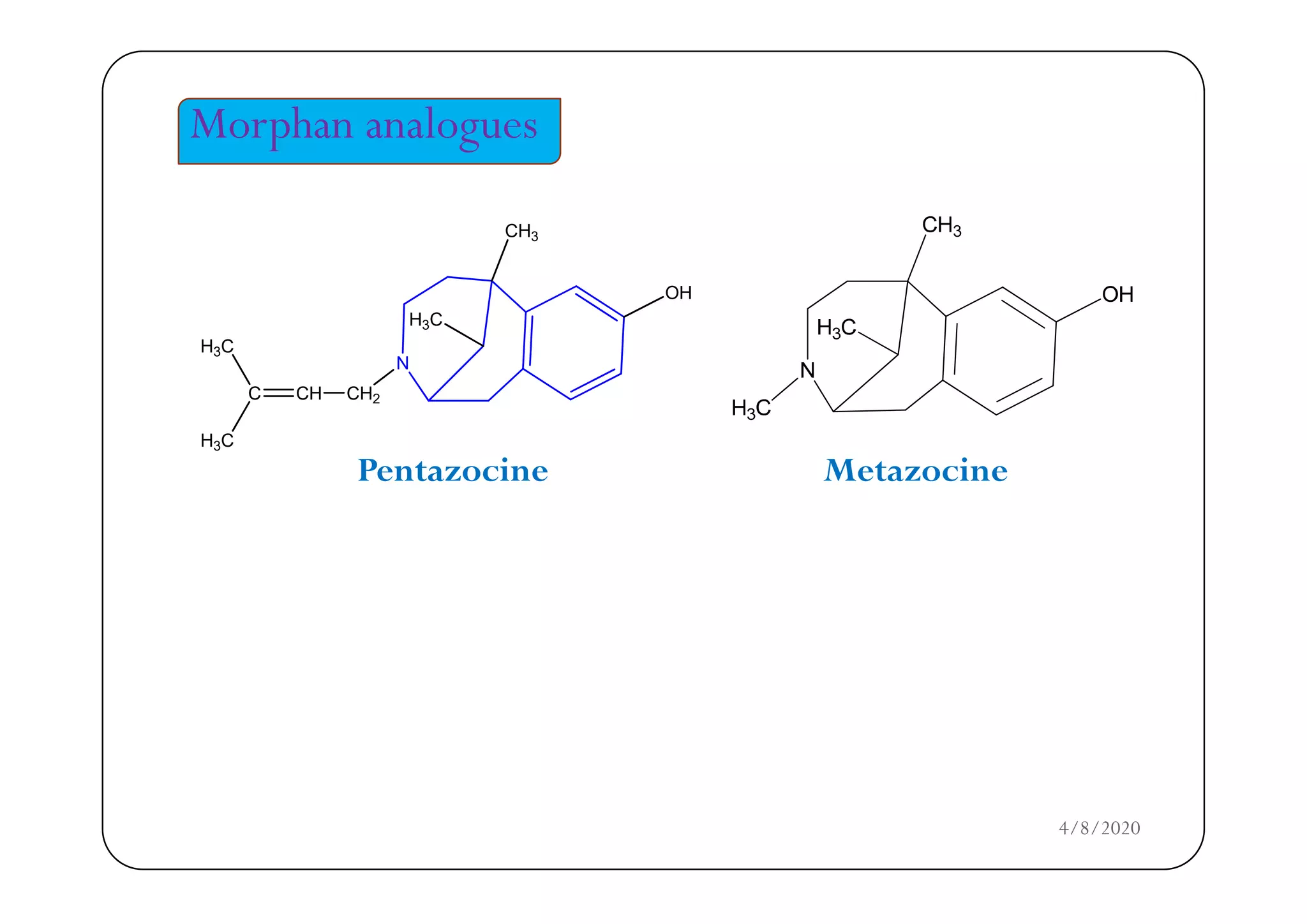
Morphan analoguesp g
CH3
N
H3C
OH
H3C
M t i
N
CH2CHC
H3C
P t i MetazocinePentazocine
4/8/2020
4 Phenylpiperidine analogues4-Phenylpiperidine analogues
N
COOC2H5
CH2CH2CNC
Meperidine / Pethidine Diphenoxylatep y
Anileridine
4/8/2020
4-anilinopiperidine analoguesp p g
2 22 5
Fentanyl
Sufentanyl
4/8/2020
Diphenyl Propylamine derivativesDiphenyl Propylamine derivatives
2
33
2 5
3
Methadone Propoxyphene
4/8/2020
Mechanism of action of Narcotic analgesics
Narcotic analgesics produce their actions at a cellular level
b b ti ti opioid receptorsby by activating on opioid receptors.
e.g. Morphine and its derivatives act as agonists of the mu and
kappa opioid receptorskappa opioid receptors.
These receptors are distributed throughout the (CNS) and
also been found on peripheral afferent nerve terminalsalso been found on peripheral afferent nerve terminals .
Opioid receptors are coupled with inhibitory G- proteins
and their activation has number of actions like closing ofand their activation has number of actions like closing of
voltage sensitive calcium channels, stimulation of
potassium efflux leading to hyperpolarization which causespotassium efflux leading to hyperpolarization which causes
reduction in neuronal cell excitability.
4/8/2020
4/8/2020
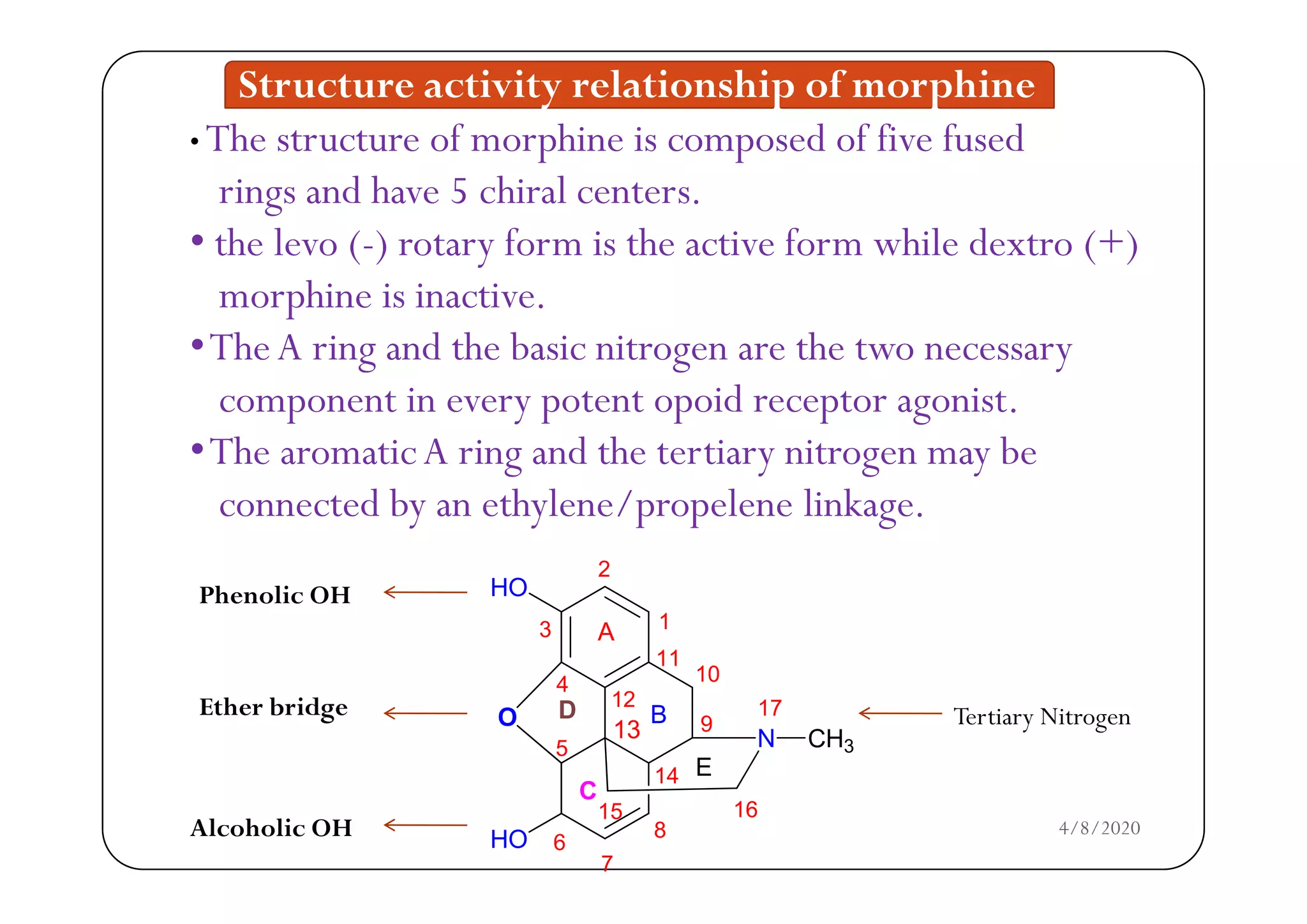
Structure activity relationship of morphine
• The structure of morphine is composed of five fusedThe structure of morphine is composed of five fused
rings and have 5 chiral centers.
• the levo (-) rotary form is the active form while dextro (+)the levo ( ) rotary form is the active form while dextro (+)
morphine is inactive.
•TheA ring and the basic nitrogen are the two necessaryTheA ring and the basic nitrogen are the two necessary
component in every potent opoid receptor agonist.
•The aromaticA ring and the tertiary nitrogen may beThe aromaticA ring and the tertiary nitrogen may be
connected by an ethylene/propelene linkage.
2
HO
1
2
3
10
11
A
Phenolic OH
O
N CH3
4
5
9
10
12
13
14
17BD
E
Ether bridge Tertiary Nitrogen
HO 6
7
8
14
15 16
C
Alcoholic OH 4/8/2020
Tertiary nitrogen atom
•The substituent on nitrogen of morphine and morphine
like structure is critical to degree and type of activitylike structure is critical to degree and type of activity.
• N-methyl substituents generally results in compound with
good agonist proportiesgood agonist proporties.
• Increasing the size of the N-substituent results in
antagonist e g naloxoneantagonist e.g. naloxone
Naloxone 4/8/2020
Hydroxyl Group
• Masking the phenolic hydroxyl group by etherification to
methyl ether decrease the analgesic activity about ten fold.
e.g. Codeine
CodeineCodeine
• Esterification of hydroxyl group leads to more active
compound than morphine. e.g. Heroin
• introduction of hydroxyl group at 14th position lead to
increase in activity e.g. oxymorphone
OxymorphoneOxymorphone
4/8/2020
Ring C
• Change in the C-ring chemistry of morphine can lead to
compounds with increased activity. e.g. Hydromorphone is 8-10p y g y p
times more potent than morphine.
HO
O
N CH3
O
C
Hydromorphone
O
4/8/2020
4,5-Epoxide bridge
• Removal of 4,5-epoxide bridge in the morphine structure
results in mophinans.p
• only levo isomer of morphinan possess opoid analgesic
activity while dextro isomer have antitussive actvity.y y
• levorphanol is 8 times more potent than morphine.
Levorphanol
•Compound that lack both epoxide bridge and the C ring of
morphine retain opoid analgesic activity e gmorphine retain opoid analgesic activity. e.g.
Benzomorphans. 4/8/2020
Methadone
MOA-In addition to opioid receptor agonist activity, methadone also act asMOA In addition to opioid receptor agonist activity, methadone also act as
antagonist of the N-methyl-D-aspartate (NMDA) receptor and it strongly
inhibits serotonin and norepinephrine uptake.
Uses-Methadone is indicated for the management of pain severe enough
to require an opioid analgesic and for which alternative treatment options
are inadequate. It is also used in treating drug addiction, since it replaces
other agonists on the receptor. 4/8/2020
Fentanyl
MOA: Similar to morphine
Uses: It is uses both independently and in combination with
droperidol for preanesthetic medication, in different forms of
narcosis, and in post-operational anesthesia.
4/8/2020
Morphine Codeine
h b dUses: Morphine is prescribed in
all cases when NSAID action is
not sufficient and requires the use
MOA S l h
not sufficient and requires the use
of strong opioid analgesics. It is
widely used in myocardial
MOA: Similar to morphine
Uses: This drug is very effective
in oral use and is used for average
y y
infarction to relieve pain and for
calming the patient. It is used in
l d d f in oral use and is used for average
to moderate pain. It is often used
as an antitussive drug. Codeine is
pulmonary edema and in few
forms of diarrhoea.
It is used in surgery as a g
used to treat mild to moderate
pain and also to reduce coughing.
It is used in surgery as a
preanesthetic medication before
the general anesthesia procedureg p
begins.
4/8/2020
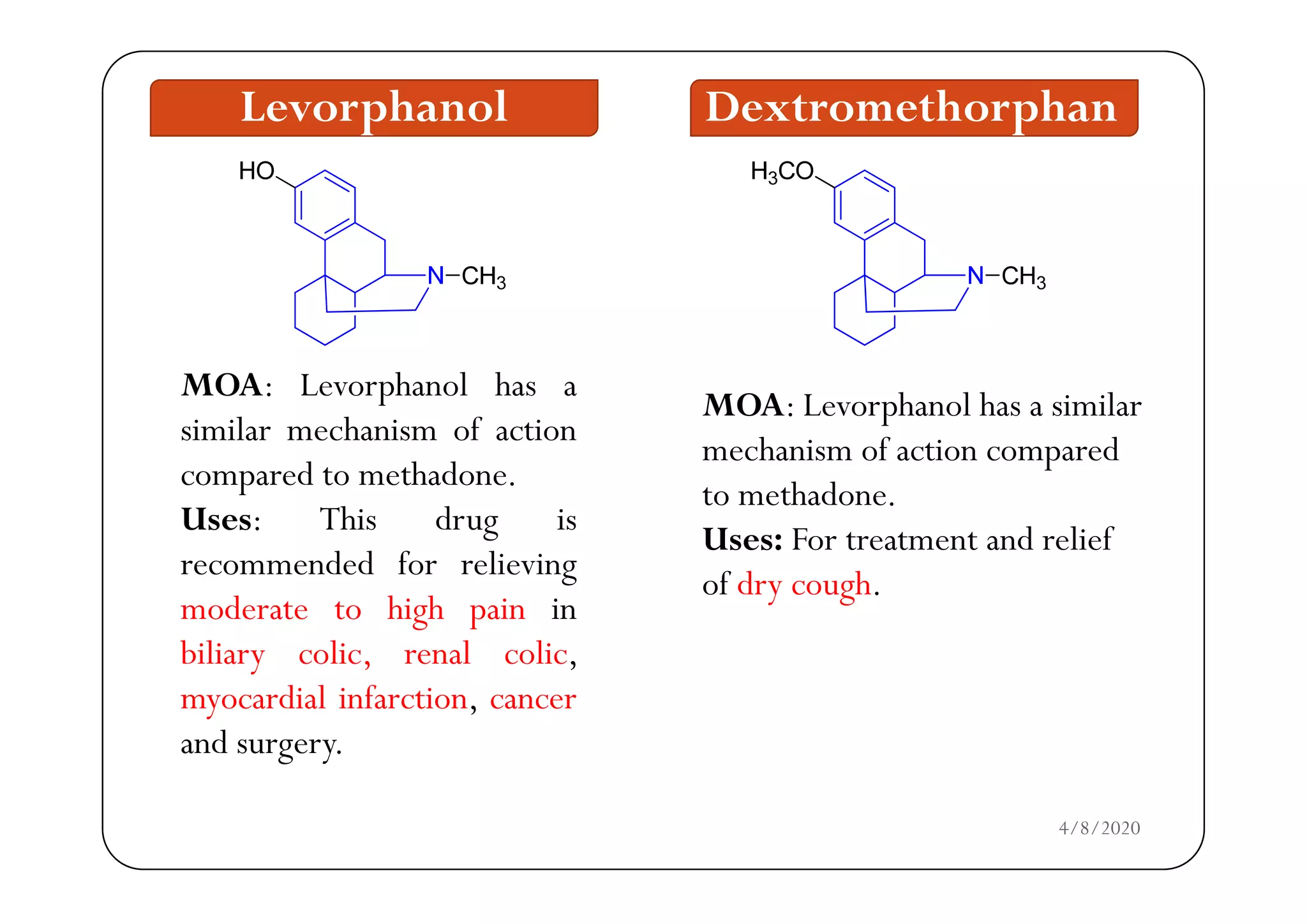
Levorphanol Dextromethorphan
MOA: Levorphanol has a
similar mechanism of action
d h d
MOA: Levorphanol has a similar
mechanism of action compared
compared to methadone.
Uses: This drug is
recommended for relieving
p
to methadone.
Uses: For treatment and relief
recommended for relieving
moderate to high pain in
biliary colic, renal colic,
of dry cough.
y
myocardial infarction, cancer
and surgery.
4/8/2020
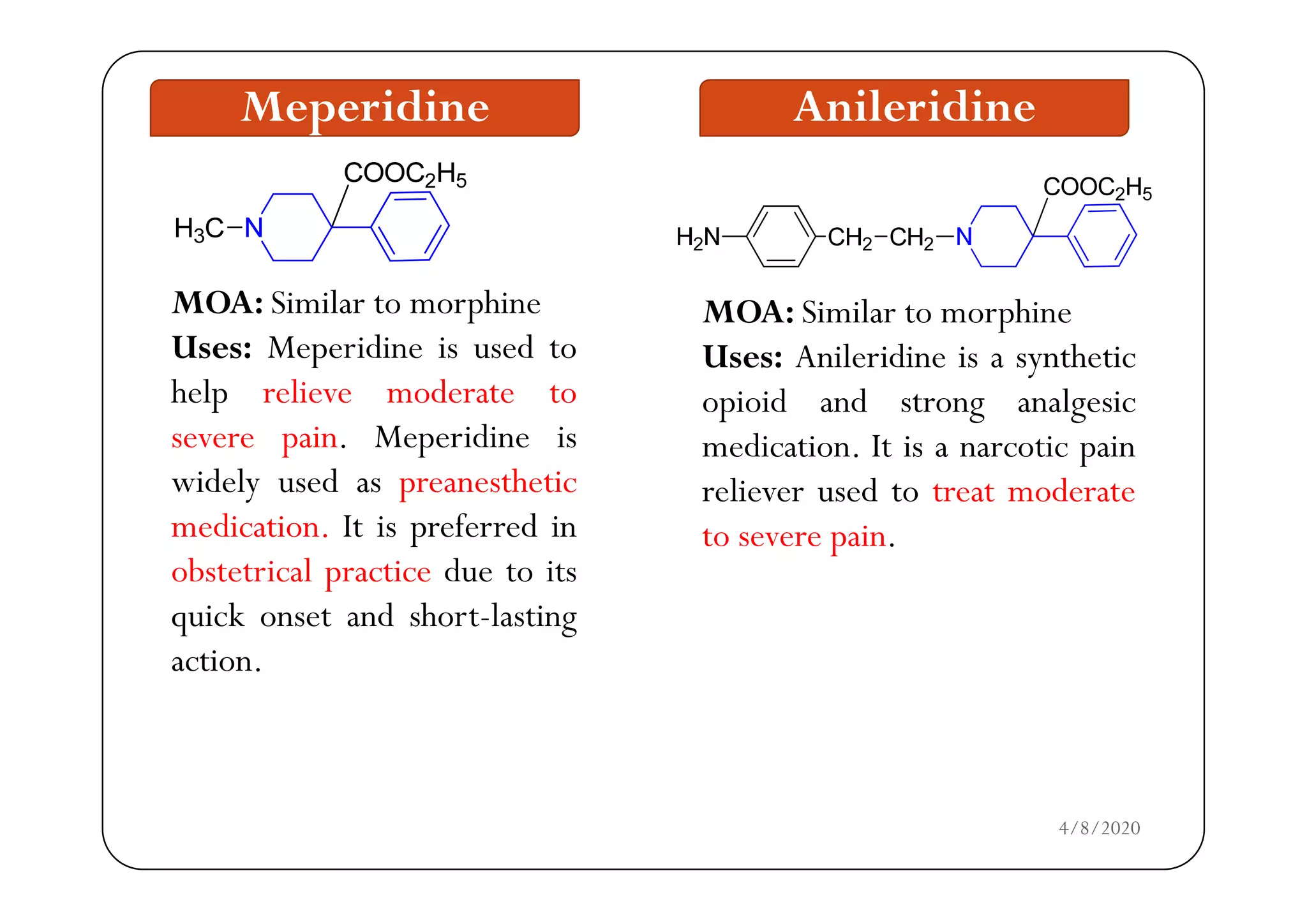
Meperidine Anileridine
MOA: Similar to morphine
Uses: Meperidine is used to
MOA: Similar to morphine
Uses: Anileridine is a syntheticUses: Meperidine is used to
help relieve moderate to
severe pain. Meperidine is
Uses: Anileridine is a synthetic
opioid and strong analgesic
medication. It is a narcotic pain
widely used as preanesthetic
medication. It is preferred in
b t t i l ti d t it
p
reliever used to treat moderate
to severe pain.
obstetrical practice due to its
quick onset and short-lasting
action..
4/8/2020
Diphenoxylate Loperamide
MOA: Diphenoxylate is an
opiate receptor agonist that
i l i GIstimulate mu receptors in GI to
decrease the peristalsis and
constrict the sphinctersconstrict the sphincters.
Diphenoxylate has a direct
effect on circular smooth MOA: Similar to diphenoxylate
muscle of the bowel, that
conceivably results in
i d l i
MOA: Similar to diphenoxylate
Uses: This medication is used to
treat sudden diarrhea (including
segmentation and prolongation
of gastrointestinal transit time.
Uses: it is mainly used for
traveler's diarrhea). Loperamide
is also used to reduce the
t f di h i ti tUses: it is mainly used for
treating diarrhea. It helps to
decrease the number and
amount of discharge in patients
who have undergone an
ileostomy.
frequency of bowel
movements.
y
4/8/2020
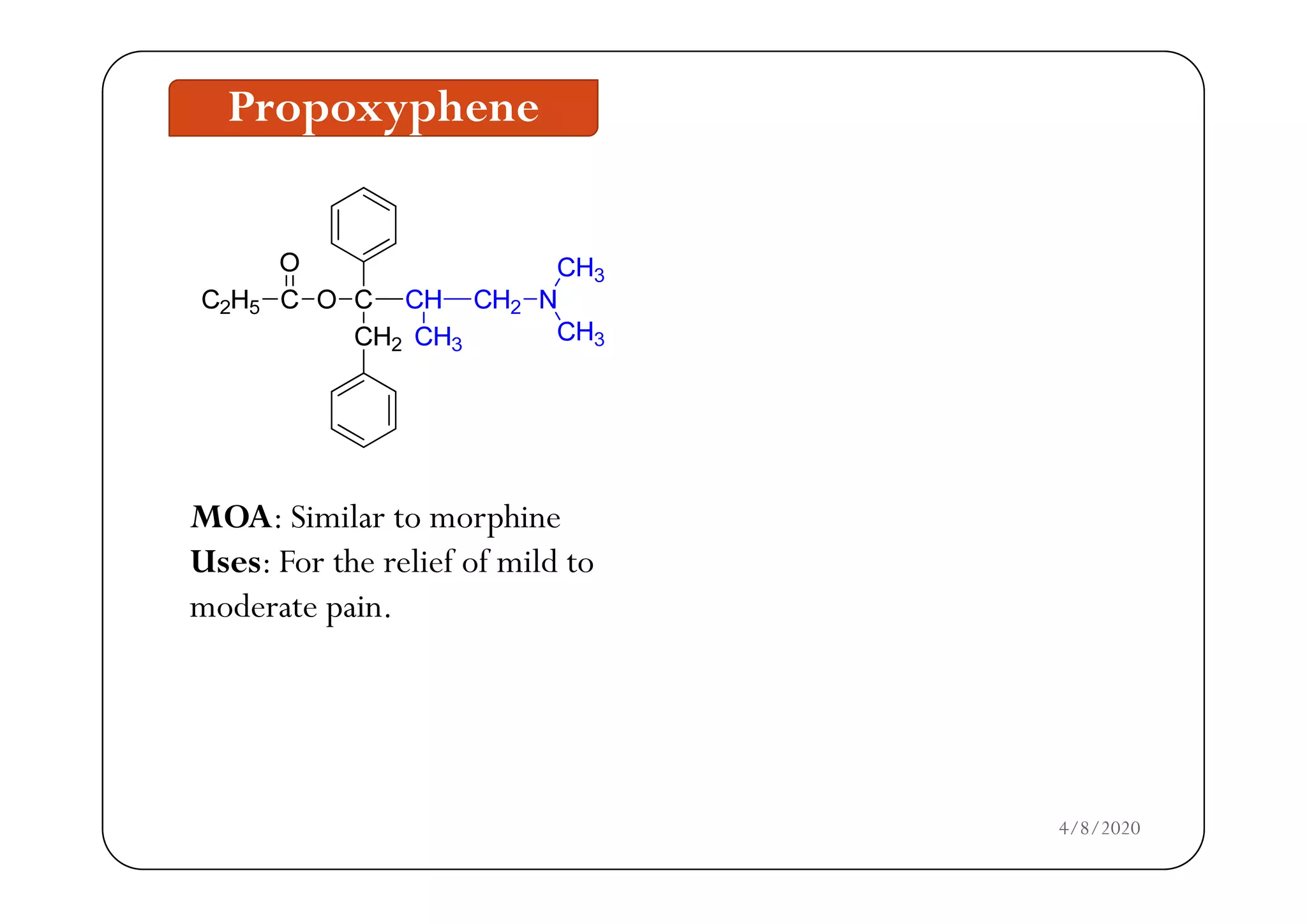
Propoxyphene
MOA: Similar to morphine
Uses: For the relief of mild toUses: For the relief of mild to
moderate pain.
4/8/2020
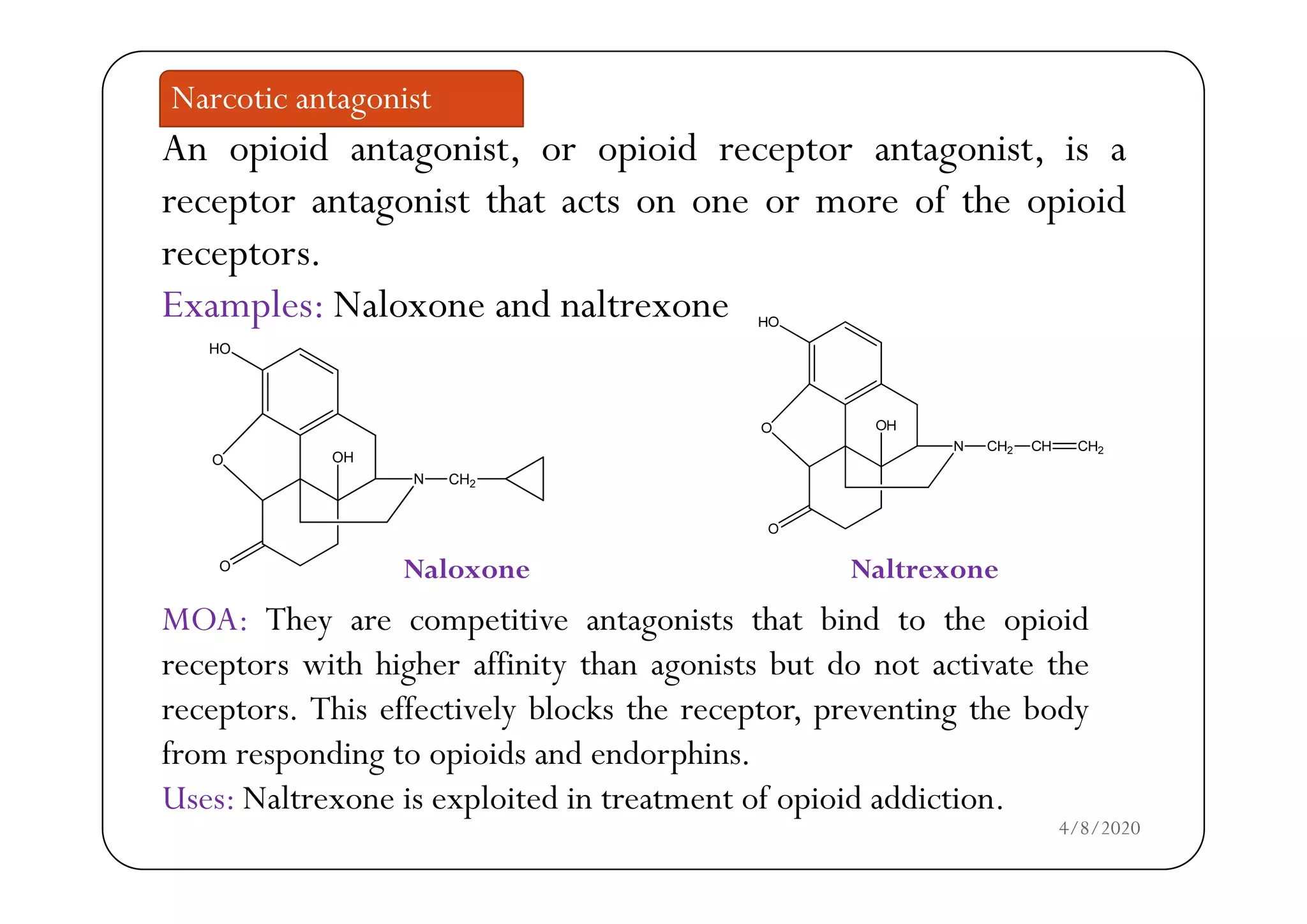
Narcotic antagonist
An opioid antagonist or opioid receptor antagonist is aAn opioid antagonist, or opioid receptor antagonist, is a
receptor antagonist that acts on one or more of the opioid
receptorsreceptors.
Examples: Naloxone and naltrexone
HO
OHO
O
N
OH
CH2
O
Naloxone NaltrexoneO Naloxone Naltrexone
MOA: They are competitive antagonists that bind to the opioid
receptors with higher affinity than agonists but do not activate thereceptors with higher affinity than agonists but do not activate the
receptors. This effectively blocks the receptor, preventing the body
from responding to opioids and endorphins.
Uses: Naltrexone is exploited in treatment of opioid addiction.
4/8/2020
BOOKS FOR FURTHER READING
Wil d Gi ld T b k f i M di i l
BOOKS FOR FURTHER READING
Wilson and Gisvold,Text book of organic, Medicinal
and Pharmaceutical Chemistry.
Foyes Principles of medicinal chemistry byWilliams
O. Foye.y
AText book of medicinal chemistry (Synthetic and
Biochemical Approach) vol I& II by SN PandeyaBiochemical Approach) vol. I& II by SN Pandeya.
Synthesis of Essential Drugs by R.S.Vardanyan and
VJ H bV.J. Hruby
4/8/2020

Narcotic Analgesics-Medicinal Chemistry

  • 1.
    Narcotic Analgesicsg Dr GopalKrishna PadhyDr. Gopal Krishna Padhy 4/8/2020
  • 2.
    Definition Analgesics are definedas drugs that selectively relieve paing g y p by acting in the central nervous system or on peripheral pain mechanism without disturbing consciousness. These are mainly divided into two types. o Narcotic analgesicso Narcotic analgesics o Non-narcotic analgesics 4/8/2020
  • 3.
    N ti liNarcotic analgesics oNarcotic analgesics are also known as opoid analgesicoNarcotic analgesics are also known as opoid analgesic. o They relieve severe pain by acting mainly on the central nervous system.y o The oldest and the best narcotic analgesics are opium alkaloids. Th i l i i ll ddi io The narcotic analgesics are potentially addictive. o If intake of the drug is stopped, very undesirable withdrawal effects like sever pain sweating salvation hyperventilationeffects like sever pain, sweating, salvation, hyperventilation, restlessness and confusion are observed 4/8/2020
  • 4.
  • 5.
  • 6.
    Morphan analoguesp g CH3 N H3C OH H3C Mt i N CH2CHC H3C P t i MetazocinePentazocine 4/8/2020
  • 7.
    4 Phenylpiperidine analogues4-Phenylpiperidineanalogues N COOC2H5 CH2CH2CNC Meperidine / Pethidine Diphenoxylatep y Anileridine 4/8/2020
  • 8.
    4-anilinopiperidine analoguesp pg 2 22 5 Fentanyl Sufentanyl 4/8/2020
  • 9.
    Diphenyl Propylamine derivativesDiphenylPropylamine derivatives 2 33 2 5 3 Methadone Propoxyphene 4/8/2020
  • 10.
    Mechanism of actionof Narcotic analgesics Narcotic analgesics produce their actions at a cellular level b b ti ti opioid receptorsby by activating on opioid receptors. e.g. Morphine and its derivatives act as agonists of the mu and kappa opioid receptorskappa opioid receptors. These receptors are distributed throughout the (CNS) and also been found on peripheral afferent nerve terminalsalso been found on peripheral afferent nerve terminals . Opioid receptors are coupled with inhibitory G- proteins and their activation has number of actions like closing ofand their activation has number of actions like closing of voltage sensitive calcium channels, stimulation of potassium efflux leading to hyperpolarization which causespotassium efflux leading to hyperpolarization which causes reduction in neuronal cell excitability. 4/8/2020
  • 11.
  • 12.
    Structure activity relationshipof morphine • The structure of morphine is composed of five fusedThe structure of morphine is composed of five fused rings and have 5 chiral centers. • the levo (-) rotary form is the active form while dextro (+)the levo ( ) rotary form is the active form while dextro (+) morphine is inactive. •TheA ring and the basic nitrogen are the two necessaryTheA ring and the basic nitrogen are the two necessary component in every potent opoid receptor agonist. •The aromaticA ring and the tertiary nitrogen may beThe aromaticA ring and the tertiary nitrogen may be connected by an ethylene/propelene linkage. 2 HO 1 2 3 10 11 A Phenolic OH O N CH3 4 5 9 10 12 13 14 17BD E Ether bridge Tertiary Nitrogen HO 6 7 8 14 15 16 C Alcoholic OH 4/8/2020
  • 13.
    Tertiary nitrogen atom •Thesubstituent on nitrogen of morphine and morphine like structure is critical to degree and type of activitylike structure is critical to degree and type of activity. • N-methyl substituents generally results in compound with good agonist proportiesgood agonist proporties. • Increasing the size of the N-substituent results in antagonist e g naloxoneantagonist e.g. naloxone Naloxone 4/8/2020
  • 14.
    Hydroxyl Group • Maskingthe phenolic hydroxyl group by etherification to methyl ether decrease the analgesic activity about ten fold. e.g. Codeine CodeineCodeine • Esterification of hydroxyl group leads to more active compound than morphine. e.g. Heroin • introduction of hydroxyl group at 14th position lead to increase in activity e.g. oxymorphone OxymorphoneOxymorphone 4/8/2020
  • 15.
    Ring C • Changein the C-ring chemistry of morphine can lead to compounds with increased activity. e.g. Hydromorphone is 8-10p y g y p times more potent than morphine. HO O N CH3 O C Hydromorphone O 4/8/2020
  • 16.
    4,5-Epoxide bridge • Removalof 4,5-epoxide bridge in the morphine structure results in mophinans.p • only levo isomer of morphinan possess opoid analgesic activity while dextro isomer have antitussive actvity.y y • levorphanol is 8 times more potent than morphine. Levorphanol •Compound that lack both epoxide bridge and the C ring of morphine retain opoid analgesic activity e gmorphine retain opoid analgesic activity. e.g. Benzomorphans. 4/8/2020
  • 17.
    Methadone MOA-In addition toopioid receptor agonist activity, methadone also act asMOA In addition to opioid receptor agonist activity, methadone also act as antagonist of the N-methyl-D-aspartate (NMDA) receptor and it strongly inhibits serotonin and norepinephrine uptake. Uses-Methadone is indicated for the management of pain severe enough to require an opioid analgesic and for which alternative treatment options are inadequate. It is also used in treating drug addiction, since it replaces other agonists on the receptor. 4/8/2020
  • 18.
    Fentanyl MOA: Similar tomorphine Uses: It is uses both independently and in combination with droperidol for preanesthetic medication, in different forms of narcosis, and in post-operational anesthesia. 4/8/2020
  • 19.
    Morphine Codeine h bdUses: Morphine is prescribed in all cases when NSAID action is not sufficient and requires the use MOA S l h not sufficient and requires the use of strong opioid analgesics. It is widely used in myocardial MOA: Similar to morphine Uses: This drug is very effective in oral use and is used for average y y infarction to relieve pain and for calming the patient. It is used in l d d f in oral use and is used for average to moderate pain. It is often used as an antitussive drug. Codeine is pulmonary edema and in few forms of diarrhoea. It is used in surgery as a g used to treat mild to moderate pain and also to reduce coughing. It is used in surgery as a preanesthetic medication before the general anesthesia procedureg p begins. 4/8/2020
  • 20.
    Levorphanol Dextromethorphan MOA: Levorphanolhas a similar mechanism of action d h d MOA: Levorphanol has a similar mechanism of action compared compared to methadone. Uses: This drug is recommended for relieving p to methadone. Uses: For treatment and relief recommended for relieving moderate to high pain in biliary colic, renal colic, of dry cough. y myocardial infarction, cancer and surgery. 4/8/2020
  • 21.
    Meperidine Anileridine MOA: Similarto morphine Uses: Meperidine is used to MOA: Similar to morphine Uses: Anileridine is a syntheticUses: Meperidine is used to help relieve moderate to severe pain. Meperidine is Uses: Anileridine is a synthetic opioid and strong analgesic medication. It is a narcotic pain widely used as preanesthetic medication. It is preferred in b t t i l ti d t it p reliever used to treat moderate to severe pain. obstetrical practice due to its quick onset and short-lasting action.. 4/8/2020
  • 22.
    Diphenoxylate Loperamide MOA: Diphenoxylateis an opiate receptor agonist that i l i GIstimulate mu receptors in GI to decrease the peristalsis and constrict the sphinctersconstrict the sphincters. Diphenoxylate has a direct effect on circular smooth MOA: Similar to diphenoxylate muscle of the bowel, that conceivably results in i d l i MOA: Similar to diphenoxylate Uses: This medication is used to treat sudden diarrhea (including segmentation and prolongation of gastrointestinal transit time. Uses: it is mainly used for traveler's diarrhea). Loperamide is also used to reduce the t f di h i ti tUses: it is mainly used for treating diarrhea. It helps to decrease the number and amount of discharge in patients who have undergone an ileostomy. frequency of bowel movements. y 4/8/2020
  • 23.
    Propoxyphene MOA: Similar tomorphine Uses: For the relief of mild toUses: For the relief of mild to moderate pain. 4/8/2020
  • 24.
    Narcotic antagonist An opioidantagonist or opioid receptor antagonist is aAn opioid antagonist, or opioid receptor antagonist, is a receptor antagonist that acts on one or more of the opioid receptorsreceptors. Examples: Naloxone and naltrexone HO OHO O N OH CH2 O Naloxone NaltrexoneO Naloxone Naltrexone MOA: They are competitive antagonists that bind to the opioid receptors with higher affinity than agonists but do not activate thereceptors with higher affinity than agonists but do not activate the receptors. This effectively blocks the receptor, preventing the body from responding to opioids and endorphins. Uses: Naltrexone is exploited in treatment of opioid addiction. 4/8/2020
  • 25.
    BOOKS FOR FURTHERREADING Wil d Gi ld T b k f i M di i l BOOKS FOR FURTHER READING Wilson and Gisvold,Text book of organic, Medicinal and Pharmaceutical Chemistry. Foyes Principles of medicinal chemistry byWilliams O. Foye.y AText book of medicinal chemistry (Synthetic and Biochemical Approach) vol I& II by SN PandeyaBiochemical Approach) vol. I& II by SN Pandeya. Synthesis of Essential Drugs by R.S.Vardanyan and VJ H bV.J. Hruby 4/8/2020