SYMPATHOMIMETICS/ ADRENERGIC
DRUGS: CLASSIFICATION AND SAR
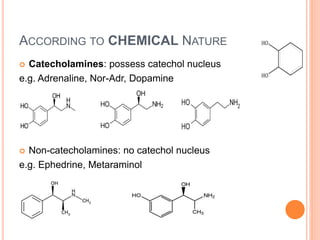
ACCORDING TO CHEMICAL NATURE
 Catecholamines: possess catechol nucleus
e.g. Adrenaline, Nor-Adr, Dopamine
 Non-catecholamines: no catechol nucleus
e.g. Ephedrine, Metaraminol
ACCORDING TO MODE OF ACTION
 Direct acting: Act directly on receptors.
E.g. Adr, Nor-Adr, Isoprenaline and Salbutamol
 Indirect acting: Act on adrenergic neurons to release Nor-Adr.
E.g. Tyramine, Amphetamine.
 Mixed acting: Can act in both ways. E.g. Ephedrine
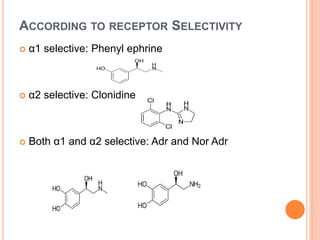
ACCORDING TO RECEPTOR SELECTIVITY
 α1 selective: Phenyl ephrine
 α2 selective: Clonidine
 Both α1 and α2 selective: Adr and Nor Adr
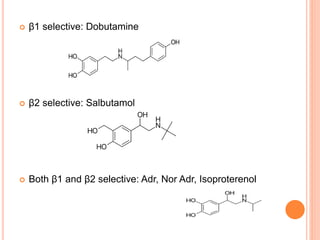
 β1 selective: Dobutamine
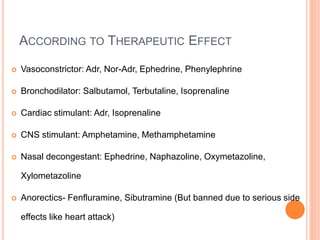
 β2 selective: Salbutamol
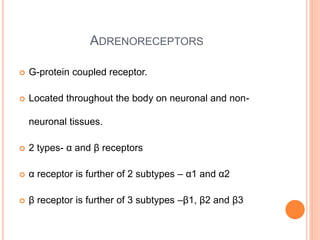
 Both β1 and β2 selective: Adr, Nor Adr, Isoproterenol
ACCORDING TO THERAPEUTIC EFFECT
 Vasoconstrictor: Adr, Nor-Adr, Ephedrine, Phenylephrine
 Bronchodilator: Salbutamol, Terbutaline, Isoprenaline
 Cardiac stimulant: Adr, Isoprenaline
 CNS stimulant: Amphetamine, Methamphetamine
 Nasal decongestant: Ephedrine, Naphazoline, Oxymetazoline,
Xylometazoline
 Anorectics- Fenfluramine, Sibutramine (But banned due to serious side
effects like heart attack)
ADRENORECEPTORS
 G-protein coupled receptor.
 Located throughout the body on neuronal and non-
neuronal tissues.
 2 types- α and β receptors
 α receptor is further of 2 subtypes – α1 and α2
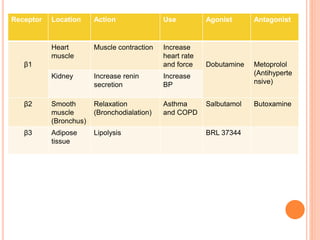
 β receptor is further of 3 subtypes –β1, β2 and β3
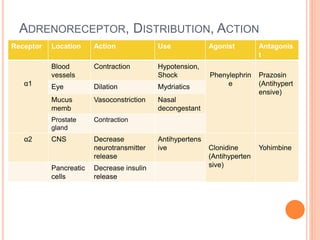
ADRENORECEPTOR, DISTRIBUTION, ACTION
Receptor Location Action Use Agonist Antagonis
t
α1
Blood
vessels
Contraction Hypotension,
Shock Phenylephrin
e
Prazosin
(Antihypert
ensive)
Eye Dilation Mydriatics
Mucus
memb
Vasoconstriction Nasal
decongestant
Prostate
gland
Contraction
α2 CNS Decrease
neurotransmitter
release
Antihypertens
ive Clonidine
(Antihyperten
sive)
Yohimbine
Pancreatic
cells
Decrease insulin
release
Receptor Location Action Use Agonist Antagonist
β1
Heart
muscle
Muscle contraction Increase
heart rate
and force Dobutamine Metoprolol
(Antihyperte
nsive)
Kidney Increase renin
secretion
Increase
BP
β2 Smooth
muscle
(Bronchus)
Relaxation
(Bronchodialation)
Asthma
and COPD
Salbutamol Butoxamine
β3 Adipose
tissue
Lipolysis BRL 37344
SAR OF SYMPATHOMIMETIC DRUGS
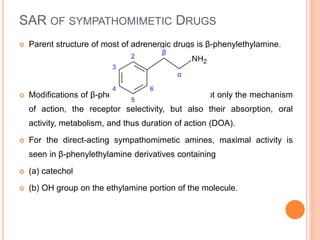
 Parent structure of most of adrenergic drugs is β-phenylethylamine.
 Modifications of β-phenylethylamine influence not only the mechanism
of action, the receptor selectivity, but also their absorption, oral
activity, metabolism, and thus duration of action (DOA).
 For the direct-acting sympathomimetic amines, maximal activity is
seen in β-phenylethylamine derivatives containing
 (a) catechol
 (b) OH group on the ethylamine portion of the molecule.
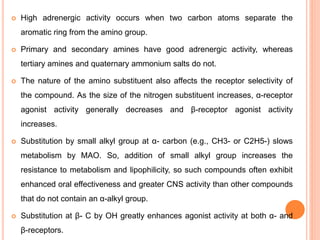
 High adrenergic activity occurs when two carbon atoms separate the
aromatic ring from the amino group.
 Primary and secondary amines have good adrenergic activity, whereas
tertiary amines and quaternary ammonium salts do not.
 The nature of the amino substituent also affects the receptor selectivity of
the compound. As the size of the nitrogen substituent increases, α-receptor
agonist activity generally decreases and β-receptor agonist activity
increases.
 Substitution by small alkyl group at α- carbon (e.g., CH3- or C2H5-) slows
metabolism by MAO. So, addition of small alkyl group increases the
resistance to metabolism and lipophilicity, so such compounds often exhibit
enhanced oral effectiveness and greater CNS activity than other compounds
that do not contain an α-alkyl group.
 Substitution at β- C by OH greatly enhances agonist activity at both α- and
β-receptors.
 Compounds with 3,4-dihydroxy group in phenyl nucleus act as direct acting
drugs whereas without catechol nucleus act as indirect acting drugs.
 Compounds without one or both phenolic OH substituents are not
metabolized by COMT, and they are orally active and have longer duration
of action.