Follow -inboxeswaran@gmail.com
1
2
The number of compounds required for synthesis
in order to place 10 different groups in 4 positions
of benzene ring is 104
Solution: synthesize a small number of
compounds and from their data derive rules to
predict the biological activity of other compounds.
3
QSAR what actually do?
IDENTIFY AND QUANTIFY the Physico-chemical properties effect on
Drug’s Biological activity
Such relationships holds – Equations can be drawn up- some
confidence
to which should be Fit to the target
PHARMACOKIINETICS
4
QSAR and Drug Design
Compounds + biological activity
New compounds with
improved biological activity
QSAR
5
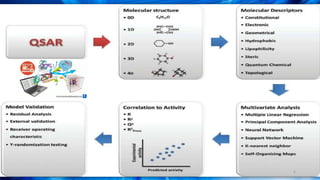
Instead of trial and error , use computer to help
Now desired structure can be designed computationally
PROCEDURE
6
HOW it is
LOOK LIKE7
PHYSICO-CHEMICAL PROPERTIES - log 10P (X axis)
BIOLOGICAL ACITIVITY - log1/C (Y axis)
“Linear regression analysis by the least Squares method”
Draw a line through the data points
most of the points will be scattered
on the either side of the line is best
Best line through the
points will be the line
where this total sum of
squares is minimum
y=mx+c
M,C are variaents determaines the
line each time for every n number of
compounds using relevant softwares8
2.Correlation graph analyse
To see if the relationship is meaningful.
figures statistical evidence obtained to support QSAR equation and Quantifies the goodness to fit
Regression coefficient (r) is the measure of How well the eqn explains the varience in activity
observed
Sscalc – measure of how much the experimental activity of the compound varies from
calculated
Ssmean –how much experimental activities varies from mean of all experimental activities
R=1 perfect
fit
9
10
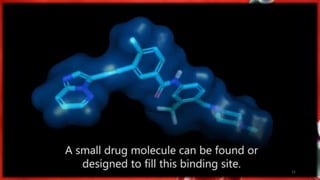
Drug and Target interactions
11
ConceptsOF DESCRIPTORS
•Aims
To relate the biological activity of a series of compounds to their
physicochemical parameters in a quantitative fashion using a mathematical
formula
•Requirements
Quantitative measurements for biological and physicochemical properties
•Physicochemical Properties
•Hydrophobicity of the molecule
•Hydrophobicity of substituents
•Electronic properties of substituents
•Steric properties of substituents
Most common
properties studied
12
Hydrophobicity of the Molecule
Partition Coefficient P = [Drug in octanol]
[Drug in water]
High P High hydrophobicity
•Activity of drugs is often related to P
e.g. binding of drugs to serum albumin
(straight line - limited range of log P)
Log (1/C)
Log P
. .
.
.. .
. ..
0.78 3.82
Log 1
C



= 0.75 logP + 2.30
•Binding increases as log P increases
•Binding is greater for hydrophobic drugs
13
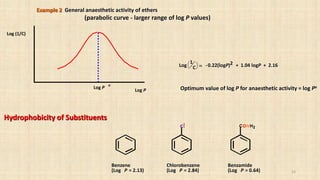
Example 2 General anaesthetic activity of ethers
(parabolic curve - larger range of log P values)
Optimum value of log P for anaesthetic activity = log Po
Log
1
C



= -0.22(logP)2 + 1.04 logP + 2.16
Log P
o
Log P
Log (1/C)
Hydrophobicity of Substituents
Benzene
(Log P = 2.13)
Chlorobenzene
(Log P = 2.84)
Benzamide
(Log P = 0.64)
cll CONH2
14
QSAR equations are only applicable to compounds in the same
structural class (e.g. ethers)
•However, log Po is similar for anaesthetics of different structural
classes (ca. 2.3)
•Structures with log P ca. 2.3 enter the CNS easily
(e.g. potent barbiturates have a log P of approximately 2.0)
•Can alter log P value of drugs away from 2.0 to avoid CNS side
effects
Hydrophobicity
Notes:
15
Electronic Effects
Hammett Substituent Constant (s)
Notes:
•The constant (s) is a measure of the e-withdrawing or e-donating influence of
substituents
•It can be measured experimentally and tabulated
(e.g. s for aromatic substituents is measured by comparing the
dissociation constants of substituted benzoic acids with benzoic acid)
X=H K H = Dissociation constant= [PhCO 2-]
[PhCO 2H]
+CO2H CO2 H
X X
16
+
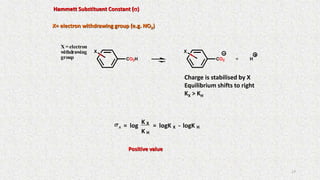
X = electron
withdrawing
group
X
CO2CO2H
X
H
X= electron withdrawing group (e.g. NO2)
s X = log
K X
K H
= logK X - logK H
Charge is stabilised by X
Equilibrium shifts to right
KX > KH
Positive value
Hammett Substituent Constant (s)
17
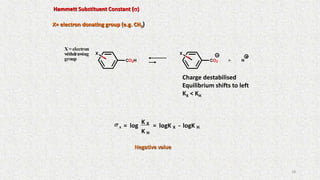
X= electron donating group (e.g. CH3)
s X = log
K X
K H
= logK X - logK H
Charge destabilised
Equilibrium shifts to left
KX < KH
Negative value
Hammett Substituent Constant (s)
+
X = electron
withdrawing
group
X
CO2CO2H
X
H
18
NOTES:
s value depends on inductive and resonance effects
s value depends on whether the substituent is meta or para
ortho values are invalid due to steric factors
Hammett Substituent Constant (s)
19
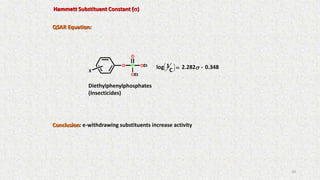
QSAR Equation:
Diethylphenylphosphates
(Insecticides)
log 1
C



= 2.282s - 0.348
Conclusion: e-withdrawing substituents increase activity
Hammett Substituent Constant (s)
X
O P
O
OEt
OEt
20
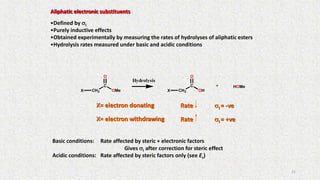
Aliphatic electronic substituents
•Defined by sI
•Purely inductive effects
•Obtained experimentally by measuring the rates of hydrolyses of aliphatic esters
•Hydrolysis rates measured under basic and acidic conditions
X= electron donating Rate sI = -ve
X= electron withdrawing Rate sI = +ve
Basic conditions: Rate affected by steric + electronic factors
Gives sI after correction for steric effect
Acidic conditions: Rate affected by steric factors only (see Es)
+
Hydrolysis
HOMe
CH2 OMe
C
O
X CH2 OH
C
O
X
21
Steric Factors
Verloop Steric Parameter
- calculated by software (STERIMOL)
- gives dimensions of a substituent
- can be used for any substituent
L
B
3
B
4
B4 B3
B2
B1
C
O
O
H
H O C O
Example - Carboxylic acid
22
23
3D-QSAR
•Physical properties are measured for the molecule as a whole
•Properties are calculated using computer software
•No experimental constants or measurements are involved
•Properties are known as ‘Fields’
•Steric field - defines the size and shape of the molecule
•Electrostatic field - defines electron rich/poor regions of molecule
•Hydrophobic properties are relatively unimportant
Advantages over QSAR
•No reliance on experimental values
•Can be applied to molecules with unusual substituents
•Not restricted to molecules of the same structural class
•Predictive capability 24
3D-QSAR
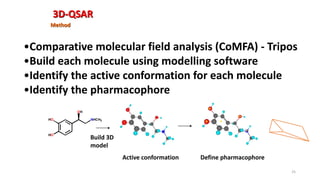
•Comparative molecular field analysis (CoMFA) - Tripos
•Build each molecule using modelling software
•Identify the active conformation for each molecule
•Identify the pharmacophore
Method
NHCH3
OH
HO
HO
Active conformation
Build 3D
model
Define pharmacophore
25
3D-QSAR
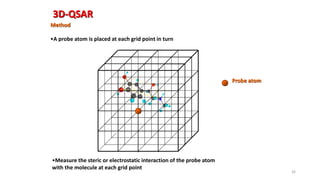
•A probe atom is placed at each grid point in turn
Method
•Measure the steric or electrostatic interaction of the probe atom
with the molecule at each grid point
.
.
.
.
.
Probe atom
26
3D-QSAR
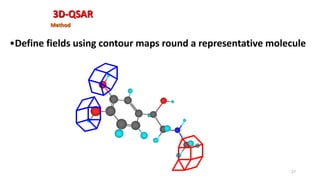
•Define fields using contour maps round a representative molecule
Method
27
28
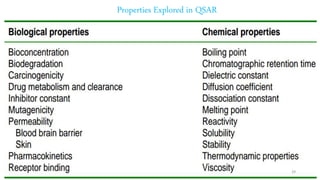
Properties Explored in QSAR
29
30
Any quaries
Ask me: inboxeswar@gmail.com

Quantitative structure - activity relationship (QSAR)

  • 1.
  • 2.
  • 3.
    The number ofcompounds required for synthesis in order to place 10 different groups in 4 positions of benzene ring is 104 Solution: synthesize a small number of compounds and from their data derive rules to predict the biological activity of other compounds. 3
  • 4.
    QSAR what actuallydo? IDENTIFY AND QUANTIFY the Physico-chemical properties effect on Drug’s Biological activity Such relationships holds – Equations can be drawn up- some confidence to which should be Fit to the target PHARMACOKIINETICS 4
  • 5.
    QSAR and DrugDesign Compounds + biological activity New compounds with improved biological activity QSAR 5
  • 6.
    Instead of trialand error , use computer to help Now desired structure can be designed computationally PROCEDURE 6
  • 7.
  • 8.
    PHYSICO-CHEMICAL PROPERTIES -log 10P (X axis) BIOLOGICAL ACITIVITY - log1/C (Y axis) “Linear regression analysis by the least Squares method” Draw a line through the data points most of the points will be scattered on the either side of the line is best Best line through the points will be the line where this total sum of squares is minimum y=mx+c M,C are variaents determaines the line each time for every n number of compounds using relevant softwares8
  • 9.
    2.Correlation graph analyse Tosee if the relationship is meaningful. figures statistical evidence obtained to support QSAR equation and Quantifies the goodness to fit Regression coefficient (r) is the measure of How well the eqn explains the varience in activity observed Sscalc – measure of how much the experimental activity of the compound varies from calculated Ssmean –how much experimental activities varies from mean of all experimental activities R=1 perfect fit 9
  • 10.
  • 11.
    Drug and Targetinteractions 11
  • 12.
    ConceptsOF DESCRIPTORS •Aims To relatethe biological activity of a series of compounds to their physicochemical parameters in a quantitative fashion using a mathematical formula •Requirements Quantitative measurements for biological and physicochemical properties •Physicochemical Properties •Hydrophobicity of the molecule •Hydrophobicity of substituents •Electronic properties of substituents •Steric properties of substituents Most common properties studied 12
  • 13.
    Hydrophobicity of theMolecule Partition Coefficient P = [Drug in octanol] [Drug in water] High P High hydrophobicity •Activity of drugs is often related to P e.g. binding of drugs to serum albumin (straight line - limited range of log P) Log (1/C) Log P . . . .. . . .. 0.78 3.82 Log 1 C    = 0.75 logP + 2.30 •Binding increases as log P increases •Binding is greater for hydrophobic drugs 13
  • 14.
    Example 2 Generalanaesthetic activity of ethers (parabolic curve - larger range of log P values) Optimum value of log P for anaesthetic activity = log Po Log 1 C    = -0.22(logP)2 + 1.04 logP + 2.16 Log P o Log P Log (1/C) Hydrophobicity of Substituents Benzene (Log P = 2.13) Chlorobenzene (Log P = 2.84) Benzamide (Log P = 0.64) cll CONH2 14
  • 15.
    QSAR equations areonly applicable to compounds in the same structural class (e.g. ethers) •However, log Po is similar for anaesthetics of different structural classes (ca. 2.3) •Structures with log P ca. 2.3 enter the CNS easily (e.g. potent barbiturates have a log P of approximately 2.0) •Can alter log P value of drugs away from 2.0 to avoid CNS side effects Hydrophobicity Notes: 15
  • 16.
    Electronic Effects Hammett SubstituentConstant (s) Notes: •The constant (s) is a measure of the e-withdrawing or e-donating influence of substituents •It can be measured experimentally and tabulated (e.g. s for aromatic substituents is measured by comparing the dissociation constants of substituted benzoic acids with benzoic acid) X=H K H = Dissociation constant= [PhCO 2-] [PhCO 2H] +CO2H CO2 H X X 16
  • 17.
    + X = electron withdrawing group X CO2CO2H X H X=electron withdrawing group (e.g. NO2) s X = log K X K H = logK X - logK H Charge is stabilised by X Equilibrium shifts to right KX > KH Positive value Hammett Substituent Constant (s) 17
  • 18.
    X= electron donatinggroup (e.g. CH3) s X = log K X K H = logK X - logK H Charge destabilised Equilibrium shifts to left KX < KH Negative value Hammett Substituent Constant (s) + X = electron withdrawing group X CO2CO2H X H 18
  • 19.
    NOTES: s value dependson inductive and resonance effects s value depends on whether the substituent is meta or para ortho values are invalid due to steric factors Hammett Substituent Constant (s) 19
  • 20.
    QSAR Equation: Diethylphenylphosphates (Insecticides) log 1 C    =2.282s - 0.348 Conclusion: e-withdrawing substituents increase activity Hammett Substituent Constant (s) X O P O OEt OEt 20
  • 21.
    Aliphatic electronic substituents •Definedby sI •Purely inductive effects •Obtained experimentally by measuring the rates of hydrolyses of aliphatic esters •Hydrolysis rates measured under basic and acidic conditions X= electron donating Rate sI = -ve X= electron withdrawing Rate sI = +ve Basic conditions: Rate affected by steric + electronic factors Gives sI after correction for steric effect Acidic conditions: Rate affected by steric factors only (see Es) + Hydrolysis HOMe CH2 OMe C O X CH2 OH C O X 21
  • 22.
    Steric Factors Verloop StericParameter - calculated by software (STERIMOL) - gives dimensions of a substituent - can be used for any substituent L B 3 B 4 B4 B3 B2 B1 C O O H H O C O Example - Carboxylic acid 22
  • 23.
  • 24.
    3D-QSAR •Physical properties aremeasured for the molecule as a whole •Properties are calculated using computer software •No experimental constants or measurements are involved •Properties are known as ‘Fields’ •Steric field - defines the size and shape of the molecule •Electrostatic field - defines electron rich/poor regions of molecule •Hydrophobic properties are relatively unimportant Advantages over QSAR •No reliance on experimental values •Can be applied to molecules with unusual substituents •Not restricted to molecules of the same structural class •Predictive capability 24
  • 25.
    3D-QSAR •Comparative molecular fieldanalysis (CoMFA) - Tripos •Build each molecule using modelling software •Identify the active conformation for each molecule •Identify the pharmacophore Method NHCH3 OH HO HO Active conformation Build 3D model Define pharmacophore 25
  • 26.
    3D-QSAR •A probe atomis placed at each grid point in turn Method •Measure the steric or electrostatic interaction of the probe atom with the molecule at each grid point . . . . . Probe atom 26
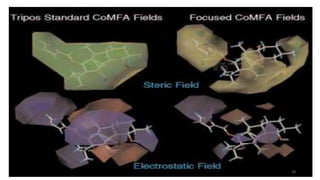
  • 27.
    3D-QSAR •Define fields usingcontour maps round a representative molecule Method 27
  • 28.
  • 29.
  • 30.
    30 Any quaries Ask me:inboxeswar@gmail.com