

Structure activity relationship of opioids
Dr.Ameya Puranik
Junior Resident
JNMC,Sawangi(M),Wardha.
Introduction
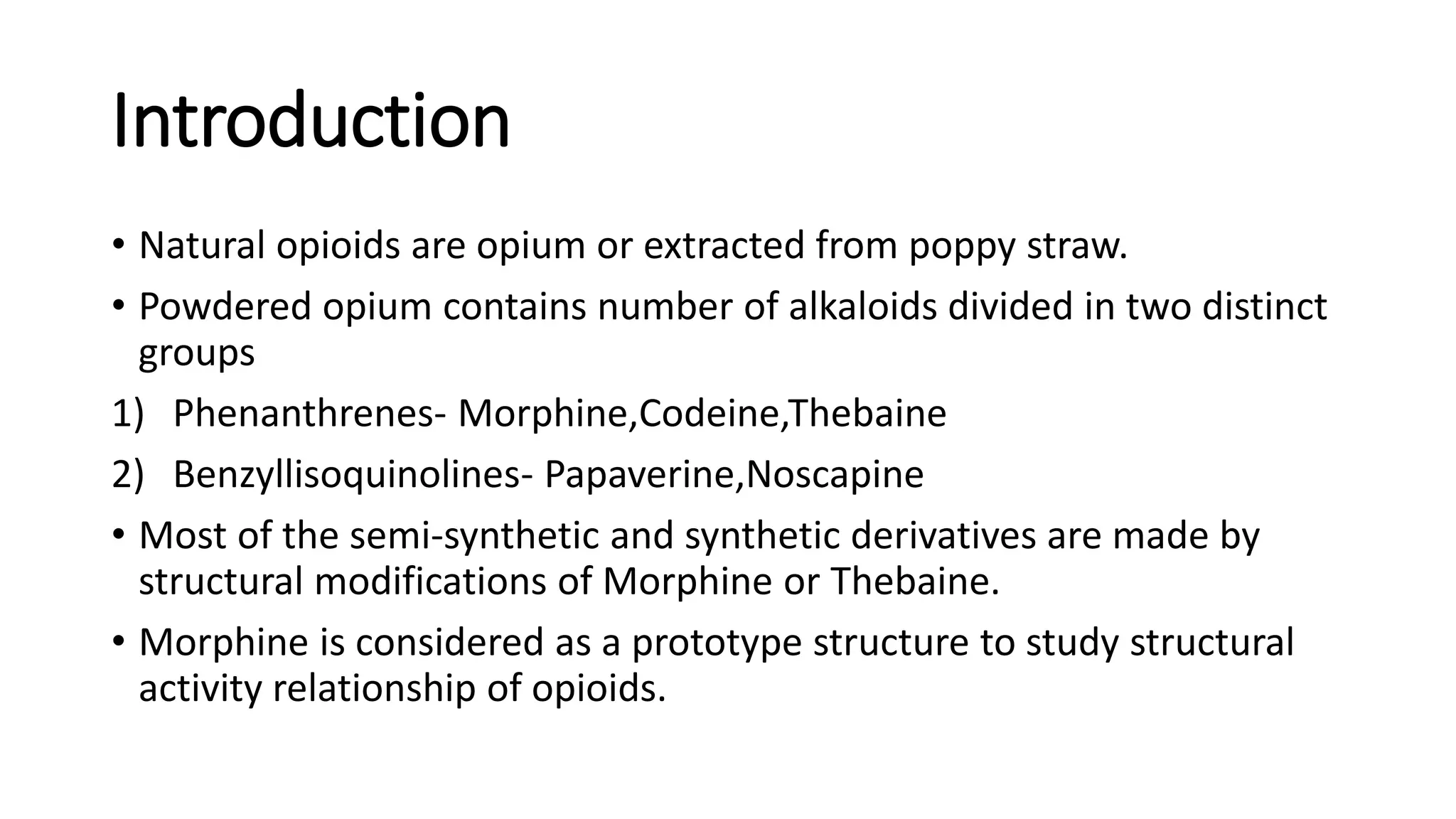
• Natural opioids are opium or extracted from poppy straw.
• Powdered opium contains number of alkaloids divided in two distinct
groups
1) Phenanthrenes- Morphine,Codeine,Thebaine
2) Benzyllisoquinolines- Papaverine,Noscapine
• Most of the semi-synthetic and synthetic derivatives are made by
structural modifications of Morphine or Thebaine.
• Morphine is considered as a prototype structure to study structural
activity relationship of opioids.
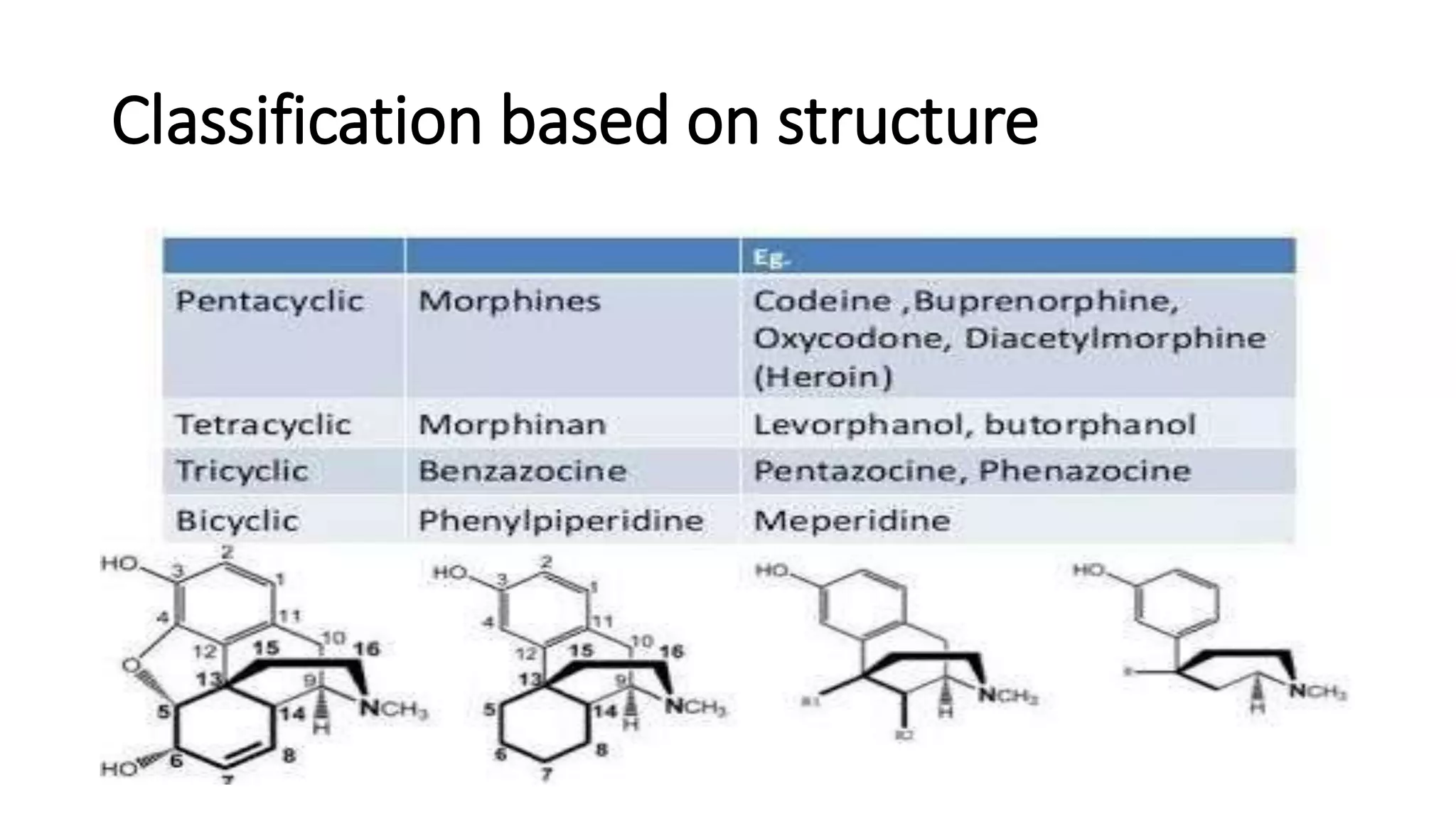
Classification based on structure
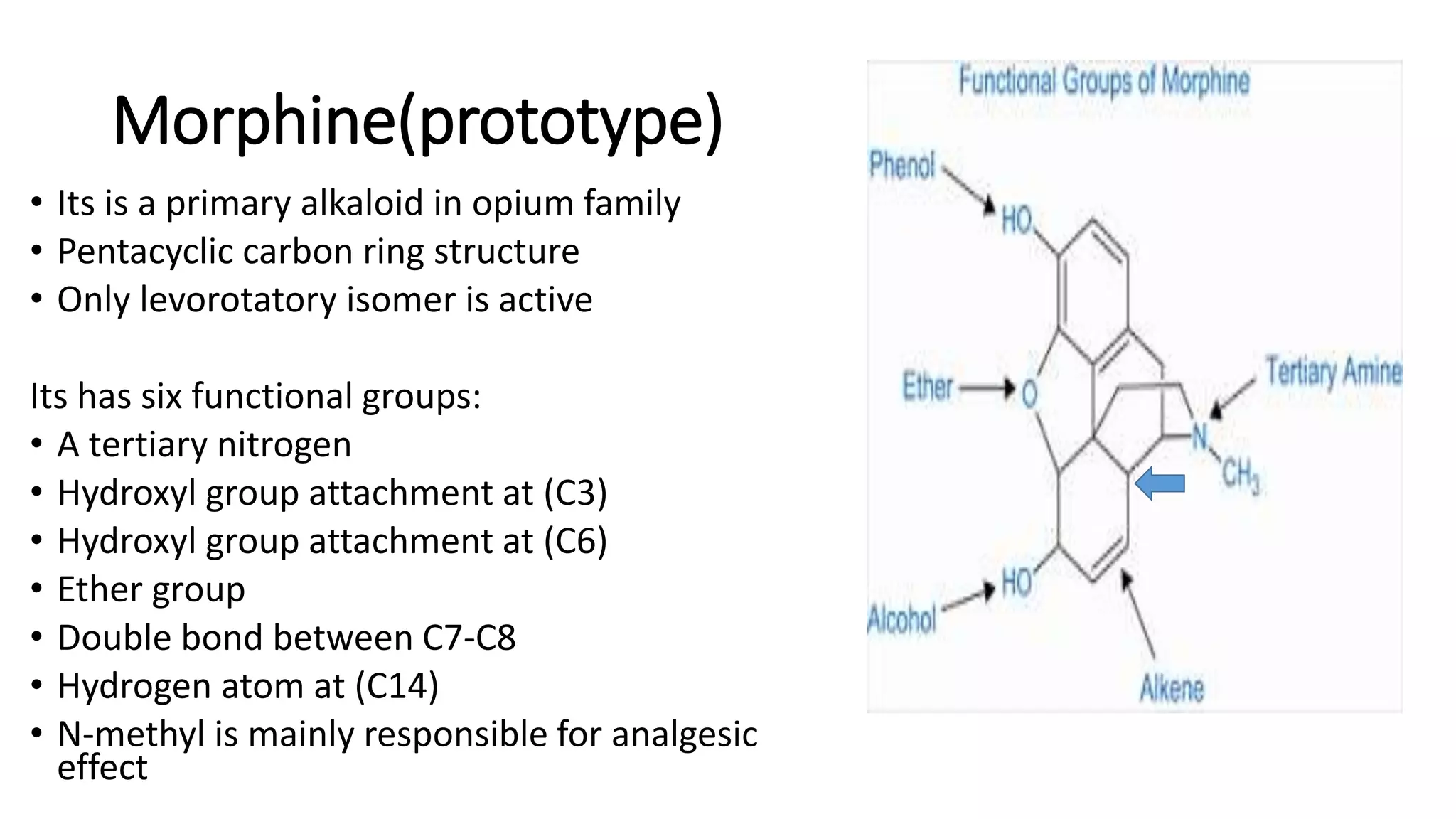
Morphine(prototype)
• Its is a primary alkaloid in opium family
• Pentacyclic carbon ring structure
• Only levorotatory isomer is active
Its has six functional groups:
• A tertiary nitrogen
• Hydroxyl group attachment at (C3)
• Hydroxyl group attachment at (C6)
• Ether group
• Double bond between C7-C8
• Hydrogen atom at (C14)
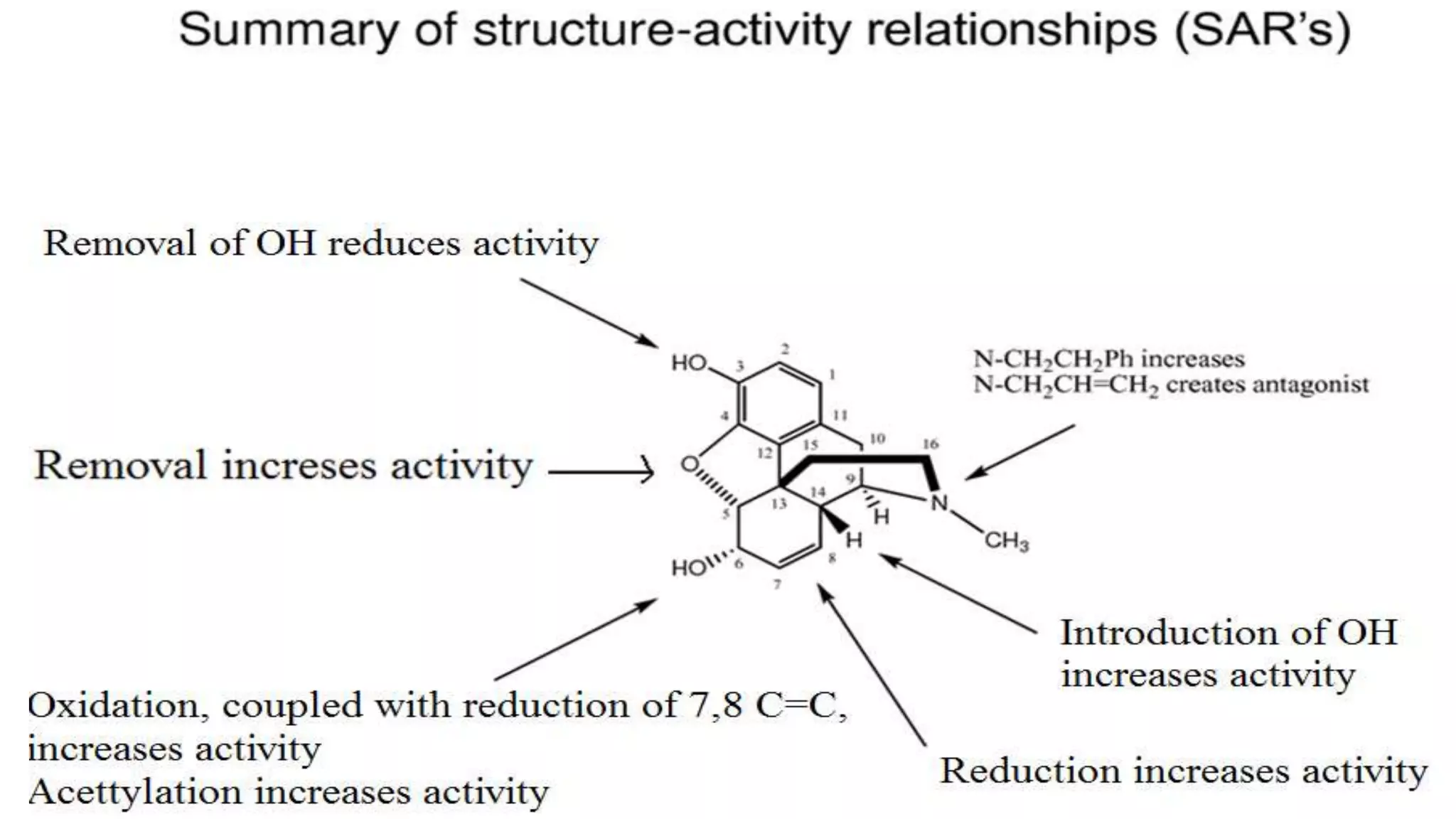
• N-methyl is mainly responsible for analgesic
effect
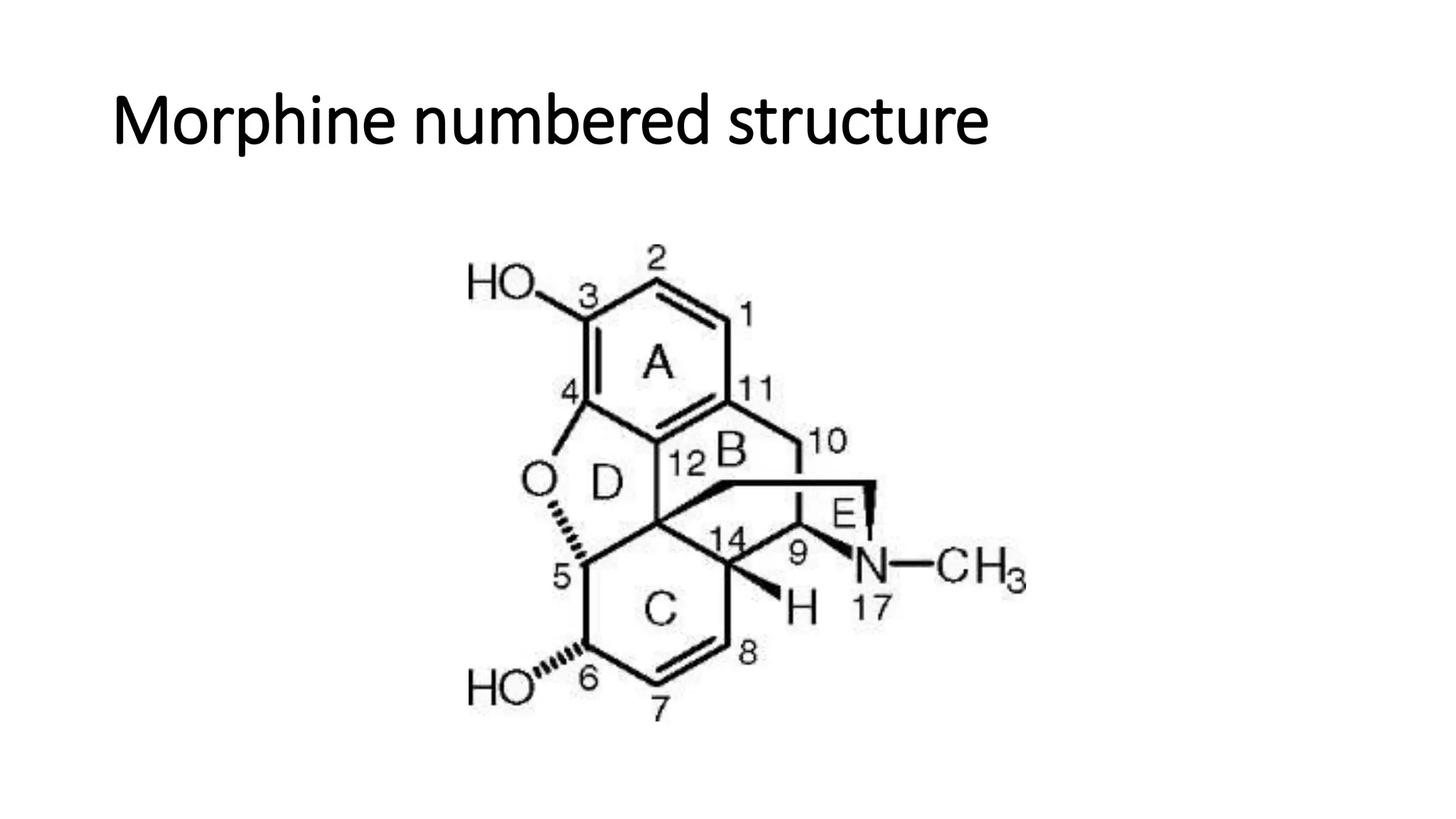
Morphine numbered structure
“Morphine rule”
It is developed for generalization of structure activity relationship of
various opioids, for the opioid to be active it should have atleast
following characteristics in the structure:
• A tertiary nitrogen atom.
• A quarternary carbon,seperated from tertiary nitrogen by a bridge of
two carbons.
• Phenyl group attachment.
Phenolic hydroxyl group (C3)
• It is needed for binding to Mu & Kappa receptors.
• Seen in all potent Mu-agonists.
• Changes at phenolic hydroxyl group:
-OH -OCH3 (1/3) Decrease in activity(eg.Codeine)
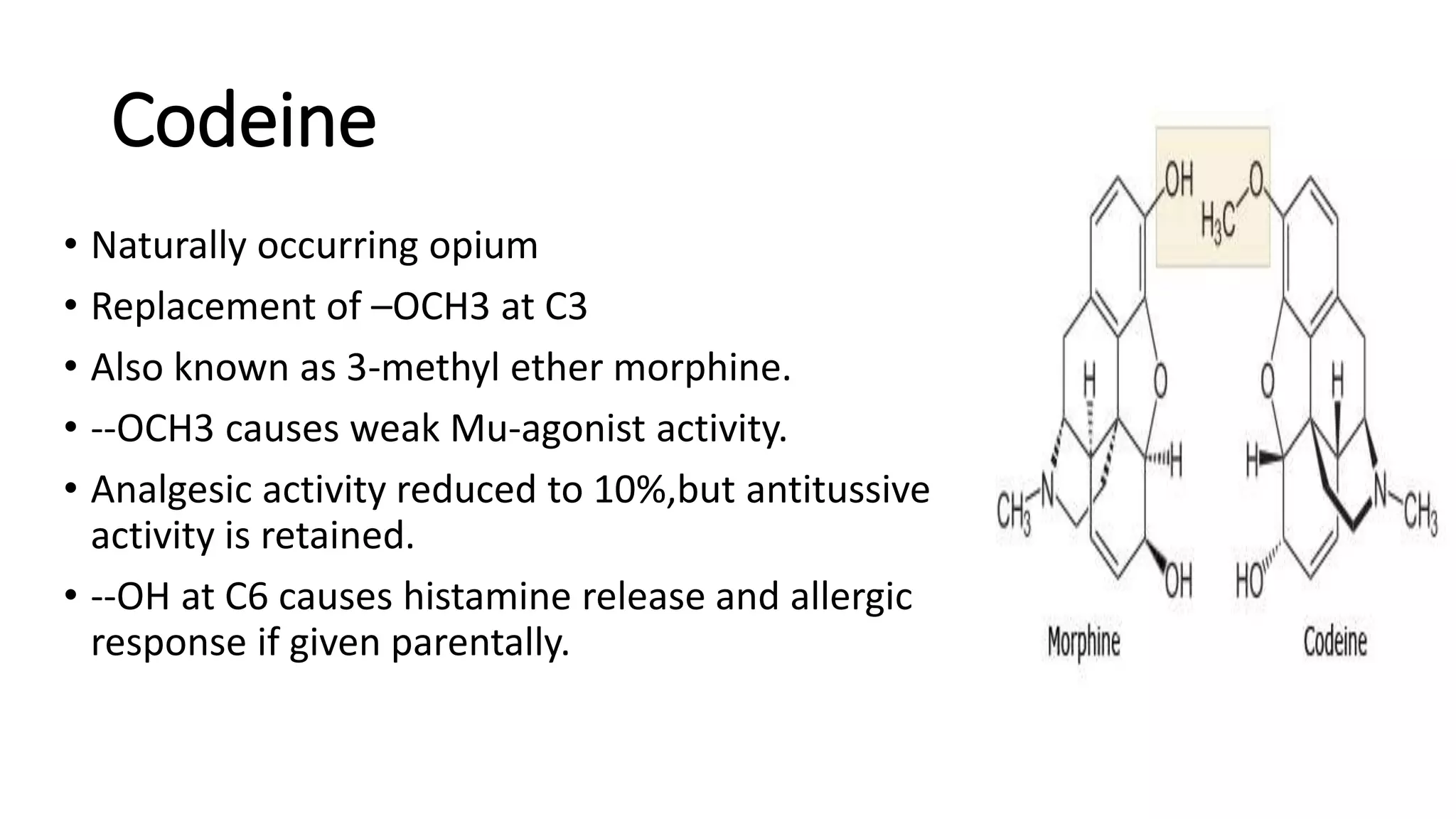
Codeine
• Naturally occurring opium
• Replacement of –OCH3 at C3
• Also known as 3-methyl ether morphine.
• --OCH3 causes weak Mu-agonist activity.
• Analgesic activity reduced to 10%,but antitussive
activity is retained.
• --OH at C6 causes histamine release and allergic
response if given parentally.
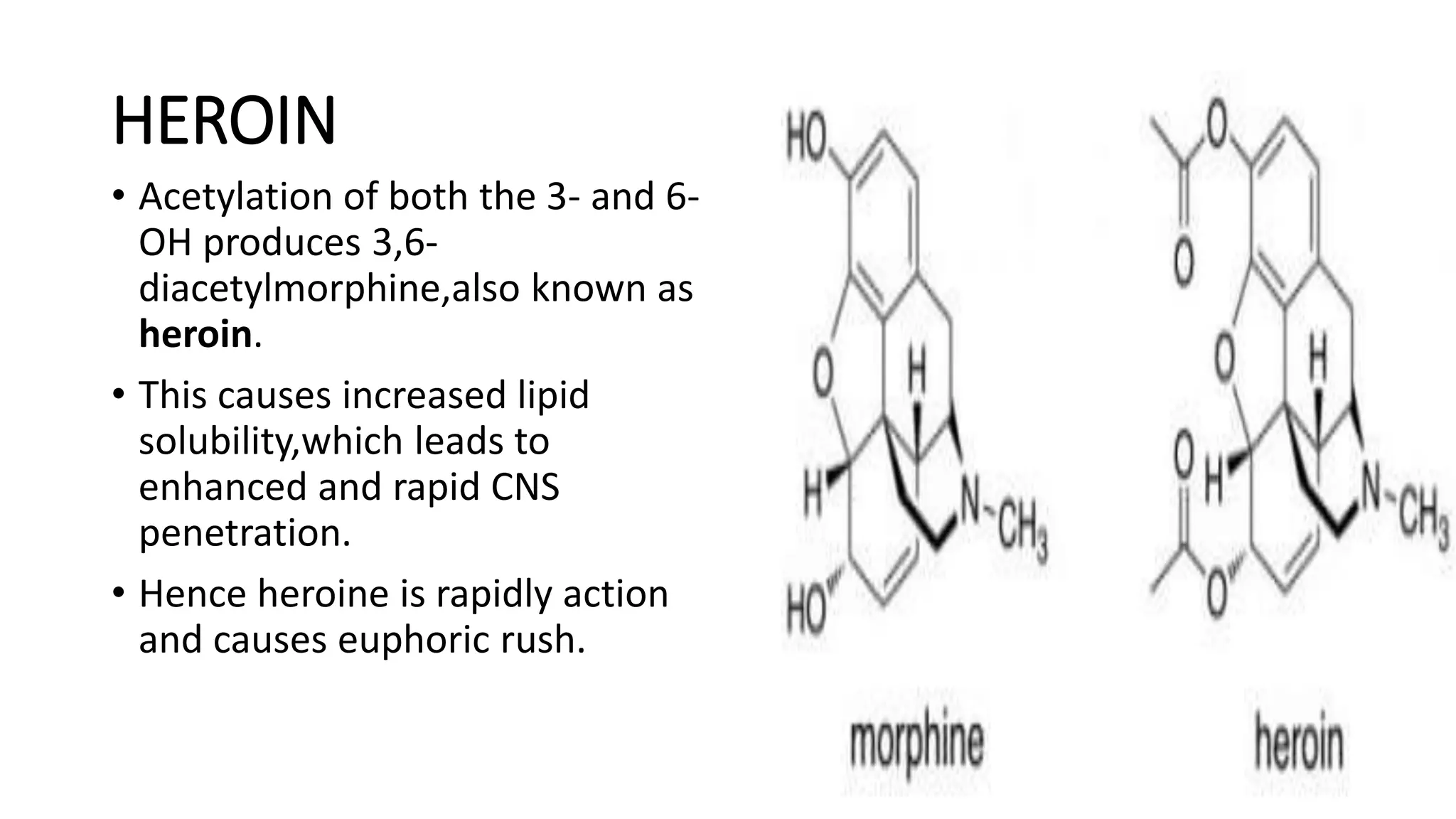
HEROIN
• Acetylation of both the 3- and 6-
OH produces 3,6-
diacetylmorphine,also known as
heroin.
• This causes increased lipid
solubility,which leads to
enhanced and rapid CNS
penetration.
• Hence heroine is rapidly action
and causes euphoric rush.
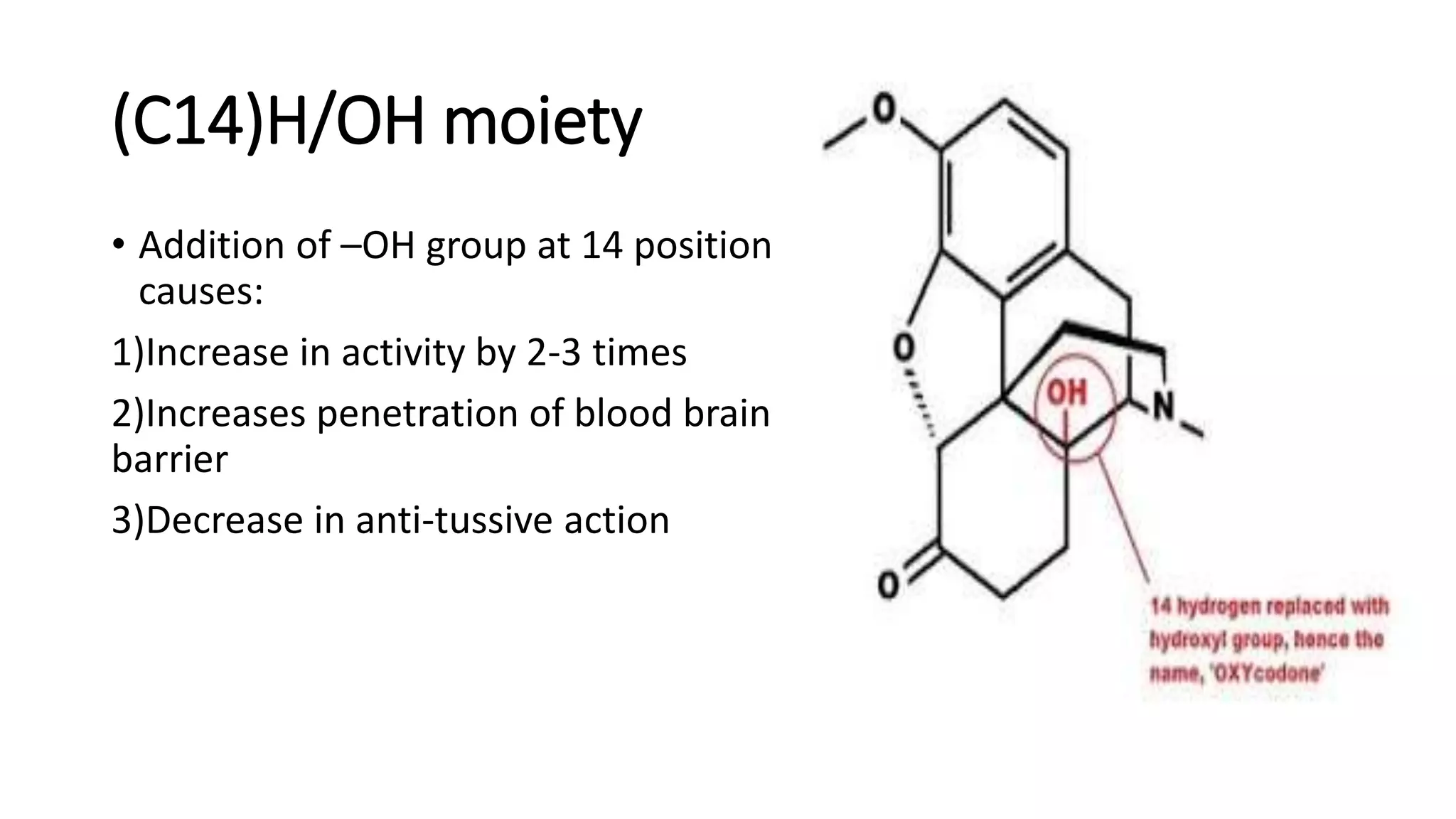
(C14)H/OH moiety
• Addition of –OH group at 14 position
causes:
1)Increase in activity by 2-3 times
2)Increases penetration of blood brain
barrier
3)Decrease in anti-tussive action
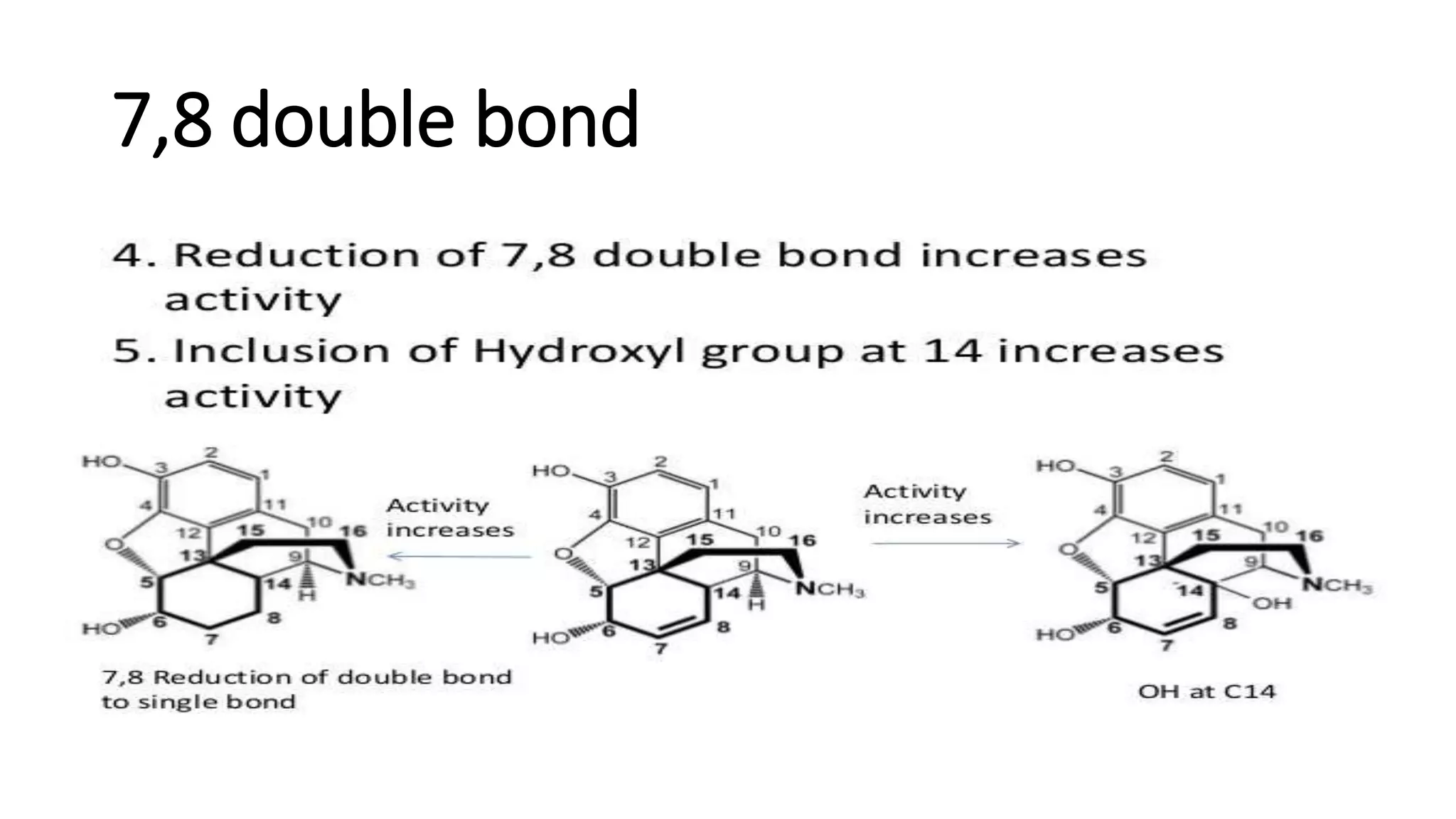
7,8 double bond
Hydroxy group at (C6)
Modifications at C6:
• Removal of –OH cause increase in lipophilicity.
• Oxidation of hydroxyl group to ketone group eg. Hydromorphone and
hydrocodone.
• Acetylation of hydroxyl group eg. Heroin.
• -OH group at C6 alone is associated with histamine release hence
causes allergic response if given parentally eg.Codeine.
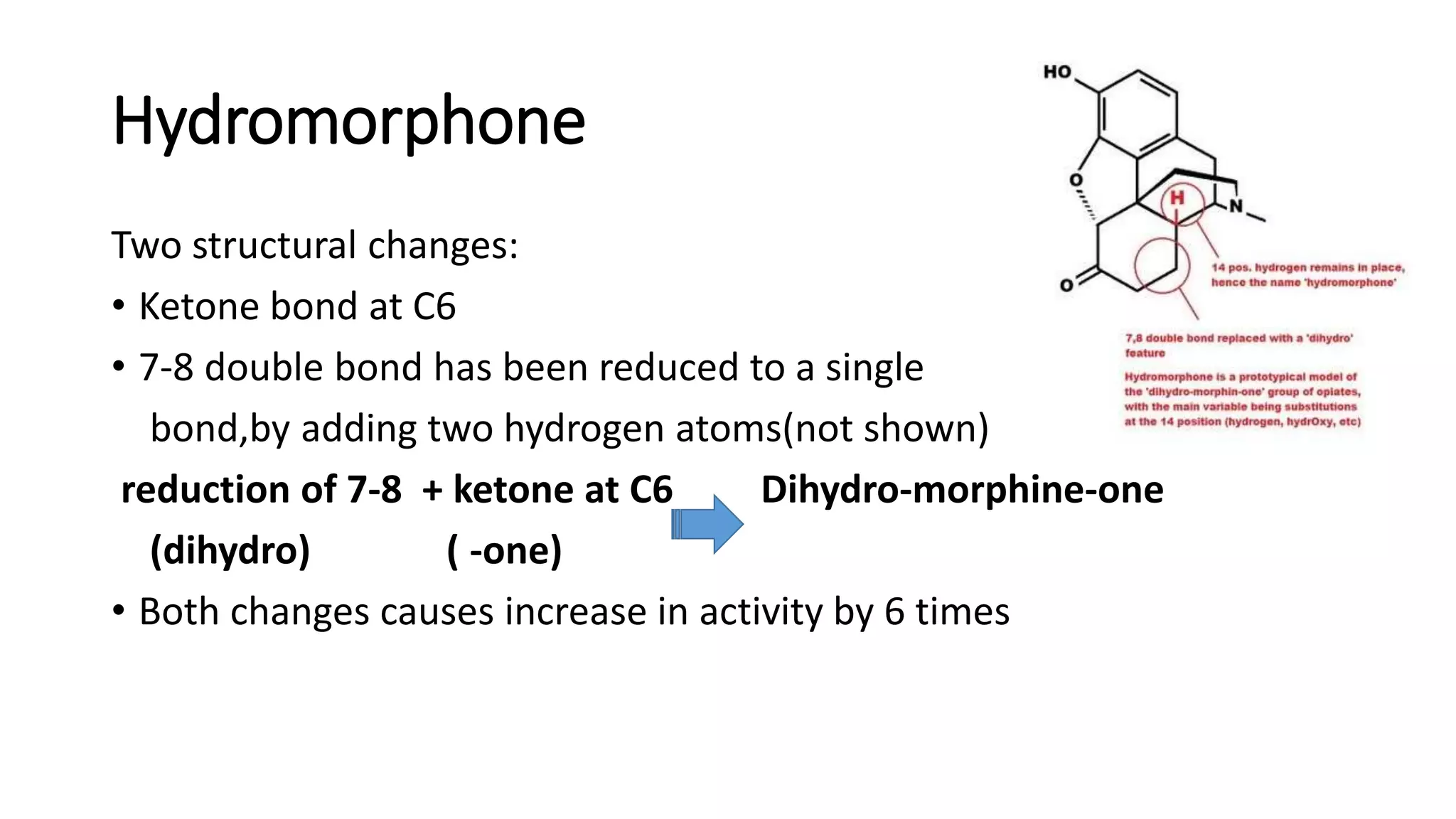
Hydromorphone
Two structural changes:
• Ketone bond at C6
• 7-8 double bond has been reduced to a single
bond,by adding two hydrogen atoms(not shown)
reduction of 7-8 + ketone at C6 Dihydro-morphine-one
(dihydro) ( -one)
• Both changes causes increase in activity by 6 times
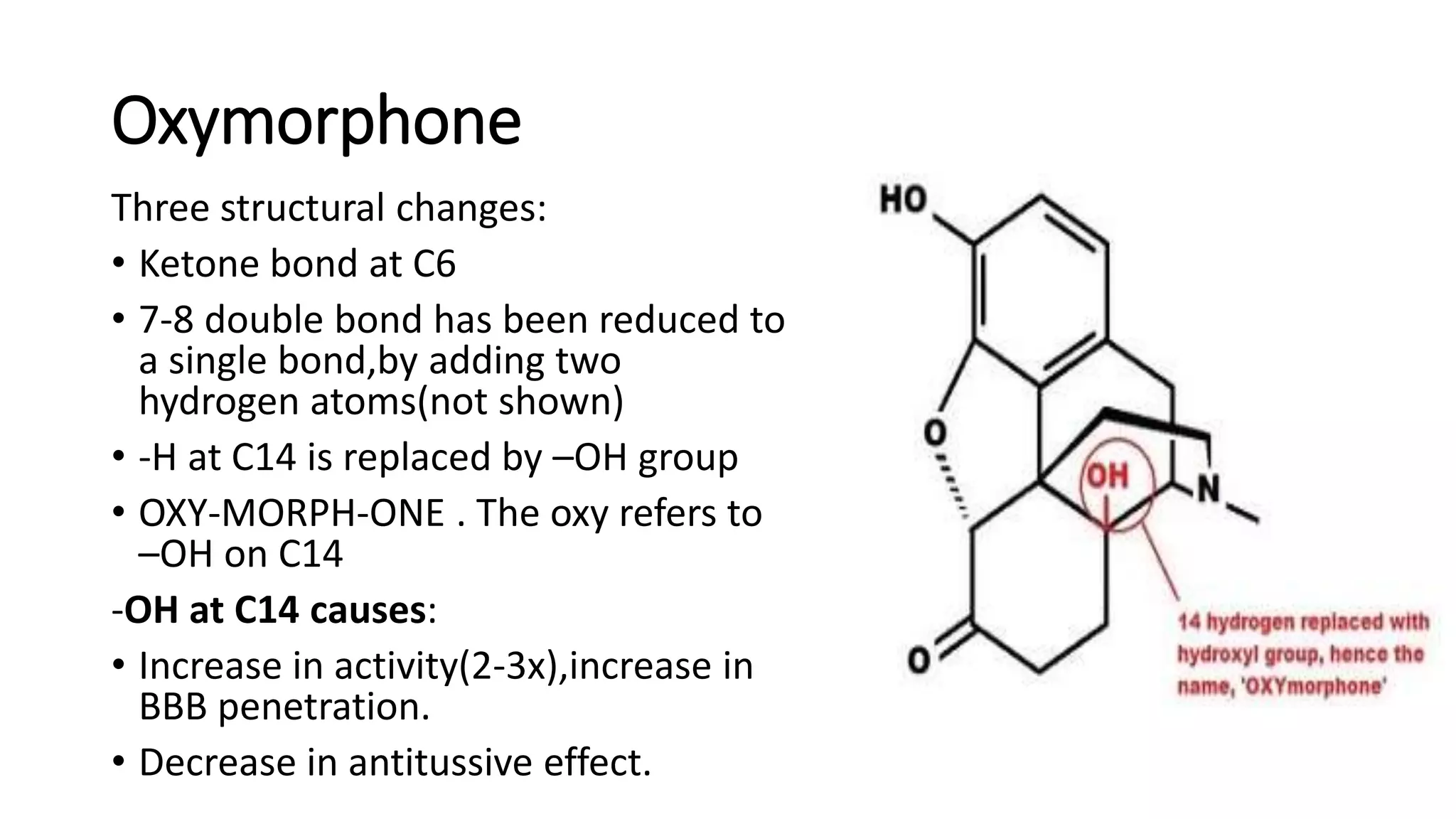
Oxymorphone
Three structural changes:
• Ketone bond at C6
• 7-8 double bond has been reduced to
a single bond,by adding two
hydrogen atoms(not shown)
• -H at C14 is replaced by –OH group
• OXY-MORPH-ONE . The oxy refers to
–OH on C14
-OH at C14 causes:
• Increase in activity(2-3x),increase in
BBB penetration.
• Decrease in antitussive effect.
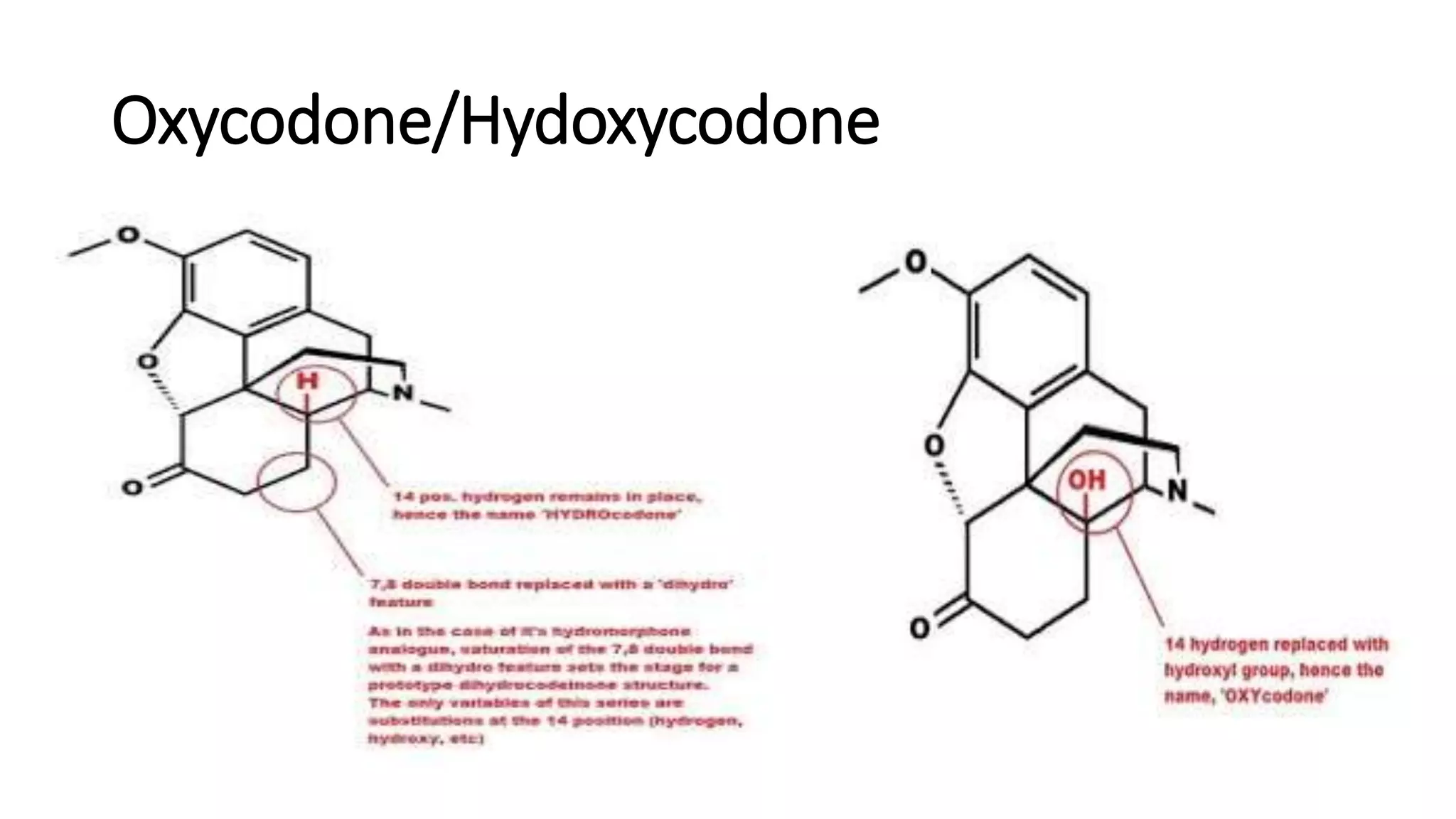
Oxycodone/Hydoxycodone
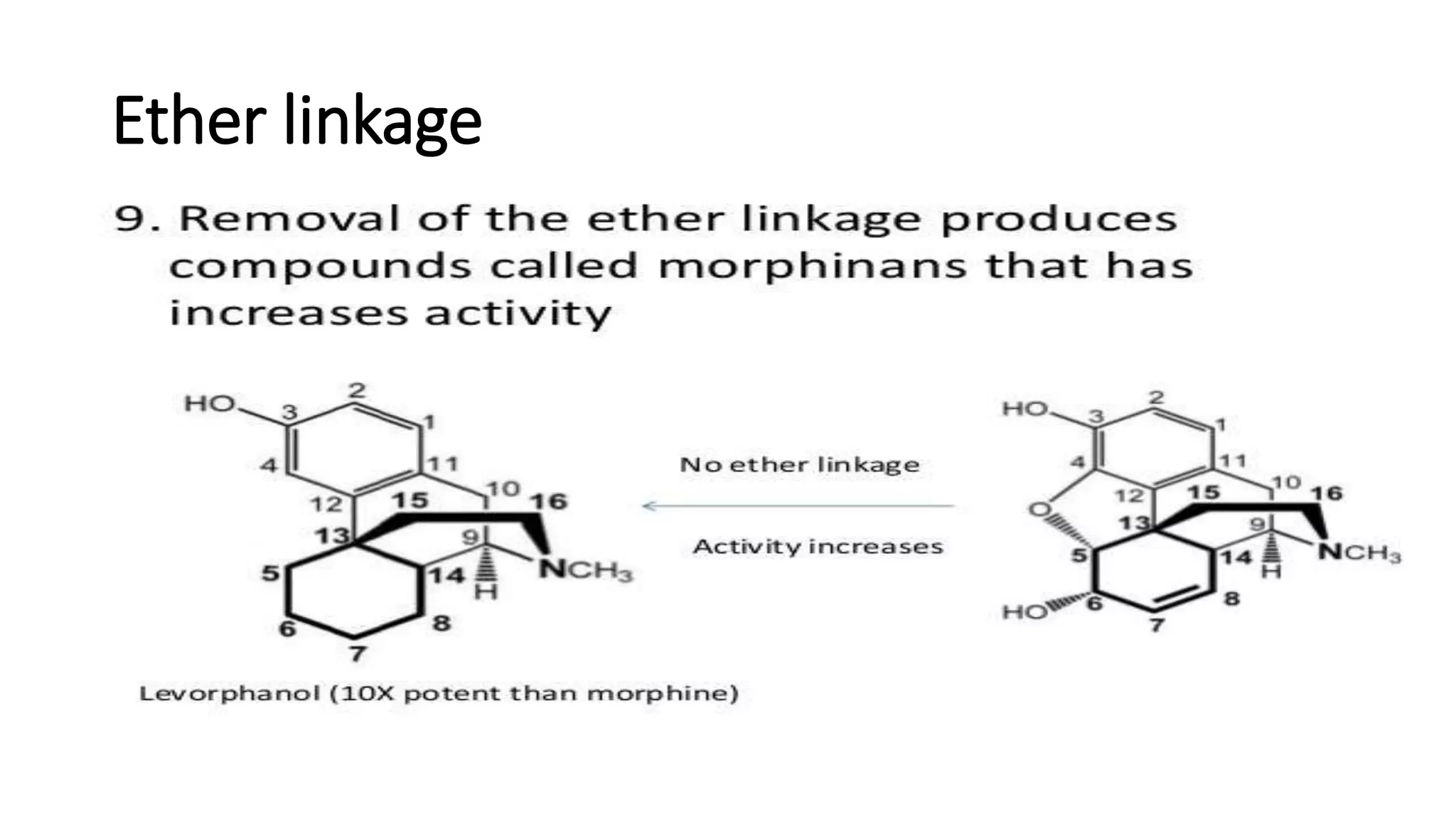
Ether linkage
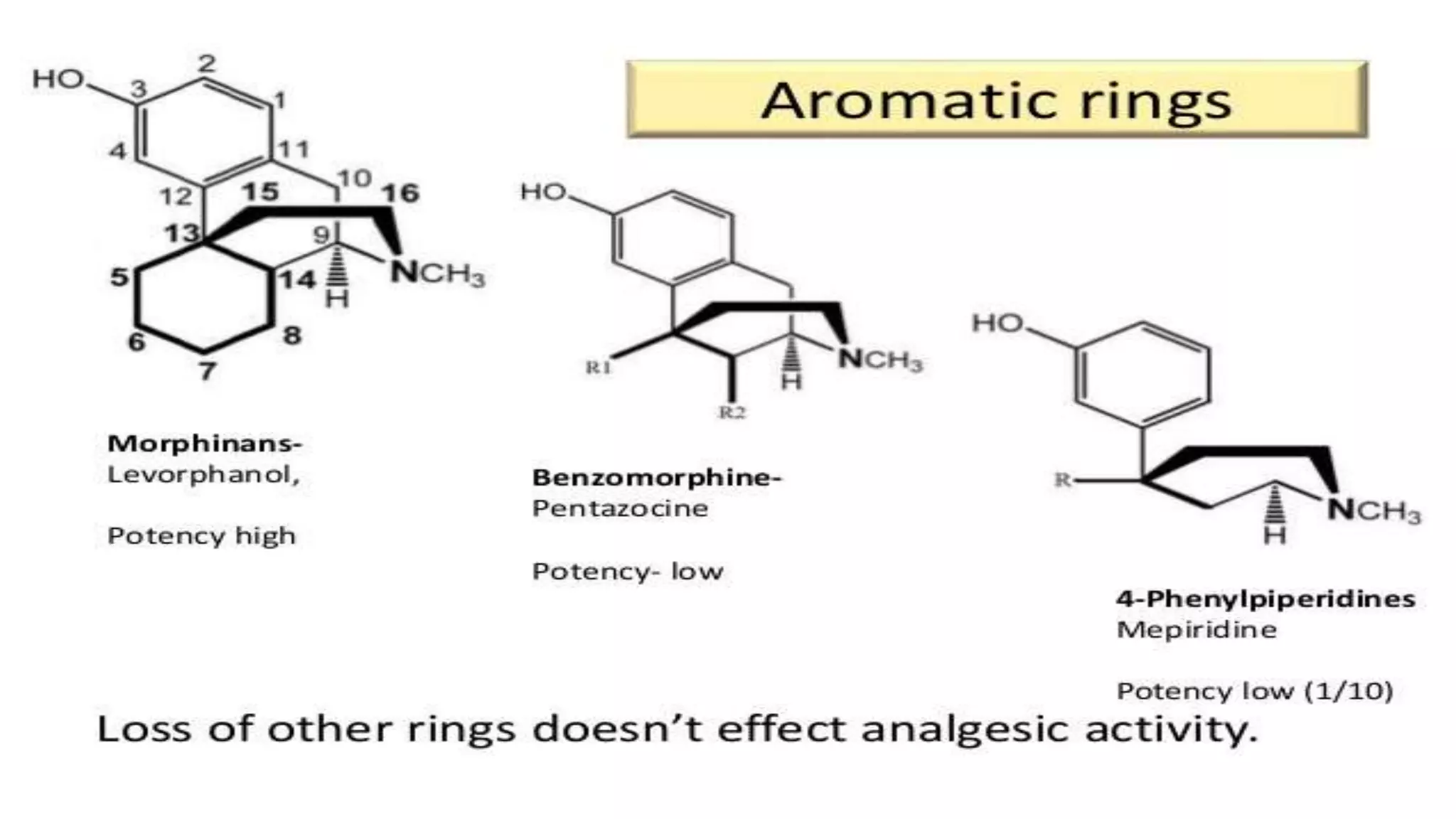
Aromatic rings
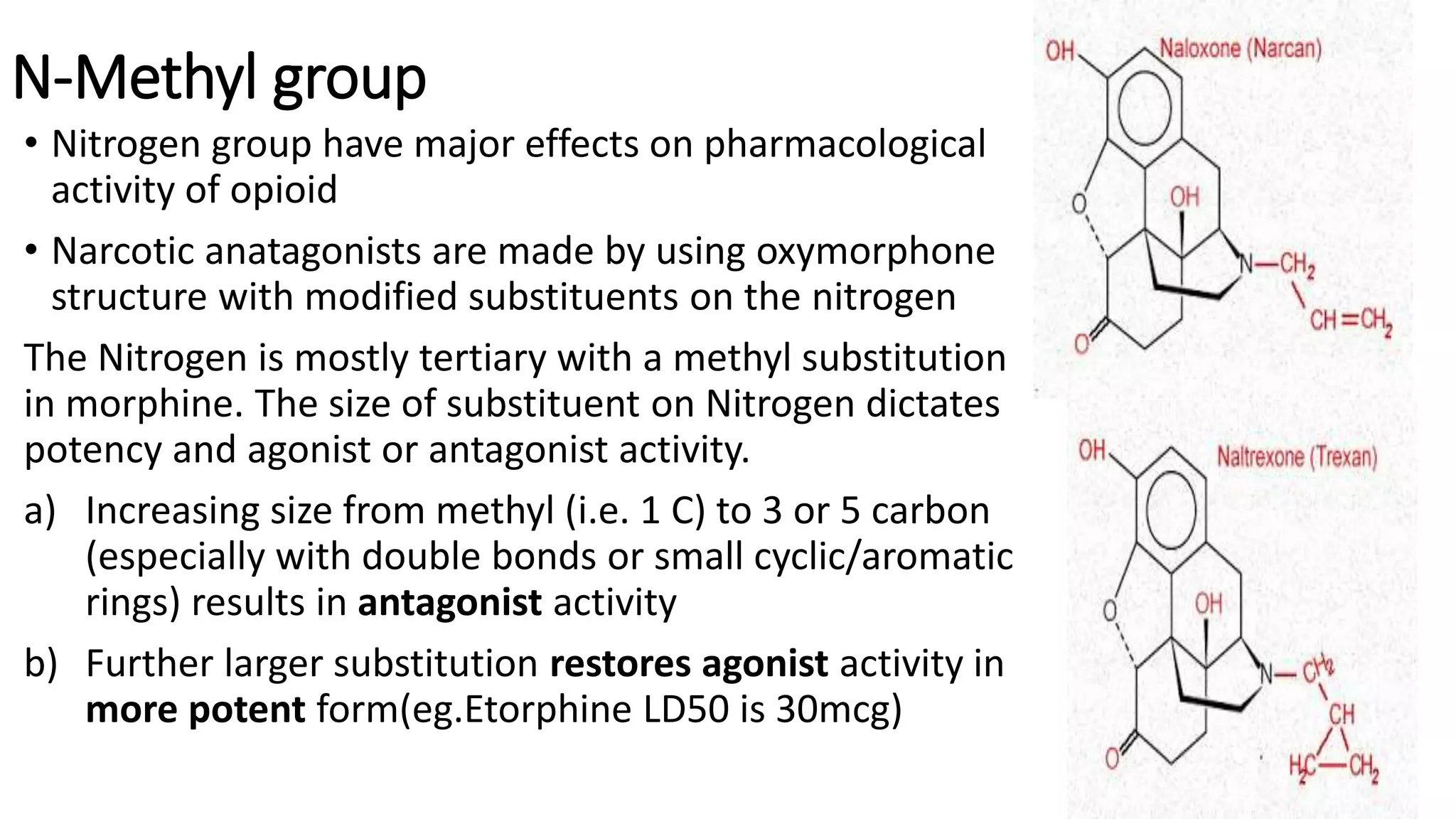
N-Methyl group
• Nitrogen group have major effects on pharmacological
activity of opioid
• Narcotic anatagonists are made by using oxymorphone
structure with modified substituents on the nitrogen
The Nitrogen is mostly tertiary with a methyl substitution
in morphine. The size of substituent on Nitrogen dictates
potency and agonist or antagonist activity.
a) Increasing size from methyl (i.e. 1 C) to 3 or 5 carbon
(especially with double bonds or small cyclic/aromatic
rings) results in antagonist activity
b) Further larger substitution restores agonist activity in
more potent form(eg.Etorphine LD50 is 30mcg)
Thank you

Structure activity relationship of Opiods

  • 1.
    Structure activity relationshipof opioids Dr.Ameya Puranik Junior Resident JNMC,Sawangi(M),Wardha.
  • 2.
    Introduction • Natural opioidsare opium or extracted from poppy straw. • Powdered opium contains number of alkaloids divided in two distinct groups 1) Phenanthrenes- Morphine,Codeine,Thebaine 2) Benzyllisoquinolines- Papaverine,Noscapine • Most of the semi-synthetic and synthetic derivatives are made by structural modifications of Morphine or Thebaine. • Morphine is considered as a prototype structure to study structural activity relationship of opioids.
  • 3.
  • 4.
    Morphine(prototype) • Its isa primary alkaloid in opium family • Pentacyclic carbon ring structure • Only levorotatory isomer is active Its has six functional groups: • A tertiary nitrogen • Hydroxyl group attachment at (C3) • Hydroxyl group attachment at (C6) • Ether group • Double bond between C7-C8 • Hydrogen atom at (C14) • N-methyl is mainly responsible for analgesic effect
  • 5.
  • 6.
    “Morphine rule” It isdeveloped for generalization of structure activity relationship of various opioids, for the opioid to be active it should have atleast following characteristics in the structure: • A tertiary nitrogen atom. • A quarternary carbon,seperated from tertiary nitrogen by a bridge of two carbons. • Phenyl group attachment.
  • 7.
    Phenolic hydroxyl group(C3) • It is needed for binding to Mu & Kappa receptors. • Seen in all potent Mu-agonists. • Changes at phenolic hydroxyl group: -OH -OCH3 (1/3) Decrease in activity(eg.Codeine)
  • 8.
    Codeine • Naturally occurringopium • Replacement of –OCH3 at C3 • Also known as 3-methyl ether morphine. • --OCH3 causes weak Mu-agonist activity. • Analgesic activity reduced to 10%,but antitussive activity is retained. • --OH at C6 causes histamine release and allergic response if given parentally.
  • 9.
    HEROIN • Acetylation ofboth the 3- and 6- OH produces 3,6- diacetylmorphine,also known as heroin. • This causes increased lipid solubility,which leads to enhanced and rapid CNS penetration. • Hence heroine is rapidly action and causes euphoric rush.
  • 10.
    (C14)H/OH moiety • Additionof –OH group at 14 position causes: 1)Increase in activity by 2-3 times 2)Increases penetration of blood brain barrier 3)Decrease in anti-tussive action
  • 11.
  • 12.
    Hydroxy group at(C6) Modifications at C6: • Removal of –OH cause increase in lipophilicity. • Oxidation of hydroxyl group to ketone group eg. Hydromorphone and hydrocodone. • Acetylation of hydroxyl group eg. Heroin. • -OH group at C6 alone is associated with histamine release hence causes allergic response if given parentally eg.Codeine.
  • 13.
    Hydromorphone Two structural changes: •Ketone bond at C6 • 7-8 double bond has been reduced to a single bond,by adding two hydrogen atoms(not shown) reduction of 7-8 + ketone at C6 Dihydro-morphine-one (dihydro) ( -one) • Both changes causes increase in activity by 6 times
  • 14.
    Oxymorphone Three structural changes: •Ketone bond at C6 • 7-8 double bond has been reduced to a single bond,by adding two hydrogen atoms(not shown) • -H at C14 is replaced by –OH group • OXY-MORPH-ONE . The oxy refers to –OH on C14 -OH at C14 causes: • Increase in activity(2-3x),increase in BBB penetration. • Decrease in antitussive effect.
  • 15.
  • 16.
  • 17.
  • 18.
    N-Methyl group • Nitrogengroup have major effects on pharmacological activity of opioid • Narcotic anatagonists are made by using oxymorphone structure with modified substituents on the nitrogen The Nitrogen is mostly tertiary with a methyl substitution in morphine. The size of substituent on Nitrogen dictates potency and agonist or antagonist activity. a) Increasing size from methyl (i.e. 1 C) to 3 or 5 carbon (especially with double bonds or small cyclic/aromatic rings) results in antagonist activity b) Further larger substitution restores agonist activity in more potent form(eg.Etorphine LD50 is 30mcg)
  • 20.