20th November 2012
 Mixing may be defined as a unit
operation in which two or more
components, in an unmixed or
partially mixed state, are treated
so that each unit
(particle, molecule etc.) of the
components lies as nearly as
possible in contact with a unit of
each of the other components.
 1. To make simple physical mixture
In the production of
tablets, capsules, sachets and dry
powders two or more powders or
granules are mixed.
 2. Physical change
Mixing may aim at producing a
change that is physical, for
example the solution of a soluble
substance. In case of dissolving a
solid in a solvent mixing will take
place by diffusion but the process
will be slow. In this case agitation
makes the process rapid.
 3. Dispersion
In case of emulsions and creams
two immiscible liquids are mixed
where one liquid is dispersed into
other.
In suspension and pastes solid
particles are dispersed in a liquid
by mixing.
 4. Promotion of reaction
Mixing encourages and controls a
chemical reaction, so ensuring
uniform products
 To ensure uniformity
 To initiate or to enhance the physical or
chemical reactions e.g. diffusion, dissolution
etc.
 To make the following products:
o Tablets
o Suspensions
o Emulsions
o Pastes
o Creams
o Ointments
o Solutions
o Syrups
o Tablet coatings
There are 3 types of mixtures:
 positive mixtures:
 Formed from materials such as, gases or
miscible liquids.
 The materials mix spontaneously and
irreversibly by diffusion
 No input of energy if time of mixing is
unlimited, although time will be shorten if
energy is supplied.
 Generally, these materials do not show any
problems during mixing.
 negative mixtures:
 materials have the tendency to separate out
from each other.
 Energy needs to be supplied to keep
components adequately dispersed.
 Some separate faster, while for others, the
separation is slower.
 For example,
a) In a suspension, there is the dispersion of solid
in the solution (fast separation)
b) Emulsions, creams and viscous suspension have
a slow separation.
c) Are more difficult to be formed and require high
degree of mixing efficiency.
 Neutral mixtures:
 Are static in behaviour
 Neither mixing nor de-mixing occurs, unless
acted upon by an external system of forces.
 Examples are:
a) Mixed powders
b) Pastes
c) Ointments.
 If the solid is not too coarse, the liquid is not
too viscous and the percentage of solids is
not too great, solids can be suspended in
liquids by the use of a propellers or a flat-
bladed turbine in a cylindrical container.
 Apparatus used:
• Planetary mixers and sigma blade mixers
used as agitator mixers
• Triple roller mills used as shear mixers-size
reduction
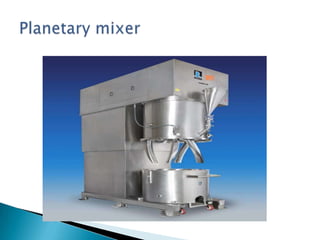
 Planetary mixers are one of the most widely
used mixers in the pharmaceutical industry.
In the pharmaceutical industry, the planetary
mixer is often used for basic operations of
mixing, blending, and low-shear granulation.
This machine is also used in other industries
like cosmetics and personal care
products, food, glass, cements, ceramics, met
al industry etc.
 The Planetary Mixer have two blades which
rotate on their own axes, while they orbit the
mix vessel on a common axis.
 The blades continuously advance along the
periphery of the vessel, removing material
from the vessel wall and transporting it to the
interior.
 These mixers are ideal for mixing and
kneading viscous pastes or putty-like
materials.
 Planetary mixers are ideal for mixing of
pharmaceutical creams, ointments, ceramics, color
and pigments, resins, ink, cosmetic creams, herbal
creams etc.
 Planetary mixers are also ideal for mixing and
kneading viscous pastes under atmospheric or
vacuum conditions.
 Used in the mixing of viscous, heat sensitive and
cohesive pastes, dough and moist etc.
 Tablet Coatings
 Tablet Granulations
 Antacid Powder Blends
 Collagen Solutions
 Dental Composites
 Ease of cleaning
 Ease of discharge
 Semi-continuous operation
 Capital cost
 Energy savings
 It is an example of agitator mixers.
 Its shape resemble the Greek letter sigma.
 It uses 2 mixer blades.
 Sigma blade mixer is a common form used to
handle semi-solids of plastic consistency.
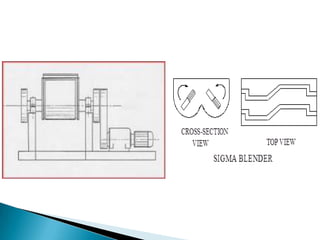
 The two blades rotate towards each other
and operate in a mixing vessel which has a
double trough shape, each blade fitting into
a trough.
 The two blades rotate at different
speeds, one usually about twice the speed of
the other, resulting in a lateral pulling of the
material and divisions into two
troughs, while the blade shape and
difference in speed causes end-to-end
movement
 It works on the principle of shearing and
convective in action.
 This mixer is designed for mixing, blending
and kneading of medium and heavy on-
flowing pastes. The impellers and bowls are
accurately machined to close
tolerances, eliminating build up and
providing high shear and rapid distribution
of materials.
 It is used for wet granulation process in the
manufacture of tablets, in the production of
ointments and pill masses.
 This mixer is well suited to high viscosity
materials like grease, putty, toffee and bubble-
gum.
 With its strong construction and high power, the
sigma blade mixer can handle the heaviest
plastic materials and products like tablet
granules, and ointments that are mixed readily.
 It is used for solid-solid & liquid-solid mixing.
 It is available in working capacities of 5 litres to
2500 litres.
 To reduce the entrainment of air in ointment
masses the sigma mixer can be enclosed and
operated under reduced pressure. This avoids
entrainment of air and reduces decomposition of
oxidisable materials but use it with caution if
mixer contains volatile materials.
 The vessel is covered for heating and cooling and
the blades are hollowed. This is useful as some
semi-solids may be reduced in viscosity by
heating, while with other materials it may be
necessary to dissipate the heat resulting from the
energy put into the mixing process
 Available in mild or stainless steel
 Available with hygienic finishes
 Heating or cooling jackets optional
 Processes heavy pastes
 No holdup of materials
 Available with single or
variable speed
 It works at a fixed
speed
 Sigma blade mixer is used in chemical and
pharmaceutical industries, to make food
products, adhesives, rubber …
construction and working principle:
o It is fitted with three rollers, made up of hard
abrasion- resistant materials.
o Rollers are fitted in such a way that they
come in close contact with each other and
rotate at different speeds.
o A scraper is used to remove the final
ointment of smooth and uniform texture.
o The feed enters through a hopper.
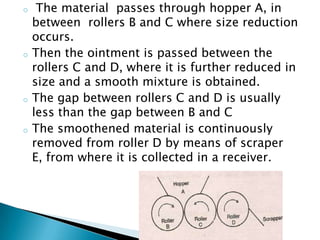
o The material passes through hopper A, in
between rollers B and C where size reduction
occurs.
o Then the ointment is passed between the
rollers C and D, where it is further reduced in
size and a smooth mixture is obtained.
o The gap between rollers C and D is usually
less than the gap between B and C
o The smoothened material is continuously
removed from roller D by means of scraper
E, from where it is collected in a receiver.
 Advantage:
Produces a uniform dispersion and a
continuous process
 Material used:
Stainless steel to prevent contamination
 Applications:
To mix paint, chemicals, glass
coatings, pigments
 Pharmaceutical homogenizers are used to
blend different kind of liquids
uniformly, specially liquids having different
properties.
 Homogenizer actually reduces the size of
particles of one material and dissolves it
evenly throughout the other material.
 Homogenization is defined as an intensive
mixing of mutually insoluble phases to obtain
a suspension or emulsion.
VALVE HOMOGENISER:
 Used to modify the physical properties of a
liquid or mixture by creating emulsions or
dispersions.
Construction
 consists of a valve, which controls the
pressure on the feed.
 Impact rings help in size reduction
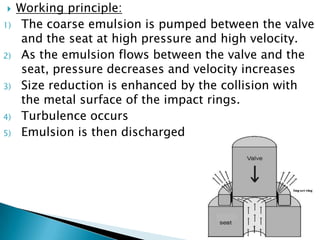
 Working principle:
1) The coarse emulsion is pumped between the valve
and the seat at high pressure and high velocity.
2) As the emulsion flows between the valve and the
seat, pressure decreases and velocity increases
3) Size reduction is enhanced by the collision with
the metal surface of the impact rings.
4) Turbulence occurs
5) Emulsion is then discharged
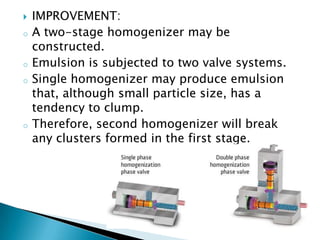
 IMPROVEMENT:
o A two-stage homogenizer may be
constructed.
o Emulsion is subjected to two valve systems.
o Single homogenizer may produce emulsion
that, although small particle size, has a
tendency to clump.
o Therefore, second homogenizer will break
any clusters formed in the first stage.
 ADVANTAGE:
 No air is incorporated in the emulsion→ no
contamination of emulsion.: the emulsifying
agent gets adsorbed at the air-water
boundary, causing denaturisation
 DRAW-BACKS:
 Increase in temperature may decrease
viscosity.
 There are some substances (ointment)which
may fail to emulsify if subjected to very high
temperature.
 Emulsion of this type should be first treated
at high temperature, then at a lower
temperature.
 Materials used:
stainless steel is used so as to prevent
contamination.
Applications:
 Dairy and food processing
 Beverages and chemical emulsions
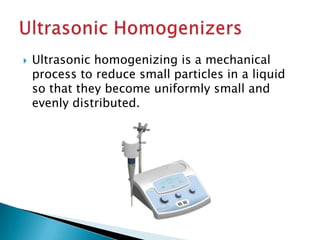
 Ultrasonic homogenizing is a mechanical
process to reduce small particles in a liquid
so that they become uniformly small and
evenly distributed.
 Ultrasonic processors are used to reduce
small particles in a liquid to improve
uniformity and stability. These particles
(disperse phase) can be either solids or
liquids. A reduction in the mean diameter of
the particles increases the number of
individual particles. This leads to a reduction
of the average particle distance and increases
the particle surface area.
 There are three main components of a laboratory
Ultrasonic Homogenizer;
 An electronic generator which provides the
power,
 A transducer which converts the signal to
mechanical energy and
 A horn or probe where the processing takes
place.
The circuitry consists of a power rectifier, power
switcher, a frequency conversion system, power
amplifier, phase-locked frequency automatic
tracking device, power regulator, power
detector, power protector device and
microcomputer controller.
Driven by the appropriate impedance and
power, the transducer subassembly generates
mechanical energy through a piezoelectric
resonator which is focused and amplified with
a tuned, titanium metal horn (probe). When
the probe tip is immersed in sample
solution, intense, high frequency sound
waves coming from the tip of the probe
induce cavitations. As the cavitations
“bubbles” collapse, high shear forces break
the material into smaller particles.
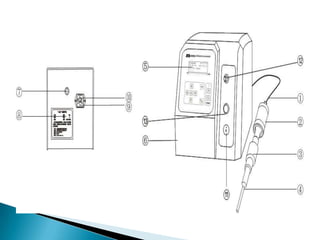
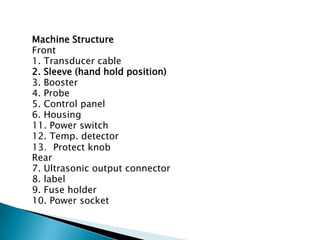
Machine Structure
Front
1. Transducer cable
2. Sleeve (hand hold position)
3. Booster
4. Probe
5. Control panel
6. Housing
11. Power switch
12. Temp. detector
13.Protect knob
Rear
7. Ultrasonic output connector
8. label
9. Fuse holder
10. Power socket
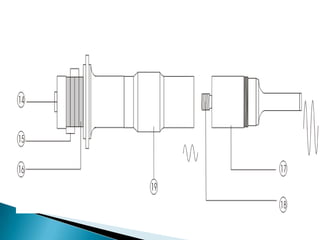
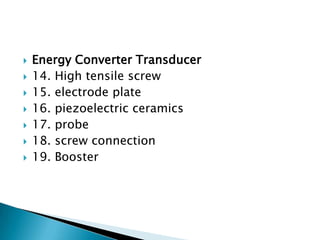
 Energy Converter Transducer
 14. High tensile screw
 15. electrode plate
 16. piezoelectric ceramics
 17. probe
 18. screw connection
 19. Booster
 Efficient for the reduction of soft and hard
particles.
 Low number of wetted and moving parts, this
reduces frictional wear and cleaning time.
 Exact control over the operational parameters
influencing the cavitations.
 Emulsifications
 Powders
 Solutions
 Suspensions
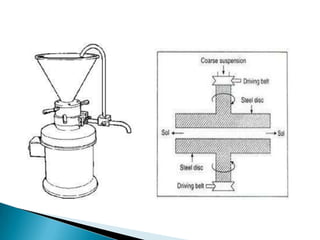
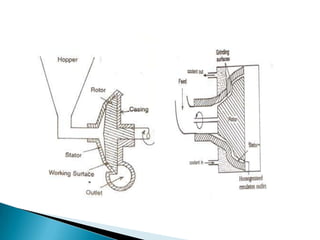
 The principle of operation of the colloid mill is
the passage of the mixed phases of an emulsion
formula between a stator and a high speed rotor
revolving at speeds of 2000 to 18,000 rpm.
 The clearance between the rotor and the stator is
adjustable, usually from 0.001 inch upward.
 The emulsion mixture, while passing between the
rotor and the stator, is subjected to a
tremendous shearing action, which effects a fine
dispersion of uniform size.
 The shearing forces applied in the colloid mill
usually raises the temperature within the
emulsion.
 It ensures a breakdown of agglomerates or in
the case of emulsions to produce droplets of
fine size around 1 micron.
 A coolant is used to absorb the excess heat.
 Continuous mixing process is possible.
 The material to be processed is fed by gravity
to the hopper or pumped so as to pass
between the rotor and stator elements where
it is subjected to high shearing and hydraulic
forces.
 The material is discharged through a hopper
whereby it can be recirculated for a second
pass.
 Materials having higher solid and fibre
contents conical grooved discs are preferred.
 Cooling and heating arrangements are also
provided in theses mills depending on the
type of material being processed.
 It is useful for milling, dispersing, homogenizing
and breaking down of agglomerates in the
manufacture of food
pastes, emulsions, coatings, ointments, creams,
pulps, grease, …
 It is used to reduce the particle size of a solid in
suspension in a liquid, or to reduce the droplet
size of a liquid suspended in another liquid.
 This is done by applying high levels of hydraulic
shear to the process liquid.
 It is frequently used to increase the stability of
suspensions and emulsions.
 It uses a high speed rotor to emulsify or disperse
lotions, creams, sauces, and oils.
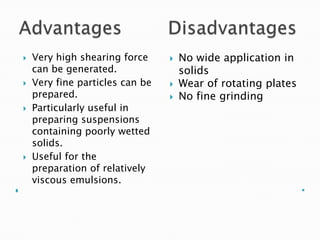
 Very high shearing force
can be generated.
 Very fine particles can be
prepared.
 Particularly useful in
preparing suspensions
containing poorly wetted
solids.
 Useful for the
preparation of relatively
viscous emulsions.
 No wide application in
solids
 Wear of rotating plates
 No fine grinding
Mixing and homogenization

Mixing and homogenization

  • 1.
  • 2.
     Mixing maybe defined as a unit operation in which two or more components, in an unmixed or partially mixed state, are treated so that each unit (particle, molecule etc.) of the components lies as nearly as possible in contact with a unit of each of the other components.
  • 3.
     1. Tomake simple physical mixture In the production of tablets, capsules, sachets and dry powders two or more powders or granules are mixed.
  • 4.
     2. Physicalchange Mixing may aim at producing a change that is physical, for example the solution of a soluble substance. In case of dissolving a solid in a solvent mixing will take place by diffusion but the process will be slow. In this case agitation makes the process rapid.
  • 5.
     3. Dispersion Incase of emulsions and creams two immiscible liquids are mixed where one liquid is dispersed into other. In suspension and pastes solid particles are dispersed in a liquid by mixing.
  • 6.
     4. Promotionof reaction Mixing encourages and controls a chemical reaction, so ensuring uniform products
  • 7.
     To ensureuniformity  To initiate or to enhance the physical or chemical reactions e.g. diffusion, dissolution etc.  To make the following products: o Tablets o Suspensions o Emulsions o Pastes o Creams o Ointments o Solutions o Syrups o Tablet coatings
  • 8.
    There are 3types of mixtures:  positive mixtures:  Formed from materials such as, gases or miscible liquids.  The materials mix spontaneously and irreversibly by diffusion  No input of energy if time of mixing is unlimited, although time will be shorten if energy is supplied.  Generally, these materials do not show any problems during mixing.
  • 9.
     negative mixtures: materials have the tendency to separate out from each other.  Energy needs to be supplied to keep components adequately dispersed.  Some separate faster, while for others, the separation is slower.  For example, a) In a suspension, there is the dispersion of solid in the solution (fast separation) b) Emulsions, creams and viscous suspension have a slow separation. c) Are more difficult to be formed and require high degree of mixing efficiency.
  • 10.
     Neutral mixtures: Are static in behaviour  Neither mixing nor de-mixing occurs, unless acted upon by an external system of forces.  Examples are: a) Mixed powders b) Pastes c) Ointments.
  • 11.
     If thesolid is not too coarse, the liquid is not too viscous and the percentage of solids is not too great, solids can be suspended in liquids by the use of a propellers or a flat- bladed turbine in a cylindrical container.  Apparatus used: • Planetary mixers and sigma blade mixers used as agitator mixers • Triple roller mills used as shear mixers-size reduction
  • 12.
     Planetary mixersare one of the most widely used mixers in the pharmaceutical industry. In the pharmaceutical industry, the planetary mixer is often used for basic operations of mixing, blending, and low-shear granulation. This machine is also used in other industries like cosmetics and personal care products, food, glass, cements, ceramics, met al industry etc.
  • 14.
     The PlanetaryMixer have two blades which rotate on their own axes, while they orbit the mix vessel on a common axis.  The blades continuously advance along the periphery of the vessel, removing material from the vessel wall and transporting it to the interior.  These mixers are ideal for mixing and kneading viscous pastes or putty-like materials.
  • 15.
     Planetary mixersare ideal for mixing of pharmaceutical creams, ointments, ceramics, color and pigments, resins, ink, cosmetic creams, herbal creams etc.  Planetary mixers are also ideal for mixing and kneading viscous pastes under atmospheric or vacuum conditions.  Used in the mixing of viscous, heat sensitive and cohesive pastes, dough and moist etc.
  • 16.
     Tablet Coatings Tablet Granulations  Antacid Powder Blends  Collagen Solutions  Dental Composites
  • 17.
     Ease ofcleaning  Ease of discharge  Semi-continuous operation  Capital cost  Energy savings
  • 18.
     It isan example of agitator mixers.  Its shape resemble the Greek letter sigma.  It uses 2 mixer blades.  Sigma blade mixer is a common form used to handle semi-solids of plastic consistency.
  • 19.
     The twoblades rotate towards each other and operate in a mixing vessel which has a double trough shape, each blade fitting into a trough.  The two blades rotate at different speeds, one usually about twice the speed of the other, resulting in a lateral pulling of the material and divisions into two troughs, while the blade shape and difference in speed causes end-to-end movement
  • 21.
     It workson the principle of shearing and convective in action.  This mixer is designed for mixing, blending and kneading of medium and heavy on- flowing pastes. The impellers and bowls are accurately machined to close tolerances, eliminating build up and providing high shear and rapid distribution of materials.
  • 22.
     It isused for wet granulation process in the manufacture of tablets, in the production of ointments and pill masses.  This mixer is well suited to high viscosity materials like grease, putty, toffee and bubble- gum.  With its strong construction and high power, the sigma blade mixer can handle the heaviest plastic materials and products like tablet granules, and ointments that are mixed readily.  It is used for solid-solid & liquid-solid mixing.
  • 23.
     It isavailable in working capacities of 5 litres to 2500 litres.  To reduce the entrainment of air in ointment masses the sigma mixer can be enclosed and operated under reduced pressure. This avoids entrainment of air and reduces decomposition of oxidisable materials but use it with caution if mixer contains volatile materials.  The vessel is covered for heating and cooling and the blades are hollowed. This is useful as some semi-solids may be reduced in viscosity by heating, while with other materials it may be necessary to dissipate the heat resulting from the energy put into the mixing process
  • 24.
     Available inmild or stainless steel  Available with hygienic finishes  Heating or cooling jackets optional
  • 25.
     Processes heavypastes  No holdup of materials  Available with single or variable speed  It works at a fixed speed
  • 26.
     Sigma blademixer is used in chemical and pharmaceutical industries, to make food products, adhesives, rubber …
  • 27.
    construction and workingprinciple: o It is fitted with three rollers, made up of hard abrasion- resistant materials. o Rollers are fitted in such a way that they come in close contact with each other and rotate at different speeds. o A scraper is used to remove the final ointment of smooth and uniform texture. o The feed enters through a hopper.
  • 28.
    o The materialpasses through hopper A, in between rollers B and C where size reduction occurs. o Then the ointment is passed between the rollers C and D, where it is further reduced in size and a smooth mixture is obtained. o The gap between rollers C and D is usually less than the gap between B and C o The smoothened material is continuously removed from roller D by means of scraper E, from where it is collected in a receiver.
  • 29.
     Advantage: Produces auniform dispersion and a continuous process  Material used: Stainless steel to prevent contamination  Applications: To mix paint, chemicals, glass coatings, pigments
  • 30.
     Pharmaceutical homogenizersare used to blend different kind of liquids uniformly, specially liquids having different properties.  Homogenizer actually reduces the size of particles of one material and dissolves it evenly throughout the other material.  Homogenization is defined as an intensive mixing of mutually insoluble phases to obtain a suspension or emulsion.
  • 31.
    VALVE HOMOGENISER:  Usedto modify the physical properties of a liquid or mixture by creating emulsions or dispersions. Construction  consists of a valve, which controls the pressure on the feed.  Impact rings help in size reduction
  • 32.
     Working principle: 1)The coarse emulsion is pumped between the valve and the seat at high pressure and high velocity. 2) As the emulsion flows between the valve and the seat, pressure decreases and velocity increases 3) Size reduction is enhanced by the collision with the metal surface of the impact rings. 4) Turbulence occurs 5) Emulsion is then discharged
  • 33.
     IMPROVEMENT: o Atwo-stage homogenizer may be constructed. o Emulsion is subjected to two valve systems. o Single homogenizer may produce emulsion that, although small particle size, has a tendency to clump. o Therefore, second homogenizer will break any clusters formed in the first stage.
  • 34.
     ADVANTAGE:  Noair is incorporated in the emulsion→ no contamination of emulsion.: the emulsifying agent gets adsorbed at the air-water boundary, causing denaturisation  DRAW-BACKS:  Increase in temperature may decrease viscosity.  There are some substances (ointment)which may fail to emulsify if subjected to very high temperature.  Emulsion of this type should be first treated at high temperature, then at a lower temperature.
  • 35.
     Materials used: stainlesssteel is used so as to prevent contamination. Applications:  Dairy and food processing  Beverages and chemical emulsions
  • 36.
     Ultrasonic homogenizingis a mechanical process to reduce small particles in a liquid so that they become uniformly small and evenly distributed.
  • 37.
     Ultrasonic processorsare used to reduce small particles in a liquid to improve uniformity and stability. These particles (disperse phase) can be either solids or liquids. A reduction in the mean diameter of the particles increases the number of individual particles. This leads to a reduction of the average particle distance and increases the particle surface area.
  • 38.
     There arethree main components of a laboratory Ultrasonic Homogenizer;  An electronic generator which provides the power,  A transducer which converts the signal to mechanical energy and  A horn or probe where the processing takes place. The circuitry consists of a power rectifier, power switcher, a frequency conversion system, power amplifier, phase-locked frequency automatic tracking device, power regulator, power detector, power protector device and microcomputer controller.
  • 39.
    Driven by theappropriate impedance and power, the transducer subassembly generates mechanical energy through a piezoelectric resonator which is focused and amplified with a tuned, titanium metal horn (probe). When the probe tip is immersed in sample solution, intense, high frequency sound waves coming from the tip of the probe induce cavitations. As the cavitations “bubbles” collapse, high shear forces break the material into smaller particles.
  • 41.
    Machine Structure Front 1. Transducercable 2. Sleeve (hand hold position) 3. Booster 4. Probe 5. Control panel 6. Housing 11. Power switch 12. Temp. detector 13.Protect knob Rear 7. Ultrasonic output connector 8. label 9. Fuse holder 10. Power socket
  • 43.
     Energy ConverterTransducer  14. High tensile screw  15. electrode plate  16. piezoelectric ceramics  17. probe  18. screw connection  19. Booster
  • 44.
     Efficient forthe reduction of soft and hard particles.  Low number of wetted and moving parts, this reduces frictional wear and cleaning time.  Exact control over the operational parameters influencing the cavitations.
  • 45.
     Emulsifications  Powders Solutions  Suspensions
  • 46.
     The principleof operation of the colloid mill is the passage of the mixed phases of an emulsion formula between a stator and a high speed rotor revolving at speeds of 2000 to 18,000 rpm.  The clearance between the rotor and the stator is adjustable, usually from 0.001 inch upward.  The emulsion mixture, while passing between the rotor and the stator, is subjected to a tremendous shearing action, which effects a fine dispersion of uniform size.  The shearing forces applied in the colloid mill usually raises the temperature within the emulsion.
  • 47.
     It ensuresa breakdown of agglomerates or in the case of emulsions to produce droplets of fine size around 1 micron.  A coolant is used to absorb the excess heat.  Continuous mixing process is possible.  The material to be processed is fed by gravity to the hopper or pumped so as to pass between the rotor and stator elements where it is subjected to high shearing and hydraulic forces.
  • 48.
     The materialis discharged through a hopper whereby it can be recirculated for a second pass.  Materials having higher solid and fibre contents conical grooved discs are preferred.  Cooling and heating arrangements are also provided in theses mills depending on the type of material being processed.
  • 51.
     It isuseful for milling, dispersing, homogenizing and breaking down of agglomerates in the manufacture of food pastes, emulsions, coatings, ointments, creams, pulps, grease, …  It is used to reduce the particle size of a solid in suspension in a liquid, or to reduce the droplet size of a liquid suspended in another liquid.  This is done by applying high levels of hydraulic shear to the process liquid.  It is frequently used to increase the stability of suspensions and emulsions.  It uses a high speed rotor to emulsify or disperse lotions, creams, sauces, and oils.
  • 52.
     Very highshearing force can be generated.  Very fine particles can be prepared.  Particularly useful in preparing suspensions containing poorly wetted solids.  Useful for the preparation of relatively viscous emulsions.  No wide application in solids  Wear of rotating plates  No fine grinding