SEMINAR
SAR OF H1-RECEPTOR ANTAGONISTS
(Medicinal Chemistry)
Joydeep Ganguly
SAR: STRUCTURE-ACTIVITY
RELATIONSHIP
• The Structure-Activity Relationship (SAR) is the
Relationship between the chemical or 3D structure of a
Molecule and its biological, physicochemical and
pharmacological activity.
• The analysis of SAR enables the determination of the
Chemical groups responsible for evoking a target
biological effect in the organism . This allows
Modification of the effect or the potency of a bioactive
Compound(a DRUG) by changing its chemical structure.
OTHER TERMS
 This method is refined to build mathematical
relationships between the chemical structure and the
biological activity, known as QUANTITATIVE
STRUCTURE-ACTIVITY RELATIONSHIP(QSAR).
 Another related term is STRUCTURE AFFINITY
RELATIONSHIP (SAFIR).
SAR OF H1 RECEPTOR
ANTAGONISTS
 Based on the Pharmacological Profile, the H1-
antihistamines are divided into two major groups:
1.FIRST GENERATION or CLASSICAL
ANTIHISTAMINES.
2.SECOND GENERATION or NON-SEDATIVE
ANTIHISTAMINES.
 The SAR of antihistamines is discussed with
reference to the First Generation antihistamines.
STRUCTURAL REQUIREMENTS
X
Ar
Ar1
CH2 N
R
R1
n
 Ar is aryl: Phenyl, substituted phenyl,hetero aryl
groups like
2- pyridyl.
 Ar1: Second aryl (or) aryl methyl
group.
CONT……
X: Connecting atom of O, C, (or) N.
 (CH2)n: Carbon chain usually ethyl.
NRR1: Basic, terminal amine functional group.
1.ARYL GROUPS
1.The diaryl substitution is essential for significant
H1-receptor affinity. The optimal antihistaminic
activity depends upon the co-planarity of two aryl
substitutions.
Ar: Phenyl, substituted phenyl and heteroaryl
group like 2-pyridyl.
2.Most of the H1-antihistamines possess substituents
in one of the aryl rings (mainly in phenyl ring), and
this influences the potency of the compound. Aryl rings
may be linked,e.g: promethazine.
2. NATURE OF X
• The X-connecting moiety of H1-antihistamines may be
simple carbon chain or saturated carbon-oxygen
moiety, which serves as a spacer group for required
pharmacophore.
Antihistamines containing a carbon atom in the
connecting moiety (e.g:carbinoxamine) exhibit
chirality, which leads to stereo-selective binding at the
receptor. X= oxygen (amino alkyl ether analogue),
X=nitrogen (ethylene-diamine derivatives),X= carbon
(mono amino propyl analogue).
3.ALKYL CHAIN
 The carbon chain consists of two or three atoms in
H1-antihistamines, which leads to the distance
between the central point of the diaryl ring system
and the terminal nitrogen atom in the extended
conformation of these compounds in he range of 5-6
Angstrom.
X
Ar
Ar1
CH2 N
R
R1
n
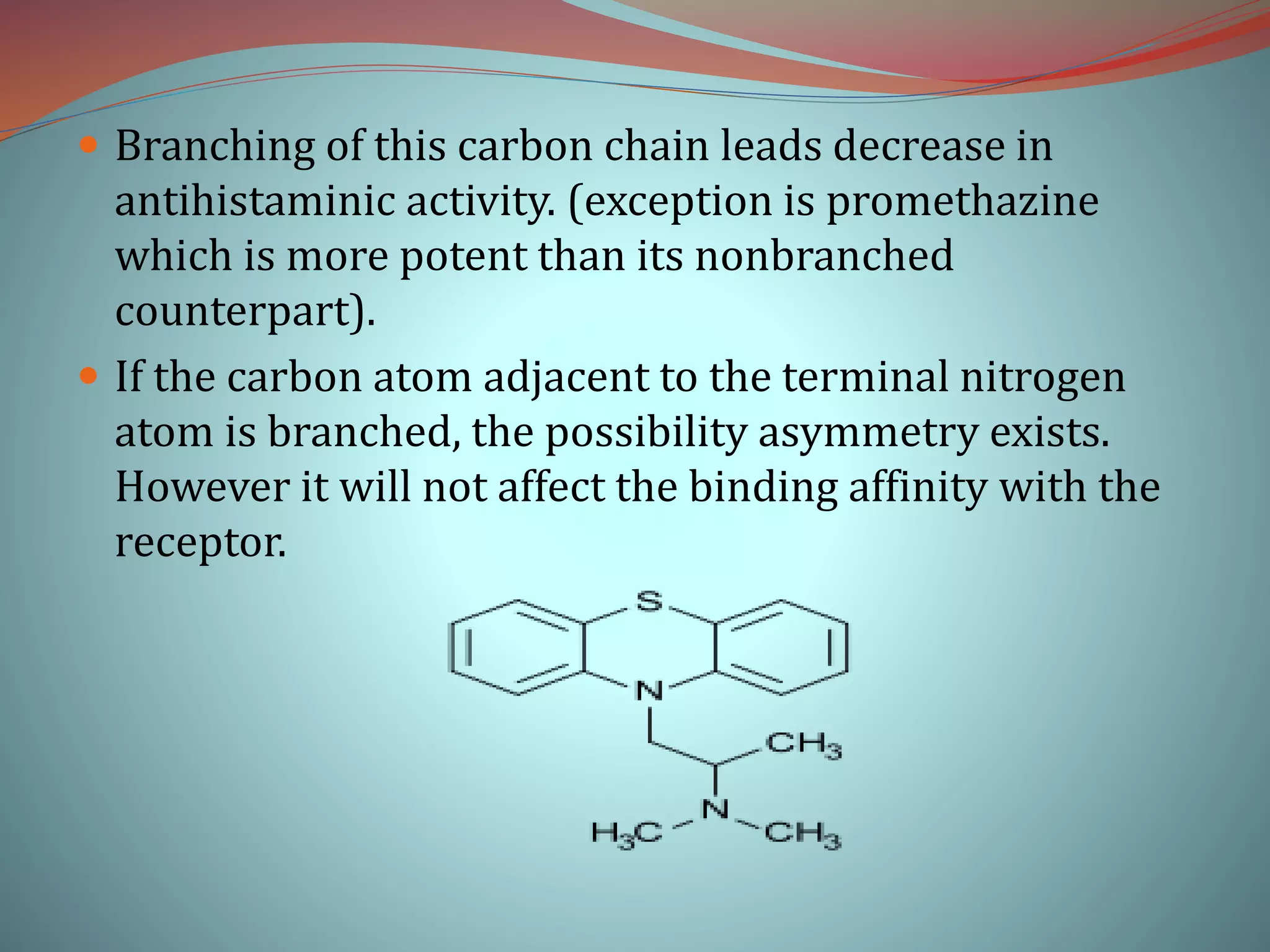
 Branching of this carbon chain leads decrease in
antihistaminic activity. (exception is promethazine
which is more potent than its nonbranched
counterpart).
 If the carbon atom adjacent to the terminal nitrogen
atom is branched, the possibility asymmetry exists.
However it will not affect the binding affinity with the
receptor.
4. TERMINAL NITROGEN
ATOM(NRR’)
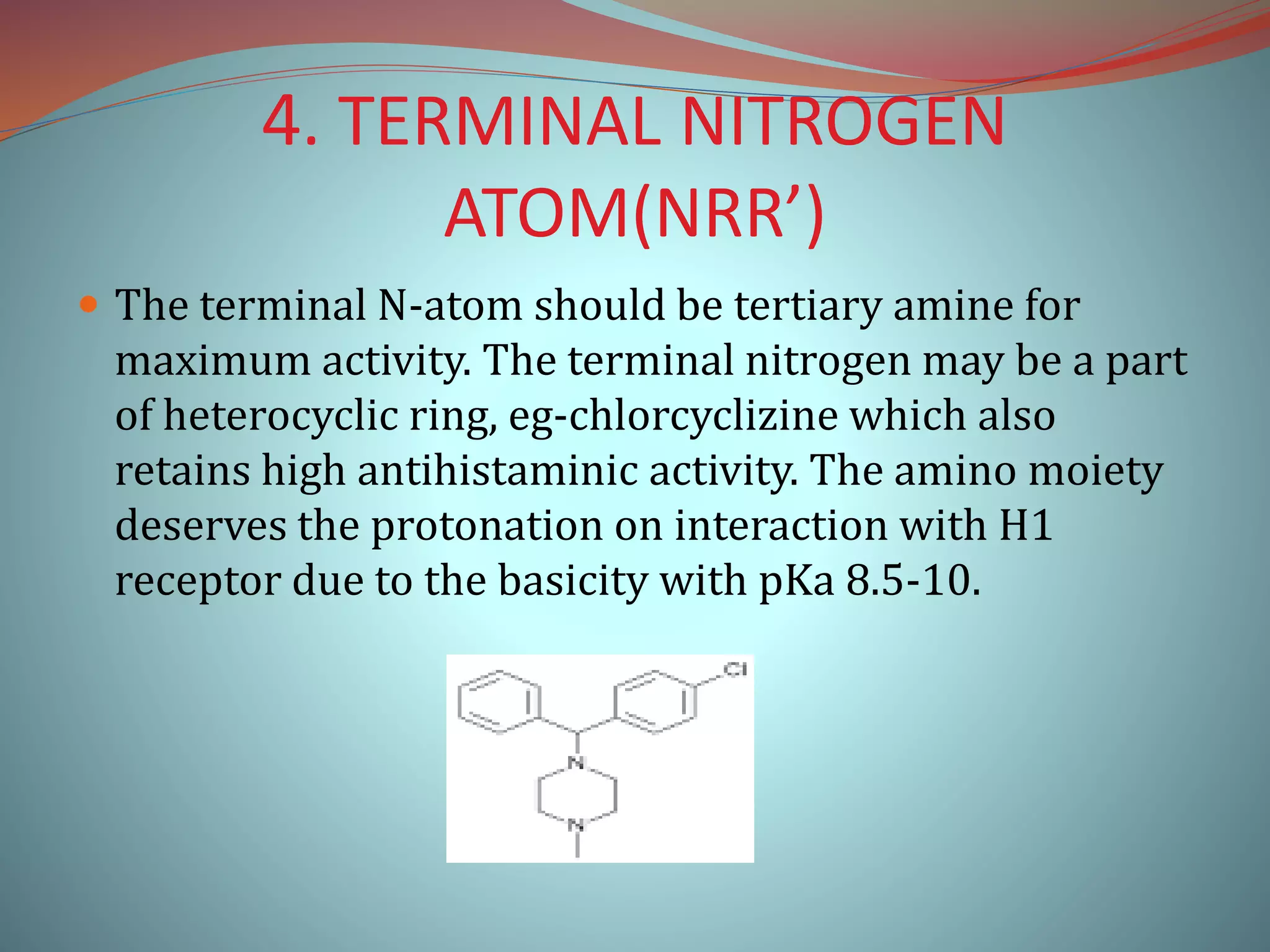
 The terminal N-atom should be tertiary amine for
maximum activity. The terminal nitrogen may be a part
of heterocyclic ring, eg-chlorcyclizine which also
retains high antihistaminic activity. The amino moiety
deserves the protonation on interaction with H1
receptor due to the basicity with pKa 8.5-10.
a) Amino alkyl ethers.
b) Ethylenediamine derivatives.
c) Propyl amine derivatives.
d) Phenothiazine derivatives.
e) Piperazine derivatives.
CLASSIFICATION:
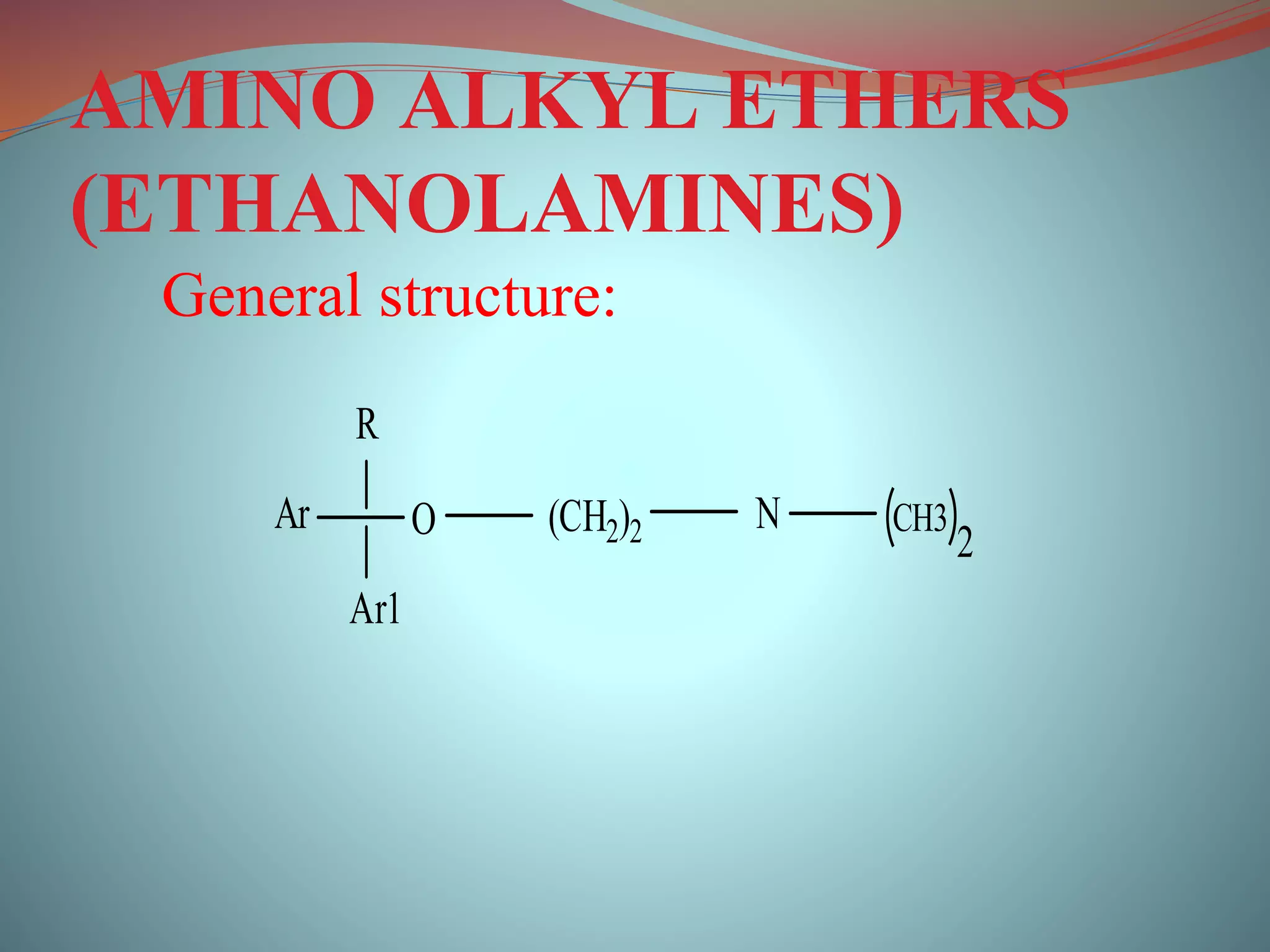
AMINO ALKYL ETHERS
(ETHANOLAMINES)
R
Ar
Ar1
O (CH2)2 N CH3
2
General structure:
STRUCTURE ACTIVITY
RELATIONSHIP
a)These are characterized by presence of OXYGEN
connecting moiety.
b)Most compounds in this series are simple N,N-
dimethyl ethanolamine derivatives.
c)Most amino alkyl ethers are optically active.
d)This amino alkyl ethers have to penetrate the BBB
and occupy central H1 receptor resulting the
DROWSINESS. eg: DOXYLAMINE
CONCLUSION
 Thus STRUCTURE-ACTIVITY RELATIONSHIP is
important to evaluate the overall physicochemical
properties of medicine.
X-connecting moieties, and the nature of substitution
in the alkyl side chain or terminal nitrogen among the
various drugs account for differences observed in
antihistaminic potency as well as pharmacological,
biodisposition, and adverse reaction profiles.
THANK YOU

SAR of H1 Receptor Antagonists..

  • 1.
    SEMINAR SAR OF H1-RECEPTORANTAGONISTS (Medicinal Chemistry) Joydeep Ganguly
  • 2.
    SAR: STRUCTURE-ACTIVITY RELATIONSHIP • TheStructure-Activity Relationship (SAR) is the Relationship between the chemical or 3D structure of a Molecule and its biological, physicochemical and pharmacological activity. • The analysis of SAR enables the determination of the Chemical groups responsible for evoking a target biological effect in the organism . This allows Modification of the effect or the potency of a bioactive Compound(a DRUG) by changing its chemical structure.
  • 3.
    OTHER TERMS  Thismethod is refined to build mathematical relationships between the chemical structure and the biological activity, known as QUANTITATIVE STRUCTURE-ACTIVITY RELATIONSHIP(QSAR).  Another related term is STRUCTURE AFFINITY RELATIONSHIP (SAFIR).
  • 4.
    SAR OF H1RECEPTOR ANTAGONISTS  Based on the Pharmacological Profile, the H1- antihistamines are divided into two major groups: 1.FIRST GENERATION or CLASSICAL ANTIHISTAMINES. 2.SECOND GENERATION or NON-SEDATIVE ANTIHISTAMINES.  The SAR of antihistamines is discussed with reference to the First Generation antihistamines.
  • 5.
    STRUCTURAL REQUIREMENTS X Ar Ar1 CH2 N R R1 n Ar is aryl: Phenyl, substituted phenyl,hetero aryl groups like 2- pyridyl.  Ar1: Second aryl (or) aryl methyl group.
  • 6.
    CONT…… X: Connecting atomof O, C, (or) N.  (CH2)n: Carbon chain usually ethyl. NRR1: Basic, terminal amine functional group.
  • 7.
    1.ARYL GROUPS 1.The diarylsubstitution is essential for significant H1-receptor affinity. The optimal antihistaminic activity depends upon the co-planarity of two aryl substitutions. Ar: Phenyl, substituted phenyl and heteroaryl group like 2-pyridyl. 2.Most of the H1-antihistamines possess substituents in one of the aryl rings (mainly in phenyl ring), and this influences the potency of the compound. Aryl rings may be linked,e.g: promethazine.
  • 8.
    2. NATURE OFX • The X-connecting moiety of H1-antihistamines may be simple carbon chain or saturated carbon-oxygen moiety, which serves as a spacer group for required pharmacophore. Antihistamines containing a carbon atom in the connecting moiety (e.g:carbinoxamine) exhibit chirality, which leads to stereo-selective binding at the receptor. X= oxygen (amino alkyl ether analogue), X=nitrogen (ethylene-diamine derivatives),X= carbon (mono amino propyl analogue).
  • 9.
    3.ALKYL CHAIN  Thecarbon chain consists of two or three atoms in H1-antihistamines, which leads to the distance between the central point of the diaryl ring system and the terminal nitrogen atom in the extended conformation of these compounds in he range of 5-6 Angstrom. X Ar Ar1 CH2 N R R1 n
  • 10.
     Branching ofthis carbon chain leads decrease in antihistaminic activity. (exception is promethazine which is more potent than its nonbranched counterpart).  If the carbon atom adjacent to the terminal nitrogen atom is branched, the possibility asymmetry exists. However it will not affect the binding affinity with the receptor.
  • 11.
    4. TERMINAL NITROGEN ATOM(NRR’) The terminal N-atom should be tertiary amine for maximum activity. The terminal nitrogen may be a part of heterocyclic ring, eg-chlorcyclizine which also retains high antihistaminic activity. The amino moiety deserves the protonation on interaction with H1 receptor due to the basicity with pKa 8.5-10.
  • 12.
    a) Amino alkylethers. b) Ethylenediamine derivatives. c) Propyl amine derivatives. d) Phenothiazine derivatives. e) Piperazine derivatives. CLASSIFICATION:
  • 13.
    AMINO ALKYL ETHERS (ETHANOLAMINES) R Ar Ar1 O(CH2)2 N CH3 2 General structure:
  • 14.
    STRUCTURE ACTIVITY RELATIONSHIP a)These arecharacterized by presence of OXYGEN connecting moiety. b)Most compounds in this series are simple N,N- dimethyl ethanolamine derivatives. c)Most amino alkyl ethers are optically active. d)This amino alkyl ethers have to penetrate the BBB and occupy central H1 receptor resulting the DROWSINESS. eg: DOXYLAMINE
  • 15.
    CONCLUSION  Thus STRUCTURE-ACTIVITYRELATIONSHIP is important to evaluate the overall physicochemical properties of medicine. X-connecting moieties, and the nature of substitution in the alkyl side chain or terminal nitrogen among the various drugs account for differences observed in antihistaminic potency as well as pharmacological, biodisposition, and adverse reaction profiles.
  • 16.