Isolation and Identification of
Salmonella
Group # 02
Group members
 Kainat Gul 2019-ag-361
 Sara Khan 2019-ag-3561
 Hamna Nadeem 2019-ag-369
 Tehzeeb Asghar 2019-ag-3585
 Asma Mairaj 2014-ag-5512
 Rimal Ayesha 2018-ag-1905
 Muqadas Amin 2012-ag-2593
 Asim Munir 2014-ag-3964
 Inam Ur Rehman 2015-ag-6349
 Ali Raza 2014-ag-4100
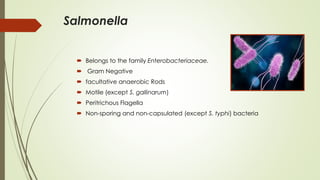
Salmonella
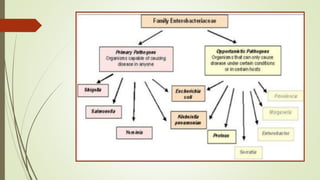
 Belongs to the family Enterobacteriaceae.
 Gram Negative
 facultative anaerobic Rods
 Motile (except S. gallinarum)
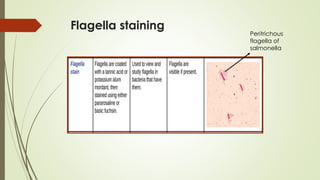
 Peritrichous Flagella
 Non-sporing and non-capsulated (except S. typhi) bacteria
Classification
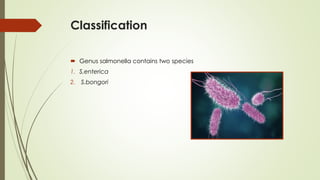
 Genus salmonella contains two species
1. S.enterica
2. S.bongori
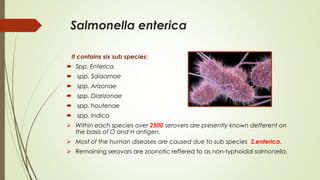
Salmonella enterica
It contains six sub species:
 Spp. Enterica
 spp. Salaamae
 spp. Arizonae
 spp. Diarizonae
 spp. houtenae
 spp. Indica
➢ Within each species over 2500 serovers are presently known defferent on
the basis of O and H antigen.
➢ Most of the human diseases are caused due to sub species S.enterica.
➢ Remaining serovars are zoonotic reffered to as non-typhoidal salmonella.
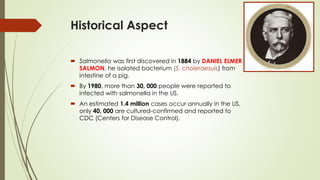
Historical Aspect
 Salmonella was first discovered in 1884 by DANIEL ELMER
SALMON, he isolated bacterium (S. choleraesuis) from
intestine of a pig.
 By 1980, more than 30, 000 people were reported to
infected with salmonella in the US.
 An estimated 1.4 million cases occur annually in the US,
only 40, 000 are cultured-confirmed and reported to
CDC (Centers for Disease Control).
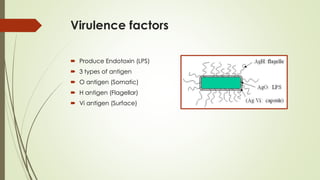
Virulence factors
 Produce Endotoxin (LPS)
 3 types of antigen
 O antigen (Somatic)
 H antigen (Flagellar)
 Vi antigen (Surface)
In Humans
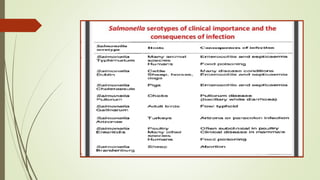
 Salmonella caused nontyphoidal and typhoidal infections in
humans
➢ Non typhoidal infection
 Self-limiting zoonotic infections such as food poisoning after
ingestion of contaminated foods
 Infection rate is more common in infants and children.
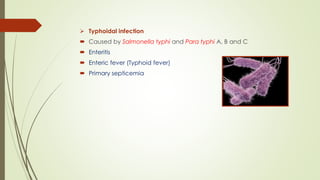
➢ Typhoidal infection
 Caused by Salmonella typhi and Para typhi A, B and C
 Enteritis
 Enteric fever (Typhoid fever)
 Primary septicemia
In Animals
 In animals, asymptomatic Salmonella infections are common.
 1-3% of domestic animals carry Salmonella spp.
 Mostly affect young and lactating animals
 Salmonella dublin causes dry gangrene and bone lesions in cattle
 Septicemic Salmonella choleraesuis causes classical swine fever in pigs and
other animals
In Poultry
➢ Salmonella enteritidis
 Infect ovaries of hens and transmitted through eggs may result in human
food poisoning
➢ Salmonella pullorum
 Causes pullorum disease or bacillary white diarrhea
 Infects young chicks and birds results in characteristic lesions includes white
nodes throughout the lungs and focal necrosis of liver
➢ Salmonella gallinarum
 Causes fowl typhoid in young chicks and birds
 Characteristic findings include enlarged, friable, bile-stained liver and
enlarged spleen
Isolation of Salmonella
Sampling:
 Contaminated food, vegetables, fruits, and eggs
 Raw meat
 Raw chicken meat
 Humans (stool samples)
Enrichment
 Selenite cystine broth or mannitol selenite broth used for enrichment
❑ Selenite cystine broth
 It contains sodium selenite inhibits Gram positive and Gram negative
bacteria other then salmonella
 L-cystine is a reducing agent incorporated to enhance the recovery
capacity of the medium.
Selective media
 SS Agar (Salmonella Shigella agar)
 Selective and differential medium
 Selective due to bile salts, brilliant green dye and sodium citrate which
inhibits Gram positive organisms
 Differential on the basis of lactose fermentation with neutral red indicator
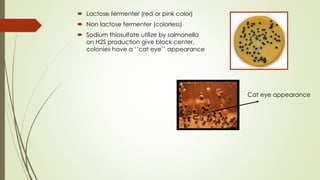
 Lactose fermenter (red or pink color)
 Non lactose fermenter (colorless)
 Sodium thiosulfate utilize by salmonella
on H2S production give black center,
colonies have a ‘’cat eye’’ appearance
Cat eye appearance
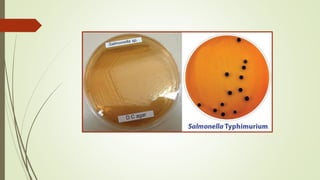
DCA (Deoxycholate Citrate Agar)
 Selective and differential medium
 Selective due to sodium deoxycholate which inhibits Gram positive
organisms
 Differential on the basis of lactose fermentation with neutral red indicator
 Ferric ammonium citrate FeS (iron suphide) Black center
XLD (Xylose lysine deoxycholate Agar)
 Selective and differential medium
 Selective due to sodium deoxycholate inhibits Gram
positive organisms
 Differential on the basis of Xylose fermentation with
phenol red indicator
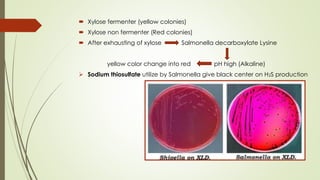
 Xylose fermenter (yellow colonies)
 Xylose non fermenter (Red colonies)
 After exhausting of xylose Salmonella decarboxylate Lysine
yellow color change into red pH high (Alkaline)
➢ Sodium thiosulfate utilize by Salmonella give black center on H2S production
Identification of Salmonella
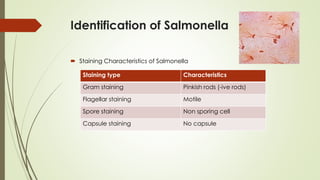
 Staining Characteristics of Salmonella
Staining type Characteristics
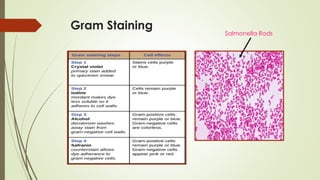
Gram staining Pinkish rods (-ive rods)
Flagellar staining Motile
Spore staining Non sporing cell
Capsule staining No capsule
Gram Staining
Salmonella Rods
Flagella staining
Peritrichous
flagella of
salmonella
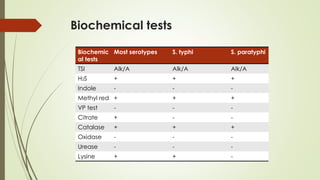
Biochemical tests
Biochemic
al tests
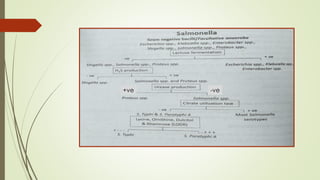
Most serotypes S. typhi S. paratyphi
TSI Alk/A Alk/A Alk/A
H2S + + +
Indole - - -
Methyl red + + +
VP test - - -
Citrate + - -
Catalase + + +
Oxidase - - -
Urease - - -
Lysine + + -
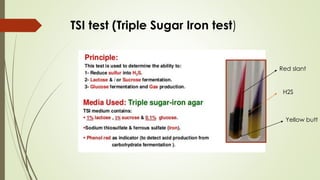
TSI test (Triple Sugar Iron test)
Red slant
H2S
Yellow butt
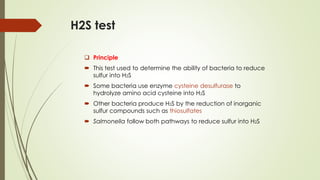
H2S test
❑ Principle
 This test used to determine the ability of bacteria to reduce
sulfur into H2S
 Some bacteria use enzyme cysteine desulfurase to
hydrolyze amino acid cysteine into H2S
 Other bacteria produce H2S by the reduction of inorganic
sulfur compounds such as thiosulfates
 Salmonella follow both pathways to reduce sulfur into H2S
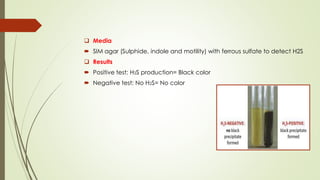
❑ Media
 SIM agar (Sulphide, indole and motility) with ferrous sulfate to detect H2S
❑ Results
 Positive test: H2S production= Black color
 Negative test: No H2S= No color
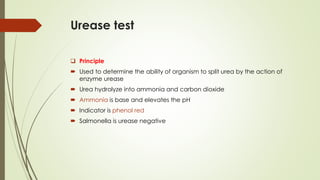
Urease test
❑ Principle
 Used to determine the ability of organism to split urea by the action of
enzyme urease
 Urea hydrolyze into ammonia and carbon dioxide
 Ammonia is base and elevates the pH
 Indicator is phenol red
 Salmonella is urease negative
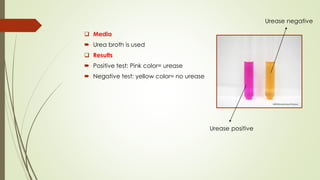
❑ Media
 Urea broth is used
❑ Results
 Positive test: Pink color= urease
 Negative test: yellow color= no urease
Urease positive
Urease negative
Citrate test
❑ Principle
 Some organisms use as carbon source
Citrate Pyruvate CO2 + Na + Na2CO3 Alkaline pH
➢ Bromothymol blue indicator
➢ Most of the serotypes of salmonella is citrate positive
citrase
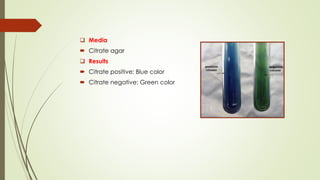
❑ Media
 Citrate agar
❑ Results
 Citrate positive: Blue color
 Citrate negative: Green color
+ve -ve
Serological testing
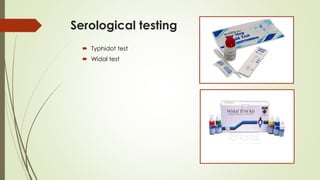
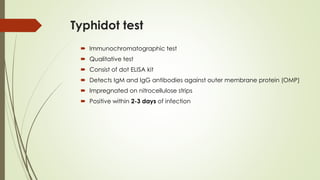
 Typhidot test
 Widal test
Typhidot test
 Immunochromatographic test
 Qualitative test
 Consist of dot ELISA kit
 Detects IgM and IgG antibodies against outer membrane protein (OMP)
 Impregnated on nitrocellulose strips
 Positive within 2-3 days of infection
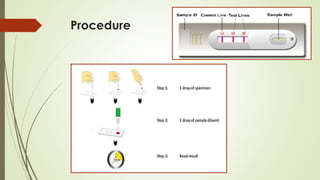
Procedure
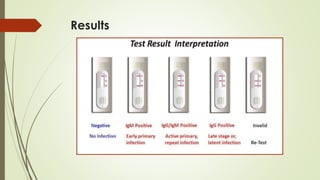
Results
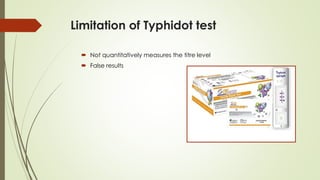
Limitation of Typhidot test
 Not quantitatively measures the titre level
 False results
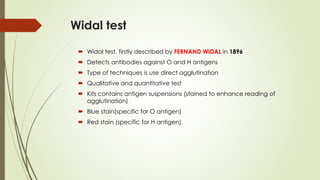
Widal test
 Widal test, firstly described by FERNAND WIDAL in 1896
 Detects antibodies against O and H antigens
 Type of techniques is use direct agglutination
 Qualitative and quantitative test
 Kits contains antigen suspensions (stained to enhance reading of
agglutination)
 Blue stain(specific for O antigen)
 Red stain (specific for H antigen)
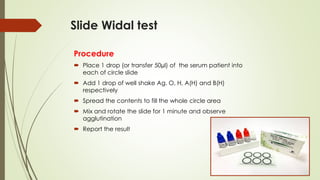
Slide Widal test
Procedure
 Place 1 drop (or transfer 50µl) of the serum patient into
each of circle slide
 Add 1 drop of well shake Ag. O, H, A(H) and B(H)
respectively
 Spread the contents to fill the whole circle area
 Mix and rotate the slide for 1 minute and observe
agglutination
 Report the result
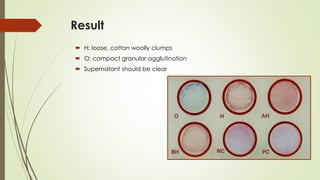
Result
 H: loose, cotton woolly clumps
 O: compact granular agglutination
 Supernatant should be clear
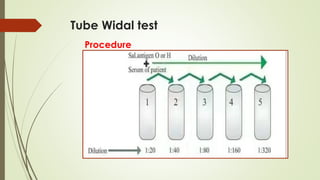
Tube Widal test
Procedure
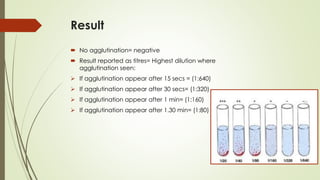
Result
 No agglutination= negative
 Result reported as titres= Highest dilution where
agglutination seen:
➢ If agglutination appear after 15 secs = (1:640)
➢ If agglutination appear after 30 secs= (1:320)
➢ If agglutination appear after 1 min= (1:160)
➢ If agglutination appear after 1.30 min= (1:80)
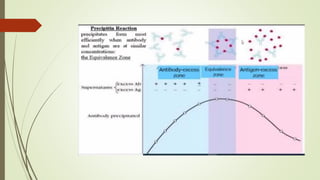
Zonal Phenomenon
 The phenomenon in which agglutination or
precipitation does not take place in zone having
excess of either antigen or antibody; maximum
precipitate or agglutinate when both the
reactants are in optimal proportion.
 Prezone or prozone
 Zone of equivalence
 Post zone
❑ Prezone or prozone
 The initial zone with no immune complexes is called as prezone or prozone.
❑ Zone of equivalence
 The middle zone with highest concentration of immune complexes is called
as zone of equivalence.
❑ Post zone
 The last zone with decreasing concentration of immune complexes is
called as post zone.
Kauffmann–White classification or scheme
 It classifies the genus Salmonella into serotypes, based on surface antigens.
 It use agglutination technique to classify them
 Philip Bruce white and fritz Kauffmann
 O antigen
 It is determined based on oligosaccharides associated with LPS
 H antigen
 It is determined based on flagellar proteins.
 Salmonella exhibit phase variation in case of H antigen
 H1 and H2
❑ Monophasic
➢ One H antigen express show either motile or non motile strain
❑ Diphasic
➢ Both H antigens express show always motile strain
❑ Lack of H antigen
➢ No H antigen express show always non motile strain
➢ Pathogenic strain such as S. typhi carry Vi antigen (capsular)
Topics
 Determine Immunogenic role of Salmonella O antigen
(LPS) helps in vaccine development against Typhoid fever
 Prevalence of multi-drug resistance Salmonella enterica in
raw chicken meat of Faisalabad region
2- Salmonella.pdf identification and isolation

2- Salmonella.pdf identification and isolation

  • 1.
    Isolation and Identificationof Salmonella Group # 02
  • 2.
    Group members  KainatGul 2019-ag-361  Sara Khan 2019-ag-3561  Hamna Nadeem 2019-ag-369  Tehzeeb Asghar 2019-ag-3585  Asma Mairaj 2014-ag-5512  Rimal Ayesha 2018-ag-1905  Muqadas Amin 2012-ag-2593  Asim Munir 2014-ag-3964  Inam Ur Rehman 2015-ag-6349  Ali Raza 2014-ag-4100
  • 4.
    Salmonella  Belongs tothe family Enterobacteriaceae.  Gram Negative  facultative anaerobic Rods  Motile (except S. gallinarum)  Peritrichous Flagella  Non-sporing and non-capsulated (except S. typhi) bacteria
  • 5.
    Classification  Genus salmonellacontains two species 1. S.enterica 2. S.bongori
  • 6.
    Salmonella enterica It containssix sub species:  Spp. Enterica  spp. Salaamae  spp. Arizonae  spp. Diarizonae  spp. houtenae  spp. Indica ➢ Within each species over 2500 serovers are presently known defferent on the basis of O and H antigen. ➢ Most of the human diseases are caused due to sub species S.enterica. ➢ Remaining serovars are zoonotic reffered to as non-typhoidal salmonella.
  • 7.
    Historical Aspect  Salmonellawas first discovered in 1884 by DANIEL ELMER SALMON, he isolated bacterium (S. choleraesuis) from intestine of a pig.  By 1980, more than 30, 000 people were reported to infected with salmonella in the US.  An estimated 1.4 million cases occur annually in the US, only 40, 000 are cultured-confirmed and reported to CDC (Centers for Disease Control).
  • 8.
    Virulence factors  ProduceEndotoxin (LPS)  3 types of antigen  O antigen (Somatic)  H antigen (Flagellar)  Vi antigen (Surface)
  • 9.
    In Humans  Salmonellacaused nontyphoidal and typhoidal infections in humans ➢ Non typhoidal infection  Self-limiting zoonotic infections such as food poisoning after ingestion of contaminated foods  Infection rate is more common in infants and children.
  • 10.
    ➢ Typhoidal infection Caused by Salmonella typhi and Para typhi A, B and C  Enteritis  Enteric fever (Typhoid fever)  Primary septicemia
  • 11.
    In Animals  Inanimals, asymptomatic Salmonella infections are common.  1-3% of domestic animals carry Salmonella spp.  Mostly affect young and lactating animals  Salmonella dublin causes dry gangrene and bone lesions in cattle  Septicemic Salmonella choleraesuis causes classical swine fever in pigs and other animals
  • 12.
    In Poultry ➢ Salmonellaenteritidis  Infect ovaries of hens and transmitted through eggs may result in human food poisoning ➢ Salmonella pullorum  Causes pullorum disease or bacillary white diarrhea  Infects young chicks and birds results in characteristic lesions includes white nodes throughout the lungs and focal necrosis of liver ➢ Salmonella gallinarum  Causes fowl typhoid in young chicks and birds  Characteristic findings include enlarged, friable, bile-stained liver and enlarged spleen
  • 14.
    Isolation of Salmonella Sampling: Contaminated food, vegetables, fruits, and eggs  Raw meat  Raw chicken meat  Humans (stool samples)
  • 15.
    Enrichment  Selenite cystinebroth or mannitol selenite broth used for enrichment ❑ Selenite cystine broth  It contains sodium selenite inhibits Gram positive and Gram negative bacteria other then salmonella  L-cystine is a reducing agent incorporated to enhance the recovery capacity of the medium.
  • 16.
    Selective media  SSAgar (Salmonella Shigella agar)  Selective and differential medium  Selective due to bile salts, brilliant green dye and sodium citrate which inhibits Gram positive organisms  Differential on the basis of lactose fermentation with neutral red indicator
  • 17.
     Lactose fermenter(red or pink color)  Non lactose fermenter (colorless)  Sodium thiosulfate utilize by salmonella on H2S production give black center, colonies have a ‘’cat eye’’ appearance Cat eye appearance
  • 18.
    DCA (Deoxycholate CitrateAgar)  Selective and differential medium  Selective due to sodium deoxycholate which inhibits Gram positive organisms  Differential on the basis of lactose fermentation with neutral red indicator  Ferric ammonium citrate FeS (iron suphide) Black center
  • 20.
    XLD (Xylose lysinedeoxycholate Agar)  Selective and differential medium  Selective due to sodium deoxycholate inhibits Gram positive organisms  Differential on the basis of Xylose fermentation with phenol red indicator
  • 21.
     Xylose fermenter(yellow colonies)  Xylose non fermenter (Red colonies)  After exhausting of xylose Salmonella decarboxylate Lysine yellow color change into red pH high (Alkaline) ➢ Sodium thiosulfate utilize by Salmonella give black center on H2S production
  • 22.
    Identification of Salmonella Staining Characteristics of Salmonella Staining type Characteristics Gram staining Pinkish rods (-ive rods) Flagellar staining Motile Spore staining Non sporing cell Capsule staining No capsule
  • 23.
  • 24.
  • 25.
    Biochemical tests Biochemic al tests Mostserotypes S. typhi S. paratyphi TSI Alk/A Alk/A Alk/A H2S + + + Indole - - - Methyl red + + + VP test - - - Citrate + - - Catalase + + + Oxidase - - - Urease - - - Lysine + + -
  • 26.
    TSI test (TripleSugar Iron test) Red slant H2S Yellow butt
  • 27.
    H2S test ❑ Principle This test used to determine the ability of bacteria to reduce sulfur into H2S  Some bacteria use enzyme cysteine desulfurase to hydrolyze amino acid cysteine into H2S  Other bacteria produce H2S by the reduction of inorganic sulfur compounds such as thiosulfates  Salmonella follow both pathways to reduce sulfur into H2S
  • 28.
    ❑ Media  SIMagar (Sulphide, indole and motility) with ferrous sulfate to detect H2S ❑ Results  Positive test: H2S production= Black color  Negative test: No H2S= No color
  • 29.
    Urease test ❑ Principle Used to determine the ability of organism to split urea by the action of enzyme urease  Urea hydrolyze into ammonia and carbon dioxide  Ammonia is base and elevates the pH  Indicator is phenol red  Salmonella is urease negative
  • 30.
    ❑ Media  Ureabroth is used ❑ Results  Positive test: Pink color= urease  Negative test: yellow color= no urease Urease positive Urease negative
  • 31.
    Citrate test ❑ Principle Some organisms use as carbon source Citrate Pyruvate CO2 + Na + Na2CO3 Alkaline pH ➢ Bromothymol blue indicator ➢ Most of the serotypes of salmonella is citrate positive citrase
  • 32.
    ❑ Media  Citrateagar ❑ Results  Citrate positive: Blue color  Citrate negative: Green color
  • 33.
  • 34.
  • 35.
    Typhidot test  Immunochromatographictest  Qualitative test  Consist of dot ELISA kit  Detects IgM and IgG antibodies against outer membrane protein (OMP)  Impregnated on nitrocellulose strips  Positive within 2-3 days of infection
  • 36.
  • 37.
  • 38.
    Limitation of Typhidottest  Not quantitatively measures the titre level  False results
  • 39.
    Widal test  Widaltest, firstly described by FERNAND WIDAL in 1896  Detects antibodies against O and H antigens  Type of techniques is use direct agglutination  Qualitative and quantitative test  Kits contains antigen suspensions (stained to enhance reading of agglutination)  Blue stain(specific for O antigen)  Red stain (specific for H antigen)
  • 40.
    Slide Widal test Procedure Place 1 drop (or transfer 50µl) of the serum patient into each of circle slide  Add 1 drop of well shake Ag. O, H, A(H) and B(H) respectively  Spread the contents to fill the whole circle area  Mix and rotate the slide for 1 minute and observe agglutination  Report the result
  • 41.
    Result  H: loose,cotton woolly clumps  O: compact granular agglutination  Supernatant should be clear
  • 42.
  • 43.
    Result  No agglutination=negative  Result reported as titres= Highest dilution where agglutination seen: ➢ If agglutination appear after 15 secs = (1:640) ➢ If agglutination appear after 30 secs= (1:320) ➢ If agglutination appear after 1 min= (1:160) ➢ If agglutination appear after 1.30 min= (1:80)
  • 44.
    Zonal Phenomenon  Thephenomenon in which agglutination or precipitation does not take place in zone having excess of either antigen or antibody; maximum precipitate or agglutinate when both the reactants are in optimal proportion.  Prezone or prozone  Zone of equivalence  Post zone
  • 45.
    ❑ Prezone orprozone  The initial zone with no immune complexes is called as prezone or prozone. ❑ Zone of equivalence  The middle zone with highest concentration of immune complexes is called as zone of equivalence. ❑ Post zone  The last zone with decreasing concentration of immune complexes is called as post zone.
  • 47.
    Kauffmann–White classification orscheme  It classifies the genus Salmonella into serotypes, based on surface antigens.  It use agglutination technique to classify them  Philip Bruce white and fritz Kauffmann  O antigen  It is determined based on oligosaccharides associated with LPS  H antigen  It is determined based on flagellar proteins.
  • 48.
     Salmonella exhibitphase variation in case of H antigen  H1 and H2 ❑ Monophasic ➢ One H antigen express show either motile or non motile strain ❑ Diphasic ➢ Both H antigens express show always motile strain ❑ Lack of H antigen ➢ No H antigen express show always non motile strain ➢ Pathogenic strain such as S. typhi carry Vi antigen (capsular)
  • 49.
    Topics  Determine Immunogenicrole of Salmonella O antigen (LPS) helps in vaccine development against Typhoid fever  Prevalence of multi-drug resistance Salmonella enterica in raw chicken meat of Faisalabad region