DONE BY :
Proteus
• Member of enterobacteriaceae
• Gram negative bacteria
• Short bacilli
• Motile they have penitrichous flagella
• Non capsulated
• Non spore forming
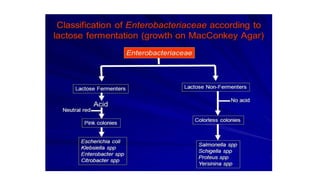
• Non-lactose fermenting
• Fishy odor
•Proteus species are most
commonly found in the human
intestinal tract as part of
normal human intestinal flora
but it becomes pathogenic when
it leaves the intestinal tract
especially when it become in
contact with urea in the urinary
tract.
Main Species of Medical
Importance:
• P.mirabilis causes urinary tract infections (UIT)
• P.vulgaris causes nosocomial infections
=> produces urease resulting in rapid hydrolysis of urea with
liberation of ammonia . Thus, in urinary tract infections with
Proteus, the urine becomes alkaline ,promoting stone
formation.
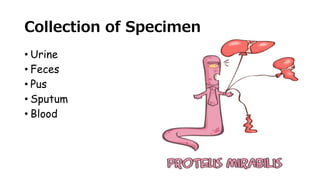
Collection of Specimen
• Urine
• Feces
• Pus
• Sputum
• Blood
Symptoms of Proteus Infection
• Urethritis
• Cystitis
These symptoms may or may not be present
• Pyelonephritis can be considered a progression of disease &
symptoms are therefore more profound
Symptoms of pyelonephritis include :
flank pain , nausea & vomiting ,fever , costo vertebral angle
tenderness, hematuria & pyuria are frequently encountered.
Culture characteristic
Blood Agar
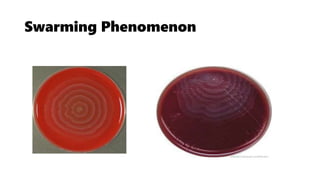
P.mirabilis and P.vulgaris => does not form distinctive
colonies on blood agar ,instead the bacteria swarm across the
surface of the agar
Swarming is described as the formation of concentric zones of
bacterial growth , able to cover the whole surface of solid culture
medium as a consequence of the organisms active motility
Swarming Phenomenon
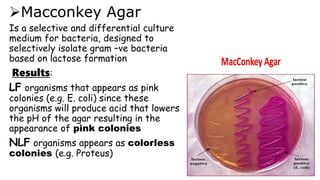
Macconkey Agar
Is a selective and differential culture
medium for bacteria, designed to
selectively isolate gram –ve bacteria
based on lactose formation
Results:
LF organisms that appears as pink
colonies (e.g. E. coli) since these
organisms will produce acid that lowers
the pH of the agar resulting in the
appearance of pink colonies
NLF organisms appears as colorless
colonies (e.g. Proteus)
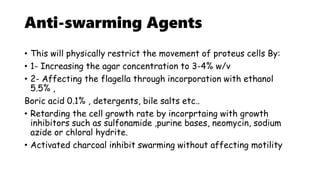
Anti-swarming Agents
• This will physically restrict the movement of proteus cells By:
• 1- Increasing the agar concentration to 3-4% w/v
• 2- Affecting the flagella through incorporation with ethanol
5.5% ,
Boric acid 0.1% , detergents, bile salts etc..
• Retarding the cell growth rate by incorprtaing with growth
inhibitors such as sulfonamide ,purine bases, neomycin, sodium
azide or chloral hydrite.
• Activated charcoal inhibit swarming without affecting motility
Biochemical Tests
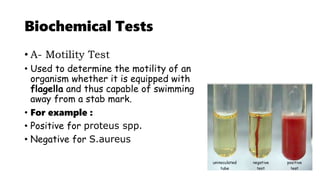
• A- Motility Test
• Used to determine the motility of an
organism whether it is equipped with
flagella and thus capable of swimming
away from a stab mark.
• For example :
• Positive for proteus spp.
• Negative for S.aureus
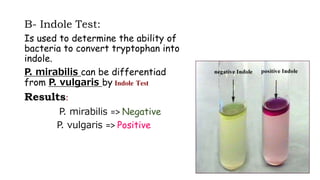
B- Indole Test:
Is used to determine the ability of
bacteria to convert tryptophan into
indole.
P. mirabilis can be differentiad
from P. vulgaris by Indole Test
Results:
P. mirabilis => Negative
P. vulgaris => Positive
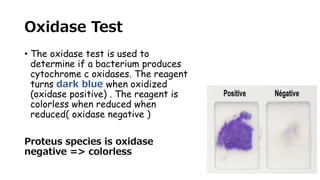
Oxidase Test
• The oxidase test is used to
determine if a bacterium produces
cytochrome c oxidases. The reagent
turns dark blue when oxidized
(oxidase positive) . The reagent is
colorless when reduced when
reduced( oxidase negative )
Proteus species is oxidase
negative => colorless
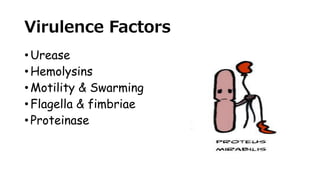
Virulence Factors
• Urease
• Hemolysins
• Motility & Swarming
• Flagella & fimbriae
• Proteinase
1.Urease
• Is a critical virulence determinant for colonization of the urinary
tract ,stone formation & the development of acute pyelonephritis
• Urease –induced formation of ammonia protects the bacterial
cell from the effects of complements
2. Fimbriae
• Also play a significant role in virulence for the urinary
tract also have a role in the colonization of the upper
part of the urinary tract
• Their presence correlates with the development of
acute pyelonephritis
3.Hemolysins
• Also known to be important virulence factor of proteus spp.
• Both HpmA & HlyA are cytotoxic for a wide variety of cell
types , together with urease they play an important role
in cell invasion & internalization
• Hemolysins and urease are expressed at higher levels in P.
mirabilis than in P.vulgaris => this may be the explanation for
the greater virulence o.f P.mirabilis
4. Proteinase
• Play a role in :
a-Degrading antibacterial peptides in the innate
defense system
b-Generating products like glutamine to induce
invasive swarm cell
Pathophysiology
• The first step in the infectious
process is adherence of the microbe to
host tissue. Fimbriae facilitate
adherence and thus enhance the
capacity of the organism to produce
disease.
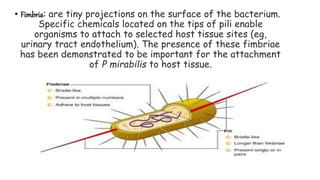
• Fimbria: are tiny projections on the surface of the bacterium.
Specific chemicals located on the tips of pili enable
organisms to attach to selected host tissue sites (eg,
urinary tract endothelium). The presence of these fimbriae
has been demonstrated to be important for the attachment
of P mirabilis to host tissue.
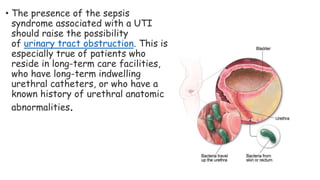
• The presence of the sepsis
syndrome associated with a UTI
should raise the possibility
of urinary tract obstruction. This is
especially true of patients who
reside in long-term care facilities,
who have long-term indwelling
urethral catheters, or who have a
known history of urethral anatomic
abnormalities.
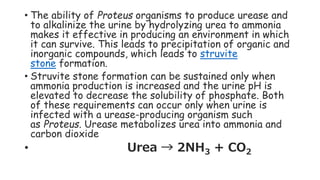
• The ability of Proteus organisms to produce urease and
to alkalinize the urine by hydrolyzing urea to ammonia
makes it effective in producing an environment in which
it can survive. This leads to precipitation of organic and
inorganic compounds, which leads to struvite
stone formation.
• Struvite stone formation can be sustained only when
ammonia production is increased and the urine pH is
elevated to decrease the solubility of phosphate. Both
of these requirements can occur only when urine is
infected with a urease-producing organism such
as Proteus. Urease metabolizes urea into ammonia and
carbon dioxide
• Urea → 2NH3 + CO2
Proteus mirabilis Resistance
• P. Mirabilis
is resistant to Nitrofurantoin & tetracyclines
but very susceptible to all beta-lactame
except penicillin G &oxacillin ,
aminoglycoside , ceftriaxone
,fluoroquinolones , & trimethoprim-
sulfamethoxazole etc…
Drug resistance has been increasingly
reported for this species. This increased
resistance to anti-microbial agents has lead
not only to a changes in anti-microbial
therapies but also to poor prognosis &
increase in the mortality of hospitalized
patients.
Treatment
• Bacteria is sensitive to these
antibiotics : beta-lactame except
penicillin G & oxacillin ,
aminoglycoside , ceftriaxone ,
fluoroquinolones , & trimethoprim-
sulfamethoxazole that can be used
as a treatment for most proteus
infection.

PROTEUS MIRABILIS slideshare presentation

  • 2.
  • 3.
    Proteus • Member ofenterobacteriaceae • Gram negative bacteria • Short bacilli • Motile they have penitrichous flagella • Non capsulated • Non spore forming • Non-lactose fermenting • Fishy odor
  • 4.
    •Proteus species aremost commonly found in the human intestinal tract as part of normal human intestinal flora but it becomes pathogenic when it leaves the intestinal tract especially when it become in contact with urea in the urinary tract.
  • 5.
    Main Species ofMedical Importance: • P.mirabilis causes urinary tract infections (UIT) • P.vulgaris causes nosocomial infections => produces urease resulting in rapid hydrolysis of urea with liberation of ammonia . Thus, in urinary tract infections with Proteus, the urine becomes alkaline ,promoting stone formation.
  • 6.
    Collection of Specimen •Urine • Feces • Pus • Sputum • Blood
  • 7.
    Symptoms of ProteusInfection • Urethritis • Cystitis These symptoms may or may not be present • Pyelonephritis can be considered a progression of disease & symptoms are therefore more profound Symptoms of pyelonephritis include : flank pain , nausea & vomiting ,fever , costo vertebral angle tenderness, hematuria & pyuria are frequently encountered.
  • 8.
    Culture characteristic Blood Agar P.mirabilisand P.vulgaris => does not form distinctive colonies on blood agar ,instead the bacteria swarm across the surface of the agar Swarming is described as the formation of concentric zones of bacterial growth , able to cover the whole surface of solid culture medium as a consequence of the organisms active motility
  • 9.
  • 10.
    Macconkey Agar Is aselective and differential culture medium for bacteria, designed to selectively isolate gram –ve bacteria based on lactose formation Results: LF organisms that appears as pink colonies (e.g. E. coli) since these organisms will produce acid that lowers the pH of the agar resulting in the appearance of pink colonies NLF organisms appears as colorless colonies (e.g. Proteus)
  • 12.
    Anti-swarming Agents • Thiswill physically restrict the movement of proteus cells By: • 1- Increasing the agar concentration to 3-4% w/v • 2- Affecting the flagella through incorporation with ethanol 5.5% , Boric acid 0.1% , detergents, bile salts etc.. • Retarding the cell growth rate by incorprtaing with growth inhibitors such as sulfonamide ,purine bases, neomycin, sodium azide or chloral hydrite. • Activated charcoal inhibit swarming without affecting motility
  • 13.
    Biochemical Tests • A-Motility Test • Used to determine the motility of an organism whether it is equipped with flagella and thus capable of swimming away from a stab mark. • For example : • Positive for proteus spp. • Negative for S.aureus
  • 14.
    B- Indole Test: Isused to determine the ability of bacteria to convert tryptophan into indole. P. mirabilis can be differentiad from P. vulgaris by Indole Test Results: P. mirabilis => Negative P. vulgaris => Positive
  • 15.
    Oxidase Test • Theoxidase test is used to determine if a bacterium produces cytochrome c oxidases. The reagent turns dark blue when oxidized (oxidase positive) . The reagent is colorless when reduced when reduced( oxidase negative ) Proteus species is oxidase negative => colorless
  • 16.
    Virulence Factors • Urease •Hemolysins • Motility & Swarming • Flagella & fimbriae • Proteinase
  • 17.
    1.Urease • Is acritical virulence determinant for colonization of the urinary tract ,stone formation & the development of acute pyelonephritis • Urease –induced formation of ammonia protects the bacterial cell from the effects of complements 2. Fimbriae • Also play a significant role in virulence for the urinary tract also have a role in the colonization of the upper part of the urinary tract • Their presence correlates with the development of acute pyelonephritis
  • 18.
    3.Hemolysins • Also knownto be important virulence factor of proteus spp. • Both HpmA & HlyA are cytotoxic for a wide variety of cell types , together with urease they play an important role in cell invasion & internalization • Hemolysins and urease are expressed at higher levels in P. mirabilis than in P.vulgaris => this may be the explanation for the greater virulence o.f P.mirabilis
  • 19.
    4. Proteinase • Playa role in : a-Degrading antibacterial peptides in the innate defense system b-Generating products like glutamine to induce invasive swarm cell
  • 21.
    Pathophysiology • The firststep in the infectious process is adherence of the microbe to host tissue. Fimbriae facilitate adherence and thus enhance the capacity of the organism to produce disease.
  • 22.
    • Fimbria: aretiny projections on the surface of the bacterium. Specific chemicals located on the tips of pili enable organisms to attach to selected host tissue sites (eg, urinary tract endothelium). The presence of these fimbriae has been demonstrated to be important for the attachment of P mirabilis to host tissue.
  • 23.
    • The presenceof the sepsis syndrome associated with a UTI should raise the possibility of urinary tract obstruction. This is especially true of patients who reside in long-term care facilities, who have long-term indwelling urethral catheters, or who have a known history of urethral anatomic abnormalities.
  • 24.
    • The abilityof Proteus organisms to produce urease and to alkalinize the urine by hydrolyzing urea to ammonia makes it effective in producing an environment in which it can survive. This leads to precipitation of organic and inorganic compounds, which leads to struvite stone formation. • Struvite stone formation can be sustained only when ammonia production is increased and the urine pH is elevated to decrease the solubility of phosphate. Both of these requirements can occur only when urine is infected with a urease-producing organism such as Proteus. Urease metabolizes urea into ammonia and carbon dioxide • Urea → 2NH3 + CO2
  • 25.
    Proteus mirabilis Resistance •P. Mirabilis is resistant to Nitrofurantoin & tetracyclines but very susceptible to all beta-lactame except penicillin G &oxacillin , aminoglycoside , ceftriaxone ,fluoroquinolones , & trimethoprim- sulfamethoxazole etc… Drug resistance has been increasingly reported for this species. This increased resistance to anti-microbial agents has lead not only to a changes in anti-microbial therapies but also to poor prognosis & increase in the mortality of hospitalized patients.
  • 26.
    Treatment • Bacteria issensitive to these antibiotics : beta-lactame except penicillin G & oxacillin , aminoglycoside , ceftriaxone , fluoroquinolones , & trimethoprim- sulfamethoxazole that can be used as a treatment for most proteus infection.