Salmonella
Shyam Kumar Mishra
1
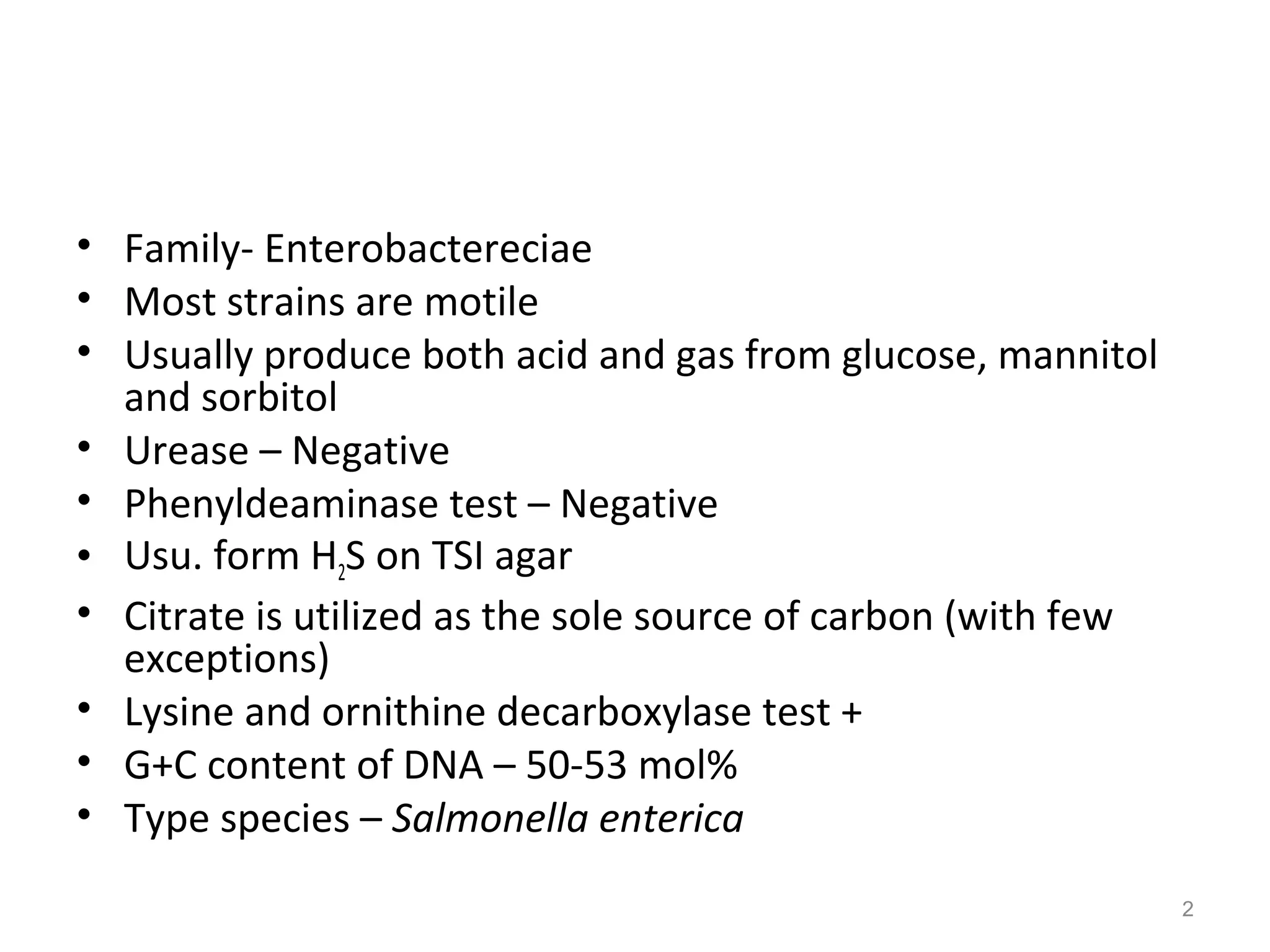
• Family- Enterobactereciae
• Most strains are motile
• Usually produce both acid and gas from glucose, mannitol
and sorbitol
• Urease – Negative
• Phenyldeaminase test – Negative
• Usu. form H2S on TSI agar
• Citrate is utilized as the sole source of carbon (with few
exceptions)
• Lysine and ornithine decarboxylase test +
• G+C content of DNA – 50-53 mol%
• Type species – Salmonella enterica
2
2 species
• S. enterica
– 6 subspecies
• enterica-------------- >2500 serotypes (at least 2541)
• salamae
• arizonae
• diarizonae
• houtenae
• indica
• S. bongori
3
Morphology of Salmonella
• Gram negative
bacilli
• 1-3 x 0.5 micron,
• Motile by
peritrichous
flagella
4
Cultural Characters
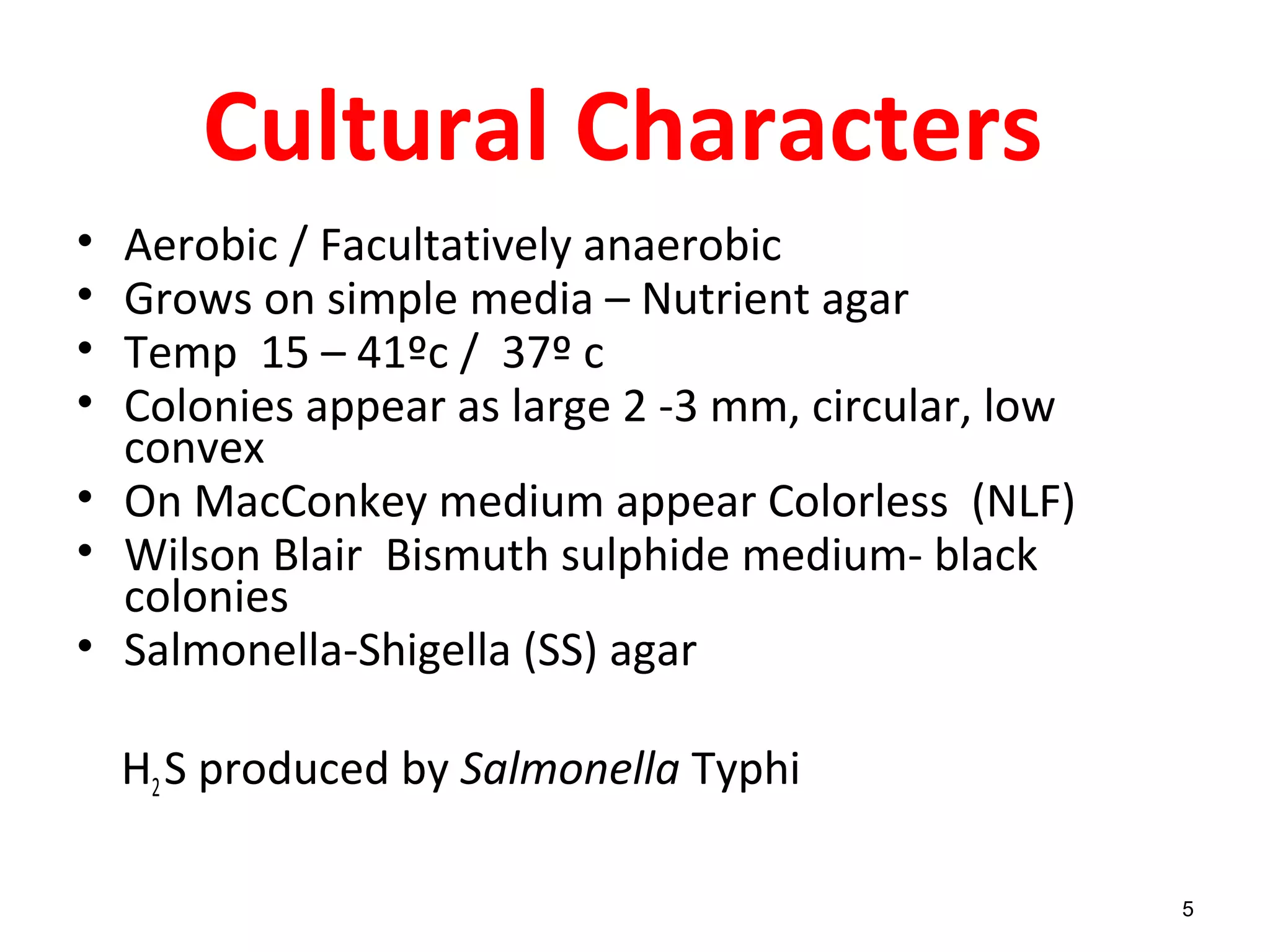
• Aerobic / Facultatively anaerobic
• Grows on simple media – Nutrient agar
• Temp 15 – 41ºc / 37º c
• Colonies appear as large 2 -3 mm, circular, low
convex
• On MacConkey medium appear Colorless (NLF)
• Wilson Blair Bismuth sulphide medium- black
colonies
• Salmonella-Shigella (SS) agar
H2S produced by Salmonella Typhi
5
Salmonella on XLD agar
6
Enrichment Medium
Liquid Medium
• Selenite F medium
• Tetrathionate broth
–Particularly stool specimens..
7
Biochemical Characters
• Glucose, Mannitol, Maltose produce A/G
(Salmonella Typhi do not produce gas)
• Lactose/Salicin/sucrose not fermented.
• Indole –
• Methyl Red +
• V P -
• Citrate + (S. Typhi -)
• Urea –
• H2S – produced by S. Typhi
(Paratyphi A do not produce H2S)
8
S. Typhi Biochemical reaction
9
Antigenic structure of Salmonella
• Somatic or 0 Antigens - Granular deposit (Felix tube)
• Flagellar or H Antigens - Loose and cotton-woolly
clumps (Dreyer’s tube)
10
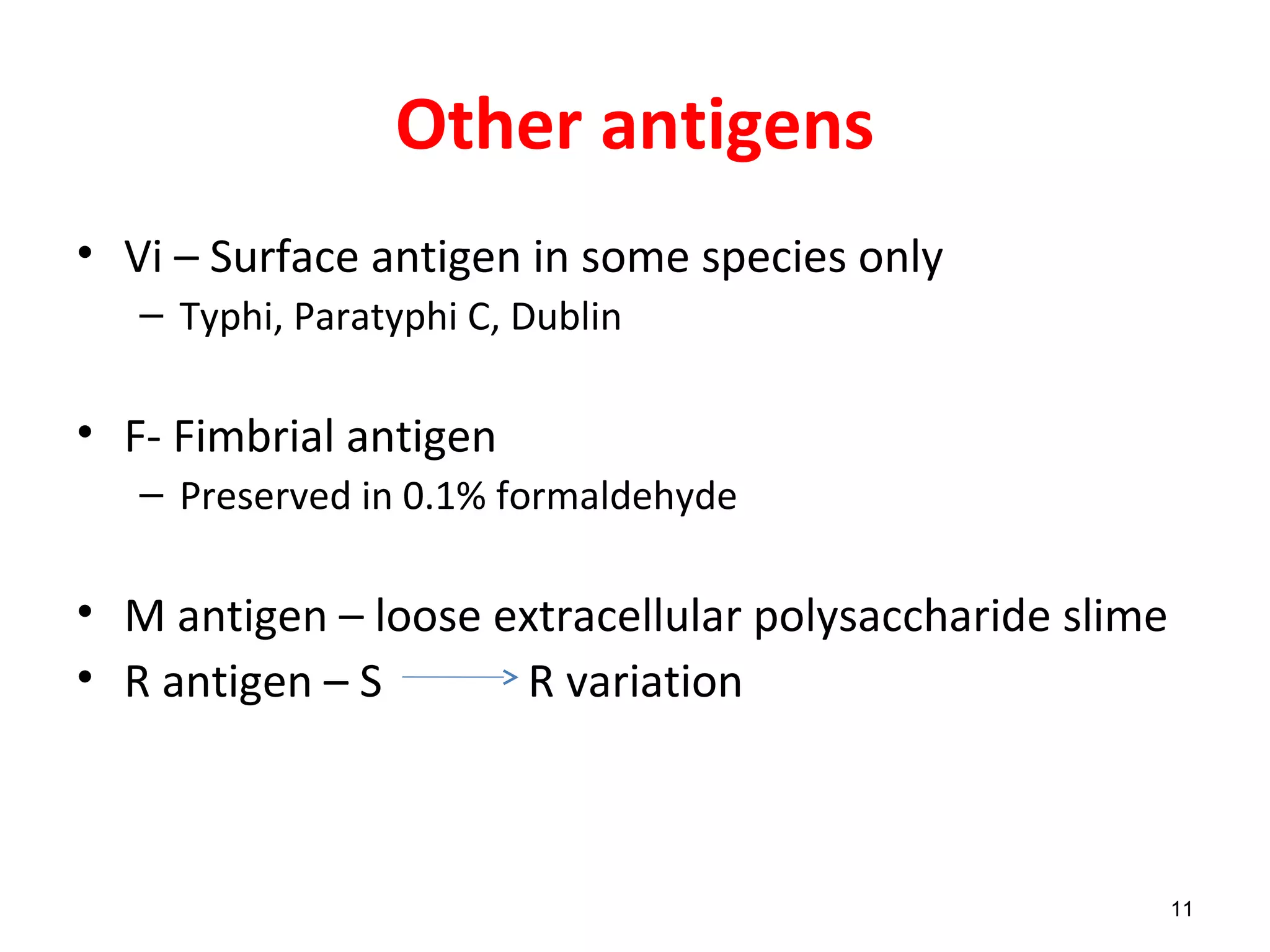
Other antigens
• Vi – Surface antigen in some species only
– Typhi, Paratyphi C, Dublin
• F- Fimbrial antigen
– Preserved in 0.1% formaldehyde
• M antigen – loose extracellular polysaccharide slime
• R antigen – S R variation
11
Kauffmann – White scheme
• Serotype 0 antigens H antigens
Phase 1 2
Typhi 9,12[Vi] d -
Paratyphi A 1,2,12 a [1,5]
12
Antigenic Variation in
Salmonella
• H O variation
• Phase variation
• V W variation
• S R variation
• Variations in O antigen
13
Virulence factors
• Fimbriae
• Salmonella pathogenicity island (Spi) and Type III
secretion system
• Endotoxin
• Invasins
• Virulence antigen (Vi)
• Acid tolerance response (ATR) gene
• Plasmid
• Property of lysogenic conversion
14
Salient features of Salmonella
• Intracellular multiplication
• Resistance to bile
• Produces endotoxin
15
Salmonellosis
• S. Typhi.
• S. Paratyphi A, B and C
• Other salmonellae
Important clinical syndromes :
Enteric fever, Septicemias, gastroenteritis.
16
Enteric Fever
Typhoid
• Typhoid – caused by S. Typhi
• Paratyphoid Caused by
Paratyphi A,B,C
• Infective dose ID50 / 107
17
Pathology and Pathogenesis
18
• Bacilli enter through
ingestion,
• Bacilli attach to microvilli,
ileal mucosa, penetrate to
lamina propria and sub
mucosa
• Phagocytosis by
Polymorphs and
Macrophages
• Enters the mesenteric
lymph nodes
• Enter the thoracic duct –
Blood stream
19
20
Ingestion of
salmonella
Small
intestine
Mesenteric
LNs
Transient
bacteremia
Multiplication in
macrophages in
liver, spleen and
BM
Gall
bladder
Signs and
symptoms
Bile
Lym
phatics
Thoracic
duct
Bile
Septicaemia
Cholecystitis,
Carrier state
Inflammation and
ulceration of
Peyer’s patches
Diarrhoea,
hemorrhage,
perforation
Incubation
period
Pathology and Pathogenesis
• Bacteremia Spread to Liver, Gall
bladder, Spleen, Bone marrow,
Lymph nodes, Lungs, Multiply in
kidneys
Once again spill into Blood stream
Causes clinical illness.
21
Pathology and Pathogenesis
• Multiply abundantly in Gall bladder,
• Bile rich source of Bacteria
• Spill into Intestine, infects peyers patches,
Lymph follicles
• Inflammation – Undergo necrosis, Slough off
• Typhoid ulcers
• Typhoid ulcers can cause perforation and
hemorrhage
• Duration of Illness 3 – 4 weeks
• Incubation 7 -14, ( 3-56 days )
22
Clinical manifestation
• Headache, malaise, anorexia, coated tongue
• Abdominal discomfort,
• Constipation / Diarrhea
• Step ladder type fever,
• Relative bradycardia,
• A soft palpable spleen
• Hepatomegaly
• Rose spots appear
23
Complications of Enteric fever
• Intestinal perforation,
• Hemorrhage,
• Circulatory collapse.
• Bronchitis Bronchopneumonia,
• Meningitis,
• Cholecystitis,
• Arthritis, Periostitis, Nephritis,
• Osteomyelitis
24
Epidemiology
• Source an active patient or a Carrier shed the
Bacilli.
• Convalescent carrier - 3 weeks to 3 months
Temporary carrier - 3 months to 1 year
Chronic carrier > 1 year
25
Typhoid Mary
• A famous example is
“Typhoid Mary” (Mary
Mallon), who was a
food handler
responsible for several
typhoid outbreaks
26
Laboratory Diagnosis of
Typhoid Fever
• Isolation of Bacilli (Gold standard)
• 1st
Week – Rose spot, Blood culture, Bone marrow
culture
• 2nd
Week – Widal test
• 3rd
Week – Stool culture
• 4th
Week –Urine culture
27
Blood Cultures in Typhoid FeversBlood Cultures in Typhoid Fevers
• Bacteremia occurs early
in the disease
• Blood Cultures are
positive in
1st
week in 90%
2nd
week in 75%
3rd
week in 60%
4th
week and later in 25%
28
• Draw 5 – 10 cc of Blood by venipuncture.
• Add to 50 -100 ml of Bile broth.
• Incubate at 37 c /Subculture in MacConkey at regular intervals
Castaneda’s method of
Blood Culture
• Double medium used Solid/Liquid medium in
the same Bottle.
• Bottle contains Bile broth/agar slant,
• Reduces the chances of contamination
• Increases the chances of isolation.
29
Salmonella on Mac Conkey's agar
30
Clot culture
• Clot cultures are more
productive in yielding
better results in
isolation.
• A blood after clotting,
the clot is lysed with
Streptokinase ,but
expensive to perform
in developing
countries.
31
Bactek and Radiometric based methods
are in recent use
• Bactec methods in
isolation of Salmonella
is a rapid and sensitive
method in early
diagnosis of Enteric
fever.
32
Biochemical Characters
• ??????
33
Slide agglutination tests
• In slide agglutination
tests a known serum
and unknown culture
isolate is mixed,
clumping occurs within
few minutes
• Polyvalent – To know
whether it is salmonella
or not
34
• Monovalent sera- To identify the serotype of Salmonella
Culturing other Specimens
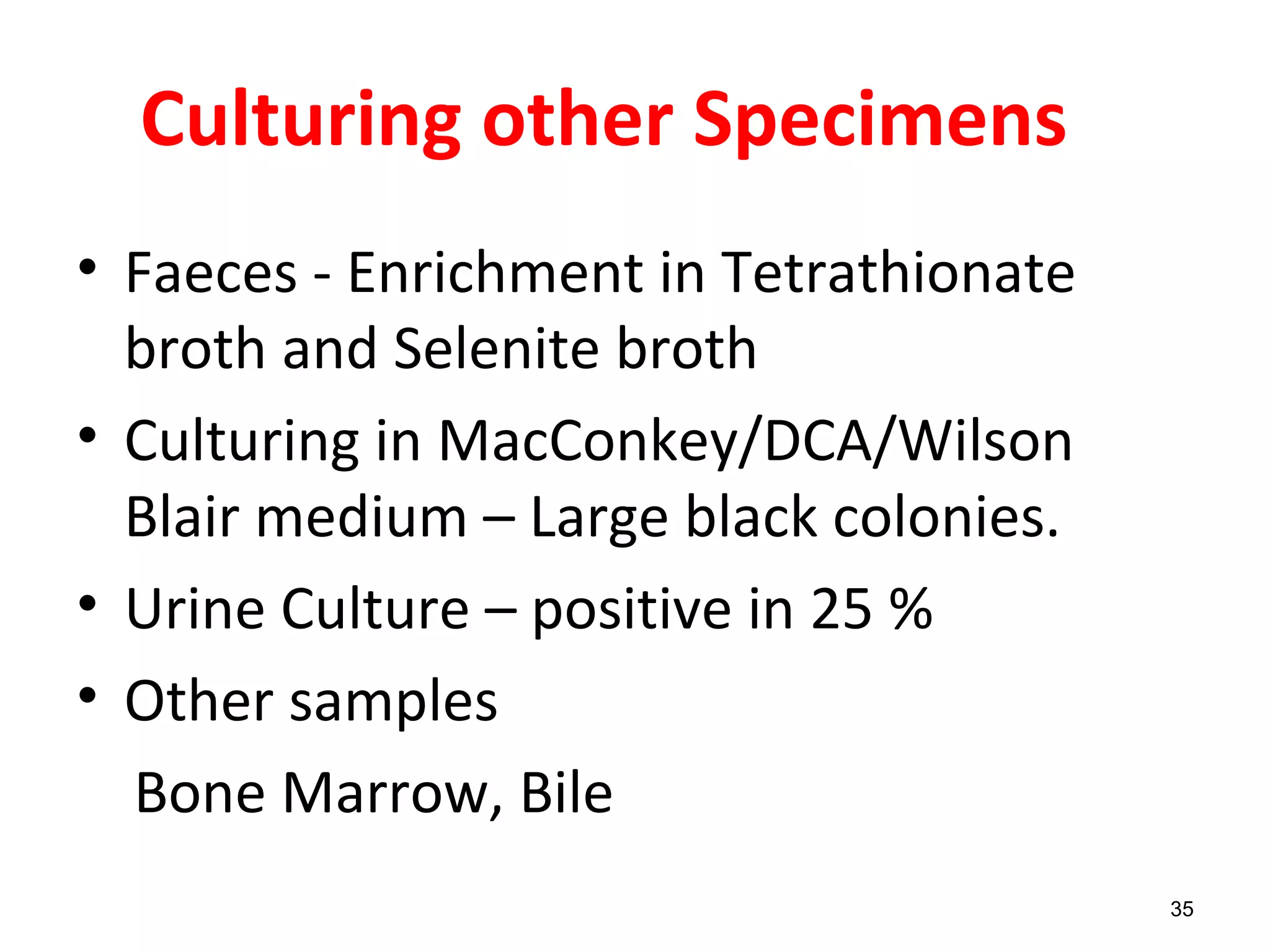
• Faeces - Enrichment in Tetrathionate
broth and Selenite broth
• Culturing in MacConkey/DCA/Wilson
Blair medium – Large black colonies.
• Urine Culture – positive in 25 %
• Other samples
Bone Marrow, Bile
35
Serology
• WIDAL Test –(Tube agglutination test)
• Detects O and H antibodies
• Diagnosis of Typhoid and Paratyphoid
• Testing for H agglutinins in Dreyers tubes, a
narrow tube floccules at the bottom
• Testing for O agglutinins in Felix tubes, Chalky
• Incubated at 37º c overnight
36
Widal test (Tile method)
Significance
• 1st week negative.
• Titers rise in 2nd week.
• Rise of titers diagnostic
• Single test not diagnostic.
• Paired samples tests
• Diagnostic.
O > 1 in 80
H > 1in 160
H agglutinins appear first (H
antigen is highly
immunogenic) 37
Limitation of Widal Test
• The Widal test is time
consuming (Tube
method)
• Anamnestic reaction
38
Diagnosis of Carriers and
Environments
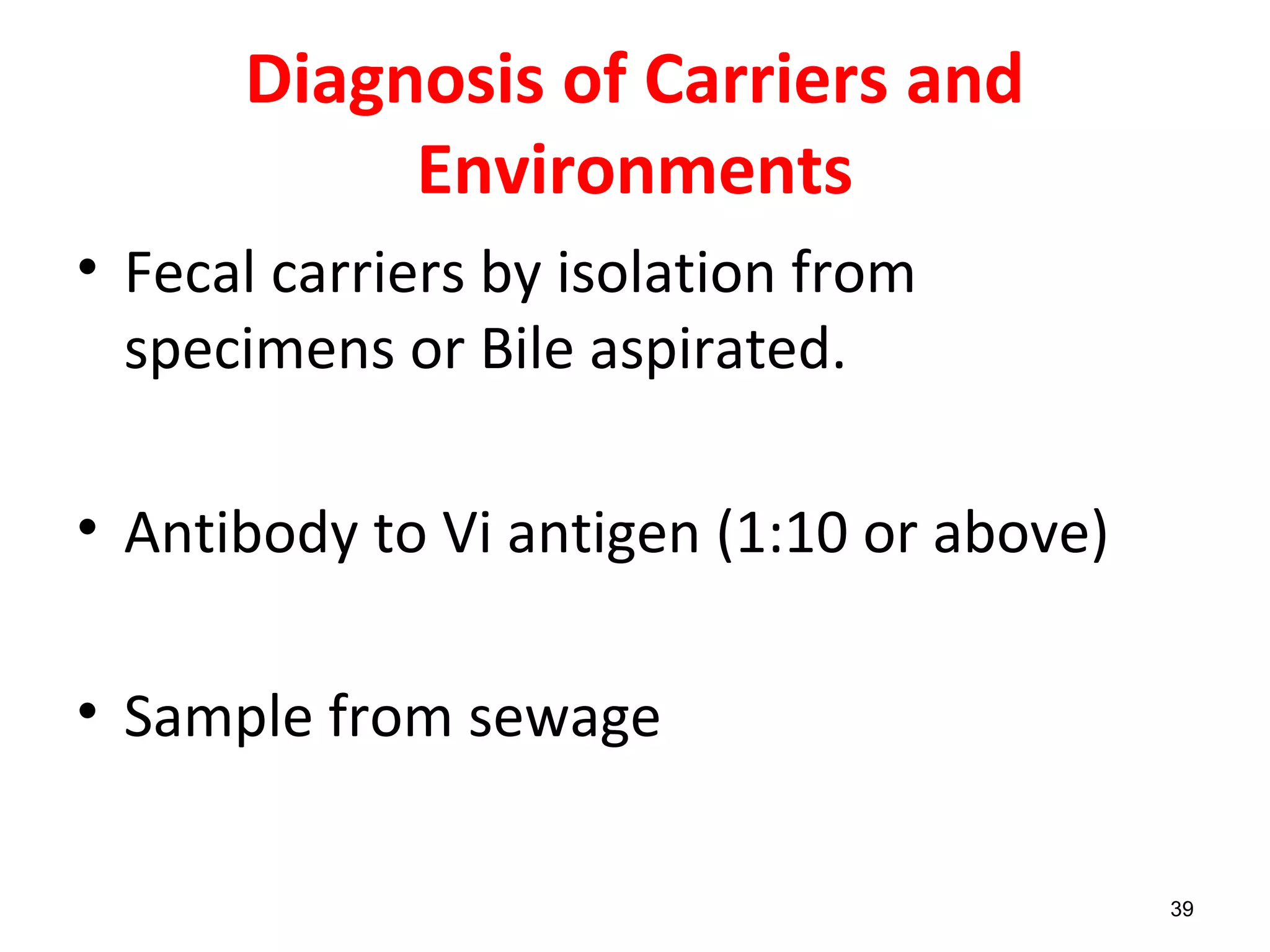
• Fecal carriers by isolation from
specimens or Bile aspirated.
• Antibody to Vi antigen (1:10 or above)
• Sample from sewage
39
Vaccines
• TAB vaccine
S. Typhi 1,000 millions
S Paratyphi A,B 750 millions.
Injected subcutaneously 0.5 ml at 4 – 6 weeks.
• Live oral (Ty2 1a) typhoid vaccine
• Purified Vi polysaccharide vaccine (Vi CPS)
40
Treatment
• Chloramphenicol
• Ampicillin
• Cotrimoxazole
• Fluoroquinolones
• Ceftriaxone
• Azithromycin
41
THANK YOU
42

Salmonella basics

  • 1.
  • 2.
    • Family- Enterobactereciae •Most strains are motile • Usually produce both acid and gas from glucose, mannitol and sorbitol • Urease – Negative • Phenyldeaminase test – Negative • Usu. form H2S on TSI agar • Citrate is utilized as the sole source of carbon (with few exceptions) • Lysine and ornithine decarboxylase test + • G+C content of DNA – 50-53 mol% • Type species – Salmonella enterica 2
  • 3.
    2 species • S.enterica – 6 subspecies • enterica-------------- >2500 serotypes (at least 2541) • salamae • arizonae • diarizonae • houtenae • indica • S. bongori 3
  • 4.
    Morphology of Salmonella •Gram negative bacilli • 1-3 x 0.5 micron, • Motile by peritrichous flagella 4
  • 5.
    Cultural Characters • Aerobic/ Facultatively anaerobic • Grows on simple media – Nutrient agar • Temp 15 – 41ºc / 37º c • Colonies appear as large 2 -3 mm, circular, low convex • On MacConkey medium appear Colorless (NLF) • Wilson Blair Bismuth sulphide medium- black colonies • Salmonella-Shigella (SS) agar H2S produced by Salmonella Typhi 5
  • 6.
  • 7.
    Enrichment Medium Liquid Medium •Selenite F medium • Tetrathionate broth –Particularly stool specimens.. 7
  • 8.
    Biochemical Characters • Glucose,Mannitol, Maltose produce A/G (Salmonella Typhi do not produce gas) • Lactose/Salicin/sucrose not fermented. • Indole – • Methyl Red + • V P - • Citrate + (S. Typhi -) • Urea – • H2S – produced by S. Typhi (Paratyphi A do not produce H2S) 8
  • 9.
  • 10.
    Antigenic structure ofSalmonella • Somatic or 0 Antigens - Granular deposit (Felix tube) • Flagellar or H Antigens - Loose and cotton-woolly clumps (Dreyer’s tube) 10
  • 11.
    Other antigens • Vi– Surface antigen in some species only – Typhi, Paratyphi C, Dublin • F- Fimbrial antigen – Preserved in 0.1% formaldehyde • M antigen – loose extracellular polysaccharide slime • R antigen – S R variation 11
  • 12.
    Kauffmann – Whitescheme • Serotype 0 antigens H antigens Phase 1 2 Typhi 9,12[Vi] d - Paratyphi A 1,2,12 a [1,5] 12
  • 13.
    Antigenic Variation in Salmonella •H O variation • Phase variation • V W variation • S R variation • Variations in O antigen 13
  • 14.
    Virulence factors • Fimbriae •Salmonella pathogenicity island (Spi) and Type III secretion system • Endotoxin • Invasins • Virulence antigen (Vi) • Acid tolerance response (ATR) gene • Plasmid • Property of lysogenic conversion 14
  • 15.
    Salient features ofSalmonella • Intracellular multiplication • Resistance to bile • Produces endotoxin 15
  • 16.
    Salmonellosis • S. Typhi. •S. Paratyphi A, B and C • Other salmonellae Important clinical syndromes : Enteric fever, Septicemias, gastroenteritis. 16
  • 17.
    Enteric Fever Typhoid • Typhoid– caused by S. Typhi • Paratyphoid Caused by Paratyphi A,B,C • Infective dose ID50 / 107 17
  • 18.
    Pathology and Pathogenesis 18 •Bacilli enter through ingestion, • Bacilli attach to microvilli, ileal mucosa, penetrate to lamina propria and sub mucosa • Phagocytosis by Polymorphs and Macrophages • Enters the mesenteric lymph nodes • Enter the thoracic duct – Blood stream
  • 19.
  • 20.
    20 Ingestion of salmonella Small intestine Mesenteric LNs Transient bacteremia Multiplication in macrophagesin liver, spleen and BM Gall bladder Signs and symptoms Bile Lym phatics Thoracic duct Bile Septicaemia Cholecystitis, Carrier state Inflammation and ulceration of Peyer’s patches Diarrhoea, hemorrhage, perforation Incubation period
  • 21.
    Pathology and Pathogenesis •Bacteremia Spread to Liver, Gall bladder, Spleen, Bone marrow, Lymph nodes, Lungs, Multiply in kidneys Once again spill into Blood stream Causes clinical illness. 21
  • 22.
    Pathology and Pathogenesis •Multiply abundantly in Gall bladder, • Bile rich source of Bacteria • Spill into Intestine, infects peyers patches, Lymph follicles • Inflammation – Undergo necrosis, Slough off • Typhoid ulcers • Typhoid ulcers can cause perforation and hemorrhage • Duration of Illness 3 – 4 weeks • Incubation 7 -14, ( 3-56 days ) 22
  • 23.
    Clinical manifestation • Headache,malaise, anorexia, coated tongue • Abdominal discomfort, • Constipation / Diarrhea • Step ladder type fever, • Relative bradycardia, • A soft palpable spleen • Hepatomegaly • Rose spots appear 23
  • 24.
    Complications of Entericfever • Intestinal perforation, • Hemorrhage, • Circulatory collapse. • Bronchitis Bronchopneumonia, • Meningitis, • Cholecystitis, • Arthritis, Periostitis, Nephritis, • Osteomyelitis 24
  • 25.
    Epidemiology • Source anactive patient or a Carrier shed the Bacilli. • Convalescent carrier - 3 weeks to 3 months Temporary carrier - 3 months to 1 year Chronic carrier > 1 year 25
  • 26.
    Typhoid Mary • Afamous example is “Typhoid Mary” (Mary Mallon), who was a food handler responsible for several typhoid outbreaks 26
  • 27.
    Laboratory Diagnosis of TyphoidFever • Isolation of Bacilli (Gold standard) • 1st Week – Rose spot, Blood culture, Bone marrow culture • 2nd Week – Widal test • 3rd Week – Stool culture • 4th Week –Urine culture 27
  • 28.
    Blood Cultures inTyphoid FeversBlood Cultures in Typhoid Fevers • Bacteremia occurs early in the disease • Blood Cultures are positive in 1st week in 90% 2nd week in 75% 3rd week in 60% 4th week and later in 25% 28 • Draw 5 – 10 cc of Blood by venipuncture. • Add to 50 -100 ml of Bile broth. • Incubate at 37 c /Subculture in MacConkey at regular intervals
  • 29.
    Castaneda’s method of BloodCulture • Double medium used Solid/Liquid medium in the same Bottle. • Bottle contains Bile broth/agar slant, • Reduces the chances of contamination • Increases the chances of isolation. 29
  • 30.
    Salmonella on MacConkey's agar 30
  • 31.
    Clot culture • Clotcultures are more productive in yielding better results in isolation. • A blood after clotting, the clot is lysed with Streptokinase ,but expensive to perform in developing countries. 31
  • 32.
    Bactek and Radiometricbased methods are in recent use • Bactec methods in isolation of Salmonella is a rapid and sensitive method in early diagnosis of Enteric fever. 32
  • 33.
  • 34.
    Slide agglutination tests •In slide agglutination tests a known serum and unknown culture isolate is mixed, clumping occurs within few minutes • Polyvalent – To know whether it is salmonella or not 34 • Monovalent sera- To identify the serotype of Salmonella
  • 35.
    Culturing other Specimens •Faeces - Enrichment in Tetrathionate broth and Selenite broth • Culturing in MacConkey/DCA/Wilson Blair medium – Large black colonies. • Urine Culture – positive in 25 % • Other samples Bone Marrow, Bile 35
  • 36.
    Serology • WIDAL Test–(Tube agglutination test) • Detects O and H antibodies • Diagnosis of Typhoid and Paratyphoid • Testing for H agglutinins in Dreyers tubes, a narrow tube floccules at the bottom • Testing for O agglutinins in Felix tubes, Chalky • Incubated at 37º c overnight 36
  • 37.
    Widal test (Tilemethod) Significance • 1st week negative. • Titers rise in 2nd week. • Rise of titers diagnostic • Single test not diagnostic. • Paired samples tests • Diagnostic. O > 1 in 80 H > 1in 160 H agglutinins appear first (H antigen is highly immunogenic) 37
  • 38.
    Limitation of WidalTest • The Widal test is time consuming (Tube method) • Anamnestic reaction 38
  • 39.
    Diagnosis of Carriersand Environments • Fecal carriers by isolation from specimens or Bile aspirated. • Antibody to Vi antigen (1:10 or above) • Sample from sewage 39
  • 40.
    Vaccines • TAB vaccine S.Typhi 1,000 millions S Paratyphi A,B 750 millions. Injected subcutaneously 0.5 ml at 4 – 6 weeks. • Live oral (Ty2 1a) typhoid vaccine • Purified Vi polysaccharide vaccine (Vi CPS) 40
  • 41.
    Treatment • Chloramphenicol • Ampicillin •Cotrimoxazole • Fluoroquinolones • Ceftriaxone • Azithromycin 41
  • 42.

Editor's Notes

  • #20 Salmonella spp. cross M (microfold) cells of the follicle-associated epithelium mainly in the Peyer's patches of the ileal portion of the small intestine but possibly also in the colon. In this subepithelial location, Salmonella spp. might cause macrophage apoptosis through effectors injected using a type III secretory system that is encoded by Spi1 (Salmonella pathogenicity island 1), thereby also triggering inflammation. Salmonella spp. also switch to expression of Spi2, which encodes a type III secretory system that allows injection of effector proteins from the endocytic vacuole into the cell cytoplasm, thereby enabling bacteria to modify the vacuole to a Salmonella-containing vacuole, which supports bacterial survival and multiplication. This provides bacteria with the capacity to both invade epithelial cells basolaterally, owing to expression of Spi1 effectors, and to disseminate systemically. Alternatively, Salmonella spp. can also directly enter intestinal cells by the apical pole of the cell or be captured by dendritic cells that emit pseudopods between epithelial cells. The latter process promotes systemic dissemination of Salmonella spp.
  • #41 TAB- Killed whole cell