Respiratory Syncytial
Virus (RSV)
Classification
• Family: Paramyxoviridae
• Sub-family: Pneumovirinae
• Genus: Pneumovirus
Morphology
• irregular spherical particles that
range in diameter from 150 to 300
nm
• consists of a nucleocapsid contained
within a lipid envelope
• non-segmented, single-stranded,
negative-sense genome of helical
symmetry
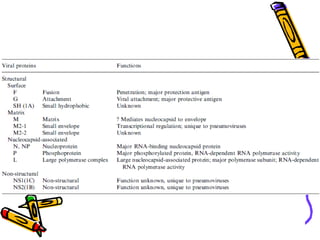
• has four nucleocapsid proteins
packaged in the virion: the major
nucleocapsid protein N, the
phosphoprotein P, the antitermination
factor M2-1, and the large
polymerase subunit L.
• envelope contains three virally
encoded transmembrane surface
glycoproteins, the attachment
protein G, the fusion protein F, and
the small hydrophobic SH protein
• The viral glycoproteins are organized
separately into virion “spikes,” which
are visualized as short (11–20 nm),
closely spaced (intervals of 6 to 10
nm) surface projections
• There also is a matrix M protein that
is thought to form a layer on the
inner envelope face
• RNA genome is 15-16 kb long
• Genome encodes 11 proteins
• Nine are structural (L, G, F, N, P, M,
M2-1, M2-2 and SH)
• Two are non-structural (NS1 and
NS2)
[RSV is divided into two antigenic
subgroups (A and B) on the basis of G
surface glycoprotein]
Epidemiology
• RSV infection is prevalent worldwide
• Highly contagious in nature
• Highly prevalent in young children
with a peak incidence in 2-8 months
of age
• Virtually all children are infected by
RSV by the age of 4 years.
• Usually seasonal, mostly occuring
during winter
• Shed in respiratory secretions for
several days, sometimes weeks
• Nosocomial infections are frequent.
• Outbreaks occur in neonatal wards of
maternity hospitals, sometimes
inflicting high mortality
Replication
• All events in the RSV replicative
cycle occur in the cytoplasm without
nuclear involvement
• Attachment is mediated by G
glycoprotein with specific cellular
receptor (suggested to be cellular
GAGs, “glycosaminoglycans”)
• Replication is similar to that of
Paramyxoviruses
Transmission
• Droplet inhalation
• Direct contact with contaminated
hands and fomites
Pathogenesis
• RSV is restricted to the respiratory
tract
• Inoculation of the virus occurs
through the upper respiratory tract
and initiates infection in the
epithelial cells.
• The virus subsequently spreads along
the epithelium of the respiratory
tract, mostly by cell-to-cell transfer
of the virus along intracytoplasmic
bridges (or syncytia formation).
• The virus usually does not cause any
viremia or systemic spread.
• As the virus spreads to the lower
respiratory tract it may produce
bronchiolitis and/or pneumonia.
• Virus causes necrosis of the small
airway epithelium, plugging of the
lumens with exudates, and edema,
leading to obstruction of the normal
airways.
Immune response
• Antibodies of IgA, IgM and IgG
classes are produced but plays the
minimal role in the host immunity
against RSV.
• Systemic and local cell-mediated
immune responses appear to be key
to the severity and recovery from
RSV infection
• Reinfection occurs, but of low
severity than that of primary
infection
• Maternal antibody does not protect
infant from infection.
• Natural infection does not prevent
reinfection
• Improper vaccination increases
severity of disease
Clinical manifestations
• The incubation period from time of
infection to onset of illness for RSV
is 4 to 5 days
• In the normal infant who encounters
RSV for the first time at age 6
weeks to 9 months, RSV infection
usually causes upper respiratory
symptoms.
• In 25% to 40% of such infections,
however, the respiratory tract below
the larynx also becomes involved.
• Bronchiolitis and pneumonia are the
primary manifestations of lower
respiratory tract disease
• RSV has been reported in various
studies as causing 10% of croup
cases, 5–40% of the pneumonias and
bronchitis in young children, and 50–
• Clinically, the condition presents as
cough, coryza, wheezing, rales and
low-grade fever.
• Reinfection with the virus occurs
throughout the life.
• However, in advancing age, the RSV
infection is confined more to the
URT than the LRT.
Complications
• Secondary bacterial complications are
rare.
• Approximately 20% of children with RSV
bronchiolitis develop a viral otitis media.
• Small children with bronchiolitis during
their first year of life may develop
chronic respiratory disease, in particular
asthma.
Laboratory diagnosis
• RSV infection may be diagnosed by
identification of the viral antigen by
rapid diagnostic techniques, viral
isolation or serology
• The gold standard is isolation of
virus in cell culture
• Specimens are best obtained by
aspiration or gentle washing out of
nasal or nasopharyngeal secretions or
by nasal swab
• Rapid antigen detection
• Viral antigens can be detected by direct
immunofluorescence or enzyme immunoassy
using specific monoclonal antibodies.
• Virus culture
– HeLa cells, Hep-2 cells or monkey kidney
cell lines can be used
– After 3-10 days of inoculation and
incubation, RSV is identified by the
characteristic synsytium formation
– DFA test can be employed for viral
detection in earlier days
• Serodiagnosis
– ELISA can be used for the
demonstration of antibodies in the
serum
– Demonstration of fourfold or more
increase in the antibody titer of acute
and convalescent sera
• Molecular diagnosis
– PCR
Prophylaxis and control
• Supportive and symptomatic care
• Ribavirin has been recommended for the
aerosolized treatment of childern with
severe RSV disease.
• Parenterally administration of RSV-
neutralizing antibodies is suggested as an
antiviral therapy against established
infection of high-risk infants and young
children.
• Development of effective vaccine
against RSV have not succceed to
date.

Respiratory Syncytial Virus (RSV)

  • 1.
  • 2.
    Classification • Family: Paramyxoviridae •Sub-family: Pneumovirinae • Genus: Pneumovirus
  • 3.
    Morphology • irregular sphericalparticles that range in diameter from 150 to 300 nm • consists of a nucleocapsid contained within a lipid envelope • non-segmented, single-stranded, negative-sense genome of helical symmetry
  • 4.
    • has fournucleocapsid proteins packaged in the virion: the major nucleocapsid protein N, the phosphoprotein P, the antitermination factor M2-1, and the large polymerase subunit L. • envelope contains three virally encoded transmembrane surface glycoproteins, the attachment protein G, the fusion protein F, and the small hydrophobic SH protein
  • 5.
    • The viralglycoproteins are organized separately into virion “spikes,” which are visualized as short (11–20 nm), closely spaced (intervals of 6 to 10 nm) surface projections • There also is a matrix M protein that is thought to form a layer on the inner envelope face
  • 6.
    • RNA genomeis 15-16 kb long • Genome encodes 11 proteins • Nine are structural (L, G, F, N, P, M, M2-1, M2-2 and SH) • Two are non-structural (NS1 and NS2) [RSV is divided into two antigenic subgroups (A and B) on the basis of G surface glycoprotein]
  • 8.
    Epidemiology • RSV infectionis prevalent worldwide • Highly contagious in nature • Highly prevalent in young children with a peak incidence in 2-8 months of age • Virtually all children are infected by RSV by the age of 4 years. • Usually seasonal, mostly occuring during winter
  • 9.
    • Shed inrespiratory secretions for several days, sometimes weeks • Nosocomial infections are frequent. • Outbreaks occur in neonatal wards of maternity hospitals, sometimes inflicting high mortality
  • 10.
    Replication • All eventsin the RSV replicative cycle occur in the cytoplasm without nuclear involvement • Attachment is mediated by G glycoprotein with specific cellular receptor (suggested to be cellular GAGs, “glycosaminoglycans”) • Replication is similar to that of Paramyxoviruses
  • 11.
    Transmission • Droplet inhalation •Direct contact with contaminated hands and fomites
  • 12.
    Pathogenesis • RSV isrestricted to the respiratory tract • Inoculation of the virus occurs through the upper respiratory tract and initiates infection in the epithelial cells. • The virus subsequently spreads along the epithelium of the respiratory tract, mostly by cell-to-cell transfer of the virus along intracytoplasmic bridges (or syncytia formation).
  • 13.
    • The virususually does not cause any viremia or systemic spread. • As the virus spreads to the lower respiratory tract it may produce bronchiolitis and/or pneumonia. • Virus causes necrosis of the small airway epithelium, plugging of the lumens with exudates, and edema, leading to obstruction of the normal airways.
  • 14.
    Immune response • Antibodiesof IgA, IgM and IgG classes are produced but plays the minimal role in the host immunity against RSV. • Systemic and local cell-mediated immune responses appear to be key to the severity and recovery from RSV infection • Reinfection occurs, but of low severity than that of primary infection
  • 15.
    • Maternal antibodydoes not protect infant from infection. • Natural infection does not prevent reinfection • Improper vaccination increases severity of disease
  • 16.
    Clinical manifestations • Theincubation period from time of infection to onset of illness for RSV is 4 to 5 days • In the normal infant who encounters RSV for the first time at age 6 weeks to 9 months, RSV infection usually causes upper respiratory symptoms.
  • 17.
    • In 25%to 40% of such infections, however, the respiratory tract below the larynx also becomes involved. • Bronchiolitis and pneumonia are the primary manifestations of lower respiratory tract disease • RSV has been reported in various studies as causing 10% of croup cases, 5–40% of the pneumonias and bronchitis in young children, and 50–
  • 18.
    • Clinically, thecondition presents as cough, coryza, wheezing, rales and low-grade fever. • Reinfection with the virus occurs throughout the life. • However, in advancing age, the RSV infection is confined more to the URT than the LRT.
  • 19.
    Complications • Secondary bacterialcomplications are rare. • Approximately 20% of children with RSV bronchiolitis develop a viral otitis media. • Small children with bronchiolitis during their first year of life may develop chronic respiratory disease, in particular asthma.
  • 20.
    Laboratory diagnosis • RSVinfection may be diagnosed by identification of the viral antigen by rapid diagnostic techniques, viral isolation or serology • The gold standard is isolation of virus in cell culture • Specimens are best obtained by aspiration or gentle washing out of nasal or nasopharyngeal secretions or by nasal swab
  • 21.
    • Rapid antigendetection • Viral antigens can be detected by direct immunofluorescence or enzyme immunoassy using specific monoclonal antibodies. • Virus culture – HeLa cells, Hep-2 cells or monkey kidney cell lines can be used – After 3-10 days of inoculation and incubation, RSV is identified by the characteristic synsytium formation – DFA test can be employed for viral detection in earlier days
  • 22.
    • Serodiagnosis – ELISAcan be used for the demonstration of antibodies in the serum – Demonstration of fourfold or more increase in the antibody titer of acute and convalescent sera • Molecular diagnosis – PCR
  • 23.
    Prophylaxis and control •Supportive and symptomatic care • Ribavirin has been recommended for the aerosolized treatment of childern with severe RSV disease. • Parenterally administration of RSV- neutralizing antibodies is suggested as an antiviral therapy against established infection of high-risk infants and young children.
  • 24.
    • Development ofeffective vaccine against RSV have not succceed to date.