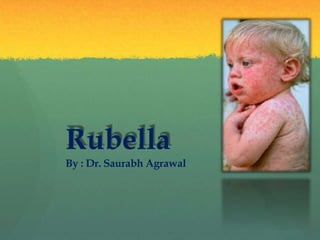
Rubella
By : Dr. Saurabh Agrawal
HISTORY - RUBELLA
 Discovered in 18th century -
thought to be variant of measles
 The Teratogenic property of the
infection was documented by an
Australian ophthalmologist
Norman McAlister Gregg, in 1941
 The virus was isolated in 1962
2 04/04/2015
Introduction
 From Latin meaning "little red"
 An attenuated vaccine was
developed in 1967
 First described as distinct
clinical entity in German
literature
3 04/04/2015
EPIDEMIOLOGY
17 04/04/2015
Occurs worldwide
The virus tends to peak in countries with temperate climates
Common in children ages 5-10 years old
Human are only known reservoir.
Host -3-10 yrs
Source of infection – Respiratory secretion
Infants with CRS may shed virus for a year or more
Immunity –life long
Occurs round the year, peak in late winter and spring season
Transmission – droplet, vertical transmission
I.P – 2-3 weeks average 18 days
Rubella is world wide in distribution
Epidemics occur every 4-9 years.
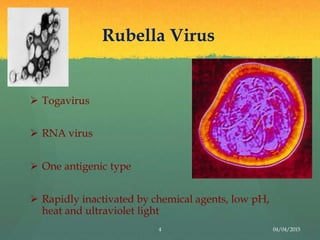
Rubella Virus
 Togavirus
 RNA virus
 One antigenic type
 Rapidly inactivated by chemical agents, low pH,
heat and ultraviolet light
4 04/04/2015
AGENT FACTORS
A- Agent
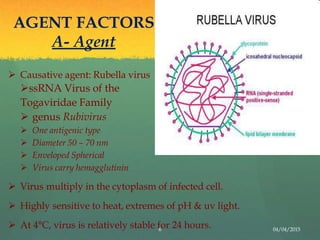
 Causative agent: Rubella virus
ssRNA Virus of the
Togaviridae Family
 genus Rubivirus
 One antigenic type
 Diameter 50 – 70 nm
 Enveloped Spherical
 Virus carry hemagglutinin
 Virus multiply in the cytoplasm of infected cell.
 Highly sensitive to heat, extremes of pH & uv light.
 At 4°C, virus is relatively stable for 24 hours.6 04/04/2015
AGENT FACTORS cont.
7 04/04/2015
B- Source of infection
 CASES
 Subclinical
 Clinical
 Congenital from infected
pregnant women to fetus.
 There is no known carrier
state.
C- Period of
communicability
 It probably extends from
a week before symptoms
to about a week after
rash appears.
 Infectivity is greatest
when the rash is
erupting.
HOST FACTORS
A- Age
 Disease of childhood
3-10 yrs age group.
 Following widespread
immunization
campaigns persons
older than 15 yrs
account for 70% cases
in developed
countries.
B- Immunity
 One attack results in
life long immunity.
 Infants of immune
mothers are protected
for 4-6 months.
 In India, about 40% of
child bearing age
group women are
susceptible to rubella.
8 04/04/2015
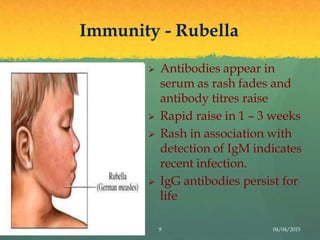
Immunity - Rubella
 Antibodies appear in
serum as rash fades and
antibody titres raise
 Rapid raise in 1 – 3 weeks
 Rash in association with
detection of IgM indicates
recent infection.
 IgG antibodies persist for
life
9 04/04/2015
ENVIRONMENTAL
FACTORS
Disease usually
occurs in seasonal
pattern, during the
late winter & spring.
10 04/04/2015
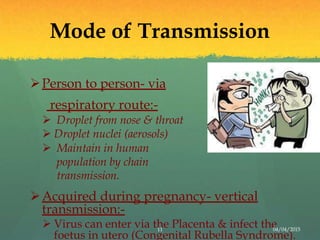
Mode of Transmission
Person to person- via
respiratory route:-
 Droplet from nose & throat
 Droplet nuclei (aerosols)
 Maintain in human
population by chain
transmission.
Acquired during pregnancy- vertical
transmission:-
 Virus can enter via the Placenta & infect the
foetus in utero (Congenital Rubella Syndrome).
11 04/04/2015
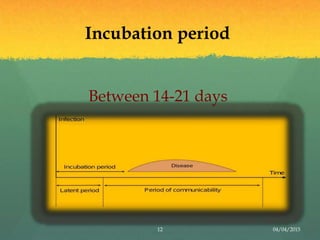
Incubation period
Between 14-21 days
12 04/04/2015
Pathogenesis Continued……
Respiratory
Tract Skin
Lymph
Nodes Joints
Placenta or
Fetus
• Cough
• Minor
sore
throat
• Rashes
• Lesions
• Mild
arthralgia
• arthritis
• Placentitis
• Fetal
Damage
• Lymphadenopathy
14 04/04/2015
Rubella Virus Developed in the nasopharynx
Rubella Clinical Features
Incubation period 14 days (range 12-23 days)
 Low grade fever
Lymphadenopathy in
second week
Maculopapular rash 14-
17 days after exposure
18 04/04/2015
SIGNS AND SYMPTOMS
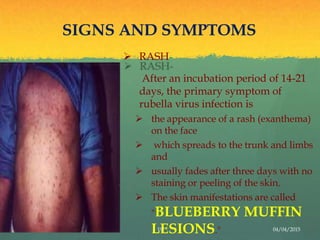
 RASH-
After an incubation period of 14-21
days, the primary symptom of
rubella virus infection is
 the appearance of a rash (exanthema)
on the face
 which spreads to the trunk and limbs
and
 usually fades after three days with no
staining or peeling of the skin.
 The skin manifestations are called
"BLUEBERRY MUFFIN
LESIONS."19 04/04/2015
SIGNS AND SYMPTOMS
continued….
 LYMPH NODE-
 Tender lymphadenopathy
(particularly posterior
auricular and suboccipital
lymph nodes)
 persist for up to a week.
20 04/04/2015
SIGNS AND SYMPTOMS
 TEMPERATURE-Fever rarely rises above 38o C (100.4 o F)
21 04/04/2015
Other manifestations &
complications
 May produce transient
Arthritis, particular in
women.
 Serious complications
are-
 Thrombocytopenia
Purpura
 Encephalitis
22 04/04/2015
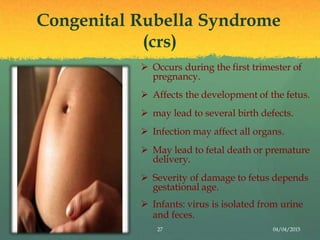
Congenital Rubella Syndrome
(crs)
 Occurs during the first trimester of
pregnancy.
 Affects the development of the fetus.
 may lead to several birth defects.
 Infection may affect all organs.
 May lead to fetal death or premature
delivery.
 Severity of damage to fetus depends
gestational age.
 Infants: virus is isolated from urine
and feces.
27 04/04/2015
Rubella infection – At various
trimesters
28 04/04/2015
 Ist trimester infections lead to abnormalities in 85 % of
cases and greater damage to organs
 2nd trimester infections lead to defects in 16 %
 > 20 weeks of pregnancy fetal defects are uncommon
 However Rubella infection can also lead to fetal deaths,
and spontaneous abortion.
 The intrauterine infections lead to viral excretion in
various secretion in newborn up to 12-18 months.
Rubella infection & Chance of
CRS
29 04/04/2015
 0–28 days before conception - 43% chance
 0–12 weeks after conception - 51% chance
 13–26 weeks after conception - 23% chance
 Infants are not generally affected if rubella is
contracted during the third trimester
Post natal Rubella
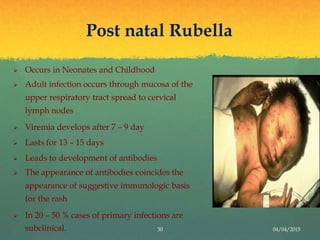
 Occurs in Neonates and Childhood
 Adult infection occurs through mucosa of the
upper respiratory tract spread to cervical
lymph nodes
 Viremia develops after 7 – 9 day
 Lasts for 13 – 15 days
 Leads to development of antibodies
 The appearance of antibodies coincides the
appearance of suggestive immunologic basis
for the rash
 In 20 – 50 % cases of primary infections are
subclinical. 04/04/201530
Clinical Features
Rash at birth
Deafness
Cataracts
Heart defects
Microcephaly
Mental retardation
Bone alterations
Liver and spleen damage
32 04/04/2015
Diagnosis of Rubella in
Adults
36 04/04/2015
 Clinical Diagnosis is unreliable
 Many viral infections mimic Rubella
 Specific diagnosis of infection with-
 1 Isolation of virus
 2 Evidence of seroconversion
Isolation and Identification of
virus
 Nasopharyngeal or
throat swabs taken 6
days prior or after
appearance of rash is a
good source of Rubella
virus
 Using cell cultured in
shell vial antigens can
be detected by
Immunofluresecent
methods37 04/04/2015
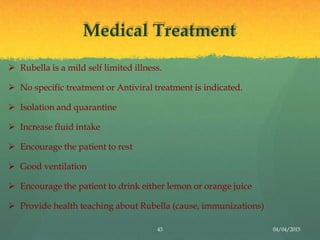
Medical Treatment
43 04/04/2015
 Rubella is a mild self limited illness.
 No specific treatment or Antiviral treatment is indicated.
 Isolation and quarantine
 Increase fluid intake
 Encourage the patient to rest
 Good ventilation
 Encourage the patient to drink either lemon or orange juice
 Provide health teaching about Rubella (cause, immunizations)
Treatment for acute maternal
rubella infection
44 04/04/2015
 Acetaminophen for symptomatic relief
 IgG –
 role is controversial, CDC recommends limiting use of
immunoglobulin to women with known rubella exposure who
decline pregnancy termination.
 Glucocorticoids, platelet transfusion, and other supportive
measures for complications.
 Counseled about maternal-fetal transmission and offered
pregnancy termination, especially prior to 16 weeks
gestation.
 After 20 weeks gestation- individualized management.
Prevention
 Rubella vaccine is given to
children at 15 months of age
as a part of the MMR
(measles-mumps-rubella)
immunization.
 The vaccine is live and
attenuated and confers
lifelong immunity.
 Given to children 12 and 15
months and again between 3-
6 years of age
45 04/04/2015
Vaccination of Women of
Childbearing Age
 Ask if pregnant or likely to
become so in next 4 weeks
 Exclude those who say "yes
the vaccine has been already
taken"
 For others
 Explain theoretical risks
 Vaccinate
47 04/04/2015
MMR Vaccine
 The MMR vaccine is a mixture of three live
attenuated viruses, administered via injection
for immunization against measles, mumps
and rubella virus strain RA 27/3 .
 It is generally administered to children around
the age of one year, with a second dose before
starting school (i.e. age 4/5).
48 04/04/2015
MMR Vaccine
 The second dose is not a booster; it is a
dose to produce immunity in the small
number of persons (2-5%) who fail to
develop measles immunity after the first
dose, the vaccine was licensed in 1963
and the second dose was introduced in
the mid 1990s. It is widely used.
 Contraindications= immunodeficiency
disorder, history of anaphylaxis to
neomycin, and pregnancy.
 Side effects: arthritis, arthralgia, rash,
adinopathy, or fever.
49 04/04/2015
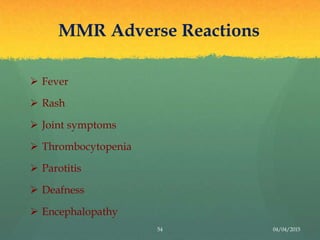
MMR Adverse Reactions
54 04/04/2015
 Fever
 Rash
 Joint symptoms
 Thrombocytopenia
 Parotitis
 Deafness
 Encephalopathy
60 04/04/2015

Rubella

  • 1.
    Rubella By : Dr.Saurabh Agrawal
  • 2.
    HISTORY - RUBELLA Discovered in 18th century - thought to be variant of measles  The Teratogenic property of the infection was documented by an Australian ophthalmologist Norman McAlister Gregg, in 1941  The virus was isolated in 1962 2 04/04/2015
  • 3.
    Introduction  From Latinmeaning "little red"  An attenuated vaccine was developed in 1967  First described as distinct clinical entity in German literature 3 04/04/2015
  • 4.
    EPIDEMIOLOGY 17 04/04/2015 Occurs worldwide Thevirus tends to peak in countries with temperate climates Common in children ages 5-10 years old Human are only known reservoir. Host -3-10 yrs Source of infection – Respiratory secretion Infants with CRS may shed virus for a year or more Immunity –life long Occurs round the year, peak in late winter and spring season Transmission – droplet, vertical transmission I.P – 2-3 weeks average 18 days Rubella is world wide in distribution Epidemics occur every 4-9 years.
  • 5.
    Rubella Virus  Togavirus RNA virus  One antigenic type  Rapidly inactivated by chemical agents, low pH, heat and ultraviolet light 4 04/04/2015
  • 6.
    AGENT FACTORS A- Agent Causative agent: Rubella virus ssRNA Virus of the Togaviridae Family  genus Rubivirus  One antigenic type  Diameter 50 – 70 nm  Enveloped Spherical  Virus carry hemagglutinin  Virus multiply in the cytoplasm of infected cell.  Highly sensitive to heat, extremes of pH & uv light.  At 4°C, virus is relatively stable for 24 hours.6 04/04/2015
  • 7.
    AGENT FACTORS cont. 704/04/2015 B- Source of infection  CASES  Subclinical  Clinical  Congenital from infected pregnant women to fetus.  There is no known carrier state. C- Period of communicability  It probably extends from a week before symptoms to about a week after rash appears.  Infectivity is greatest when the rash is erupting.
  • 8.
    HOST FACTORS A- Age Disease of childhood 3-10 yrs age group.  Following widespread immunization campaigns persons older than 15 yrs account for 70% cases in developed countries. B- Immunity  One attack results in life long immunity.  Infants of immune mothers are protected for 4-6 months.  In India, about 40% of child bearing age group women are susceptible to rubella. 8 04/04/2015
  • 9.
    Immunity - Rubella Antibodies appear in serum as rash fades and antibody titres raise  Rapid raise in 1 – 3 weeks  Rash in association with detection of IgM indicates recent infection.  IgG antibodies persist for life 9 04/04/2015
  • 10.
    ENVIRONMENTAL FACTORS Disease usually occurs inseasonal pattern, during the late winter & spring. 10 04/04/2015
  • 11.
    Mode of Transmission Personto person- via respiratory route:-  Droplet from nose & throat  Droplet nuclei (aerosols)  Maintain in human population by chain transmission. Acquired during pregnancy- vertical transmission:-  Virus can enter via the Placenta & infect the foetus in utero (Congenital Rubella Syndrome). 11 04/04/2015
  • 12.
  • 13.
    Pathogenesis Continued…… Respiratory Tract Skin Lymph NodesJoints Placenta or Fetus • Cough • Minor sore throat • Rashes • Lesions • Mild arthralgia • arthritis • Placentitis • Fetal Damage • Lymphadenopathy 14 04/04/2015 Rubella Virus Developed in the nasopharynx
  • 14.
    Rubella Clinical Features Incubationperiod 14 days (range 12-23 days)  Low grade fever Lymphadenopathy in second week Maculopapular rash 14- 17 days after exposure 18 04/04/2015
  • 15.
    SIGNS AND SYMPTOMS RASH- After an incubation period of 14-21 days, the primary symptom of rubella virus infection is  the appearance of a rash (exanthema) on the face  which spreads to the trunk and limbs and  usually fades after three days with no staining or peeling of the skin.  The skin manifestations are called "BLUEBERRY MUFFIN LESIONS."19 04/04/2015
  • 16.
    SIGNS AND SYMPTOMS continued…. LYMPH NODE-  Tender lymphadenopathy (particularly posterior auricular and suboccipital lymph nodes)  persist for up to a week. 20 04/04/2015
  • 17.
    SIGNS AND SYMPTOMS TEMPERATURE-Fever rarely rises above 38o C (100.4 o F) 21 04/04/2015
  • 18.
    Other manifestations & complications May produce transient Arthritis, particular in women.  Serious complications are-  Thrombocytopenia Purpura  Encephalitis 22 04/04/2015
  • 19.
    Congenital Rubella Syndrome (crs) Occurs during the first trimester of pregnancy.  Affects the development of the fetus.  may lead to several birth defects.  Infection may affect all organs.  May lead to fetal death or premature delivery.  Severity of damage to fetus depends gestational age.  Infants: virus is isolated from urine and feces. 27 04/04/2015
  • 20.
    Rubella infection –At various trimesters 28 04/04/2015  Ist trimester infections lead to abnormalities in 85 % of cases and greater damage to organs  2nd trimester infections lead to defects in 16 %  > 20 weeks of pregnancy fetal defects are uncommon  However Rubella infection can also lead to fetal deaths, and spontaneous abortion.  The intrauterine infections lead to viral excretion in various secretion in newborn up to 12-18 months.
  • 21.
    Rubella infection &Chance of CRS 29 04/04/2015  0–28 days before conception - 43% chance  0–12 weeks after conception - 51% chance  13–26 weeks after conception - 23% chance  Infants are not generally affected if rubella is contracted during the third trimester
  • 22.
    Post natal Rubella Occurs in Neonates and Childhood  Adult infection occurs through mucosa of the upper respiratory tract spread to cervical lymph nodes  Viremia develops after 7 – 9 day  Lasts for 13 – 15 days  Leads to development of antibodies  The appearance of antibodies coincides the appearance of suggestive immunologic basis for the rash  In 20 – 50 % cases of primary infections are subclinical. 04/04/201530
  • 23.
    Clinical Features Rash atbirth Deafness Cataracts Heart defects Microcephaly Mental retardation Bone alterations Liver and spleen damage 32 04/04/2015
  • 24.
    Diagnosis of Rubellain Adults 36 04/04/2015  Clinical Diagnosis is unreliable  Many viral infections mimic Rubella  Specific diagnosis of infection with-  1 Isolation of virus  2 Evidence of seroconversion
  • 25.
    Isolation and Identificationof virus  Nasopharyngeal or throat swabs taken 6 days prior or after appearance of rash is a good source of Rubella virus  Using cell cultured in shell vial antigens can be detected by Immunofluresecent methods37 04/04/2015
  • 26.
    Medical Treatment 43 04/04/2015 Rubella is a mild self limited illness.  No specific treatment or Antiviral treatment is indicated.  Isolation and quarantine  Increase fluid intake  Encourage the patient to rest  Good ventilation  Encourage the patient to drink either lemon or orange juice  Provide health teaching about Rubella (cause, immunizations)
  • 27.
    Treatment for acutematernal rubella infection 44 04/04/2015  Acetaminophen for symptomatic relief  IgG –  role is controversial, CDC recommends limiting use of immunoglobulin to women with known rubella exposure who decline pregnancy termination.  Glucocorticoids, platelet transfusion, and other supportive measures for complications.  Counseled about maternal-fetal transmission and offered pregnancy termination, especially prior to 16 weeks gestation.  After 20 weeks gestation- individualized management.
  • 28.
    Prevention  Rubella vaccineis given to children at 15 months of age as a part of the MMR (measles-mumps-rubella) immunization.  The vaccine is live and attenuated and confers lifelong immunity.  Given to children 12 and 15 months and again between 3- 6 years of age 45 04/04/2015
  • 29.
    Vaccination of Womenof Childbearing Age  Ask if pregnant or likely to become so in next 4 weeks  Exclude those who say "yes the vaccine has been already taken"  For others  Explain theoretical risks  Vaccinate 47 04/04/2015
  • 30.
    MMR Vaccine  TheMMR vaccine is a mixture of three live attenuated viruses, administered via injection for immunization against measles, mumps and rubella virus strain RA 27/3 .  It is generally administered to children around the age of one year, with a second dose before starting school (i.e. age 4/5). 48 04/04/2015
  • 31.
    MMR Vaccine  Thesecond dose is not a booster; it is a dose to produce immunity in the small number of persons (2-5%) who fail to develop measles immunity after the first dose, the vaccine was licensed in 1963 and the second dose was introduced in the mid 1990s. It is widely used.  Contraindications= immunodeficiency disorder, history of anaphylaxis to neomycin, and pregnancy.  Side effects: arthritis, arthralgia, rash, adinopathy, or fever. 49 04/04/2015
  • 32.
    MMR Adverse Reactions 5404/04/2015  Fever  Rash  Joint symptoms  Thrombocytopenia  Parotitis  Deafness  Encephalopathy
  • 33.