KYASANUR FOREST
DISEASE
HARSH RASTOGI
M.Sc. NURSING FIRST YEAR
KGMU INSTITUTE OF NURSING
KYASANUR FOREST DISEASE
KFD is a febrile disease associated with
haemorrhage caused by kyasanur forest
disease virus, a member of virus family of
arbovirus & flavivirus and transmitted to man
by bite of infected ticks.
History
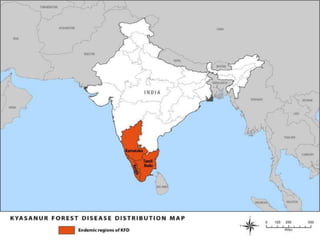
• KFD was First recognised in 1957 in SHIMOGA
district of Karnataka state in South INDIA,
• local inhabitants called the disease ‘monkey
disease’ because of its association with dead
monkeys.
• According to the reports, about 400-500 cases
occur every year. The Karnataka Government has
established a surveillance system which monitors
the occurrence of KFD in humans and mortality in
monkeys in known epidemic areas , as well as
neighbouring areas. Deaths of monkeys are
considered as heralders of this disease in
endemic areas.
Epidemiological determinants
• AGENT
The agent KFD virus is a member of group B
togaviruses(flaviviruses). It is antigenically related
to other tick-borne flaviviruses.
• NATURAL HOSTS AND RESERVOIRS
Small mammals particularly rats and squirrels are
the main reservoirs of the virus. Birds and bats
are less important hosts. The monkeys are
recognized as amplifying hosts for the virus.
• VECTORS
The virus has complex life cycle involving as
wide variety of tick-species.At least 15 species
of hard ticks of the genus Haemaphysalits,
particularly H. Spinigera and H. Turtura are
known to transmit the disease. KFD has also
been isolated from soft ticks.
The highest number of human and monkey
infections occur during drier months,
particularly from January to June. This period
coincides with the peak nymphal activity of
ticks.
• HOST FACTORS
Age- Majority of cases affected were between
20 and 40 years .
Gender - Attack rate was greater in males than
in females.
Occupation- The attacked people were mostly
cultivators who visited forests accompanying
their cattle or cutting woods
Human activity- The epidemic period
correlates well with the period of greatest
human activity in the forest, i.e., from January
until the onset of rains in June.
• MODE OF TRANSMISSION
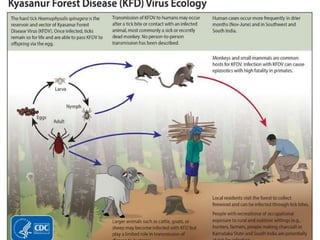
The transmission cycle involves mainly
monkeys and ticks. The diseases in
transmitted by the bite of infective ticks,
especially nymphal stages. There is no
evidence of man to man transmission.
• INCUBATION PERIOD
Estimated to be between 3 and 8 days.
CLINICAL FEATURES
The disease appears with a sudden onset of
fever,
Headache
 severe myalgia, with prostration in some
patients.
The acute phase lasts for about 2 weeks.
Gastrointestinal disturbances
haemorrhages from nose, gums, stomach and
intestine may occur in severe cases.
In a number of cases, there is a second phase
characterized by mild meningoencephalitis
after an a febrile period of 7 to 21 days. It is
manifested by a return of fever,
 severe headache followed by neck stiffness,
coarse tremors
 abnormal reflexes
mental disturbances,
The case fatality rate has been estimated to be
5 to 10 per cent.
Diagnosis
It is established only after detecting the
presence of the virus in the blood and/or
serological evidence.
ELISA
PCR
TREATMENT
There is no specific treatment for KFD, but
early hospitalization and supportive therapy is
important
Supportive therapy includes the maintenance
of hydration and usual precaution for patient
with bleeding disorders
Vaccine is also available.
CONTROL
CONTROL OF TICKS- Since KFD is a tick-borne
disease, control of ticks should be undertaken.
For control of ticks in forests application can
be made by power equipment or by aircraft-
mounted equipment to dispense carbaryl,
fenthion, naled or propoxur at 2.24 kg of
active ingredient per hectare.
Insect repellants.
Protective clothing
Health education
ASSIGNMENT
• Write a brief note on Kyasanur Forest Disease.
REFERENCES
• Park K., Text Book of Preventive & Social
Medicine. 24th Edition, Banarsidas Bhanot;
Page Number: 305 to 320.
• https://www.cdc.gov>vhf>kyasanur
• https://www.ncbi.nlm.nih.gov>articles
Stay away from ticks !

Kyasanur forest disease PPT

  • 1.
    KYASANUR FOREST DISEASE HARSH RASTOGI M.Sc.NURSING FIRST YEAR KGMU INSTITUTE OF NURSING
  • 3.
    KYASANUR FOREST DISEASE KFDis a febrile disease associated with haemorrhage caused by kyasanur forest disease virus, a member of virus family of arbovirus & flavivirus and transmitted to man by bite of infected ticks.
  • 4.
    History • KFD wasFirst recognised in 1957 in SHIMOGA district of Karnataka state in South INDIA, • local inhabitants called the disease ‘monkey disease’ because of its association with dead monkeys. • According to the reports, about 400-500 cases occur every year. The Karnataka Government has established a surveillance system which monitors the occurrence of KFD in humans and mortality in monkeys in known epidemic areas , as well as neighbouring areas. Deaths of monkeys are considered as heralders of this disease in endemic areas.
  • 5.
    Epidemiological determinants • AGENT Theagent KFD virus is a member of group B togaviruses(flaviviruses). It is antigenically related to other tick-borne flaviviruses. • NATURAL HOSTS AND RESERVOIRS Small mammals particularly rats and squirrels are the main reservoirs of the virus. Birds and bats are less important hosts. The monkeys are recognized as amplifying hosts for the virus.
  • 6.
    • VECTORS The virushas complex life cycle involving as wide variety of tick-species.At least 15 species of hard ticks of the genus Haemaphysalits, particularly H. Spinigera and H. Turtura are known to transmit the disease. KFD has also been isolated from soft ticks. The highest number of human and monkey infections occur during drier months, particularly from January to June. This period coincides with the peak nymphal activity of ticks.
  • 7.
    • HOST FACTORS Age-Majority of cases affected were between 20 and 40 years . Gender - Attack rate was greater in males than in females. Occupation- The attacked people were mostly cultivators who visited forests accompanying their cattle or cutting woods Human activity- The epidemic period correlates well with the period of greatest human activity in the forest, i.e., from January until the onset of rains in June.
  • 8.
    • MODE OFTRANSMISSION The transmission cycle involves mainly monkeys and ticks. The diseases in transmitted by the bite of infective ticks, especially nymphal stages. There is no evidence of man to man transmission. • INCUBATION PERIOD Estimated to be between 3 and 8 days.
  • 9.
    CLINICAL FEATURES The diseaseappears with a sudden onset of fever, Headache  severe myalgia, with prostration in some patients. The acute phase lasts for about 2 weeks. Gastrointestinal disturbances haemorrhages from nose, gums, stomach and intestine may occur in severe cases.
  • 10.
    In a numberof cases, there is a second phase characterized by mild meningoencephalitis after an a febrile period of 7 to 21 days. It is manifested by a return of fever,  severe headache followed by neck stiffness, coarse tremors  abnormal reflexes mental disturbances, The case fatality rate has been estimated to be 5 to 10 per cent.
  • 12.
    Diagnosis It is establishedonly after detecting the presence of the virus in the blood and/or serological evidence. ELISA PCR
  • 13.
    TREATMENT There is nospecific treatment for KFD, but early hospitalization and supportive therapy is important Supportive therapy includes the maintenance of hydration and usual precaution for patient with bleeding disorders Vaccine is also available.
  • 14.
    CONTROL CONTROL OF TICKS-Since KFD is a tick-borne disease, control of ticks should be undertaken. For control of ticks in forests application can be made by power equipment or by aircraft- mounted equipment to dispense carbaryl, fenthion, naled or propoxur at 2.24 kg of active ingredient per hectare. Insect repellants. Protective clothing Health education
  • 16.
    ASSIGNMENT • Write abrief note on Kyasanur Forest Disease.
  • 17.
    REFERENCES • Park K.,Text Book of Preventive & Social Medicine. 24th Edition, Banarsidas Bhanot; Page Number: 305 to 320. • https://www.cdc.gov>vhf>kyasanur • https://www.ncbi.nlm.nih.gov>articles
  • 18.