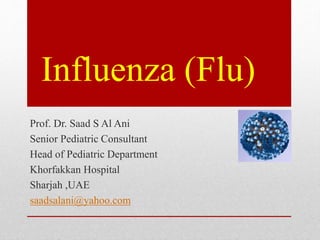
Influenza (Flu)
Prof. Dr. Saad S Al Ani
Senior Pediatric Consultant
Head of Pediatric Department
Khorfakkan Hospital
Sharjah ,UAE
saadsalani@yahoo.com
Facts
• Influenza is a highly contagious viral
infection of the nose, throat, and lungs
that occurs most often in the late fall,
winter, and early spring.
http://www.nfid.org/idinfo/influenza
22/12/2018Influenza (Flu) Prof. Dr. Saad S Al Ani
2
Facts
• Influenza is a serious infection that
affects between 5-20% of the US
population annually.
http://www.nfid.org/idinfo/influenza
22/12/2018Influenza (Flu) Prof. Dr. Saad S Al Ani
3
• During the 2017-2018 season:
 An estimated 900,000 individuals
were hospitalized
 Nearly 80,000 deaths
Occurred in the US from flu and flu-
related complications.
http://www.nfid.org/idinfo/influenza
22/12/2018Influenza (Flu) Prof. Dr. Saad S Al Ani
4Facts
• In temperate climates:
Seasonal epidemics occur mainly during
winter
• In tropical regions:
Influenza may occur throughout the year,
causing outbreaks more irregularly.
22/12/2018Influenza (Flu) Prof. Dr. Saad S Al Ani
5Facts
• Incubation period, is about 2 days, but
ranges from one to four days
22/12/2018Influenza (Flu) Prof. Dr. Saad S Al Ani
6Facts
The pathogen
• There are 4 types of seasonal influenza
viruses, types A, B, C and D.
• Influenza A and B viruses circulate and
cause seasonal epidemics of disease.
http://www.who.int/news-room/fact-sheets/detail/influenza-(seasonal)
22/12/2018Influenza (Flu) Prof. Dr. Saad S Al Ani
7
Influenza A viruses
• Influenza A viruses are further classified
into subtypes according to the
combinations of the hemagglutinin (HA)
and the neuraminidase (NA), the
proteins on the surface of the virus.
http://www.who.int/news-room/fact-sheets/detail/influenza-(seasonal)
22/12/2018Influenza (Flu) Prof. Dr. Saad S Al Ani
8
Viral Proteins
TCI Chemicals
22/12/2018Influenza (Flu) Prof. Dr. Saad S Al Ani
9
Influenza A viruses
• Currently circulating in humans are
subtype A(H1N1) and A(H3N2)
influenza viruses.
• Only influenza type A viruses are known
to have caused pandemics.
http://www.who.int/news-room/fact-sheets/detail/influenza-(seasonal)
22/12/2018Influenza (Flu) Prof. Dr. Saad S Al Ani
10
Influenza B viruses
• Influenza B viruses are not classified into
subtypes, but can be broken down into
lineages.
• Currently circulating influenza type B
viruses belong to either B/Yamagata or
B/Victoria lineage.
22/12/2018Influenza (Flu) Prof. Dr. Saad S Al Ani
11
Influenza C virus
• Influenza C virus is detected less
frequently and usually causes mild
infections, thus does not present public
health importance.
22/12/2018Influenza (Flu) Prof. Dr. Saad S Al Ani
12
Influenza D viruses
• Influenza D viruses primarily affect
cattle and are not known to infect or
cause illness in people.
22/12/2018Influenza (Flu) Prof. Dr. Saad S Al Ani
13
Epidemiology
• All age groups can be affected but
there are groups that are more at risk
than others.
22/12/2018Influenza (Flu) Prof. Dr. Saad S Al Ani
14
Epidemiology (Cont.)
• Pregnant women
• Children under 59 months
• The elderly
22/12/2018Influenza (Flu) Prof. Dr. Saad S Al Ani
15
Epidemiology(Cont.)
• Individuals with:
Chronic medical conditions (such as
chronic cardiac, pulmonary, renal, metabolic,
neurodevelopmental, liver or hematologic
diseases)
Immunosuppressive conditions
(such as HIV/AIDS, receiving chemotherapy or
steroids, or malignancy).
22/12/2018Influenza (Flu) Prof. Dr. Saad S Al Ani
16
Epidemiology (Cont.)
• Health care workers are at high risk
acquiring influenza virus infection
 due to increased exposure to the
patients
 risk further spread particularly to
vulnerable individuals.
22/12/2018Influenza (Flu) Prof. Dr. Saad S Al Ani
17
Epidemiology (Cont.)
• Illnesses range from mild to
severe and even death
• Hospitalization and death occur
mainly among high risk groups.
22/12/2018Influenza (Flu) Prof. Dr. Saad S Al Ani
18
Transmission
• Seasonal influenza spreads easily,
with rapid transmission in
crowded areas including schools
and nursing homes.
22/12/2018Influenza (Flu) Prof. Dr. Saad S Al Ani
19
Transmission (Cont.)
• Coughs or sneezes, droplets
containing viruses (infectious
droplets)
• Infectious droplets can spread up
to one meter
22/12/2018Influenza (Flu) Prof. Dr. Saad S Al Ani
20
Transmission (Cont.)
• Infect persons in close proximity
who breathe these droplets in.
• The virus can also be spread by
hands contaminated with
influenza viruses.
22/12/2018Influenza (Flu) Prof. Dr. Saad S Al Ani
21
Transmission(Cont.)
• To prevent transmission, people should:
 Cover their mouth and nose with a tissue
when coughing
 Wash their hands regularly
22/12/2018Influenza (Flu) Prof. Dr. Saad S Al Ani
22
Signs and symptoms
• Seasonal influenza is characterized by
a sudden onset of :
22/12/2018Influenza (Flu) Prof. Dr. Saad S Al Ani
23
Fever Muscle and Joint pain
Cough
(usually dry)
Severe malaise
Headache Sore throat
Runny nose
Diagnosis
• The majority of cases of human
influenza are clinically diagnosed
22/12/2018Influenza (Flu) Prof. Dr. Saad S Al Ani
24
Diagnosis (Cont.)
• The clinical differentiation of
influenza from other pathogens is
difficult:-
During periods of low influenza
activity
Outside of epidemics situations,
22/12/2018Influenza (Flu) Prof. Dr. Saad S Al Ani
25
Diagnosis (Cont.)
• Other respiratory viruses that can present
as Influenza-like Illness (ILI) include:
Rhinovirus
Respiratory syncytial virus
Parainfluenza
Adenovirus
22/12/2018Influenza (Flu) Prof. Dr. Saad S Al Ani
26
Laboratory confirmation
of influenza virus
• Throat, nasal and nasopharyngeal
secretions or tracheal aspirate or
washings is commonly performed
22/12/2018Influenza (Flu) Prof. Dr. Saad S Al Ani
27
WHO recommended surveillance standards, Second edition.
Laboratory confirmation
of influenza virus (cont.)
• Direct antigen detection
• Virus isolation
• Detection of influenza-specific RNA
by reverse transcriptase-polymerase
chain reaction (RT-PCR).
22/12/2018Influenza (Flu) Prof. Dr. Saad S Al Ani
28
WHO recommended surveillance standards, Second edition.
Treatment
• Uncomplicated seasonal influenza:
Not from a high risk group
Symptomatic treatment
if symptomatic
Stay home in order to minimize the
risk of infecting others in the community
Group at high risk
Antivirals + Symptomatic treatment
22/12/2018Influenza (Flu) Prof. Dr. Saad S Al Ani
29
Treatment(Cont.)
• Severe or progressive clinical illness
(associated with suspected or confirmed
influenza virus infection)
 Clinical syndromes of :
Pneumonia
Sepsis
Exacerbation of chronic underling
diseases
Antiviral drug
22/12/2018Influenza (Flu) Prof. Dr. Saad S Al Ani
30
Treatment(Cont.)
• Neuraminidase inhibitors (i.e. Oseltamivir)
as soon as possible (ideally, within 48
hours following symptom onset) to
maximize therapeutic benefits.
22/12/2018Influenza (Flu) Prof. Dr. Saad S Al Ani
31
Treatment(Cont.)
Administration of the drug should
also be considered in patients
presenting later in the course of
illness.
22/12/2018Influenza (Flu) Prof. Dr. Saad S Al Ani
32
Treatment(Cont.)
A minimum of 5 days, but can be
extended until there is satisfactory
clinical improvement
22/12/2018Influenza (Flu) Prof. Dr. Saad S Al Ani
33
Treatment(Cont.)
• Corticosteroids should not be used
routinely (unless indicated for other
reasons e.g.: asthma and other specific
conditions); as it has been associated
with:
 Prolonged viral clearance
 Immunosuppression leading to
bacterial or fungal superinfection.
22/12/2018Influenza (Flu) Prof. Dr. Saad S Al Ani
34
Treatment(Cont.)
• All currently circulating influenza
viruses are resistant to adamantane
antiviral drugs (such as amantadine and
rimantadine), and these are therefore
not recommended for monotherapy.
22/12/2018Influenza (Flu) Prof. Dr. Saad S Al Ani
35
Prevention
• The most effective way to prevent
the disease is vaccination
22/12/2018Influenza (Flu) Prof. Dr. Saad S Al Ani
36
Prevention
• Annual vaccination is
recommended to protect against
influenza as immunity from
vaccination wanes over time
22/12/2018Influenza (Flu) Prof. Dr. Saad S Al Ani
37
Prevention
• Injected inactivated influenza
vaccines are most commonly used
throughout the world.
22/12/2018Influenza (Flu) Prof. Dr. Saad S Al Ani
38
Prevention(Cont.)
• Vaccination is especially important
for people:
 At high risk of influenza
complications
 Who live with or care for the
people at high risk
22/12/2018Influenza (Flu) Prof. Dr. Saad S Al Ani
39
Prevention(Cont.)
WHO recommends annual vaccination for:
• Pregnant women at any stage of pregnancy
• Children aged between 6 months to 5 yrs.
• Elderly individuals (aged more than 65yrs.
• Individuals with chronic medical conditions
• Health-care workers.
22/12/2018Influenza (Flu) Prof. Dr. Saad S Al Ani
40
Prevention(Cont.)
• Personal protective measures
 Regular hand washing
 Good respiratory hygiene
 Early self-isolation of those feeling unwell,
feverish and having other symptoms of influenza
 Avoiding close contact with sick people
 Avoiding touching one’s eyes, nose or
mouth
22/12/2018Influenza (Flu) Prof. Dr. Saad S Al Ani
41
Summary
Antiviral Treatment Recommendations for
Seasonal Influenza
22/12/2018Influenza (Flu) Prof. Dr. Saad S Al Ani
42
Patient with
Flu Symptoms
Assess clinically
and investigate
Mild or Uncomplicated illness. Severe Acute Respiratory
Infection(SARI)
· Requiring hospital admission
· Pregnancy
· Severe illness
No risk
factor
High risk*
Treat with Tamiflu immediately
do not wait for lab confirmation
Summary Cont.)
Antiviral Treatment Recommendations for
Seasonal Influenza (Cont.)
22/12/2018Influenza (Flu) Prof. Dr. Saad S Al Ani
43
Mild or Uncomplicated illness
No risk
factor
High
risk*
.Consider Antiviral if within 48 Hrs.
· Infection control
· Return to care within 72 Hrs. if no
improvement
.Treat with Antiviral
· Close follow up
· Infection control
· Return to care within 72 Hrs in no
improvement
*High Risk :
· Children below 5 especially
<2 years
· Elderly >65 years
· Pregnant women till 2Wks
post partum
· Comorbidities
Seasonal Influenza Contact Management
Recommendations
22/12/2018Influenza (Flu) Prof. Dr. Saad S Al Ani
44Summary Cont.)
• No need to screen contacts ·
• Vaccination is not recommended as post exposure measure
• Close Contact: Resides with or taking care of confirmed
H1N1 case, Sharing eating or drinking utensils,
 Does not include walking by infected person or sitting
across the room
• Infectious Period: “One day before fever begins until 24
Hrs. after fever ends”
22/12/2018Influenza (Flu) Prof. Dr. Saad S Al Ani
45Summary Cont.)
Assess contact risk profile
High risk contacts
• Provide Tamiflu as Prophylaxis
• Follow up
• Report to service if symptoms develop
22/12/2018Influenza (Flu) Prof. Dr. Saad S Al Ani
46Summary Cont.)
Assess contact risk profile (Cont.)
Healthcare workers and Emergency Medical
personnel
• Provide Tamiflu as Prophylaxis
• Follow up
• Report to service if symptoms develop
22/12/2018Influenza (Flu) Prof. Dr. Saad S Al Ani
47Summary Cont.)
Assess contact risk profile
Healthy Children and Adults
• Do not provide prophylaxis especially
 >48 Hrs. since last close contact
 Contact not during the infectious period
Consider Early treatment as an alternative to
Chemoprophylaxis:
• Counsel contacts on early Flu symptoms,
• Close follow up for high risk contacts,
• Start Tamiflu as treatment as soon as
symptoms develop
22/12/2018Influenza (Flu) Prof. Dr. Saad S Al Ani
48Summary Cont.)
Seasonal Influenza Laboratory Testing Guide
22/12/2018Influenza (Flu) Prof. Dr. Saad S Al Ani
49Summary Cont.)
Asymptomatic contact of laboratory
confirmed influenza case
Laboratory testing not required**
Seasonal Influenza Laboratory Testing Guide
(Cont.)
22/12/2018Influenza (Flu) Prof. Dr. Saad S Al Ani
50Summary Cont.)
Influenza Like Illness: (ILI)
An acute respiratory infection with measured fever
of ≥ 38 C°, and cough; with onset within the last 10
days.
Healthy Children and Adults High risk category*
Laboratory testing not
required**
Laboratory testing
recommended
Seasonal Influenza Laboratory Testing Guide
(Cont.)
22/12/2018Influenza (Flu) Prof. Dr. Saad S Al Ani
51Summary Cont.)
Influenza Like Illness: (ILI)
An acute respiratory infection with measured fever
of ≥ 38 C°, and cough; with onset within the last 10
days.
High risk category*
Laboratory testing
recommended
*Start Antiviral treatment immediately
Do not wait for the Laboratory result
Seasonal Influenza Laboratory Testing Guide
(Cont.)
22/12/2018Influenza (Flu) Prof. Dr. Saad S Al Ani
52Summary Cont.)
Influenza Like Illness: (ILI)
An acute respiratory infection with measured fever
of ≥ 38 C°, and cough; with onset within the last 10
days.
Healthy Children and Adults
Laboratory testing not
required**
**Post exposure
Preventive measure
done without screening
Seasonal Influenza Laboratory Testing Guide
(Cont.)
22/12/2018Influenza (Flu) Prof. Dr. Saad S Al Ani
53Summary Cont.)
Severe Acute Respiratory Infection: (SARI)*
An acute respiratory infection with: History
of fever or measured fever of ≥ 38 C°; and
cough; with onset within the last 10 days;
and requires hospitalization.
Laboratory testing recommended
Seasonal Influenza Laboratory Testing Guide
(Cont.)
22/12/2018Influenza (Flu) Prof. Dr. Saad S Al Ani
54Summary Cont.)
Severe Acute Respiratory Infection: (SARI)*
An acute respiratory infection with: History
of fever or measured fever of ≥ 38 C°; and
cough; with onset within the last 10 days;
and requires hospitalization.
Laboratory testing recommended
*Start Antiviral treatment immediately
Do not wait for the Laboratory result
Reference
• Influenza seasonal : https://www.who.int/en/news-room/fact-
sheets/detail/influenza-(seasonal)
• Estimates of US influenza-associated deaths made using four
different methods.
Thompson WW, Weintraub E, Dhankhar P, Cheng OY,
Brammer L, Meltzer MI, et al. Influenza Other Respi Viruses.
2009;3:37-49
• Global burden of respiratory infections due to seasonal
influenza in young children: a systematic review and meta-
analysis.
Nair H, Abdullah Brooks W, Katz M et al. Lancet 2011; 378:
1917–3
• WHO recommended surveillance standards, Second edition.
22/12/2018Influenza (Flu) Prof. Dr. Saad S Al Ani
55
Thank you
22/12/2018Influenza (Flu) Prof. Dr. Saad S Al Ani
56

Infleunza

  • 1.
    Influenza (Flu) Prof. Dr.Saad S Al Ani Senior Pediatric Consultant Head of Pediatric Department Khorfakkan Hospital Sharjah ,UAE saadsalani@yahoo.com
  • 2.
    Facts • Influenza isa highly contagious viral infection of the nose, throat, and lungs that occurs most often in the late fall, winter, and early spring. http://www.nfid.org/idinfo/influenza 22/12/2018Influenza (Flu) Prof. Dr. Saad S Al Ani 2
  • 3.
    Facts • Influenza isa serious infection that affects between 5-20% of the US population annually. http://www.nfid.org/idinfo/influenza 22/12/2018Influenza (Flu) Prof. Dr. Saad S Al Ani 3
  • 4.
    • During the2017-2018 season:  An estimated 900,000 individuals were hospitalized  Nearly 80,000 deaths Occurred in the US from flu and flu- related complications. http://www.nfid.org/idinfo/influenza 22/12/2018Influenza (Flu) Prof. Dr. Saad S Al Ani 4Facts
  • 5.
    • In temperateclimates: Seasonal epidemics occur mainly during winter • In tropical regions: Influenza may occur throughout the year, causing outbreaks more irregularly. 22/12/2018Influenza (Flu) Prof. Dr. Saad S Al Ani 5Facts
  • 6.
    • Incubation period,is about 2 days, but ranges from one to four days 22/12/2018Influenza (Flu) Prof. Dr. Saad S Al Ani 6Facts
  • 7.
    The pathogen • Thereare 4 types of seasonal influenza viruses, types A, B, C and D. • Influenza A and B viruses circulate and cause seasonal epidemics of disease. http://www.who.int/news-room/fact-sheets/detail/influenza-(seasonal) 22/12/2018Influenza (Flu) Prof. Dr. Saad S Al Ani 7
  • 8.
    Influenza A viruses •Influenza A viruses are further classified into subtypes according to the combinations of the hemagglutinin (HA) and the neuraminidase (NA), the proteins on the surface of the virus. http://www.who.int/news-room/fact-sheets/detail/influenza-(seasonal) 22/12/2018Influenza (Flu) Prof. Dr. Saad S Al Ani 8
  • 9.
    Viral Proteins TCI Chemicals 22/12/2018Influenza(Flu) Prof. Dr. Saad S Al Ani 9
  • 10.
    Influenza A viruses •Currently circulating in humans are subtype A(H1N1) and A(H3N2) influenza viruses. • Only influenza type A viruses are known to have caused pandemics. http://www.who.int/news-room/fact-sheets/detail/influenza-(seasonal) 22/12/2018Influenza (Flu) Prof. Dr. Saad S Al Ani 10
  • 11.
    Influenza B viruses •Influenza B viruses are not classified into subtypes, but can be broken down into lineages. • Currently circulating influenza type B viruses belong to either B/Yamagata or B/Victoria lineage. 22/12/2018Influenza (Flu) Prof. Dr. Saad S Al Ani 11
  • 12.
    Influenza C virus •Influenza C virus is detected less frequently and usually causes mild infections, thus does not present public health importance. 22/12/2018Influenza (Flu) Prof. Dr. Saad S Al Ani 12
  • 13.
    Influenza D viruses •Influenza D viruses primarily affect cattle and are not known to infect or cause illness in people. 22/12/2018Influenza (Flu) Prof. Dr. Saad S Al Ani 13
  • 14.
    Epidemiology • All agegroups can be affected but there are groups that are more at risk than others. 22/12/2018Influenza (Flu) Prof. Dr. Saad S Al Ani 14
  • 15.
    Epidemiology (Cont.) • Pregnantwomen • Children under 59 months • The elderly 22/12/2018Influenza (Flu) Prof. Dr. Saad S Al Ani 15
  • 16.
    Epidemiology(Cont.) • Individuals with: Chronicmedical conditions (such as chronic cardiac, pulmonary, renal, metabolic, neurodevelopmental, liver or hematologic diseases) Immunosuppressive conditions (such as HIV/AIDS, receiving chemotherapy or steroids, or malignancy). 22/12/2018Influenza (Flu) Prof. Dr. Saad S Al Ani 16
  • 17.
    Epidemiology (Cont.) • Healthcare workers are at high risk acquiring influenza virus infection  due to increased exposure to the patients  risk further spread particularly to vulnerable individuals. 22/12/2018Influenza (Flu) Prof. Dr. Saad S Al Ani 17
  • 18.
    Epidemiology (Cont.) • Illnessesrange from mild to severe and even death • Hospitalization and death occur mainly among high risk groups. 22/12/2018Influenza (Flu) Prof. Dr. Saad S Al Ani 18
  • 19.
    Transmission • Seasonal influenzaspreads easily, with rapid transmission in crowded areas including schools and nursing homes. 22/12/2018Influenza (Flu) Prof. Dr. Saad S Al Ani 19
  • 20.
    Transmission (Cont.) • Coughsor sneezes, droplets containing viruses (infectious droplets) • Infectious droplets can spread up to one meter 22/12/2018Influenza (Flu) Prof. Dr. Saad S Al Ani 20
  • 21.
    Transmission (Cont.) • Infectpersons in close proximity who breathe these droplets in. • The virus can also be spread by hands contaminated with influenza viruses. 22/12/2018Influenza (Flu) Prof. Dr. Saad S Al Ani 21
  • 22.
    Transmission(Cont.) • To preventtransmission, people should:  Cover their mouth and nose with a tissue when coughing  Wash their hands regularly 22/12/2018Influenza (Flu) Prof. Dr. Saad S Al Ani 22
  • 23.
    Signs and symptoms •Seasonal influenza is characterized by a sudden onset of : 22/12/2018Influenza (Flu) Prof. Dr. Saad S Al Ani 23 Fever Muscle and Joint pain Cough (usually dry) Severe malaise Headache Sore throat Runny nose
  • 24.
    Diagnosis • The majorityof cases of human influenza are clinically diagnosed 22/12/2018Influenza (Flu) Prof. Dr. Saad S Al Ani 24
  • 25.
    Diagnosis (Cont.) • Theclinical differentiation of influenza from other pathogens is difficult:- During periods of low influenza activity Outside of epidemics situations, 22/12/2018Influenza (Flu) Prof. Dr. Saad S Al Ani 25
  • 26.
    Diagnosis (Cont.) • Otherrespiratory viruses that can present as Influenza-like Illness (ILI) include: Rhinovirus Respiratory syncytial virus Parainfluenza Adenovirus 22/12/2018Influenza (Flu) Prof. Dr. Saad S Al Ani 26
  • 27.
    Laboratory confirmation of influenzavirus • Throat, nasal and nasopharyngeal secretions or tracheal aspirate or washings is commonly performed 22/12/2018Influenza (Flu) Prof. Dr. Saad S Al Ani 27 WHO recommended surveillance standards, Second edition.
  • 28.
    Laboratory confirmation of influenzavirus (cont.) • Direct antigen detection • Virus isolation • Detection of influenza-specific RNA by reverse transcriptase-polymerase chain reaction (RT-PCR). 22/12/2018Influenza (Flu) Prof. Dr. Saad S Al Ani 28 WHO recommended surveillance standards, Second edition.
  • 29.
    Treatment • Uncomplicated seasonalinfluenza: Not from a high risk group Symptomatic treatment if symptomatic Stay home in order to minimize the risk of infecting others in the community Group at high risk Antivirals + Symptomatic treatment 22/12/2018Influenza (Flu) Prof. Dr. Saad S Al Ani 29
  • 30.
    Treatment(Cont.) • Severe orprogressive clinical illness (associated with suspected or confirmed influenza virus infection)  Clinical syndromes of : Pneumonia Sepsis Exacerbation of chronic underling diseases Antiviral drug 22/12/2018Influenza (Flu) Prof. Dr. Saad S Al Ani 30
  • 31.
    Treatment(Cont.) • Neuraminidase inhibitors(i.e. Oseltamivir) as soon as possible (ideally, within 48 hours following symptom onset) to maximize therapeutic benefits. 22/12/2018Influenza (Flu) Prof. Dr. Saad S Al Ani 31
  • 32.
    Treatment(Cont.) Administration of thedrug should also be considered in patients presenting later in the course of illness. 22/12/2018Influenza (Flu) Prof. Dr. Saad S Al Ani 32
  • 33.
    Treatment(Cont.) A minimum of5 days, but can be extended until there is satisfactory clinical improvement 22/12/2018Influenza (Flu) Prof. Dr. Saad S Al Ani 33
  • 34.
    Treatment(Cont.) • Corticosteroids shouldnot be used routinely (unless indicated for other reasons e.g.: asthma and other specific conditions); as it has been associated with:  Prolonged viral clearance  Immunosuppression leading to bacterial or fungal superinfection. 22/12/2018Influenza (Flu) Prof. Dr. Saad S Al Ani 34
  • 35.
    Treatment(Cont.) • All currentlycirculating influenza viruses are resistant to adamantane antiviral drugs (such as amantadine and rimantadine), and these are therefore not recommended for monotherapy. 22/12/2018Influenza (Flu) Prof. Dr. Saad S Al Ani 35
  • 36.
    Prevention • The mosteffective way to prevent the disease is vaccination 22/12/2018Influenza (Flu) Prof. Dr. Saad S Al Ani 36
  • 37.
    Prevention • Annual vaccinationis recommended to protect against influenza as immunity from vaccination wanes over time 22/12/2018Influenza (Flu) Prof. Dr. Saad S Al Ani 37
  • 38.
    Prevention • Injected inactivatedinfluenza vaccines are most commonly used throughout the world. 22/12/2018Influenza (Flu) Prof. Dr. Saad S Al Ani 38
  • 39.
    Prevention(Cont.) • Vaccination isespecially important for people:  At high risk of influenza complications  Who live with or care for the people at high risk 22/12/2018Influenza (Flu) Prof. Dr. Saad S Al Ani 39
  • 40.
    Prevention(Cont.) WHO recommends annualvaccination for: • Pregnant women at any stage of pregnancy • Children aged between 6 months to 5 yrs. • Elderly individuals (aged more than 65yrs. • Individuals with chronic medical conditions • Health-care workers. 22/12/2018Influenza (Flu) Prof. Dr. Saad S Al Ani 40
  • 41.
    Prevention(Cont.) • Personal protectivemeasures  Regular hand washing  Good respiratory hygiene  Early self-isolation of those feeling unwell, feverish and having other symptoms of influenza  Avoiding close contact with sick people  Avoiding touching one’s eyes, nose or mouth 22/12/2018Influenza (Flu) Prof. Dr. Saad S Al Ani 41
  • 42.
    Summary Antiviral Treatment Recommendationsfor Seasonal Influenza 22/12/2018Influenza (Flu) Prof. Dr. Saad S Al Ani 42 Patient with Flu Symptoms Assess clinically and investigate Mild or Uncomplicated illness. Severe Acute Respiratory Infection(SARI) · Requiring hospital admission · Pregnancy · Severe illness No risk factor High risk* Treat with Tamiflu immediately do not wait for lab confirmation
  • 43.
    Summary Cont.) Antiviral TreatmentRecommendations for Seasonal Influenza (Cont.) 22/12/2018Influenza (Flu) Prof. Dr. Saad S Al Ani 43 Mild or Uncomplicated illness No risk factor High risk* .Consider Antiviral if within 48 Hrs. · Infection control · Return to care within 72 Hrs. if no improvement .Treat with Antiviral · Close follow up · Infection control · Return to care within 72 Hrs in no improvement *High Risk : · Children below 5 especially <2 years · Elderly >65 years · Pregnant women till 2Wks post partum · Comorbidities
  • 44.
    Seasonal Influenza ContactManagement Recommendations 22/12/2018Influenza (Flu) Prof. Dr. Saad S Al Ani 44Summary Cont.) • No need to screen contacts · • Vaccination is not recommended as post exposure measure • Close Contact: Resides with or taking care of confirmed H1N1 case, Sharing eating or drinking utensils,  Does not include walking by infected person or sitting across the room • Infectious Period: “One day before fever begins until 24 Hrs. after fever ends”
  • 45.
    22/12/2018Influenza (Flu) Prof.Dr. Saad S Al Ani 45Summary Cont.) Assess contact risk profile High risk contacts • Provide Tamiflu as Prophylaxis • Follow up • Report to service if symptoms develop
  • 46.
    22/12/2018Influenza (Flu) Prof.Dr. Saad S Al Ani 46Summary Cont.) Assess contact risk profile (Cont.) Healthcare workers and Emergency Medical personnel • Provide Tamiflu as Prophylaxis • Follow up • Report to service if symptoms develop
  • 47.
    22/12/2018Influenza (Flu) Prof.Dr. Saad S Al Ani 47Summary Cont.) Assess contact risk profile Healthy Children and Adults • Do not provide prophylaxis especially  >48 Hrs. since last close contact  Contact not during the infectious period
  • 48.
    Consider Early treatmentas an alternative to Chemoprophylaxis: • Counsel contacts on early Flu symptoms, • Close follow up for high risk contacts, • Start Tamiflu as treatment as soon as symptoms develop 22/12/2018Influenza (Flu) Prof. Dr. Saad S Al Ani 48Summary Cont.)
  • 49.
    Seasonal Influenza LaboratoryTesting Guide 22/12/2018Influenza (Flu) Prof. Dr. Saad S Al Ani 49Summary Cont.) Asymptomatic contact of laboratory confirmed influenza case Laboratory testing not required**
  • 50.
    Seasonal Influenza LaboratoryTesting Guide (Cont.) 22/12/2018Influenza (Flu) Prof. Dr. Saad S Al Ani 50Summary Cont.) Influenza Like Illness: (ILI) An acute respiratory infection with measured fever of ≥ 38 C°, and cough; with onset within the last 10 days. Healthy Children and Adults High risk category* Laboratory testing not required** Laboratory testing recommended
  • 51.
    Seasonal Influenza LaboratoryTesting Guide (Cont.) 22/12/2018Influenza (Flu) Prof. Dr. Saad S Al Ani 51Summary Cont.) Influenza Like Illness: (ILI) An acute respiratory infection with measured fever of ≥ 38 C°, and cough; with onset within the last 10 days. High risk category* Laboratory testing recommended *Start Antiviral treatment immediately Do not wait for the Laboratory result
  • 52.
    Seasonal Influenza LaboratoryTesting Guide (Cont.) 22/12/2018Influenza (Flu) Prof. Dr. Saad S Al Ani 52Summary Cont.) Influenza Like Illness: (ILI) An acute respiratory infection with measured fever of ≥ 38 C°, and cough; with onset within the last 10 days. Healthy Children and Adults Laboratory testing not required** **Post exposure Preventive measure done without screening
  • 53.
    Seasonal Influenza LaboratoryTesting Guide (Cont.) 22/12/2018Influenza (Flu) Prof. Dr. Saad S Al Ani 53Summary Cont.) Severe Acute Respiratory Infection: (SARI)* An acute respiratory infection with: History of fever or measured fever of ≥ 38 C°; and cough; with onset within the last 10 days; and requires hospitalization. Laboratory testing recommended
  • 54.
    Seasonal Influenza LaboratoryTesting Guide (Cont.) 22/12/2018Influenza (Flu) Prof. Dr. Saad S Al Ani 54Summary Cont.) Severe Acute Respiratory Infection: (SARI)* An acute respiratory infection with: History of fever or measured fever of ≥ 38 C°; and cough; with onset within the last 10 days; and requires hospitalization. Laboratory testing recommended *Start Antiviral treatment immediately Do not wait for the Laboratory result
  • 55.
    Reference • Influenza seasonal: https://www.who.int/en/news-room/fact- sheets/detail/influenza-(seasonal) • Estimates of US influenza-associated deaths made using four different methods. Thompson WW, Weintraub E, Dhankhar P, Cheng OY, Brammer L, Meltzer MI, et al. Influenza Other Respi Viruses. 2009;3:37-49 • Global burden of respiratory infections due to seasonal influenza in young children: a systematic review and meta- analysis. Nair H, Abdullah Brooks W, Katz M et al. Lancet 2011; 378: 1917–3 • WHO recommended surveillance standards, Second edition. 22/12/2018Influenza (Flu) Prof. Dr. Saad S Al Ani 55
  • 56.
    Thank you 22/12/2018Influenza (Flu)Prof. Dr. Saad S Al Ani 56