

Powerpoint Templates
Page 1
LEPTOSPIROSIS
Dr. Amandeep Kaur
Powerpoint Templates
Page 2
INTRODUCTION
• Also known as – field fever, eye cather’s yellows, 7-
day fever, cane-field fever
• Disease was first described by Adolf Weil in 1886
• Leptospira was first observed in 1907 from a post
mortem renal tissue slice
• World War I - where the sodden conditions of trench
warfare favoured infection
• L. icterohaemorrhagiae was identified as the
causative agent in pre-World War II outbreaks in
Japan
• Reinstated as a nationally notifiable disease as of
Powerpoint Templates
Page 3
SCOPE OF THE PROBLEM
• Number of human cases worldwide is not well-
documented
• Probably ranges from 0.1 to 1 per 100 000 per year in
temperate climates to 10 or more per 100 000 per
year in the humid tropics
• During outbreaks and in high-risk groups, 100 or
more per 100 000 infected
• 7-10 million peoples are infected annually
Powerpoint Templates
Page 4
SCOPE OF THE PROBLEM
• Hurricane Mitch (1995) - outbreak of leptospirosis
with pulmonary haemorrhages reported in Nicaragua
• 1998 - outbreak in the continental United States.
• 1998 - outbreak in Peru and Ecuador following heavy
flooding
• 1999 - post-cyclone outbreak was reported in Orissa,
India
Powerpoint Templates
Page 5
EPIDEMIOLOGICAL
DETERMINANTS
Powerpoint Templates
Page 6
AGENT
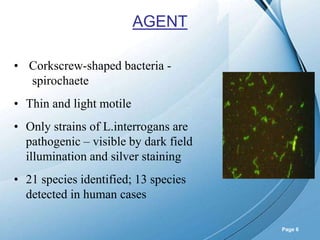
• Corkscrew-shaped bacteria -
spirochaete
• Thin and light motile
• Only strains of L.interrogans are
pathogenic – visible by dark field
illumination and silver staining
• 21 species identified; 13 species
detected in human cases
Powerpoint Templates
Page 7
AGENT
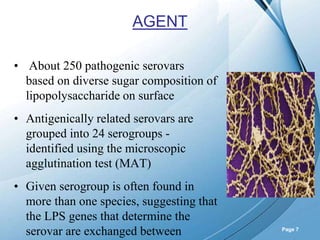
• About 250 pathogenic serovars
based on diverse sugar composition of
lipopolysaccharide on surface
• Antigenically related serovars are
grouped into 24 serogroups -
identified using the microscopic
agglutination test (MAT)
• Given serogroup is often found in
more than one species, suggesting that
the LPS genes that determine the
serovar are exchanged between
Powerpoint Templates
Page 8
AGENT
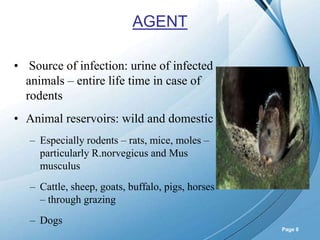
• Source of infection: urine of infected
animals – entire life time in case of
rodents
• Animal reservoirs: wild and domestic
– Especially rodents – rats, mice, moles –
particularly R.norvegicus and Mus
musculus
– Cattle, sheep, goats, buffalo, pigs, horses
– through grazing
– Dogs
Powerpoint Templates
Page 9
HOST
• Human infection is accidental
• AGE: Children acquire infection from dogs more
frequently
• OCCUPATION: veterinarians, slaughterhouse
workers, farmers, sewer maintenance workers, waste
disposal facility workers, and people who work on
derelict buildings; Rowers, kayakers and canoeists
also sometimes
• IMMUNITY: serovar specific immunity
Powerpoint Templates
Page 10
ENVIRONMENT
• Leptospira shed in urine survive for weeks in soil and
water – high level of environmental contamination
were carrier animals frequently urinate
• Poor housing
• Limited water supply
• Inadequate waste disposal
Powerpoint Templates
Page 11
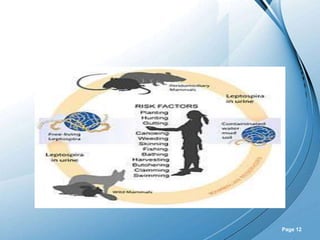
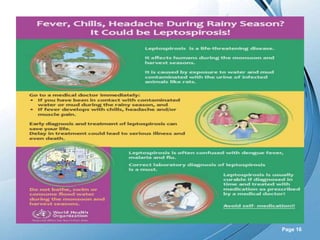
TRANSMISSION
• DIRECT CONTACT: skin abrasions or intact
mucous membrane
• INDIRECT CONTACT:
– broken skin with contaminated soil, water or vegetation
– ingestion of contaminated food or water
• DROPLET INFECTION: breathing air polluted with
droplets of urine – like while milking cattle
Powerpoint Templates
Page 12
Powerpoint Templates
Page 13
SIGNS & SYMPTOMS
• Incubation period: 7–12 days
• Biphasic disease - sudden fever with chills, intense
headache, severe myalgia, abdominal
pain, conjunctival suffusion, and occasionally a skin
rash
• First phase (septicemic phase) - 3–7 days
• Disappearance of symptoms coincides with the
appearance of antibodies and disappearance of
bacteria from bloodstream - Patient asymptomatic for
3–4 days
• Second phase - more severe; the person may have
Powerpoint Templates
Page 14
SIGNS & SYMPTOMS
• 90 percent of cases of the disease are mild
leptospirosis.
• Lung affected as the most serious and life-threatening
of all complications
• Often incorrectly diagnosed due to the nonspecific
symptoms
• Case fatality rate is 1 to 5%
Powerpoint Templates
Page 15
Clinical criteria
• History of fever within past 2weeks and at least two of
the following clinical findings: myalgia, headache,
jaundice, conjunctival suffusion without purulent
discharge, or rash (i.e. maculopapular or petechial); OR at
least one of the following:
– Aseptic meningitis
– GI symptoms (abdominal pain, nausea, vomiting,
diarrhoea)
– Pulmonary complications (cough, breathlessness,
haemoptysis)
– Cardiac arrhythmias, ECG abnormalities
– Renal insufficiency (anuria, oliguria)
Powerpoint Templates
Page 16
Powerpoint Templates
Page 17
DIAGNOSIS
• Difficult to diagnose clinically; laboratory support is
indispensable
• Supportive:
– Leptospira agglutination titer of ≥ 200 but < 800 by
Microscopic Agglutination Test (MAT) in one or more
serum specimens, or
– Demonstration of anti-Leptospira antibodies in a clinical
specimen by indirect immunofluorescence, or
– Demonstration of Leptospira in a clinical specimen by
dark-field microscopy, or
– Detection of IgM antibodies against Leptospira in an in
acute phase serum specimen.
Powerpoint Templates
Page 18
DIAGNOSIS
• Confirmed:
– Isolation of Leptospira from a clinical specimen, or
– Fourfold or greater increase in Leptospira agglutination
titer between acute- and convalescent-phase serum
specimens studied at the same laboratory, or
– Demonstration of Leptospira in tissue by direct
immunofluorescence, or
– Leptospira agglutination titer of ≥ 800 by Microscopic
Agglutination Test (MAT) in one or more serum
specimens, or
– Detection of pathogenic Leptospira DNA (e.g., by PCR)
from a clinical specimen.
Powerpoint Templates
Page 19
Case definition
• Probable
A clinically compatible case with at least one of the
following:
– Involvement in an exposure event (e.g., adventure race,
triathlon, flooding) with known associated cases, or
– Presumptive laboratory findings, but without confirmatory
laboratory evidence of Leptospira infection.
• Confirmed
– A case with confirmatory laboratory results
• Epidemiologic Linkage
– Involvement in an exposure event (e.g., adventure race,
triathlon, flooding) with associated laboratory-confirmed
Powerpoint Templates
Page 20
TREATMENT
• Penicillin G – drug of choice – 6million units daily
I/V
• Other drugs - ampicillin, amoxicillin and
Doxycycline
• In more severe cases - cefotaxime or ceftriaxone
• Glucose and salt solution infusions
• Dialysis in serious cases.
• Organ specific care and treatment are essential in
cases of renal, liver, or heart involvement
Powerpoint Templates
Page 21
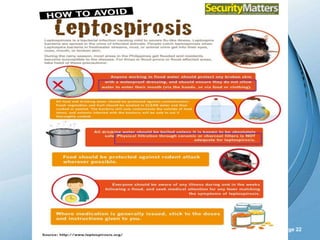
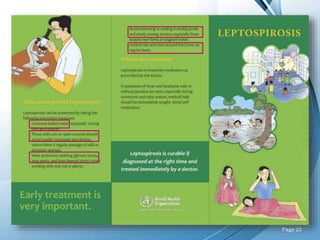
PREVENTION & CONTROL
• Control of infection source (e.g. rodent control,
animal vaccination);
• Interrupt transmission route (e.g. wearing protective
clothing, refrain from contact with infected animals
and from swimming in contaminated water, provide
clean drinking-water); or
• Prevent infection or disease in human host (e.g.
vaccination, antibiotic prophylaxis, information to
doctors, veterinarians, risk groups and the general
population).
Powerpoint Templates
Page 22
Powerpoint Templates
Page 23
Powerpoint Templates
Page 24
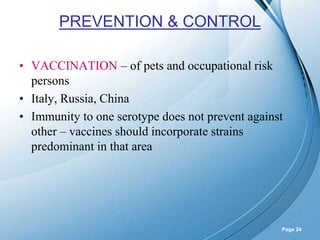
PREVENTION & CONTROL
• VACCINATION – of pets and occupational risk
persons
• Italy, Russia, China
• Immunity to one serotype does not prevent against
other – vaccines should incorporate strains
predominant in that area
Powerpoint Templates
Page 25
.THANK YOU.

Leptospirosis

  • 1.
  • 2.
    Powerpoint Templates Page 2 INTRODUCTION •Also known as – field fever, eye cather’s yellows, 7- day fever, cane-field fever • Disease was first described by Adolf Weil in 1886 • Leptospira was first observed in 1907 from a post mortem renal tissue slice • World War I - where the sodden conditions of trench warfare favoured infection • L. icterohaemorrhagiae was identified as the causative agent in pre-World War II outbreaks in Japan • Reinstated as a nationally notifiable disease as of
  • 3.
    Powerpoint Templates Page 3 SCOPEOF THE PROBLEM • Number of human cases worldwide is not well- documented • Probably ranges from 0.1 to 1 per 100 000 per year in temperate climates to 10 or more per 100 000 per year in the humid tropics • During outbreaks and in high-risk groups, 100 or more per 100 000 infected • 7-10 million peoples are infected annually
  • 4.
    Powerpoint Templates Page 4 SCOPEOF THE PROBLEM • Hurricane Mitch (1995) - outbreak of leptospirosis with pulmonary haemorrhages reported in Nicaragua • 1998 - outbreak in the continental United States. • 1998 - outbreak in Peru and Ecuador following heavy flooding • 1999 - post-cyclone outbreak was reported in Orissa, India
  • 5.
  • 6.
    Powerpoint Templates Page 6 AGENT •Corkscrew-shaped bacteria - spirochaete • Thin and light motile • Only strains of L.interrogans are pathogenic – visible by dark field illumination and silver staining • 21 species identified; 13 species detected in human cases
  • 7.
    Powerpoint Templates Page 7 AGENT •About 250 pathogenic serovars based on diverse sugar composition of lipopolysaccharide on surface • Antigenically related serovars are grouped into 24 serogroups - identified using the microscopic agglutination test (MAT) • Given serogroup is often found in more than one species, suggesting that the LPS genes that determine the serovar are exchanged between
  • 8.
    Powerpoint Templates Page 8 AGENT •Source of infection: urine of infected animals – entire life time in case of rodents • Animal reservoirs: wild and domestic – Especially rodents – rats, mice, moles – particularly R.norvegicus and Mus musculus – Cattle, sheep, goats, buffalo, pigs, horses – through grazing – Dogs
  • 9.
    Powerpoint Templates Page 9 HOST •Human infection is accidental • AGE: Children acquire infection from dogs more frequently • OCCUPATION: veterinarians, slaughterhouse workers, farmers, sewer maintenance workers, waste disposal facility workers, and people who work on derelict buildings; Rowers, kayakers and canoeists also sometimes • IMMUNITY: serovar specific immunity
  • 10.
    Powerpoint Templates Page 10 ENVIRONMENT •Leptospira shed in urine survive for weeks in soil and water – high level of environmental contamination were carrier animals frequently urinate • Poor housing • Limited water supply • Inadequate waste disposal
  • 11.
    Powerpoint Templates Page 11 TRANSMISSION •DIRECT CONTACT: skin abrasions or intact mucous membrane • INDIRECT CONTACT: – broken skin with contaminated soil, water or vegetation – ingestion of contaminated food or water • DROPLET INFECTION: breathing air polluted with droplets of urine – like while milking cattle
  • 12.
  • 13.
    Powerpoint Templates Page 13 SIGNS& SYMPTOMS • Incubation period: 7–12 days • Biphasic disease - sudden fever with chills, intense headache, severe myalgia, abdominal pain, conjunctival suffusion, and occasionally a skin rash • First phase (septicemic phase) - 3–7 days • Disappearance of symptoms coincides with the appearance of antibodies and disappearance of bacteria from bloodstream - Patient asymptomatic for 3–4 days • Second phase - more severe; the person may have
  • 14.
    Powerpoint Templates Page 14 SIGNS& SYMPTOMS • 90 percent of cases of the disease are mild leptospirosis. • Lung affected as the most serious and life-threatening of all complications • Often incorrectly diagnosed due to the nonspecific symptoms • Case fatality rate is 1 to 5%
  • 15.
    Powerpoint Templates Page 15 Clinicalcriteria • History of fever within past 2weeks and at least two of the following clinical findings: myalgia, headache, jaundice, conjunctival suffusion without purulent discharge, or rash (i.e. maculopapular or petechial); OR at least one of the following: – Aseptic meningitis – GI symptoms (abdominal pain, nausea, vomiting, diarrhoea) – Pulmonary complications (cough, breathlessness, haemoptysis) – Cardiac arrhythmias, ECG abnormalities – Renal insufficiency (anuria, oliguria)
  • 16.
  • 17.
    Powerpoint Templates Page 17 DIAGNOSIS •Difficult to diagnose clinically; laboratory support is indispensable • Supportive: – Leptospira agglutination titer of ≥ 200 but < 800 by Microscopic Agglutination Test (MAT) in one or more serum specimens, or – Demonstration of anti-Leptospira antibodies in a clinical specimen by indirect immunofluorescence, or – Demonstration of Leptospira in a clinical specimen by dark-field microscopy, or – Detection of IgM antibodies against Leptospira in an in acute phase serum specimen.
  • 18.
    Powerpoint Templates Page 18 DIAGNOSIS •Confirmed: – Isolation of Leptospira from a clinical specimen, or – Fourfold or greater increase in Leptospira agglutination titer between acute- and convalescent-phase serum specimens studied at the same laboratory, or – Demonstration of Leptospira in tissue by direct immunofluorescence, or – Leptospira agglutination titer of ≥ 800 by Microscopic Agglutination Test (MAT) in one or more serum specimens, or – Detection of pathogenic Leptospira DNA (e.g., by PCR) from a clinical specimen.
  • 19.
    Powerpoint Templates Page 19 Casedefinition • Probable A clinically compatible case with at least one of the following: – Involvement in an exposure event (e.g., adventure race, triathlon, flooding) with known associated cases, or – Presumptive laboratory findings, but without confirmatory laboratory evidence of Leptospira infection. • Confirmed – A case with confirmatory laboratory results • Epidemiologic Linkage – Involvement in an exposure event (e.g., adventure race, triathlon, flooding) with associated laboratory-confirmed
  • 20.
    Powerpoint Templates Page 20 TREATMENT •Penicillin G – drug of choice – 6million units daily I/V • Other drugs - ampicillin, amoxicillin and Doxycycline • In more severe cases - cefotaxime or ceftriaxone • Glucose and salt solution infusions • Dialysis in serious cases. • Organ specific care and treatment are essential in cases of renal, liver, or heart involvement
  • 21.
    Powerpoint Templates Page 21 PREVENTION& CONTROL • Control of infection source (e.g. rodent control, animal vaccination); • Interrupt transmission route (e.g. wearing protective clothing, refrain from contact with infected animals and from swimming in contaminated water, provide clean drinking-water); or • Prevent infection or disease in human host (e.g. vaccination, antibiotic prophylaxis, information to doctors, veterinarians, risk groups and the general population).
  • 22.
  • 23.
  • 24.
    Powerpoint Templates Page 24 PREVENTION& CONTROL • VACCINATION – of pets and occupational risk persons • Italy, Russia, China • Immunity to one serotype does not prevent against other – vaccines should incorporate strains predominant in that area
  • 25.