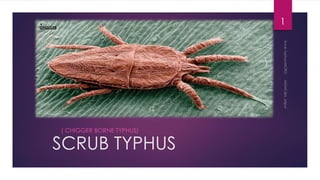
( CHIGGER BORNE TYPHUS)
SCRUB TYPHUS
1CHIGGER
Scrub typhus-MICRO MGMC&H, Jaipur
2
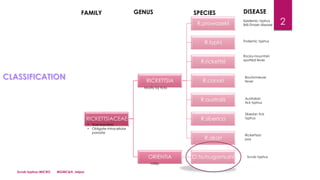
RICKETTSIACEAE
RICKETTSIA
R.prowazekii
R.typhi
R.rickettsii
R.conori
R.australis
R.siberica
R.akari
ORIENTIA O.tsutsugamushi
FAMILY GENUS SPECIES DISEASE
• True bacteria
• Obligate intracellular
parasite
Mostly by ticks
mites
Epidemic typhus
Brill-Zinsser disease
Endemic typhus
Rocky-mountain
spotted fever
Boutonneuse
fever
Australian
tick typhus
Siberian tick
typhus
Rickettsial
pox
Scrub typhus
INTRODUCTION-
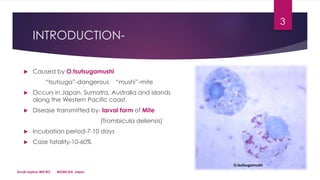
 Caused by O.tsutsugamushi
“tsutsuga”-dangerous “mushi”-mite
 Occurs in Japan, Sumatra, Australia and islands
along the Western Pacific coast.
 Disease transmitted by- larval form of Mite
(Trombicula deliensis)
 Incubation period-7-10 days
 Case fatality-10-60%
Scrub typhus-MICRO MGMC&H, Jaipur
3
O.tsutsugamushi
INFECTION-
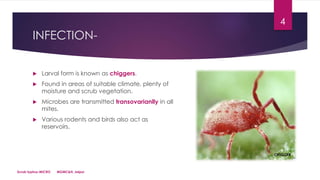
 Larval form is known as chiggers.
 Found in areas of suitable climate, plenty of
moisture and scrub vegetation.
 Microbes are transmitted transovarianlly in all
mites.
 Various rodents and birds also act as
reservoirs.
Scrub typhus-MICRO MGMC&H, Jaipur
4
CHIGGER
Scrub typhus-MICRO MGMC&H, Jaipur
5
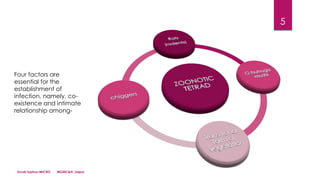
Four factors are
essential for the
establishment of
infection, namely, co-
existence and intimate
relationship among-
CLINICAL FEATURES-
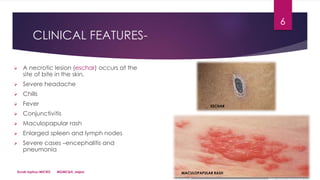
 A necrotic lesion (eschar) occurs at the
site of bite in the skin.
 Severe headache
 Chills
 Fever
 Conjunctivitis
 Maculopapular rash
 Enlarged spleen and lymph nodes
 Severe cases –encephalitis and
pneumonia
Scrub typhus-MICRO MGMC&H, Jaipur
6
MACULOPAPULAR RASH
ESCHAR
LABORATORY
DIAGNOSIS
• SPECIMENS
• DIRECT MICROSCOPY
• CULTURE (ISOLATION OF ORGANISM)
• SEROLOGY
• MOLECULAR METHODS
Scrub typhus-MICRO MGMC&H, Jaipur
7
PRE REQUISITE -
They are highly infectious, their isolation should be attempted only in labs
equipped with appropriate safety measures.
UNABLE TO GROW ON CELL FREE MEDIA.
Scrub typhus-MICRO MGMC&H, Jaipur
8
SPECIMENS-
For culture-
 Blood
 Tissue
For serological test
 serum
Scrub typhus-MICRO MGMC&H, Jaipur
9
DIRECT MICROSCOPY
GIEMSA STAIN
 Purple colored basophilic inclusions
MACHIAVELLO’S STAIN
 Red colored inclusions
Scrub typhus-MICRO MGMC&H, Jaipur
10
ISOLATION -
Scrub typhus-MICRO MGMC&H, Jaipur
11
Blood clot in skimmed milk is inoculated
intraperitoneally in male mice.
Animals are to be observed for 3-4
weeks. Temperatures are recorded
daily.
RESULT- animal becomes ill and
develop ASCITIS.
Demonstration-
 Smears are taken from peritoneum, tunica and spleen of
infected animals.
 Stained by- GIEMSA STAIN
 Culture used- 1. YOLK SAC OF CHICK EMBRYO
2. TISSUE CULTURE
3. Vero and MRC5 CELL CULTURES
(not suitable for primary inoculation)
 Identified by- IMMUNOFLUOESCENCE TEST
Scrub typhus-MICRO MGMC&H, Jaipur
12
TISSUE CULTURE
SEROLOGY
Weil felix test
Scrub typhus-MICRO MGMC&H, Jaipur
13
Others-
• Compliment fixation test
• Latex agglutination test
• Enzyme immune assay
Weil-Felix Test
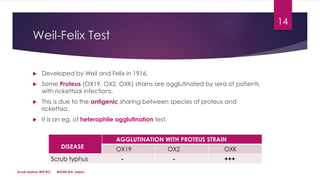
 Developed by Weil and Felix in 1916.
 Some Proteus (OX19, OX2, OXK) strains are agglutinated by sera of patients
with rickettsial infections.
 This is due to the antigenic sharing between species of proteus and
rickettsia.
 It is an eg. of heterophile agglutination test.
Scrub typhus-MICRO MGMC&H, Jaipur
14
DISEASE
AGGLUTINATION WITH PROTEUS STRAIN
OX19 OX2 OXK
Scrub typhus - - +++
Scrub typhus-MICRO MGMC&H, Jaipur
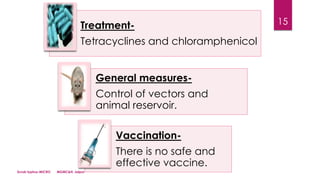
15Treatment-
Tetracyclines and chloramphenicol
General measures-
Control of vectors and
animal reservoir.
Vaccination-
There is no safe and
effective vaccine.
THANK YOU
BY-
UMANG JUNEJA
16

Scrub typhus

  • 1.
    ( CHIGGER BORNETYPHUS) SCRUB TYPHUS 1CHIGGER
  • 2.
    Scrub typhus-MICRO MGMC&H,Jaipur 2 RICKETTSIACEAE RICKETTSIA R.prowazekii R.typhi R.rickettsii R.conori R.australis R.siberica R.akari ORIENTIA O.tsutsugamushi FAMILY GENUS SPECIES DISEASE • True bacteria • Obligate intracellular parasite Mostly by ticks mites Epidemic typhus Brill-Zinsser disease Endemic typhus Rocky-mountain spotted fever Boutonneuse fever Australian tick typhus Siberian tick typhus Rickettsial pox Scrub typhus
  • 3.
    INTRODUCTION-  Caused byO.tsutsugamushi “tsutsuga”-dangerous “mushi”-mite  Occurs in Japan, Sumatra, Australia and islands along the Western Pacific coast.  Disease transmitted by- larval form of Mite (Trombicula deliensis)  Incubation period-7-10 days  Case fatality-10-60% Scrub typhus-MICRO MGMC&H, Jaipur 3 O.tsutsugamushi
  • 4.
    INFECTION-  Larval formis known as chiggers.  Found in areas of suitable climate, plenty of moisture and scrub vegetation.  Microbes are transmitted transovarianlly in all mites.  Various rodents and birds also act as reservoirs. Scrub typhus-MICRO MGMC&H, Jaipur 4 CHIGGER
  • 5.
    Scrub typhus-MICRO MGMC&H,Jaipur 5 Four factors are essential for the establishment of infection, namely, co- existence and intimate relationship among-
  • 6.
    CLINICAL FEATURES-  Anecrotic lesion (eschar) occurs at the site of bite in the skin.  Severe headache  Chills  Fever  Conjunctivitis  Maculopapular rash  Enlarged spleen and lymph nodes  Severe cases –encephalitis and pneumonia Scrub typhus-MICRO MGMC&H, Jaipur 6 MACULOPAPULAR RASH ESCHAR
  • 7.
    LABORATORY DIAGNOSIS • SPECIMENS • DIRECTMICROSCOPY • CULTURE (ISOLATION OF ORGANISM) • SEROLOGY • MOLECULAR METHODS Scrub typhus-MICRO MGMC&H, Jaipur 7
  • 8.
    PRE REQUISITE - Theyare highly infectious, their isolation should be attempted only in labs equipped with appropriate safety measures. UNABLE TO GROW ON CELL FREE MEDIA. Scrub typhus-MICRO MGMC&H, Jaipur 8
  • 9.
    SPECIMENS- For culture-  Blood Tissue For serological test  serum Scrub typhus-MICRO MGMC&H, Jaipur 9
  • 10.
    DIRECT MICROSCOPY GIEMSA STAIN Purple colored basophilic inclusions MACHIAVELLO’S STAIN  Red colored inclusions Scrub typhus-MICRO MGMC&H, Jaipur 10
  • 11.
    ISOLATION - Scrub typhus-MICROMGMC&H, Jaipur 11 Blood clot in skimmed milk is inoculated intraperitoneally in male mice. Animals are to be observed for 3-4 weeks. Temperatures are recorded daily. RESULT- animal becomes ill and develop ASCITIS.
  • 12.
    Demonstration-  Smears aretaken from peritoneum, tunica and spleen of infected animals.  Stained by- GIEMSA STAIN  Culture used- 1. YOLK SAC OF CHICK EMBRYO 2. TISSUE CULTURE 3. Vero and MRC5 CELL CULTURES (not suitable for primary inoculation)  Identified by- IMMUNOFLUOESCENCE TEST Scrub typhus-MICRO MGMC&H, Jaipur 12 TISSUE CULTURE
  • 13.
    SEROLOGY Weil felix test Scrubtyphus-MICRO MGMC&H, Jaipur 13 Others- • Compliment fixation test • Latex agglutination test • Enzyme immune assay
  • 14.
    Weil-Felix Test  Developedby Weil and Felix in 1916.  Some Proteus (OX19, OX2, OXK) strains are agglutinated by sera of patients with rickettsial infections.  This is due to the antigenic sharing between species of proteus and rickettsia.  It is an eg. of heterophile agglutination test. Scrub typhus-MICRO MGMC&H, Jaipur 14 DISEASE AGGLUTINATION WITH PROTEUS STRAIN OX19 OX2 OXK Scrub typhus - - +++
  • 15.
    Scrub typhus-MICRO MGMC&H,Jaipur 15Treatment- Tetracyclines and chloramphenicol General measures- Control of vectors and animal reservoir. Vaccination- There is no safe and effective vaccine.
  • 16.