RUBELLA VIRUS-
GERMAN
MEASLES
DEFINITION
• Rubella, also known as German measles or three-day measles, is an
infection caused by the rubella virus.
• Rubella virus (RuV) is the pathogenic agent of the disease rubella, and is
the main cause of congenital rubella syndrome when infection occurs
during the first weeks of pregnancy.
• Rubella virus is the only member of the genus Rubivirus and belongs to
the family of Matonaviridae, whose members commonly have a genome
of single-stranded RNA of positive polarity which is enclosed by an
icosahedral capsid.
RUBELLA VS RUBEOLA
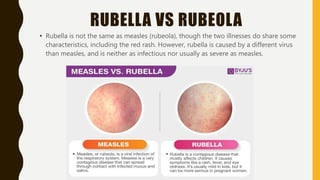
• Rubella is not the same as measles (rubeola), though the two illnesses do share some
characteristics, including the red rash. However, rubella is caused by a different virus
than measles, and is neither as infectious nor usually as severe as measles.
DIAGNOSIS
• The presence of these antibodies along with, or a short time after, the characteristic
rash- confirms the diagnosis.
• Rubella virus specific IgM antibodies are present in people recently infected by rubella
virus, but these antibodies can persist for over a year, and a positive test result needs
to be interpreted with caution.
SIGNS AND SYMPTOMS
• Rubella has symptoms that are similar to those of flu.
However, the primary symptom of rubella virus
infection is the appearance of a rash on the face which
spreads to the trunk and limbs and usually fades after
three days (that is why it is often referred to as three-
day measles).
SIGNS AND SYMPTOMS
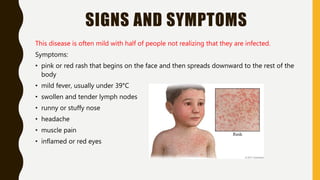
This disease is often mild with half of people not realizing that they are infected.
Symptoms:
• pink or red rash that begins on the face and then spreads downward to the rest of the
body
• mild fever, usually under 39°C
• swollen and tender lymph nodes
• runny or stuffy nose
• headache
• muscle pain
• inflamed or red eyes
PATHOGENESIS
• The virus is transmitted by the respiratory route. (droplet way)
• The virus replicates in the nasopharynx and lymph nodes.
• The virus is found in the blood 5 to 7 days after infection and spreads throughout the
body.
• During this incubation period, the patient is contagious typically for about one week
before he develops a rash and for about one week thereafter.
• The rubella virus can cause developmental malformations and is capable of crossing
the placenta and infecting the fetus where it stops cells from developing or destroys
them.
TREATMENT
• There is no specific treatment for rubella; however, management is a matter of
responding to symptoms to diminish discomfort. Treatment of newborn babies is
focused on management of the complications. Congenital heart defects and cataracts
can be corrected by direct surgery.
PREVENTION
• Rubella infections are prevented by active immunisation programs using live
attenuated virus vaccines.
• The vaccine is now usually given as part of the MMR vaccine.
• The MMR vaccine is a vaccine against measles, mumps, and rubella.
• The first dose is generally given to children around 9 to 15 months of age, with a
second dose at 15 months to 6 years of age, with at least 4 weeks between the doses.
• After two doses, 97% of people are protected against measles, 88% against mumps,
and at least 97% against rubella.
• The vaccine is also recommended in those who do not have evidence of immunity,[4]
those with well controlled HIV/AIDS
CONGENITAL RUBELLA SYNDROME
• It was discovered in 1941 by Australian Norman McAlister Gregg.
• Can occur in a developing fetus of a pregnant woman who has contracted rubella,
usually in the first trimester.
• If infection occurs 0–28 days before conception, the infant has a 43% risk of being
affected. If the infection occurs 0–12 weeks after conception, the risk increases to 81%.
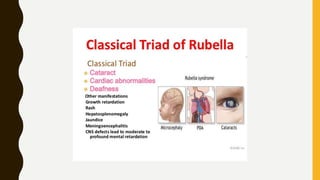
CONGENITAL RUBELLA SYNDROME
Symptoms:
• Sensorineural deafness (58% of patients)
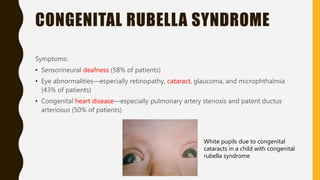
• Eye abnormalities—especially retinopathy, cataract, glaucoma, and microphthalmia
(43% of patients)
• Congenital heart disease—especially pulmonary artery stenosis and patent ductus
arteriosus (50% of patients)
White pupils due to congenital
cataracts in a child with congenital
rubella syndrome
PREVENTION OF CRS
• Vaccinating the majority of the population is effective at preventing congenital rubella
syndrome.
• For females who plan on pregnancy, the MMR (measles mumps, rubella) vaccination is
highly recommend, at least 28 days prior to conception.
• If already pregnant, vaccination is strictly prohibited as the vaccine contains a live
version of the virus.
• Other preventative actions can include the screening and vaccinations of high-risk
personal, such as medical and child care professions.
EPIDEMIOLOGY
• Rubella occurs worldwide.
• The virus tends to peak during the spring in countries with temperate climates.
• Before the vaccine against rubella was introduced in 1969, widespread outbreaks
usually occurred every 6–9 years in the United States and 3–5 years in Europe, mostly
affecting children in the 5-9 year old age group.
• Since the introduction of vaccine, occurrences have become rare in those countries
with high uptake rates.
ANTI-VACCINE MOVEMENTS THREAT
• Vaccines against preventable illnesses like measles, tetanus, mumps and rubella are
safe and effective, but healthcare professionals still find themselves having to push
back against vocal anti-vaccination campaigns.
• Parents looking for answers on the safety of vaccinations are led astray by fake news,
hoaxes, as well as religious and cultural beliefs, and sometimes even threats of violence
- which mean diseases once thought eradicated are making a comeback.
• The problem facing medicine is global, where disinformation about vaccines is readily
accepted as having equal or greater value than the work of scientists who have spent
their careers fighting disease.
• https://www.youtube.com/watch?v=Y4N4_1PNtfk
• https://www.youtube.com/watch?v=b03U6BYF9L0
THANK YOU FOR THE ATTENTION!

Rubella

  • 1.
  • 2.
    DEFINITION • Rubella, alsoknown as German measles or three-day measles, is an infection caused by the rubella virus. • Rubella virus (RuV) is the pathogenic agent of the disease rubella, and is the main cause of congenital rubella syndrome when infection occurs during the first weeks of pregnancy. • Rubella virus is the only member of the genus Rubivirus and belongs to the family of Matonaviridae, whose members commonly have a genome of single-stranded RNA of positive polarity which is enclosed by an icosahedral capsid.
  • 3.
    RUBELLA VS RUBEOLA •Rubella is not the same as measles (rubeola), though the two illnesses do share some characteristics, including the red rash. However, rubella is caused by a different virus than measles, and is neither as infectious nor usually as severe as measles.
  • 4.
    DIAGNOSIS • The presenceof these antibodies along with, or a short time after, the characteristic rash- confirms the diagnosis. • Rubella virus specific IgM antibodies are present in people recently infected by rubella virus, but these antibodies can persist for over a year, and a positive test result needs to be interpreted with caution.
  • 5.
    SIGNS AND SYMPTOMS •Rubella has symptoms that are similar to those of flu. However, the primary symptom of rubella virus infection is the appearance of a rash on the face which spreads to the trunk and limbs and usually fades after three days (that is why it is often referred to as three- day measles).
  • 6.
    SIGNS AND SYMPTOMS Thisdisease is often mild with half of people not realizing that they are infected. Symptoms: • pink or red rash that begins on the face and then spreads downward to the rest of the body • mild fever, usually under 39°C • swollen and tender lymph nodes • runny or stuffy nose • headache • muscle pain • inflamed or red eyes
  • 7.
    PATHOGENESIS • The virusis transmitted by the respiratory route. (droplet way) • The virus replicates in the nasopharynx and lymph nodes. • The virus is found in the blood 5 to 7 days after infection and spreads throughout the body. • During this incubation period, the patient is contagious typically for about one week before he develops a rash and for about one week thereafter. • The rubella virus can cause developmental malformations and is capable of crossing the placenta and infecting the fetus where it stops cells from developing or destroys them.
  • 8.
    TREATMENT • There isno specific treatment for rubella; however, management is a matter of responding to symptoms to diminish discomfort. Treatment of newborn babies is focused on management of the complications. Congenital heart defects and cataracts can be corrected by direct surgery.
  • 9.
    PREVENTION • Rubella infectionsare prevented by active immunisation programs using live attenuated virus vaccines. • The vaccine is now usually given as part of the MMR vaccine. • The MMR vaccine is a vaccine against measles, mumps, and rubella. • The first dose is generally given to children around 9 to 15 months of age, with a second dose at 15 months to 6 years of age, with at least 4 weeks between the doses. • After two doses, 97% of people are protected against measles, 88% against mumps, and at least 97% against rubella. • The vaccine is also recommended in those who do not have evidence of immunity,[4] those with well controlled HIV/AIDS
  • 10.
    CONGENITAL RUBELLA SYNDROME •It was discovered in 1941 by Australian Norman McAlister Gregg. • Can occur in a developing fetus of a pregnant woman who has contracted rubella, usually in the first trimester. • If infection occurs 0–28 days before conception, the infant has a 43% risk of being affected. If the infection occurs 0–12 weeks after conception, the risk increases to 81%.
  • 11.
    CONGENITAL RUBELLA SYNDROME Symptoms: •Sensorineural deafness (58% of patients) • Eye abnormalities—especially retinopathy, cataract, glaucoma, and microphthalmia (43% of patients) • Congenital heart disease—especially pulmonary artery stenosis and patent ductus arteriosus (50% of patients) White pupils due to congenital cataracts in a child with congenital rubella syndrome
  • 13.
    PREVENTION OF CRS •Vaccinating the majority of the population is effective at preventing congenital rubella syndrome. • For females who plan on pregnancy, the MMR (measles mumps, rubella) vaccination is highly recommend, at least 28 days prior to conception. • If already pregnant, vaccination is strictly prohibited as the vaccine contains a live version of the virus. • Other preventative actions can include the screening and vaccinations of high-risk personal, such as medical and child care professions.
  • 14.
    EPIDEMIOLOGY • Rubella occursworldwide. • The virus tends to peak during the spring in countries with temperate climates. • Before the vaccine against rubella was introduced in 1969, widespread outbreaks usually occurred every 6–9 years in the United States and 3–5 years in Europe, mostly affecting children in the 5-9 year old age group. • Since the introduction of vaccine, occurrences have become rare in those countries with high uptake rates.
  • 15.
    ANTI-VACCINE MOVEMENTS THREAT •Vaccines against preventable illnesses like measles, tetanus, mumps and rubella are safe and effective, but healthcare professionals still find themselves having to push back against vocal anti-vaccination campaigns. • Parents looking for answers on the safety of vaccinations are led astray by fake news, hoaxes, as well as religious and cultural beliefs, and sometimes even threats of violence - which mean diseases once thought eradicated are making a comeback. • The problem facing medicine is global, where disinformation about vaccines is readily accepted as having equal or greater value than the work of scientists who have spent their careers fighting disease. • https://www.youtube.com/watch?v=Y4N4_1PNtfk • https://www.youtube.com/watch?v=b03U6BYF9L0
  • 16.
    THANK YOU FORTHE ATTENTION!