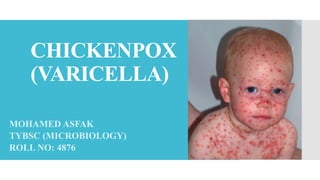
CHICKENPOX
(VARICELLA)
MOHAMED ASFAK
TYBSC (MICROBIOLOGY)
ROLL NO: 4876
Varicella-
Zoster Virus
(VZV)
• VZV has the smallest genome of the human herpesviruses (family-
Herpesviridae)
• VZV is closely related to the herpes simplex viruses (HSV),
sharing much genome homology.
• VZV is spherical and 180–200 nm in diameter, enclosed by lipid
envelope
• Pentameric capsomeres arranged in an icosahedral form
• It’s DNA is linear, double-stranded molecule
• The capsid is surrounded by loosely associated proteins known
collectively as the tegument; many of these proteins play critical
roles in initiating the process of virus reproduction in the infected
cell.
How it
spreads?
By mother to baby by pregnancy, labour or
nursing.
By airborne respiratory droplets (coughs or
sneezes).
By skin-to-skin contact (handshakes or
hugs).
By saliva (kissing or shared drinks).
By touching a contaminated surface (blanket
or doorknob).
By direct contact with the fluid that is in the
chickenpox or shingles rash blisters.
Disease
Mechanisms
Herpes Zoster (Shingles)
(2nd)
Varicella
(1st)
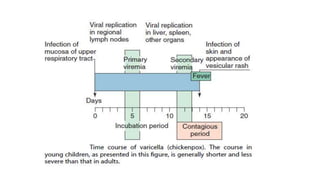
Mechanism of spread of varicella-zoster virus (VZV) within
the body
Epidemiology
VZV is extremely communicable, with rates of
infection exceeding 90% among susceptible
household contacts
The disease is spread principally by the
respiratory route but may also be spread through
contact with skin vesicles.
Patients are contagious before and during
symptoms.
More than 90% of adults in developed countries
have the VZV antibody.
• The disease develops in approximately 10% to 20% of the
population infected with VZV, and the incidence rises with age.
• Herpes zoster lesions contain viable virus and therefore may be a
source of varicella infection in a nonimmune person (child).
• After recovery from Chickenpox, the virus stays dormant (inactive)
in the nerves near the spine. Years later the virus can become active
again and cause herpes zoster (Shingles)
A reactivation of the chickenpox virus in the body,
causing a painful rash- Herpes Zoster (Shingles)
Who Is at Risk?
• Children (ages 5 to 9) experience mild classic disease.
• Teenagers and adults are at risk for more severe disease with potential
pneumonia.
• Immunocompromised people and newborns are at risk for life-
threatening pneumonia, encephalitis, and progressive disseminated
varicella.
• Elderly and immunocompromised people are at risk for recurrent
disease (herpes zoster [shingles]).
Geography/Season
• Virus is found worldwide.
• There is no seasonal incidence.
Symptoms
The early symptoms: mild fever, loss of
appetite, headache and feeling tired
followed by the appearance of a red rash that
becomes blistered and itchy, mostly on the
trunk, head and face with some on the arms
and legs.
The blisters can occur in the eyes, mouth and
throat, vagina and urinary tract. For up to 5-7
days, new blisters appear, filled with liquid
containing the virus which then form crusts
that fall off after 1-2 weeks.
• It is usually mild in children, with most healthy children recovering
fully. However for some it can be more severe requiring
hospitalization, and in rare cases, death.
• Complication:
Skin infections
Inflammation of the brain
Pneumonia (Varicella Pneumonia)
Blood infections
Those who catch the disease from another household member often
have more severe chickenpox than the person they caught it from.
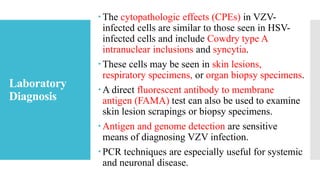
Laboratory
Diagnosis
The cytopathologic effects (CPEs) in VZV-
infected cells are similar to those seen in HSV-
infected cells and include Cowdry type A
intranuclear inclusions and syncytia.
These cells may be seen in skin lesions,
respiratory specimens, or organ biopsy specimens.
A direct fluorescent antibody to membrane
antigen (FAMA) test can also be used to examine
skin lesion scrapings or biopsy specimens.
Antigen and genome detection are sensitive
means of diagnosing VZV infection.
PCR techniques are especially useful for systemic
and neuronal disease.
• Isolation of VZV is not routinely done because the virus is labile
during transport to the laboratory and replicates poorly in vitro.
• Serologic tests that detect antibodies to VZV are used to screen
populations for immunity to VZV.
• However, antibody levels are normally low, so sensitive tests such as
fluorescent antibody to membrane antigen test (FAMA) and enzyme-
linked immunosorbent assay (ELISA) must be performed to detect
the antibody.
• A significant increase in antibody level can be detected in people
experiencing herpes zoster.
Syncytia is formed by fusion of an infected cells with neighboring cells
leading to the formation of multi-nucleate enlarged cells. This event is
induced by surface expression of viral fusion protein that are fusogenic
directly at the host cell membrane.
Syncytia can only happen with viruses able to directly fuse at the
cellular surface without the need of endocytosis.
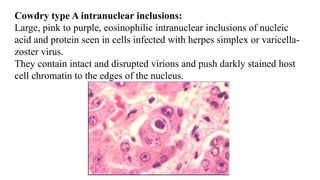
Cowdry type A intranuclear inclusions:
Large, pink to purple, eosinophilic intranuclear inclusions of nucleic
acid and protein seen in cells infected with herpes simplex or varicella-
zoster virus.
They contain intact and disrupted virions and push darkly stained host
cell chromatin to the edges of the nucleus.
Treatment,
Prevention,
and Control
Treatment may be appropriate for adults and
immunocompromised patients with VZV
infections and for people with shingles, but no
treatment is usually necessary for children with
varicella. Exposure of children to VZV early in life is
often encouraged. (induces lifelong immunity)
• Acyclovir, Famciclovir, and Valacyclovir have been approved for the
treatment of VZV infections.
• There is no good treatment, but analgesics and other painkillers,
topical anesthetics, or capsaicin cream may provide some relief
• Immunosuppressed patients susceptible to severe disease may be
protected from serious disease through the administration of varicella-
zoster immunoglobulin (VZIG).
VZIG is prepared through the pooling of plasma from seropositive
people. VZIG prophylaxis can prevent viremic spread leading to
disease but is ineffective as a therapy for patients already suffering
from active varicella or herpes zoster disease.
Vaccination
A live attenuated vaccine for VZV (Oka strain)
has been licensed for use in the United States and
elsewhere and is administered on the same
schedule as the measles, mumps, and rubella
vaccine.
Dosage
Children should receive two doses of the vaccine.
The first dose should be given when the child is 12 - 15 months old.
A second dose should be given when they are 4 - 6 years old. This
second dose can be given before age 4, as long as 3 months have passed
since the first dose.
People aged 13 and older who have not received the vaccine and have
not had chickenpox should get two doses, 4 to 8 weeks apart. People
(aged 13 and older) who have had a previous dose and have not had the
disease should receive a second dose.
Reference
 Medical Microbiology, 7th edition-Patrick R. Murray, Ken S.
Rosenthal, Michael A. Pfaller,
 http://www.immune.org.nz
 https://www.quora.com
 https://en.wikipedia.org
 https://www.practo.com

Chickenpox (Varicella)

  • 1.
  • 3.
  • 4.
    • VZV hasthe smallest genome of the human herpesviruses (family- Herpesviridae) • VZV is closely related to the herpes simplex viruses (HSV), sharing much genome homology. • VZV is spherical and 180–200 nm in diameter, enclosed by lipid envelope • Pentameric capsomeres arranged in an icosahedral form • It’s DNA is linear, double-stranded molecule • The capsid is surrounded by loosely associated proteins known collectively as the tegument; many of these proteins play critical roles in initiating the process of virus reproduction in the infected cell.
  • 5.
    How it spreads? By motherto baby by pregnancy, labour or nursing. By airborne respiratory droplets (coughs or sneezes). By skin-to-skin contact (handshakes or hugs). By saliva (kissing or shared drinks). By touching a contaminated surface (blanket or doorknob). By direct contact with the fluid that is in the chickenpox or shingles rash blisters.
  • 6.
  • 7.
    Mechanism of spreadof varicella-zoster virus (VZV) within the body
  • 9.
    Epidemiology VZV is extremelycommunicable, with rates of infection exceeding 90% among susceptible household contacts The disease is spread principally by the respiratory route but may also be spread through contact with skin vesicles. Patients are contagious before and during symptoms. More than 90% of adults in developed countries have the VZV antibody.
  • 10.
    • The diseasedevelops in approximately 10% to 20% of the population infected with VZV, and the incidence rises with age. • Herpes zoster lesions contain viable virus and therefore may be a source of varicella infection in a nonimmune person (child). • After recovery from Chickenpox, the virus stays dormant (inactive) in the nerves near the spine. Years later the virus can become active again and cause herpes zoster (Shingles)
  • 11.
    A reactivation ofthe chickenpox virus in the body, causing a painful rash- Herpes Zoster (Shingles)
  • 12.
    Who Is atRisk? • Children (ages 5 to 9) experience mild classic disease. • Teenagers and adults are at risk for more severe disease with potential pneumonia. • Immunocompromised people and newborns are at risk for life- threatening pneumonia, encephalitis, and progressive disseminated varicella. • Elderly and immunocompromised people are at risk for recurrent disease (herpes zoster [shingles]). Geography/Season • Virus is found worldwide. • There is no seasonal incidence.
  • 13.
    Symptoms The early symptoms:mild fever, loss of appetite, headache and feeling tired followed by the appearance of a red rash that becomes blistered and itchy, mostly on the trunk, head and face with some on the arms and legs. The blisters can occur in the eyes, mouth and throat, vagina and urinary tract. For up to 5-7 days, new blisters appear, filled with liquid containing the virus which then form crusts that fall off after 1-2 weeks.
  • 14.
    • It isusually mild in children, with most healthy children recovering fully. However for some it can be more severe requiring hospitalization, and in rare cases, death. • Complication: Skin infections Inflammation of the brain Pneumonia (Varicella Pneumonia) Blood infections
  • 15.
    Those who catchthe disease from another household member often have more severe chickenpox than the person they caught it from.
  • 16.
    Laboratory Diagnosis The cytopathologic effects(CPEs) in VZV- infected cells are similar to those seen in HSV- infected cells and include Cowdry type A intranuclear inclusions and syncytia. These cells may be seen in skin lesions, respiratory specimens, or organ biopsy specimens. A direct fluorescent antibody to membrane antigen (FAMA) test can also be used to examine skin lesion scrapings or biopsy specimens. Antigen and genome detection are sensitive means of diagnosing VZV infection. PCR techniques are especially useful for systemic and neuronal disease.
  • 17.
    • Isolation ofVZV is not routinely done because the virus is labile during transport to the laboratory and replicates poorly in vitro. • Serologic tests that detect antibodies to VZV are used to screen populations for immunity to VZV. • However, antibody levels are normally low, so sensitive tests such as fluorescent antibody to membrane antigen test (FAMA) and enzyme- linked immunosorbent assay (ELISA) must be performed to detect the antibody. • A significant increase in antibody level can be detected in people experiencing herpes zoster.
  • 18.
    Syncytia is formedby fusion of an infected cells with neighboring cells leading to the formation of multi-nucleate enlarged cells. This event is induced by surface expression of viral fusion protein that are fusogenic directly at the host cell membrane. Syncytia can only happen with viruses able to directly fuse at the cellular surface without the need of endocytosis.
  • 19.
    Cowdry type Aintranuclear inclusions: Large, pink to purple, eosinophilic intranuclear inclusions of nucleic acid and protein seen in cells infected with herpes simplex or varicella- zoster virus. They contain intact and disrupted virions and push darkly stained host cell chromatin to the edges of the nucleus.
  • 20.
    Treatment, Prevention, and Control Treatment maybe appropriate for adults and immunocompromised patients with VZV infections and for people with shingles, but no treatment is usually necessary for children with varicella. Exposure of children to VZV early in life is often encouraged. (induces lifelong immunity)
  • 21.
    • Acyclovir, Famciclovir,and Valacyclovir have been approved for the treatment of VZV infections. • There is no good treatment, but analgesics and other painkillers, topical anesthetics, or capsaicin cream may provide some relief • Immunosuppressed patients susceptible to severe disease may be protected from serious disease through the administration of varicella- zoster immunoglobulin (VZIG). VZIG is prepared through the pooling of plasma from seropositive people. VZIG prophylaxis can prevent viremic spread leading to disease but is ineffective as a therapy for patients already suffering from active varicella or herpes zoster disease.
  • 22.
    Vaccination A live attenuatedvaccine for VZV (Oka strain) has been licensed for use in the United States and elsewhere and is administered on the same schedule as the measles, mumps, and rubella vaccine.
  • 23.
    Dosage Children should receivetwo doses of the vaccine. The first dose should be given when the child is 12 - 15 months old. A second dose should be given when they are 4 - 6 years old. This second dose can be given before age 4, as long as 3 months have passed since the first dose. People aged 13 and older who have not received the vaccine and have not had chickenpox should get two doses, 4 to 8 weeks apart. People (aged 13 and older) who have had a previous dose and have not had the disease should receive a second dose.
  • 24.
    Reference  Medical Microbiology,7th edition-Patrick R. Murray, Ken S. Rosenthal, Michael A. Pfaller,  http://www.immune.org.nz  https://www.quora.com  https://en.wikipedia.org  https://www.practo.com