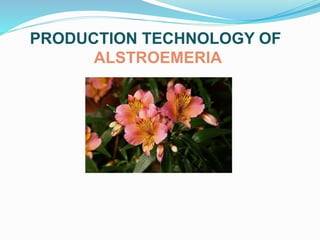
PRODUCTION TECHNOLOGY OF
ALSTROEMERIA
Scientific name:- Alstroemeria aurantiaca
Common name:- Inca or Peruvian Lily
Family:- Alstromeriaceae
Origin:- South America
Chromosome No. :- 2n = 16
The genus Alstroemeria has about 60 species. They were
found in different environmental conditions – swamps,
woodland, desert areas and rocky hillsides. In India it is grown
profusely in the Nilgiris and Bangalore .
INTRODUCTION
IMPORTANCE AND USES
 Being a hardy perennial, Alstroemeria is easy to grow in bed,
border and plot, and are used for garden display.
 Straight and erect flower stems of various colors are used as cut
flowers. The cut flowers stay fresh in water for 2-3 weeks at 2-
4°C.
 It can serve as a lovely flower in arrangements and bouquets.
 The flower symbolizing for friendship, it grabs the demand on
Friendship’s day next to yellow rose.
CULTIVARS
•White:- Amanda, Mona Lisa, White Wings
•Red:- Carmen, King Cardinal, Red Sunset
•Pink:- Capitol Fiona, Veronica, Pink Triumph
•Orange:- Harlequin, Sunrise, Orange King
•Yellow:- Canaria, Friendship, Rio Bright
•Purple:- Marina, Joy, Sunstar
•Bronze:- Butterscotch
•Lavender:- Barbara, Butterfly, Jubilee
•Salmon:- Atlas
•Ligtu Hybrid bears flowers in shades of pink, yellow,
orange or streaked with contrasting colors.
ENVIRONMENT REQUIREMENTS
1) Climate: Alstroemeria thrives well in cool sub-tropical climate
and need partial shade. Low humidity causes leaf scorch.
2) Soil: It grows well in light, well drained and slightly acidic soil
for the succulent roots to develop freely. Recommended pH is
5.5-6.5. In sandy soil, incorporation of organic matter into top
soil helps in water retention.
3) Temperature : Alstroemeria cultivars are sensitive to high
temperatures. So, soil temperature above 20ºC must be avoided
because it inhibits and reduce flower induction. The flower
development occurs at temperatures between 14-20ºC.
Alstroemeria does best when humidity is between 65-85%.
CULTURAL PRACTICES
a. Soil preparation:- For proper growth the soil must be ploughed
to a depth of 450mm after manuring . For cut flower production
soil must be sterilized with methyl bromide.
b. Propagation:- It is propagated by 2 ways- vegetative and seeds.
Generally propagated by rhizomes and seed propagation is done
for crop improvements.
c. Planting:- The planting time is Nov- May. Rhizomes are set 7-
10cm deep.
d) Spacing:- 50cm x 40cm is recommended.
e) Manures and fertilizers:- FYM= 5-8 kg/m2
N:P:K @ 15: 30 : 20 g/m2
f) Shoot thinning:- Removing of thin blind shoots leads to
quality bloom. Young plants are thinned in spring whereas old
plants are thinned in autumn.
g) Mulching:- The effect of black polythene mulch is positive in
growth and flowering.
h)Irrigation:- Alstroemeria perform best when plant gets frequent,
fairly heavy irrigation. In autumn and winter, it requires less water.
HARVESTING
Flowers are harvested when they show full color but are not
quite open. It is done by rapid upward pulling of the stems out
of soil, instead of cutting.
Yield = 80-100 blooms/ m2
STORAGE
Rhizomes are stored in cool places and not allowed to dry.
Flowers are stored by wet preservation.
DISEASES
1.Pythium rot:-It is sometimes a problem
only when soil is too wet. Its symptom is
glazed appearance to a part of root which
ultimately rots. It can be controlled by
spraying Fluralaxyl @ o.2%.
2.Rhizoctonia wilt: - It develops under
warm humid conditions. The stems show
rotting just above soil level.The under-
ground portions of stem often shows brown
stain. It can be controlled by sterilizing seed
bed with 4% Formalin at planting.
PESTS
1.Aphids:- It causes misforming to leaf
and blooms. It sucks cell sap and retards growth.
Spraying of Malathion 1% controls the damage.
2.Leaf miner:- It makes holes on the underside
of foliage. To control spray Methomyl 1%
repeatedly 3 times at an interval of 5 days
3. Thrips:- It mostly damages young foliage.
Silver strains appear and shoot tops are
crumbled. Flowers are malformed and petal tops
become brown. Spray Methomyl 1% as control.
REFERENCES
 Talukdar, M.C. ‘Alstroemeria’. Advances in Ornamental
Horticulture.
 Bose,T.K. et al. ‘Commercial Flowers’.
 Wikipedia.org/wiki/File:alstroemeria
 Sunset Western Garden book,1995:606-607
THANK YOU

Alstroemeria

  • 1.
  • 2.
    Scientific name:- Alstroemeriaaurantiaca Common name:- Inca or Peruvian Lily Family:- Alstromeriaceae Origin:- South America Chromosome No. :- 2n = 16 The genus Alstroemeria has about 60 species. They were found in different environmental conditions – swamps, woodland, desert areas and rocky hillsides. In India it is grown profusely in the Nilgiris and Bangalore . INTRODUCTION
  • 3.
    IMPORTANCE AND USES Being a hardy perennial, Alstroemeria is easy to grow in bed, border and plot, and are used for garden display.  Straight and erect flower stems of various colors are used as cut flowers. The cut flowers stay fresh in water for 2-3 weeks at 2- 4°C.  It can serve as a lovely flower in arrangements and bouquets.  The flower symbolizing for friendship, it grabs the demand on Friendship’s day next to yellow rose.
  • 4.
    CULTIVARS •White:- Amanda, MonaLisa, White Wings •Red:- Carmen, King Cardinal, Red Sunset •Pink:- Capitol Fiona, Veronica, Pink Triumph •Orange:- Harlequin, Sunrise, Orange King •Yellow:- Canaria, Friendship, Rio Bright •Purple:- Marina, Joy, Sunstar •Bronze:- Butterscotch •Lavender:- Barbara, Butterfly, Jubilee •Salmon:- Atlas •Ligtu Hybrid bears flowers in shades of pink, yellow, orange or streaked with contrasting colors.
  • 5.
    ENVIRONMENT REQUIREMENTS 1) Climate:Alstroemeria thrives well in cool sub-tropical climate and need partial shade. Low humidity causes leaf scorch. 2) Soil: It grows well in light, well drained and slightly acidic soil for the succulent roots to develop freely. Recommended pH is 5.5-6.5. In sandy soil, incorporation of organic matter into top soil helps in water retention. 3) Temperature : Alstroemeria cultivars are sensitive to high temperatures. So, soil temperature above 20ºC must be avoided because it inhibits and reduce flower induction. The flower development occurs at temperatures between 14-20ºC. Alstroemeria does best when humidity is between 65-85%.
  • 6.
    CULTURAL PRACTICES a. Soilpreparation:- For proper growth the soil must be ploughed to a depth of 450mm after manuring . For cut flower production soil must be sterilized with methyl bromide. b. Propagation:- It is propagated by 2 ways- vegetative and seeds. Generally propagated by rhizomes and seed propagation is done for crop improvements. c. Planting:- The planting time is Nov- May. Rhizomes are set 7- 10cm deep.
  • 7.
    d) Spacing:- 50cmx 40cm is recommended. e) Manures and fertilizers:- FYM= 5-8 kg/m2 N:P:K @ 15: 30 : 20 g/m2 f) Shoot thinning:- Removing of thin blind shoots leads to quality bloom. Young plants are thinned in spring whereas old plants are thinned in autumn. g) Mulching:- The effect of black polythene mulch is positive in growth and flowering. h)Irrigation:- Alstroemeria perform best when plant gets frequent, fairly heavy irrigation. In autumn and winter, it requires less water.
  • 8.
    HARVESTING Flowers are harvestedwhen they show full color but are not quite open. It is done by rapid upward pulling of the stems out of soil, instead of cutting. Yield = 80-100 blooms/ m2 STORAGE Rhizomes are stored in cool places and not allowed to dry. Flowers are stored by wet preservation.
  • 9.
    DISEASES 1.Pythium rot:-It issometimes a problem only when soil is too wet. Its symptom is glazed appearance to a part of root which ultimately rots. It can be controlled by spraying Fluralaxyl @ o.2%. 2.Rhizoctonia wilt: - It develops under warm humid conditions. The stems show rotting just above soil level.The under- ground portions of stem often shows brown stain. It can be controlled by sterilizing seed bed with 4% Formalin at planting.
  • 10.
    PESTS 1.Aphids:- It causesmisforming to leaf and blooms. It sucks cell sap and retards growth. Spraying of Malathion 1% controls the damage. 2.Leaf miner:- It makes holes on the underside of foliage. To control spray Methomyl 1% repeatedly 3 times at an interval of 5 days 3. Thrips:- It mostly damages young foliage. Silver strains appear and shoot tops are crumbled. Flowers are malformed and petal tops become brown. Spray Methomyl 1% as control.
  • 11.
    REFERENCES  Talukdar, M.C.‘Alstroemeria’. Advances in Ornamental Horticulture.  Bose,T.K. et al. ‘Commercial Flowers’.  Wikipedia.org/wiki/File:alstroemeria  Sunset Western Garden book,1995:606-607
  • 12.