Krishna S. Tomar
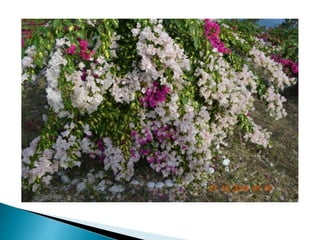
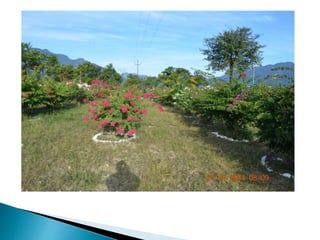
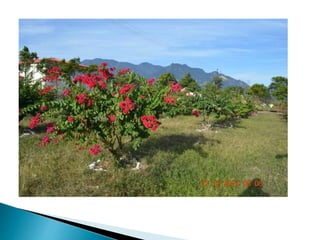
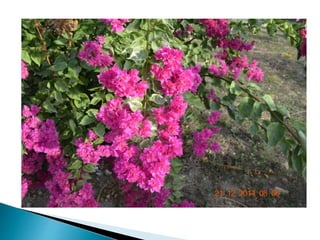
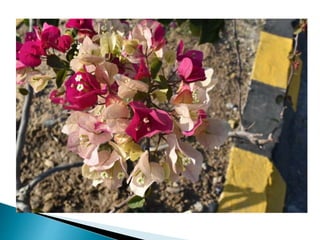
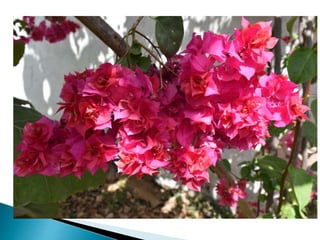
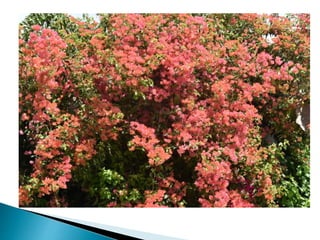
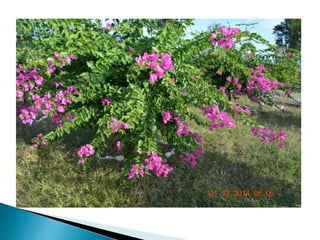
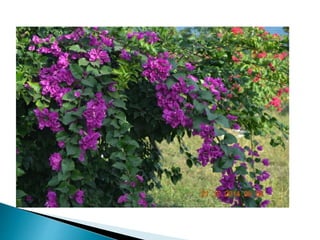
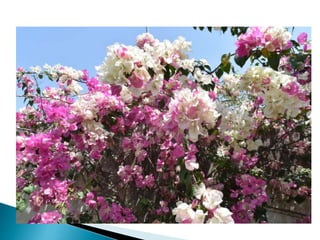
 Bougainvillea is a popular ornamental plant
mainly grown for its attractive colourful
bracts that splash colour to the surrounding.
 It is popular among parks, home and
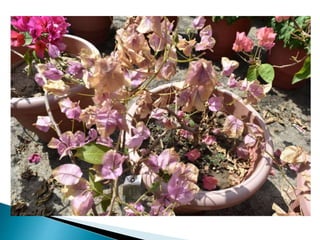
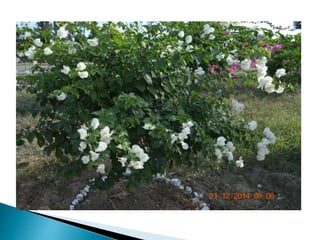
institutional gardens grown mainly as bush,
climber, hedge, topiary, standard, pot plant,
bonsai, on pergolas and trees.
 Wide adaptability to different agro-climatic
conditions and easy multiplication has made
it a popular ornamental plant of the world.
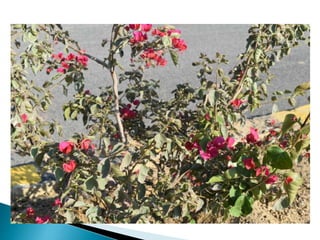
 Moreover, as it is a drought and pollution
resistant plant, it is well suited for industrial
places and on road dividers.
 Bougainvillea is originated in South America
and was first collected by French Botanist Dr.
Philibert Commerson, a French Botanist, at
Rio-de-Janeiro, Brazil in 1766-69.
 It was named after his close friend and ship’s
admiral Louis-Antoine de Bougainville, who
commanded the ship La Boudeuse.
 The generic name as Buginvillea was first
published by A. L. de Jusseau in his work
Genera Plantarum in 1789.
 It was finally corrected to Bougainvillea in the
Index Kewensis in the1930.
 It is not clear whether the cultivars outside South
America were derived from plants already
cultivated in Brazil or from truly wild plants.
 Much of the evolution in Bougainvillea took
place outside its native home, primary factor
being natural hybridisation and showy bracts
accompanied by self incompatibility.
 The B. glabra and B. spectabilis are widely used
species and most of the present Bougainvillea
cultivars are thought to have originated from
them.
 Third species, B. peruviana is also of
horticultural importance.
 Bougainvillea also has three hybrid groups
namely,
 B. × buttiana (glabra × peruviana),
 B. × specto-peruviana and
 B. × specto-glabra.
 Among these, B. spectabilis and B. glabra
were reported to be more tolerant to cooler
climate.
 Bougainvillea grows well throughout the
plains of India, but only B. glabra thrives
well at higher altitudes.
 Considering its ornamental and commercial
importance in nursery trade, R and D were taken
up by different national research institutes (IARI,
IIHR, NBRI, BARC), state agricultural universities,
Agri-Horticultural Societies (Kolkata and
Chennai) and even by progressive nursery men.
 As a result, a large number of new cultivars have
been developed in India.
 Considering the contribution made by India, the
International Registration Authority for new
cultivars lies in the Indian Agricultural Research
Institute (IARI), New Delhi, which is an
international recognition conferred upon by
International Society for Horticultural Science
(ISHS).
 In India, crop improvement work was started in
early 20th century with the introduction of B.
spectabilis in 1860 from Europe.
 However, the popularity really started with the
introduction of cv. ‘Mrs. Butt’ from Royal Botanic
Garden, Kew to The Royal Horticultural Society,
Kolkata in 1923.
 Percy Lancaster, the renowned British
horticulturist, has been credited for the
development of first cultivar of Bougainvillea -
‘Scarlet Queen’ in 1920 and subsequently
another excellent bi-coloured cultivar ‘Mary
Palmer’ developed by him paved the way for
Bougainvillea cultivation in India.
 The year 1910 was marked by a major discovery
in cultivated Bougainvillea when Mrs. R.V. Butt
brought crimson coloured Bougainvillea
cuttings from Cratagena (Columbia) to Trinidad.
 Over the years the cultivar turned out to be ever
mutating, being the source of various colour
mutants that have added materially to the
richness of the colour in the genus.
 The plant was named after Mrs. Butt. This plant
reached Kew in 1915 and from there it got
distributed to India, Africa, Australia, Malaya and
Singapore in 1923.
 The cv. ‘Scarlet Queen’ was introduced to India
directly from West Indies by Mr. Tomlinson in
1920. Percy Lancaster gave the name Scarlet
Queen to this variety.
 According to him, the coloured bracts of this
plant are slightly darker than Mrs. Butt but the
actual flower is malformed, so instead of there
being three white or cream coloured flowers in
the bracts, there are merely little bunch of
anthers.
 In 1931, Mrs. McClean of Trinidad produced
apricot orange bracts instead of the normal
crimson bracts of Mrs. Butt plant. This variant
was propagated by R.O. Williams and named as
cv. ‘Mrs. McClean’
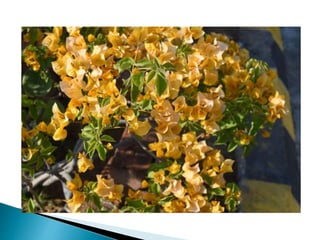
 The cv. ‘Scarlet Queen’ produced orange
coloured variety in 1932 at Madras in the garden
of Mrs. Louis Wathen.
 It was named as ‘Louis Wathen’ by Mr. B.S.
Nirody. Subsequently majolica yellow sports
appeared from Louis Wathen and Mrs. McClean
by spontaneous bud variation and were named as
Enid Lancaster and Mary Baring.
 S. Percy Lancaster had separated a purple
coloured sport from Scarlet Queen in 1942 and
named it as Alick Lancaster. The variegated
leaved bud sports from Scarlet Queen has been
released as cvs. ‘Scarlet Queen Variegata’ and
‘Rao’
 An important floriferous and recurrent
blooming seedling was raised by P.S.
Swaminathan at Madras from Princess
Margaret rose and named it Mrs. H.C. Buck.
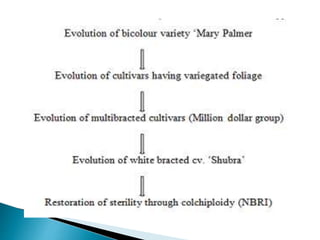
 The famous bicoloured variety Mary Palmer
was isolated from Mrs. H.C. Buck in 1949 by
S. Percy Lancaster.
 ‘Thimma’ with variegated foliage and
‘Shubhra’ with pure white bracts were evolved
as a sport of Mary Palmer.
 To understand the morphology of a flower is
very important for the crop improvement
programme of any crop.
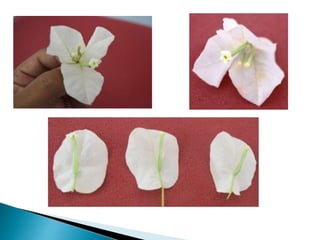
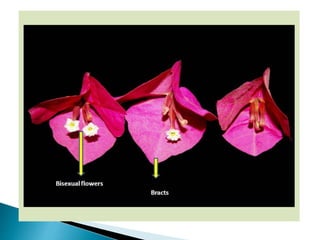
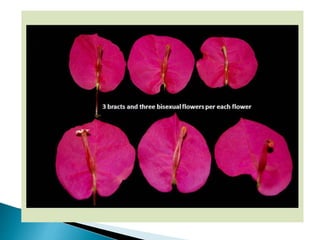
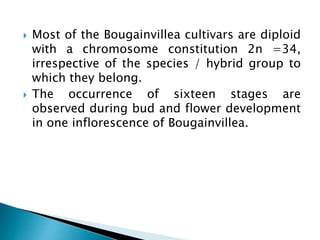
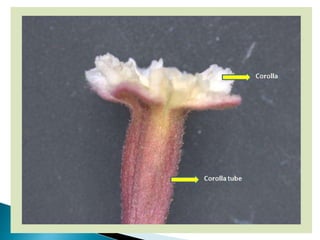
 The flowers of Bougainvillea are
hermaphrodite, tubular in shape with a
constriction in the middle and borne in
clusters of three, each flower subtended by a
brightly coloured bract, which helps to attract
insects for cross pollination.
 Bract colour in bougainvillea is contributed by
betacyanins and betaxanthins i.e. betalains.
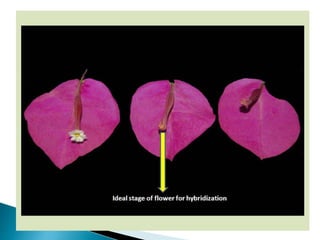
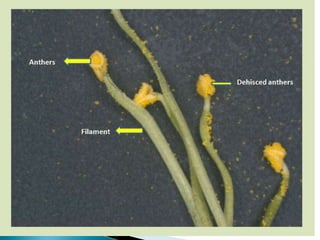
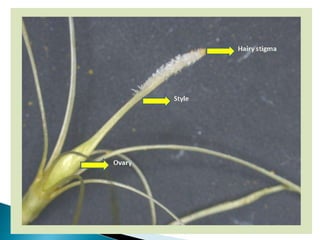
 The tip of the flower is conspicuous with a
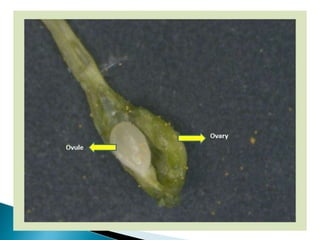
star. There is a solitary carpel at the base
surrounded by a ring shaped nectar. During
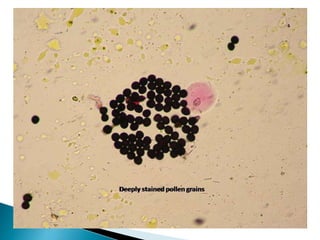
morning hours (around 10 am) anthesis takes
place followed by anther dehiscence and
stigma receptivity.
 Butterflies visit the flowers attracted by the
brightly coloured bracts and the nectar
glands aids in cross pollination.
 The opened flowers remain so for a day, after
which the upper part of the flower tube gets
twisted in a spiral.
 Most of the Bougainvillea cultivars are diploid
with a chromosome constitution 2n =34,
irrespective of the species / hybrid group to
which they belong.
 The occurrence of sixteen stages are
observed during bud and flower development
in one inflorescence of Bougainvillea.
 India is one of the major repositories of a wide range
of bougainvilleas, and approximately 50 % of the
present-day cultivars have been evolved in India.
 The work on development of Bougainvillea has largely
been done by the Agri-Horticultural Societies at
Calcutta and Madras.
 The Lal Bagh Garden (Bengaluru) also contributed a
great deal by introducing a large number of exotic
cultivars, particularly the multi-bracted varieties from
the Philippines.
 Different breeding approaches followed in
bougainvillea are hybridization, polyploidy, mutation
and bud sports. A large number of varieties have
been developed at the NBRI (Lucknow), BARC
(Mumbai) and IIHR (Bengaluru).
 Hybridization enable the origin of totally new
colour forms of Bougainvillea. It also in-
creased the possibilities and limits of
selection.
 The natural hybridization with polyploidy has
been the single factor contributing to
evolution in nature and under domestication
by plant breeding.
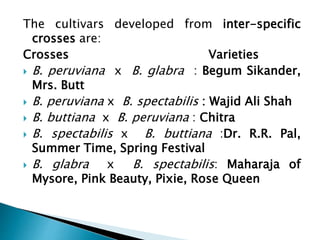
The cultivars developed from inter-specific
crosses are:
Crosses Varieties
 B. peruviana x B. glabra : Begum Sikander,
Mrs. Butt
 B. peruviana x B. spectabilis : Wajid Ali Shah
 B. buttiana x B. peruviana : Chitra
 B. spectabilis x B. buttiana :Dr. R.R. Pal,
Summer Time, Spring Festival
 B. glabra x B. spectabilis: Maharaja of
Mysore, Pink Beauty, Pixie, Rose Queen
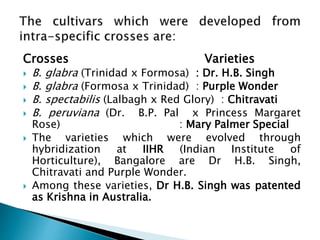
Crosses Varieties
 B. glabra (Trinidad x Formosa) : Dr. H.B. Singh
 B. glabra (Formosa x Trinidad) : Purple Wonder
 B. spectabilis (Lalbagh x Red Glory) : Chitravati
 B. peruviana (Dr. B.P. Pal x Princess Margaret
Rose) : Mary Palmer Special
 The varieties which were evolved through
hybridization at IIHR (Indian Institute of
Horticulture), Bangalore are Dr H.B. Singh,
Chitravati and Purple Wonder.
 Among these varieties, Dr H.B. Singh was patented
as Krishna in Australia.
 The hybridization is not possible in multi-
bracted bougainvillea due to absence of
flower tubes/ flowers and all varieties are not
able to set seeds at all places. Hence, a
alternative method, i.e. induced mutation
breeding resulted in evolution of different
new Bougainvillea cultivars.
 Mutation leads to the origin of many new
forms of Bougainvillea. In recent years,
mutation breeding has been used as a
valuable supplement to traditional methods
of plant breeding which helps in the
development of better cultivars.
 Most of the cultivars of Bougainvillea were
developed through selection of ‘bud sports’
or by mutation breeding.
 Mutation breeding is one of the important
methods to create variability in flower crops
and it also reduces the time required to
develop a new variety.
 Mutation breeding is the only method that
can be used to improve double bracted
Bougainvillea, since conventional cross-
breeding is not possible because of the
absence of flowers.
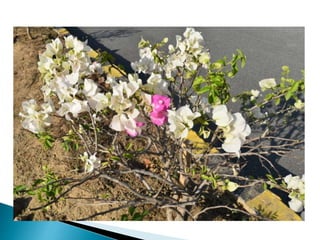
 Different bract colours ranging from white to
yellow, orange, magenta, red, purple and
violet have arisen as a result of mutation
among various forms of three basic species.
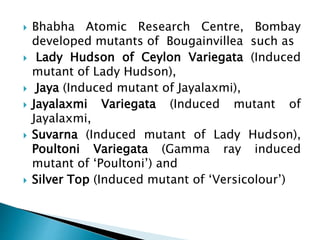
 Bhabha Atomic Research Centre, Bombay
developed mutants of Bougainvillea such as
 Lady Hudson of Ceylon Variegata (Induced
mutant of Lady Hudson),
 Jaya (Induced mutant of Jayalaxmi),
 Jayalaxmi Variegata (Induced mutant of
Jayalaxmi,
 Suvarna (Induced mutant of Lady Hudson),
Poultoni Variegata (Gamma ray induced
mutant of ‘Poultoni’) and
 Silver Top (Induced mutant of ‘Versicolour’)
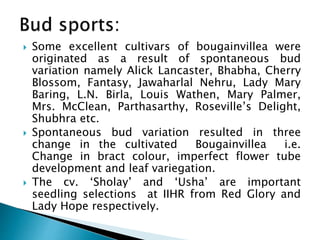
 Some excellent cultivars of bougainvillea were
originated as a result of spontaneous bud
variation namely Alick Lancaster, Bhabha, Cherry
Blossom, Fantasy, Jawaharlal Nehru, Lady Mary
Baring, L.N. Birla, Louis Wathen, Mary Palmer,
Mrs. McClean, Parthasarthy, Roseville’s Delight,
Shubhra etc.
 Spontaneous bud variation resulted in three
change in the cultivated Bougainvillea i.e.
Change in bract colour, imperfect flower tube
development and leaf variegation.
 The cv. ‘Sholay’ and ‘Usha’ are important
seedling selections at IIHR from Red Glory and
Lady Hope respectively.
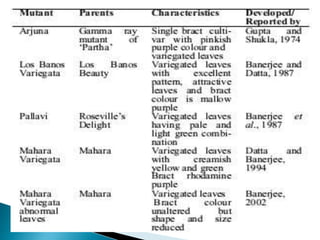
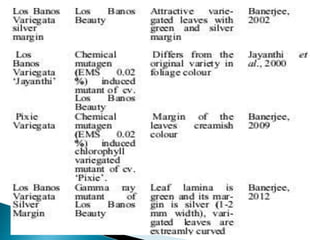
 From cv. ‘Arjuna’ a chlorophyll variegated bud sport
originated which were named as ‘Abhimanyu’. It was
detected by Dr. Banerjee at NBRI, Lucknow.
 In the year 1963-1967, Dr. J.V. Pancho first reported
the multibracted cultivars of bougainvillea in Laguna,
Phillipines.
 The cultivar such as Carmentica, Cherry Blossom,
Mahara, Godrej Cherry Blossom, Los Banos Beauty,
Mahara Variegata, Pallavi, Rosevilles Delight, Archana
and Marietta are multibracted.
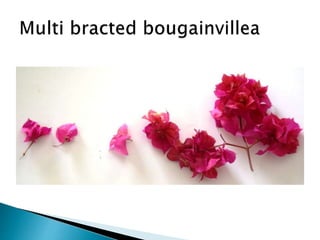
 They are called multibracted cultivars as they have
20-40 bracts as compared to the normally occurring
three bracted cultivars of bougainvillea. Also the
flower tube is absent or rudimentary in such varieties.
The multibracted varieties originated from the
cultivars of B.x buttiana.
 Due to seed sterility in bougainvillea further
breeding was hindered as a result of which it
limits the selection of male and female
parents for developing new cultivars.
 After detailed studies, fertility in
bougainvillea was restored by colchiploidy.
Thereafter, numerous colourful and
floriferous bicoloured cultivars at triploid,
tetraploid and aneuploid has been raised.
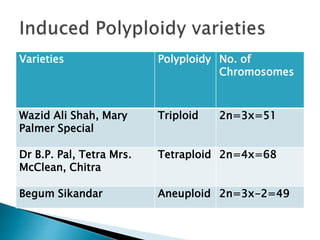
 Some of the cultivars with induced polyploidy
are- Wajid Ali Shah, Mary Palmer Special, Dr.
B.P. Pal, Tetra Mrs. McClean, Chitra and
Begum Sikander.
Varieties Polyploidy No. of
Chromosomes
Wazid Ali Shah, Mary
Palmer Special
Triploid 2n=3x=51
Dr B.P. Pal, Tetra Mrs.
McClean, Chitra
Tetraploid 2n=4x=68
Begum Sikandar Aneuploid 2n=3x-2=49
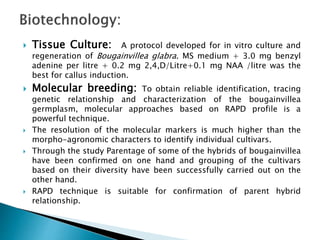
 Tissue Culture: A protocol developed for in vitro culture and
regeneration of Bougainvillea glabra. MS medium + 3.0 mg benzyl
adenine per litre + 0.2 mg 2,4,D/Litre+0.1 mg NAA /litre was the
best for callus induction.
 Molecular breeding: To obtain reliable identification, tracing
genetic relationship and characterization of the bougainvillea
germplasm, molecular approaches based on RAPD profile is a
powerful technique.
 The resolution of the molecular markers is much higher than the
morpho-agronomic characters to identify individual cultivars.
 Through the study Parentage of some of the hybrids of bougainvillea
have been confirmed on one hand and grouping of the cultivars
based on their diversity have been successfully carried out on the
other hand.
 RAPD technique is suitable for confirmation of parent hybrid
relationship.
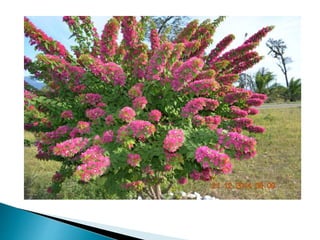
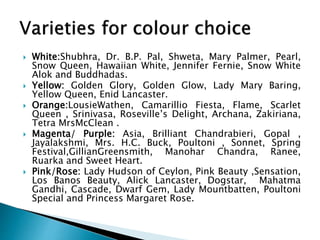
 White:Shubhra, Dr. B.P. Pal, Shweta, Mary Palmer, Pearl,
Snow Queen, Hawaiian White, Jennifer Fernie, Snow White
Alok and Buddhadas.
 Yellow: Golden Glory, Golden Glow, Lady Mary Baring,
Yellow Queen, Enid Lancaster.
 Orange:LousieWathen, Camarillio Fiesta, Flame, Scarlet
Queen , Srinivasa, Roseville’s Delight, Archana, Zakiriana,
Tetra MrsMcClean .
 Magenta/ Purple: Asia, Brilliant Chandrabieri, Gopal ,
Jayalakshmi, Mrs. H.C. Buck, Poultoni , Sonnet, Spring
Festival,GillianGreensmith, Manohar Chandra, Ranee,
Ruarka and Sweet Heart.
 Pink/Rose: Lady Hudson of Ceylon, Pink Beauty ,Sensation,
Los Banos Beauty, Alick Lancaster, Dogstar, Mahatma
Gandhi, Cascade, Dwarf Gem, Lady Mountbatten, Poultoni
Special and Princess Margaret Rose.
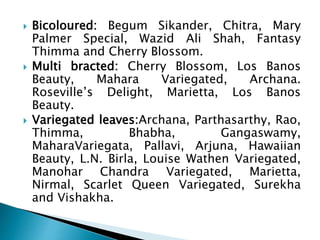
 Bicoloured: Begum Sikander, Chitra, Mary
Palmer Special, Wazid Ali Shah, Fantasy
Thimma and Cherry Blossom.
 Multi bracted: Cherry Blossom, Los Banos
Beauty, Mahara Variegated, Archana.
Roseville’s Delight, Marietta, Los Banos
Beauty.
 Variegated leaves:Archana, Parthasarthy, Rao,
Thimma, Bhabha, Gangaswamy,
MaharaVariegata, Pallavi, Arjuna, Hawaiian
Beauty, L.N. Birla, Louise Wathen Variegated,
Manohar Chandra Variegated, Marietta,
Nirmal, Scarlet Queen Variegated, Surekha
and Vishakha.
 Thorn less cultivars : Pink Beauty, Lady
Hudson, Perfusion, Lilac Queen, Dr. H.B.
Singh, Jawahar Lal Nehru, Torch Glory
(Mutant)
 Cultivars with few thorns: Cherry Blossom,
Dr. B.P. Pal, Zakiriana, Gangaswamy,
Refulgens, Shubhra, Bhabha, Rao
 Cultivars with vigorous thorns: Chitra, Partha,
Singapor Red, Stanza, Mahatma Gandhi,
Parthasarthy, Lady Mary Baring, Mahara,
Gopal, Spring Festival, Vishakha
Bougainvillea.pptx

Bougainvillea.pptx

  • 1.
  • 2.
     Bougainvillea isa popular ornamental plant mainly grown for its attractive colourful bracts that splash colour to the surrounding.  It is popular among parks, home and institutional gardens grown mainly as bush, climber, hedge, topiary, standard, pot plant, bonsai, on pergolas and trees.  Wide adaptability to different agro-climatic conditions and easy multiplication has made it a popular ornamental plant of the world.  Moreover, as it is a drought and pollution resistant plant, it is well suited for industrial places and on road dividers.
  • 3.
     Bougainvillea isoriginated in South America and was first collected by French Botanist Dr. Philibert Commerson, a French Botanist, at Rio-de-Janeiro, Brazil in 1766-69.  It was named after his close friend and ship’s admiral Louis-Antoine de Bougainville, who commanded the ship La Boudeuse.  The generic name as Buginvillea was first published by A. L. de Jusseau in his work Genera Plantarum in 1789.  It was finally corrected to Bougainvillea in the Index Kewensis in the1930.
  • 4.
     It isnot clear whether the cultivars outside South America were derived from plants already cultivated in Brazil or from truly wild plants.  Much of the evolution in Bougainvillea took place outside its native home, primary factor being natural hybridisation and showy bracts accompanied by self incompatibility.  The B. glabra and B. spectabilis are widely used species and most of the present Bougainvillea cultivars are thought to have originated from them.  Third species, B. peruviana is also of horticultural importance.
  • 5.
     Bougainvillea alsohas three hybrid groups namely,  B. × buttiana (glabra × peruviana),  B. × specto-peruviana and  B. × specto-glabra.  Among these, B. spectabilis and B. glabra were reported to be more tolerant to cooler climate.  Bougainvillea grows well throughout the plains of India, but only B. glabra thrives well at higher altitudes.
  • 6.
     Considering itsornamental and commercial importance in nursery trade, R and D were taken up by different national research institutes (IARI, IIHR, NBRI, BARC), state agricultural universities, Agri-Horticultural Societies (Kolkata and Chennai) and even by progressive nursery men.  As a result, a large number of new cultivars have been developed in India.  Considering the contribution made by India, the International Registration Authority for new cultivars lies in the Indian Agricultural Research Institute (IARI), New Delhi, which is an international recognition conferred upon by International Society for Horticultural Science (ISHS).
  • 7.
     In India,crop improvement work was started in early 20th century with the introduction of B. spectabilis in 1860 from Europe.  However, the popularity really started with the introduction of cv. ‘Mrs. Butt’ from Royal Botanic Garden, Kew to The Royal Horticultural Society, Kolkata in 1923.  Percy Lancaster, the renowned British horticulturist, has been credited for the development of first cultivar of Bougainvillea - ‘Scarlet Queen’ in 1920 and subsequently another excellent bi-coloured cultivar ‘Mary Palmer’ developed by him paved the way for Bougainvillea cultivation in India.
  • 8.
     The year1910 was marked by a major discovery in cultivated Bougainvillea when Mrs. R.V. Butt brought crimson coloured Bougainvillea cuttings from Cratagena (Columbia) to Trinidad.  Over the years the cultivar turned out to be ever mutating, being the source of various colour mutants that have added materially to the richness of the colour in the genus.  The plant was named after Mrs. Butt. This plant reached Kew in 1915 and from there it got distributed to India, Africa, Australia, Malaya and Singapore in 1923.
  • 9.
     The cv.‘Scarlet Queen’ was introduced to India directly from West Indies by Mr. Tomlinson in 1920. Percy Lancaster gave the name Scarlet Queen to this variety.  According to him, the coloured bracts of this plant are slightly darker than Mrs. Butt but the actual flower is malformed, so instead of there being three white or cream coloured flowers in the bracts, there are merely little bunch of anthers.  In 1931, Mrs. McClean of Trinidad produced apricot orange bracts instead of the normal crimson bracts of Mrs. Butt plant. This variant was propagated by R.O. Williams and named as cv. ‘Mrs. McClean’
  • 10.
     The cv.‘Scarlet Queen’ produced orange coloured variety in 1932 at Madras in the garden of Mrs. Louis Wathen.  It was named as ‘Louis Wathen’ by Mr. B.S. Nirody. Subsequently majolica yellow sports appeared from Louis Wathen and Mrs. McClean by spontaneous bud variation and were named as Enid Lancaster and Mary Baring.  S. Percy Lancaster had separated a purple coloured sport from Scarlet Queen in 1942 and named it as Alick Lancaster. The variegated leaved bud sports from Scarlet Queen has been released as cvs. ‘Scarlet Queen Variegata’ and ‘Rao’
  • 11.
     An importantfloriferous and recurrent blooming seedling was raised by P.S. Swaminathan at Madras from Princess Margaret rose and named it Mrs. H.C. Buck.  The famous bicoloured variety Mary Palmer was isolated from Mrs. H.C. Buck in 1949 by S. Percy Lancaster.  ‘Thimma’ with variegated foliage and ‘Shubhra’ with pure white bracts were evolved as a sport of Mary Palmer.
  • 12.
     To understandthe morphology of a flower is very important for the crop improvement programme of any crop.  The flowers of Bougainvillea are hermaphrodite, tubular in shape with a constriction in the middle and borne in clusters of three, each flower subtended by a brightly coloured bract, which helps to attract insects for cross pollination.  Bract colour in bougainvillea is contributed by betacyanins and betaxanthins i.e. betalains.
  • 13.
     The tipof the flower is conspicuous with a star. There is a solitary carpel at the base surrounded by a ring shaped nectar. During morning hours (around 10 am) anthesis takes place followed by anther dehiscence and stigma receptivity.  Butterflies visit the flowers attracted by the brightly coloured bracts and the nectar glands aids in cross pollination.  The opened flowers remain so for a day, after which the upper part of the flower tube gets twisted in a spiral.
  • 19.
     Most ofthe Bougainvillea cultivars are diploid with a chromosome constitution 2n =34, irrespective of the species / hybrid group to which they belong.  The occurrence of sixteen stages are observed during bud and flower development in one inflorescence of Bougainvillea.
  • 25.
     India isone of the major repositories of a wide range of bougainvilleas, and approximately 50 % of the present-day cultivars have been evolved in India.  The work on development of Bougainvillea has largely been done by the Agri-Horticultural Societies at Calcutta and Madras.  The Lal Bagh Garden (Bengaluru) also contributed a great deal by introducing a large number of exotic cultivars, particularly the multi-bracted varieties from the Philippines.  Different breeding approaches followed in bougainvillea are hybridization, polyploidy, mutation and bud sports. A large number of varieties have been developed at the NBRI (Lucknow), BARC (Mumbai) and IIHR (Bengaluru).
  • 27.
     Hybridization enablethe origin of totally new colour forms of Bougainvillea. It also in- creased the possibilities and limits of selection.  The natural hybridization with polyploidy has been the single factor contributing to evolution in nature and under domestication by plant breeding.
  • 28.
    The cultivars developedfrom inter-specific crosses are: Crosses Varieties  B. peruviana x B. glabra : Begum Sikander, Mrs. Butt  B. peruviana x B. spectabilis : Wajid Ali Shah  B. buttiana x B. peruviana : Chitra  B. spectabilis x B. buttiana :Dr. R.R. Pal, Summer Time, Spring Festival  B. glabra x B. spectabilis: Maharaja of Mysore, Pink Beauty, Pixie, Rose Queen
  • 29.
    Crosses Varieties  B.glabra (Trinidad x Formosa) : Dr. H.B. Singh  B. glabra (Formosa x Trinidad) : Purple Wonder  B. spectabilis (Lalbagh x Red Glory) : Chitravati  B. peruviana (Dr. B.P. Pal x Princess Margaret Rose) : Mary Palmer Special  The varieties which were evolved through hybridization at IIHR (Indian Institute of Horticulture), Bangalore are Dr H.B. Singh, Chitravati and Purple Wonder.  Among these varieties, Dr H.B. Singh was patented as Krishna in Australia.
  • 30.
     The hybridizationis not possible in multi- bracted bougainvillea due to absence of flower tubes/ flowers and all varieties are not able to set seeds at all places. Hence, a alternative method, i.e. induced mutation breeding resulted in evolution of different new Bougainvillea cultivars.  Mutation leads to the origin of many new forms of Bougainvillea. In recent years, mutation breeding has been used as a valuable supplement to traditional methods of plant breeding which helps in the development of better cultivars.
  • 31.
     Most ofthe cultivars of Bougainvillea were developed through selection of ‘bud sports’ or by mutation breeding.  Mutation breeding is one of the important methods to create variability in flower crops and it also reduces the time required to develop a new variety.  Mutation breeding is the only method that can be used to improve double bracted Bougainvillea, since conventional cross- breeding is not possible because of the absence of flowers.
  • 32.
     Different bractcolours ranging from white to yellow, orange, magenta, red, purple and violet have arisen as a result of mutation among various forms of three basic species.
  • 36.
     Bhabha AtomicResearch Centre, Bombay developed mutants of Bougainvillea such as  Lady Hudson of Ceylon Variegata (Induced mutant of Lady Hudson),  Jaya (Induced mutant of Jayalaxmi),  Jayalaxmi Variegata (Induced mutant of Jayalaxmi,  Suvarna (Induced mutant of Lady Hudson), Poultoni Variegata (Gamma ray induced mutant of ‘Poultoni’) and  Silver Top (Induced mutant of ‘Versicolour’)
  • 37.
     Some excellentcultivars of bougainvillea were originated as a result of spontaneous bud variation namely Alick Lancaster, Bhabha, Cherry Blossom, Fantasy, Jawaharlal Nehru, Lady Mary Baring, L.N. Birla, Louis Wathen, Mary Palmer, Mrs. McClean, Parthasarthy, Roseville’s Delight, Shubhra etc.  Spontaneous bud variation resulted in three change in the cultivated Bougainvillea i.e. Change in bract colour, imperfect flower tube development and leaf variegation.  The cv. ‘Sholay’ and ‘Usha’ are important seedling selections at IIHR from Red Glory and Lady Hope respectively.
  • 38.
     From cv.‘Arjuna’ a chlorophyll variegated bud sport originated which were named as ‘Abhimanyu’. It was detected by Dr. Banerjee at NBRI, Lucknow.  In the year 1963-1967, Dr. J.V. Pancho first reported the multibracted cultivars of bougainvillea in Laguna, Phillipines.  The cultivar such as Carmentica, Cherry Blossom, Mahara, Godrej Cherry Blossom, Los Banos Beauty, Mahara Variegata, Pallavi, Rosevilles Delight, Archana and Marietta are multibracted.  They are called multibracted cultivars as they have 20-40 bracts as compared to the normally occurring three bracted cultivars of bougainvillea. Also the flower tube is absent or rudimentary in such varieties. The multibracted varieties originated from the cultivars of B.x buttiana.
  • 39.
     Due toseed sterility in bougainvillea further breeding was hindered as a result of which it limits the selection of male and female parents for developing new cultivars.  After detailed studies, fertility in bougainvillea was restored by colchiploidy. Thereafter, numerous colourful and floriferous bicoloured cultivars at triploid, tetraploid and aneuploid has been raised.  Some of the cultivars with induced polyploidy are- Wajid Ali Shah, Mary Palmer Special, Dr. B.P. Pal, Tetra Mrs. McClean, Chitra and Begum Sikander.
  • 40.
    Varieties Polyploidy No.of Chromosomes Wazid Ali Shah, Mary Palmer Special Triploid 2n=3x=51 Dr B.P. Pal, Tetra Mrs. McClean, Chitra Tetraploid 2n=4x=68 Begum Sikandar Aneuploid 2n=3x-2=49
  • 41.
     Tissue Culture:A protocol developed for in vitro culture and regeneration of Bougainvillea glabra. MS medium + 3.0 mg benzyl adenine per litre + 0.2 mg 2,4,D/Litre+0.1 mg NAA /litre was the best for callus induction.  Molecular breeding: To obtain reliable identification, tracing genetic relationship and characterization of the bougainvillea germplasm, molecular approaches based on RAPD profile is a powerful technique.  The resolution of the molecular markers is much higher than the morpho-agronomic characters to identify individual cultivars.  Through the study Parentage of some of the hybrids of bougainvillea have been confirmed on one hand and grouping of the cultivars based on their diversity have been successfully carried out on the other hand.  RAPD technique is suitable for confirmation of parent hybrid relationship.
  • 58.
     White:Shubhra, Dr.B.P. Pal, Shweta, Mary Palmer, Pearl, Snow Queen, Hawaiian White, Jennifer Fernie, Snow White Alok and Buddhadas.  Yellow: Golden Glory, Golden Glow, Lady Mary Baring, Yellow Queen, Enid Lancaster.  Orange:LousieWathen, Camarillio Fiesta, Flame, Scarlet Queen , Srinivasa, Roseville’s Delight, Archana, Zakiriana, Tetra MrsMcClean .  Magenta/ Purple: Asia, Brilliant Chandrabieri, Gopal , Jayalakshmi, Mrs. H.C. Buck, Poultoni , Sonnet, Spring Festival,GillianGreensmith, Manohar Chandra, Ranee, Ruarka and Sweet Heart.  Pink/Rose: Lady Hudson of Ceylon, Pink Beauty ,Sensation, Los Banos Beauty, Alick Lancaster, Dogstar, Mahatma Gandhi, Cascade, Dwarf Gem, Lady Mountbatten, Poultoni Special and Princess Margaret Rose.
  • 59.
     Bicoloured: BegumSikander, Chitra, Mary Palmer Special, Wazid Ali Shah, Fantasy Thimma and Cherry Blossom.  Multi bracted: Cherry Blossom, Los Banos Beauty, Mahara Variegated, Archana. Roseville’s Delight, Marietta, Los Banos Beauty.  Variegated leaves:Archana, Parthasarthy, Rao, Thimma, Bhabha, Gangaswamy, MaharaVariegata, Pallavi, Arjuna, Hawaiian Beauty, L.N. Birla, Louise Wathen Variegated, Manohar Chandra Variegated, Marietta, Nirmal, Scarlet Queen Variegated, Surekha and Vishakha.
  • 60.
     Thorn lesscultivars : Pink Beauty, Lady Hudson, Perfusion, Lilac Queen, Dr. H.B. Singh, Jawahar Lal Nehru, Torch Glory (Mutant)  Cultivars with few thorns: Cherry Blossom, Dr. B.P. Pal, Zakiriana, Gangaswamy, Refulgens, Shubhra, Bhabha, Rao  Cultivars with vigorous thorns: Chitra, Partha, Singapor Red, Stanza, Mahatma Gandhi, Parthasarthy, Lady Mary Baring, Mahara, Gopal, Spring Festival, Vishakha