PRODUCTION TECHNOLOGY
OF Dutch ROSES
OF Dutch ROSES
Floriculture industry in India is growing as a profitable
business during the past two decades. Among the different
cut flowers cultivated, Cut rose occupies the first position in
area and cultivation. Cut roses belong to Rosa spp. of
Rosaceae family. Karnataka leads in cut rose production
followed by West Bengal and Maharastra. Tamil Nadu holds
a meager share in production and the major areas cultivating
roses under polyhouse are Hosur, Krishnagiri, Kodaikanal,
Yercaud and Kolli Hills.
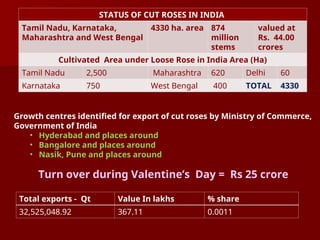
STATUS OF CUT ROSES IN INDIA
Tamil Nadu, Karnataka,
Maharashtra and West Bengal
4330 ha. area 874
million
stems
valued at
Rs. 44.00
crores
Cultivated Area under Loose Rose in India Area (Ha)
Tamil Nadu 2,500 Maharashtra 620 Delhi 60
Karnataka 750 West Bengal 400 TOTAL 4330
Growth centres identified for export of cut roses by Ministry of Commerce,
Government of India
• Hyderabad and places around
• Bangalore and places around
• Nasik, Pune and places around
Turn over during Valentine’s Day = Rs 25 crore
Total exports - Qt Value In lakhs % share
32,525,048.92 367.11 0.0011
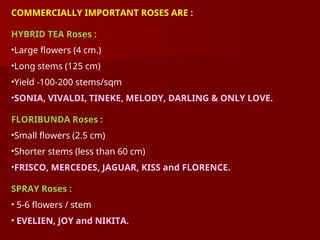
COMMERCIALLY IMPORTANT ROSES ARE :
HYBRID TEA Roses :
•Large flowers (4 cm.)
•Long stems (125 cm)
•Yield -100-200 stems/sqm
•SONIA, VIVALDI, TINEKE, MELODY, DARLING & ONLY LOVE.
FLORIBUNDA Roses :
•Small flowers (2.5 cm)
•Shorter stems (less than 60 cm)
•FRISCO, MERCEDES, JAGUAR, KISS and FLORENCE.
SPRAY Roses :
• 5-6 flowers / stem
• EVELIEN, JOY and NIKITA.
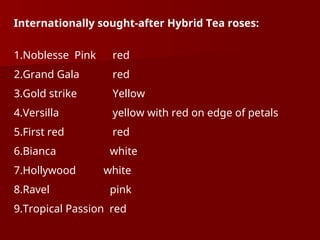
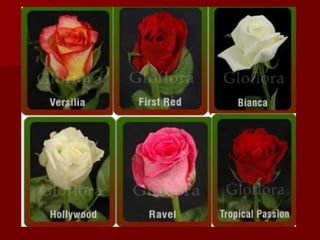
Internationally sought-after Hybrid Tea roses:
1.Noblesse Pink red
2.Grand Gala red
3.Gold strike Yellow
4.Versilla yellow with red on edge of petals
5.First red red
6.Bianca white
7.Hollywood white
8.Ravel pink
9.Tropical Passion red
Exotic cultivars
Exotic cultivars
White : John F. Kenedy
Yellow : Aalsmeer Gold, Golden Moments, Golden
Giant.
Red : Christian Dior, First Prize, Forever, Gladiator,
Happiness
Pink : Brides Dream, Confidence
Scarlet : Crimson Glory, Forever
Orange: Harvest Sun, Super Star
Hybrid Tea
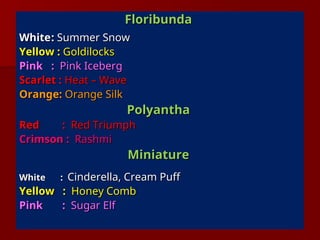
Floribunda
Floribunda
White
White:
: Summer Snow
Summer Snow
Yellow :
Yellow : Goldilocks
Goldilocks
Pink
Pink :
: Pink Iceberg
Pink Iceberg
Scarlet :
Scarlet : Heat – Wave
Heat – Wave
Orange:
Orange: Orange Silk
Orange Silk
Polyantha
Polyantha
Red
Red :
: Red Triumph
Red Triumph
Crimson :
Crimson : Rashmi
Rashmi
Miniature
Miniature
White
White :
: Cinderella, Cream Puff
Cinderella, Cream Puff
Yellow :
Yellow : Honey Comb
Honey Comb
Pink
Pink :
: Sugar Elf
Sugar Elf
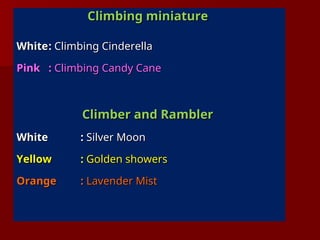
Climbing miniature
Climbing miniature
White
White:
: Climbing Cinderella
Climbing Cinderella
Pink
Pink :
: Climbing Candy Cane
Climbing Candy Cane
Climber and Rambler
Climber and Rambler
White
White :
: Silver Moon
Silver Moon
Yellow
Yellow :
: Golden showers
Golden showers
Orange
Orange :
: Lavender Mist
Lavender Mist
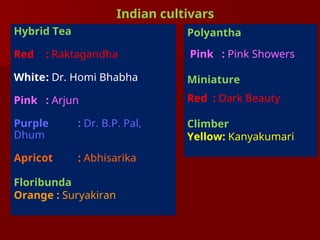
Hybrid Tea
Red : Raktagandha
White: Dr. Homi Bhabha
Pink : Arjun
Purple : Dr. B.P. Pal,
Dhum
Apricot : Abhisarika
Floribunda
Orange : Suryakiran
Indian cultivars
Polyantha
Pink : Pink Showers
Miniature
Red : Dark Beauty
Climber
Yellow: Kanyakumari
Rose Species and
Rose Species and
Identification
Identification
Rose species of importance:
1.
1. R.canina
R.canina (Dog rose)
(Dog rose)
2.
2. R. chinensis
R. chinensis
3. R. moschata
3. R. moschata (Musk rose)
(Musk rose)
4.
4. R. phoenicia
R. phoenicia (Phoenician rose)
(Phoenician rose)
5. Rosa gallica
5. Rosa gallica, the French rose - Caucasus & Middle – East
, the French rose - Caucasus & Middle – East
6.
6. R. damascena
R. damascena (Damask rose) - natural variation of
(Damask rose) - natural variation of R. gallica
R. gallica
7. R. indica
7. R. indica (Pink China rose) -natural to Canton- introduced
(Pink China rose) -natural to Canton- introduced
in
in England by Peter Osbeck
England by Peter Osbeck
8.
8. R.odorata
R.odorata
9.
9. R. gigantea
R. gigantea
• Bourbon rose - natural cross between
Bourbon rose - natural cross between
R. chinensis
R. chinensis x
x R. damascena bifera
R. damascena bifera x
x R. moschata
R. moschata
Parson’s Pink China rose
Parson’s Pink China rose Autumn Damask rose
Autumn Damask rose Musk rose
Musk rose
• Tea roses hybrids – cross between
Tea roses hybrids – cross between
R.odorata
R.odorata x
x R. gigantea
R. gigantea
• Hybird Tea roses – cross between
Hybird Tea roses – cross between
Tea roses x Hybrid Perpetuals
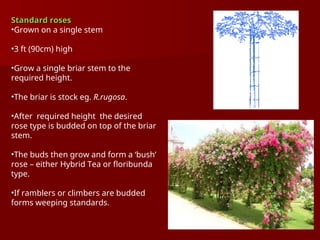
Standard roses
Standard roses
•Grown on a single stem
•3 ft (90cm) high
•Grow a single briar stem to the
required height.
•The briar is stock eg. R.rugosa.
•After required height the desired
rose type is budded on top of the briar
stem.
•The buds then grow and form a ‘bush’
rose – either Hybrid Tea or floribunda
type.
•If ramblers or climbers are budded
forms weeping standards.
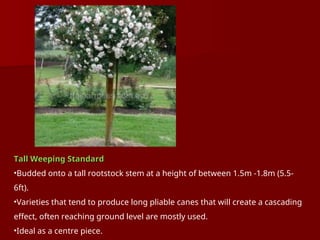
Tall Weeping Standard
•Budded onto a tall rootstock stem at a height of between 1.5m -1.8m (5.5-
6ft).
•Varieties that tend to produce long pliable canes that will create a cascading
effect, often reaching ground level are mostly used.
•Ideal as a centre piece.
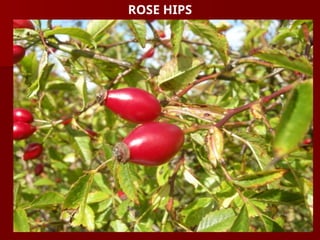
ROSE HIPS
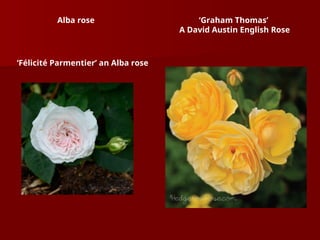
Alba rose
‘Félicité Parmentier’ an Alba rose
‘Graham Thomas’
A David Austin English Rose
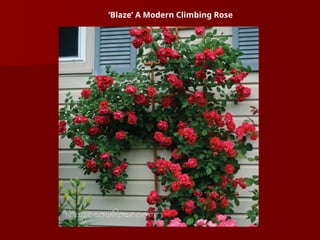
‘Blaze’ A Modern Climbing Rose
‘Rosa mundi’ A Gallica Rose
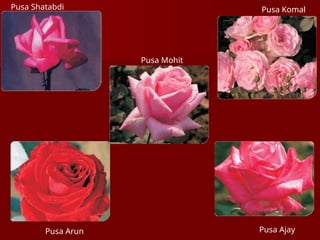
Pusa Shatabdi Pusa Komal
Pusa Arun Pusa Ajay
Pusa Mohit
ROSE BREEDERS
•David C.H. Austin - Constance Spry
•Henry Bennett - Captain Hayward
•Interplant Roses, The Netherlands
•W. Kordes' Sons, Germany, "Frühlings" series & the
Kordesii Hybrids
•Meilland family - 'Peace‘ 'Bonica '82' and 'Swany'.
•Mathias Tantau , Germany.
'Super Star‘ , 'Fragrant Cloud’ and 'Black Magic’
 B. K. Roy Chaudhury - 'Dr. S. D. Mukherjee' (1935)
 B. S. Bhatacharji - 125 varieties 1941 and 1968
 Raja Surendra Singh of Nalagarh P.L. Airun;
 S. Banerjee Brahm Dutt
 J.P. Agarwal C. R. Chiplunkar
 Y. K. Hande;; Arpi Thakur
 M. N. Hardikar N. V. Shastri
 Kalyan Chakrabarti R. S. Jagtap
 Dr. B. P. Pal - Dr. Homi Bhabha Banjaran Delhi Princess Kanakangi
'Mechak'
 S. C. Dey
 M. S. Viraraghavan
 The nurserymen group after Bhatcharji has been dominated by G.
Kasturirangan of K. S. G. Son, Bangalore.
.
Indian Breeders
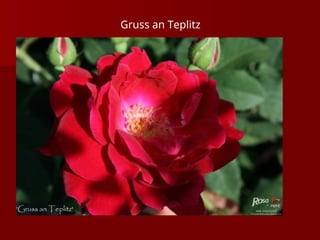
Gruss an Teplitz
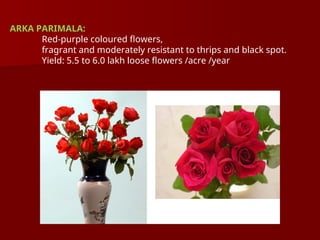
ARKA PARIMALA:
Red-purple coloured flowers,
fragrant and moderately resistant to thrips and black spot.
Yield: 5.5 to 6.0 lakh loose flowers /acre /year
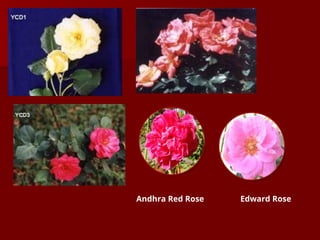
Andhra Red Rose Edward Rose
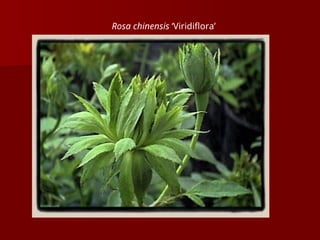
Rosa chinensis ‘Viridiflora’
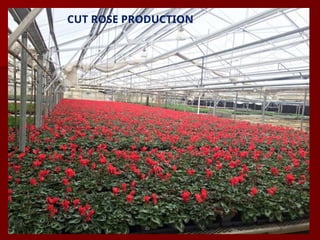
CUT ROSE PRODUCTION
VARIETAL CHARACTERS
VARIETAL CHARACTERS
 Higher production
Higher production
 Long vase life
Long vase life
 Colour
Colour
 Type of rose : HT/ Floribundas etc
Type of rose : HT/ Floribundas etc
 Fragrance
Fragrance
 Soft thorns
Soft thorns
 Resistance to stress
Resistance to stress
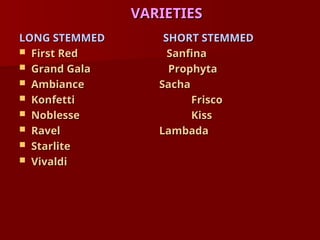
VARIETIES
VARIETIES
LONG STEMMED SHORT STEMMED
 First Red Sanfina
First Red Sanfina
 Grand Gala Prophyta
Grand Gala Prophyta
 Ambiance
Ambiance Sacha
Sacha
 Konfetti
Konfetti Frisco
Frisco
 Noblesse
Noblesse Kiss
Kiss
 Ravel
Ravel Lambada
Lambada
 Starlite
Starlite
 Vivaldi
Vivaldi
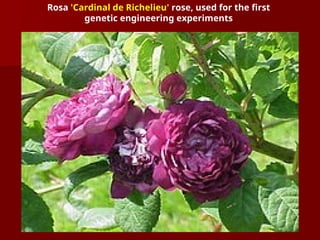
Rosa 'Cardinal de Richelieu' rose, used for the first
genetic engineering experiments
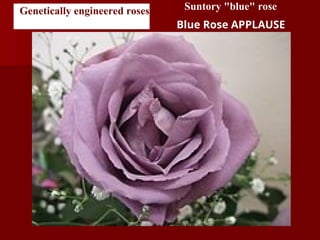
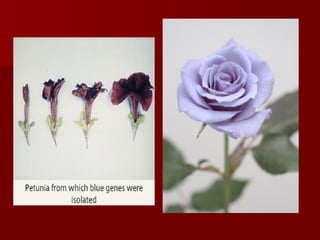
Genetically engineered roses Suntory "blue" rose
Blue Rose APPLAUSE
Started in 1990.
Suntory in collaboration with Florigene Ltd. (named Calgene
Pacific Pty Ltd.
There were two technical barriers:
• One was to "isolate genes (blue genes) necessary to synthesize
a
blue pigment (delphinidin)
• 2nd
was to "develop the methods to introduce these genes to
cells of roses and produce genetically modified roses from
these cells.”
• Success got by introducing blue genes isolated from a pansy.
• However, introduced into a red rose variety, so darkish red.
• Even after blue pigments are produced, how blue the flower become
depends greatly on the original characteristics of the roses.
• e.g. low / acidic pH - in the cell vacuoles in which blue pigments are
accumulated, the color becomes red,
and if it is neutral, the color becomes blue.
• 40 rose varieties tried.
Greenhouse Planting
Greenhouse Planting
 5 beds each of 1.20m width per 8m bay.
5 beds each of 1.20m width per 8m bay.
 width of path : 0.40m.
width of path : 0.40m.
 2 rows of plants / bed.
2 rows of plants / bed.
 row to row spacing : 30 cm
row to row spacing : 30 cm
 plant to plant spacing : 17cm.
plant to plant spacing : 17cm.
 A row of 24m length = 140 plants
A row of 24m length = 140 plants
- 70,000 plants / ha
 Season of Planting : February to April
Season of Planting : February to April
July to September
July to September
CLIMATIC REQUIREMENTS
 Temperature
Temperature : 15
: 15 0
0
C ( 60
C ( 600
0
F) – 28
F) – 28 0
0
C ( 76
C ( 760
0
F)
F)
 Day Length
Day Length > 12 hours
> 12 hours
 Relative Humidity
Relative Humidity : 77
: 77± 5
± 50
0
C
C
 CO
CO2
2 enrichment
enrichment : 1000 -3000 ppm
: 1000 -3000 ppm
 Cooling
Cooling : Fan & Pad cooling
: Fan & Pad cooling
: Dist bet fan & pad 30 -60 m
 Shading
Shading : reduces leaf scorch
: reduces leaf scorch
: prevents flower fading
 Heating
Heating : Pipe coil heat distribution with
: Pipe coil heat distribution with
high pressure hot water boiler
: Most suitable fuel is natural gas
SOIL AND MEDIA
SOIL AND MEDIA
 Garden soil
Garden soil : common in India
: common in India
 Sand
Sand : cheap good drainage
: cheap good drainage
lower soil borne disease incidence
 Coco peat
Coco peat : used loose / in beds / in pots / brick
: used loose / in beds / in pots / brick
form / in poly tubing
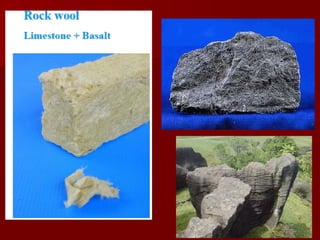
 Rock wool
Rock wool : costly – has to be imported
: costly – has to be imported
: accurate monitoring required
: EC <1.0
: EC <1.0
: pH -6.5
: pH -6.5
: Root temp 22-23
: Root temp 22-230
0
C
C
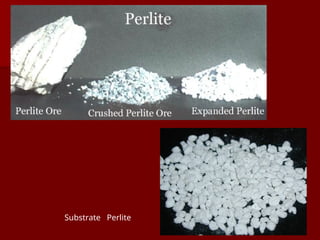
Substrate Perlite
PLANTING DENSITY
PLANTING DENSITY
 Greenhouse bay
Greenhouse bay : 6.4m / 8m wide
: 6.4m / 8m wide
 Bed size
Bed size : 1.0 -1.6 m wide & 30 – 40 m long
: 1.0 -1.6 m wide & 30 – 40 m long
 Path width
Path width : 60 cm
: 60 cm
 Spacing
Spacing : Between plants - 14 -18 cm
: Between plants - 14 -18 cm
: Between rows - varies
 Planting density
Planting density : 60,000 – 70,000 plts / ha
: 60,000 – 70,000 plts / ha
 Bed ht
Bed ht : 25 – 30 cm above ground
: 25 – 30 cm above ground
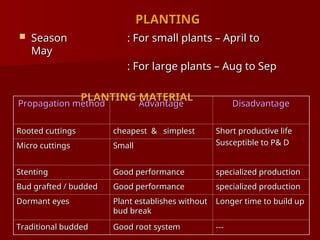
PLANTING
PLANTING
 Season
Season : For small plants – April to
: For small plants – April to
May
May
: For large plants – Aug to Sep
PLANTING MATERIAL
PLANTING MATERIAL
Propagation method
Propagation method Advantage
Advantage Disadvantage
Disadvantage
Rooted cuttings
Rooted cuttings cheapest & simplest
cheapest & simplest Short productive life
Short productive life
Susceptible to P& D
Susceptible to P& D
Micro cuttings
Micro cuttings Small
Small
Stenting
Stenting Good performance
Good performance specialized production
specialized production
Bud grafted / budded
Bud grafted / budded Good performance
Good performance specialized production
specialized production
Dormant eyes
Dormant eyes Plant establishes without
Plant establishes without
bud break
bud break
Longer time to build up
Traditional budded
Traditional budded Good root system
Good root system ---
---
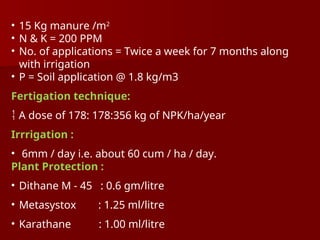
• 15 Kg manure /m2
• N & K = 200 PPM
• No. of applications = Twice a week for 7 months along
with irrigation
• P = Soil application @ 1.8 kg/m3
Fertigation technique:
 A dose of 178: 178:356 kg of NPK/ha/year
Irrrigation :
• 6mm / day i.e. about 60 cum / ha / day.
Plant Protection :
• Dithane M - 45 : 0.6 gm/litre
• Metasystox : 1.25 ml/litre
• Karathane : 1.00 ml/litre
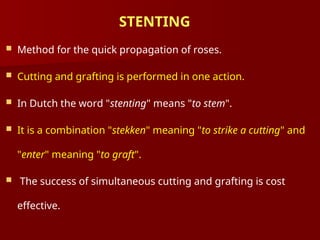
 Method for the quick propagation of roses.
 Cutting and grafting is performed in one action.
 In Dutch the word "stenting" means "to stem".
 It is a combination "stekken" meaning "to strike a cutting" and
"enter" meaning "to graft".
 The success of simultaneous cutting and grafting is cost
effective.
STENTING
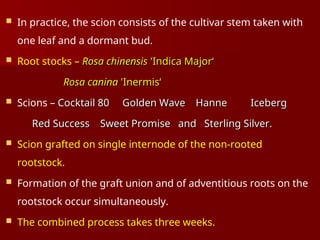
 In practice, the scion consists of the cultivar stem taken with
one leaf and a dormant bud.
 Root stocks – Rosa chinensis
Rosa chinensis 'Indica Major‘
'Indica Major‘
Rosa canina
Rosa canina 'Inermis‘
'Inermis‘
 Scions – Cocktail 80 Golden Wave Hanne Iceberg
Cocktail 80 Golden Wave Hanne Iceberg
Red Success Sweet Promise and Sterling Silver.
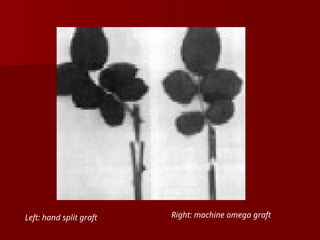
 Scion grafted on single internode of the non-rooted
rootstock.
 Formation of the graft union and of adventitious roots on the
rootstock occur simultaneously.
 The combined process takes three weeks.
Left: hand split graft Right: machine omega graft
Building up plants
Building up plants
 In budded plants - flower buds removed 4 weeks after planting
- leaves retained
- remove lateral shoots formed below removed bud
- After 3-4 weeks flower production allowed
- 3 -4 true leaves left / shoot
 In Rooted cuttings / Stents - remove pea size flower buds
- allow leaves to grow
- prune after plants establish well
SPECIAL PRACTICES
SPECIAL PRACTICES
 Shoot-bending
Shoot-bending
 Pruning
Pruning
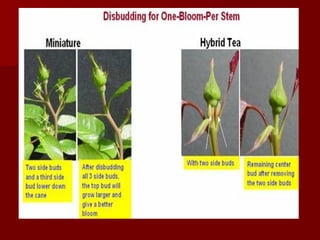
 Disbudding
Disbudding
 Pinching
Pinching
 De shooting
De shooting
 Removal of faded flowers
Removal of faded flowers
SPECIAL PRACTICES
SPECIAL PRACTICES
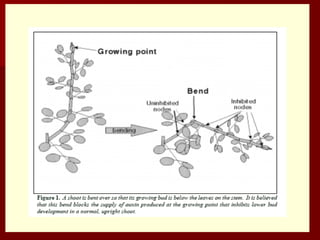
 SHOOT BENDING
SHOOT BENDING : Done instead of pruning
: Done instead of pruning
: Removal of center bud & laterals not necessary
: Branches form a bow without
: Branches form a bow without breakage
breakage
: Increases shoot prod close to base of
: Increases shoot prod close to base of plant
plant
 RESTING DURING
RESTING DURING
OFF SEASON
OFF SEASON : App of water & fertilizer stopped
: App of water & fertilizer stopped
: Duration 4-8 weeks
: Pruned down to 30 -60 cm above soil
: After pruning start irrigation & fertilization
: Give shade
: Give shade
: Gives few bottom breaks & too weak stems
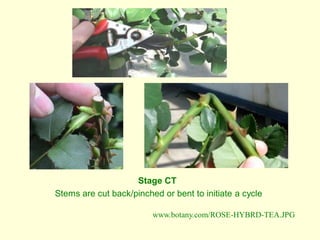
Stage CT
Stems are cut back/pinched or bent to initiate a cycle
www.botany.com/ROSE-HYBRD-TEA.JPG
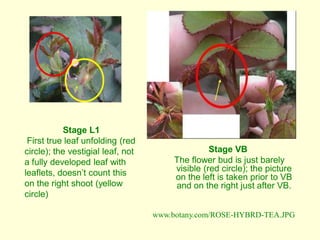
Stage VB
The flower bud is just barely
visible (red circle); the picture
on the left is taken prior to VB
and on the right just after VB.
Stage L1
First true leaf unfolding (red
circle); the vestigial leaf, not
a fully developed leaf with
leaflets, doesn’t count this
on the right shoot (yellow
circle)
www.botany.com/ROSE-HYBRD-TEA.JPG
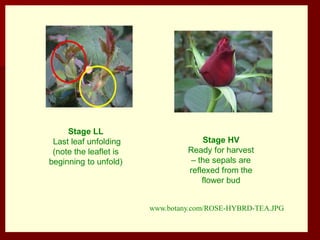
Stage LL
Last leaf unfolding
(note the leaflet is
beginning to unfold)
Stage HV
Ready for harvest
– the sepals are
reflexed from the
flower bud
www.botany.com/ROSE-HYBRD-TEA.JPG
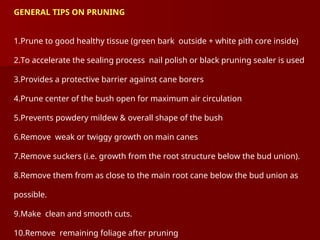
GENERAL TIPS ON PRUNING
1.Prune to good healthy tissue (green bark outside + white pith core inside)
2.To accelerate the sealing process nail polish or black pruning sealer is used
3.Provides a protective barrier against cane borers
4.Prune center of the bush open for maximum air circulation
5.Prevents powdery mildew & overall shape of the bush
6.Remove weak or twiggy growth on main canes
7.Remove suckers (i.e. growth from the root structure below the bud union).
8.Remove them from as close to the main root cane below the bud union as
possible.
9.Make clean and smooth cuts.
10.Remove remaining foliage after pruning
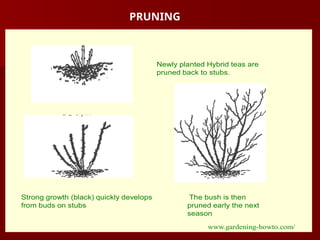
PRUNING
Newly planted Hybrid teas are
pruned back to stubs.
Strong growth (black) quickly develops
from buds on stubs
The bush is then
pruned early the next
season
www.gardening-howto.com/
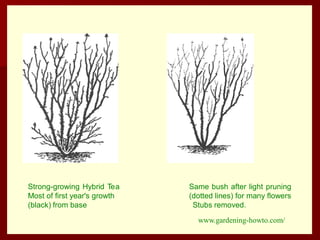
Strong-growing Hybrid Tea Same bush after light pruning
Most of first year's growth (dotted lines) for many flowers
(black) from base Stubs removed.
www.gardening-howto.com/
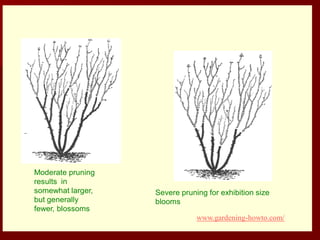
Moderate pruning
results in
somewhat larger,
but generally
fewer, blossoms
Severe pruning for exhibition size
blooms
www.gardening-howto.com/
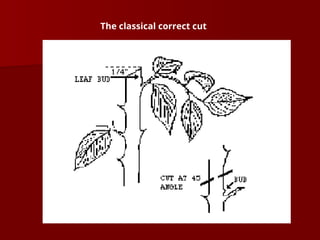
The classical correct cut
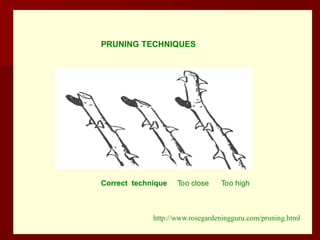
Correct technique Too close Too high
PRUNING TECHNIQUES
http://www.rosegardeningguru.com/pruning.html
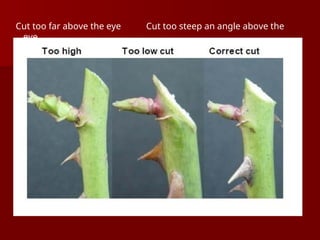
Cut too far above the eye Cut too steep an angle above the
eye.
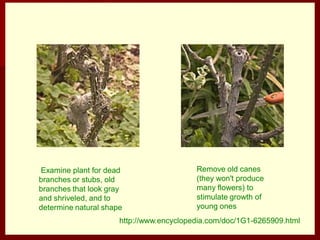
Examine plant for dead
branches or stubs, old
branches that look gray
and shriveled, and to
determine natural shape
Remove old canes
(they won't produce
many flowers) to
stimulate growth of
young ones
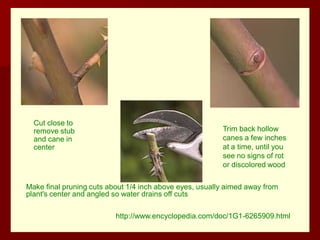
http://www.encyclopedia.com/doc/1G1-6265909.html
Cut close to
remove stub
and cane in
center
Trim back hollow
canes a few inches
at a time, until you
see no signs of rot
or discolored wood
Make final pruning cuts about 1/4 inch above eyes, usually aimed away from
plant's center and angled so water drains off cuts
http://www.encyclopedia.com/doc/1G1-6265909.html
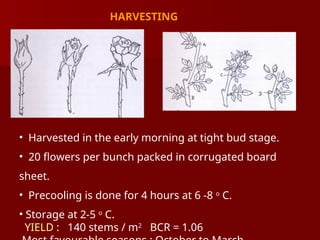
HARVESTING
• Harvested in the early morning at tight bud stage.
• 20 flowers per bunch packed in corrugated board
sheet.
• Precooling is done for 4 hours at 6 -8 o
C.
• Storage at 2-5 o
C.
YIELD : 140 stems / m2
BCR = 1.06
• Re-cut stems, about 2 cm. above previous level
• Do not remove lower leaves/thorns
• Placed in clean containers in clean warm (40-480
C) water adjusted with
citric acid to pH 3.0-3.5 for 30-60 min.
• Prevents vascular blockage
• Put in the preservative solution.
• Shifted to the cold storage at 0 to 20
C.
• May be kept for 4-5 days in preservative solution in cold store
containing :
− Citric acid - 100-700 mg/litre.
− HQC/captan - 16 mg/litre.
− Sucrose - 20 mg/litre.
POST HARVEST
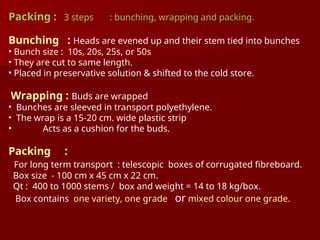
Packing : 3 steps : bunching, wrapping and packing.
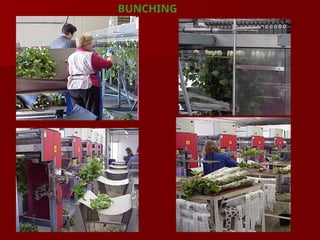
Bunching : Heads are evened up and their stem tied into bunches
• Bunch size : 10s, 20s, 25s, or 50s
• They are cut to same length.
• Placed in preservative solution & shifted to the cold store.
Wrapping : Buds are wrapped
• Bunches are sleeved in transport polyethylene.
• The wrap is a 15-20 cm. wide plastic strip
• Acts as a cushion for the buds.
Packing :
For long term transport : telescopic boxes of corrugated fibreboard.
Box size - 100 cm x 45 cm x 22 cm.
Qt : 400 to 1000 stems / box and weight = 14 to 18 kg/box.
Box contains one variety, one grade or mixed colour one grade.
Post harvesting handling
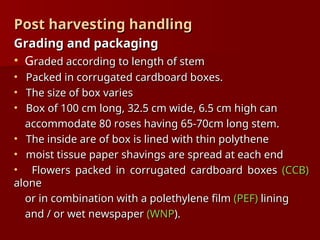
Grading and packaging
• Graded according to length of stem
raded according to length of stem
• Packed in corrugated cardboard boxes.
Packed in corrugated cardboard boxes.
• The size of box varies
The size of box varies
• Box of 100 cm long, 32.5 cm wide, 6.5 cm high can
Box of 100 cm long, 32.5 cm wide, 6.5 cm high can
accommodate 80 roses having 65-70cm long stem.
• The inside are of box is lined with thin polythene
The inside are of box is lined with thin polythene
• moist tissue paper shavings are spread at each end
moist tissue paper shavings are spread at each end
• Flowers packed in corrugated cardboard boxes
Flowers packed in corrugated cardboard boxes (CCB)
(CCB)
alone
alone
or in combination with a polethylene film
or in combination with a polethylene film (PEF)
(PEF) lining
lining
and / or wet newspaper
and / or wet newspaper (WNP
(WNP).
).
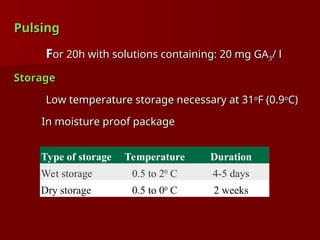
Pulsing
Pulsing
F
For 20h with solutions containing: 20 mg GA
or 20h with solutions containing: 20 mg GA3
3/ l
/ l
Storage
Storage
Low temperature storage necessary at 31
Low temperature storage necessary at 31o
o
F (0.9
F (0.9o
o
C)
C)
In moisture proof package
Type of storage Temperature Duration
Wet storage 0.5 to 20
C 4-5 days
Dry storage 0.5 to 00
C 2 weeks
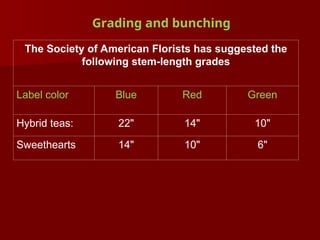
Grading and bunching
The Society of American Florists has suggested the
following stem-length grades
Label color Blue Red Green
Hybrid teas: 22" 14" 10"
Sweethearts 14" 10" 6"
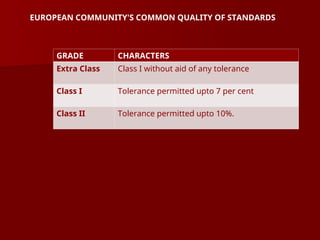
EUROPEAN COMMUNITY'S COMMON QUALITY OF STANDARDS
GRADE CHARACTERS
Extra Class Class I without aid of any tolerance
Class I Tolerance permitted upto 7 per cent
Class II Tolerance permitted upto 10%.
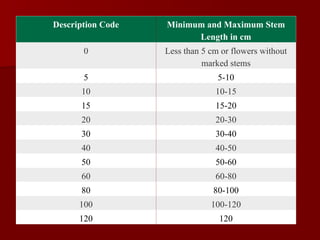
Description Code Minimum and Maximum Stem
Length in cm
0 Less than 5 cm or flowers without
marked stems
5 5-10
10 10-15
15 15-20
20 20-30
30 30-40
40 40-50
50 50-60
60 60-80
80 80-100
100 100-120
120 120
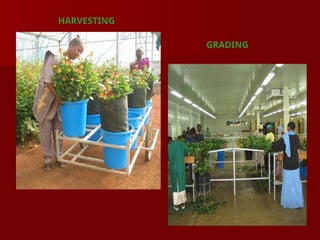
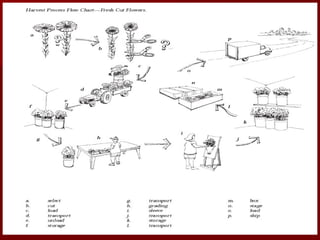
HARVESTING
GRADING
BUNCHING
PACKAGING
Karen L.B. Gast,, 1997
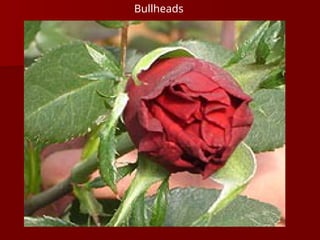
Bull heads or malformed flowers
The center petals of the bud remain only partly developed
and the bud appears flat. They are common on very vigorous
shoots, particularly bottom breaks, and it is possible that there
is a lack of carbohydrates to develop the petals.
The cause of bull heading is yet unknown, however, thrips
infestation will also cause malformed flowers. Also at low
temperature, some varieties will form bull heads.
Bullheads
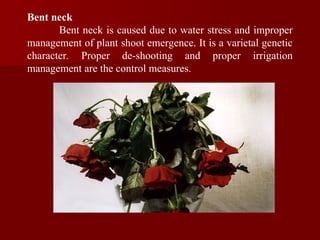
Bent neck
Bent neck is caused due to water stress and improper
management of plant shoot emergence. It is a varietal genetic
character. Proper de-shooting and proper irrigation
management are the control measures.
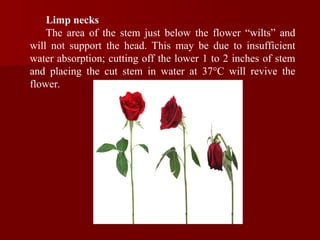
Limp necks
The area of the stem just below the flower “wilts” and
will not support the head. This may be due to insufficient
water absorption; cutting off the lower 1 to 2 inches of stem
and placing the cut stem in water at 37°C will revive the
flower.
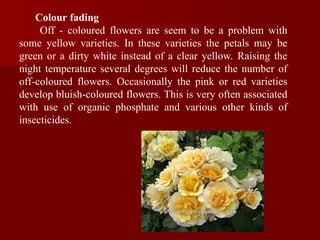
Colour fading
Off - coloured flowers are seem to be a problem with
some yellow varieties. In these varieties the petals may be
green or a dirty white instead of a clear yellow. Raising the
night temperature several degrees will reduce the number of
off-coloured flowers. Occasionally the pink or red varieties
develop bluish-coloured flowers. This is very often associated
with use of organic phosphate and various other kinds of
insecticides.
Blackening of rose petals
This is caused by low temperature and high anthocyanin
content. GA3 treatment causes accumulation of
anthocyanin in petals of Baccara roses. This effect was
more pronounced at low temperature (20°C at day and 4°C
at night) than in higher temperature (30°C at day and 20°C
at night).

L-4 Prod tech ofcut rose.ppt. .....

  • 1.
  • 2.
    Floriculture industry inIndia is growing as a profitable business during the past two decades. Among the different cut flowers cultivated, Cut rose occupies the first position in area and cultivation. Cut roses belong to Rosa spp. of Rosaceae family. Karnataka leads in cut rose production followed by West Bengal and Maharastra. Tamil Nadu holds a meager share in production and the major areas cultivating roses under polyhouse are Hosur, Krishnagiri, Kodaikanal, Yercaud and Kolli Hills.
  • 3.
    STATUS OF CUTROSES IN INDIA Tamil Nadu, Karnataka, Maharashtra and West Bengal 4330 ha. area 874 million stems valued at Rs. 44.00 crores Cultivated Area under Loose Rose in India Area (Ha) Tamil Nadu 2,500 Maharashtra 620 Delhi 60 Karnataka 750 West Bengal 400 TOTAL 4330 Growth centres identified for export of cut roses by Ministry of Commerce, Government of India • Hyderabad and places around • Bangalore and places around • Nasik, Pune and places around Turn over during Valentine’s Day = Rs 25 crore Total exports - Qt Value In lakhs % share 32,525,048.92 367.11 0.0011
  • 4.
    COMMERCIALLY IMPORTANT ROSESARE : HYBRID TEA Roses : •Large flowers (4 cm.) •Long stems (125 cm) •Yield -100-200 stems/sqm •SONIA, VIVALDI, TINEKE, MELODY, DARLING & ONLY LOVE. FLORIBUNDA Roses : •Small flowers (2.5 cm) •Shorter stems (less than 60 cm) •FRISCO, MERCEDES, JAGUAR, KISS and FLORENCE. SPRAY Roses : • 5-6 flowers / stem • EVELIEN, JOY and NIKITA.
  • 5.
    Internationally sought-after HybridTea roses: 1.Noblesse Pink red 2.Grand Gala red 3.Gold strike Yellow 4.Versilla yellow with red on edge of petals 5.First red red 6.Bianca white 7.Hollywood white 8.Ravel pink 9.Tropical Passion red
  • 6.
    Exotic cultivars Exotic cultivars White: John F. Kenedy Yellow : Aalsmeer Gold, Golden Moments, Golden Giant. Red : Christian Dior, First Prize, Forever, Gladiator, Happiness Pink : Brides Dream, Confidence Scarlet : Crimson Glory, Forever Orange: Harvest Sun, Super Star Hybrid Tea
  • 7.
    Floribunda Floribunda White White: : Summer Snow SummerSnow Yellow : Yellow : Goldilocks Goldilocks Pink Pink : : Pink Iceberg Pink Iceberg Scarlet : Scarlet : Heat – Wave Heat – Wave Orange: Orange: Orange Silk Orange Silk Polyantha Polyantha Red Red : : Red Triumph Red Triumph Crimson : Crimson : Rashmi Rashmi Miniature Miniature White White : : Cinderella, Cream Puff Cinderella, Cream Puff Yellow : Yellow : Honey Comb Honey Comb Pink Pink : : Sugar Elf Sugar Elf
  • 8.
    Climbing miniature Climbing miniature White White: :Climbing Cinderella Climbing Cinderella Pink Pink : : Climbing Candy Cane Climbing Candy Cane Climber and Rambler Climber and Rambler White White : : Silver Moon Silver Moon Yellow Yellow : : Golden showers Golden showers Orange Orange : : Lavender Mist Lavender Mist
  • 9.
    Hybrid Tea Red :Raktagandha White: Dr. Homi Bhabha Pink : Arjun Purple : Dr. B.P. Pal, Dhum Apricot : Abhisarika Floribunda Orange : Suryakiran Indian cultivars Polyantha Pink : Pink Showers Miniature Red : Dark Beauty Climber Yellow: Kanyakumari
  • 10.
    Rose Species and RoseSpecies and Identification Identification
  • 11.
    Rose species ofimportance: Rose species of importance: 1. 1. R.canina R.canina (Dog rose) (Dog rose) 2. 2. R. chinensis R. chinensis 3. R. moschata 3. R. moschata (Musk rose) (Musk rose) 4. 4. R. phoenicia R. phoenicia (Phoenician rose) (Phoenician rose) 5. Rosa gallica 5. Rosa gallica, the French rose - Caucasus & Middle – East , the French rose - Caucasus & Middle – East 6. 6. R. damascena R. damascena (Damask rose) - natural variation of (Damask rose) - natural variation of R. gallica R. gallica 7. R. indica 7. R. indica (Pink China rose) -natural to Canton- introduced (Pink China rose) -natural to Canton- introduced in in England by Peter Osbeck England by Peter Osbeck 8. 8. R.odorata R.odorata 9. 9. R. gigantea R. gigantea
  • 12.
    • Bourbon rose- natural cross between Bourbon rose - natural cross between R. chinensis R. chinensis x x R. damascena bifera R. damascena bifera x x R. moschata R. moschata Parson’s Pink China rose Parson’s Pink China rose Autumn Damask rose Autumn Damask rose Musk rose Musk rose • Tea roses hybrids – cross between Tea roses hybrids – cross between R.odorata R.odorata x x R. gigantea R. gigantea • Hybird Tea roses – cross between Hybird Tea roses – cross between Tea roses x Hybrid Perpetuals Tea roses x Hybrid Perpetuals
  • 13.
    Standard roses Standard roses •Grownon a single stem •3 ft (90cm) high •Grow a single briar stem to the required height. •The briar is stock eg. R.rugosa. •After required height the desired rose type is budded on top of the briar stem. •The buds then grow and form a ‘bush’ rose – either Hybrid Tea or floribunda type. •If ramblers or climbers are budded forms weeping standards.
  • 14.
    Tall Weeping Standard TallWeeping Standard •Budded onto a tall rootstock stem at a height of between 1.5m -1.8m (5.5- 6ft). •Varieties that tend to produce long pliable canes that will create a cascading effect, often reaching ground level are mostly used. •Ideal as a centre piece.
  • 15.
  • 16.
    Alba rose ‘Félicité Parmentier’an Alba rose ‘Graham Thomas’ A David Austin English Rose
  • 17.
    ‘Blaze’ A ModernClimbing Rose
  • 18.
    ‘Rosa mundi’ AGallica Rose
  • 19.
    Pusa Shatabdi PusaKomal Pusa Arun Pusa Ajay Pusa Mohit
  • 20.
    ROSE BREEDERS •David C.H.Austin - Constance Spry •Henry Bennett - Captain Hayward •Interplant Roses, The Netherlands •W. Kordes' Sons, Germany, "Frühlings" series & the Kordesii Hybrids •Meilland family - 'Peace‘ 'Bonica '82' and 'Swany'. •Mathias Tantau , Germany. 'Super Star‘ , 'Fragrant Cloud’ and 'Black Magic’
  • 21.
     B. K.Roy Chaudhury - 'Dr. S. D. Mukherjee' (1935)  B. S. Bhatacharji - 125 varieties 1941 and 1968  Raja Surendra Singh of Nalagarh P.L. Airun;  S. Banerjee Brahm Dutt  J.P. Agarwal C. R. Chiplunkar  Y. K. Hande;; Arpi Thakur  M. N. Hardikar N. V. Shastri  Kalyan Chakrabarti R. S. Jagtap  Dr. B. P. Pal - Dr. Homi Bhabha Banjaran Delhi Princess Kanakangi 'Mechak'  S. C. Dey  M. S. Viraraghavan  The nurserymen group after Bhatcharji has been dominated by G. Kasturirangan of K. S. G. Son, Bangalore. . Indian Breeders
  • 22.
  • 23.
    ARKA PARIMALA: Red-purple colouredflowers, fragrant and moderately resistant to thrips and black spot. Yield: 5.5 to 6.0 lakh loose flowers /acre /year
  • 24.
    Andhra Red RoseEdward Rose
  • 25.
  • 26.
  • 27.
    VARIETAL CHARACTERS VARIETAL CHARACTERS Higher production Higher production  Long vase life Long vase life  Colour Colour  Type of rose : HT/ Floribundas etc Type of rose : HT/ Floribundas etc  Fragrance Fragrance  Soft thorns Soft thorns  Resistance to stress Resistance to stress
  • 28.
    VARIETIES VARIETIES LONG STEMMED SHORTSTEMMED LONG STEMMED SHORT STEMMED  First Red Sanfina First Red Sanfina  Grand Gala Prophyta Grand Gala Prophyta  Ambiance Ambiance Sacha Sacha  Konfetti Konfetti Frisco Frisco  Noblesse Noblesse Kiss Kiss  Ravel Ravel Lambada Lambada  Starlite Starlite  Vivaldi Vivaldi
  • 30.
    Rosa 'Cardinal deRichelieu' rose, used for the first genetic engineering experiments
  • 31.
    Genetically engineered rosesSuntory "blue" rose Blue Rose APPLAUSE
  • 33.
    Started in 1990. Suntoryin collaboration with Florigene Ltd. (named Calgene Pacific Pty Ltd. There were two technical barriers: • One was to "isolate genes (blue genes) necessary to synthesize a blue pigment (delphinidin) • 2nd was to "develop the methods to introduce these genes to cells of roses and produce genetically modified roses from these cells.”
  • 34.
    • Success gotby introducing blue genes isolated from a pansy. • However, introduced into a red rose variety, so darkish red. • Even after blue pigments are produced, how blue the flower become depends greatly on the original characteristics of the roses. • e.g. low / acidic pH - in the cell vacuoles in which blue pigments are accumulated, the color becomes red, and if it is neutral, the color becomes blue. • 40 rose varieties tried.
  • 35.
    Greenhouse Planting Greenhouse Planting 5 beds each of 1.20m width per 8m bay. 5 beds each of 1.20m width per 8m bay.  width of path : 0.40m. width of path : 0.40m.  2 rows of plants / bed. 2 rows of plants / bed.  row to row spacing : 30 cm row to row spacing : 30 cm  plant to plant spacing : 17cm. plant to plant spacing : 17cm.  A row of 24m length = 140 plants A row of 24m length = 140 plants - 70,000 plants / ha - 70,000 plants / ha  Season of Planting : February to April Season of Planting : February to April July to September July to September
  • 36.
    CLIMATIC REQUIREMENTS  Temperature Temperature: 15 : 15 0 0 C ( 60 C ( 600 0 F) – 28 F) – 28 0 0 C ( 76 C ( 760 0 F) F)  Day Length Day Length > 12 hours > 12 hours  Relative Humidity Relative Humidity : 77 : 77± 5 ± 50 0 C C  CO CO2 2 enrichment enrichment : 1000 -3000 ppm : 1000 -3000 ppm  Cooling Cooling : Fan & Pad cooling : Fan & Pad cooling : Dist bet fan & pad 30 -60 m : Dist bet fan & pad 30 -60 m  Shading Shading : reduces leaf scorch : reduces leaf scorch : prevents flower fading : prevents flower fading  Heating Heating : Pipe coil heat distribution with : Pipe coil heat distribution with high pressure hot water boiler high pressure hot water boiler : Most suitable fuel is natural gas : Most suitable fuel is natural gas
  • 37.
    SOIL AND MEDIA SOILAND MEDIA  Garden soil Garden soil : common in India : common in India  Sand Sand : cheap good drainage : cheap good drainage lower soil borne disease incidence lower soil borne disease incidence  Coco peat Coco peat : used loose / in beds / in pots / brick : used loose / in beds / in pots / brick form / in poly tubing form / in poly tubing  Rock wool Rock wool : costly – has to be imported : costly – has to be imported : accurate monitoring required : accurate monitoring required : EC <1.0 : EC <1.0 : pH -6.5 : pH -6.5 : Root temp 22-23 : Root temp 22-230 0 C C
  • 39.
  • 40.
    PLANTING DENSITY PLANTING DENSITY Greenhouse bay Greenhouse bay : 6.4m / 8m wide : 6.4m / 8m wide  Bed size Bed size : 1.0 -1.6 m wide & 30 – 40 m long : 1.0 -1.6 m wide & 30 – 40 m long  Path width Path width : 60 cm : 60 cm  Spacing Spacing : Between plants - 14 -18 cm : Between plants - 14 -18 cm : Between rows - varies : Between rows - varies  Planting density Planting density : 60,000 – 70,000 plts / ha : 60,000 – 70,000 plts / ha  Bed ht Bed ht : 25 – 30 cm above ground : 25 – 30 cm above ground
  • 41.
    PLANTING PLANTING  Season Season :For small plants – April to : For small plants – April to May May : For large plants – Aug to Sep : For large plants – Aug to Sep PLANTING MATERIAL PLANTING MATERIAL Propagation method Propagation method Advantage Advantage Disadvantage Disadvantage Rooted cuttings Rooted cuttings cheapest & simplest cheapest & simplest Short productive life Short productive life Susceptible to P& D Susceptible to P& D Micro cuttings Micro cuttings Small Small Stenting Stenting Good performance Good performance specialized production specialized production Bud grafted / budded Bud grafted / budded Good performance Good performance specialized production specialized production Dormant eyes Dormant eyes Plant establishes without Plant establishes without bud break bud break Longer time to build up Longer time to build up Traditional budded Traditional budded Good root system Good root system --- ---
  • 42.
    • 15 Kgmanure /m2 • N & K = 200 PPM • No. of applications = Twice a week for 7 months along with irrigation • P = Soil application @ 1.8 kg/m3 Fertigation technique:  A dose of 178: 178:356 kg of NPK/ha/year Irrrigation : • 6mm / day i.e. about 60 cum / ha / day. Plant Protection : • Dithane M - 45 : 0.6 gm/litre • Metasystox : 1.25 ml/litre • Karathane : 1.00 ml/litre
  • 43.
     Method forthe quick propagation of roses.  Cutting and grafting is performed in one action.  In Dutch the word "stenting" means "to stem".  It is a combination "stekken" meaning "to strike a cutting" and "enter" meaning "to graft".  The success of simultaneous cutting and grafting is cost effective. STENTING
  • 44.
     In practice,the scion consists of the cultivar stem taken with one leaf and a dormant bud.  Root stocks – Rosa chinensis Rosa chinensis 'Indica Major‘ 'Indica Major‘ Rosa canina Rosa canina 'Inermis‘ 'Inermis‘  Scions – Cocktail 80 Golden Wave Hanne Iceberg Cocktail 80 Golden Wave Hanne Iceberg Red Success Sweet Promise and Sterling Silver. Red Success Sweet Promise and Sterling Silver.  Scion grafted on single internode of the non-rooted rootstock.  Formation of the graft union and of adventitious roots on the rootstock occur simultaneously.  The combined process takes three weeks.
  • 45.
    Left: hand splitgraft Right: machine omega graft
  • 46.
    Building up plants Buildingup plants  In budded plants - flower buds removed 4 weeks after planting - leaves retained - remove lateral shoots formed below removed bud - After 3-4 weeks flower production allowed - 3 -4 true leaves left / shoot  In Rooted cuttings / Stents - remove pea size flower buds - allow leaves to grow - prune after plants establish well
  • 47.
    SPECIAL PRACTICES SPECIAL PRACTICES Shoot-bending Shoot-bending  Pruning Pruning  Disbudding Disbudding  Pinching Pinching  De shooting De shooting  Removal of faded flowers Removal of faded flowers
  • 48.
    SPECIAL PRACTICES SPECIAL PRACTICES SHOOT BENDING SHOOT BENDING : Done instead of pruning : Done instead of pruning : Removal of center bud & laterals not necessary : Removal of center bud & laterals not necessary : Branches form a bow without : Branches form a bow without breakage breakage : Increases shoot prod close to base of : Increases shoot prod close to base of plant plant  RESTING DURING RESTING DURING OFF SEASON OFF SEASON : App of water & fertilizer stopped : App of water & fertilizer stopped : Duration 4-8 weeks : Duration 4-8 weeks : Pruned down to 30 -60 cm above soil : Pruned down to 30 -60 cm above soil : After pruning start irrigation & fertilization : After pruning start irrigation & fertilization : Give shade : Give shade : Gives few bottom breaks & too weak stems : Gives few bottom breaks & too weak stems
  • 49.
    Stage CT Stems arecut back/pinched or bent to initiate a cycle www.botany.com/ROSE-HYBRD-TEA.JPG
  • 50.
    Stage VB The flowerbud is just barely visible (red circle); the picture on the left is taken prior to VB and on the right just after VB. Stage L1 First true leaf unfolding (red circle); the vestigial leaf, not a fully developed leaf with leaflets, doesn’t count this on the right shoot (yellow circle) www.botany.com/ROSE-HYBRD-TEA.JPG
  • 51.
    Stage LL Last leafunfolding (note the leaflet is beginning to unfold) Stage HV Ready for harvest – the sepals are reflexed from the flower bud www.botany.com/ROSE-HYBRD-TEA.JPG
  • 53.
    GENERAL TIPS ONPRUNING 1.Prune to good healthy tissue (green bark outside + white pith core inside) 2.To accelerate the sealing process nail polish or black pruning sealer is used 3.Provides a protective barrier against cane borers 4.Prune center of the bush open for maximum air circulation 5.Prevents powdery mildew & overall shape of the bush 6.Remove weak or twiggy growth on main canes 7.Remove suckers (i.e. growth from the root structure below the bud union). 8.Remove them from as close to the main root cane below the bud union as possible. 9.Make clean and smooth cuts. 10.Remove remaining foliage after pruning
  • 54.
    PRUNING Newly planted Hybridteas are pruned back to stubs. Strong growth (black) quickly develops from buds on stubs The bush is then pruned early the next season www.gardening-howto.com/
  • 55.
    Strong-growing Hybrid TeaSame bush after light pruning Most of first year's growth (dotted lines) for many flowers (black) from base Stubs removed. www.gardening-howto.com/
  • 56.
    Moderate pruning results in somewhatlarger, but generally fewer, blossoms Severe pruning for exhibition size blooms www.gardening-howto.com/
  • 57.
  • 58.
    Correct technique Tooclose Too high PRUNING TECHNIQUES http://www.rosegardeningguru.com/pruning.html
  • 59.
    Cut too farabove the eye Cut too steep an angle above the eye.
  • 60.
    Examine plant fordead branches or stubs, old branches that look gray and shriveled, and to determine natural shape Remove old canes (they won't produce many flowers) to stimulate growth of young ones http://www.encyclopedia.com/doc/1G1-6265909.html
  • 61.
    Cut close to removestub and cane in center Trim back hollow canes a few inches at a time, until you see no signs of rot or discolored wood Make final pruning cuts about 1/4 inch above eyes, usually aimed away from plant's center and angled so water drains off cuts http://www.encyclopedia.com/doc/1G1-6265909.html
  • 63.
    HARVESTING • Harvested inthe early morning at tight bud stage. • 20 flowers per bunch packed in corrugated board sheet. • Precooling is done for 4 hours at 6 -8 o C. • Storage at 2-5 o C. YIELD : 140 stems / m2 BCR = 1.06
  • 64.
    • Re-cut stems,about 2 cm. above previous level • Do not remove lower leaves/thorns • Placed in clean containers in clean warm (40-480 C) water adjusted with citric acid to pH 3.0-3.5 for 30-60 min. • Prevents vascular blockage • Put in the preservative solution. • Shifted to the cold storage at 0 to 20 C. • May be kept for 4-5 days in preservative solution in cold store containing : − Citric acid - 100-700 mg/litre. − HQC/captan - 16 mg/litre. − Sucrose - 20 mg/litre. POST HARVEST
  • 65.
    Packing : 3steps : bunching, wrapping and packing. Bunching : Heads are evened up and their stem tied into bunches • Bunch size : 10s, 20s, 25s, or 50s • They are cut to same length. • Placed in preservative solution & shifted to the cold store. Wrapping : Buds are wrapped • Bunches are sleeved in transport polyethylene. • The wrap is a 15-20 cm. wide plastic strip • Acts as a cushion for the buds. Packing : For long term transport : telescopic boxes of corrugated fibreboard. Box size - 100 cm x 45 cm x 22 cm. Qt : 400 to 1000 stems / box and weight = 14 to 18 kg/box. Box contains one variety, one grade or mixed colour one grade.
  • 66.
    Post harvesting handling Postharvesting handling Grading and packaging Grading and packaging • Graded according to length of stem raded according to length of stem • Packed in corrugated cardboard boxes. Packed in corrugated cardboard boxes. • The size of box varies The size of box varies • Box of 100 cm long, 32.5 cm wide, 6.5 cm high can Box of 100 cm long, 32.5 cm wide, 6.5 cm high can accommodate 80 roses having 65-70cm long stem. accommodate 80 roses having 65-70cm long stem. • The inside are of box is lined with thin polythene The inside are of box is lined with thin polythene • moist tissue paper shavings are spread at each end moist tissue paper shavings are spread at each end • Flowers packed in corrugated cardboard boxes Flowers packed in corrugated cardboard boxes (CCB) (CCB) alone alone or in combination with a polethylene film or in combination with a polethylene film (PEF) (PEF) lining lining and / or wet newspaper and / or wet newspaper (WNP (WNP). ).
  • 67.
    Pulsing Pulsing F For 20h withsolutions containing: 20 mg GA or 20h with solutions containing: 20 mg GA3 3/ l / l Storage Storage Low temperature storage necessary at 31 Low temperature storage necessary at 31o o F (0.9 F (0.9o o C) C) In moisture proof package In moisture proof package Type of storage Temperature Duration Wet storage 0.5 to 20 C 4-5 days Dry storage 0.5 to 00 C 2 weeks
  • 68.
    Grading and bunching TheSociety of American Florists has suggested the following stem-length grades Label color Blue Red Green Hybrid teas: 22" 14" 10" Sweethearts 14" 10" 6"
  • 69.
    EUROPEAN COMMUNITY'S COMMONQUALITY OF STANDARDS GRADE CHARACTERS Extra Class Class I without aid of any tolerance Class I Tolerance permitted upto 7 per cent Class II Tolerance permitted upto 10%.
  • 70.
    Description Code Minimumand Maximum Stem Length in cm 0 Less than 5 cm or flowers without marked stems 5 5-10 10 10-15 15 15-20 20 20-30 30 30-40 40 40-50 50 50-60 60 60-80 80 80-100 100 100-120 120 120
  • 71.
  • 72.
  • 73.
  • 75.
  • 76.
    Bull heads ormalformed flowers The center petals of the bud remain only partly developed and the bud appears flat. They are common on very vigorous shoots, particularly bottom breaks, and it is possible that there is a lack of carbohydrates to develop the petals. The cause of bull heading is yet unknown, however, thrips infestation will also cause malformed flowers. Also at low temperature, some varieties will form bull heads.
  • 77.
  • 78.
    Bent neck Bent neckis caused due to water stress and improper management of plant shoot emergence. It is a varietal genetic character. Proper de-shooting and proper irrigation management are the control measures.
  • 79.
    Limp necks The areaof the stem just below the flower “wilts” and will not support the head. This may be due to insufficient water absorption; cutting off the lower 1 to 2 inches of stem and placing the cut stem in water at 37°C will revive the flower.
  • 80.
    Colour fading Off -coloured flowers are seem to be a problem with some yellow varieties. In these varieties the petals may be green or a dirty white instead of a clear yellow. Raising the night temperature several degrees will reduce the number of off-coloured flowers. Occasionally the pink or red varieties develop bluish-coloured flowers. This is very often associated with use of organic phosphate and various other kinds of insecticides.
  • 81.
    Blackening of rosepetals This is caused by low temperature and high anthocyanin content. GA3 treatment causes accumulation of anthocyanin in petals of Baccara roses. This effect was more pronounced at low temperature (20°C at day and 4°C at night) than in higher temperature (30°C at day and 20°C at night).