ROSE
GENERAL HORTICULTURE
Presented By: Aftab Ali
Wht:03173794826
SCIENTIFIC CLASSIFICATION
Rosa rubiginosa
• Kingdom : Plantae
• Class : Magnoliopsida
• Family : Rosaceae
• Specie : Rubigonisa
• Genus : Rosa
INTRODUCTION
• Roses are most popular Cut Flower world wide.
• Rose is a ornamental shrub with upright or climbing
stem.
• There are roughly 360 species of roses in the genus
Rosa & Rosaceae.
• Roses come in a variety of colors including red, pink,
white, yellow and orange.
HISTORY & ORIGIN
• The rose is one of the most admired and universally
recognizable flowers in existence.
• According to the fossils evidence, the rose is 35
Million years old.
• Garden cultivation of the rose began about 5,000
years ago, probably in china .
• It wasn't until the 18th century the cultivation of roses
were introduced to Europe from China.
IMPORTANCE
• Roses are ornamental plants grown for their flowers in
garden and indoor.
• Roses are valued for their rich and varied colors,
profusion of bloom, velvety petal texture and, in many
cultivars, a rich sweet scent.
• It is always the flower of choice for home, flower
arrangement, surprise gift in any occasion and events.
• Roses are also economically important.
USES
• Garden Decors
• Flower Arrangement
• Medicine
• Perfumes
• Wall Decors
• Rose oil and rose water
• Sweet freshener ( house, car, office )
• Perfect for landscaping in parks; amusement parks
• For decorations in any event like; weddings, festivities,
birthdays.
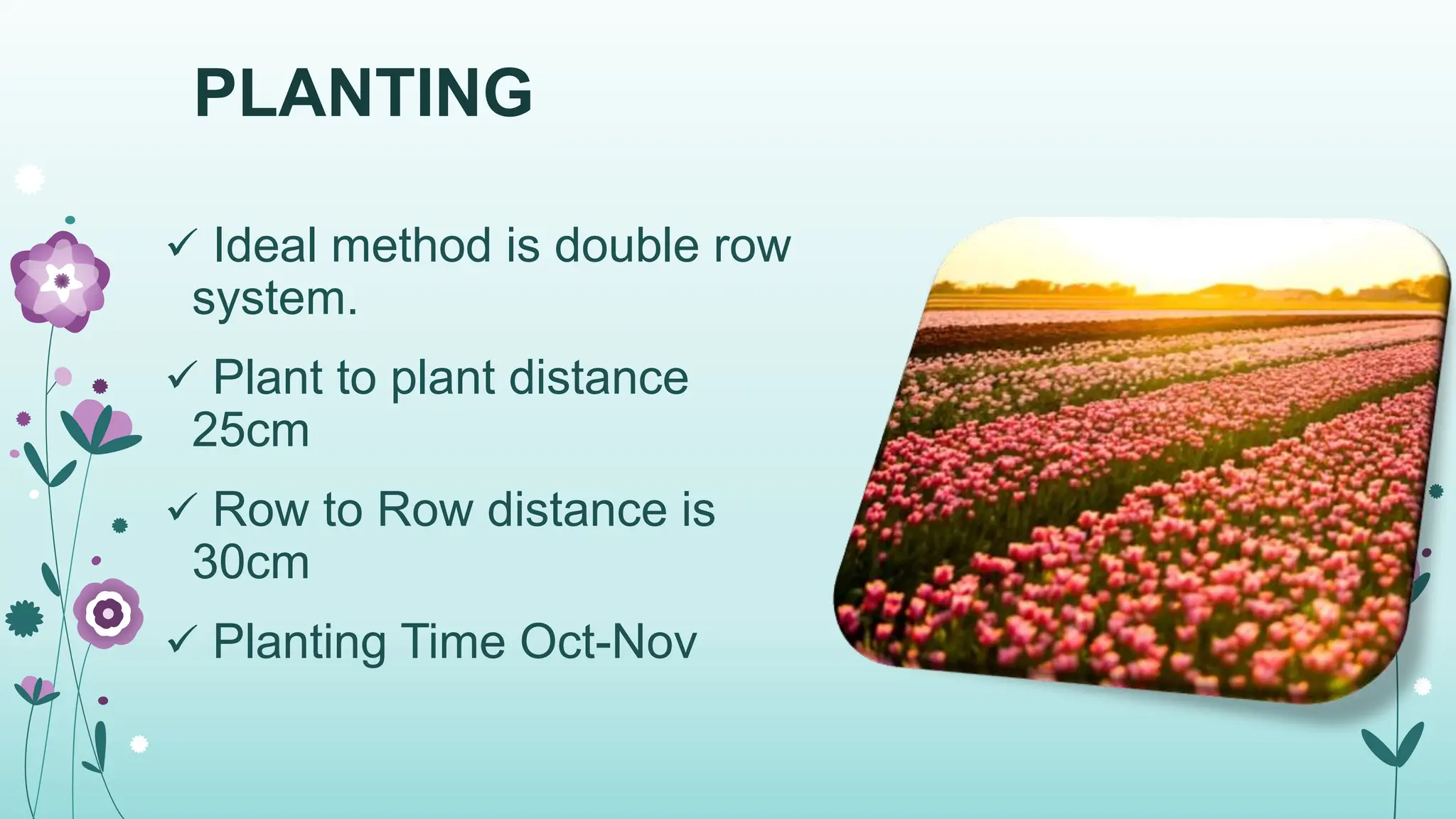
PLANTING
 Ideal method is double row
system.
 Plant to plant distance
25cm
 Row to Row distance is
30cm
 Planting Time Oct-Nov
PROPAGATION
Cutting: for most rose varieties, a stem cutting is taken
from a healthy plant, dipped in rooting hormone, and
planted in soil or water
Grafting: Grafting, or budding, is a technique for
propagating plants wherein you take a piece from one
plant and fuse it onto another.
Seeding: for all rose species, the seeds are collected
from the rose hips and sown in pots or beds
Layering: Plant division and layering: for hardwood
species, the plant is divided or bent to the ground and
covered with soil to form new roots
Cutting
Seeding
Grafting
CLIMATE
• Day temperature of 25C and night temperature of
10C, are good for high quality roses.
• Roses typically grow in warm climates and flowers in
summer.
• The Humidity is maintained between 50-60.
• In a open field Condition Ideal temperatures is 15-28
and humidity 75%
• The Site Chosen should be free from nematodes or
soil-borne pathogens.
SOIL & PH
• Soil Should be rich loose and structurally stable with
depth of 50 cm.
• Ensuring optiumum drainage and aeration to the
roots.
• Rose also can be grown in soil less media like rock
wool, coco peat, perlite
• Incorporated with organic or inorganic material to
improve the soil structure.
• Soil PH should be slightly acidic 6.2 to 6.8.
IRRIGATION
• Roses do not like water logging but need plenty of water for
their growth & development.
• Irrigation depends on the water requirement particular
variety.
• Ideals Methods is drip irrigation.
• Another method of irrigation is sub surface in which water is
directly delivered to the root zone.
• Regular soil moisture is important for rose.
MANURES AND FERTILIZERS
• An important part of caring for roses is regular and
proper fertilization as roses are heavy feeders.
• Roses need the three main macronutrients for plants
• Nitrogen (N): for foliage growth,
• Phosphorus (P): for root growth, and
• Potassium (K): for flower formation
• plus various micronutrients, including iron, calcium, and
magnesium
HARVESTING
• Harvesting is done with a sharp object
• When color is fully established and petals have not
started unfolding.
• There should be 1-2 mature leaves left after flower
cutting.
• Leaving the mature leaves will increase the production
of new strong shoots.
• Harvesting is preferred in early morning hours.
THANKU

presentation ROSE FLOWERS HORTICULTURE pptx

  • 1.
    ROSE GENERAL HORTICULTURE Presented By:Aftab Ali Wht:03173794826
  • 2.
    SCIENTIFIC CLASSIFICATION Rosa rubiginosa •Kingdom : Plantae • Class : Magnoliopsida • Family : Rosaceae • Specie : Rubigonisa • Genus : Rosa
  • 3.
    INTRODUCTION • Roses aremost popular Cut Flower world wide. • Rose is a ornamental shrub with upright or climbing stem. • There are roughly 360 species of roses in the genus Rosa & Rosaceae. • Roses come in a variety of colors including red, pink, white, yellow and orange.
  • 4.
    HISTORY & ORIGIN •The rose is one of the most admired and universally recognizable flowers in existence. • According to the fossils evidence, the rose is 35 Million years old. • Garden cultivation of the rose began about 5,000 years ago, probably in china . • It wasn't until the 18th century the cultivation of roses were introduced to Europe from China.
  • 5.
    IMPORTANCE • Roses areornamental plants grown for their flowers in garden and indoor. • Roses are valued for their rich and varied colors, profusion of bloom, velvety petal texture and, in many cultivars, a rich sweet scent. • It is always the flower of choice for home, flower arrangement, surprise gift in any occasion and events. • Roses are also economically important.
  • 6.
    USES • Garden Decors •Flower Arrangement • Medicine • Perfumes • Wall Decors • Rose oil and rose water • Sweet freshener ( house, car, office ) • Perfect for landscaping in parks; amusement parks • For decorations in any event like; weddings, festivities, birthdays.
  • 8.
    PLANTING  Ideal methodis double row system.  Plant to plant distance 25cm  Row to Row distance is 30cm  Planting Time Oct-Nov
  • 9.
    PROPAGATION Cutting: for mostrose varieties, a stem cutting is taken from a healthy plant, dipped in rooting hormone, and planted in soil or water Grafting: Grafting, or budding, is a technique for propagating plants wherein you take a piece from one plant and fuse it onto another. Seeding: for all rose species, the seeds are collected from the rose hips and sown in pots or beds Layering: Plant division and layering: for hardwood species, the plant is divided or bent to the ground and covered with soil to form new roots
  • 10.
  • 11.
    CLIMATE • Day temperatureof 25C and night temperature of 10C, are good for high quality roses. • Roses typically grow in warm climates and flowers in summer. • The Humidity is maintained between 50-60. • In a open field Condition Ideal temperatures is 15-28 and humidity 75% • The Site Chosen should be free from nematodes or soil-borne pathogens.
  • 12.
    SOIL & PH •Soil Should be rich loose and structurally stable with depth of 50 cm. • Ensuring optiumum drainage and aeration to the roots. • Rose also can be grown in soil less media like rock wool, coco peat, perlite • Incorporated with organic or inorganic material to improve the soil structure. • Soil PH should be slightly acidic 6.2 to 6.8.
  • 13.
    IRRIGATION • Roses donot like water logging but need plenty of water for their growth & development. • Irrigation depends on the water requirement particular variety. • Ideals Methods is drip irrigation. • Another method of irrigation is sub surface in which water is directly delivered to the root zone. • Regular soil moisture is important for rose.
  • 14.
    MANURES AND FERTILIZERS •An important part of caring for roses is regular and proper fertilization as roses are heavy feeders. • Roses need the three main macronutrients for plants • Nitrogen (N): for foliage growth, • Phosphorus (P): for root growth, and • Potassium (K): for flower formation • plus various micronutrients, including iron, calcium, and magnesium
  • 15.
    HARVESTING • Harvesting isdone with a sharp object • When color is fully established and petals have not started unfolding. • There should be 1-2 mature leaves left after flower cutting. • Leaving the mature leaves will increase the production of new strong shoots. • Harvesting is preferred in early morning hours.
  • 17.