Introduction
• Kingdom: Plantae
• Class: Magnoliopsida
• Family: Rosaceae
• Genus: Rosa
• Roses are the most popular cut-flower world
wide.
• The rose has been a symbol of love, beauty,
even war and politics.
• More than 30000 species of rose exist in world.
Out of these 30000, in Pakistan 11000 to 12000
are present.
• Rosaceae is the third largest plant family in both
world distribution and economic importance.
History
• The rose is one of the most admired and universally
recognizable flowers in existence.
• The rose has a long heritage in literature, art, movies,
history, and sports.
• According to fossil evidence, the rose is 35 million years
old.
• Garden cultivation of the rose began about 5,000 years
ago, probably in China.
• It wasn’t until the late 18th century that cultivation of
roses were introduced to Europe from China.
Importance and Uses
• Roses are best known as ornamental plants grown for
their flowers in the garden and sometimes indoors.
• Some are used as landscape plants, for hedging and for
other utilitarian purposes such as game cover.
• Roses are a popular crop for both domestic and
commercial cut flowers.
• Rose perfumes are made from attar of roses or rose oil.
• Rose water, made as a byproduct of rose oil production.
• Rose hips are occasionally made into jam, jelly, and
marmalade.
• Roses are also used in herbal and folk medicine.
Rose Color Meaning
• Red ~ Love, Passion, Respect, Courage
• White ~ Innocence, Purity, Secrecy
• Yellow ~ Joy, Friendship
• Coral ~ Desire
• Light Pink ~ Grace, Gladness, Joy
• Dark Pink ~ Thankfulness
• Lavender ~ Enchantment, Love at first Sight
• Orange ~ Fascination
Climate
• Day temperature of 25°C and a night
temperature of 10°C, are good for high quality
roses.
• The optimum temperature for standard carnation
is 15°–20°C.
• Clay soils, warm temperatures are always
preferred.
• The site chosen should be free from weeds,
nematodes or soil-borne pathogens.
Planting
• Roses require loamy, well drained soil.
• They are planted in the circular pits about 60- 90
cm across and 60 -75 cm deep.
• Remove all the broken and bruised leaves while
planting the plant.
• Roses require atleast six hours of direct sunlight
for the growth.
• The best time to plant the Rose plants rests
between September to October.
Cont…
• The rose plant needs cutting from time to time. It
requires manures and fertilizers at the time of
planting.
• Watering: Rose should be given one or two deep
soaks per week to encourage deep rooting and
drought resistance.
• Mulching is also done for protection against hot
sun and to keep the weeds down. Example:
Bark mulch, peat moss, well rotted compost
etc…
Pruning
• The best time to prune is in the early spring just
as you see the new growth beginning to bud.
Pruning is done to:
• Encourage new growth and bloom
• Remove dead wood
• Improve air circulation
• Shape the plant
There are 3 methods of Pruning:
• Hard Pruning
• Moderate Pruning
• Light Pruning
Classification of Roses
Roses are divided into three classes:
• Species Roses
• Old Garden Roses
• Modern Roses
Types of Roses
• Hybrid Tea Roses
• Floribunda
• Grandifloras
• Modern Shrub Roses
• Climbing Roses
• Miniature Roses
Floribunda
• Known for its large
clusters of medium sized
blooms that cover the
rose bush all season
long.
• The plant is generally
hardy and easy to grow
and maintain.
• It usually grows to about
3 feet tall.
Grandifloras
• They are similar to
hybrid teas.
• It has a unique ability
to grow clusters of
large hybrid tea-type
flowers on strong
straight stems.
• Plants are large and
grow to about 6-9 feet
tall.
Propagation
• Seeds
• Cuttings
• Layering
• Grafting
Diseases
• Black Spot
• Botrytis
• Powdery Mildew
• Rust
• Rose Mosaic
Black Spot
• It is caused by the fungus Diplocarpon rosae.
• The spots, which may be as much as 12mm
across, are generally circular and have an
irregular edge often with a yellow halo.
• Spray of Thiophanatemethyl(0.1%) is effective
for its control.
Powdery Mildew
• It is caused by the fungus Sphaerotheca
pannosa.
• This disease can cause young leaves to curl and
turn purple. Young canes may be distorted and
dwarfed.
• It can be controlled by the lime- sulphur spray.
Pests
• Aphids
• Two Spotted Mite
• Thrips
• Root Knot Nematode
Aphids
• Aphids are soft bodied
insects 1-2mm long. Often
green but occasionally light-
brown.
• They feed on the sap of the
plant by piercing the plant
cells via a proboscis.
Thrips
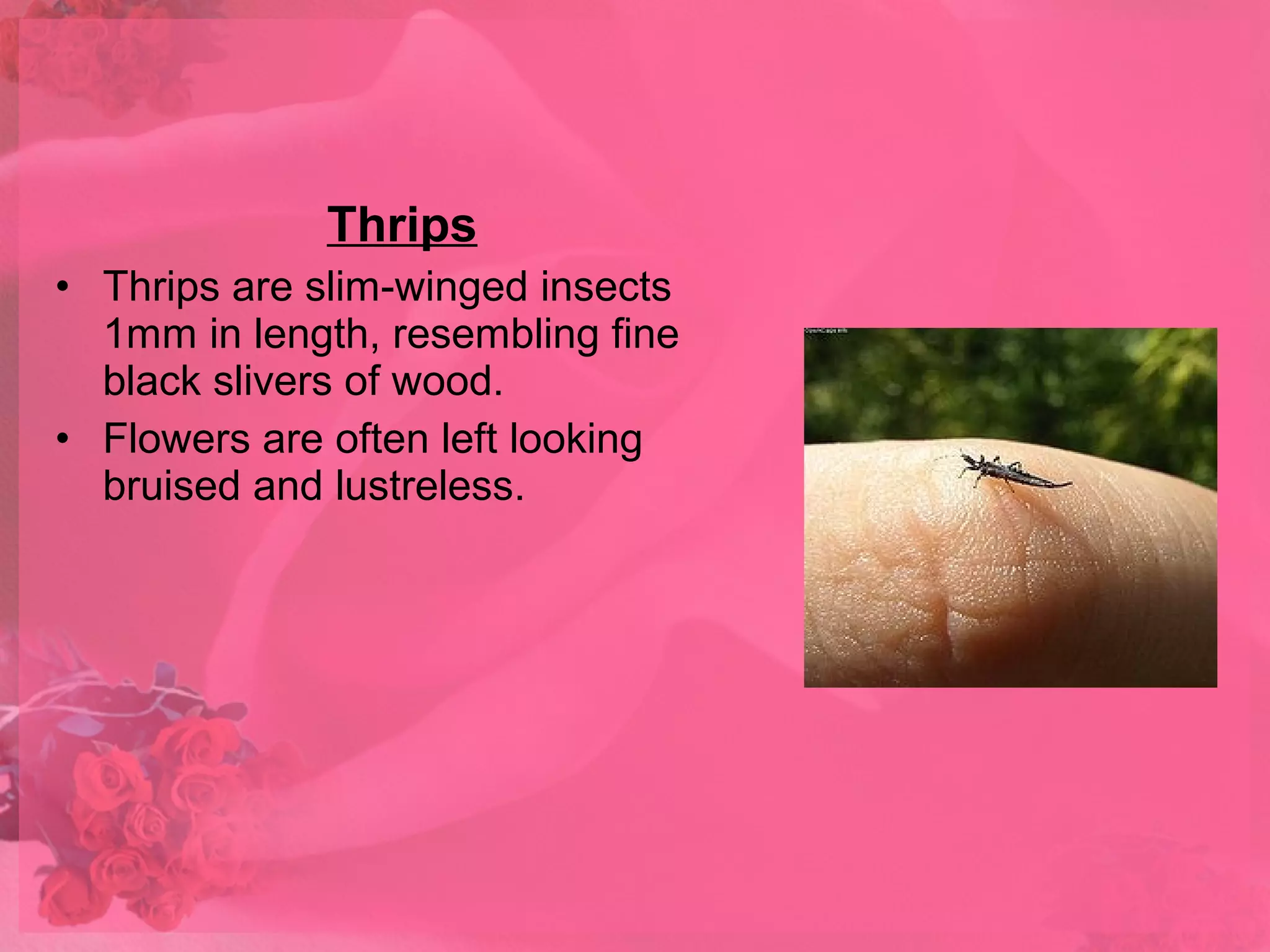
• Thrips are slim-winged insects
1mm in length, resembling fine
black slivers of wood.
• Flowers are often left looking
bruised and lustreless.
World Leading Rose Exporters
• The Netherlands, with about 8000 hectares of land
under Rose cultivation, is the global leader in Rose
cultivation.
Post Harvest Handling
• 1. Grading
• 2. Leaf Removal
• 3. Bunching
• 4. Recutting
• 5. Hydration
• 6. Special Treatments
• 7. Packing
• 8. Precooling
• 9. Cold Storage
• 10. Delivery to Market

Rose

  • 2.
    Introduction • Kingdom: Plantae •Class: Magnoliopsida • Family: Rosaceae • Genus: Rosa
  • 3.
    • Roses arethe most popular cut-flower world wide. • The rose has been a symbol of love, beauty, even war and politics. • More than 30000 species of rose exist in world. Out of these 30000, in Pakistan 11000 to 12000 are present. • Rosaceae is the third largest plant family in both world distribution and economic importance.
  • 4.
    History • The roseis one of the most admired and universally recognizable flowers in existence. • The rose has a long heritage in literature, art, movies, history, and sports. • According to fossil evidence, the rose is 35 million years old. • Garden cultivation of the rose began about 5,000 years ago, probably in China. • It wasn’t until the late 18th century that cultivation of roses were introduced to Europe from China.
  • 5.
    Importance and Uses •Roses are best known as ornamental plants grown for their flowers in the garden and sometimes indoors. • Some are used as landscape plants, for hedging and for other utilitarian purposes such as game cover. • Roses are a popular crop for both domestic and commercial cut flowers. • Rose perfumes are made from attar of roses or rose oil. • Rose water, made as a byproduct of rose oil production. • Rose hips are occasionally made into jam, jelly, and marmalade. • Roses are also used in herbal and folk medicine.
  • 6.
    Rose Color Meaning •Red ~ Love, Passion, Respect, Courage • White ~ Innocence, Purity, Secrecy • Yellow ~ Joy, Friendship • Coral ~ Desire • Light Pink ~ Grace, Gladness, Joy • Dark Pink ~ Thankfulness • Lavender ~ Enchantment, Love at first Sight • Orange ~ Fascination
  • 7.
    Climate • Day temperatureof 25°C and a night temperature of 10°C, are good for high quality roses. • The optimum temperature for standard carnation is 15°–20°C. • Clay soils, warm temperatures are always preferred. • The site chosen should be free from weeds, nematodes or soil-borne pathogens.
  • 8.
    Planting • Roses requireloamy, well drained soil. • They are planted in the circular pits about 60- 90 cm across and 60 -75 cm deep. • Remove all the broken and bruised leaves while planting the plant. • Roses require atleast six hours of direct sunlight for the growth. • The best time to plant the Rose plants rests between September to October.
  • 9.
    Cont… • The roseplant needs cutting from time to time. It requires manures and fertilizers at the time of planting. • Watering: Rose should be given one or two deep soaks per week to encourage deep rooting and drought resistance. • Mulching is also done for protection against hot sun and to keep the weeds down. Example: Bark mulch, peat moss, well rotted compost etc…
  • 10.
    Pruning • The besttime to prune is in the early spring just as you see the new growth beginning to bud. Pruning is done to: • Encourage new growth and bloom • Remove dead wood • Improve air circulation • Shape the plant
  • 11.
    There are 3methods of Pruning: • Hard Pruning • Moderate Pruning • Light Pruning
  • 12.
    Classification of Roses Rosesare divided into three classes: • Species Roses • Old Garden Roses • Modern Roses
  • 13.
    Types of Roses •Hybrid Tea Roses • Floribunda • Grandifloras • Modern Shrub Roses • Climbing Roses • Miniature Roses
  • 14.
    Floribunda • Known forits large clusters of medium sized blooms that cover the rose bush all season long. • The plant is generally hardy and easy to grow and maintain. • It usually grows to about 3 feet tall.
  • 15.
    Grandifloras • They aresimilar to hybrid teas. • It has a unique ability to grow clusters of large hybrid tea-type flowers on strong straight stems. • Plants are large and grow to about 6-9 feet tall.
  • 16.
  • 17.
    Diseases • Black Spot •Botrytis • Powdery Mildew • Rust • Rose Mosaic
  • 18.
    Black Spot • Itis caused by the fungus Diplocarpon rosae. • The spots, which may be as much as 12mm across, are generally circular and have an irregular edge often with a yellow halo. • Spray of Thiophanatemethyl(0.1%) is effective for its control.
  • 19.
    Powdery Mildew • Itis caused by the fungus Sphaerotheca pannosa. • This disease can cause young leaves to curl and turn purple. Young canes may be distorted and dwarfed. • It can be controlled by the lime- sulphur spray.
  • 20.
    Pests • Aphids • TwoSpotted Mite • Thrips • Root Knot Nematode
  • 21.
    Aphids • Aphids aresoft bodied insects 1-2mm long. Often green but occasionally light- brown. • They feed on the sap of the plant by piercing the plant cells via a proboscis.
  • 22.
    Thrips • Thrips areslim-winged insects 1mm in length, resembling fine black slivers of wood. • Flowers are often left looking bruised and lustreless.
  • 23.
    World Leading RoseExporters • The Netherlands, with about 8000 hectares of land under Rose cultivation, is the global leader in Rose cultivation.
  • 24.
    Post Harvest Handling •1. Grading • 2. Leaf Removal • 3. Bunching • 4. Recutting • 5. Hydration • 6. Special Treatments • 7. Packing • 8. Precooling • 9. Cold Storage • 10. Delivery to Market