Ms. Rohini Haridas
• Need
• What is it?
• What Causes it?• What Causes it?
• History (Evoluation)
• Wind Power & Energy
• How does it work?
• Wind Turbine
• Maths Calculations
Ms. Rohini Haridas
 Energy is a major input for overall socio economic
development of any society
 The prices of the fossil fuels steeply increasing
 So renewables are expected to play a key role
 Wind energy is the fastest growing renewable
 Wind turbines are up to the task of producing serious
amounts of electricity
Ms. Rohini Haridas
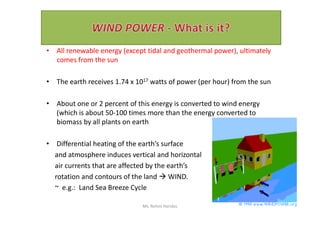
• All renewable energy (except tidal and geothermal power), ultimately
comes from the sun
• The earth receives 1.74 x 10¹⁷ watts of power (per hour) from the sun
• About one or 2 percent of this energy is converted to wind energy
(which is about 50-100 times more than the energy converted to(which is about 50-100 times more than the energy converted to
biomass by all plants on earth
• Differential heating of the earth’s surface
and atmosphere induces vertical and horizontal
air currents that are affected by the earth’s
rotation and contours of the land  WIND.
~ e.g.: Land Sea Breeze Cycle
Ms. Rohini Haridas
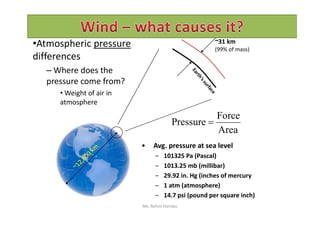
•Atmospheric pressure
differences
– Where does the
pressure come from?
• Weight of air in
atmosphere
Force
~31 km
(99% of mass)
Area
Force
Pressure 
• Avg. pressure at sea level
– 101325 Pa (Pascal)
– 1013.25 mb (millibar)
– 29.92 in. Hg (inches of mercury
– 1 atm (atmosphere)
– 14.7 psi (pound per square inch)
Ms. Rohini Haridas
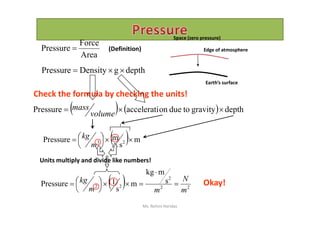
depthgDensityPressure 
Area
Force
Pressure  (Definition)
Earth’s surface
    depthgravitytodueonacceleratiPressure 
volume
mass
Check the formula by checking the units!
Space (zero pressure)
Edge of atmosphere
    depthgravitytodueonacceleratiPressure 
volume
  m
s
mPressure 23 




m
kg
Units multiply and divide like numbers!
  22
2
22
s
mkg
m
s
1Pressure
m
N
mm
kg 





 Okay!
Ms. Rohini Haridas
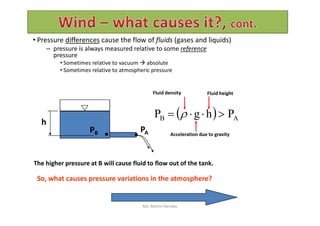
• Pressure differences cause the flow of fluids (gases and liquids)
– pressure is always measured relative to some reference
pressure
• Sometimes relative to vacuum  absolute
• Sometimes relative to atmospheric pressure
  PhgP  
Fluid density Fluid height
h
PB PA
The higher pressure at B will cause fluid to flow out of the tank.
So, what causes pressure variations in the atmosphere?
  AB PhgP  
Acceleration due to gravity
Ms. Rohini Haridas
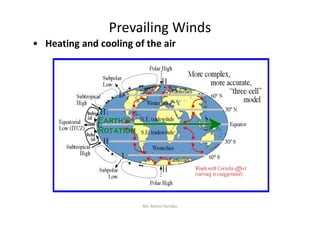
Prevailing Winds
• Heating and cooling of the air
Ms. Rohini Haridas
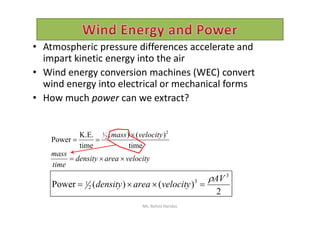
• Atmospheric pressure differences accelerate and
impart kinetic energy into the air
• Wind energy conversion machines (WEC) convert
wind energy into electrical or mechanical forms
• How much power can we extract?
time
)()(
time
K.E.
Power
2
2
1 velocitymass 

velocityareadensity
time
mass

2
)()(Power
3
3
2
1
AV
velocityareadensity


Ms. Rohini Haridas
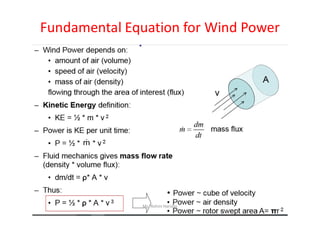
Fundamental Equation for Wind Power
Ms. Rohini Haridas
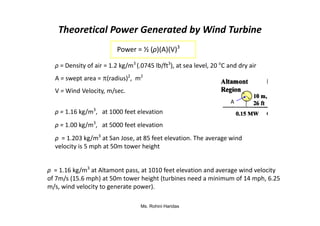
Theoretical Power Generated by Wind Turbine
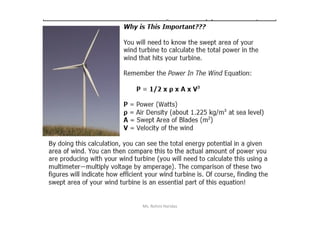
Power = ½ (ρ)(A)(V)3
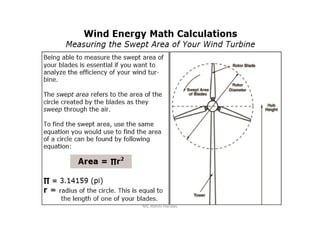
A = swept area = (radius)2
, m2
V = Wind Velocity, m/sec.
ρ = 1.16 kg/m3
, at 1000 feet elevation
ρ = Density of air = 1.2 kg/m3
(.0745 lb/ft3
), at sea level, 20 o
C and dry air
A
Ms. Rohini Haridas
ρ = 1.16 kg/m3
at Altamont pass, at 1010 feet elevation and average wind velocity
of 7m/s (15.6 mph) at 50m tower height (turbines need a minimum of 14 mph, 6.25
m/s, wind velocity to generate power).
ρ = 1.16 kg/m , at 1000 feet elevation
ρ = 1.00 kg/m3
, at 5000 feet elevation
ρ = 1.203 kg/m3
at San Jose, at 85 feet elevation. The average wind
velocity is 5 mph at 50m tower height
Used for
• Pumping water
• Grinding grain
Mainly used for
• Generating Electricity
Ms. Rohini Haridas
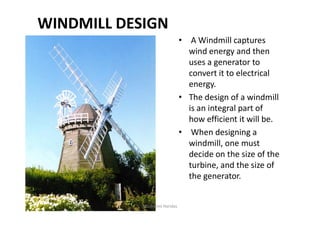
WINDMILL DESIGN
• A Windmill captures
wind energy and then
uses a generator to
convert it to electrical
energy.
• The design of a windmill
is an integral part ofis an integral part of
how efficient it will be.
• When designing a
windmill, one must
decide on the size of the
turbine, and the size of
the generator.
Ms. Rohini Haridas
Wind energy is created when the atmosphere is heated
unevenly by the Sun, some patches of air become warmer than
others. These warm patches of air rise, other air rushes in to
replace them – thus, wind blows.
A wind turbine extracts energy from moving air by slowing
the wind down, and transferring this energy into a spinning
shaft, which usually turns a generator to produce electricity.
The power in the wind that’s available for harvest depends on
both the wind speed and the area that’s swept by the turbine
blades.
Ms. Rohini Haridas
• Factors
– Efficiency
• Power produced per unit cost
– Directionality
– Support configuration
Speed of rotation– Speed of rotation
– Reliability
– Cost
– Maintainability
Which type is best, HAWT or VAWT?
Ms. Rohini Haridas
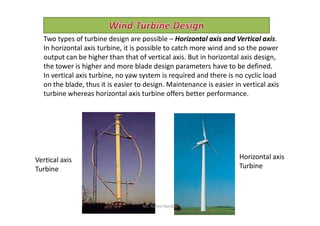
Two types of turbine design are possible – Horizontal axis and Vertical axis.
In horizontal axis turbine, it is possible to catch more wind and so the power
output can be higher than that of vertical axis. But in horizontal axis design,
the tower is higher and more blade design parameters have to be defined.
In vertical axis turbine, no yaw system is required and there is no cyclic load
on the blade, thus it is easier to design. Maintenance is easier in vertical axis
turbine whereas horizontal axis turbine offers better performance.
Horizontal axis
Turbine
Vertical axis
Turbine
Ms. Rohini Haridas
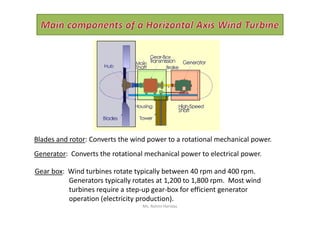
Gear box: Wind turbines rotate typically between 40 rpm and 400 rpm.
Generators typically rotates at 1,200 to 1,800 rpm. Most wind
turbines require a step-up gear-box for efficient generator
operation (electricity production).
Blades and rotor: Converts the wind power to a rotational mechanical power.
Generator: Converts the rotational mechanical power to electrical power.
Ms. Rohini Haridas
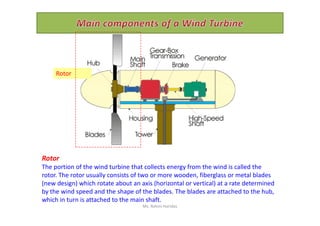
Rotor
Rotor
The portion of the wind turbine that collects energy from the wind is called the
rotor. The rotor usually consists of two or more wooden, fiberglass or metal blades
(new design) which rotate about an axis (horizontal or vertical) at a rate determined
by the wind speed and the shape of the blades. The blades are attached to the hub,
which in turn is attached to the main shaft.
Ms. Rohini Haridas
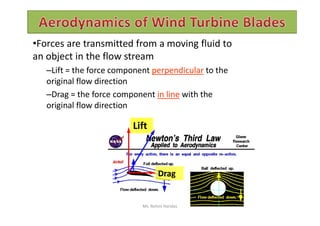
•Forces are transmitted from a moving fluid to
an object in the flow stream
–Lift = the force component perpendicular to the
original flow direction
–Drag = the force component in line with the
original flow direction
Lift
Drag
Ms. Rohini Haridas
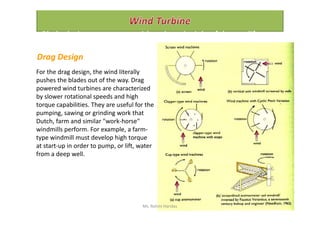
For the drag design, the wind literally
pushes the blades out of the way. Drag
powered wind turbines are characterized
by slower rotational speeds and high
torque capabilities. They are useful for the
pumping, sawing or grinding work that
Drag Design
Blade designs operate on either the principle of drag or lift.
pumping, sawing or grinding work that
Dutch, farm and similar "work-horse"
windmills perform. For example, a farm-
type windmill must develop high torque
at start-up in order to pump, or lift, water
from a deep well.
Ms. Rohini Haridas
Ms. Rohini Haridas
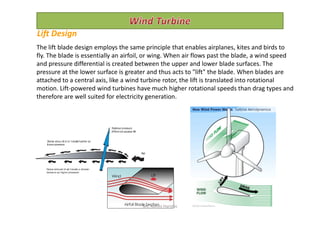
The lift blade design employs the same principle that enables airplanes, kites and birds to
fly. The blade is essentially an airfoil, or wing. When air flows past the blade, a wind speed
and pressure differential is created between the upper and lower blade surfaces. The
pressure at the lower surface is greater and thus acts to "lift" the blade. When blades are
attached to a central axis, like a wind turbine rotor, the lift is translated into rotational
motion. Lift-powered wind turbines have much higher rotational speeds than drag types and
therefore are well suited for electricity generation.
Lift Design
Ms. Rohini Haridas
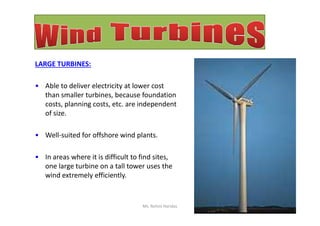
LARGE TURBINES:
• Able to deliver electricity at lower cost
than smaller turbines, because foundation
costs, planning costs, etc. are independent
of size.of size.
• Well-suited for offshore wind plants.
• In areas where it is difficult to find sites,
one large turbine on a tall tower uses the
wind extremely efficiently.
Ms. Rohini Haridas
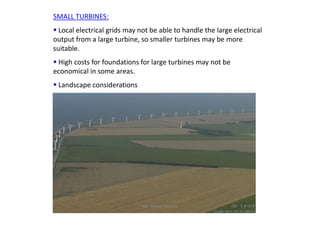
SMALL TURBINES:
 Local electrical grids may not be able to handle the large electrical
output from a large turbine, so smaller turbines may be more
suitable.
 High costs for foundations for large turbines may not be
economical in some areas.
 Landscape considerations
Ms. Rohini Haridas
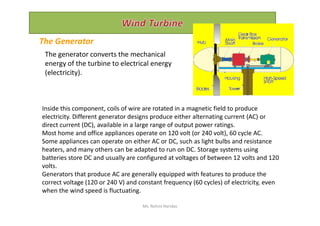
Inside this component, coils of wire are rotated in a magnetic field to produce
electricity. Different generator designs produce either alternating current (AC) or
The Generator
The generator converts the mechanical
energy of the turbine to electrical energy
(electricity).
electricity. Different generator designs produce either alternating current (AC) or
direct current (DC), available in a large range of output power ratings.
Most home and office appliances operate on 120 volt (or 240 volt), 60 cycle AC.
Some appliances can operate on either AC or DC, such as light bulbs and resistance
heaters, and many others can be adapted to run on DC. Storage systems using
batteries store DC and usually are configured at voltages of between 12 volts and 120
volts.
Generators that produce AC are generally equipped with features to produce the
correct voltage (120 or 240 V) and constant frequency (60 cycles) of electricity, even
when the wind speed is fluctuating.
Ms. Rohini Haridas
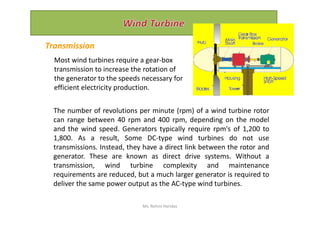
The number of revolutions per minute (rpm) of a wind turbine rotor
Transmission
Most wind turbines require a gear-box
transmission to increase the rotation of
the generator to the speeds necessary for
efficient electricity production.
The number of revolutions per minute (rpm) of a wind turbine rotor
can range between 40 rpm and 400 rpm, depending on the model
and the wind speed. Generators typically require rpm's of 1,200 to
1,800. As a result, Some DC-type wind turbines do not use
transmissions. Instead, they have a direct link between the rotor and
generator. These are known as direct drive systems. Without a
transmission, wind turbine complexity and maintenance
requirements are reduced, but a much larger generator is required to
deliver the same power output as the AC-type wind turbines.
Ms. Rohini Haridas
Cut-in speed is the minimum wind speed at which the wind turbine will
generate usable power. This wind speed is typically between 7 and 15
mph.
Cut-in Speed
Rated Speed
The rated speed is the minimum wind speed at which the wind turbineThe rated speed is the minimum wind speed at which the wind turbine
will generate its designated rated power. For example, a "10 kilowatt"
wind turbine may not generate 10 kilowatts until wind speeds reach 25
mph. Rated speed for most machines is in the range of 25 to 35 mph.
At wind speeds between cut-in and rated, the power output from a
wind turbine increases as the wind increases. The output of most
machines levels off above the rated speed. Most manufacturers
provide graphs, called "power curves," showing how their wind turbine
output varies with wind speed.
Ms. Rohini Haridas
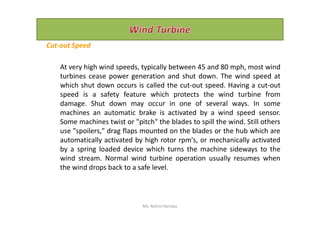
At very high wind speeds, typically between 45 and 80 mph, most wind
turbines cease power generation and shut down. The wind speed at
which shut down occurs is called the cut-out speed. Having a cut-out
speed is a safety feature which protects the wind turbine from
damage. Shut down may occur in one of several ways. In some
machines an automatic brake is activated by a wind speed sensor.
Cut-out Speed
machines an automatic brake is activated by a wind speed sensor.
Some machines twist or "pitch" the blades to spill the wind. Still others
use "spoilers," drag flaps mounted on the blades or the hub which are
automatically activated by high rotor rpm's, or mechanically activated
by a spring loaded device which turns the machine sideways to the
wind stream. Normal wind turbine operation usually resumes when
the wind drops back to a safe level.
Ms. Rohini Haridas
Wind turbines with rotors (turbine blades and hub) that are about 8 feet in diameter
(50 square feet of swept area) may peak at about 1,000 watts (1 kilowatt; kW), and
generate about 75 kilowatt-hours (kWh) per month with a 10 mph average wind speed.
Turbines smaller than this may be appropriate for sailboats, cabins, or other
applications that require only a small amount of electricity. [Small Wind]
For wind turbine farms, it’s reasonable to use turbines with rotors up to 56 feet inFor wind turbine farms, it’s reasonable to use turbines with rotors up to 56 feet in
diameter (2,500 square feet of swept area). These turbines may peak at about 90,000
watts (90 kW), and generate 3,000 to 5,000 kWh per month at a 10 mph average wind
speed, enough to supply 200 homes with electricity.
Homes typically use 500-1,500 kilowatt-hours of electricity per month. Depending
upon the average wind speed in the area this will require a wind turbine rated in the
range 5-15 kilowatts, which translates into a rotor diameter of 14 to 26 feet.
Ms. Rohini Haridas
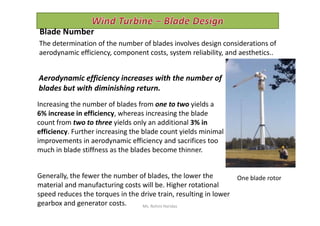
Increasing the number of blades from one to two yields a
6% increase in efficiency, whereas increasing the blade
Blade Number
The determination of the number of blades involves design considerations of
aerodynamic efficiency, component costs, system reliability, and aesthetics..
Aerodynamic efficiency increases with the number of
blades but with diminishing return.
6% increase in efficiency, whereas increasing the blade
count from two to three yields only an additional 3% in
efficiency. Further increasing the blade count yields minimal
improvements in aerodynamic efficiency and sacrifices too
much in blade stiffness as the blades become thinner.
One blade rotorGenerally, the fewer the number of blades, the lower the
material and manufacturing costs will be. Higher rotational
speed reduces the torques in the drive train, resulting in lower
gearbox and generator costs. Ms. Rohini Haridas
Wind turbines are built to catch the wind's kinetic (motion) energy. You
may therefore wonder why modern wind turbines are not built with a lot
of rotor blades, like the old "American" windmills you have seen in the
The ideal wind turbine design is not dictated by technology alone, but by a
combination of technology and economics: Wind turbine manufacturers wish to
optimize their machines, so that they deliver electricity at the lowest possible cost
per kilowatt hour (kWh) of energy.
The ideal wind turbine rotor has an infinite number of infinitely thin
blades. In the real world, more blades give more torque, but slower
speed, and most alternators need fairly good speed to cut in.
of rotor blades, like the old "American" windmills you have seen in the
Western movies and still being used in many farms.
Turbines with many blades or very wide blades will be subject to very
large forces, when the wind blows at a hurricane speed.
Ms. Rohini Haridas
A rotor with an even number of blades will cause stability
problems for a wind turbine. The reason is that at the very
moment when the uppermost blade bends backwards,
because it gets the maximum power from the wind, the lower
Even or Odd Number of Blades
because it gets the maximum power from the wind, the lower
most blade passes into the wind shade in front of the tower.
This produces uneven forces on the rotor shaft and rotor
blade.
Ms. Rohini Haridas
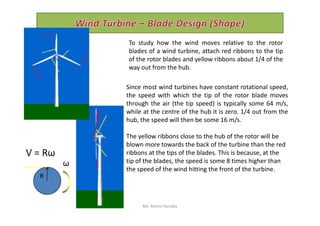
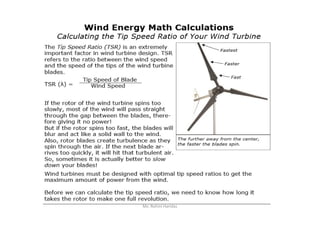
To study how the wind moves relative to the rotor
blades of a wind turbine, attach red ribbons to the tip
of the rotor blades and yellow ribbons about 1/4 of the
way out from the hub.
Since most wind turbines have constant rotational speed,
the speed with which the tip of the rotor blade moves
through the air (the tip speed) is typically some 64 m/s,
while at the centre of the hub it is zero. 1/4 out from thewhile at the centre of the hub it is zero. 1/4 out from the
hub, the speed will then be some 16 m/s.
The yellow ribbons close to the hub of the rotor will be
blown more towards the back of the turbine than the red
ribbons at the tips of the blades. This is because, at the
tip of the blades, the speed is some 8 times higher than
the speed of the wind hitting the front of the turbine.
V = Rω
ω
R
Ms. Rohini Haridas
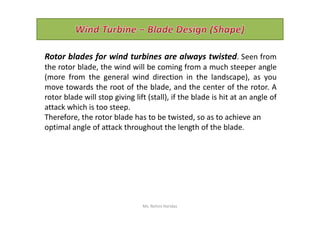
Rotor blades for wind turbines are always twisted. Seen from
the rotor blade, the wind will be coming from a much steeper angle
(more from the general wind direction in the landscape), as you
move towards the root of the blade, and the center of the rotor. A
rotor blade will stop giving lift (stall), if the blade is hit at an angle of
attack which is too steep.
Therefore, the rotor blade has to be twisted, so as to achieve anTherefore, the rotor blade has to be twisted, so as to achieve an
optimal angle of attack throughout the length of the blade.
Ms. Rohini Haridas
Wind Turbines: Number of Blades
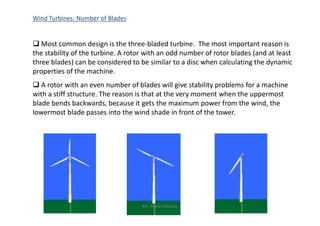
 Most common design is the three-bladed turbine. The most important reason is
the stability of the turbine. A rotor with an odd number of rotor blades (and at least
three blades) can be considered to be similar to a disc when calculating the dynamic
properties of the machine.
 A rotor with an even number of blades will give stability problems for a machine
with a stiff structure. The reason is that at the very moment when the uppermost
blade bends backwards, because it gets the maximum power from the wind, the
lowermost blade passes into the wind shade in front of the tower.lowermost blade passes into the wind shade in front of the tower.
Ms. Rohini Haridas
Blade Length
Blade Number
Blade Pitch
Blade Shape
Blade Materials
Blade Weight
Rotor Blade Variables
What should be the blade profile?
Ms. Rohini Haridas
Conduct an internet search to obtain enough
information to help you decide on the number and
profile of the blades.
What should be the angle of attack?
How many blades to use?
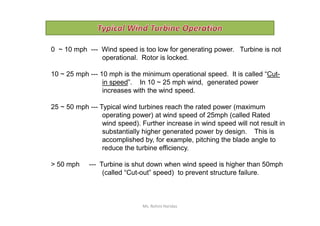
0 ~ 10 mph --- Wind speed is too low for generating power. Turbine is not
operational. Rotor is locked.
10 ~ 25 mph --- 10 mph is the minimum operational speed. It is called “Cut-
in speed”. In 10 ~ 25 mph wind, generated power
increases with the wind speed.
25 ~ 50 mph --- Typical wind turbines reach the rated power (maximum
operating power) at wind speed of 25mph (called Ratedoperating power) at wind speed of 25mph (called Rated
wind speed). Further increase in wind speed will not result in
substantially higher generated power by design. This is
accomplished by, for example, pitching the blade angle to
reduce the turbine efficiency.
> 50 mph --- Turbine is shut down when wind speed is higher than 50mph
(called “Cut-out” speed) to prevent structure failure.
Ms. Rohini Haridas
Ms. Rohini Haridas
Ms. Rohini Haridas
Ms. Rohini Haridas
Ms. Rohini Haridas
Ms. Rohini Haridas
Ms. Rohini Haridas
Ms. Rohini Haridas
Ms. Rohini Haridas
Ms. Rohini Haridas
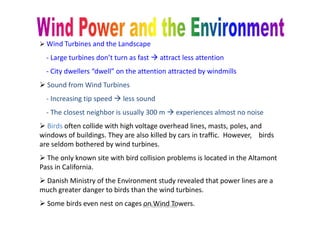
 Wind Turbines and the Landscape
- Large turbines don’t turn as fast  attract less attention
- City dwellers “dwell” on the attention attracted by windmills
 Sound from Wind Turbines
- Increasing tip speed  less sound
- The closest neighbor is usually 300 m  experiences almost no noise- The closest neighbor is usually 300 m  experiences almost no noise
 Birds often collide with high voltage overhead lines, masts, poles, and
windows of buildings. They are also killed by cars in traffic. However, birds
are seldom bothered by wind turbines.
 The only known site with bird collision problems is located in the Altamont
Pass in California.
 Danish Ministry of the Environment study revealed that power lines are a
much greater danger to birds than the wind turbines.
 Some birds even nest on cages on Wind Towers.Ms. Rohini Haridas
Ms. Rohini Haridas

Rohini haridas wind energy

  • 1.
  • 2.
    • Need • Whatis it? • What Causes it?• What Causes it? • History (Evoluation) • Wind Power & Energy • How does it work? • Wind Turbine • Maths Calculations Ms. Rohini Haridas
  • 3.
     Energy isa major input for overall socio economic development of any society  The prices of the fossil fuels steeply increasing  So renewables are expected to play a key role  Wind energy is the fastest growing renewable  Wind turbines are up to the task of producing serious amounts of electricity Ms. Rohini Haridas
  • 4.
    • All renewableenergy (except tidal and geothermal power), ultimately comes from the sun • The earth receives 1.74 x 10¹⁷ watts of power (per hour) from the sun • About one or 2 percent of this energy is converted to wind energy (which is about 50-100 times more than the energy converted to(which is about 50-100 times more than the energy converted to biomass by all plants on earth • Differential heating of the earth’s surface and atmosphere induces vertical and horizontal air currents that are affected by the earth’s rotation and contours of the land  WIND. ~ e.g.: Land Sea Breeze Cycle Ms. Rohini Haridas
  • 5.
    •Atmospheric pressure differences – Wheredoes the pressure come from? • Weight of air in atmosphere Force ~31 km (99% of mass) Area Force Pressure  • Avg. pressure at sea level – 101325 Pa (Pascal) – 1013.25 mb (millibar) – 29.92 in. Hg (inches of mercury – 1 atm (atmosphere) – 14.7 psi (pound per square inch) Ms. Rohini Haridas
  • 6.
    depthgDensityPressure  Area Force Pressure (Definition) Earth’s surface     depthgravitytodueonacceleratiPressure  volume mass Check the formula by checking the units! Space (zero pressure) Edge of atmosphere     depthgravitytodueonacceleratiPressure  volume   m s mPressure 23      m kg Units multiply and divide like numbers!   22 2 22 s mkg m s 1Pressure m N mm kg        Okay! Ms. Rohini Haridas
  • 7.
    • Pressure differencescause the flow of fluids (gases and liquids) – pressure is always measured relative to some reference pressure • Sometimes relative to vacuum  absolute • Sometimes relative to atmospheric pressure   PhgP   Fluid density Fluid height h PB PA The higher pressure at B will cause fluid to flow out of the tank. So, what causes pressure variations in the atmosphere?   AB PhgP   Acceleration due to gravity Ms. Rohini Haridas
  • 8.
    Prevailing Winds • Heatingand cooling of the air Ms. Rohini Haridas
  • 9.
    • Atmospheric pressuredifferences accelerate and impart kinetic energy into the air • Wind energy conversion machines (WEC) convert wind energy into electrical or mechanical forms • How much power can we extract? time )()( time K.E. Power 2 2 1 velocitymass   velocityareadensity time mass  2 )()(Power 3 3 2 1 AV velocityareadensity   Ms. Rohini Haridas
  • 10.
    Fundamental Equation forWind Power Ms. Rohini Haridas
  • 11.
    Theoretical Power Generatedby Wind Turbine Power = ½ (ρ)(A)(V)3 A = swept area = (radius)2 , m2 V = Wind Velocity, m/sec. ρ = 1.16 kg/m3 , at 1000 feet elevation ρ = Density of air = 1.2 kg/m3 (.0745 lb/ft3 ), at sea level, 20 o C and dry air A Ms. Rohini Haridas ρ = 1.16 kg/m3 at Altamont pass, at 1010 feet elevation and average wind velocity of 7m/s (15.6 mph) at 50m tower height (turbines need a minimum of 14 mph, 6.25 m/s, wind velocity to generate power). ρ = 1.16 kg/m , at 1000 feet elevation ρ = 1.00 kg/m3 , at 5000 feet elevation ρ = 1.203 kg/m3 at San Jose, at 85 feet elevation. The average wind velocity is 5 mph at 50m tower height
  • 12.
    Used for • Pumpingwater • Grinding grain Mainly used for • Generating Electricity Ms. Rohini Haridas
  • 13.
    WINDMILL DESIGN • AWindmill captures wind energy and then uses a generator to convert it to electrical energy. • The design of a windmill is an integral part ofis an integral part of how efficient it will be. • When designing a windmill, one must decide on the size of the turbine, and the size of the generator. Ms. Rohini Haridas
  • 14.
    Wind energy iscreated when the atmosphere is heated unevenly by the Sun, some patches of air become warmer than others. These warm patches of air rise, other air rushes in to replace them – thus, wind blows. A wind turbine extracts energy from moving air by slowing the wind down, and transferring this energy into a spinning shaft, which usually turns a generator to produce electricity. The power in the wind that’s available for harvest depends on both the wind speed and the area that’s swept by the turbine blades. Ms. Rohini Haridas
  • 15.
    • Factors – Efficiency •Power produced per unit cost – Directionality – Support configuration Speed of rotation– Speed of rotation – Reliability – Cost – Maintainability Which type is best, HAWT or VAWT? Ms. Rohini Haridas
  • 16.
    Two types ofturbine design are possible – Horizontal axis and Vertical axis. In horizontal axis turbine, it is possible to catch more wind and so the power output can be higher than that of vertical axis. But in horizontal axis design, the tower is higher and more blade design parameters have to be defined. In vertical axis turbine, no yaw system is required and there is no cyclic load on the blade, thus it is easier to design. Maintenance is easier in vertical axis turbine whereas horizontal axis turbine offers better performance. Horizontal axis Turbine Vertical axis Turbine Ms. Rohini Haridas
  • 17.
    Gear box: Windturbines rotate typically between 40 rpm and 400 rpm. Generators typically rotates at 1,200 to 1,800 rpm. Most wind turbines require a step-up gear-box for efficient generator operation (electricity production). Blades and rotor: Converts the wind power to a rotational mechanical power. Generator: Converts the rotational mechanical power to electrical power. Ms. Rohini Haridas
  • 18.
    Rotor Rotor The portion ofthe wind turbine that collects energy from the wind is called the rotor. The rotor usually consists of two or more wooden, fiberglass or metal blades (new design) which rotate about an axis (horizontal or vertical) at a rate determined by the wind speed and the shape of the blades. The blades are attached to the hub, which in turn is attached to the main shaft. Ms. Rohini Haridas
  • 19.
    •Forces are transmittedfrom a moving fluid to an object in the flow stream –Lift = the force component perpendicular to the original flow direction –Drag = the force component in line with the original flow direction Lift Drag Ms. Rohini Haridas
  • 20.
    For the dragdesign, the wind literally pushes the blades out of the way. Drag powered wind turbines are characterized by slower rotational speeds and high torque capabilities. They are useful for the pumping, sawing or grinding work that Drag Design Blade designs operate on either the principle of drag or lift. pumping, sawing or grinding work that Dutch, farm and similar "work-horse" windmills perform. For example, a farm- type windmill must develop high torque at start-up in order to pump, or lift, water from a deep well. Ms. Rohini Haridas
  • 21.
  • 22.
    The lift bladedesign employs the same principle that enables airplanes, kites and birds to fly. The blade is essentially an airfoil, or wing. When air flows past the blade, a wind speed and pressure differential is created between the upper and lower blade surfaces. The pressure at the lower surface is greater and thus acts to "lift" the blade. When blades are attached to a central axis, like a wind turbine rotor, the lift is translated into rotational motion. Lift-powered wind turbines have much higher rotational speeds than drag types and therefore are well suited for electricity generation. Lift Design Ms. Rohini Haridas
  • 23.
    LARGE TURBINES: • Ableto deliver electricity at lower cost than smaller turbines, because foundation costs, planning costs, etc. are independent of size.of size. • Well-suited for offshore wind plants. • In areas where it is difficult to find sites, one large turbine on a tall tower uses the wind extremely efficiently. Ms. Rohini Haridas
  • 24.
    SMALL TURBINES:  Localelectrical grids may not be able to handle the large electrical output from a large turbine, so smaller turbines may be more suitable.  High costs for foundations for large turbines may not be economical in some areas.  Landscape considerations Ms. Rohini Haridas
  • 25.
    Inside this component,coils of wire are rotated in a magnetic field to produce electricity. Different generator designs produce either alternating current (AC) or The Generator The generator converts the mechanical energy of the turbine to electrical energy (electricity). electricity. Different generator designs produce either alternating current (AC) or direct current (DC), available in a large range of output power ratings. Most home and office appliances operate on 120 volt (or 240 volt), 60 cycle AC. Some appliances can operate on either AC or DC, such as light bulbs and resistance heaters, and many others can be adapted to run on DC. Storage systems using batteries store DC and usually are configured at voltages of between 12 volts and 120 volts. Generators that produce AC are generally equipped with features to produce the correct voltage (120 or 240 V) and constant frequency (60 cycles) of electricity, even when the wind speed is fluctuating. Ms. Rohini Haridas
  • 26.
    The number ofrevolutions per minute (rpm) of a wind turbine rotor Transmission Most wind turbines require a gear-box transmission to increase the rotation of the generator to the speeds necessary for efficient electricity production. The number of revolutions per minute (rpm) of a wind turbine rotor can range between 40 rpm and 400 rpm, depending on the model and the wind speed. Generators typically require rpm's of 1,200 to 1,800. As a result, Some DC-type wind turbines do not use transmissions. Instead, they have a direct link between the rotor and generator. These are known as direct drive systems. Without a transmission, wind turbine complexity and maintenance requirements are reduced, but a much larger generator is required to deliver the same power output as the AC-type wind turbines. Ms. Rohini Haridas
  • 27.
    Cut-in speed isthe minimum wind speed at which the wind turbine will generate usable power. This wind speed is typically between 7 and 15 mph. Cut-in Speed Rated Speed The rated speed is the minimum wind speed at which the wind turbineThe rated speed is the minimum wind speed at which the wind turbine will generate its designated rated power. For example, a "10 kilowatt" wind turbine may not generate 10 kilowatts until wind speeds reach 25 mph. Rated speed for most machines is in the range of 25 to 35 mph. At wind speeds between cut-in and rated, the power output from a wind turbine increases as the wind increases. The output of most machines levels off above the rated speed. Most manufacturers provide graphs, called "power curves," showing how their wind turbine output varies with wind speed. Ms. Rohini Haridas
  • 28.
    At very highwind speeds, typically between 45 and 80 mph, most wind turbines cease power generation and shut down. The wind speed at which shut down occurs is called the cut-out speed. Having a cut-out speed is a safety feature which protects the wind turbine from damage. Shut down may occur in one of several ways. In some machines an automatic brake is activated by a wind speed sensor. Cut-out Speed machines an automatic brake is activated by a wind speed sensor. Some machines twist or "pitch" the blades to spill the wind. Still others use "spoilers," drag flaps mounted on the blades or the hub which are automatically activated by high rotor rpm's, or mechanically activated by a spring loaded device which turns the machine sideways to the wind stream. Normal wind turbine operation usually resumes when the wind drops back to a safe level. Ms. Rohini Haridas
  • 29.
    Wind turbines withrotors (turbine blades and hub) that are about 8 feet in diameter (50 square feet of swept area) may peak at about 1,000 watts (1 kilowatt; kW), and generate about 75 kilowatt-hours (kWh) per month with a 10 mph average wind speed. Turbines smaller than this may be appropriate for sailboats, cabins, or other applications that require only a small amount of electricity. [Small Wind] For wind turbine farms, it’s reasonable to use turbines with rotors up to 56 feet inFor wind turbine farms, it’s reasonable to use turbines with rotors up to 56 feet in diameter (2,500 square feet of swept area). These turbines may peak at about 90,000 watts (90 kW), and generate 3,000 to 5,000 kWh per month at a 10 mph average wind speed, enough to supply 200 homes with electricity. Homes typically use 500-1,500 kilowatt-hours of electricity per month. Depending upon the average wind speed in the area this will require a wind turbine rated in the range 5-15 kilowatts, which translates into a rotor diameter of 14 to 26 feet. Ms. Rohini Haridas
  • 30.
    Increasing the numberof blades from one to two yields a 6% increase in efficiency, whereas increasing the blade Blade Number The determination of the number of blades involves design considerations of aerodynamic efficiency, component costs, system reliability, and aesthetics.. Aerodynamic efficiency increases with the number of blades but with diminishing return. 6% increase in efficiency, whereas increasing the blade count from two to three yields only an additional 3% in efficiency. Further increasing the blade count yields minimal improvements in aerodynamic efficiency and sacrifices too much in blade stiffness as the blades become thinner. One blade rotorGenerally, the fewer the number of blades, the lower the material and manufacturing costs will be. Higher rotational speed reduces the torques in the drive train, resulting in lower gearbox and generator costs. Ms. Rohini Haridas
  • 31.
    Wind turbines arebuilt to catch the wind's kinetic (motion) energy. You may therefore wonder why modern wind turbines are not built with a lot of rotor blades, like the old "American" windmills you have seen in the The ideal wind turbine design is not dictated by technology alone, but by a combination of technology and economics: Wind turbine manufacturers wish to optimize their machines, so that they deliver electricity at the lowest possible cost per kilowatt hour (kWh) of energy. The ideal wind turbine rotor has an infinite number of infinitely thin blades. In the real world, more blades give more torque, but slower speed, and most alternators need fairly good speed to cut in. of rotor blades, like the old "American" windmills you have seen in the Western movies and still being used in many farms. Turbines with many blades or very wide blades will be subject to very large forces, when the wind blows at a hurricane speed. Ms. Rohini Haridas
  • 32.
    A rotor withan even number of blades will cause stability problems for a wind turbine. The reason is that at the very moment when the uppermost blade bends backwards, because it gets the maximum power from the wind, the lower Even or Odd Number of Blades because it gets the maximum power from the wind, the lower most blade passes into the wind shade in front of the tower. This produces uneven forces on the rotor shaft and rotor blade. Ms. Rohini Haridas
  • 33.
    To study howthe wind moves relative to the rotor blades of a wind turbine, attach red ribbons to the tip of the rotor blades and yellow ribbons about 1/4 of the way out from the hub. Since most wind turbines have constant rotational speed, the speed with which the tip of the rotor blade moves through the air (the tip speed) is typically some 64 m/s, while at the centre of the hub it is zero. 1/4 out from thewhile at the centre of the hub it is zero. 1/4 out from the hub, the speed will then be some 16 m/s. The yellow ribbons close to the hub of the rotor will be blown more towards the back of the turbine than the red ribbons at the tips of the blades. This is because, at the tip of the blades, the speed is some 8 times higher than the speed of the wind hitting the front of the turbine. V = Rω ω R Ms. Rohini Haridas
  • 34.
    Rotor blades forwind turbines are always twisted. Seen from the rotor blade, the wind will be coming from a much steeper angle (more from the general wind direction in the landscape), as you move towards the root of the blade, and the center of the rotor. A rotor blade will stop giving lift (stall), if the blade is hit at an angle of attack which is too steep. Therefore, the rotor blade has to be twisted, so as to achieve anTherefore, the rotor blade has to be twisted, so as to achieve an optimal angle of attack throughout the length of the blade. Ms. Rohini Haridas
  • 35.
    Wind Turbines: Numberof Blades  Most common design is the three-bladed turbine. The most important reason is the stability of the turbine. A rotor with an odd number of rotor blades (and at least three blades) can be considered to be similar to a disc when calculating the dynamic properties of the machine.  A rotor with an even number of blades will give stability problems for a machine with a stiff structure. The reason is that at the very moment when the uppermost blade bends backwards, because it gets the maximum power from the wind, the lowermost blade passes into the wind shade in front of the tower.lowermost blade passes into the wind shade in front of the tower. Ms. Rohini Haridas
  • 36.
    Blade Length Blade Number BladePitch Blade Shape Blade Materials Blade Weight Rotor Blade Variables What should be the blade profile? Ms. Rohini Haridas Conduct an internet search to obtain enough information to help you decide on the number and profile of the blades. What should be the angle of attack? How many blades to use?
  • 37.
    0 ~ 10mph --- Wind speed is too low for generating power. Turbine is not operational. Rotor is locked. 10 ~ 25 mph --- 10 mph is the minimum operational speed. It is called “Cut- in speed”. In 10 ~ 25 mph wind, generated power increases with the wind speed. 25 ~ 50 mph --- Typical wind turbines reach the rated power (maximum operating power) at wind speed of 25mph (called Ratedoperating power) at wind speed of 25mph (called Rated wind speed). Further increase in wind speed will not result in substantially higher generated power by design. This is accomplished by, for example, pitching the blade angle to reduce the turbine efficiency. > 50 mph --- Turbine is shut down when wind speed is higher than 50mph (called “Cut-out” speed) to prevent structure failure. Ms. Rohini Haridas
  • 38.
  • 39.
  • 40.
  • 41.
  • 42.
  • 43.
  • 44.
  • 45.
  • 46.
  • 47.
     Wind Turbinesand the Landscape - Large turbines don’t turn as fast  attract less attention - City dwellers “dwell” on the attention attracted by windmills  Sound from Wind Turbines - Increasing tip speed  less sound - The closest neighbor is usually 300 m  experiences almost no noise- The closest neighbor is usually 300 m  experiences almost no noise  Birds often collide with high voltage overhead lines, masts, poles, and windows of buildings. They are also killed by cars in traffic. However, birds are seldom bothered by wind turbines.  The only known site with bird collision problems is located in the Altamont Pass in California.  Danish Ministry of the Environment study revealed that power lines are a much greater danger to birds than the wind turbines.  Some birds even nest on cages on Wind Towers.Ms. Rohini Haridas
  • 48.