STEPPER MOTOR

By,
Rohini Haridas
Assistant Professor,
Dept of Electrical Engineering,
SSGM College of Engineering,Shegaon
Introduction
A stepper motor is a form of ac motor. The input given to
this motor is in the form of electric pulses.
Stepper motor is known by its important property to convert
a train of input pulses i.e. square wave pulse into a precisely
defined increment in the shaft position.
Each pulse moves the shaft through a fixed angle.
The angle through which the motor turns or shaft moves for
each pulse is known as the step angle, expressed in degrees
As such angle is dependent on the number of input
pulses,the motor is suitable for controlling position by
controlling the number of input pulses
Step Angle
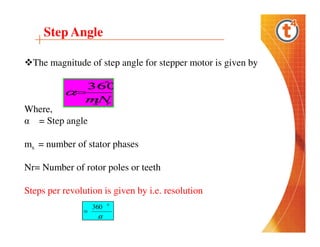
The magnitude of step angle for stepper motor is given by

Where,
α = Step angle
ms = number of stator phases
Nr= Number of rotor poles or teeth
Steps per revolution is given by i.e. resolution
=

360

α

0
Numerical
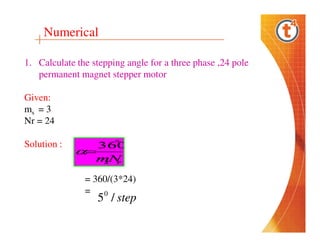
1. Calculate the stepping angle for a three phase ,24 pole
permanent magnet stepper motor
Given:
ms = 3
Nr = 24
Solution :

= 360/(3*24)
= 0

5 / step
Numerical
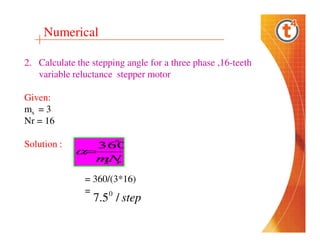
2. Calculate the stepping angle for a three phase ,16-teeth
variable reluctance stepper motor
Given:
ms = 3
Nr = 16
Solution :

= 360/(3*16)
=
0

7.5 / step
Difference between Conventional
Motor and Stepper motor
Input to SM is in the form of electric pulses whereas input
to CM is from constant voltage source

A CM has a free running shaft whereas shaft of SM moves
through angular steps
Types of stepper motors
Permanent Magnet Stepper Motor
Variable Reluctance Stepper Motor
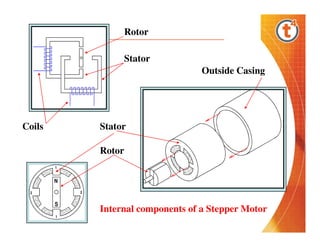
Rotor
Stator
Outside Casing

Coils

Stator
Rotor
1

N
2

2

S
1

Internal components of a Stepper Motor
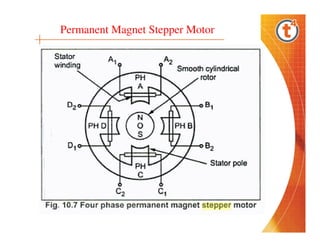
Permanent Magnet Stepper Motor
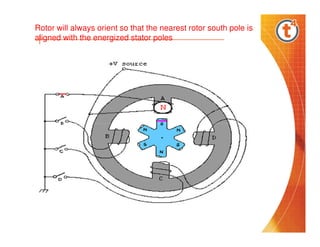
Rotor will always orient so that the nearest rotor south pole is
aligned with the energized stator poles
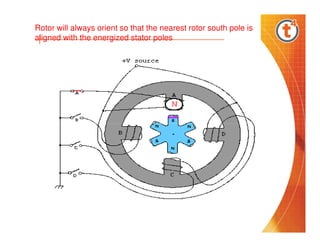
Rotor will always orient so that the nearest rotor south pole is
aligned with the energized stator poles
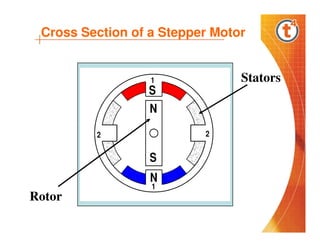
Cross Section of a Stepper Motor

Stators

1

S
N
2

2

S
N
1

Rotor
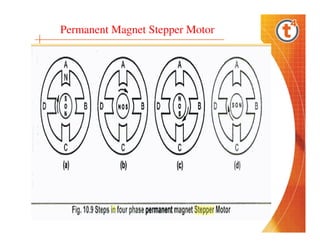
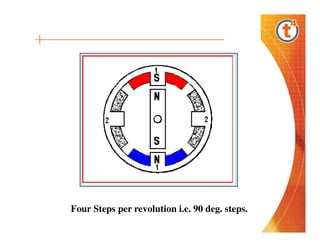
Four Steps per revolution i.e. 90 deg. steps.
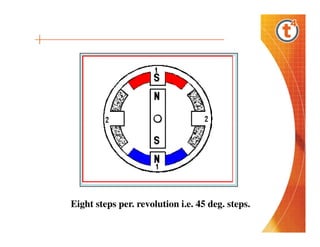
Eight steps per. revolution i.e. 45 deg. steps.
Variable Reluctance Stepper Motor

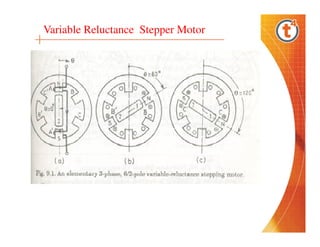
The principle of operation of a variable reluctance
stepper motor is based on the property of flux lines to
occupy low reluctance path.

The stator and rotor therefore get aligned such that
the magnetic reluctance is minimum
Variable Reluctance Stepper Motor
Practical Stepper motor operation

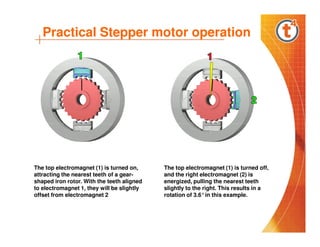
The top electromagnet (1) is turned on,
attracting the nearest teeth of a gearshaped iron rotor. With the teeth aligned
to electromagnet 1, they will be slightly
offset from electromagnet 2

The top electromagnet (1) is turned off,
and the right electromagnet (2) is
energized, pulling the nearest teeth
slightly to the right. This results in a
rotation of 3.6°in this example.
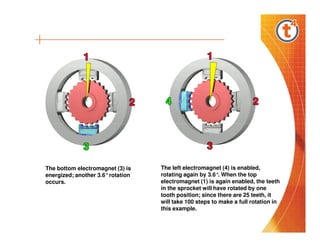
The bottom electromagnet (3) is
energized; another 3.6°rotation
occurs.

The left electromagnet (4) is enabled,
rotating again by 3.6° When the top
.
electromagnet (1) is again enabled, the teeth
in the sprocket will have rotated by one
tooth position; since there are 25 teeth, it
will take 100 steps to make a full rotation in
this example.
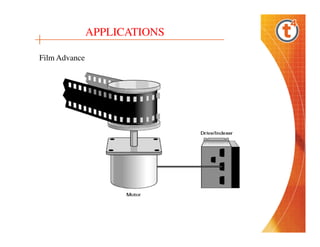
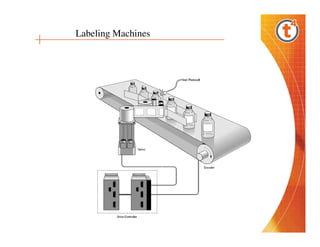
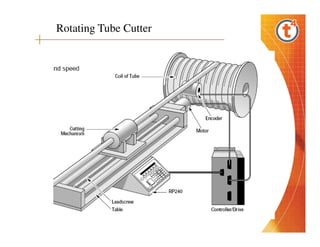
APPLICATIONS
Film Advance
Labeling Machines
Rotating Tube Cutter
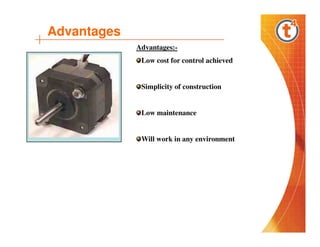
Advantages
Advantages:Low cost for control achieved

Simplicity of construction

Low maintenance

Will work in any environment
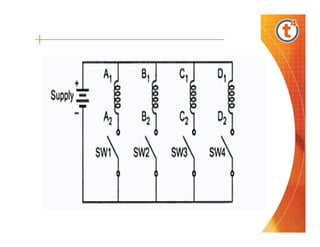
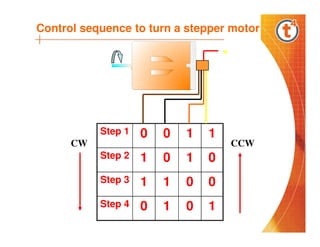
Control sequence to turn a stepper motor
+

Step 1

0

0

1

1

Step 2

1

0

1

0

Step 3

1

1

0

0

Step 4

0

1

0

1

CW

CCW

Stepper motor(encrypted)

  • 1.
    STEPPER MOTOR By, Rohini Haridas AssistantProfessor, Dept of Electrical Engineering, SSGM College of Engineering,Shegaon
  • 2.
    Introduction A stepper motoris a form of ac motor. The input given to this motor is in the form of electric pulses. Stepper motor is known by its important property to convert a train of input pulses i.e. square wave pulse into a precisely defined increment in the shaft position. Each pulse moves the shaft through a fixed angle. The angle through which the motor turns or shaft moves for each pulse is known as the step angle, expressed in degrees As such angle is dependent on the number of input pulses,the motor is suitable for controlling position by controlling the number of input pulses
  • 3.
    Step Angle The magnitudeof step angle for stepper motor is given by Where, α = Step angle ms = number of stator phases Nr= Number of rotor poles or teeth Steps per revolution is given by i.e. resolution = 360 α 0
  • 4.
    Numerical 1. Calculate thestepping angle for a three phase ,24 pole permanent magnet stepper motor Given: ms = 3 Nr = 24 Solution : = 360/(3*24) = 0 5 / step
  • 5.
    Numerical 2. Calculate thestepping angle for a three phase ,16-teeth variable reluctance stepper motor Given: ms = 3 Nr = 16 Solution : = 360/(3*16) = 0 7.5 / step
  • 6.
    Difference between Conventional Motorand Stepper motor Input to SM is in the form of electric pulses whereas input to CM is from constant voltage source A CM has a free running shaft whereas shaft of SM moves through angular steps
  • 7.
    Types of steppermotors Permanent Magnet Stepper Motor Variable Reluctance Stepper Motor
  • 8.
  • 9.
  • 11.
  • 12.
    Rotor will alwaysorient so that the nearest rotor south pole is aligned with the energized stator poles
  • 13.
    Rotor will alwaysorient so that the nearest rotor south pole is aligned with the energized stator poles
  • 14.
    Cross Section ofa Stepper Motor Stators 1 S N 2 2 S N 1 Rotor
  • 15.
    Four Steps perrevolution i.e. 90 deg. steps.
  • 16.
    Eight steps per.revolution i.e. 45 deg. steps.
  • 17.
    Variable Reluctance StepperMotor The principle of operation of a variable reluctance stepper motor is based on the property of flux lines to occupy low reluctance path. The stator and rotor therefore get aligned such that the magnetic reluctance is minimum
  • 18.
  • 19.
    Practical Stepper motoroperation The top electromagnet (1) is turned on, attracting the nearest teeth of a gearshaped iron rotor. With the teeth aligned to electromagnet 1, they will be slightly offset from electromagnet 2 The top electromagnet (1) is turned off, and the right electromagnet (2) is energized, pulling the nearest teeth slightly to the right. This results in a rotation of 3.6°in this example.
  • 20.
    The bottom electromagnet(3) is energized; another 3.6°rotation occurs. The left electromagnet (4) is enabled, rotating again by 3.6° When the top . electromagnet (1) is again enabled, the teeth in the sprocket will have rotated by one tooth position; since there are 25 teeth, it will take 100 steps to make a full rotation in this example.
  • 21.
  • 22.
  • 23.
  • 24.
    Advantages Advantages:Low cost forcontrol achieved Simplicity of construction Low maintenance Will work in any environment
  • 25.
    Control sequence toturn a stepper motor + Step 1 0 0 1 1 Step 2 1 0 1 0 Step 3 1 1 0 0 Step 4 0 1 0 1 CW CCW