Energy from
Offshore Wind Farm
FAR 1805
SEMINARS
N. Ragavan
(5370LS2017016)
Content
• Wind Energy
• Significance of wind power
• Wind turbine
• Wind Farm
• Types of Wind Farm
• Offshore Wind farm
• Types of Offshore wind farm
• Advantages and Disadvantages of wind farms
• Conclusion
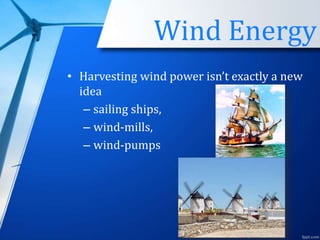
Wind Energy
• Harvesting wind power isn’t exactly a new
idea
– sailing ships,
– wind-mills,
– wind-pumps
Significance of Wind
Energy
Green Power
Sustainable
Affordable
Economic Development
Wind turbines
A wind turbine is a device that
converts kinetic energy from the
wind into electricity.
Wind turbines
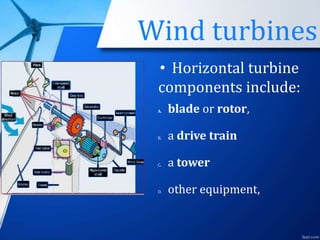
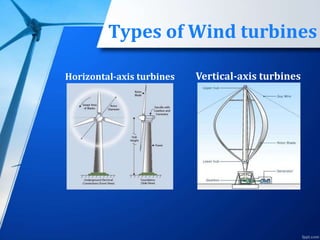
• Horizontal turbine
components include:
A. blade or rotor,
B. a drive train
C. a tower
D. other equipment,
Types of Wind turbines
Horizontal-axis turbines Vertical-axis turbines
Windmills Vs Wind
Turbines
• Windmills generate mechanical
energy, but they do not generate
electricity.
• Modern wind turbines harness
wind's kinetic energy and
convert it into electricity.
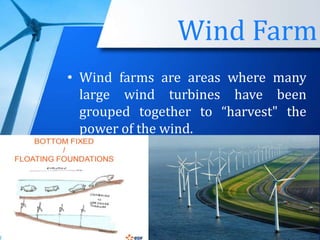
Wind Farm
• Wind farms are areas where many
large wind turbines have been
grouped together to “harvest" the
power of the wind.
Wind Farm
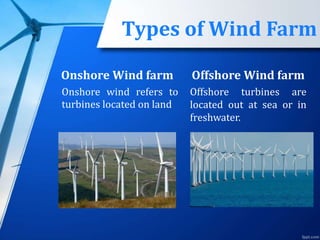
Types of Wind Farm
Onshore Wind farm
Onshore wind refers to
turbines located on land
Offshore Wind farm
Offshore turbines are
located out at sea or in
freshwater.
Offshore Wind Farm
 Europe is the world leader in offshore
wind power.
 The first offshore wind farm (Vindeby)
being installed in Denmark in 1991.
 As of 2010, there are 39 offshore wind
farms in waters off Belgium, Denmark,
Finland, Germany, Ireland, the
Netherlands, Norway, Sweden and the
United Kingdom, with a combined
operating capacity of 2,396 MW.
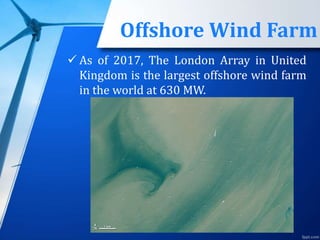
Offshore Wind Farm
 As of 2017, The London Array in United
Kingdom is the largest offshore wind farm
in the world at 630 MW.
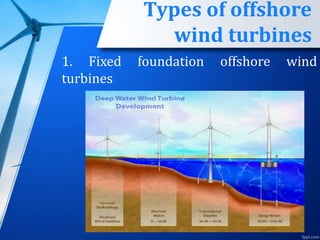
Types of offshore
wind turbines
1. Fixed foundation offshore wind
turbines
Types of offshore
wind turbines
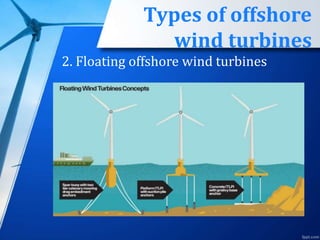
2. Floating offshore wind turbines
Types of offshore
wind turbines
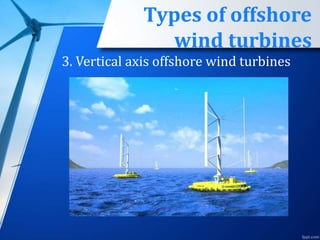
3. Vertical axis offshore wind turbines
Common Advantages of
Offshore & Onshore Wind Farm
No Pollution and Global Warming
Effects
Low Costs
Big Industrial
No Fuel
Limitation of Offshore
Wind Farm
 It’s very difficult to build secure structures in
water deeper than 60 m.
 Waves, hurricanes, can be detrimental to
infrastructure.
 Underwater cables are expensive and easily
broken.
 turbines within 26 miles of shore are unpopular
because of the fear that they will affect tourism or
property value.
Ecological Impacts of
Offshore Wind Farm
 Risks of increased turbidity,
 Negative impacts on seabirds through
habitat change.
 Increased noise levels generated by wind
farms,
Anticipated positive impacts of
Offshore Wind Farm
 The protection against fishing activities
inside the wind.
 Combined with a possible reef effect,
 Fouling organisms colonising artificial
hard substrata.
Conclusion
• Since wind farms are emerging as an
alternative energy supplement,
but its impacts on ecology should
be thoroughly overcome before
implementing.
Reference
• Madsen & Krogsgaard. Offshore Wind
Power 2010 Archived June 30, 2011, at the
Wayback Machine. BTM Consult, 22
November 2010.
• Environmental and Energy Study Institute
(October 2010). "Offshore Wind Energy" .
• "Challenges in design of foundations for
offshore wind turbines". The E&T Energy
and Power Hub. The E&T Energy and
Power Hub. 9 August 2017.
Reference
• "Classification and Certification of Floating
Offshore Wind Turbines"
ArchivedDecember 3, 2013, at the
Wayback Machine. Bureau Veritas,
November 2010.
• Sun, Xiaojing; Huang, Diangui; Wu,
Guoqing (May 2012). "The current state of
offshore wind energy technology
development". Energy. 41 (1): 298–312.
Discussion
ThankYou
ForYourPatience

Energy from Offshore wind farm

  • 1.
    Energy from Offshore WindFarm FAR 1805 SEMINARS N. Ragavan (5370LS2017016)
  • 2.
    Content • Wind Energy •Significance of wind power • Wind turbine • Wind Farm • Types of Wind Farm • Offshore Wind farm • Types of Offshore wind farm • Advantages and Disadvantages of wind farms • Conclusion
  • 3.
    Wind Energy • Harvestingwind power isn’t exactly a new idea – sailing ships, – wind-mills, – wind-pumps
  • 4.
    Significance of Wind Energy GreenPower Sustainable Affordable Economic Development
  • 5.
    Wind turbines A windturbine is a device that converts kinetic energy from the wind into electricity.
  • 6.
    Wind turbines • Horizontalturbine components include: A. blade or rotor, B. a drive train C. a tower D. other equipment,
  • 8.
    Types of Windturbines Horizontal-axis turbines Vertical-axis turbines
  • 9.
    Windmills Vs Wind Turbines •Windmills generate mechanical energy, but they do not generate electricity. • Modern wind turbines harness wind's kinetic energy and convert it into electricity.
  • 10.
    Wind Farm • Windfarms are areas where many large wind turbines have been grouped together to “harvest" the power of the wind.
  • 11.
  • 12.
    Types of WindFarm Onshore Wind farm Onshore wind refers to turbines located on land Offshore Wind farm Offshore turbines are located out at sea or in freshwater.
  • 13.
    Offshore Wind Farm Europe is the world leader in offshore wind power.  The first offshore wind farm (Vindeby) being installed in Denmark in 1991.  As of 2010, there are 39 offshore wind farms in waters off Belgium, Denmark, Finland, Germany, Ireland, the Netherlands, Norway, Sweden and the United Kingdom, with a combined operating capacity of 2,396 MW.
  • 14.
    Offshore Wind Farm As of 2017, The London Array in United Kingdom is the largest offshore wind farm in the world at 630 MW.
  • 15.
    Types of offshore windturbines 1. Fixed foundation offshore wind turbines
  • 16.
    Types of offshore windturbines 2. Floating offshore wind turbines
  • 17.
    Types of offshore windturbines 3. Vertical axis offshore wind turbines
  • 18.
    Common Advantages of Offshore& Onshore Wind Farm No Pollution and Global Warming Effects Low Costs Big Industrial No Fuel
  • 19.
    Limitation of Offshore WindFarm  It’s very difficult to build secure structures in water deeper than 60 m.  Waves, hurricanes, can be detrimental to infrastructure.  Underwater cables are expensive and easily broken.  turbines within 26 miles of shore are unpopular because of the fear that they will affect tourism or property value.
  • 20.
    Ecological Impacts of OffshoreWind Farm  Risks of increased turbidity,  Negative impacts on seabirds through habitat change.  Increased noise levels generated by wind farms,
  • 21.
    Anticipated positive impactsof Offshore Wind Farm  The protection against fishing activities inside the wind.  Combined with a possible reef effect,  Fouling organisms colonising artificial hard substrata.
  • 22.
    Conclusion • Since windfarms are emerging as an alternative energy supplement, but its impacts on ecology should be thoroughly overcome before implementing.
  • 23.
    Reference • Madsen &Krogsgaard. Offshore Wind Power 2010 Archived June 30, 2011, at the Wayback Machine. BTM Consult, 22 November 2010. • Environmental and Energy Study Institute (October 2010). "Offshore Wind Energy" . • "Challenges in design of foundations for offshore wind turbines". The E&T Energy and Power Hub. The E&T Energy and Power Hub. 9 August 2017.
  • 24.
    Reference • "Classification andCertification of Floating Offshore Wind Turbines" ArchivedDecember 3, 2013, at the Wayback Machine. Bureau Veritas, November 2010. • Sun, Xiaojing; Huang, Diangui; Wu, Guoqing (May 2012). "The current state of offshore wind energy technology development". Energy. 41 (1): 298–312.
  • 25.
  • 26.