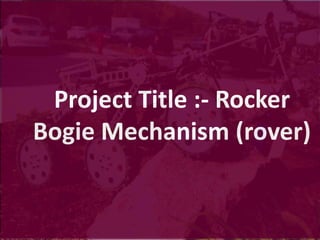
Project Title :- Rocker
Bogie Mechanism (rover)
Introduction
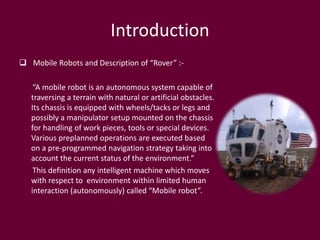
 Mobile Robots and Description of “Rover” :-
“A mobile robot is an autonomous system capable of
traversing a terrain with natural or artificial obstacles.
Its chassis is equipped with wheels/tacks or legs and
possibly a manipulator setup mounted on the chassis
for handling of work pieces, tools or special devices.
Various preplanned operations are executed based
on a pre-programmed navigation strategy taking into
account the current status of the environment.”
This definition any intelligent machine which moves
with respect to environment within limited human
interaction (autonomously) called “Mobile robot”.
Mobile robots can be classified by
significant properties:-
• Locomotion (Legged, wheeled, limbless, etc.)
• Suspension (Rocker-bogie, independent, soft, etc.)
• Steering (Skid, Ackerman, explicit)
• Control Algorithm (Fully-Autonomous, semi-autonomous)
• Body Flexibility (Unibody, multibody)
• Usage Area (Rough Terrain, even surface, etc.)
• Guidance and Navigation (Star field or Sun detection, GPS,
sensor-based)
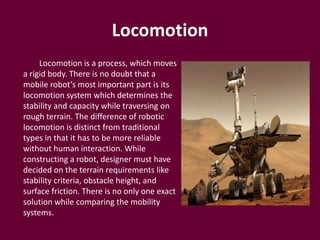
Locomotion
Locomotion is a process, which moves
a rigid body. There is no doubt that a
mobile robot’s most important part is its
locomotion system which determines the
stability and capacity while traversing on
rough terrain. The difference of robotic
locomotion is distinct from traditional
types in that it has to be more reliable
without human interaction. While
constructing a robot, designer must have
decided on the terrain requirements like
stability criteria, obstacle height, and
surface friction. There is no only one exact
solution while comparing the mobility
systems.
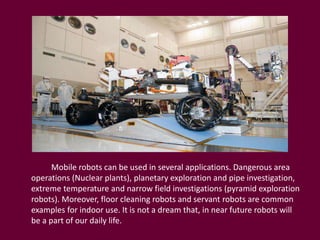
Mobile robots can be used in several applications. Dangerous area
operations (Nuclear plants), planetary exploration and pipe investigation,
extreme temperature and narrow field investigations (pyramid exploration
robots). Moreover, floor cleaning robots and servant robots are common
examples for indoor use. It is not a dream that, in near future robots will
be a part of our daily life.
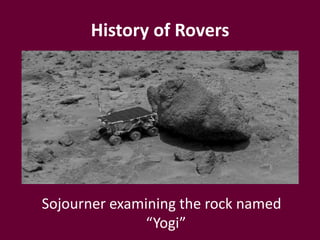
History of Rovers
Sojourner examining the rock named
“Yogi”
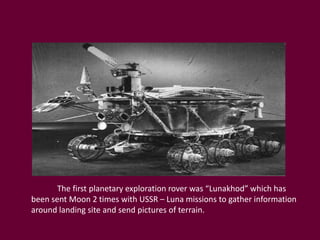
The first planetary exploration rover was “Lunakhod” which has
been sent Moon 2 times with USSR – Luna missions to gather information
around landing site and send pictures of terrain.
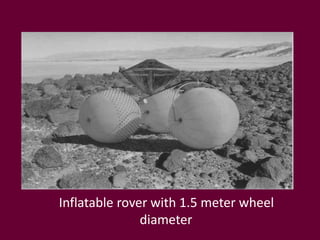
Inflatable rover with 1.5 meter wheel
diameter
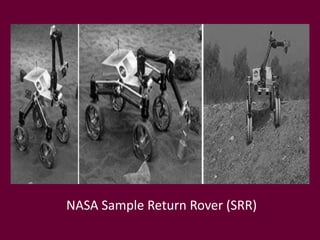
NASA Sample Return Rover (SRR)
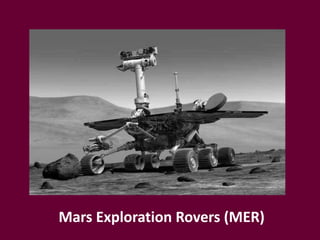
Mars Exploration Rovers (MER)
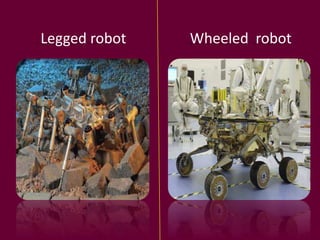
Legged robot Wheeled robot
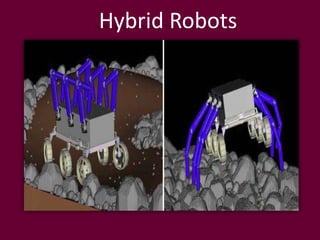
Hybrid Robots
Objectives of the project
The objective of this project is to design a
small, robust and highly maneuverable rover
robot. It will be designed for working on the
different platforms like rough terrains, smooth
surfaces, overcoming obstacles in its path and
climbing over obstacles of certain height,
choosing different predetermined gaits and to
have good stability, speed as well as payload
capacity.
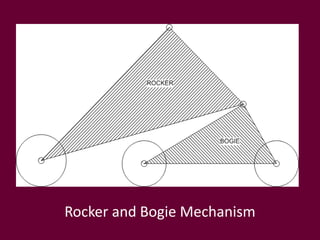
Rocker and Bogie Mechanism
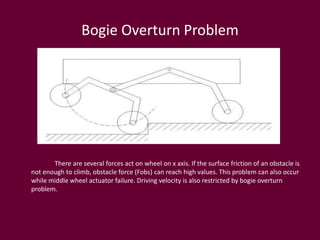
Bogie Overturn Problem
There are several forces act on wheel on x axis. If the surface friction of an obstacle is
not enough to climb, obstacle force (Fobs) can reach high values. This problem can also occur
while middle wheel actuator failure. Driving velocity is also restricted by bogie overturn
problem.
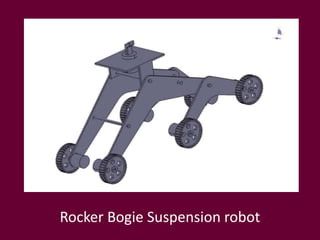
Rocker Bogie Suspension robot
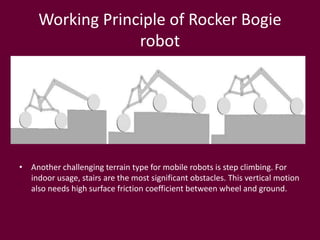
Working Principle of Rocker Bogie
robot
• Another challenging terrain type for mobile robots is step climbing. For
indoor usage, stairs are the most significant obstacles. This vertical motion
also needs high surface friction coefficient between wheel and ground.
Application of Rover robots
• Mobile robots can be used in several applications.
Dangerous area operations such as,
• (Nuclear plants), planetary exploration and pipe
investigation, extreme temperature and
• narrow field investigations (pyramid exploration
robots). Moreover, floor cleaning
• robots and servant robots are common examples for
indoor use.
• It is not a dream that, in near future robots will be a
part of our daily life
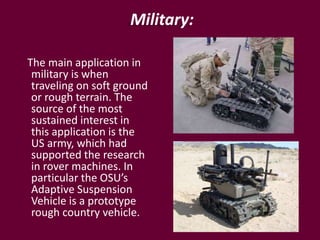
Military:
The main application in
military is when
traveling on soft ground
or rough terrain. The
source of the most
sustained interest in
this application is the
US army, which had
supported the research
in rover machines. In
particular the OSU’s
Adaptive Suspension
Vehicle is a prototype
rough country vehicle.
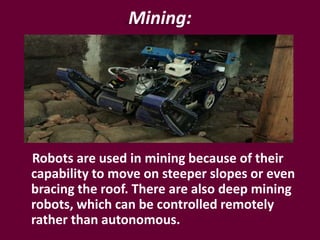
Mining:
Robots are used in mining because of their
capability to move on steeper slopes or even
bracing the roof. There are also deep mining
robots, which can be controlled remotely
rather than autonomous.
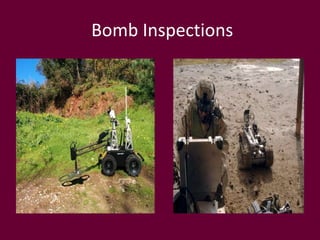
Bomb Inspections
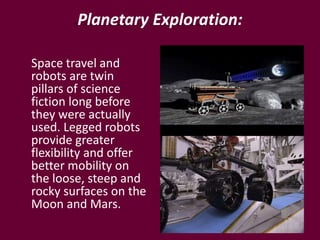
Planetary Exploration:
Space travel and
robots are twin
pillars of science
fiction long before
they were actually
used. Legged robots
provide greater
flexibility and offer
better mobility on
the loose, steep and
rocky surfaces on the
Moon and Mars.
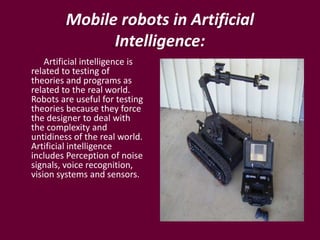
Mobile robots in Artificial
Intelligence:
Artificial intelligence is
related to testing of
theories and programs as
related to the real world.
Robots are useful for testing
theories because they force
the designer to deal with
the complexity and
untidiness of the real world.
Artificial intelligence
includes Perception of noise
signals, voice recognition,
vision systems and sensors.
Conclusion
We can develop this mechanism to create
wonders and can be used in almost all our
related fields.
We have tried our best to make this project
much more economical and efficient.
THANK YOU

ppt on rocker bogie mechanism

  • 1.
    Project Title :-Rocker Bogie Mechanism (rover)
  • 2.
    Introduction  Mobile Robotsand Description of “Rover” :- “A mobile robot is an autonomous system capable of traversing a terrain with natural or artificial obstacles. Its chassis is equipped with wheels/tacks or legs and possibly a manipulator setup mounted on the chassis for handling of work pieces, tools or special devices. Various preplanned operations are executed based on a pre-programmed navigation strategy taking into account the current status of the environment.” This definition any intelligent machine which moves with respect to environment within limited human interaction (autonomously) called “Mobile robot”.
  • 3.
    Mobile robots canbe classified by significant properties:- • Locomotion (Legged, wheeled, limbless, etc.) • Suspension (Rocker-bogie, independent, soft, etc.) • Steering (Skid, Ackerman, explicit) • Control Algorithm (Fully-Autonomous, semi-autonomous) • Body Flexibility (Unibody, multibody) • Usage Area (Rough Terrain, even surface, etc.) • Guidance and Navigation (Star field or Sun detection, GPS, sensor-based)
  • 4.
    Locomotion Locomotion is aprocess, which moves a rigid body. There is no doubt that a mobile robot’s most important part is its locomotion system which determines the stability and capacity while traversing on rough terrain. The difference of robotic locomotion is distinct from traditional types in that it has to be more reliable without human interaction. While constructing a robot, designer must have decided on the terrain requirements like stability criteria, obstacle height, and surface friction. There is no only one exact solution while comparing the mobility systems.
  • 5.
    Mobile robots canbe used in several applications. Dangerous area operations (Nuclear plants), planetary exploration and pipe investigation, extreme temperature and narrow field investigations (pyramid exploration robots). Moreover, floor cleaning robots and servant robots are common examples for indoor use. It is not a dream that, in near future robots will be a part of our daily life.
  • 6.
    History of Rovers Sojournerexamining the rock named “Yogi”
  • 7.
    The first planetaryexploration rover was “Lunakhod” which has been sent Moon 2 times with USSR – Luna missions to gather information around landing site and send pictures of terrain.
  • 8.
    Inflatable rover with1.5 meter wheel diameter
  • 9.
    NASA Sample ReturnRover (SRR)
  • 10.
  • 11.
  • 12.
  • 13.
    Objectives of theproject The objective of this project is to design a small, robust and highly maneuverable rover robot. It will be designed for working on the different platforms like rough terrains, smooth surfaces, overcoming obstacles in its path and climbing over obstacles of certain height, choosing different predetermined gaits and to have good stability, speed as well as payload capacity.
  • 14.
  • 15.
    Bogie Overturn Problem Thereare several forces act on wheel on x axis. If the surface friction of an obstacle is not enough to climb, obstacle force (Fobs) can reach high values. This problem can also occur while middle wheel actuator failure. Driving velocity is also restricted by bogie overturn problem.
  • 16.
  • 17.
    Working Principle ofRocker Bogie robot • Another challenging terrain type for mobile robots is step climbing. For indoor usage, stairs are the most significant obstacles. This vertical motion also needs high surface friction coefficient between wheel and ground.
  • 18.
    Application of Roverrobots • Mobile robots can be used in several applications. Dangerous area operations such as, • (Nuclear plants), planetary exploration and pipe investigation, extreme temperature and • narrow field investigations (pyramid exploration robots). Moreover, floor cleaning • robots and servant robots are common examples for indoor use. • It is not a dream that, in near future robots will be a part of our daily life
  • 19.
    Military: The main applicationin military is when traveling on soft ground or rough terrain. The source of the most sustained interest in this application is the US army, which had supported the research in rover machines. In particular the OSU’s Adaptive Suspension Vehicle is a prototype rough country vehicle.
  • 20.
    Mining: Robots are usedin mining because of their capability to move on steeper slopes or even bracing the roof. There are also deep mining robots, which can be controlled remotely rather than autonomous.
  • 21.
  • 22.
    Planetary Exploration: Space traveland robots are twin pillars of science fiction long before they were actually used. Legged robots provide greater flexibility and offer better mobility on the loose, steep and rocky surfaces on the Moon and Mars.
  • 23.
    Mobile robots inArtificial Intelligence: Artificial intelligence is related to testing of theories and programs as related to the real world. Robots are useful for testing theories because they force the designer to deal with the complexity and untidiness of the real world. Artificial intelligence includes Perception of noise signals, voice recognition, vision systems and sensors.
  • 24.
    Conclusion We can developthis mechanism to create wonders and can be used in almost all our related fields. We have tried our best to make this project much more economical and efficient.
  • 25.