HYBRID MOTORCYCLE

1) KHATRI ROHAN RAJESHBHAI                 090190119004

2) THAKOR JAYRAJSINH SANTOSHSINH
090190119014

3) CHAHWALA VIJAY HARISHBHAI
090190119037

4) PATIL SAGAR KAPTAN
090190119063                   UNDER THE GUIDANCE OF

                               Prof. M.M.MADHIKAR
                               MECH. DEPT., G.E.C., VALSAD
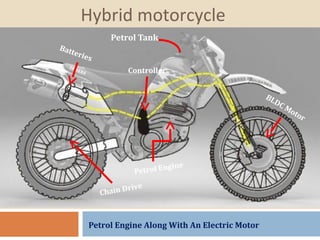
Hybrid motorcycle
                Petrol Tank
Bat
    teri
         es
                        Controller


                                                       BL
                                                            DC
                                                                 Mo
                                                                   tor


                                  ngine
                         Petrol E

                        rive
              Chain D


          Petrol Engine Along With An Electric Motor
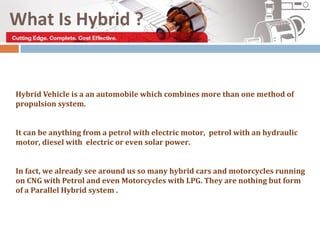
What Is Hybrid ?


Hybrid Vehicle is a an automobile which combines more than one method of
propulsion system.


It can be anything from a petrol with electric motor, petrol with an hydraulic
motor, diesel with electric or even solar power.


In fact, we already see around us so many hybrid cars and motorcycles running
on CNG with Petrol and even Motorcycles with LPG. They are nothing but form
of a Parallel Hybrid system .
Aim of our Project

This project outlines the design, construction and testing of a 1000W DC brushless
motor controller for use in a light electric vehicle. Specific attention was paid to the
layout of the motor controller to ensure high reliability, ease of manufacture and
lightweight construction without compromising efficiency.
The concept is to club the two technologies of an Internal Combustion Engine with the
Electric main drive.

This we thrive to achieve by using the electric hub motor installed in the wheel and a
programmable controller which will have the maximum speed of the motor to 50km/hr.,
once the motorcycle goes above 50km/hr., the controller cuts of the current to the motor
and the fuel is induced into the petrol engine and then the normal commuting is possible.

Once the vehicle is running on petrol, the battery will be regenerated for further usage
and can be fully charged with a 220v ac supply and Dynamo in the wheel.

The motor used is a BLDC (Brush Less DC Motor) hub motor and we target to achieve 150
km of mileage within Rs. 100 worth the fuel (combining petrol and electric power). The
portability of the batteries is a high value concerned and shall be met with proper result
in this project.
Project Development                     Process


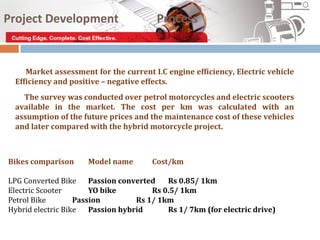
    Market assessment for the current I.C engine efficiency, Electric vehicle
 Efficiency and positive – negative effects.
   The survey was conducted over petrol motorcycles and electric scooters
 available in the market. The cost per km was calculated with an
 assumption of the future prices and the maintenance cost of these vehicles
 and later compared with the hybrid motorcycle project.


Bikes comparison     Model name        Cost/km

LPG Converted Bike     Passion converted   Rs 0.85/ 1km
Electric Scooter       YO bike         Rs 0.5/ 1km
Petrol Bike        Passion         Rs 1/ 1km
Hybrid electric Bike   Passion hybrid      Rs 1/ 7km (for electric drive)
Feasibility of the project as per current market
                          condition

Although there has been development in the diesel fuel with an advent of bio
diesel and LPG conversion kits in the market but still there is almost no
competition in the market with this kind of hybrid motorcycle.

The sale if motorcycle is still increasing and in future so will the fuel prices, for
that the hybrid concept seems quite ideal as it not only decreases the per km
cost of the consumer but also enhances the range of the drive.

Below listed is an article report from www.zigwheels.com of the motorcycle
sales from mid-2012. From which we can determine the future necessity of
hybrid.
“Two-wheeler manufacturer Honda Motorcycle & Scooter India (HMSI) today
reported a 38.65 per cent growth in total sales for August at 2,22,768 units.
Motorcycle sales jumped by 69.44 per cent to 1,04,316 units in August this year
as against 61,562 units in the same month last year, HMSI said in a statement.”
Parameters responsible for project components
            based on end user Requirement terms


These requirements were necessary in order to find the complete set of calculations
on which the project can be made, unless we know what our need we can’t develop a
good project is.


    Range:   60 km to 80 km on electric power

    Speed:    Maximum speed 40-50km/hr. (as per the city driving condition)

    Torque: Enough to carry a passenger and a rider with a tank full of petrol
        (300kg approximately ( + or – 30 kg).
Motor Power Study


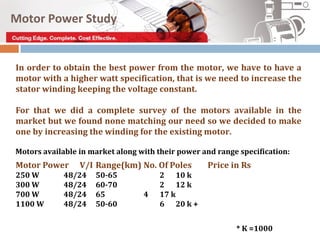
In order to obtain the best power from the motor, we have to have a
motor with a higher watt specification, that is we need to increase the
stator winding keeping the voltage constant.

For that we did a complete survey of the motors available in the
market but we found none matching our need so we decided to make
one by increasing the winding for the existing motor.

Motors available in market along with their power and range specification:
Motor Power      V/I Range(km) No. Of Poles        Price in Rs
250 W        48/24   50-65            2 10 k
300 W        48/24   60-70            2 12 k
700 W        48/24   65           4   17 k
1100 W       48/24   50-60            6 20 k +


                                                           * K =1000
What is a Hub Motor ?

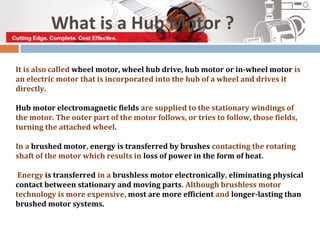
It is also called wheel motor, wheel hub drive, hub motor or in-wheel motor is
an electric motor that is incorporated into the hub of a wheel and drives it
directly.

Hub motor electromagnetic fields are supplied to the stationary windings of
the motor. The outer part of the motor follows, or tries to follow, those fields,
turning the attached wheel.

In a brushed motor, energy is transferred by brushes contacting the rotating
shaft of the motor which results in loss of power in the form of heat.

 Energy is transferred in a brushless motor electronically, eliminating physical
contact between stationary and moving parts. Although brushless motor
technology is more expensive, most are more efficient and longer-lasting than
brushed motor systems.
Electric Motor Defined

            Click to edit Master text styles
                Second level                                Brush less Direct
                                                             Current (BLDC) motors
                Third level                                 in which permanent
                    Fourth level                            magnets on the rotor
                        Fifth level                         create a magnetic field
                                                             which interact with
                                                             synchronous stator
                                                             current.


Basic Terminology
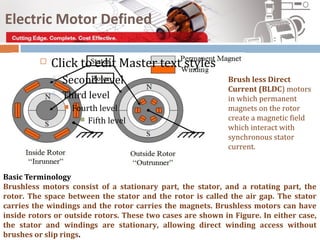
Brushless motors consist of a stationary part, the stator, and a rotating part, the
rotor. The space between the stator and the rotor is called the air gap. The stator
carries the windings and the rotor carries the magnets. Brushless motors can have
inside rotors or outside rotors. These two cases are shown in Figure. In either case,
the stator and windings are stationary, allowing direct winding access without
brushes or slip rings.
Motor Rotor Position

                     Click to edit Master text styles
                         Second level
                         Third level
                             Fourth level
                                 Fifth level


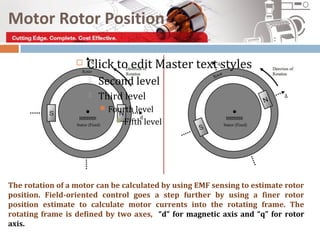
The rotation of a motor can be calculated by using EMF sensing to estimate rotor
position. Field-oriented control goes a step further by using a finer rotor
position estimate to calculate motor currents into the rotating frame. The
rotating frame is defined by two axes, “d” for magnetic axis and “q” for rotor
axis.
Rotor angle calculation


         Click to edit Master text styles
             Second level
             Third level
                 Fourth level
                     Fifth level


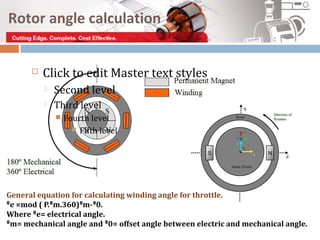
General equation for calculating winding angle for throttle.
ᶿe =mod ( P.ᶿm.360)ᶿm-ᶿ0.
Where ᶿe= electrical angle.
ᶿm= mechanical angle and ᶿ0= offset angle between electric and mechanical angle.
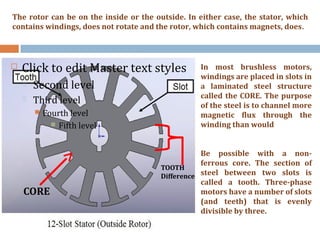
The rotor can be on the inside or the outside. In either case, the stator, which
contains windings, does not rotate and the rotor, which contains magnets, does.


   Click to edit Master text styles              In most brushless motors,
                                                  windings are placed in slots in
       Second level                              a laminated steel structure
                                                  called the CORE. The purpose
       Third level                               of the steel is to channel more
           Fourth level                          magnetic flux through the
               Fifth level                       winding than would


                                                   Be possible with a non-
                                                   ferrous core. The section of
                                        TOOTH
                                        Difference steel between two slots is
                                                   called a tooth. Three-phase
    CORE                                           motors have a number of slots
                                                   (and teeth) that is evenly
                                                   divisible by three.
Conclusion and Testing of Motor
                                                  Output

lick to edit Master text styles
Second level
Third level
    Fourth level
        Fifth level


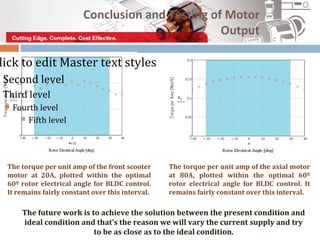
 The torque per unit amp of the front scooter     The torque per unit amp of the axial motor
 motor at 20A, plotted within the optimal         at 80A, plotted within the optimal 60º
 60º rotor electrical angle for BLDC control.     rotor electrical angle for BLDC control. It
 It remains fairly constant over this interval.   remains fairly constant over this interval.

       The future work is to achieve the solution between the present condition and
       ideal condition and that’s the reason we will vary the current supply and try
                           to be as close as to the ideal condition.
Single Stator CORE developed to test the winding method


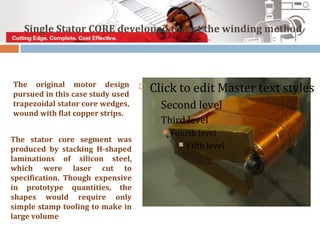
The original motor design
pursued in this case study used
                                     Click to edit Master text styles
trapezoidal stator core wedges,          Second level
wound with flat copper strips.
                                         Third level
                                             Fourth level
The stator core segment was
                                                 Fifth level
produced by stacking H-shaped
laminations of silicon steel,
which were laser cut to
specification. Though expensive
in prototype quantities, the
shapes would require only
simple stamp tooling to make in
large volume
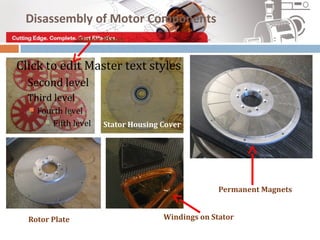
Disassembly of Motor Components
                       Stator Plates


   Click to edit Master text styles
       Second level
       Third level
           Fourth level
               Fifth level   Stator Housing Cover


                                                           Permanent Magnets


        Rotor Plate                          Windings on Stator
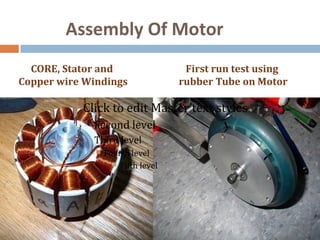
Assembly Of Motor
  CORE, Stator and                      First run test using
Copper wire Windings                   rubber Tube on Motor

            Click to edit Master text styles
                Second level
                Third level
                    Fourth level
                        Fifth level
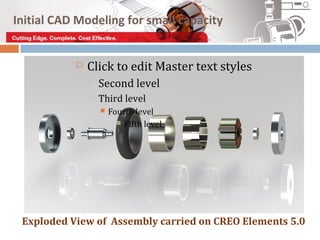
Initial CAD Modeling for small capacity


              Click to edit Master text styles
                  Second level
                  Third level
                      Fourth level
                          Fifth level


 Exploded View of Assembly carried on CREO Elements 5.0
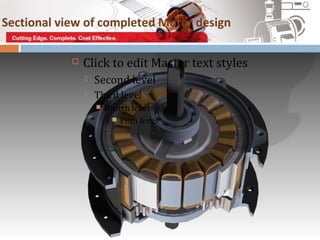
Sectional view of completed Motor design

               Click to edit Master text styles
                   Second level
                   Third level
                       Fourth level
                           Fifth level
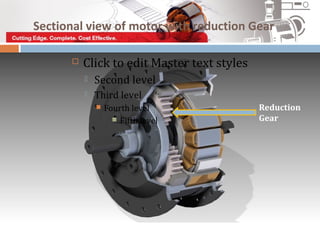
Sectional view of motor with reduction Gear

         Click to edit Master text styles
             Second level
             Third level
                 Fourth level               Reduction
                     Fifth level            Gear
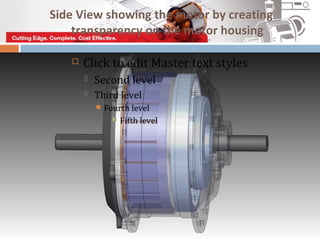
Side View showing the motor by creating
    transparency on the motor housing

      Click to edit Master text styles
          Second level
          Third level
              Fourth level
                  Fifth level
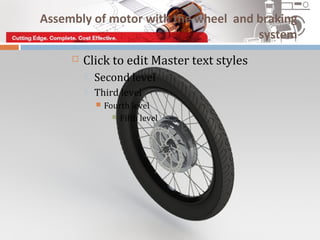
Assembly of motor with the wheel and braking
                                     system
        Click to edit Master text styles
            Second level
            Third level
                Fourth level
                    Fifth level
Battery System


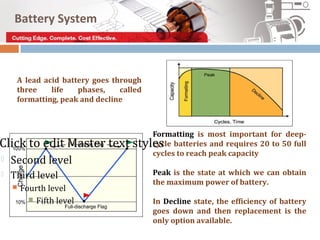
     A lead acid battery goes through
     three    life   phases,    called
     formatting, peak and decline


                                         Formatting is most important for deep-
Click to edit Master text styles         cycle batteries and requires 20 to 50 full
                                         cycles to reach peak capacity
   Second level
   Third level                          Peak is the state at which we can obtain
                                         the maximum power of battery.
       Fourth level
           Fifth level                  In Decline state, the efficiency of battery
                                         goes down and then replacement is the
                                         only option available.
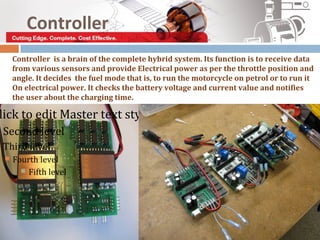
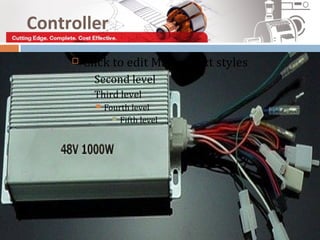
Controller
     Controller is a brain of the complete hybrid system. Its function is to receive data
     from various sensors and provide Electrical power as per the throttle position and
     angle. It decides the fuel mode that is, to run the motorcycle on petrol or to run it
     On electrical power. It checks the battery voltage and current value and notifies
     the user about the charging time.

lick to edit Master text styles
Second level
Third level
    Fourth level
        Fifth level
Controller
        Click to edit Master text styles
            Second level
            Third level
                Fourth level
                    Fifth level
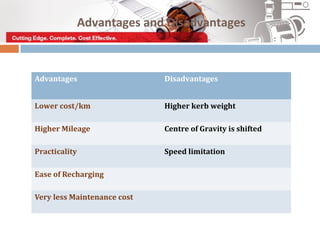
Advantages and Disadvantages


Advantages                   Disadvantages


Lower cost/km                Higher kerb weight

Higher Mileage               Centre of Gravity is shifted

Practicality                 Speed limitation

Ease of Recharging

Very less Maintenance cost
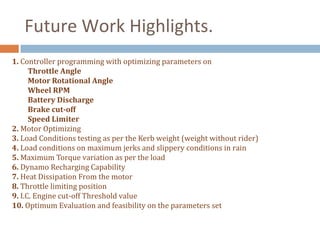
Future Work Highlights.
1. Controller programming with optimizing parameters on
      Throttle Angle
      Motor Rotational Angle
      Wheel RPM
      Battery Discharge
      Brake cut-off
      Speed Limiter
2. Motor Optimizing
3. Load Conditions testing as per the Kerb weight (weight without rider)
4. Load conditions on maximum jerks and slippery conditions in rain
5. Maximum Torque variation as per the load
6. Dynamo Recharging Capability
7. Heat Dissipation From the motor
8. Throttle limiting position
9. I.C. Engine cut-off Threshold value
10. Optimum Evaluation and feasibility on the parameters set
Thank you 

Hybrid Motorcycle

  • 1.
    HYBRID MOTORCYCLE 1) KHATRIROHAN RAJESHBHAI 090190119004 2) THAKOR JAYRAJSINH SANTOSHSINH 090190119014 3) CHAHWALA VIJAY HARISHBHAI 090190119037 4) PATIL SAGAR KAPTAN 090190119063 UNDER THE GUIDANCE OF Prof. M.M.MADHIKAR MECH. DEPT., G.E.C., VALSAD
  • 2.
    Hybrid motorcycle Petrol Tank Bat teri es Controller BL DC Mo tor ngine Petrol E rive Chain D Petrol Engine Along With An Electric Motor
  • 3.
    What Is Hybrid? Hybrid Vehicle is a an automobile which combines more than one method of propulsion system. It can be anything from a petrol with electric motor, petrol with an hydraulic motor, diesel with electric or even solar power. In fact, we already see around us so many hybrid cars and motorcycles running on CNG with Petrol and even Motorcycles with LPG. They are nothing but form of a Parallel Hybrid system .
  • 4.
    Aim of ourProject This project outlines the design, construction and testing of a 1000W DC brushless motor controller for use in a light electric vehicle. Specific attention was paid to the layout of the motor controller to ensure high reliability, ease of manufacture and lightweight construction without compromising efficiency. The concept is to club the two technologies of an Internal Combustion Engine with the Electric main drive. This we thrive to achieve by using the electric hub motor installed in the wheel and a programmable controller which will have the maximum speed of the motor to 50km/hr., once the motorcycle goes above 50km/hr., the controller cuts of the current to the motor and the fuel is induced into the petrol engine and then the normal commuting is possible. Once the vehicle is running on petrol, the battery will be regenerated for further usage and can be fully charged with a 220v ac supply and Dynamo in the wheel. The motor used is a BLDC (Brush Less DC Motor) hub motor and we target to achieve 150 km of mileage within Rs. 100 worth the fuel (combining petrol and electric power). The portability of the batteries is a high value concerned and shall be met with proper result in this project.
  • 5.
    Project Development Process Market assessment for the current I.C engine efficiency, Electric vehicle Efficiency and positive – negative effects. The survey was conducted over petrol motorcycles and electric scooters available in the market. The cost per km was calculated with an assumption of the future prices and the maintenance cost of these vehicles and later compared with the hybrid motorcycle project. Bikes comparison Model name Cost/km LPG Converted Bike Passion converted Rs 0.85/ 1km Electric Scooter YO bike Rs 0.5/ 1km Petrol Bike Passion Rs 1/ 1km Hybrid electric Bike Passion hybrid Rs 1/ 7km (for electric drive)
  • 6.
    Feasibility of theproject as per current market condition Although there has been development in the diesel fuel with an advent of bio diesel and LPG conversion kits in the market but still there is almost no competition in the market with this kind of hybrid motorcycle. The sale if motorcycle is still increasing and in future so will the fuel prices, for that the hybrid concept seems quite ideal as it not only decreases the per km cost of the consumer but also enhances the range of the drive. Below listed is an article report from www.zigwheels.com of the motorcycle sales from mid-2012. From which we can determine the future necessity of hybrid. “Two-wheeler manufacturer Honda Motorcycle & Scooter India (HMSI) today reported a 38.65 per cent growth in total sales for August at 2,22,768 units. Motorcycle sales jumped by 69.44 per cent to 1,04,316 units in August this year as against 61,562 units in the same month last year, HMSI said in a statement.”
  • 7.
    Parameters responsible forproject components based on end user Requirement terms These requirements were necessary in order to find the complete set of calculations on which the project can be made, unless we know what our need we can’t develop a good project is. Range: 60 km to 80 km on electric power Speed: Maximum speed 40-50km/hr. (as per the city driving condition) Torque: Enough to carry a passenger and a rider with a tank full of petrol (300kg approximately ( + or – 30 kg).
  • 8.
    Motor Power Study Inorder to obtain the best power from the motor, we have to have a motor with a higher watt specification, that is we need to increase the stator winding keeping the voltage constant. For that we did a complete survey of the motors available in the market but we found none matching our need so we decided to make one by increasing the winding for the existing motor. Motors available in market along with their power and range specification: Motor Power V/I Range(km) No. Of Poles Price in Rs 250 W 48/24 50-65 2 10 k 300 W 48/24 60-70 2 12 k 700 W 48/24 65 4 17 k 1100 W 48/24 50-60 6 20 k + * K =1000
  • 9.
    What is aHub Motor ? It is also called wheel motor, wheel hub drive, hub motor or in-wheel motor is an electric motor that is incorporated into the hub of a wheel and drives it directly. Hub motor electromagnetic fields are supplied to the stationary windings of the motor. The outer part of the motor follows, or tries to follow, those fields, turning the attached wheel. In a brushed motor, energy is transferred by brushes contacting the rotating shaft of the motor which results in loss of power in the form of heat. Energy is transferred in a brushless motor electronically, eliminating physical contact between stationary and moving parts. Although brushless motor technology is more expensive, most are more efficient and longer-lasting than brushed motor systems.
  • 10.
    Electric Motor Defined  Click to edit Master text styles  Second level Brush less Direct Current (BLDC) motors  Third level in which permanent  Fourth level magnets on the rotor  Fifth level create a magnetic field which interact with synchronous stator current. Basic Terminology Brushless motors consist of a stationary part, the stator, and a rotating part, the rotor. The space between the stator and the rotor is called the air gap. The stator carries the windings and the rotor carries the magnets. Brushless motors can have inside rotors or outside rotors. These two cases are shown in Figure. In either case, the stator and windings are stationary, allowing direct winding access without brushes or slip rings.
  • 11.
    Motor Rotor Position  Click to edit Master text styles  Second level  Third level  Fourth level  Fifth level The rotation of a motor can be calculated by using EMF sensing to estimate rotor position. Field-oriented control goes a step further by using a finer rotor position estimate to calculate motor currents into the rotating frame. The rotating frame is defined by two axes, “d” for magnetic axis and “q” for rotor axis.
  • 12.
    Rotor angle calculation  Click to edit Master text styles  Second level  Third level  Fourth level  Fifth level General equation for calculating winding angle for throttle. ᶿe =mod ( P.ᶿm.360)ᶿm-ᶿ0. Where ᶿe= electrical angle. ᶿm= mechanical angle and ᶿ0= offset angle between electric and mechanical angle.
  • 13.
    The rotor canbe on the inside or the outside. In either case, the stator, which contains windings, does not rotate and the rotor, which contains magnets, does.  Click to edit Master text styles In most brushless motors, windings are placed in slots in  Second level a laminated steel structure called the CORE. The purpose  Third level of the steel is to channel more  Fourth level magnetic flux through the  Fifth level winding than would Be possible with a non- ferrous core. The section of TOOTH Difference steel between two slots is called a tooth. Three-phase CORE motors have a number of slots (and teeth) that is evenly divisible by three.
  • 14.
    Conclusion and Testingof Motor Output lick to edit Master text styles Second level Third level  Fourth level  Fifth level The torque per unit amp of the front scooter The torque per unit amp of the axial motor motor at 20A, plotted within the optimal at 80A, plotted within the optimal 60º 60º rotor electrical angle for BLDC control. rotor electrical angle for BLDC control. It It remains fairly constant over this interval. remains fairly constant over this interval. The future work is to achieve the solution between the present condition and ideal condition and that’s the reason we will vary the current supply and try to be as close as to the ideal condition.
  • 15.
    Single Stator COREdeveloped to test the winding method The original motor design pursued in this case study used  Click to edit Master text styles trapezoidal stator core wedges,  Second level wound with flat copper strips.  Third level  Fourth level The stator core segment was  Fifth level produced by stacking H-shaped laminations of silicon steel, which were laser cut to specification. Though expensive in prototype quantities, the shapes would require only simple stamp tooling to make in large volume
  • 16.
    Disassembly of MotorComponents Stator Plates  Click to edit Master text styles  Second level  Third level  Fourth level  Fifth level Stator Housing Cover Permanent Magnets Rotor Plate Windings on Stator
  • 17.
    Assembly Of Motor CORE, Stator and First run test using Copper wire Windings rubber Tube on Motor  Click to edit Master text styles  Second level  Third level  Fourth level  Fifth level
  • 18.
    Initial CAD Modelingfor small capacity  Click to edit Master text styles  Second level  Third level  Fourth level  Fifth level Exploded View of Assembly carried on CREO Elements 5.0
  • 19.
    Sectional view ofcompleted Motor design  Click to edit Master text styles  Second level  Third level  Fourth level  Fifth level
  • 20.
    Sectional view ofmotor with reduction Gear  Click to edit Master text styles  Second level  Third level  Fourth level Reduction  Fifth level Gear
  • 21.
    Side View showingthe motor by creating transparency on the motor housing  Click to edit Master text styles  Second level  Third level  Fourth level  Fifth level
  • 22.
    Assembly of motorwith the wheel and braking system  Click to edit Master text styles  Second level  Third level  Fourth level  Fifth level
  • 23.
    Battery System A lead acid battery goes through three life phases, called formatting, peak and decline Formatting is most important for deep- Click to edit Master text styles cycle batteries and requires 20 to 50 full cycles to reach peak capacity  Second level  Third level Peak is the state at which we can obtain the maximum power of battery.  Fourth level  Fifth level In Decline state, the efficiency of battery goes down and then replacement is the only option available.
  • 24.
    Controller Controller is a brain of the complete hybrid system. Its function is to receive data from various sensors and provide Electrical power as per the throttle position and angle. It decides the fuel mode that is, to run the motorcycle on petrol or to run it On electrical power. It checks the battery voltage and current value and notifies the user about the charging time. lick to edit Master text styles Second level Third level  Fourth level  Fifth level
  • 25.
    Controller  Click to edit Master text styles  Second level  Third level  Fourth level  Fifth level
  • 26.
    Advantages and Disadvantages Advantages Disadvantages Lower cost/km Higher kerb weight Higher Mileage Centre of Gravity is shifted Practicality Speed limitation Ease of Recharging Very less Maintenance cost
  • 27.
    Future Work Highlights. 1.Controller programming with optimizing parameters on Throttle Angle Motor Rotational Angle Wheel RPM Battery Discharge Brake cut-off Speed Limiter 2. Motor Optimizing 3. Load Conditions testing as per the Kerb weight (weight without rider) 4. Load conditions on maximum jerks and slippery conditions in rain 5. Maximum Torque variation as per the load 6. Dynamo Recharging Capability 7. Heat Dissipation From the motor 8. Throttle limiting position 9. I.C. Engine cut-off Threshold value 10. Optimum Evaluation and feasibility on the parameters set
  • 28.