VERTICAL TAKE-OFF AND
LANDING (VTOL)
GUIDED BY: SUBMITTED BY :
TWINKY JOSEPH AKHILMON .K
HOD ,DEP. OF AERONAUTICAL S7 , AERONAUTICAL
RIET REG. NO : 14428001
RIET , NAGAROOR
1
INTRODUCTION
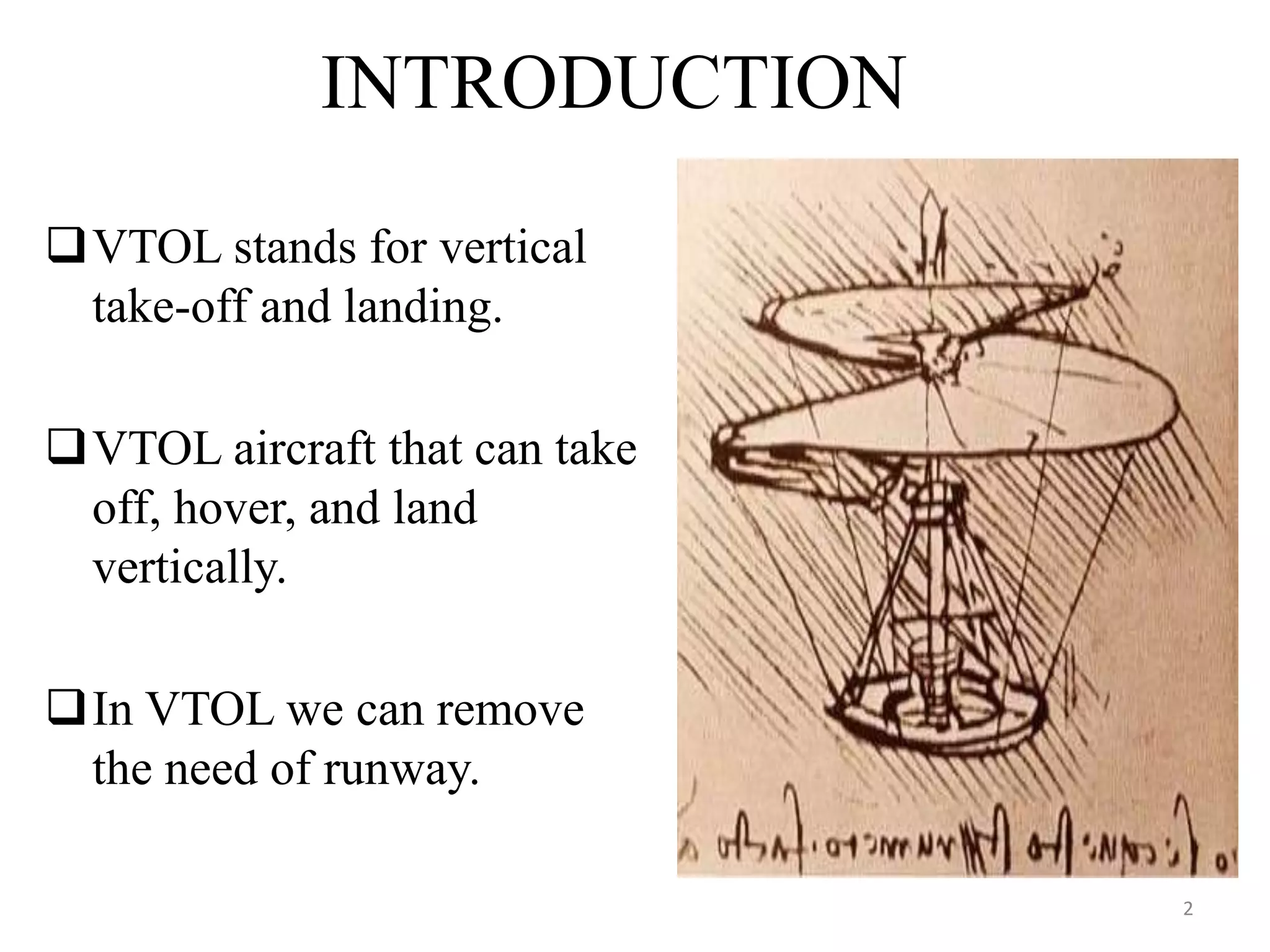
VTOL stands for vertical
take-off and landing.
VTOL aircraft that can take
off, hover, and land
vertically.
In VTOL we can remove
the need of runway.
2
What is VTOL ?
 A VTOL aircraft is one that can hover, take
off, and land vertically.
The best-known example is the helicopters and
drones.
 VTOL aircraft can land and take off at any
worst conditions .
3
Types of VTOL
 There are two different types of VTOL
technology.
1. ROTORCRAFT
.
2. POWERED LIFT
4
Rotorcraft
• Known as rotary wing
aircraft.
• Lift generated by rotor
blades spinning around a
central mast.
• Eg : Helicopters ,
Cyclogyro , Autogyro ,
Gyrodynes.
5
HELICOPTERS
A helicopter is a type of rotorcraft
 Lift and thrust are supplied
by rotors.
It can take off and land vertically,
to hover.
 It can fly forward and backward
It can used in congested or
isolated areas.
6
CYCLOGYRO
The cyclorotors as the principal
source of lift, propulsion, and
control.
They are capable of VTOL and
hovering performance like
a helicopter
The wing resembles a paddle
wheel, with airfoils replacing the
paddles.
7
AUTOGYRO
Also known as gyroplanes or
gyrocopters .
The rotor is unpowered and rotates
freely in the airflow as the craft travels
forward .
So the craft needs a conventional
powerplant to provide thrust .
8
Gyrodynes
It has a separate forward
thrust system of an autogyro.
 Lift during forward flight is
provided by a combination of
the rotor, like an autogyro, as
well as conventional wings.
9
Powered lift
• Powered-lift vehicles are those
that take off and land vertically.
.
• Vectored thrust planes such as
the Harrier Jump jet series also
used powered-lift technology.
• Eg; Convertiplane, Tilt rotor,
Tilt wing, Tail-sitter., vectored
thrust ,
10
Convertiplane
Uses rotor power for VTOL and
converts to fixed wing lift in normal
flight.
an aircraft that takes off and lands
like a helicopter and is convertible
to a fixed-wing configuration for
forward flight
This aircraft that converts in
flight to change its method of
obtaining lift.
11
Vectored thrust
used powered-lift by
manipulating the thrust from the
engine or motor.
Plane diverted its engine thrust
downward for vertical takeoff
using rotatable engine exhaust.
Harrier jump jet is the known
example.
12
Tiltwing
Propellers or rotors fixed to a
conventional wing and tilts the
whole assembly to transition
between vertical and horizontal
flight.
 The wing is horizontal for
conventional forward flight and
rotates up for vertical takeoff and
landing.
13
Tail-sitter
A tail-sitter sits vertically on its tail for takeoff and landing,
then tilts the whole aircraft forward for horizontal flight.
When hovering the nose of the aircraft will try to point up for
“level” flight.
14
Advantages of VTOL Technology
 energy efficient than those using jet engines.
 Remove the need for runway.
 Time and fuel saving.
 This makes already safe air travel even safer.
 Simplicity (cellular construction)
 Ease of Maintenance
 Safety
15
16
Future development of VTOL
• Uber has pledged to launch its first flying taxis in
2020 using VTOL.
• Munich based aviation startup aims to offer a flying
taxi service that it will be five times faster than
travelling in a car.
• At the 2017 Geneva Motor show, Airbus showcased a
prototype flying hybrid car.
• Nasa has developed the battery-powered GL-
10,which take off and land vertically .
17
Conclusion
VTOL enables a traveler to travel directly from
point A to point B.
 VTOL transport aircraft is just not economical
in the commercial world.
VTOL technology has an important role for
future development of aviation field.
 VTOL is suitable for use in manned or un-
manned aircraft.
18
REFERENCE
 VTOL AIRCRAFT WITH DISTRIBUTED THRUST AND
CONTROL , Journal by ‘Joslah VanderMey’ (2007).
 VEHICLES PARTICULARLY USEFUL AS VTOL VEHICLES
,journal by ‘Rafi Yoeli’ (2007).
 AIRCRAFT CAPABLE OF VERTICAL AND SHORT TAKE-OFF
AND LANDING , journal by ‘Gregory F- Heath’ (2007).
 VERTICAL/SHORT TAKE-OFF AND LANDING AIRCRAFT
,journal by’ Robert T. Clifton, Woodrow L Cook’(1989).
 HORIZONTAL AND VERTICAL TAKE OFF AND LANDING
UNMANNED AERIAL VEHICLE, journal by ‘Johny
sinson’(1999).
19
QUERIES ?
20
THANK YOU
21

VTOL ( VERTICAL TAKE OFF AND LANDING)

  • 1.
    VERTICAL TAKE-OFF AND LANDING(VTOL) GUIDED BY: SUBMITTED BY : TWINKY JOSEPH AKHILMON .K HOD ,DEP. OF AERONAUTICAL S7 , AERONAUTICAL RIET REG. NO : 14428001 RIET , NAGAROOR 1
  • 2.
    INTRODUCTION VTOL stands forvertical take-off and landing. VTOL aircraft that can take off, hover, and land vertically. In VTOL we can remove the need of runway. 2
  • 3.
    What is VTOL?  A VTOL aircraft is one that can hover, take off, and land vertically. The best-known example is the helicopters and drones.  VTOL aircraft can land and take off at any worst conditions . 3
  • 4.
    Types of VTOL There are two different types of VTOL technology. 1. ROTORCRAFT . 2. POWERED LIFT 4
  • 5.
    Rotorcraft • Known asrotary wing aircraft. • Lift generated by rotor blades spinning around a central mast. • Eg : Helicopters , Cyclogyro , Autogyro , Gyrodynes. 5
  • 6.
    HELICOPTERS A helicopter isa type of rotorcraft  Lift and thrust are supplied by rotors. It can take off and land vertically, to hover.  It can fly forward and backward It can used in congested or isolated areas. 6
  • 7.
    CYCLOGYRO The cyclorotors asthe principal source of lift, propulsion, and control. They are capable of VTOL and hovering performance like a helicopter The wing resembles a paddle wheel, with airfoils replacing the paddles. 7
  • 8.
    AUTOGYRO Also known asgyroplanes or gyrocopters . The rotor is unpowered and rotates freely in the airflow as the craft travels forward . So the craft needs a conventional powerplant to provide thrust . 8
  • 9.
    Gyrodynes It has aseparate forward thrust system of an autogyro.  Lift during forward flight is provided by a combination of the rotor, like an autogyro, as well as conventional wings. 9
  • 10.
    Powered lift • Powered-liftvehicles are those that take off and land vertically. . • Vectored thrust planes such as the Harrier Jump jet series also used powered-lift technology. • Eg; Convertiplane, Tilt rotor, Tilt wing, Tail-sitter., vectored thrust , 10
  • 11.
    Convertiplane Uses rotor powerfor VTOL and converts to fixed wing lift in normal flight. an aircraft that takes off and lands like a helicopter and is convertible to a fixed-wing configuration for forward flight This aircraft that converts in flight to change its method of obtaining lift. 11
  • 12.
    Vectored thrust used powered-liftby manipulating the thrust from the engine or motor. Plane diverted its engine thrust downward for vertical takeoff using rotatable engine exhaust. Harrier jump jet is the known example. 12
  • 13.
    Tiltwing Propellers or rotorsfixed to a conventional wing and tilts the whole assembly to transition between vertical and horizontal flight.  The wing is horizontal for conventional forward flight and rotates up for vertical takeoff and landing. 13
  • 14.
    Tail-sitter A tail-sitter sitsvertically on its tail for takeoff and landing, then tilts the whole aircraft forward for horizontal flight. When hovering the nose of the aircraft will try to point up for “level” flight. 14
  • 15.
    Advantages of VTOLTechnology  energy efficient than those using jet engines.  Remove the need for runway.  Time and fuel saving.  This makes already safe air travel even safer.  Simplicity (cellular construction)  Ease of Maintenance  Safety 15
  • 16.
  • 17.
    Future development ofVTOL • Uber has pledged to launch its first flying taxis in 2020 using VTOL. • Munich based aviation startup aims to offer a flying taxi service that it will be five times faster than travelling in a car. • At the 2017 Geneva Motor show, Airbus showcased a prototype flying hybrid car. • Nasa has developed the battery-powered GL- 10,which take off and land vertically . 17
  • 18.
    Conclusion VTOL enables atraveler to travel directly from point A to point B.  VTOL transport aircraft is just not economical in the commercial world. VTOL technology has an important role for future development of aviation field.  VTOL is suitable for use in manned or un- manned aircraft. 18
  • 19.
    REFERENCE  VTOL AIRCRAFTWITH DISTRIBUTED THRUST AND CONTROL , Journal by ‘Joslah VanderMey’ (2007).  VEHICLES PARTICULARLY USEFUL AS VTOL VEHICLES ,journal by ‘Rafi Yoeli’ (2007).  AIRCRAFT CAPABLE OF VERTICAL AND SHORT TAKE-OFF AND LANDING , journal by ‘Gregory F- Heath’ (2007).  VERTICAL/SHORT TAKE-OFF AND LANDING AIRCRAFT ,journal by’ Robert T. Clifton, Woodrow L Cook’(1989).  HORIZONTAL AND VERTICAL TAKE OFF AND LANDING UNMANNED AERIAL VEHICLE, journal by ‘Johny sinson’(1999). 19
  • 20.
  • 21.