“CHARGING STATIONS FOR
ELECTRIC VEHICLE”
-By Sarang
Bongirwar Under the guidance of,
Dr. K. D. Thakur.
Department of Electrical Engineering
Government College of Engineering, Amravati
(An Autonomous Institute of Government of Maharashtra)
2017-2018
PROLOGUE
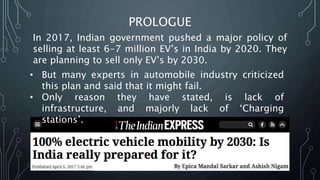
In 2017, Indian government pushed a major policy of
selling at least 6-7 million EV’s in India by 2020. They
are planning to sell only EV’s by 2030.
• But many experts in automobile industry criticized
this plan and said that it might fail.
• Only reason they have stated, is lack of
infrastructure, and majorly lack of ‘Charging
stations’.
RANGE ANXIETY
Indian government is really trying to push
electrical vehicle in our ecosystem. But people
are reluctant to buy an electric vehicle.
• Reason people are not buying electric vehicle
is “Range Anxiety”.
• Range anxiety is worry on the part of a person
driving an electric car that the battery will run
out of power before the destination or a
suitable charging point is reached.
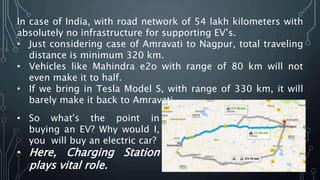
In case of India, with road network of 54 lakh kilometers with
absolutely no infrastructure for supporting EV’s.
• Just considering case of Amravati to Nagpur, total traveling
distance is minimum 320 km.
• Vehicles like Mahindra e2o with range of 80 km will not
even make it to half.
• If we bring in Tesla Model S, with range of 330 km, it will
barely make it back to Amravati.
• So what's the point in
buying an EV? Why would I,
you will buy an electric car?
• Here, Charging Station
plays vital role.
INTRODUCTION
• Electric charging station is an element in an
infrastructure that supplies electric energy for the
recharging of electric vehicles, such as plug-in electric
vehicles, including electric cars, plug-in hybrids, etc.
• Charging stations are inevitable part of electric vehicle
ecosystem.
• In case of India, with road network of 54,72,144
kilometers, the country needs nation wide network of
charging stations for electric vehicles as government
is planning to sell only EV’s by 2030.
WORKING OF CHARGING STATIONS
• Electricity from the grid is delivered as alternating current
(AC) but the EV requires direct current (DC). A rectifier
needs to sit between the grid and the battery to convert
one to the other. For home and third party public charging
this AC-to-DC conversion is done by the EV’s on-board
rectifier. AC current at the charge port is converted to DC
for the battery by the rectifier.
• Superchargers deliver high voltage, high current DC
electricity directly to the EV’s battery, bypassing the on-
board rectifier. This allows the Supercharger to push
electricity into the battery as fast as the battery can take
BLOCK DIAGRAM
Fig: Working of Charging Station,
Ref [2]
TECHNICAL DETAIL
For those of a technical bent, here’s how a typical
DC charging station is configured: the whole setup,
takes a 12 kV, 750 kVA feed from the utility, steps it
down to 480V three phase on site, pushes that into
2000A switchgear which feeds four banks of charging
units at 480V/200A. Each unit contains twelve 10 kW
rectifiers (the same “rectifier” that is found in EV’s)
giving a total of 120 kW per pair of pods.
DIFFERENT LEVELS OF CHARGING STATIONS
• Level 1, 120 Volt Charging: The slowest form of charging.
Uses a plug to connect to the on-board charger and a
standard household outlet. This setup provides between 2-
5 miles per hour.
• Level 2, 220/240 Volt Charging: Provide power at 220v or
240v and up to 30 amps. Drivers can add 10-25 miles of
range in an hour of charging at home or at a public station.
• Level 3, 480 Volt Charging: Some refer to this charging as
DC Fast charging. In this case, the charger is a gas pump-
sized machine. All fast chargers deliver about 80% charge
Fig: Levels of charging station, Ref [3]
SOLAR POWERED CHARGING STATION
• Charging stations can also
be powered by solar
energy.
• Number of solar panels can
be placed on roof of
charging station. This solar
panel will deliver power to
charging point.
• Use of solar will reduce
load on power grid and will
also save considerable
amount of fossil fuel used
Fig: Solar Powered Charging Station,
Ref [4]
ADVANTAGES
•Increase in number of charging station will boost
the selling of EV’s as their will be reduced range
anxiety.
•It is always great for environment, if many EV’s are
being sold in country.
•This will boost direct and indirect employment in
country.
•As India lack charging stations, it is good
opportunity to young business aspirants to install
DISADVANTAGE
•It’s Initial installation cost is high due to non
availability of equipments in India. But all
investment will eventually get recovered
through charging station.
•It derives large power from grid, which increase
load. Regions with lack of power may not be
able to handle this load.
CONCLUSIONS
As India is country with vast road network, if country
wants to boost the popularity of EV’s, it need to install
as many charging station as possible.
Installation of charging station is much easier, but lack
of knowledge makes it difficult to handle. Proper
knowledge will surely improve current state of
infrastructure.
REFERENCES
[1] The Indian Express Dt: 6th April 2017. Title: “100% Electric mobility in
India by 2030; Is India really prepared for it?” Author: Epica Mandal Sarkar
and Ashish Nigam.
[2] Mehmet Cem Catalbas, Merve Yildirim, Arif Gulten, and Hasan Kurum,
“Estimation of Optimal Location for Electric Vehicle Charging Stations”,
IEEE 2017. Date: 08/09/2017 Topics Referred: Working of charging
staions.
[3] R. Benger, R. Heyne, A. Haubrock, and H.P. Beck, “Sustainable Fast
Charging Stations for Electric Vehicles,” in 5 th, International Renewable
Energy Storage Conference (IRES 2010), Berlin, Germany. Date:
08/09/2017 Topics Referred:Levels of charging station.
[4] Ciprian Vlad, Gabriel Murariu, “Using Renewable Energy Sources For
Electric Vehicles Charging” IEEE 2013. Date: 08/09/2017
THANK YOU!

Charging Stations For Electric Vehicle

  • 1.
    “CHARGING STATIONS FOR ELECTRICVEHICLE” -By Sarang Bongirwar Under the guidance of, Dr. K. D. Thakur. Department of Electrical Engineering Government College of Engineering, Amravati (An Autonomous Institute of Government of Maharashtra) 2017-2018
  • 2.
    PROLOGUE In 2017, Indiangovernment pushed a major policy of selling at least 6-7 million EV’s in India by 2020. They are planning to sell only EV’s by 2030. • But many experts in automobile industry criticized this plan and said that it might fail. • Only reason they have stated, is lack of infrastructure, and majorly lack of ‘Charging stations’.
  • 3.
    RANGE ANXIETY Indian governmentis really trying to push electrical vehicle in our ecosystem. But people are reluctant to buy an electric vehicle. • Reason people are not buying electric vehicle is “Range Anxiety”. • Range anxiety is worry on the part of a person driving an electric car that the battery will run out of power before the destination or a suitable charging point is reached.
  • 4.
    In case ofIndia, with road network of 54 lakh kilometers with absolutely no infrastructure for supporting EV’s. • Just considering case of Amravati to Nagpur, total traveling distance is minimum 320 km. • Vehicles like Mahindra e2o with range of 80 km will not even make it to half. • If we bring in Tesla Model S, with range of 330 km, it will barely make it back to Amravati. • So what's the point in buying an EV? Why would I, you will buy an electric car? • Here, Charging Station plays vital role.
  • 5.
    INTRODUCTION • Electric chargingstation is an element in an infrastructure that supplies electric energy for the recharging of electric vehicles, such as plug-in electric vehicles, including electric cars, plug-in hybrids, etc. • Charging stations are inevitable part of electric vehicle ecosystem. • In case of India, with road network of 54,72,144 kilometers, the country needs nation wide network of charging stations for electric vehicles as government is planning to sell only EV’s by 2030.
  • 6.
    WORKING OF CHARGINGSTATIONS • Electricity from the grid is delivered as alternating current (AC) but the EV requires direct current (DC). A rectifier needs to sit between the grid and the battery to convert one to the other. For home and third party public charging this AC-to-DC conversion is done by the EV’s on-board rectifier. AC current at the charge port is converted to DC for the battery by the rectifier. • Superchargers deliver high voltage, high current DC electricity directly to the EV’s battery, bypassing the on- board rectifier. This allows the Supercharger to push electricity into the battery as fast as the battery can take
  • 7.
    BLOCK DIAGRAM Fig: Workingof Charging Station, Ref [2]
  • 8.
    TECHNICAL DETAIL For thoseof a technical bent, here’s how a typical DC charging station is configured: the whole setup, takes a 12 kV, 750 kVA feed from the utility, steps it down to 480V three phase on site, pushes that into 2000A switchgear which feeds four banks of charging units at 480V/200A. Each unit contains twelve 10 kW rectifiers (the same “rectifier” that is found in EV’s) giving a total of 120 kW per pair of pods.
  • 9.
    DIFFERENT LEVELS OFCHARGING STATIONS • Level 1, 120 Volt Charging: The slowest form of charging. Uses a plug to connect to the on-board charger and a standard household outlet. This setup provides between 2- 5 miles per hour. • Level 2, 220/240 Volt Charging: Provide power at 220v or 240v and up to 30 amps. Drivers can add 10-25 miles of range in an hour of charging at home or at a public station. • Level 3, 480 Volt Charging: Some refer to this charging as DC Fast charging. In this case, the charger is a gas pump- sized machine. All fast chargers deliver about 80% charge
  • 10.
    Fig: Levels ofcharging station, Ref [3]
  • 11.
    SOLAR POWERED CHARGINGSTATION • Charging stations can also be powered by solar energy. • Number of solar panels can be placed on roof of charging station. This solar panel will deliver power to charging point. • Use of solar will reduce load on power grid and will also save considerable amount of fossil fuel used Fig: Solar Powered Charging Station, Ref [4]
  • 12.
    ADVANTAGES •Increase in numberof charging station will boost the selling of EV’s as their will be reduced range anxiety. •It is always great for environment, if many EV’s are being sold in country. •This will boost direct and indirect employment in country. •As India lack charging stations, it is good opportunity to young business aspirants to install
  • 13.
    DISADVANTAGE •It’s Initial installationcost is high due to non availability of equipments in India. But all investment will eventually get recovered through charging station. •It derives large power from grid, which increase load. Regions with lack of power may not be able to handle this load.
  • 14.
    CONCLUSIONS As India iscountry with vast road network, if country wants to boost the popularity of EV’s, it need to install as many charging station as possible. Installation of charging station is much easier, but lack of knowledge makes it difficult to handle. Proper knowledge will surely improve current state of infrastructure.
  • 15.
    REFERENCES [1] The IndianExpress Dt: 6th April 2017. Title: “100% Electric mobility in India by 2030; Is India really prepared for it?” Author: Epica Mandal Sarkar and Ashish Nigam. [2] Mehmet Cem Catalbas, Merve Yildirim, Arif Gulten, and Hasan Kurum, “Estimation of Optimal Location for Electric Vehicle Charging Stations”, IEEE 2017. Date: 08/09/2017 Topics Referred: Working of charging staions. [3] R. Benger, R. Heyne, A. Haubrock, and H.P. Beck, “Sustainable Fast Charging Stations for Electric Vehicles,” in 5 th, International Renewable Energy Storage Conference (IRES 2010), Berlin, Germany. Date: 08/09/2017 Topics Referred:Levels of charging station. [4] Ciprian Vlad, Gabriel Murariu, “Using Renewable Energy Sources For Electric Vehicles Charging” IEEE 2013. Date: 08/09/2017
  • 16.