AUTOMATED MANUAL
TRANSMISSION (AMT)
AMT :
A semi-automatic transmission (SAT) (also known as a clutch less manual
transmission, automated manual transmission(AMT), flappy-paddle
gearbox, or paddle-shift gearbox) is an automobile transmission that does
not have clutch paddle. It uses electronic sensors, pneumatics, processors
and actuators to execute gear shifts on input from the driver or by a
computer. This removes the need for a clutch pedal which the driver
otherwise needs to depress before making a gear change, since the clutch
itself is actuated by electronic equipment which can synchronize the
timing and torque required to make quick, smooth gear shifts.
AMT
• AMT has a clutch but there is no clutch pedal.
• AMT is a kit that can be added to any manual transmission. AMT
operates on the manual transmission of car in the way a driver
would: it engages and disengages the clutch and gears.
• It also has a sports mode, which enables drivers to move to manual
transmission.
• It is convenient for car manufacturers because it doesn't replace the
manual transmission, unlike the automatic transmission system,
which is entirely different.
• The Maruti Suzuki Celerio AMT is the first car in the country to get
an Automatic Manual Transmission.
WHY AMT?
• AMT is more fuel efficient than manual transmission, unlike
automatic transmission, which reduces efficiency by up to 10%, in
most cases.
• The cost differential between manual transmission and AMT is Rs.
40,000 to Rs. 50,000 in India. Same for automatic transmission is
up to 1 lac.
• Can be used as manual transmission as well as automatic
transmission according to driver’s comfort.
Description:
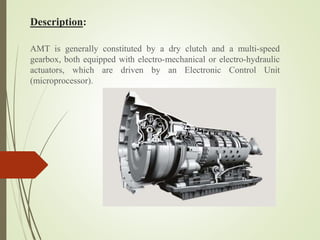
AMT is generally constituted by a dry clutch and a multi-speed
gearbox, both equipped with electro-mechanical or electro-hydraulic
actuators, which are driven by an Electronic Control Unit
(microprocessor).
Contd.
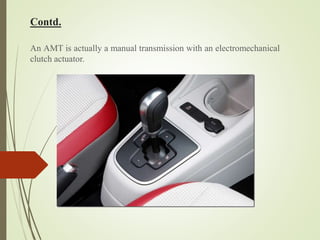
An AMT is actually a manual transmission with an electromechanical
clutch actuator.
ADVANTAGES:
• Can be installed with manual transmission system. No need to
change whole transmission system
• More fuel efficient, cheaper and lighter than traditional automatic
transmission system.
• Reliable compared to manual transmission system as there is no
clutch pedal.
• Prevents stalling during traffic.
• Gears can be changed automatically or manually according to
driver’s choice.
Disadvantages:
• Costlier than manual transmission system.
• Gear shifting is not so smooth compared to automatic transmission
system.
Future in India
• According to AMT maker Magneti Marelli, 30% of the passenger
vehicles sold in India will have AMT by 2020.
• Maruti Suzuki is launching AMT variant for all of its vehicle. It
has launched AMT variant for Alto k10 and Celerio.
• Renault, Maruti Suzuki, Tata etc. are launching vehicles with
AMT in year 2016.

Automatic manual transmission

  • 1.
  • 2.
    AMT : A semi-automatictransmission (SAT) (also known as a clutch less manual transmission, automated manual transmission(AMT), flappy-paddle gearbox, or paddle-shift gearbox) is an automobile transmission that does not have clutch paddle. It uses electronic sensors, pneumatics, processors and actuators to execute gear shifts on input from the driver or by a computer. This removes the need for a clutch pedal which the driver otherwise needs to depress before making a gear change, since the clutch itself is actuated by electronic equipment which can synchronize the timing and torque required to make quick, smooth gear shifts.
  • 3.
    AMT • AMT hasa clutch but there is no clutch pedal. • AMT is a kit that can be added to any manual transmission. AMT operates on the manual transmission of car in the way a driver would: it engages and disengages the clutch and gears. • It also has a sports mode, which enables drivers to move to manual transmission. • It is convenient for car manufacturers because it doesn't replace the manual transmission, unlike the automatic transmission system, which is entirely different. • The Maruti Suzuki Celerio AMT is the first car in the country to get an Automatic Manual Transmission.
  • 4.
    WHY AMT? • AMTis more fuel efficient than manual transmission, unlike automatic transmission, which reduces efficiency by up to 10%, in most cases. • The cost differential between manual transmission and AMT is Rs. 40,000 to Rs. 50,000 in India. Same for automatic transmission is up to 1 lac. • Can be used as manual transmission as well as automatic transmission according to driver’s comfort.
  • 5.
    Description: AMT is generallyconstituted by a dry clutch and a multi-speed gearbox, both equipped with electro-mechanical or electro-hydraulic actuators, which are driven by an Electronic Control Unit (microprocessor).
  • 6.
    Contd. An AMT isactually a manual transmission with an electromechanical clutch actuator.
  • 7.
    ADVANTAGES: • Can beinstalled with manual transmission system. No need to change whole transmission system • More fuel efficient, cheaper and lighter than traditional automatic transmission system. • Reliable compared to manual transmission system as there is no clutch pedal. • Prevents stalling during traffic. • Gears can be changed automatically or manually according to driver’s choice.
  • 8.
    Disadvantages: • Costlier thanmanual transmission system. • Gear shifting is not so smooth compared to automatic transmission system.
  • 9.
    Future in India •According to AMT maker Magneti Marelli, 30% of the passenger vehicles sold in India will have AMT by 2020. • Maruti Suzuki is launching AMT variant for all of its vehicle. It has launched AMT variant for Alto k10 and Celerio. • Renault, Maruti Suzuki, Tata etc. are launching vehicles with AMT in year 2016.